BiBlid
: 0353-4537, 2016, стр. 09-28
ФЕНОЛОШКИ ОБРАЗАЦ ФЕНОФАЗЕ ОПАДАЊА ЛИСТА ЛУЖЊАКА
У ПОПУЛАЦИЈАМА НА ПОДРУЧЈУ БЕОГРАДА
Др Бранислава Батос, научни сарадник, Институт за шумарство, Кнеза Вишеслава 3, Београд, ([email protected])
Др Саша Орловић, редовни професор, Пољопривредни факултет, Универзитет у Новом Саду, Др Јелена Нинић-Тодоровић, редовни професор, Пољопривредни факултет, Универзитет у Новом Саду, Др Дарка Шешлија Јовановић, виши научни сарадник, Институт за Биолошка истраживања ”С. Станковић”, Универзитет у Београду
Др Данијела Миљковић, виши научни сарадник, Институт за Биолошка истраживања ”С. Станковић”, Универзитет у Београду
Извод: У оквиру истраживања фенолошке варијабилности лужњака (Quercus robur L.) анализирана је фенофаза опадања листа. Осматрања су вршена у две популације на по -дручју Београда на 29 стабала по популацији, током три узастопне године. Према резул -татима непараметарске анализе Mann-Whitney U test установљене су разлике фенофазе опадања листа (почетак, крај, трајање) између популација: статистички значајне разлике су потврђене за почетак и трајање опадања листа за две од три године осматрања, а за крај опадања листа за једну годину осматрања. Разлике у опадању листа унутар сваке популације између година осматрања су потврђене путем F-test- а на нивоу значајности P < 0,05: статистички значајне разлике су потврђене за почетак опадања листа само у популацији Ада Циганлија а за трајање и крај опадања листа у обе популације. Према фенолошком обрасцу популације 31,0% стабала у популацији Ада Циганлија и 24,1% ста -бала у популацији Бојчинска шума током три године осматрања није мењало фенолошку групу у односу на почетак опадања листа („рана“, „просек“ и „касна“). С обзиром да су фенолошке особине под значајним утицајем и срединских и генетичких фактора, дефи -нисање удела ових фактора у диференцијацији стабала на фенолошке групе је нарочито битно за селекцију лужњака. Сагледавање фенолошког обрасца и одговор на промену климатских фактора помоћи ће у разумевању фенологије опадања листа на индивидуал -ном и на нивоу врсте.
Кључне речи: лужњак, фенологија, индивидуална и популациона варијабилност UDK: 581.54
Оригинални научни рад DOI: 10.2298/GSF1614009B
УВОД
Промена климатских фактора утиче на
биљне организме и на њихов фенолошки ци
-клус (почетак, крај и трајање фенофазе) (Merklová, Bednářová, 2008; Juknys et al., 2012).
Б. Батос, С. Орловић, Ј. Нинић-Тодоровић, Д. Шешлија Јовановић, Д. Миљковић
Фенолошка истраживања пружају корисне информације у области систематике на нивоу
врсте и рода, нарочито врста чији је таксоном
-ски статус недефинисан. На основу фенолошке
варијабилности у Србији је извршено издваја
-ње два основна варијетета лужњака: „рани“
(Q. robur var. praecox Čern.) и „касни“ (Quercus
robur var. tardiflora Čern.), који се осим разлике
у времену наступања појединих фенофаза, ра
-зликују и у параметрима раста (Erdeši, 1971; Panić, 1971).
У Србији, поред наведених истраживања
Ердешија, није било систематског истражива
-ња индивидуалне варијаблности ове врсте,
што је допуњено истраживањима новијег да
-тума (Batos, 2010; Batos, 2012; Batos et al., 2012; Batos et al., 2014a; Batos et al., 2014б).
Циљ истраживања је био дефинисање об
-расца фенофазе опадања листа код лужњака у две популације. У том контексту тражени су
одговори на следећа питања. Да ли постоји ра
-злика у вредностима испитиваних карактера између популација за сваку од анализираних година? Да ли постоји разлика у вредностима
испитиваних карактера унутар популација из
-међу година осматрања? Какав је фенолошки образац анализираних популација у односу на
процентуалну заступљеност стабала са разли
-читим почетком фенофазе опадања листа? Да
ли стабла из године у годину остају у истој фе
-нолошкој групи („рана“, „просек“, „касна“)?
МАТЕРИЈАЛ И МЕТОДЕ РАДА
Праћење фенофазе је вршено на 29 (по по
-пулацији) фенотипски правилно развијених
стабала, доброг прираста и здравственог ста
-ња, старости 60 - 120 г, једанпут недељно то
-ком септембра, октобра, новембра и децембра у три узастопне године (2004, 2005, 2006.) у
две популације на подручју Београда: „Ада Ци
-ганлија“ и „Бојчинска шума“. Популација „Ада
Циганлија“ (парк шума) се налази на коорди
-натама N 44˚48’, Е 20˚24’, надморској висини 70
- 76 m, станишту Fraxino angustifoliae -
Querce-tum roboris Jov. i Tom. 1979., и земљишту типа fluvi-sol calcaric, а популација „Бојчинска шума“
је на координатама N 44˚43’, Е 20˚10’, надмор
-ској висини 77 - 78 m, на нешто свежијем ста
-ништу типа Carpino - quercetum roboris Rauš
1969., коме одговара тип земљишта planosol
dystric (приградска парк шума, 25 кm удаљена од Београда (Слика 1, 2).
Фенофаза опадања листа траје од почетка до потпуно или скоро потпуно опалог листа после чега више нема опадања листа (Bunuše-vac et al., 1961). Почетак и крај фенофазе је одређен процентом опалог листа у односу на пуну круну (100%): почетак је дефинисан са < 20% а крај са > 80% опалог листа (Schlarbaum, Bagley, 1981).
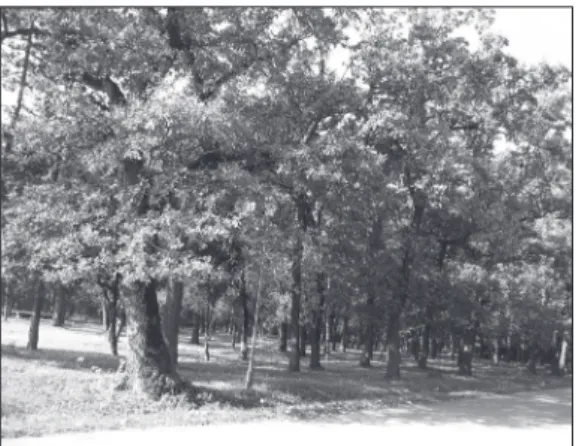
Слика 1. Почетак фенофазе опадања листа лужњака
у популацији лужњака „Ада Циганлија“ (27.10.2005.) Слика 2
У односу на време почетка фенофазе опа
-дања листа (у 2004., 2005. и 2006. години) из
-вршено је „условно“ груписање стабала на три нивоа (=групе): 1. ниво - „рана“ стабла која имају почетак опадања листа у првој недељи осматрања (друга недеља септембра), 2. ниво - „просек“ стабла која имају почетак опадања
листа у другој недељи осматрања (трећа неде
-ља септембра) и 3. ниво - „касна“ стабла која имају почетак опадања листа у трећој недељи
осматрања и касније (четврта недеља септем
-бра и касније). Груписање је вршено само за почетак опадања листа које је издвојено као најважнија промена у јесењем фенолошком
циклусу. Nа основу издвојених група анализи
-ран је фенолошки образац популације (Crawley, Akhteruzzamax, 1988; Bacilieri et al., 1994; Batos et al., 2014a, Batos et al., 2014b).
У статистичкој обради података као показа
-тељ варијабилности (почетка, краја и трајања фенофазе) коришћен је број дана од 1. јануара
до датума наступања одређене фазе, као и ра
-злика између броја дана за крај односно за почетак фенофазе (Hemery et al., 2005).
За статистичку обраду коришћен је про
-грамски пакет SAS 9.1.3. (SAS Institute, 2003) i
STATISTICA 10. Поред основних параметара де
-скриптивне статистике, процена статистичке
значајности различитих нивоа извора варира
-ња почетка, краја и траја-ња фенофазе рађена
је помоћу једнофакторијалног ANOVA теста и
непараметарске анализе Mann-Whitney U теста.
РЕЗУЛТАТИ
Индивидуална варијабилност фенофа
-зе опадања листа
Најранији почетак фенофазе опадања листа
лужњака, имајући у виду сва анализирана ста
-бла у обе популације („Ада Циганлија“ и „Бој
-чинска шума“) и три године осматрања (2004, 2005, 2006), забележен је 7. септембра 2004. г. („Ада Циганлија“: стабло број 1, 4, 16, 19, 25,
26, 27, 28; „Бојчинска шума“: ст. бр. 1), а најка
-снији 10. октобра 2005. г. („Ада Циганлија“: ст.
бр. 21), 2006. г. („Ада Циганлија“: ст. бр. 21, 23, 24; „Бојчинска шума“: ст. бр. 5, 24, 31).
У популацији „Ада Циганлија“ највећи број
стабала је припадао групи „просек“ и имао по
-четак опадања листа у трећој недељи септем
-бра (2005: 41,4%; 2006: 55,2%), а у популацији
„Бојчинска шума“ групи „касна“ и имао поче
-так опадања листа у четвртој недељи септем
-бра (2004: 79,3%; 2006: 69,0%) (Графикон 3). Индивидуална варијабилност у погледу
трајања фенофазе опадања листа је веома из
-ражена у обе популације. Разлика између по
-јединачних стабала била је у популацији „Ада Циганлија“ од 43 дана (ст. бр. 12, 2005. г.) до 112 дана (ст. бр. 19, 2004. г.), а у популацији Бојчинска шума од 49 дана (ст. бр. 5, 2006. г.) до 100 дана (ст. бр. 1, 2004. г.).
Крај фенофазе опадања листа у две од три
године осматрања већина стабала у обе попу
-лације имала је у последњој недељи новембра (24.11.2005. година: „Ада Циганлија“ – 31,0%, „Бојчинска шума“ – 51,7%; 28.11.2006. година: „Ада Циганлија“ – 55,2%, „Бојчинска шума“ 79,3%).
Индивидуална варијабилност фенофазе опадања листа у анализираним популацијама
за године осматрања приказана је на графико
-нима 1а-ф.
Варијабилност фенофазе опадања
листа између популација
Просечно трајање фенофазе опадања листа
за године осматрања у популацији „Ада Циган
-лија“ било је 78,7 дана а у популацији Бојчинска шума 71,1 дан, односно једну недељу краће.
Разлике између популација за почетак и
трајање опадања листа су потврђене
Mann-Whitney U Test-oм за прву 2004. г. (p-level =
0,0000) и трећу 2006. (P = 0,0282 односно P <
0.001) годину осматрања. У погледу времена завршетка фенофазе опадања листа између популација није било значајне разлике за 2005 и 2006. г. (p > 0,05). Крај фенофазе био је у обе
Б. Батос, С. Орловић, Ј. Нинић-Тодоровић, Д. Шешлија Јовановић, Д. Миљковић
Графикон 1. Индивидуални образац фенофазе опадања листа лужњака за анализиране популације и го -дине осматрања
Д
Б А
Е
Варијабилност фенофазе опадања
листа између година осматрања
Разлике између година осматрања за поче
-так опадања листа су потврђене one- wаy АNО-VА тестом. Високо значајне разлике су биле за
почетак опадања листа у популацији „Ада Ци
-ганлија“ (F-test2,84 =27,37, p=0,0000), док у попу
-лацији „Бојчинска шума“ разлике нису биле
значајне (F-test2,84=1,9608, p=0,1471). Вредности
за крај опадања листа између година осматра
-ња су биле значајне унутар сваке популације
(F-test (2,84)=43,10, p=0.0001 за популацију
„Ада Циганлија“, и F-test (2,84)=13,88, p=0.0001,
за популацију Бојчинска шума). За трајање опа
-дања листа између година било је значајних разлика унутар сваке популације (F-test (2,84)
=130,42, p=0.0000, за популацију „Ада Циганли
-ја“, и F-test (2,84)=9,49, p=0,0000, за популацију
„Бојчинска шума“) (Графикон 2).
Фенолошки образац популација
У односу на заступљеност стабала у издво
-јеним фенолошким групама („рана“, „просек“,
„касна“), према времену почетка опадања ли
-ста, било је разлике између анализираних по
-пулација и година осматрања.
У популацији „Ада Циганлија“ од три годи
-не осматрања у две годи-не највећи број стаба
-ла је био у групи „просек“ што значи да је имао почетак опадања листа у трећој недељи
септембра (41,4% - 2005; 55,2% - 2006) (Графи
-кон 3А, у првој групи од по три хистограма то су сива поља), а у све три године осматрања најмањи број стабала је био у групи „рана“ са
почетком опадања листа у другој недељи сеп
-тембра (27,6% - 2004; 20,7% - 2005; 13,8% - 2006) (Графикон 3А, у првој групи од по три хистограма то су бела поља). У три године осматрања вредности процента стабала која су
била у групи „касна“ нису се много разликова
-ле (41,4% - 2004; 37,9% - 2005; 31,0% - 2006)
(Графикон 3А, у првој групи од по три хистогра
-ма то су црна поља). У овој популацији за три
године осматрања 9 стабала (31,0%) није ме
-њало групу у односу на почетак опадања ли
-ста, 17 стабала (58,6%) је мењало групу за 1 ниво и 3 стабла (10,4%) су мењала групу за 2 нивоа (Графикон 3Б). Од 9 стабала која нису
мењала групу током година осматрања 2 ста
-бла су била са раним почетком опадања листа,
2 у групи „просек“, и 5 са касним почетком опа
-дања листа.
У популацији „Бојчинска шума“ од три го
-дине осматрања, у две го-дине је највише ста
-бала припадало групи „касна“, односно имало
Табела 1. Mann-Whitney U тест непараметарске анализе фенофазе опадања листа за осматрања у популацијама “Ада Циганлија” (АC) и “Бојчинска шума” (БС)
Valid N AC Valid N BS Rank Sum AC Rank Sum BS p-level
Година Почетак фенофазе опадања листа
2004 29 29 590.50 1120.50 0.0000
2005 29 29 914.00 797.00 0.3274
2006 29 29 723.00 988.00 0.0282
Година Крај фенофазе опадања листа
2004 29 29 1276.00 435.00 0.0000
2005 29 29 887.00 824.00 0.4943
2006 29 29 740.00 971.00 0.0725
Година Трајање фенофазе опадања листа
2004 29 29 1192.00 519.00 0.0000
2005 29 29 916.00 795.00 0.3397
Б. Батос, С. Орловић, Ј. Нинић-Тодоровић, Д. Шешлија Јовановић, Д. Миљковић
почетак опадања листа у четвртој недељи сеп
-тембра и касније (79,3% - 2004; 69,0% - 2006)
(Графикон 3А, у другој групи од по три хисто
-грама то су црна поља), у две године је најма
-њи број стабала припадао групи „рана“ са по
-четком опадања листа у другој недељи септембра (3,5% - 2004; 6,9% - 2006) (Графикон 3А, у другој групи од по три хистограма то су
бела поља), а у једној години (2005) био је јед
-нак број стабала у групи „рана“ и групи „касна“
(24,1%). У 2005. г. највећи број стабала припа
-дао је групи „просек“, а њихов број је у друге две године био значајно мањи (17,2 % - 2004; 51,8 % - 2005; 24,1% - 2006) (Графикон 3А, у другој групи од по три хистограма то су сива поља). За три године осматрања 7 стабала (24,1%) није мењало групу, 14 стабала (48,3%) је мењало групу за 1 ниво и 8 стабала (27,6%) је мењало групу за 2 нивоа (Графикон 3Ц). Од 7 стабала која нису мењала групу током година
осматрања није било ни једног стабла у „ра
-ној“ групи, 1 стабло је било у групи „просек“ а највише (6) их је било у групи „касна“.
Број стабала која из године у годину остају у истој фенолошкој групи био је за популацију
(„Ада Циганлија“ 31,0%, а за популацију „Бој
-чинска шума“ 24,1%.
ДИСКУСИЈА
Студије које се баве фенологијом истичу да
су почетак и дужина опадања листа карактери
-стике врсте, али и да зависе од климатских фактора, првенствено температуре ваздуха и количине падавина, а онда и других чинилаца
као што су фотопериоди, зрачење, CO2, аеропо
-лутанти итд. (Richardson et al., 2006; Polgar and Primack, 2011). Анализиране популације „Ада Циганлија“ и „Бојчинска“ шума се разликују у односу на педолошки супстрат и минеролошки
састав листа. У популацији „Ада Циганлија“ фи
-зичке и хемијске особине земљишта су повољ
-није, лист је богатији у нутријентиmа (Batos et
al., 2010). Подаци о клими указују да је темпе
-ратура ваздуха и количина падавина такође нешто већа у популацији „Ада Циганлија“, у просеку година осматрања за 0,7º C односно
74,7 mm, (граф 4, 5, 6). Очекивало би се да је
период вегетације у популацији Ада Циганлија дужи, што није случај. Међутим, вегетација траје дуже у популацији “Бојчинска шума” што је последица ранијег листања (Batos et al., 2012, Batos et al., 2014a), а опадање листа које почиње раније у популацији „Ада Циганлија“ завршава у исто време у обе популације.
Графикон 2. Почетак, крај и трајање (број дана од почетка године) фенофазе опадања листа лужњака у
Између година осматрања су потврђене
статистички значајне разлике за почетак опа
-дања листа у једној популацији а за трајање и
крај опадања листа у обе анализиране попула
-ције. Међутим, три године осматрања нису дале јасан закључак о утицају температуре и падавина на фенофазу опадања листа.
Утицај еколошких чинилаца је различит на
поједине фенофазе. У анализи фенолошке ва
-ријабилности неколико врста храста из више провенијенција са подручја Јапана потврђена
је корелација између географске ширине и је
-сење фенофазе (јесења фенофаза је била ра
-нија код храстова са виших надморских виси
-на) док за пролећну фенофазу корелација није
потврђена (Kadomatsu, 1997). Pочетак пролећ
-них фенофаза лужњака на подручју Зволенског
басена је зависио од температуре и падавина током сезоне, сазревање плодова је зависило
од температуре и сунчевог зрачења али и ге
-нетичких особина, а јесење фенофазе су се завршавале раније у сушним годинама (Škvareninova et al., 2008). Такође и Bacilieri et al. (1994) потврђују утицај еколошких фактора
на припадност стабла лужњака одређеној фе
-нолошкој групи, што може да утиче на величи
-ну популације.
Касније опадање листа, у односу на подат
-ке од пре 20 и више година, евидентирано је код многих дрвенастих врста и највише зависи од географске ширине и надморске висине и промене климе (Acer saccharum Marsh., Fagus grandifolia Ehrh., Betula alleghaniensis Britt. in Richardson et al., 2006; Quercus dalechampii Ten.
Графикон 3. Усправни хистограми (А) приказују фенолошки образац фенолошких група – “рана” (бела
поља), “просек” (сива поља), и “касна” (црна поља) за године осматрања (% анализираних стабала), у популацијама “Ада Циганлија” и “Бојчинска шума” за почетак опадања листа лужњака.
Б. Батос, С. Орловић, Ј. Нинић-Тодоровић, Д. Шешлија Јовановић, Д. Миљковић
in Schieber et al., 2009; Quercus robur L. in
Šimatonytė i Žeimavičius, 2009; Fagus sylvatica L. in Hájková et al., 2010).
Скорашња истраживања фенологије лу
-жњака на подручју Београда такође указују на нешто другачији фенолошки циклус у односу на истраживања у ранијем периоду. Према Batos et al. (2014а) почетак листања је реги
-строван 18. марта а већина анализираних ста
-бала је имала почетак листања у последњој недељи марта и првој недељи априла. Према
овде изнетим резулатима, крај вегетације – од
-носно опадања листа, је био за већину стабала
у последњој недељи новембра. Према истра
-живањима од пре 40-50 година (Bunuševac, 1961) почетак листања лужњака на подручју Београда био је 29. марта а крај опадања листа
25. новембра. Према Jovanović i Uvalić-Tomić
(1971) почетак листања лужњака на подручју
Београда у годинама осматрања (1962-1967) био је у другој половини априла са изузетком
једне изузетно топле године када је било кра
-јем марта.
Истраживање фенофазе опадања листа код лужњака у популацијама на подручју Београда потврдила су веома изражену индивидуалну
варијабилност. Индивидуална варијабилност има великог значаја за адаптивност и опстанак популације (Figueiredo Goulart et al., 2005). Crawley, Akhteruzzamax (1988) такође потврђују значај индивидуалне варијабилности у вези са осетљивошћу на нападе инсеката: иста стабла
су имала исти фенолошки ранг из године у го
-дину, што значи увек су иста стабла прва ли
-стала и увек иста прва губила лист и у вези са тим иста стабла су увек из године у годину била оштећена или одолела нападу. Наведени аутори у свом истраживању истичу генетску основу отпорности на патогене и донекле су у складу са традиционалним схватањем да су стабла код којих фенофаза листања почиње раније више подложна нападима патогена (Feeny, 1970).
Током огледног истраживања опадања ли
-ста лужњака у обе анализиране популације
(„Ада Циганлија“ и „Бојчинска шума“) запаже
-на су поједи-на стабла која су задржавала лист и након што су га сва друга стабла одбацила.
Ова стабла су евидентирана и предмет су да
-љих истраживања о учесталости и природи ове појаве. У литератури постоје разна тумачења појаве задржавања листа у зимском периоду.
Графикон 4. Подаци о клими за анализиране попу -лације: „Ада Циганлија“ (Хидрометеоролошка ста -ница Београд) и „Бојчинска шума“ (Хидрометеоро -лошка станица Сурчин) – средња годишња температура и сума падавина
10,0 10,5 11,0 11,5 12,0 12,5 13,0
2004 2005 2006
Те м п ер а ту р а ( ° C ) 0 100 200 300 400 500 600 700 800 900 П а д а в и н е ( m m )
Температура Београд Температура Сурчин
Падавине Београд Падавине Сурчин
Графикон 5. Подаци средњим месечним темпера -турама ваздуха за анализиране популације: „Ада Циганлија“ (Хидрометеоролошка станица Београд) и „Бојчинска шума“ (Хидрометеоролошка станица Сурчин) за 2004, 2005, 2006
-5,0 0,0 5,0 10,0 15,0 20,0 25,0 30,0
1 2 3 4 5 6 7 8 9 10 11 12
Месеци Те м пер ат ур а ( ° C
2004 Београд 2004 Сурчин
2005 Београд 2005 Сурчин
Већина истраживача сматра да је ова појава одговор индивидуе на стресне услове средине нпр. ниске температуре или недостатак воде (Schlarbaum, Bagley, 1981; Nilsson, 1983; Escudero, Del Arco, 1987). Према Dunberg (1982) задржавање листова код букве (Fagus sylvatica
L.) и храста (Quercus rоbur L.) током зиме је по
-знат феномен и узроци су једнако важни и фи
-зиолошки и генетички. Новија истраживања
претпостављају да је ова појава више генетич
-ки условљена и више резултат индивидуалне варијабилности него еколошког утицаја (Herzog, Krabel, 1996; Sabatier et al., 2003;
Schiller et al., 2005). Ова појава је уочена и ана
-лизирана и на подручју Србије и према Erdeši (1971) погрешно се везује за касни лужњак (Quercus robur tardiflora Čern.) јер је много че
-шћа код типичног лужњака (Quercus robur L.).
Резултати фенолошких истраживања су
применљиви у пракси: у одабиру провенијен
-ција за потребе пошумљавања, у заштити про
-тив биотичких и абиотичких штетних утицаја, а могу да буду и основ за прављење модела
предвиђања промене климе за потребе урба
-не екологије, алергологије и агрометеорологи
-је (Garcia-Mozo et al., 2006; Bandoc, 2008; Chuine et al., 2008).
Разумевање самог механизма развића ли
-стова као и одговора регулаторних механизама
на варијабилност услова између година, проме
-ном климатских фактора, помоћи ће у сагледа
-вању обрасца фенологије опадања листова, како на индивидуалном нивоу тако и на нивоу популација и самих врста (Polgar, Primack, 2011).
ЗАКЉУЧАК
Фенофаза опадања листа код лужњака у
анализираним популацијама на подручју Бео
-града почиње почетком септембра и траје до
краја децембра, што указује на веома израже
-ну индивидуал-ну варијабилност врсте. Анали
-зиране популације се налазе у еколошким
условима који се разликују у погледу педоло
-шког супстрата и у погледу климе. Потврђен је статистички значајан утицај године као фактора
варијабилности. Међутим, период од три годи
-не осматрања није дао јасан закључак о утица
-ју температуре и падавина на фенофазу опада
-ња листа. Претпоставка је да на разлике између анализираних популација има утицаја
и фенолошки образац популације, односно по
-стојање „раних“, „просек“ и „касних“ група ста
-бала у односу на почетак опадања листа. До
-бијени резултати указују на постојање стабала
која из године у годину задржавају исту фено
-лошку групу што упућује на претпоставку о њи
-ховом заједничком пореклу. Као такви они
могу да нађу примену у индивидуалној селек
-цији лужњака у односу на отпорност и особине прираста. Већи број истраживања фенологије
лужњака, са освртом на индивидуалну гене
-тичку и популациону варијабилност у дужем
временском интервалу, омогући ће боље разу
-мевање утицаја климатских промена на фено
-логију. На тај начин моћи ће да се стекне увид
у правац промена које ће омогућити даље пла
-нирање и гајење шума као и очување биоди
-верзитета и природних станишта ове врсте.
Напомена: Рад је реализован као део пројек
-та финансираног средствима добијеним од Ми
-нистарства просвете и науке Републике Србије.
Графикон 6. Подаци о количини падавина по месе -цима и годинама за анализиране популације: „Ада Циганлија“ (Хидрометеоролошка станица Београд) и „Бојчинска шума“ (Хидрометеоролошка станица Сурчин)
0,0 20,0 40,0 60,0 80,0 100,0 120,0 140,0 160,0
1 2 3 4 5 6 7 8 9 10 11 12
Месеци
П
ад
ав
ин
е
(
mm
)
2004 Београд 2004 Сурчин
2005 Београд 2005 Сурчин
Branislava Batos, Saša Orlović, Jelena Ninić-Todorović, Darka Šešlija Jovanović, Danijela Miljković
PHENOLOGICAL PATERN OF LEAF-FALL PHENOPHASE IN QUERCUS
ROBUR L. POPULATIONS OF THE BELGADE AREA
Dr Branislava Batos, Institute of Forestry, Kneza Višeslava 3, Belgrade, 11030, Serbia, Corresponding Author: [email protected]
Dr Saša Orlović, Faculty of Agriculture, University of Novi Sad, Dositeja Obradovića Sq. 8, Serbia Dr Jelena Ninić-Todorović, Faculty of Agriculture, University of Novi Sad, Dositeja Obradovića Sq. 8, Serbia
Dr Darka Šešlija Jovanović, Institute for Biological Research ”S. Stanković”, University of Belgrade, Despot Stefan Blvd. 142, Serbia Dr Danijela Miljković, Institute for Biological Research ”S. Stanković”, University of Belgrade, Despot Stefan Blvd. 142, Serbia
Abstract: Our study of phenological variability in the common oak (Quercus robur L.) was mainly focused on the analysis of the leaf-fall phenophase. The observaions were made in two populaions in the area of Belgrade (Serbia). We observed 29 trees in each site, during three consecuive years. According to the results of a nonparametric analysis of Mann-Whitney U test we found diferences in the leaf fall phenophase (the start, the length and the end) among the populaions: staisically signiicant diferences were veriied for the start and the length of the leaf fall in two of three observed years, and for the end of leaf fall in one observed year. The diferences in the leaf fall within each populaion among the observed years were veriied by the F-test at the signiicance level of P < 0.05: staisically signiicant diferences were found for the start of leaf fall in “Ada Ciganlija” populaion, and for the length and the end of leaf fall in both populaions. According to the phenological patern of populaion 31% of trees in “Ada Ciganlija“ populaion and 24.1% of trees in “Bojčin forest“ populaion did not change its phenological group in relaion to the start of the leaf fall (“early“, “average“ and “late“) during three years of observaion. Since the phenological traits are under signiicant inluence of both environmental and geneic factors, it is very important to evaluate those factors according to tree difereniaion to phenological groups for pedunculate oak selecion. An overview of the patern of leaf fall phenology and the response to the changing climaic factors will help in understanding the leaf fall phenology at the level of an individual and at the level of species.
Keywords: Pedunculate oak, phenology, individual and populaion variability
INTRODUCTION
The climate change inluences plant organ
-isms and their phenological cycle (the start, the length and the end of phenophase) (Merklova, Bednářová, 2008; Juknys et al., 2012). Organisms adapt to the changed climate condiions during long periods of exposure (Baliuckas, Pliura, 2003).
Phenological research provides useful infor
-maion in the ield of systemaics at the level of
species and genera, especially species whose tax
-onomic status is not deined or not certain. Based
on the phenological variability in Serbia peduncu
-late oak varieies were divided into two essenial groups: “early“ (Q. robur var. praecox Čern.) and
“late“ (Quercus robur var. tardilora Čern.), which also difer in growth parameters (Erdeši, 1971; Panić, 1971).
In Serbia, beside the menioned study of
Erdeši, there was no systemaic research of indi
-vidual variability of this species, which has been compensated by recent studies (Batos, 2010; Ba-tos, 2012; Batos et al., 2012; Batos et al., 2014a; Batos et al., 2014b).
The aim of this research was to deine the
paterns of the leaf-fall phenophase in the pedun
there a diference in examined traits’ values among populaions in each analyzed year? Is
there a diference in examined traits’ values with
-in populaions among the years of observaion?
What is the phenological patern of analyzed pop
-ulaions relaive to the percentage presence of
trees with a diferent start of the leaf fall pheno
-phase? Do trees stay in the same phenological group (“early”, “average”, “late”) every year?
MATERIALS AND METHODS
Phenophase observaions were performed on 29 (per populaion) phenotypically well developed trees, of good growth and health condiion, at the age of 60 - 120 years, once a week during September, October, November and December in three consecuive years (2004, 2005, 2006.) in two populaions in the area of Belgrade (Serbia):
“Ada Ciganlija“ and “Bojčin forest“. The“Ada Cigan
-lija“ (forest park) populaion is located at the co
-ordinates N 44˚48’, E 20˚24’, alitude 70-76 m,
habitat Fraxino angusifoliae - Quercetum roboris Jov. and Tom. 1979., soil type luvisol calcaric, and populaion “Bojčin forest“ is located at N 44˚43’,
E 20˚10’, alitude 77-78 m, at a bit more humid
habitat Carpino - quercetum roboris Rauš 1969., with soil type planosol dystric (a suburban forest park, 25 km away from Belgrade (Figures 1 and 2). Leaf-fall phenophase lasts from the start to the completely or almost completely fallen leaf
ater which there is no more falling of (Bunuševac et al., 1961). The start and the end of pheno
-phase are determined by the percentage of fallen leaves compared to the full crown (100%): the start is deined with less then 20%, and the end with more then 80% of fallen leaves (Schlarbaum, Bagley, 1981).
According to the ime of the start of leaf-fall phenophase (in years 2004., 2005., and 2006.), a “condiional” grouping of trees was performed into three levels (= groups): 1. level - “early“ trees wherein the leaf-fall phenophase started in the irst week of observaion (the second week of September), 2. level - “average” trees wherein the leaf-fall started in the second week of observaion (the third week of September) and 3. level - “late“ trees wherein the leaf-fall started in the third week of observaion and later (the fourth week of September and later). The grouping was done only for the start of the leaf-fall that was ideniied
as the most important change in the autumn phe
-nological cycle. On the basis of selected groups
there was analyzed phenological patern of popu
-laion (Crawley, Akhteruzzamax, 1988; Bacilieri et al., 1994; Batos et al., 2014a, Batos et al., 2014b).
For staisical data analysis, as an indicator of the variability of the leaf-fall phenophase (start, length and the end) the employed amount of
days was from 1st January ill the date of the oc
-currence of a speciic phase, as well as the difer
-ence among the amount of days for the end and the start of phenophase, respecively) (Hemery et al., 2005).
Figure 1. The start of leaf fall phenology in the
pedun-culate oak population “Ada Ciganlija“ (27.10.2005.)
Figure 2. Group of pedunculate oak trees in the
All staisical analyses were performed using
the SAS 9.1.3. (SAS Insitute, 2003) and STATISTI
-KA 10 sotware packages. Beside the basic param
-eters of descripive staisics, the evaluaion of the staisical signiicance of diferent levels of sources of variaion of the start, the length and the end of phenophase was performed using one-
way ANOVA test and the Mann-Whitney U non
-parametric analysis.
RESULTS
The individual pattern of leaf-fall
phenophase
The earliest start of the leaf-fall phenophase in pedunculate oak in both populaions (“Ada Ciganlija” and “Bojčin forest“) for all three years of observaion (2004, 2005, 2006) was recorded
on 7th September 2004. (“Ada Ciganlija”: tree 1, 4,
16, 19, 25, 26, 27, 28; “Bojčin forest“: tree 1), and
the latest one on 10th October 2005. (“Ada Cigan
-lija“: tree 21), and in 2006. (“Ada Cigan-lija“: tree 21, 23, 24; “Bojčin forest“: tree 5, 24, 31).
The majority of trees in the populaion “Ada Ciganlija” belonged to the “average” group whose
start of the leaf-fall was in the third week of Sep
-tember (2005: 41,4%; 2006: 55,2%), while the trees in the populaion “Bojčin forest“ belonged to the “late” group whose start of the leaf-fall was in the fourth week of September (2004: 79,3%; 2006: 69,0%) (Diagram 3).
Individual variability in the length of leaf-fall
phenophase was very pronounced in both popu
-laions. Diference between individual trees ran-ged from 43 (tree 12 in 2005.) to 112 days (tree 19 in 2004.) in the “Ada Ciganlija“ locaion, and from 49 (tree 5 in 2006.) to 100 days (tree 1 in 2004.) in the “Bojčin forest“ populaion.
The end of the leaf-fall phenophase happened in the last week of November in two out of the three years of observaion for the majority of
trees in both populaions (speciically on 24th No
-vember 2005: “Ada Ciganlija“ – 31.0%, “Bojčin forest“ – 51.7%; on 28th November 2006: “Ada Ciganlija“ – 55.2%, “Bojčin forest“ 79.3%).
Individual variability of leaf-fall phenophase in the analyzed populaions and observed years is shown in Diagram 1a-f.
Among populations leaf-fall phenophase
variability
The average length of the leaf-fall phenophase for all years of observaion lasted 78.7 days in the
Table 1. Mann-Whitney U nonparametric analysis of leaf fall phenophases in observed pedunculate oak populations ”Ada Ciganlija“ (AC) and ”Bojčin forest“ (BS)
Valid N AC Valid N BS Rank Sum AC Rank Sum BS p-level
year Start of leaf fall phanophase
2004 29 29 590.50 1120.50 0.0000
2005 29 29 914.00 797.00 0.3274
2006 29 29 723.00 988.00 0.0282
year End of leaf fall phanophase
2004 29 29 1276.00 435.00 0.0000
2005 29 29 887.00 824.00 0.4943
2006 29 29 740.00 971.00 0.0725
year Length of leaf fall phanophase
2004 29 29 1192.00 519.00 0.0000
2005 29 29 916.00 795.00 0.3397
2006 29 29 1101.00 610.00 0.0001
Diagram 1. An individual pattern of the leaf-fall phenophase in pedunculate oak populations and years of
observation
Bojčin forest 2004.
Bojčin forest 2005.
populaion “Ada Ciganlija“ and 71.1 days, or one week less, in the populaion “Bojčin forest“.
Signiicant diferences among populaions for the leaf-fall start and length were conirmed by Mann-Whitney U – test, for the irst year 2004. (for both characterisics P < 0.001), and the third
year 2006. (P = 0.0282 and P < 0.001; respecive
-ly). Considering the end of the leaf-fall we found no signiicant diferences among populaions in 2005. and 2006. (in both periods P > 0.05). The
end of phenophase was in the last week of No
-vember in both populaions, and staisically sig
-niicant diferences were found only for data from 2004. (P < 0.001, Table 1).
Among years leaf-fall phenophase
variability
Signiicant diference among the observed years for the leaf-fall start was conirmed by the one-way ANOVA test. Highly signiicant diference
was found in the start of the leaf-fall in the pop
-ulaion “Ada Ciganlija“ (F(2,84) = 27.37, P < 0.001),
while in the populaion “Bojčin forest” this difer
-ence was not signiicant (F(2,84) = 1.96, P = 0.1471).
The values for the end of phenophase among
observed years were staisically signiicantly dif
-ferent within each populaion (F(2,84) = 43.10, P <
0.001 for the “Ada Ciganlija“ populaion, and F(2,84)
= 13.88, P < 0.001 for the “Bojčin forest“ popula
-ion). The length of the leaf-fall phenophase among the years of observaion was staisically signiicantly diferent in both populaions “Ada Ciganlija“ and “Bojčin forest“ (F(2,84) = 130.42, P <
0.001, and F(2,84) = 9.49, P < 0.001, respecively)
(Diagram 2).
Phenological pattern of populations
The presence of selected phenological groups
(“early”, “average”, “late”) showed signiicant dif
-ference in the start of the leaf-fall among popula
-ions and observed years.
In two out of three observed years in the “Ada Ciganlija” populaion, the majority of trees was in the “average” group, which means that the start
of the leaf-fall happened in the third week of Sep
-tember (41.4% - 2005; 55.2% - 2006) (Diagram 3A, in the irst three levels histograms are gray), while in all three observed years the minority of trees was in the “early” group with the beginning of leaf-fall in the second week of September
Diagram 2. The start, the length (number of days from the beginning of year) and the end of pedunculate oak
leaf-fall phenophase in 2004, 2005, 2006 years of observation: “Ada Ciganlija“ (white box) and “Bojčin forest“ (gray box). The values of F – test and statistical significance p - value of leaf-fall traits differences among years for each of the populations are given in the results part
(27.6% - 2004; 20.7% - 2005; 13.8% - 2006) (Dia
-gram 3A, in the irst three levels histo-grams are white). In three observed years there was almost equal percentage of trees belonging to the “late” group of the leaf-fall start (41.4 % - 2004; 37.9 % - 2005; 31.0 % - 2006) (Diagram 3A, in the irst
three levels histograms are black). In this popula
-ion, during three years of observa-ion, 9 trees (31.0%) did not change the level of the leaf-fall beginning, 17 trees (58.6%) changed the group for one level and 3 trees (10.4%) changed its group for two levels (Diagram 3B). Two out of nine trees that did not change its level over the years of observaion belonged to the “early” group, two trees were in the “average” group, and ive trees were in the “late” leaf-fall group.
In the “Bojčin forest“ populaion most trees belonged to the “late” group in two out of three observed years, i.e. their leaf-fall started in the fourth week of September and later (79.3% -
2004; 69.0% - 2006) (Diagram 3A, in the second three levels histograms are black), in two years
the lowest number of trees belonged to the “ear
-ly” group with the beginning of the leaf-fall in the second week of September (3,5% - 2004; 6.9% - 2006) (Diagram 3A, in the second three levels histograms are white), and in one of the observed years (2005) there was an equal percentage of trees in “early“ and “late“ groups (24.1%). The highest percentage of trees that belonged to the “average” group was in 2005, while its percentage in 2004 and 2006 was much lower (17.2 % - 2004; 51.8 % - 2005; 24.1% - 2006) (Diagram 3A, in the second three levels histograms are gray). During three years of observaion, 7 trees (24.1%) did not change the group, 14 trees (48.3%) changed the group for one level and 8 trees (27.6%) changed its group for two levels (Diagram 3C). Seven trees did not change its group over the years of observaion and none of them belonged
Diagram 3. Verical histograms (A) show the phenological patern of phenological groups -“early” (white bars), “average” (gray bars) and “late” (black bar) from year to year (as percentage of analyzed trees), of the “Ada Ciganlija“ and “Bojčin forest“ populaions for the start of leaf- fall phenophase in pedunculate oak.
to the “early” group, one tree was in the “aver
-age” group and six trees were in the “late” leaf-fall group.
The amount of trees that every year stayed in the same phenological group was 31.0% in the
“Ada Ciganlija” populaion and 24.1% in the “Bo
-jčin forest“ populaion.
DISCUSSION
Studies of phenology emphasize that the be
-ginning and the length of the leaf-fall phenophase are species-speciic characterisics, but that they
also depend on climaic changes, mostly temper
-ature and precipitaion, but also photoperiod, ra
-diaion, CO2, air pollutants, etc. (Richardson et al.,
2006; Polgar and Primack, 2011). The analyzed populaions of “Ada Ciganlija” and “Bojčin forest” difer in relaion to the pedological substrate and mineralogical composiion of the leaf. In the ”Ada
Ciganlija” populaion physical and chemical prop
-eries of soil are more favorable, and the leaf is reacher in nutrients (Batos et al., 2010). Climat
data show that the air temperature and precipita
-ion arealso slightly higher in the “Ada Ciganlija”
populaion: averagely for three years of observa
-ion period they were higher by 0.7º C and 74.7 mm, respecivley (Diagrams 4, 5 and 6). It could be expected that the period of vegetaion in the “Ada Ciganlija” populaion lasted longer, but it was not the case. However, the growing season lasted longer in the “Bojčin forest” populaion, which was the consequence of earlier leaing (Batos et al., 2012, Batos et al., 2014a), while the leaf-fall
that occured earlier in the “Ada Ciganlija“ popula
-ion ended at the same ime in both popula-ions.
We conirmed staisically signiicant diferenc
-es among the observed years for the start of the leaf-fall in one populaion and for the length and
the end of leaf-fall in both study populaions. How
-ever, three years of observaion did not provide any clear conclusion on the impact of temperature and precipitaion on the leaf-fall phenophase.
The inluence of ecological factors is diferent
in each phenophase. In an analysis of phenologi
-cal variability of several oak species from the Ja
-pan provenances was revealed a correlaion be
-tween laitude and autumn phenophase (autumn phenophase started earlier in oaks from higher alitudes), while there was no correlaion found for spring phenophase (Kadomatsu, 1997). The
beginning of the spring phenophase in peduncu
-late oak in the area of Zvolensko basin depended
Diagram 4. Climate data for the analyzed“Ada Ciganli -ja“ (Hydrological staion Belgrade) and “Bojčin forest“ (Hydrological staion Surčin) populaions - mean annu -al air temperature and precipitaion
10,0 10,5 11,0 11,5 12,0 12,5 13,0
2004 2005 2006
T e m p e ra tu re ( ° C 0 100 200 300 400 500 600 700 800 900 P re c ip it a ti o n ( m m )
Temperature Belgrade Temperature Surčin Precipitation Belgrade Precipitation Surčin
Diagram 5. Data on average monthly air temperature for the analyzed“Ada Ciganlija“ (Hydrological staion Belgrade) and “Bojčin forest“ (Hydrological staion Surčin) populaions in 2004, 2005, 2006.
-5,0 0,0 5,0 10,0 15,0 20,0 25,0 30,0
1 2 3 4 5 6 7 8 9 10 11 12
Month T e m pe ra tu re ( ° C )
on the temperature and the rainfall during the
season, the fruit ripening depended on tempera
-ture, solar radiaion and geneic factors as well, and autumn phenophase ended earlier in dry years (Škvareninova et al., 2008). Also, Bacilieri et
al. (1994)conirmed the inluence of ecological
factors on the presence of pedunculate oak in a
speciic phenological group, which may have af
-fected the size of populaion.
Compared to the data from more than 20 years ago, later leaf-fall was registered in many
woody species and it mostly depended on geo
-graphical laitude and alitude and on climate change (Acer saccharum Marsh., Fagus
grandifo-lia Ehrh., Betula alleghaniensisBrit. in Richard
-son et al., 2006; Quercus dalechampii Ten. in
Schieber et al., 2009; Quercus robur L. in
Šimato-nytė i Žeimavičius, 2009; Fagus sylvaica L. in Há
-jková et al., 2010).
Recent phenology research in pedunculate oak in the Belgrade area also points to somewhat diferent phenological cycle relaive to previous studies. According to Batos et al. (2014a) the start of leaing was registered on March 18, and most of the analyzed trees started leaing in the last week of March and irst week of April. According
to these results, the end of the growing season – i.e. leaf-fall, was for most of the trees in the last week of November. According to the research from 40-50 years ago (Bunuševac, 1961) the start of leaing in pedunculate oak tree in the Belgrade area was on March 29, and the end of leaf-fall on
November 25. According to Jovanović and
Uval-ić-Tomić (1971) the start of leaing in pedunculate oak tree in the area of Belgrade in the observed years (1962-1967) was in the second half of April, with the excepion of a very hot year, when it was at the end of March.
A research of leaf-fall phenophase in the pe
-dunculate oak in the area of Belgrade conirmed extremely large individual variability. Individual variability is of great importance for populaion adapibility and survival (Figueiredo Goulart et al.,
2005). Crawley, Akhteruzzamax (1988) also con
-irmed the importance of individual variability in relaion to suscepibility to insect atack: the same trees belonged to the same phenological group from year to year, meaning that always the
same trees leafed and leaf-fall the irst, and relat
-ed to this, the same trees were always damag-ed
or resisted the atack. The above menioned au
-thors indicate the importance of geneic basis of resistance to pathogens, which is in accordance
with the tradiional idea that trees that start leaf
-ing earlier are more suscepible to pathogens (Feeny, 1970).
During the experimental research of the
leaf-fall phenophase in pedunculate oak in both ana
-lyzed populaions (“Ada Ciganlija“ and “Bojčin forest“) some trees were noted that kept leaves even ater all other trees had discarded them.
These trees were recorded and subjected to fur
-ther research on the frequency and nature of this phenomenon. There are various interpretaions in the literature on leaf retain appearance in the winter period. Most researchers believe that this phenomenon is an individual response to stressful
environmental condiions, for example low tem
-peratures or lack of water (Schlarbaum, Bagley, 1981; Nilsson, 1983; Escudero, Del Arco, 1987).
According to Dunberg (1982), leaf retenion in
beech (Fagus sylvaica L.) and oak (Quercus ribur L.) during winter is a well known phenomenon,
whose causes are equally important physiological
-ly and geneical-ly. Recent studies suggest that this
Diagram 6. Data on the amount of precipitaion for the months and years of analyzed “Ada Ciganlija“ (Hydro -logical staion Belgrade) and “Bojčin forest“ (Hydrolog -ical staion Surčin) populaions
0,0 20,0 40,0 60,0 80,0 100,0 120,0 140,0 160,0
1 2 3 4 5 6 7 8 9 10 11 12 Month P rec ip it a ti on ( mm )
phenomenon is more geneically condiioned and more the result of an individual variability, than the consequence of an ecological impact (Herzog, Krabel, 1996; Sabaier et al., 2003; Schiller et al., 2005). This phenomenon was also spoted and explored in Serbia and according to Erdeši (1971) was mistakenly associated with late pedunculate
oak (Quercus robur tardilora Čern.), because it
was much more oten in typical pedunculate oak (Quercus robur L.).
Phenological research results are applicable in
pracice: in the selecion of provenances for af
-forestaion, in protecion against bioic and abiot
-ic damaging agents, and for making model pred-ic
-tions of climate change in urban ecology, allergology and agrometeorology (Garcia-Mozo et al., 2006; Bandoc, 2008; Chuine et al., 2008).
Comprehension of the mechanism of leaf de
-velopment and response of the regulatory mech
-anisms on the variable condiions among years,
by changing climaic factors, will help in under
-standing the patern of the leaf-fall phenology,
both at an individual level and at the level of pop
-ulaions and species themselves (Polgar, Primack, 2011).
CONCLUSION
Leaf-fall phenophase in the common oak in the analyzed populaions of the Belgrade area began in early September and lasted unil the end of December, which indicated very pronounced
individual variability of the species. Analyzed pop
-ulaions were located in ecological condiions that difered according to pedological substrate and climate. Staisically signiicant impact of the year as a source of variaion was conirmed. However, the period of three years of observaton did not
provide a clear conclusion on the impact of tem
-perature and precipitaion on leaf-fall phenopase. It is assumed that the phenological patern of populaion inluences the diferences among the
analyzed populaions, i.e. that the presence of
“early”, “average” and “late” group of trees is re
-lated to the beginning of the leaf-fall. The results obtained indicated the existence of trees that each year remained in the same phenological
group which led to the presumpion of their com
-mon origin. As such, they could ind applicaion in the individual selecion of pedunculate oak in relaion to the resistance and properies of
growth. More studies of leaf-fall phenology in pe
-dunculate oak, with an emphasis on the on the individual and populaion geneic variability, in
the longer period of ime will enable beter un
-derstanding of the efects of climate change on phenology. In this way it will be possible to gain an insight into the direcion of change which will enable further planning and forest culivaion as
well as the conservaion of biodiversity and nat
-ural habitat of this species.
Acknowlegements: This paper was realized as
part of the project inanced by the Ministry of Educaion and Science of the Republic of Serbia.
ЛИТЕРАТУРА / REFERENCES
Bacilieri R., Ducousso A., Kremer A. (1994): Geneic, Morphological, Ecological and Phenological Difereniaion between Quercus petraea (Mat.) Liebl. and Quercus robur L. in a Mixed Stand of Northwest of France, Silvae Geneica 44 (1) (1-10)
Baliuckas V., Pliura A. (2003): Geneic Variaion and Phenotypic Plasicity of Quercus robur Pop -ulaions and Open-pollinated Families in Lithuania, Scandinavian Journal of Forest Re -search 18 (4) (305-319)
Bandoc G. (2008): Coastal phenologic cycles for Sfan -tu Gheorghe staion (the Danube delta), Journal of Environmental Protecion and Ecology 9 (4) (953-960)
Batos B. (2010): Populaciona i individualna varijabil -nost hemijskih markera-lavonoida i mor -fo-anatomskih karakterisika hrasta lužnjaka (Quercus robur L.). Doktorska disertacija, Poljoprivredni fakultet, Univerzitet Novi Sad. Batos B. (2012): Diversity of Pedunculate Oak (Quer
-cus robur L.), Monograph, Foundaion An -drejević, Belgrade, ISSN 1450-801X, Serbia. Batos B., Mileić Z., Orlović S., Miljković D. (2010):
Variability of nutriive macroelements in Quercus robur L. in north Serbia, Geneika 42 (3) (435-453)
Batos B., Miljković D., Ninić-Todorović J. (2012): Length of vegetaion period as parameter of common oak (Quercus robur L.) phenological variability, Geneika 44 (1) (139-152) Batos B., Ninić-Todorović J., Miljković D. (2014a):
Populaciona i individualna varijabilnost feno -faze listanja lužnjaka (Quercus robur L.) u tri sukcesivne godine, Glasnik šumarskog fakulteta Beograd 109 (9-32)
Batos B., Šešlija Jovanović D., Miljković D. (2014b): Spaial and temporal variability of lowering in the pedunculate oak (Quercus robur L.), Šumarski list 7-8 (371-379)
Bunuševac T. (1961): Rezultai istraživanja fenoloških i drugih pojava na dendrolori zelenih površi -na Novog Beograda u 1959. godini, Univer -zitet u Beogradu. Glasnik Šumarskog fakulte -ta Beograd 25 (69-126)
Chuine I., Cambon G., Comtois P. (2008): Scaling phenology from the local to the regional lev -el: advances from species-speciic honologi -cal models, Global Change Biology 6 (8) (943-952)
Crawley M.J., Akhteruzzamax M. (1988): Individual variaion in the phenology of oak trees and its consequences for herbivorous insects, Funcional Ecology 2 (3) (409-415)
Dunberg A. (1982): Why beech and oak trees retain leaves unil spring: a comment on the con -tribuion by Oto and Nilsson, Oikos 39 (2) (257-277)
Erdeši J. (1971): Fitocenoze šuma Jugozapadnog Sre -ma, Doktorska disertacija, Šumsko Gazdin -stvo Sremska Mitrovica (1-384)
Escudero A., Del Arco J. M. (1987): Ecological signif -icance of the phenology of leaf abscission, Oikos 49 (11-14)
Feeny P. (1970): Seasonal changes in oak leaf tannins and nutrients as a cause of spring feeding by winter moth caterpillars, Ecology 51 (4) (565-581)
Figueiredo Goulart M., Filho J.P.L., Lovato M.B. (2005): Phenological Variaion Within and Among Populaions of Plathymenia honolog -ic in Brazilian Cerrado. The Atlan-ic Forest and Transiional Sites, Annals of Botany 96 (445-455)
Garcia-Mozo H., Galan C., Jato V., Belmonte J., Diaz de la Guardia C., Fernandez D., Guierrez M., Aira J.M., Roure M.J., Ruiz L., Mar Trigo M., Dominguez-Vilches E. (2006): Quercus pollen season dynamics in Iberian peninsula: re -sponse to meteorogical parameters and pos -sible consequences of climate change, An -nals of Agricultural and Environmental Medicine 13 (209-224)
Hájková L., Nekovár J., Richterová D. (2010): Assess -ment of vegetaive honological phases of European beech (Fagus sylvaica L.) in rela -ion to efecive temperature during period of 1992-2008 in Czechia, Folia Oecologica 37 (2) (152-161)
Hemery G.E., Savill P.S. and Thakur A. (2005): Height growth and lushing in common walnut (Jug -lans regia L.): 5-year results from provenance trials in Great Britain, Forestry 78 (2) (121-133)
Herzog S., Krabel D. (1996): Geneic Studies on Leaf Retenion in Quercus robur, Silvae Geneica 45 (5-6) (272-276)
Jovanović B., Uvalić-Tomić Z. (1971): Uicaj visokih temperatura u februaru 1966. godine na fenofaze nekih lišćara u Beogradu, Glasnik Šumarskog fakulteta, Beograd 38 (A) (61-80) Juknys R., Sujetovienė G., Žeimavičius K. and Šveikau
-skaitė I. (2012): Comparison of Climate War-ming Induced Changes in Silver Birch (Betula pendula Roth) and Lime (Tilia cordata Mill.) Phenology, Balic Forestry 18 (1) (25-32) Kadomatsu M. (1997): Diferences in Phenology of
Quercus Collected from Northeastern China, Eastern Hokkaido and Western Honshu, Re -search Bullein of the Hokkaido University. Forest 54 (2) (188-201)
Merklová L., Bednářová E. (2008): Results of a phe -nological study of the tree layer of a mixed stand in the region of the Drahanská vrcho -vina Upland, Journal of Forest Science 54 (7) (294–305)
Nilsson S.G. (1983): Evoluion of leaf abscission imes: alternaive hypothesis. Oikos 40 (2) (318-319)
Polgar C.A., Primack R.B. (2011): Leaf-out phenology of temperate woody plants: from trees to ecosystems, New Phytologist 191 (926–941) Richardson A.D., Schenck Bailey A., Denny E.G.,
Wayne Marin C. and O Keefe J. (2006): Phe -nology of northern hardwood forest canopy, Global Change Biology 12 (1174-1188) Sabatier S., Baradat P., Barthelemy D. (2003): Intra-
and interspecific variations of polycyclism in young trees of Cedrus atlantica (Endl.) Manetti ex. Carrière and Cedrus libani A. Rich (Pinaceae), Annals of Forest Science 60 (19-29)
Schieber B., Janik R., Snopkova Z. (2009): Phenology of four broad – leaved forest trees in a sub -mountain beech forest, Journal of Forest Science 55 (1) (15-22)
Schiller G., Shklar G., Korol L., Herr N. (2005): Diver -sity assessment of leaf phenology variaion in Quercus ithaburensis Decne by RAPD, Is -rael Journal of Plant Sciences 53 (1) (75-78) Schlarbaum E.S., Bagley T.W. (1981): Intraspeciic Ge -neic Variaion of Quercus rubra L.. (Northern Red Oak), Silvae Geneica 30 (2-3) (50-56) Šimatonytė A., Žeimavičius K. (2009): Climate Change
Impact on Duraion of Vegetaive Period of Five Deciduous Tree Species, Environmental Research, Engineering and Management 4 (50) (13-19)
Škvareninova J., Domčekova D., Snopkova Z., Škvareni -na J., Šiška, B. (2008): Phenology of peduncu -late oak (Quercus robur L.) in the Zvolen ba -sin, in dependence on bio-meteorological factors, Folia Oecologica 35 (1) (40-47) Branislava Batos, Saša Orlović, Jelena Ninić-Todorović, Darka Šešlija Jovanović, Danijela Miljković