Suicide in Recent Onset Psychosis Revisited:
Significant Reduction of Suicide Rate over the
Last Two Decades
—
A Replication Study of a
Dutch Incidence Cohort
Stynke Castelein1,2☯, Edith J. Liemburg1,3☯
*, Jill S. de Lange1, Frank D. van Es1,4, Ellen Visser1, André Aleman3,5, Richard Bruggeman1,4, Henderikus Knegtering1,2,3
1Rob Giel Research Center, University of Groningen, University Medical Center Groningen, Groningen, The Netherlands,2Lentis Research, Lentis Psychiatric Institute, Groningen, The Netherlands,3NeuroImaging Center, Department of Neuroscience, University of Groningen, University Medical Center Groningen, Groningen, The Netherlands,4University Center for Psychiatry, University of Groningen, University Medical Center Groningen, Groningen, The Netherlands,5Department of Psychology, University of Groningen, Groningen, The Netherlands
☯These authors contributed equally to this work. *[email protected]
Abstract
This study aims to compare the suicide risk over the past decade following recent onset psychosis to findings from the eighties and nineties in the same catchment area and to iden-tify predictors of suicide in the context of the Psychosis Recent Onset Groningen-Survey (PROGR-S). A medical file search was carried out to determine the current status of all pa-tients admitted between 2000 and 2009. The suicide rate was compared with a study exe-cuted in 1973–1988 in the same catchment area. Predictors of suicide were investigated
using Cox regression. The status of 424 of the 614 patients was known in July 2014. Suicide occurred in 2.4% of patients with psychosis disorders (n = 10; mean follow-up 5.6 years); 6 out of 10 suicides took place within two years. Within two decades, the suicide rate dropped from 11% (follow-up 15 years, 8.5% after 5 years) to 2.4%. The Standardized Mortality Rate (SMR) of suicides compared with the general population was 41.6. A higher age was the only significant predictor for suicide. Neuroticism, living situation, disorganized and negative symptoms, and passive coping style all showed a trend for significance. A significant reduc-tion in the suicide rate was found for people with psychosis over the past decades. Given the high SMR, suicide research should be given the highest priority. Identifying predictors may contribute to further reduction of suicide among patients with psychosis.
Introduction
Suicide remains an important cause of premature death in patients with psychotic disorders [1,2]. In early studies, the lifetime suicide risk for schizophrenia was established at
OPEN ACCESS
Citation:Castelein S, Liemburg EJ, de Lange JS, van Es FD, Visser E, Aleman A, et al. (2015) Suicide in Recent Onset Psychosis Revisited: Significant Reduction of Suicide Rate over the Last Two Decades—A Replication Study of a Dutch Incidence
Cohort. PLoS ONE 10(6): e0129263. doi:10.1371/ journal.pone.0129263
Academic Editor:Martin Voracek, University of Vienna, AUSTRIA
Received:December 8, 2014
Accepted:May 6, 2015
Published:June 12, 2015
Copyright:© 2015 Castelein et al. This is an open access article distributed under the terms of the
Creative Commons Attribution License, which permits unrestricted use, distribution, and reproduction in any medium, provided the original author and source are credited.
Data Availability Statement:All relevant data are within the paper and its Supporting Information fileS1 Dataset.
Funding:This work was supported by investments of local health care organizations (http://www.rgoc.nl/ #home/englishpages).
Competing Interests:The authors have declared
approximately 10% [3,4]. This may have been caused by the conditions of patients at that time, but also with methodological approaches that may have caused overestimation of the suicide rate [5]. Indeed, more recent reviews and large studies suggest that this risk has dropped to 5% [5–7]. Dutta et al. even found lower suicide rates of 1.9% (follow-up 11.5 years) [8]. Similarly, up to 60% of patients with schizophrenia reported suicidal ideation and/or attempted suicides in studies published a decade ago [9,10]. Albeit some studies still find prevalence of approxi-mately 60% of suicidal ideation [11] and methodological progress may have caused differences in findings, other recent studies show reduced rates, with a prevalence of approximately 20% [12,13]. Whether such a decrease in suicide risk and suicidal behavior can be replicated and also holds for the Netherlands remains to be determined.
Numerous studies have been carried out with the aim of identifying predictors of suicide risk in patients with psychotic disorders. As suicide risk peaks in the first years after onset, much attention has been given to this phase of the illness [5]. It has been argued that early in-tervention is important in preventing suicide [14,15], although not all studies showed an effect [16,17]. The aim of the current study is to investigate the risk factors of suicide in recent onset psychosis. In the following paragraphs, relevant literature concerning the investigated risk fac-tors will be described briefly.
The relation between suicide risk and age of onset of psychotic symptoms is complex. Some studies have reported a higher risk in patients with earlier age of onset [18,19], others have found a relationship with later onset [20–23] and some failed to find any relationship at all [16,17]. With regard to gender, males seem to have a greater tendency to commit suicide [1,24–26], although the opposite has also been reported, with female patients having a higher risk of suicide and suicidal behavior [18,27].
There are no consistent findings on the influence of social status on suicide risk. Whereas one study showed a trend that cohabiting decreases suicide risk [28], a more recent study found a non-significant association in the opposite direction [22,29]. With regard to employ-ment, being unemployed did not impact suicide risk [22] or may even decrease the risk [29,30].
Suicide risk has also been reported in association with higher education [22,29,31]. The same holds for intelligence: the higher the IQ, the higher the suicide risk [32,33], although not all studies found an association between IQ and suicide risk [10,19].
There is conflicting evidence on the predictive value of specific symptom domains on sui-cide risk. Thus, severity of positive symptoms was found to be associated with a higher suisui-cide risk [19], but more recent studies did not show any effect [16,17]. Interestingly, in 1985, Drake et al. demonstrated that patients committed suicide in a relatively non-psychotic phase of the illness [31]. A significant lower long-term risk for suicide was found when negative symptoms were present as a prominent component of illness in patients with schizophrenia spectrum dis-orders [9,34]. Moreover, Doihara et al. and Wu et al. have suggested that suicide attempters had higher impulsivity [35,36]. There is strong evidence for depressive disorders or elevated levels of depressive symptoms as a significant risk factor for suicide [28,30,37–39]. Indeed, de-pressed mood is often reported by attempters as one of the reasons for suicidal behavior [14,33,40].
Aims of the study
The primary aim of the present study was to investigate the change in suicide risk in recent onset psychosis by replicating a study on suicide risk two decades later in the same catchment area (cf. Wiersma et al. 1998). Based on innovations in mental health care over the past two de-cades, we hypothesize that suicide risk will be lower compared with two decades ago. Second, we aim to investigate the possible predictors of suicide risk, which may give indications for ef-fective treatment options to prevent suicide. We expect that suicide risk will be higher in pa-tients with male gender, older age, living alone, being unemployed, higher education level, higher IQ, longer presence of positive symptoms, depressive symptoms, neuroticism and a pas-sive coping style. Protective factors could be female gender, the presence of negative symptoms and an active coping style.
Materials and Methods
Study sample
The diagnostic protocol of the Psychosis Recent Onset Groningen—Survey (PROGR-S) started in 1997 for those living in of the province of Groningen in the north of the Netherlands with 550,000 inhabitants, who were referred to a psychiatric institute with a suspected first psychotic episode (<2 years) or were evaluated for a recurrent psychotic episode not diagnosed as such
before. There were no exclusion criteria with regard to age, diagnoses, substance abuse, or eth-nicity. All data were collected for clinical purposes and after the process had been fully ex-plained, participants gave oral and written informed consent to the use of their data for research purposes. Only persons eligible to provide informed consent were included, i.e. they should understand their current condition, understand the information provided and respond accordingly. A final informed consent was obtained after the protocol was completed (6–8 weeks) and florid psychotic symptoms had ceased. All procedures were in accordance with local and international rules as confirmed by the local ethical committee of the University Medical Center of Groningen (Medische Ethische Toetsingscommissie UMCG). The medical ethical committee of the University Medical Center Groningen declared that their approval was not required, as data were collected for diagnostic purposes, no interventions outside stan-dard care were performed, and data were anonymized for research purposes. In total, 614 pa-tients were included (2000–2009 period). An extensive description of the survey can be found elsewhere [44].
Data collection
Database and patient file search were used to identify cases where patients had committed sui-cide. File search was conducted by JSL, assistant physician member of the treatment team, under supervision of RB and HK, both psychiatrists and heads of the involved departments. An anonymous, coded file was provided to the researchers SC and EJL. Beforehand, this proce-dure was discussed with an external data protection committee that approved that proceproce-dures were conducted in accordance with the Dutch law.
all databases. We determined whether a subject had committed suicide, or if he/she was still in care, moved out of the catchment area, or had died due to causes other than suicide up to July 2011. In some cases, the current status of a subject could not be ascertained from the file search. The status of these subjects was classified as‘unknown’. The patients of whom the status was unknown at the end of the study period, were not censored, because a specific end point could not be reliably determined and may differ substantially between patients.
Measures
Demographic characteristics were reported for reference. These included age, gender, highest completed level of education, occupation, and living situation. Clinical characteristics included symptom-severity as assessed by the Positive and Negative Syndrome Scale (PANSS) [45], Depression was measured with the Montgomery-Asberg Depression Rating Scale (MADRS) [46]. The use of antipsychotics was noted and expressed as haloperidol equivalents [47]. The DSM-IV diagnosis of patients was based on the Schedules for Clinical Assessment in Neuropsychiatry (SCAN) [48]. First-episode psychosis was established by interrogating life-time psychotic experiences. The eventual diagnosis was based on all information collected in the PROGR-S protocol and consensus was reached in a multidisciplinary meeting with SCAN-trained psychiatrists, psychologists and nurse practitioners. IQ was calculated based on outcome of the Wechsler Adult Intelligence Scale (WAIS-III) [49]. Personality traits were mea-sured based on the Neuroticism-Extroversion-Openness Five Factor Inventory (NEO-FFI), which is a self-report questionnaire that measures the Big Five personality traits [50]. Coping strategies were assessed using the Utrecht Coping List (UCL) [51].
The hypothesized variables were prepared for the subsequent Cox regression survival analy-sis. Categorical variables were grouped into few categories to save degrees of freedom in the Cox regression. The following demographic data were included: Age, gender (male/female), IQ, occupation defined as‘yes’(paid or voluntary job, student or running a household) or‘no’
(unemployed or disabled), living together (married, living with parent(s) or living with family/ partner) divided into‘yes’or‘no’(living alone, at a mental health institute or homeless). Posi-tive, negaPosi-tive, excited, and disorganized symptoms were assessed with the PANSS [52]—the depression dimension was excluded. Depression was measured with the (MADRS), from which the total score and the score on the suicide item were drawn. Neuroticism was extracted from the NEO-FFI. Active and passive coping styles were derived from the UCL. Due to the number of missing values, duration of Illness (DUP) was not included in the analysis.
Statistical analysis
Statistical analyses were performed using the SPSS statistical package version 20.0 for Windows (IBM SPSS Statistics 20). The main demographic and clinical variables were compared between patients for whom the situation (in care, out of care, deceased or moved) was identified at the 1st of July 2011 (the‘known’group) and patients for whom their status not known at that date (the‘unknown’group). The Shapiro-Wilk test was conducted to test for normality. Mann-Whitney U tests were used to compare both groups on continuous variables, because data were non-normally distributed, and Chi-Square tests for independence were used for the categorical variables.
there was an effect of differences in demographic variables in both samples, age in six catego-ries, gender, living situation, and occupation were added as strata in this regression. The stan-dardized mortality rate (SMR) comparing the suicide rate in our cohort with the general Dutch population was also calculated. Mortality rates were drawn from Statistics Netherlands data (www.cbs.nl) and were categorized into age groups (<15 years, 15–20, 20–30,. . .,>80),
gender, and year of occurrence (2000–2011). The expected number of suicides for each group was calculated and then the SMR was calculated as follows: (expected suicides/100,000/year) / (observed suicides/100,000/year). The significance was determined by calculating the 95% confidence intervals.
Next, Cox regression was performed with all aforementioned variables in the model. Covari-ates were stepwise removed from the model using the Likelihood Ratio test with p<0.1 to
se-lect the optimal model.
Because the number of suicide events was limited and some cases had missing values for IQ and the UCL and NEO, multiple imputations were used for the remaining variables in the model. Continuous variables were estimated with linear regression and categorical variables (gender, occupation, and living situation) with logistic regression. The range of variables was restricted to realistic values. Age was restricted from 16 to 120 years and questionnaire and in-terview subscales to their minimum and maximum scores. Fifty imputed datasets were generat-ed. After imputation, averages, standard deviations and distributions were compared between the original and imputed data for continuous variables, and ratios were checked for categorical variables. Cox regression analysis was applied to the imputed dataset without further elimina-tion of covariates. This implies that Cox regression was performed 50 times on every imputed dataset separately, and then combined for pooled statistics.
Results
Of the 614 individuals in the PROGR-S database, the status of 424 was known as of July 1st 2011, as shown inFig 1. For dataset seeS1 Dataset. For 190 subjects, there was no recent corre-spondence in the mental health care medical file system. This group of subjects was lost at fol-low-up and classified as‘unknown’. An overview of the demographic data on both groups is presented inS1 Table. The unknown group had a significantly lower age (27.4 years vs. 28.5 years) and less positive symptoms (6.7 vs. 7.7). Age and positive symptoms were significantly different between the known and unknown groups. The demographic characteristics of Wiersma et al. are also shown for reference [4].
Ten individuals had committed suicide before July 1st 2011, and six had died of other causes. This implies that 2.4% of the‘known’subjects committed suicide within an average fol-low-up of 5.6 years (range: 1 week-11.6 years). The cumulative suicide rate, which takes drop-outs into account, was 4.3%. Six suicides (1.4% of the suicides) occurred within the first two years, with four in the first year. The other suicides occurred 6, 7 and 9 years after the PROGR-S measurement. The survival graph is shown inFig 2. The graph is corrected for the number of known cases in care at that point in time. The survival curve plotted by Wiersma et al. [4] displaying the 1973–1988 period is also shown. The log rank test showed that there was a significant difference in the survival rate (Chi2= 5.3, p = 0.021). Results remained signifi-cant after adding age (Chi2= 7.3, p = 0.007), gender (Chi2= 5.7, p = 0.019), and living situation (Chi2= 9.4, p = 0.002) as stratum. Occupation could not be tested, because there were no cases in the Wiersma sample without occupation.
of death were unknown. The SMR for suicides compared with the general population was 41.62 (4162%); 95% CI = [37.67–45.6].
Analysis of patterns of missing data showed that data were randomly missing across cases. After imputation, the mean and distribution of continuous variables in the imputed sets was Fig 1. Flow diagram of patient status at July 2011, the unknown group was lost to follow up and not included in analysis.
doi:10.1371/journal.pone.0129263.g001
Fig 2. Survival curves of both samples, the known PROGR-S sample (n = 424; black) censored for patients that were out of care at a certain point in time; a graph based on Wiersma et al., 1998 [3] (n = 85; gray) is shown for referential purposes.
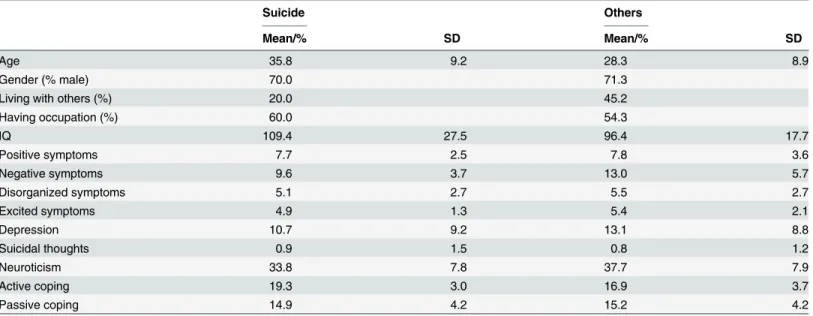
highly similar to the original sets, as were ratios for categorical variables. Averages, standard deviations, and ratios for the predictors in the model from the original dataset are given in
Table 1. Cox regression was performed on the original dataset and the imputed dataset. Results of the original dataset are shown inTable 2. All data were available for 7 suicide cases and 297 other cases. The analysis without imputation showed a significant effect for age, neuroticism and passive coping, and a trend for significance of living situation, negative, and disorganized symptoms.
When the analysis was repeated with these covariates in the imputed dataset, only age re-mained significant and neuroticism showed a trend. Pooled results are shown inS2 Table.
Discussion
This study demonstrated a suicide risk of 2.4% during a mean follow-up period of 5.6 years in individuals with recent onset psychosis in the Northern Netherlands (period: 2000–2009), which is significantly lower than two decades earlier (1973–1988). The suicide risk was highest in the first two years following the onset of psychosis. Later age of onset was the only strong Table 1. Overview of potential predictors of suicide for the suicide group and the other patients from the original dataset.
Suicide Others
Mean/% SD Mean/% SD
Age 35.8 9.2 28.3 8.9
Gender (% male) 70.0 71.3
Living with others (%) 20.0 45.2
Having occupation (%) 60.0 54.3
IQ 109.4 27.5 96.4 17.7
Positive symptoms 7.7 2.5 7.8 3.6
Negative symptoms 9.6 3.7 13.0 5.7
Disorganized symptoms 5.1 2.7 5.5 2.7
Excited symptoms 4.9 1.3 5.4 2.1
Depression 10.7 9.2 13.1 8.8
Suicidal thoughts 0.9 1.5 0.8 1.2
Neuroticism 33.8 7.8 37.7 7.9
Active coping 19.3 3.0 16.9 3.7
Passive coping 14.9 4.2 15.2 4.2
doi:10.1371/journal.pone.0129263.t001
Table 2. Results of Cox regression analysis of complete cases in original dataset (n = 7).
B SE Sig. Exp(B) 95% CI for Exp(B)
Lower Upper
Age 0.2 0.1 0.003* 1.2 1.1 1.3
Living with others -2.3 1.2 0.057 0.1 0.009 1.1
Negative symptoms -0.2 0.1 0.054 0.8 0.6 1.0
Disorganized symptoms 0.4 0.2 0.051 1.5 1.0 2.3
Excited symptoms -0.9 0.5 0.116 0.4 0.1 1.2
Neuroticism -0.3 0.1 0.007* 0.8 0.6 0.9
Passive coping 0.5 0.2 0.036* 1.6 1.0 2.5
*Significant association
predictor of suicide confirmed in the imputed dataset. Neuroticism was a moderate predictor showing a trend toward significance in the imputed dataset. Living situation, negative and dis-organized symptoms, and passive coping may also predict the risk of suicide, although the find-ings are less convincing for these variables.
The finding of a decline in suicide rate from 11.0% (follow-up at 15 years; 8.5% after 5 years) to 2.4% (mean follow-up 5.6 years, cumulative rate 4.3%) within two decades was not af-fected by differences in age, gender, and living situation between both samples. We could not investigate the effect of occupation, but this was not a significant predictor of suicide in our re-cent sample. Our finding is consistent with a large naturalistic study [53]. Moreover, these data confirm a recent Western European study showing a suicide rate of 1.9% (mean follow-up of 11.5 years) with most of the suicides occurring within the first two years [8]. A recent large worldwide study also showed a low incidence [54]. A meta-analysis in 2005 found an interme-diate suicide rate of 4.9% in the intervening period, supporting the gradual decline over the years [5].
Although we can only speculate, improvements in mental health care may have had a major impact on suicide risk. In the late 1970s and 1980s, psychiatric care delivered to patients with psychotic disorders in the Netherlands was characterized by inconsistent, less adequate phar-macotherapy and a lack of rehabilitation focusing on daily living, work as well as low levels of independence for more severe patients [4]. Nowadays, in the Groningen-area, all patients with recent onset psychosis are referred for a standardized diagnostic procedure with validated in-struments; and all clinical data are collected in the Psychosis Recent Onset in Groningen Sur-vey (PROGR-S) [44]. On the basis of multidisciplinary guidelines, evidence-based
interventions are offered as part of an Integrated Psychosis Care Program, including: pharma-cotherapy (relatively low dosages, majority second generation antipsychotics), cognitive behav-ioral therapy, an active rehabilitation and recovery oriented approach (e.g. Individual
Placement and Support) [55]. The program also includes a focus on the patient’s perspective e.g. on side effects [56], extensive psycho-education, and annual Routine Outcome Monitoring (ROM) of all patients with psychotic disorders. It has been shown that patients in communities with an early detection program have a significantly lower rate of suicidal behavior compared with others [57].
While the decline of suicide is substantial in the study group, the mortality rate due to sui-cide is still alarming. Thus, patients diagnosed with recent onset psychosis have a markedly in-creased chance of completing suicide, as the reported deaths were 4162% the expected rate in the general population. This underlines the importance of studying the predictors of suicide [58].
We found a higher age during assessment to be the only independent risk factor for suicide. With each year, the risk of suicide increased by 1.1%. This finding corresponds with earlier re-sults [20–23]. Individuals assessed later in life, the majority of whom experienced a later onset of psychosis, might find it more difficult to accept the changes and limitations associated with the diagnosis, as many have built a family, career and future plans. While age is a fixed factor, therapy could focus more on illness related losses that patients experience. Moreover, we ob-served a trend for living situation; only in 20% of the suicide cases, the individual concerned lived together with another person, as opposed to 45% of the other cases, suggesting that living together may be a protecting factor. Previous studies on this subject showed varying results. Whereas one study showed a similar trend [28], others found a trend in the opposite direction [22,29]. Other socio-demographic characteristics,i.e. gender and occupation, showed no
Most studies report that higher education or a higher IQ is associated with an increased risk for suicide [22,31,33], and only a few studies support our finding that intelligence had no effect [10,19]. Of note: we observed that the IQ of suicide cases was on average almost 15 points higher than other cases; however, the high standard deviation may have caused a lack of power.
As expected, more negative symptoms showed a trend for significance in relation to a de-creased suicide risk. It has been shown that negative symptoms may protect against suicide risk [9,34]. A similar mechanism may underlie the finding that fewer disorganized symptoms cor-relate with a higher suicide risk. There was no effect for positive and excited symptoms, in line with some previous findings for positive symptoms [16,17], although other studies did show a significant association [19,23].
Notably, no clinically relevant difference was observed between groups on suicidal ideation or depression. Studies in which depression was reported as a risk factor for suicide measured the degree of depression prior to suicide [37,38], although meta-analyses are able to detect an effect of prior depression [28,30]. In our results, we observed more suicidal ideation and less se-vere negative symptoms in patients who committed suicide within two years after PROGR-S compared with suicide cases after two years and non-suicide cases. Thus, clinicians should be aware that diagnostic screening on symptoms might predict suicide in the short-term, but not the long-term. Fleischhacker et al. showed that monitoring the history of suicide attempts might help to predict increased suicide risk [54]. Indeed, half of the cases in our sample had previous suicide attempts.
Patients who completed suicide within two years referral had lower levels of neuroticism and showed more passive coping, suggesting that neuroticism may be predictive in the short term for suicide risk. While our findings fit our hypothesis for passive coping [59], we expected that higher levels of neuroticism would be related to suicide risk [41,42]. One could speculate that higher levels of neuroticism and passive coping may also protect against suicide in a simi-lar way to negative symptoms. There was no effect for an active coping style.
The major strength of the present study was the broader inclusion criteria of different diag-noses compared with most studies, since all psychotic diagdiag-noses were incorporated. Another strength is that this study had the same catchment area as the study of Wiersma et al. [3] en-abling us to compare suicide rates over time.
A limitation of this study was that data on a part of the patients was lost to follow-up. The patients of whom the status was unknown at the end of the study period were not censored cause a specific end point could not be reliably determined and may differ substantially be-tween patients. A patient may have moved, deceased, refused further care, etcetera. Addition of those patients may bias the suicide rate to even lower values. It is possible, that suicide rates are higher in the group lost to follow-up, e.g. suicidal persons may avoid contact with mental health services [60]. However, we do not expect that this influenced the findings, as the
values are inevitable in the clinical setup of PROGR-S. In the future, we plan to repeat the anal-ysis with a larger sample.
Conclusion
To conclude, a considerable drop in suicide rate was found over the past two decades in the north of the Netherlands in patients with psychotic disorders. Nonetheless, research and pre-vention of suicide in psychosis should have the highest priority, as the risk is still very high when compared with the general population.
Supporting Information
S1 Table. Demographic data of subjects whose status was known at the end of the measure-ment period (n = 424) and subjects whose status was unknown (n = 190).The last column contains demographic information of Wiersma et al. (1998) for comparison.
(DOCX)
S2 Table. Pooled results of Cox regression analysis of imputed dataset (n = 10).
(DOCX)
S1 Dataset. Dataset used for the survival analyses.Both recent dataset and the dataset of Wiersma et al. (1998) are included.
(ZIP)
Acknowledgments
We would like to thank Geke Taymour, Erna van‘t Hag and Marieke van der Werff (University Medical Center Groningen); Anke van der Heide and Mia Drenth (Lentis Psychiatric Institute) for their help with data collection.
Author Contributions
Conceived and designed the experiments: RB HK SC. Analyzed the data: EL JSDL SC. Contrib-uted reagents/materials/analysis tools: EV. Wrote the paper: EL SC JSDL FDVE EV AA RB HK.
References
1. Healy D, Le Noury J, Harris M, Butt M, Linden S, Whitaker C, et al. Mortality in schizophrenia and relat-ed psychoses: Data from two cohorts, 1875–1924 and 1994–2010. BMJ Open. 2012; 2: 10.
2. Laursen TM. Life expectancy among persons with schizophrenia or bipolar affective disorder. Schi-zophr Res. 2011; 131: 101–104. doi:10.1016/j.schres.2011.06.008PMID:21741216
3. Miles CP. Conditions predisposing to suicide: A review. J Nerv Ment Dis. 1977; 164: 231–246. PMID:
321725
4. Wiersma D, Nienhuis FJ, Slooff CJ, Giel R. Natural course of schizophrenic disorders: A 15-year follow-up of a Dutch incidence cohort. Schizophr Bull. 1998; 24: 75–85. PMID:9502547
5. Palmer BA, Pankratz VS, Bostwick JM. The lifetime risk of suicide in schizophrenia: A reexamination. Arch Gen Psychiatry. 2005; 62: 247–253. PMID:15753237
6. Hor K, Taylor M. Suicide and schizophrenia: A systematic review of rates and risk factors. J Psycho-pharmacol. 2010; 24: 81–90. doi:10.1177/1359786810385490PMID:20923923
7. Nordentoft M, Mortensen PB, Pedersen CB. Absolute risk of suicide after first hospital contact in mental disorder. Arch Gen Psychiatry. 2011; 68: 1058–1064. doi:10.1001/archgenpsychiatry.2011.113PMID:
21969462
8. Dutta R, Murray RM, Hotopf M, Allardyce J, Jones PB, Boydell J. Reassessing the long-term risk of sui-cide after a first episode of psychosis. Arch Gen Psychiatry. 2010; 67: 1230–1237. doi:10.1001/
9. Fenton WS, McGlashan TH, Victor BJ, Blyler CR. Symptoms, subtype, and suicidality in patients with schizophrenia spectrum disorders. Am J Psychiatry. 1997; 154: 199–204. PMID:9016268
10. Kim CH, Jayathilake K, Meltzer HY. Hopelessness, neurocognitive function, and insight in schizophre-nia: Relationship to suicidal behavior. Schizophr Res. 2003; 60: 71–80. PMID:12505140
11. Austad G, Joa I, Johannessen JO, Larsen TK. Gender differences in suicidal behaviour in patients with first-episode psychosis. Early Interv Psychiatry. 2013.
12. Yan F, Xiang YT, Hou YZ, Ungvari GS, Dixon LB, Chan SS, et al. Suicide attempt and suicidal ideation and their associations with demographic and clinical correlates and quality of life in chinese schizophre-nia patients. Soc Psychiatry Psychiatr Epidemiol. 2013; 48: 447–454. doi:10.1007/s00127-012-0555-0 PMID:22847130
13. Witt K, Hawton K, Fazel S. The relationship between suicide and violence in schizophrenia: Analysis of the clinical antipsychotic trials of intervention effectiveness (CATIE) dataset. Schizophr Res. 2014. 14. Altamura AC, Bassetti R, Bignotti S, Pioli R, Mundo E. Clinical variables related to suicide attempts in
schizophrenic patients: A retrospective study. Schizophr Res. 2003; 60: 47–55. PMID:12505137 15. Pompili M, Serafini G, Innamorati M, Lester D, Shrivastava A, Girardi P, et al. Suicide risk in first
epi-sode psychosis: A selective review of the current literature. Schizophr Res. 2011; 129: 1–11. doi:10.
1016/j.schres.2011.03.008PMID:21530179
16. Pratt D, Gooding P, Johnson J, Taylor P, Tarrier N. Suicide schemas in non-affective psychosis: An em-pirical investigation. Behav Res Ther. 2010; 48: 1211–1220. doi:10.1016/j.brat.2010.08.005PMID:
20869042
17. Fedyszyn IE, Robinson J, Harris MG, Paxton SJ, Francey S. Predictors of suicide-related behaviors during treatment following a first episode of psychosis: The contribution of baseline, past, and recent factors. Schizophr Res. 2012; 140: 17–24. doi:10.1016/j.schres.2012.06.022PMID:22784686 18. Bertelsen M, Jeppesen P, Petersen L, Thorup A, Ohlenschlaeger J, le Quach P, et al. Suicidal
behav-iour and mortality in first-episode psychosis: The OPUS trial. Br J Psychiatry Suppl. 2007; 51: s140–6. doi:10.1192/bjp.191.51.s140PMID:18055932
19. Nangle JM, Clarke S, Morris DW, Schwaiger S, McGhee KA, Kenny N, et al. Neurocognition and suicid-al behaviour in an Irish population with major psychotic disorders. Schizophr Res. 2006; 85: 196–200. PMID:16690256
20. Kuo CJ, Tsai SY, Lo CH, Wang YP, Chen CC. Risk factors for completed suicide in schizophrenia. J Clin Psychiatry. 2005; 66: 579–585. PMID:15889943
21. Pompili M, Lester D, Grispini A, Innamorati M, Calandro F, Iliceto P, et al. Completed suicide in schizo-phrenia: Evidence from a case-control study. Psychiatry Res. 2009; 167: 251–257. doi:10.1016/j.
psychres.2008.03.018PMID:19395048
22. Reutfors J, Brandt L, Jonsson EG, Ekbom A, Sparen P, Osby U. Risk factors for suicide in schizophre-nia: Findings from a Swedish population-based case-control study. Schizophr Res. 2009; 108: 231– 237. doi:10.1016/j.schres.2008.12.023PMID:19176276
23. Mitter N, Subramaniam M, Abdin E, Poon LY, Verma S. Predictors of suicide in Asian patients with first episode psychosis. Schizophr Res. 2013; 151: 274–278. doi:10.1016/j.schres.2013.10.006PMID:
24200417
24. Dutta R, Murray RM, Allardyce J, Jones PB, Boydell J. Early risk factors for suicide in an epidemiologi-cal first episode psychosis cohort. Schizophr Res. 2011; 126: 11–19. doi:10.1016/j.schres.2010.11.
021PMID:21183318
25. Brugnoli R, Novick D, Haro JM, Rossi A, Bortolomasi M, Frediani S, et al. Risk factors for suicide behav-iors in the observational schizophrenia outpatient health outcomes (SOHO) study. BMC Psychiatry. 2012; 12: 83-244X-12-83.
26. Lester D. Sex differences in completed suicide by schizophrenic patients: A meta-analysis. Suicide Life Threat Behav. 2006; 36: 50–56. PMID:16676625
27. Melle I, Johannessen JO, Friis S, Haahr U, Joa I, Larsen TK, et al. Course and predictors of suicidality over the first two years of treatment in first-episode schizophrenia spectrum psychosis. Arch Suicide Res. 2010; 14: 158–170. doi:10.1080/13811111003704787PMID:20455151
28. Hawton K, Sutton L, Haw C, Sinclair J, Deeks JJ. Schizophrenia and suicide: Systematic review of risk factors. Br J Psychiatry. 2005; 187: 9–20. PMID:15994566
29. Agerbo E. High income, employment, postgraduate education, and marriage: A suicidal cocktail among psychiatric patients. Arch Gen Psychiatry. 2007; 64: 1377–1384. PMID:18056545
31. Drake RE, Gates C, Whitaker A, Cotton PG. Suicide among schizophrenics: A review. Compr Psychia-try. 1985; 26: 90–100. PMID:3881217
32. Webb RT, Langstrom N, Runeson B, Lichtenstein P, Fazel S. Violent offending and IQ level as predic-tors of suicide in schizophrenia: National cohort study. Schizophr Res. 2011; 130: 143–147. doi:10.
1016/j.schres.2011.04.031PMID:21605959
33. Delaney C, McGrane J, Cummings E, Morris DW, Tropea D, Gill M, et al. Preserved cognitive function is associated with suicidal ideation and single suicide attempts in schizophrenia. Schizophr Res. 2012; 140: 232–236. doi:10.1016/j.schres.2012.06.017PMID:22796150
34. McGirr A, Tousignant M, Routhier D, Pouliot L, Chawky N, Margolese HC, et al. Risk factors for com-pleted suicide in schizophrenia and other chronic psychotic disorders: A case-control study. Schizophr Res. 2006; 84: 132–143. PMID:16626940
35. Doihara C, Kawanishi C, Ohyama N, Yamada T, Nakagawa M, Iwamoto Y, et al. Trait impulsivity in sui-cide attempters: Preliminary study. Psychiatry Clin Neurosci. 2012; 66: 529–532. doi:
10.1111/j.1440-1819.2012.02379.xPMID:22989319
36. Wu CS, Liao SC, Lin KM, Tseng MM, Wu EC, Liu SK. Multidimensional assessments of impulsivity in subjects with history of suicidal attempts. Compr Psychiatry. 2009; 50: 315–321. doi:10.1016/j.
comppsych.2008.09.006PMID:19486729
37. Cheng AT, Chen TH, Chen CC, Jenkins R. Psychosocial and psychiatric risk factors for suicide. case-control psychological autopsy study. Br J Psychiatry. 2000; 177: 360–365. PMID:11116779 38. Kelly DL, Shim JC, Feldman SM, Yu Y, Conley RR. Lifetime psychiatric symptoms in persons with
schizophrenia who died by suicide compared to other means of death. J Psychiatr Res. 2004; 38: 531– 536. PMID:15380404
39. Kreyenbuhl JA, Kelly DL, Conley RR. Circumstances of suicide among individuals with schizophrenia. Schizophr Res. 2002; 58: 253–261. PMID:12409166
40. Potkin SG, Alphs L, Hsu C, Krishnan KR, Anand R, Young FK, et al. Predicting suicidal risk in schizo-phrenic and schizoaffective patients in a prospective two-year trial. Biol Psychiatry. 2003; 54: 444–452. PMID:12915289
41. Fang L, Heisel MJ, Duberstein PR, Zhang J. Combined effects of neuroticism and extraversion: Find-ings from a matched case control study of suicide in rural China. J Nerv Ment Dis. 2012; 200: 598–602. doi:10.1097/NMD.0b013e31825bfb53PMID:22759937
42. Lonnqvist JE, Verkasalo M, Haukka J, Nyman K, Tiihonen J, Laaksonen I, et al. Premorbid personality factors in schizophrenia and bipolar disorder: Results from a large cohort study of male conscripts. J Abnorm Psychol. 2009; 118: 418–423. doi:10.1037/a0015127PMID:19413416
43. Li Z, Zhang J. Coping skills, mental disorders, and suicide among rural youths in China. J Nerv Ment Dis. 2012; 200: 885–890. doi:10.1097/NMD.0b013e31826b6eccPMID:22986278
44. Liemburg EJ, Castelein S, Van 't Hag E, Van Es FD, SCholte-Stalenhoef AN, Van de Willige G, et al. The psychosis recent onset GRoningen survey (PROGR-S): Defining dimensions and improving out-come in early psychosis. PLoS ONE. 2014; 9: e113521. doi:10.1371/journal.pone.0113521PMID: 25412332
45. Kay S, Fitzbein A, Opler L. The positive and negative syndrome scale (PANSS) for schizophrenia. Schi-zophr Bull. 1987; 13: 231–267.
46. Montgomery SA, Asberg M. A new depression scale designed to be sensitive to change. Br J Psychia-try. 1979; 134: 382–389. PMID:444788
47. Andreasen NC, Pressler M, Nopoulos P, Miller D, Ho BC. Antipsychotic dose equivalents and dose-years: A standardized method for comparing exposure to different drugs. Biol Psychiatry. 2010; 67: 255–262. doi:10.1016/j.biopsych.2009.08.040PMID:19897178
48. Giel R, Nienhuis F. Scan 2.1: Schedules for clinical assessment in neuropsychiatry (in Dutch). Ge-neve/Groningen: WHO; 1996.
49. Wechsler D. WAIS-III: Wechsler adult intelligence scale, administration and scoring manual. 3rd ed. San Antonio, Texas: Psychological Corporation/Harcourt Brace; 1997.
50. McCrae RR, Costa PT Jr. Validation of the five-factor model of personality across instruments and ob-servers. J Pers Soc Psychol. 1987; 52: 81–90. PMID:3820081
51. Schreurs PJG, Van de Willige G. Coping with problems and events: The Utrecht coping list UCL (In Dutch: Omgaan met problemen en gebeurtenissen: De Utrechtse copinglijst (UCL)). 1st ed Lisse: Swets & Zeitlinger; 1988.
53. Nordentoft M, Laursen TM, Agerbo E, Qin P, Hoyer EH, Mortensen PB. Change in suicide rates for pa-tients with schizophrenia in Denmark, 1981–97: Nested case-control study. BMJ. 2004; 329: 261. PMID:15213108
54. Fleischhacker WW, Kane JM, Geier J, Karayal O, Kolluri S, Eng SM, et al. Completed and attempted suicides among 18,154 subjects with schizophrenia included in a large simple trial. J Clin Psychiatry. 2014; 75: e184–90. doi:10.4088/JCP.13m08563PMID:24717389
55. Koletsi M, Niersman A, van Busschbach JT, Catty J, Becker T, Burns T, et al. Working with mental health problems: Clients' experiences of IPS, vocational rehabilitation and employment. Soc Psychiatry Psychiatr Epidemiol. 2009; 44: 961–970. doi:10.1007/s00127-009-0017-5PMID:19280083
56. Wolters HA, Knegtering H, Van den Bosch RJ, Wiersma D. Effects and side effects of antipsychotic treatment in schizophrenia: Pros and cons of available self-rating scales. Schizophr Res. 2009; 112: 114–118. doi:10.1016/j.schres.2009.03.026PMID:19395241
57. Melle I, Johannesen JO, Friis S, Haahr U, Joa I, Larsen TK, et al. Early detection of the first episode of schizophrenia and suicidal behavior. Am J Psychiatry. 2006; 163: 800–804. PMID:16648319
58. Aleman A, Denys D. Mental health: A road map for suicide research and prevention. Nature. 2014; 509: 421–423. PMID:24860882
59. Zhang D, Guo L, Hu X, Li K, Zhao Q, Liu T. Increased cortico-subcortical functional connectivity in schizophrenia. Brain Imaging Behav. 2011; 6: 27–35.
![Fig 2. Survival curves of both samples, the known PROGR-S sample (n = 424; black) censored for patients that were out of care at a certain point in time; a graph based on Wiersma et al., 1998 [3]](https://thumb-eu.123doks.com/thumbv2/123dok_br/16284094.184868/6.918.298.739.657.992/survival-curves-samples-progr-censored-patients-certain-wiersma.webp)