ISSN 2278-4136 ISSN 2349-8234 JPP 2013; 2 (3): 50-54 © 2013 AkiNik Publications Received: 19-7-2013 Accepted: 09-8-2013
Maushumi Kulkarni
M.C.E Society’s Allana College of Pharmacy, K,B Hidayatullah Road, Azam Campus,Camp, Pune 1, Maharashtra, India.
Rashmi Tambe
M.C.E Society’s Allana College of Pharmacy, K,B Hidayatullah Road, Azam Campus,Camp, Pune 1, Maharashtra, India.
Kiran Bhise
M.C.E Society’s Allana College of Pharmacy, K,B Hidayatullah Road, Azam Campus,Camp, Pune 1, Maharashtra, India.
Correspondence:
Maushumi Kulkarni
M.C.E Society’s Allana College of Pharmacy, K,B Hidayatullah Road, Azam Campus,Camp, Pune 1, Maharashtra, India.
Tel: +91-9822615436
E-Mail: [email protected]
Preliminary Phytochemical screening and HPTLC
Studies of Extracts of Dried Rhizomes of
Aspidium cicutarium
Maushumi Kulkarni*, Rashmi Tambe, Kiran Bhise
ABSTRACT
Objective: Many herbal formulations are widely used in Ayurveda since ancient times. However it is not possible to attribute their pharmacological activity to a particular phytoconstituent present in the extract unless thorough phytochemical investigation is carried out. The present study aims at phytochemical screening of methanolic and aqueous extracts of rhizomes of Aspidium cicutarium Family Dryopteridaceae. The powdered dried rhizome was subjected to initial studies to determine the physical constants. Results: Extracts were made and subjected to various chemical tests and showed presence of steroids, flavonoids, saponins. Further investigation of the extracts by HPTLC is an attempt to deduce the varied composition of methanolic and aqueous extract of Aspidium cicutarium. The chromatogram shows presence of multiple peaks which indicate diverse composition of extract. Conclusion: Further detailed investigations of the extracts can be helpful in making formulations of these extracts so that they can successfully and safely be used to treat some diseases.
Keywords: Aspidium cicutarium, Rhizome, Physical Constants, Phytoconstituents, HPTLC.
1. Introduction
Natural products are a source of many traditional medicines and even some synthetic herbal medicines .In some parts of the world the herbal medicines are commonly used to treat a number of diseases. The alternate systems of medicine such as Unani, Siddha, Ayurveda
comprise of the natural products.[1]The modern Herbal medicines have been widely used all
over the world. The pharmaceutical industry itself still relies largely on the diversity of secondary metabolites in plants. The synthesized aromatic substances (metabolites) are used by plants as defensive weapon against predation by microorganisms, insects and herbivores. The search for the alternative systems of medicines having potential anti-inflammatory, antibiotic and other activities has gained an importance considering the harmful side effects which the modern synthetic medicine has. Medicinal plant is defined as any plant with one or undesirable side effect of some antibiotics. Herbal medicines have been widely used and form an integral part of primary health care of many countries and may constitute a reservoir of new antimicrobial substances to be discovered. [2] Similarly many disease conditions are a result of
excessive stress and require an individual to be on anti-oxidant therapy. Antioxidants are abundantly found in a number of trees and in their various parts. In the present study the plant
material selected was rhizomes of Aspidium cicutarium commonly known as a fern species
belonging to family Dryopteridaceae. These rhizomes are used mainly as anthelmintic. Methanolic extract is reported to contain phenolic compounds and tannins. The rhizomes are known as kombank in Marathi and find a wide use in Ayurveda as an anti-arthritic drug. Free radical scavenging activity of the methanolic extracts is also reported. Further investigation in this regard needs to be done to explore the potential of this extract as anti-inflammatory and anti-oxidant, with this objective this drug was selected in the present study [3-6]. Standardization
Hence the modern methods describing the identification and quantification of active constituents in the plant material may be useful for proper standardization of herbals and its formulations. Also, the WHO has emphasized the need to ensure the quality of medicinal plant products using modern controlled techniques and applying suitable standards. HPTLC offers better resolution and estimation of active constituents can be done with reasonable accuracy in a shorter time[7-9].
2. Materials and Methods 2.1 Plant material
The plant specimens for the proposed study were purchased from Ayurvedic Bhandar that sells crude drugs used in Ayurveda located in Bibwewadi, Pune, Maharashtra, India. The dried rhizomes of
Aspidium cicutarium were authenticated by Dr. Upadhyay Senior Scientist at Botany Department at Agharkar Research Institute, Pune, India.
2.2 Preparation and Extraction of Plant Material
The dried Rhizomes of Aspidium cicutarium were first powdered coarsely in a grinder and defatted with petroleum ether and 100 g was packed in a Soxhlet apparatus and extracted with methanol. Similarly for aqueous extract 100 g of dried powdered drug was defatted using Petroleum ether (60-80 °C) and then extracted with distilled water. The extraction was carried out until the extractive becomes colorless. The methanolic extract was filtered and evaporated under reduced pressure using Rotary vacuum Evaporator.
2.3 Phytochemical Screening
The phytochemical investigation of the methanolic and aqueous extracts of rhizomes of Aspidium cicutarium was carried out using standard protocol [10]. The extracts were finally weighed. The
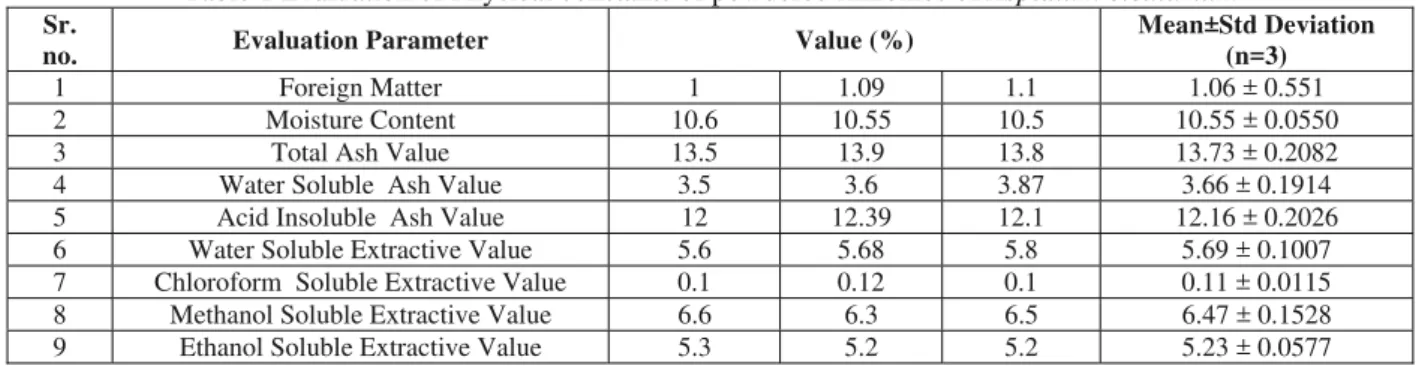
phytochemical tests were performed on the liquid and dried extracts using standard methods and the physical constants were evaluated. The results are stated in table 1.
2.4 HPTLC Profile (High Performance Thin Layer Chromatography)
HPTLC studies were carried out following the method of Harborne
[11]and Wagner [12]et al.
2.4.1 Sample Preparation
Each extract residue was re-dissolved in 1ml of chromatographic grade methanol and water which was used for sample application on pre-coated silica gel 60 F 254 aluminium sheets.
2.5 Developing Solvent System
A number of solvent systems were tried, for extracts, but the satisfactory resolution was obtained in the solvent n Hexane: Ethyl Acetate in the ratio of 7:3 for methanolic extract of Aspidium cicutarium. The solvent system selected for the aqueous extract was Ethyl Acetate: n Butanol in the ratio of 6:4.
2.5.1 Sample Application
Application of bands of each extract was carried out (4mm in length and 1µl in concentration) using spray technique. Samples were applied in duplicate on pre-coated silica gel 60 F254 aluminium sheets (5 x 10 cm) with the help of Linomat 5 applicator attached to CAMAG HPTLC system, which was programmed through WIN CATS software.
2.6 Development of Chromatogram
After the application of sample, the chromatogram was developed in Twin trough glass chamber 10 x 10 cm saturated with and n hexane: Ethyl Acetate in the ratio of 7:3 for methanolic extract and Ethyl Acetate: n Butanol in the ratio of 6:4 for aqueous extract.
2.6.1 Detection of Spots
The air-dried plates were viewed in ultraviolet radiation to mid-day light. The chromatograms were scanned by densitometer at 200 nm for methanolic extract and 220 nm after spraying with anisaldehyde with sulphuric acid for aqueous extract The Rf values and finger
print data were recorded by WIN CATS software.
3. Results and Discussion 3.1 Physical constants.
The proximate analysis showed satisfactory result with respect to foreign matter, moisture content, Ash value and Extractive values
[13, 14]. The water soluble extractive value is 5.69% and methanolic
extractive value is 6.47%. The physical constants are given in table 1.
Table 1 Evaluation of Physical constants of powdered rhizomes of Aspidium cicutarium Sr.
no. Evaluation Parameter Value (%)
Mean±Std Deviation (n=3)
1 Foreign Matter 1 1.09 1.1 1.06 ± 0.551
2 Moisture Content 10.6 10.55 10.5 10.55 ± 0.0550
3 Total Ash Value 13.5 13.9 13.8 13.73 ± 0.2082
4 Water Soluble Ash Value 3.5 3.6 3.87 3.66 ± 0.1914
5 Acid Insoluble Ash Value 12 12.39 12.1 12.16 ± 0.2026
6 Water Soluble Extractive Value 5.6 5.68 5.8 5.69 ± 0.1007
7 Chloroform Soluble Extractive Value 0.1 0.12 0.1 0.11 ± 0.0115
8 Methanol Soluble Extractive Value 6.6 6.3 6.5 6.47 ± 0.1528
9 Ethanol Soluble Extractive Value 5.3 5.2 5.2 5.23 ± 0.0577
3.2 Phytochemical Screening
The methanolic and aqueous extracts of rhizomes of Aspidium cicutarium showed presence of sugars, carbohydrates, tannins, steroids, flavonoids and saponins. The results are reported in Table
Phytochemical constituents
Methanolic Extract
Aqueous Extract
Alkaloids
Mayer’s reagent
+ -
Dragendorff’s reagent + -
Hager’s reagent + -
Wagner’s reagent + -
Phenolic compounds Ferric chloride test + +
Lead acetate test + +
Carbohydrates
Molisch’s reagent + +
Barfoed’s test + +
Fehling’s test + +
Benedict’s test + +
Flavonoids
Lead acetate test + +
Ferric chloride test + +
Sodium Hydroxide test + +
Shinoda test + +
Steroids
Liebermann-Burchard test + -
Salkowski reaction + -
Liebermann’s test + -
Saponins Foam test + +
Tannins
Ferric chloride test + +
Lead acetate test + +
Potassium Dichromate + +
Dilute Potassium Permanganate + +
Cardiac Glycosides Keller-Kiliani test + -
Legal’s test + -
Anthraquinone
Glycosides. Borntrager’s test - -
Saponin Glycosides Foam Test - +
Hemolytic test - -
Carbohydrates Molisch’s test + +
Fehlings test + +
Benedict’s test + +
Proteins Biuret’s test - -
Millon’s test - +
3.3 HPTLC studies
3.3.1 HPTLC studies of methanolic extract of Aspidium
cicutarium
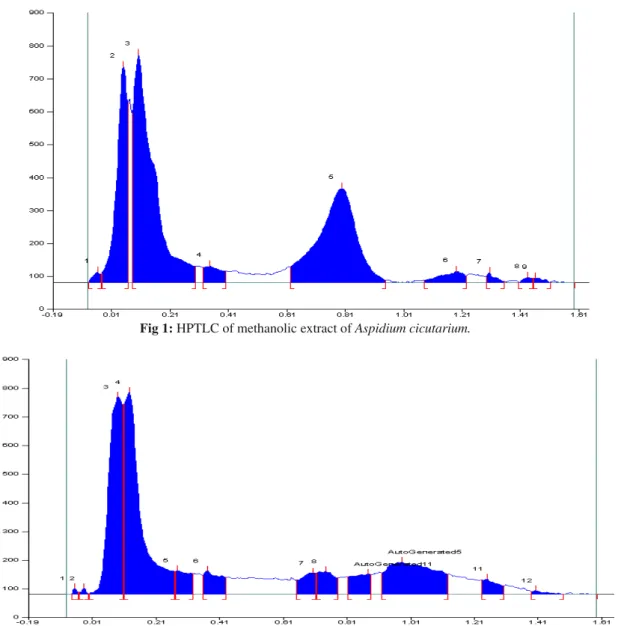
The mobile phase selected for the HPTLC studies of methanolic extract was n hexane: Ethyl Acetate in the ratio of (7:3). The resolution was obtained at 200nm. The result is depicted in figure 1. The following HPTLC figure for the methanolic extract of
Aspidium cicutarium sample whose 10 µl was injected shows 5 peaks at Rf values 0.41, 0.61, 0.81, 1.21, 1.41. The maximum
concentration of 350 is obtained at Rf value 0.61 and 0.81
indicating presence of phytoconstituents eluting out at 200 nm with
the mobile phase of n Hexane: Ethyl acetate (7:3).
3.3.2 HPTLC studies of aqueous extract of Aspidium cicutarium
The mobile phase for the aqueous extract of Aspidium cicutarium
was ethyl acetate: n Butanol at the ratio (6:4). The resolution was obtained at 220 nm. The results are depicted in Figure 2. The Figure shows 06 peaks. The peaks at Rf value 1.01 shows the
Fig 1: HPTLC of methanolic extract of Aspidium cicutarium.
Fig 2: HPTLC of aqueous extract of Aspidium cicutarium.
4. Conclusion:
Herbal medicines are composed of many constituents and are therefore very capable of variation. Hence it is very important to obtain reliable chromatographic fingerprints that represent pharmacologically active components of the herbal medicine. HPTLC fingerprinting profile is very important parameter of herbal drug standardization for the proper identification of medicinal plants. Aspidium cicutarium is widely used in Ayurveda in treatment of rheumatoid arthritis and has anti-inflammatory activity which has been proven in the traditional systems since ancient times. Different preparations made from different parts of the plant have been used in different ailments but their exact chemical components were unknown for a long time. To understand the actual chemical constituents responsible for the pharmacological activities of the plant detailed chromatographic studies are needed to be carried. Present study is the first report pertaining to deduce the varied composition of methanolic and aqueous extract of
Aspidium cicutarium using the HPTLC technique. In this study multiple peaks correspond to various pigments and the other lipid soluble compounds like alkaloids, flavonoids, steroids, anthraquinones. Several peaks observed in this experiment indicate the diverse composition of the extracts. The data and HPTLC fingerprint profile could be used as a valuable analytical tool in the
routine quality control and standardization. Further characterization of these fractions by applying more sophisticated separation and purification techniques are necessary to find out the exact chemical compounds and their relation to the pharmacological activity.
5. Acknowledgement
I wish to express my sincere gratitude to Principal Dr. (Mrs) Kiran Bhise and the Management, of M.C.E. Society’s Allana College of Pharmacy for giving me an opportunity to carry out the research work and for their support throughout the work.
6. Reference:
1. Brindha P, Nagaran A, Saralla RP, Narendran R, Shreedharan KA. Study on chemical and botanical standards of a traditional drug source Spathodea campanulata Beauv. International Journal of Pharmacy and Pharmaceutical Sciences 2012; 4(2):157-160.
2. Akharayi FC, Bobeye B, Adetuyi FC.Antibacterial, Phytochemical and Antioxidant Activities of the Leaf Extracts of Gliricidia sepium and Spathodea campanulata. World Applied Sciences Journal 2012; 16(4):523-530.
saponins in animal systems: a review. British Journal of Nutrition 2002; 88(6):587-605.
5. Sushma GS, Devi BA, Madhulatha CH, Kumar KU, Harathi P, Subramanian NS et al. Preliminary phytochemical screening and HPTLC fingerprinting of leaf extracts of Ficus nervosa Heyne ex Roth. Journal of Chemical and Pharmaceutical Research 2013; 5(3):98-104.
6. Ghogari AM, Bagul MS, Anandjiwala S, Chauhan MG, Rajanai M. Free radical scavenging activity of Aspidium cicutarium rhizome. Journal of Natural Remedies 2006; 6(2):131-134.
7. Sasikumar JM, Jinu U, Shamna R. Antioxidant Activity and HPTLC Analysis of Pandanus odoratissimus L. root. European Journal of Biological Sciences 2009; 1(2):17-22.
8. Ojha N, Kumar A, HPTLC profile of aqueous extract of different chromatographic fractions of Aloe barbadensis Miller. Asian Pacific Journal of Tropical Disease; 2012; S104-S108.
9. Mona A, Yogesh A, Prakash I, Arun P, Jayshree V, Amruta K. Phytochemical and HPTLC Studies of Various Extracts of Annona squamosa (Annonaceae). International Journal of Pharmaceutical Technology and Research 2012; 4(1):364-368,
10. Khandelwal KR. Techniques and Experiments, Practical Pharmacognosy. Ed 17th, Nirali Prakashan, Pune, 2007, 149-156.
11. Harborne JB. Phytochemical methods. 3rd Ed, Chapman and Hall,
London, 1998.
12. Wagner H, Baldt S. Plant drug analysis. Springer, Berlin, 1996. 13. Ejoba R. Phytochemical constituents of some leaves extract of Aloe
vera and Azadirachta indica plant species. Global Advanced Research Journal of Environmental Science and Toxicology 2012; 1(2):14-17.
14. Márcia TP, Eliana CF, Luís AE, Brasil E, Paulo VF, Fábio AS et al. Phytochemical screening, antioxidant, and antimicrobial activities of the crude leaves’ extract from Ipomoea batatas (L.) Lam. Pharmacognosy Magazine 2011; 7(26):165–170.
15. Sethi PD. High Performance Thin Layer Chromatography: Quantitative Analysis of Pharmaceutical Formulations; CBS Publishers and Distributers, New Delhi; 1996, 10-60.