..
' " 4"'"FUNDAÇÃO
' "
GETULIO VARGAS
EPGE
Escola de Pós-Graduação em
Economia
Coordenação: Prof. Rubens Penha Cysne
Diretor de Pesquisa da EPGEIFGV
Email: [email protected] -
ti
(021) 536-9245
"EX'J:Il\TCTIOl\T POLLU'l-IOl\T
,
,
ARD TBE SUSTAll\TABLE USE OP
EXBAUSTIBLE Al\TD
BEl\TEWABLE BESOUBCES"
DANBILLER
(FGV)
LOCAL
Fundação Getulio Vargas
Praia de Botafogo, 190 - 10° andar - Auditório
DATA
12/06/97 (5
afeira)
HORÁRIO
..
•
Extinction. Pollution. and the Sustainable Use of Exhaustible and Renewable
Resources
by
Dan Biller*
Fundação Getulio Vargas
Praia de Botafogo 190, # 812
22253-900 Rio de Janeiro, Brazil
E-mail: [email protected]
*
The author is a Senior Economist at the Fundação Getulio Vargas in Rio de Janeiro,
Brazil and a professor at the Environmental Economics Program of the Universidade
Santa Ursula. He is currently on leave from the World Bank. He is grateful to Herman
Daily, Shanta Devarajan, Emmanuel Jimenez, Leonard
J.
Mirman, Paulo Sergio Tenani,
and the participants of the CECPE seminar series for helpful comments. Any errors and
opinions expressed
in
this article are those of the author and do not necessarily represent
, I
Lセ@
Bxtinction. Pollution. and the Sustainable Use of Bxhaustible and aenewable Resources
by Dan Biller
Single ownership of natural resources is conunon in many developing countries and socialist economies. The sole owner is usually the .state or society at large, and governments are responsible for either distributing • exploitation rights or engaging in exploitation through their own corporations.
•
Under this circumstance, the notion of externality may not fully explain pollution problems existent in these nations.
This paper studies the case where a single agent owns both exhaustible and renewable resources, and attempts to maximize its welfare. The resources are either perfect or imperfect substitutes. Initially, exhaustible resource extraction does not affect the renewable resource, and sustainable growth is attainable. A lactor of pollution flowing from the extraction of the nc.n-renewable resource into the growth of the nc.n-renewable resource is introduced. The continuous exploitation of the exhaustible resource leads to the " optimal " extinction of the renewable resource, and sustainable growth is no longer reached. Regulation from a supra governmental agency such as an multinational institution may prove to be of utmost importance, if sustainability is to be achieved.
i
Extinetion. Pollution. and the Sustainable Use of Exhaustible and
Renewabla Resouree.
by
Dan Billar
Introduetion
Natural Resources can be divided into two categories: Exhaustib1e and renewab1e. Exhaustible resources may in geologica1 time be replaced, yet under an economic time frame they are doomed to total depletion. Alternatively, there is no steady state for the growth of an exhaustib1e resourcei therefore, a country that bases its growth on exhaustib1e resource extraction - given the absences of both technological progress and reinvestment in renewable activities - will at a point in time notice the collapse of its economic strategy.
Renewable resources may be harvested under a steady statei that is, as 10ng as the growth characteristic of a given renewab1e resource is respected, it may be harvested indefinitely. A country that bases its growth on renewable .resource harvesting may sustain its economic strategy. Yet, renewable resources a1so have a point of co1lapse in which they cannot be regenerated. Mismanagement, or economic factors such as discount rates may ultimately lead to the extinction of a renewable resource.
This paper analyses the case in which the extraction of an exhaustible resource generates pollution affecting the growth of a renewable resource. It compares the solution of the pollution prob1em with the case where pollution is absent, and shows that with pollution the renewable resource may disappear.
"
Literature Review
An important occurrence studied in this paper is the extinction of renewable resources. This has been extensively discussed- in Clark (1976). The standard result on renewable resource management links extinction to the discount rate; that is, it is usually optimal to exploit the renewable resource.more than the maximum sustainable yieldl when the rate of discount exceed its maximum
growth2• Extinction may also come about related to problems of open access and common property (the "tragedy of the commons"). For the sole owner's case, as studied by Lewis and Schmalensee (1977), and Cropper (1988), extinction may be further associated with the initial size of the renewable resource stock and with the choice for the resource's growth function. Finally, Swallow (1990) studies the trade-offs between renewable resource production and environmental development motivated by the irreversible impacts of coastal zone development. In this case, extinction only occurs if development proceeds too faro
Substitutability as translated in the use of natural resources is also discussed in this paper • In the economic literature, the output side of . substitution - i.e. the joint production of natural resources - was addressed in detail by Pindyck (1982), Hoel (1983), Kemp and Long (1984), and Wirl (1987 and 1988). Kemp and Long (1984) presents a comprehensive study on the economics of exhaustible resources. Pindyck (1982) explores market functioning in the presence of joint production with storage costs and uncertain future resource demando Hoel (1983) combines an exhaustible resource with a backstop technologyl, where there is a gradual transition from the former to the latter.
I The maximum sustainable yield (MSY) is the point where the growth function
of a renewable resource is maximized. This point is often considered optimal in the biological framework but not in economic analysis.
2 As Clark (1976) points out, the term "optimal" refers solely to the idea
of maximizing present values. It does not consider aesthetic or moral issues pertaining the decision of extinction. These are undoubtedly very important particularly when dealing with irreversible actions.
3
Finally, Wirl (1987 and 1988) analyze in a dynamic context the joint production of exhaustible resources and their optimal extraction policies.
The works mentioned in the paragraph above address primarily the cases of exhaustible resources or exhaustible resource and a backstop technology. The mixed case, i.e. the simultaneous use of exhaustible and renewab1e resources, was studied in Biller (1990) and Aarrestad (1990). Biller (1990) models the behavior of a mO,nopoly that produces both types of resources for the cases of perfect and imperfect substitutes. Aarrestad (1990) investigates an economy for which the welfare function is dependent on the production (and consumption) of perfect
substitute renewable and exhaustible resources.
Finally, an additional topic of relevance to the models presented be10w is the issue of sustainability. Although this issue serves as a link between natural resource and environrnental economics, finding an unique definition for sustainability has been a difficult task. Pezzey (March 1989), for example, gives more than forty-five definitions of sustainability coming from the literature. As pointed out by Barbier and Markandya (1990), at least two categories of definitions may be identified: a broader concept involving .economic, ecological and social development and a narrower notion focused on intertemporal optimal resource and environrnental management. Like Barbier and Markandya, our model will center on the latter. That is, we will consider sustainable any growth for which a steady state is possible.
Economic Use of Mixed Resources Without Pollution
Substitutability as emphasized by Wirl (1987 and 1988) is a concept that can be largely defined by consumers. In this sense, at the firm level the substitutability of jointly produced resources would appear in the demand faced by producers4 • In the welfare case studied by Aarrestad (1990), substitutability emerges in the utility function of the economic agents. Both cases, though different in approach, hold primari1y the same idea. For the case of perfect
substitutes, price or utility is basically a function of the sum of both resources. Imperfect substitutes would involve different price and utility systems.
a. The Perfect Substitute Case
cッセゥ、・イ@ an economy that derives its welfare from the extraction of an
exhaustible resource and the production of a renewable one. The instantaneous social welfare can thus be written as:
with
U=U[q(t)+y(t)] (1)
> O, < O, U»' < O.
The planner's problem would be:
W=Max!e-reu[q(t) +y(t)]dt
o
s. t. :
アHエIセoLケHエIセo@
R=-q H=G(H)-y
state variables: R(t), H(t) control variables: q(t), y(t)
5
As mentioned previously, from the point of view of society both resources are assumed to be perfect substitutes with no costs attached to their extraction or production. It should also be mentioned that there exists a finite and positive level of utility for which the non-renewable resource is exhausted
(a "choke" level of utility)5.
The Hamiltonian of this problem is given by
H=e-rc [U(q+y)] -oq+1l (G(H) -y) (2)
which has the following first order conditions
H =e-rtu. q q -0=0 (3)
H.=e-Y rcu.-"=O Y ,.. (4)
a and セ@ are the shadow prices of the exhaustible and the renewable source, respectively. By taking the time derivatives of equations (3) and (4), and incorporating equations (5) and (6), it is possible to find the extraction rate and production path of the resources. More importantly, we can find the relationship between the two resources as given in the proposition below:
Proposition 1 (Biller, 1990): In the case of jointly used perfect substitute exhaustible and renewable resources - when the exhaustible resource
is extracted first - the switching point occurs when the marginal growth of the renewable resource is zero.
Proof: The time derivatives of equations (3) and (4) yield the Hotelling rule for the exhaustible resource and a "varia-tion" for the renewable resource. These equations will only hold simultaneously when GH
=
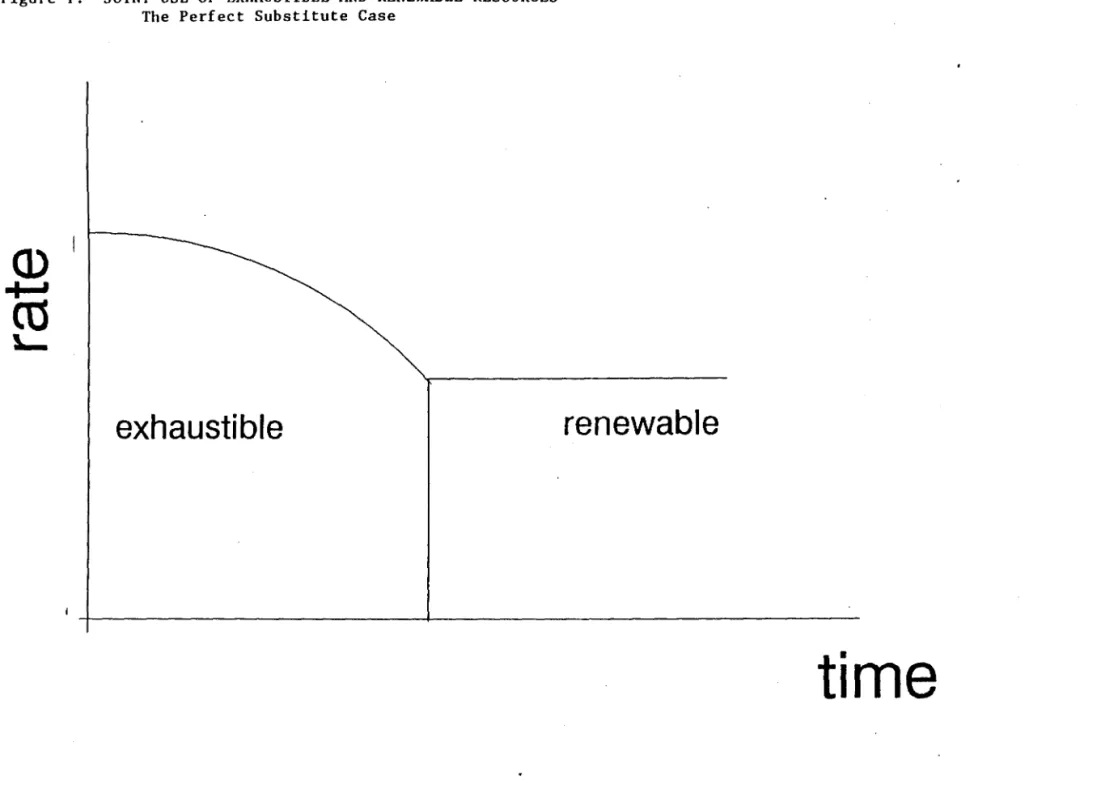
0.6The condition above is also related to the steady state of the renewable resource. Steady state requires that the derivatives with respect to time of the renewable resource' s shadow pr ice, stock and production are equal to zero. This requisite implies that the marginal growth is zero as above, and this point is commonly known as the maximum sustainable yield. Figure 1 depicts the case in which the production path is constant over time.
(Place figure 1 here) b. The Imperfect Substitute Case
In the imperfect substitute case, the marginal utility derived from each resource may be different; therefore, the utility function cannot be written as a function of the sum of both resources. The remaining conditions are kept the sarne. The problems, thus, becomes:
W=Max!e-reu(q(t), y(t»)dt
o
s. t. :
q( t) セoL@ y( t) セッ@
Figure 1: JOINT USE OF EXHAUSTlBLE AND RENEWABLE RESOURCES
The Perfect Substitute Case
())
+-'
CO
'-exhaustible
,.
renewable
H=G(H)-y
state variables: R(t), H(t) control variables: q(t), y(t) The Hamiltonian of this problem is given by
R=e-rt [U(q,y)-aq+I'(G(H)-y) (7)
which has the following first order conditions
R
q =e-rtU -a=O q (8)fi
=e-rtu. -11 =0 (9)Y Y ,..
Taking the time derivatives of equations 8 and 9 yields the time path 'of the exhaustible resource extraction and the renewable resource production:
where
8 possible solution for this system.
[Place figure 2 here)
Economic Use of Mixed Resources with Pollution
In this section, we will introduce an additional factor to the model presented above. Consider now the situation where the extraction of the exhaustible resource causes pollution affecting the renewable resource. The pollution alters the renewable resource growth function, but its flow depends on the extraction rate and on the ability of the environment to "clean-up" itself. Once again, we consider the cases of perfect and imperfect substitutability.
a. The Perfect Substitute Case
The planner's problem would be:
W=Max!e-rtu(q{t) +y{t)]dt
o
s. t. :
q( t) セoL@ y( t) セo@
R=-q H=G{H,S)-y S=aq-bS; a, b>O
state variables: R(t), H(t), S{t) control variables: q(t), y(t)
Figure 2: JDINT USE DF EXHAUSTIBLE AND RENEWARLE RESDURCES
The Imperfect Substitute Case
Q)
+-'
exhaustible
CO
'
-renewable
セ@
.
time
•
..
9
The Hamiltonian of this problem is given by
H=e -rt [U( q+y) ] -aq+j.1 (G (H, S) -y) +'t (aq-bS) (14)
which has the following first order conditions:
fi. =e -rtu. -11 =0 (16)
Y Y ,.
T is the pollution's shadow price. By taking the time derivatives of
(15) and (16) and equating them with (17)-(19), the natural growth rate at the switching point can be determined and is given by:
G=baerc_b_aG (20)
H U S
q
It should be noted that a positive and ever increasing GH means the
extinction of the renewable resource. The exponential factor in equation (20) should dominate over alI other factors, and the only negative factor in the equation is likely to be small'. The renewable resource could thus be extinct prior to the beginning of its exploitation. Alternatively, as depicted in Figure 3, under the presence of pollution from the extraction of an exhaustible resource
•
..
la
a renewable resource becomes in fact optimally exhaustible. This is a rather gloomy scenario if one considers the sustainable option of the previous section.
[Place figure 3 here) b. Imperfect Substitute Case
The imperfect substitute case yields a similar result to the case above; that is, in both cases it will be optimal in present value terms to render extinction to the renewable resource.
Under imperfect substitutes with pollution, the planer faces the following problem:
W
=
Max! e-rtU[q( t) I y( t)] dto
s.t.:
q( t) セo@ I y( t) セo@
R=-q H=G(H,S)-y S=aq-bS; a, b>O
state variables: R(t), H(t), S(t) control variables: q(t), y(t)
The harniltonian and the first order conditions of this problem are the sarne as in the perfect substitute case, but it should be noted that now Uq is different than Uy '
Taking the time derivatives of (1S) and (16) and equating them with (17)-(19) yields the time path of the exhaustible resource extraction and the renewab1e resource production:
BIBLIOTECA MARIO
heセ[Mュue@SIMONSEI
FUNDACÃO
GETULIO VARGAS
Figure 3: JOINT USE OF EXHAUSTIBLE AND RENEWABLE RESOURCES WITH POLLUTION
The Perfect Substitute Case
Q)
CO
,...
exhaustible
renewable
.. J #
time
•
where
Due to the exponential faetor, the produetion of the renewable resouree eannot have a steady state. In addition, its time derivative is negative, implying that at one point the renewable resouree will exhausted. Figure 4 depiets a possibility for the extraetionjproduetion paths.
(plaee figure 4 here] Final Considerations
In the seetions above, we have diseussed an eeonomy that derives its welfare from the exploitation of two resourees, one exhaustible and the other renewable. In the first instanee, the exhaustible resouree has no negative effeet on the renewable side, and sustainable growth as defined in the existenee . of a steady state is attainable. When a pollution faetor flowing from the exhaustible to the renewable resouree is introdueed, steady state and thus sustainability is no longer reaehed. The renewable resouree sooner or later beeomes extinet, and the eeonomy is doomed to eollapse some time after the total eeonomie depletion of the exhaustible resouree.
Fjgure 4: JOINT USE OI<' EXHAUSTIBLE AND RENEWABLE RESOURCES WITH POLLUTION
The Imperfect Substitute Case
Q)
10
'-exhaustible
renewable
• I セ@
time
•
..
•
does not consider an exhaustible source.
We have been avoiding the use of the term "externality", for in our case a single agent controls both renewable and exhaustible resources. In fact, in the cases studied here, the externality notion is absent.,- because no other party is affected by the pollution of the exhaustible resource exploitation. The exercise becomes a trade-off between the production of a renewable resource, the extraction of an exhaustible resource, and its pollution •
In addition, contrary to most of the available literature on sustainability where extinction is either not optimal or suboptimal, in our case unsustainable production of the renewable resource in present value terms is indeed optimal. As previously discussed, this result arises from the maximization of a standard welfare function, and under different assumptions may no longer hold. One such assumption is the introduction of irreversibility factors as analyzed, for example, in Bishop (1978) and Fisher and Hanemann (1990) •
Nonetheless, this doomsday scenario may closely explain the behavior of several developing nations and previously socialist economies. The basis of the problem rests in the ide a of property rights. In many countries, exhaustible resources such as minerals and renewable resources such as fish and forests belong to the state or to soc iety at large. Governrnents are generally responsible for distributing exploitation rights or exploiting the resources through their own corporations. This is in essence a single ownership case. This does not imply, however, that externality considerations are irrelevant; rather, it suggests that focusing on externalities only may not fully explain the issue of pollution and unsustainable growth.
A third interesting outcome of the model lies on the possibility for correcting of the pollution "problem". Since under the described cases with pollution, the social planner is actually behaving optimally, what would it take to change his / her behavior and reach the sustainability of the two initial examples?
•
•
13
growth, could attempt to influence the social planner by subsidizing conservation. This goal may be attained at lower costs than initially expected. If the multinational institution acknowledges a direct benefit to the rest of the world of not polluting a renewable resource, it can suggest a change in the objective function of the resources' owner and compensate the country for the change. In a similar instance, Berck (1981) has found the possibility.of steady growth •
,
•
References
Aarrestad, Jostein. "Simultaneous Use of Renewable and Non-Renewable Natural Resources." Resources and Energy. Vol. 12, pp. 253 - 262, 1990.
Barbier, Edward B.; Markandya, Anil. "The Conditions for Achieving European Economic Review.
Berck,
Environmentally Sustainable Development." Vol. 34, pp. 659 - 669, 1990.
Peter. "Optimal Management of Renewable Resources With Growing Demand and Stock Externalities." Journal of Env"ironmental Economics and Management. Vol. 8, pp. 105 - 117, 1981.
Biller, Dan. "Petroleum, Alcohol, and Energy Substitution in
Bishop,
Clark,
Brazil: Theoretical and Empirical Issues." Unpublished Ph. D. Dissertation, University of Illinois.
Richard. "Endangered Species and Economics of a Safe Minimum Standard." Agricultural Economics. February, 1978.
Uncertainty:
American Journal The of
Colin W. Mathematical Bioeconomics: The Optimal
of Renewable Resources, John Wiley
&
Sons, 1976. Management Cropper, M. L. "A Note on the Extinction of Renewable Resources."Journal of Environmental Economics and Management. Vol. 15, pp. 64 -70, 1988.
Dasgupta, P. S. Control of Resources, Cambridge University Press, 1982.
Fisher, Anthony C.; Hanemann, W. Michael. "Information and the Dynamics of Environmental Protection: The Concept of the Critical Period." Scandinavian Journal of Economics. Vol. 92, No. 3, pp. 399 -414, 1990.
Hoel, Michael. "Monopoly Resource Extractions Under the Presence of Predetermined Substitute Production", Journal of Economic Theory, vol 30 No 1 (June, 1983).
Lewis, T. R. and Schmalensee, R. " Nonconvexity and the Optimal Exhaustion of Renewable Resources", International Economic Review, 18, pp. 535 - 552, 1977.
Kemp, M. C. and Long, N. V. (Eds) • ZヲZeセウセウセ。オケセウセ⦅ゥセョ⦅NNNZZエZNZNィZNZ・]MMMM]eセ」BLッBLョBBッZZNZュZZNNZZゥNNL」ZNNZウ]MMMBLッNNZNヲ@
Exhaustible Resources. North-Holland, 1984.
Pezzey, John. "Economic Analysis of Sustainable
Sustainable Development." Working Paper No. 15. Growth Environment and Department, The World Bank, March 1989.
Pindyck, R. S. "Uncertainty in the Theory of
Markets", Review of Economic Studies, 1982, 51. Renewable Resource Swallow, Stephen K. "Depletion of the Environmental Basis
Renewable Resources: The Economics of Interdependent Renewable and Nonrenewable Resources. " Journal of Environrnental Economics and Management, Vol. 19, # 3, November 1990.
for
15
Wirl, Franz "Resources Extraction of Imperfect Substitutes", Energy Economics, Vol 10, No 3 (July, 1988).
N.Cham. P/EPGE SPE B597e
Autor: Bille:r, Dan.
Título: Extinction, pollution, and the sustainable use of ex
087376 1111111111111111111111111111111111111111 50755
FGV - BMHS N° Pat.:ABFI75/98