Fundação Getulio Vargas
Escola de Administração de Empresa de São Paulo
Mestrado Profissional em Gestão Internacional
LEAN MANAGEMENT AND INNOVATION IN OPERATIONAL
EFFICIENCY: THE EGR PROJECT IMPLEMENTED BY PIRELLI TYRE
BRAZIL IN SANTO ANDRÉ PLANT
VINCENZO PRUDENTINO
SÃO PAULO
VINCENZO PRUDENTINO
LEAN MANAGEMENT AND INNOVATION IN OPERATIONAL
EFFICIENCY: THE EGR PROJECT IMPLEMENTED BY PIRELLI TYRE
BRAZIL IN SANTO ANDRÉ PLANT
Thesis developed and presented to Escola de Administração de Empresas de São Paulo of Fundação Getulio Vargas, as a requirement to obtain the title of Master in International Management (MPGI).
Knowledge Field: Operations
Adviser: Prof. Dr. Tales Andreassi
SÃO PAULO
Prudentino, Vincenzo.
Lean Management and innovation in operational efficiency: The EGR project implemented by Pirelli Tyre Brazil in Santo André plant / Vincenzo Prudentino - 2012 126 f.
Orientador: Tales Andreassi.
Dissertação (MPGI) - Escola de Administração de Empresas de São Paulo.
1. Pirelli Companhia Industrial Brasileira. 2. Liderança. 3. Eficiência
organizacional. 4. Administração da Produção. I. Andreassi, Tales. II. Dissertação (MPGI) - Escola de Administração de Empresas de São Paulo. III. Título.
VINCENZO PRUDENTINO
LEAN MANAGEMENT AND INNOVATION IN OPERATIONAL
EFFICIENCY: THE EGR PROJECT IMPLEMENTED BY PIRELLI TYRE
BRAZIL IN SANTO ANDRÉ PLANT
.
Thesis presented to Escola de Administração de Empresas de São Paulo of Fundação Getulio Vargas, as a requirement to obtain the title of Master in International Management (MPGI).
Knowledge Field: Operations
Approval Date ____/____/_____
Committee members:
________________________________ Prof. Dr. Tales Andreassi
________________________________ Prof. Dr. Andre Duarte
Abstract
This thesis aims to analytically describe and assess the implementation of lean manufacturing practices by Pirelli Tyre within its Latin American Industrial complex. In addition to a
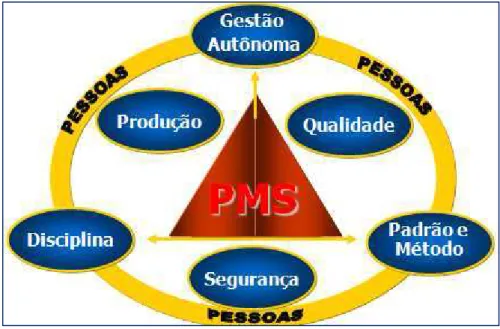
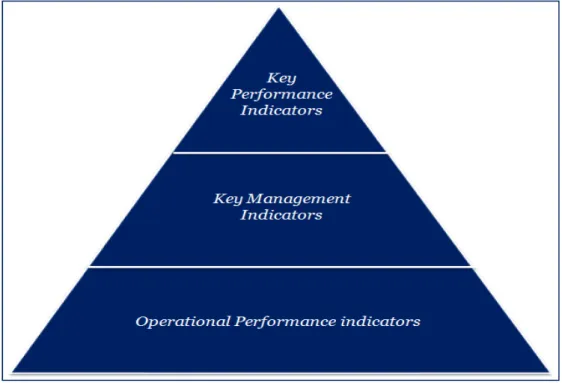
structured and vast description of Toyota production principles and lean thinking theoretical foundations, a special emphasis will be devoted to the EGR project (Especialistas em Gestão da Rotina), as a strategic tool to be used by the Italian multinational company in the upcoming future, so to achieve a more effective and efficient results in daily routine management. This project, representing a significant component of Pirelli Manufacturing System (PMS) and primarily geared to plant supervisors and coordinators, mainly consists of helping the firm to develop the corporate ability to correctly evaluate the potential gap existing between actual and expected results, in order to both understand deviations as well as underlying causes, and continuously improve company performance through process standardization and waste reduction. Those goals can be pursued by acting on two essential means: technical skills and behavioral leadership to support each project team; enhanced effectiveness in managing performance indicators across the different factory units, in accordance to KPIs set at the Head Quarter level. Furthermore, the research will be focused on the peculiar experience of Santo André plant, where EGR has firstly kicked off, with the aim to capture the relevant changes (on the organizational and economic side) brought to the company, through the conduction of field research and interviews, which are oriented to gather evidence, considerations and insights from all the organizational actors involved.
Resumo
O trabalho tem como objetivo avaliar e descrever analiticamente a implementação de práticas de manufatura enxuta pela Pirelli Pneus no seu complexo industrial da América Latina. Além de uma descrição estruturada e ampla dos princípios de produção de Toyota e fundamentos teóricos do Lean thinking, uma ênfase especial será dedicada ao projeto EGR (Especialistas em Gestão da Rotina), como uma ferramenta estratégica para ser usada pela empresa multinacional italiana no futuro próximo, de modo a alcançar um resultado mais eficaz e eficiente na gestão da rotina diária. Este projeto, que representa um componente significativo do Pirelli Manufacturing System (PMS) e, principalmente, voltado para supervisores e gestores de plantas, consiste principalmente em ajudar a empresa a desenvolver a capacidade empresarial para avaliar corretamente o gap potencial existente entre os resultados atuais e os esperados, para tanto entender os desvios, bem como as causas subjacentes, e melhorar continuamente o desempenho da empresa por meio da padronização de processos e redução de desperdicios. Esses objetivos podem ser perseguidos, atuando em dois meios essenciais: habilidades técnicas e comportamentais de liderança para apoiar cada equipe de projeto; uma maior eficácia na gestão de indicadores de desempenho nas diferentes unidades de fábrica, de acordo com KPIs estabelecidos no nível central pelo Head Quarter. Além disso, a
investigação será focada na experiência peculiar da planta de Santo André, onde o EGR começou como piloto, com o objetivo de captar as alterações relevantes (no lado
organizacional e econômico) que este projeto trouxe para a empresa, através da realização de pesquisa de campo e entrevistas, que são orientados a recolher provas, considerações e opiniões de todos os principais atores envolvidos.
Acknowledgements
This Thesis has meant to me the very happy ending of a fantastic, precious, hard and unique experience here in São Paulo. In the last fourteen months I enriched my knowledge as a student and strengthened my personality as a man. I will take with me all these great achievements, wherever my future will be.
I would like to thank my Brazilian supervisor, Prof. Tales Andreassi, competent and patient teacher, who guided and supported me along the winding path of realization.
A sincere thanks goes to my Italian supervisor, Prof. Arnaldo Camuffo, for his valuable advices and teachings, the great availability, the enlightening cooperation and essential contribution provided during the preparation of the thesis.
A special thanks to all the member of Industrial Division Staff of Pirelli Tyre Brazil, in Santo André. In particular, a sincere thanks goes to Alessandro Villa and Denise Filipini. Thank you
very much for your valuable support and great cooperation.
A massive thanks to all my family, authentic, precious and irreplaceable cardinal point of my life. To my father, tireless and hardworking man, on the pitch as much as in everyday life. To my mother, apprehensive, sweet, and so poetically funny friend in all my days. To my sister, stubborn interlocutor, incredible force of nature, beautiful and lovable confidant. To my grandparents and uncles, loyal and incomparable supporters of my university struggles, and careful advisers on my diets overseas. Thanks to all of you for every single day spent away from home.
TABLE OF CONTENTS
1. INTRODUCTION ... 10
1.1 Introduction ... 10
1.2 Analytical approach and objectives ... 10
1.3 Structure of the thesis ... 11
2. THEORETICAL BACKGROUND ... 12
2.1 The Lean way in Manufacturing Companies... 12
2.2 The Toyota way: Differential features and success factors ... 13
2.3 The impact of Lean thinking on manufacturing: The Toyota Production System ... 15
2.4 Lean Thinking at Toyota: What really makes difference from the other firms ... 16
2.5 Lean thinking: Much more than merely acting on the shop floor ... 17
2.6 How to become lean: A five-step process ... 20
2.7 From mass production to lean production approach: Reasons for transition and the evolution of lean concept ... 21
2.8 The Lean Way: A crucial driver for lasting success and steadily growing results ... 24
2.9 Waste in management work: How to root it out and create value ... 25
2.10 Standard is the way: Creating value basing on daily routine management principles ... 27
2.11 Visual Management, Control and Discipline on the shop floor ... 30
2.12 The diffusion of lean practices as a knowledge transfer process ... 32
2.13 Organizational ambidexterity: The importance of adapt to change and align capabilities ... 35
2.14 People: The driver to continuous improvement and long-term success ... 37
2.15 How do managers behave in lean environments: Literature overview and insights... 40
2.16 Lean manufacturing: The good of being more efficient and smoother ... 47
2.17 A preliminary step in the route towards Lean: Total Productive Maintenance ... 52
2.18 The TPM practical implementation within the firm ... 55
3. BE LEAN: HOW TO MAKE IT HAPPEN AT PIRELLI TYRE BRAZIL: TPM AND PMS ... 57
3.1 A brief introduction ... 57
3.2 Total Productive Maintenance: The Experience of Santo André plant ... 57
3.3 Pirelli Manufacturing System: The Experience of Santo André plant ... 60
4. METHODOLOGY ... 68
4.1 Theoretical background ... 68
4.2 Data collection ... 69
4.3 Methodological approach ... 70
5.1 Introduction ... 74
5.2 Core features and purposes of the project ... 75
5.3 The project implementation: A seven-step process ... 79
5.3.1 Identification and verification of the current system for controlling company performance ... 80
5.3.2 Development of the tree structure for performance indicators ... 82
5.3.3 Definition and setting of the new system for controlling company performance ... 84
5.3.4 Development and installation of the new set of indicators for the firm performance assessment .. 88
5.3.5 Framing and building up plans, reports and more efficient formats of routine meetings, in accordance with the new operational model to be introduced ... 91
5.3.6 Implementation of the new system for monitoring and controlling company’s performance ... 93
5.3.7 Checking the effectiveness and regular functioning of the system, through frequent follows up and feedbacks ... 95
5.4 Research results ... 95
5.4.1 The project impact on economic results ... 95
5.4.2 The project impact on employees’ daily routine ... 98
5.4.3 The project impact on plant area managers, supervisors and coordinators ... 98
5.4.4 The project impact on Continuous Improvement Staff ... 103
6. CONCLUSIONS AND FINAL CONSIDERATIONS ... 105
6. 1 The SWOT Analysis applied to EGR Project... 106
6.1.1 Strengths ... 107
6.1.2 Weaknesses and threats ... 108
6.1.3 Opportunities ... 111
6.2 Theoretical implications ... 113
6.3 Managerial implications ... 114
6.4 Limitations ... 115
7. REFERENCES ... 115
APPENDIX I : Interview protocol for individual focused interviews with area managers, supervisors and coordinators ... 123
APPENDIX II: Pictures from EGR Project in Santo André plant ... 124
1.
INTRODUCTION
1.1 Introduction
In the current economic scenario, it’s definitely critical for each firm to develop and consistently adopt a leading change approach. In fact, the challenging struggles all the firms have to cope with, turn to definitely be a function of a rapidly growing landscape, mainly characterized by a worldwide integrated communication, continuous technological advancement and widespread competition. In this sense then, even the way a firm is managed can vary over time and according to the economic environment at any period of time. Generally speaking, in fact, the real lasting value of a company really lies in its capacity to both change year in and year out and strive to adapt itself as much as possible to the surrounding context, so to achieve a sustained competitive advantage, not so easily replicable by other players.
For all these reasons, lean thinking can therefore prove to be a valuable mean, for a given company, to stay competitive in the long term by strongly evolving its managing methods, in order to achieve a better efficiency, productivity and high quality standards in services and products. All the practices and techniques that will be explained later on were successfully tested by companies like Boeing and Toyota and deeply investigated by researchers as Womack (1996), Jones (1996) and Liker (2004), among all. Initially started as a breakthrough in factory management and aimed at pursuing great efficiency by reducing wasteful non-added value activities, lean thinking moved soon to be a companywide approach, oriented to trigger the overall firm improvement at any level process.
The thesis has the chance to practically experiment and apply the described practices and techniques to a real case study, represented by the EGR implementation by Pirelli Tyre Brazil. In fact, the emphasis is focused on the vivid interest of describing the sequential steps of the project realization, underlining peculiar challenges and criticalities faced in progress, and finally portraying the results deriving from EGR entrance within the daily factory routine. Besides, a further essential aspect of the analysis regards the chance to understand whether lean approach, in operations, can effectively represent a feasible alternative to be implemented by those manufacturing firms which would hope to play a significant role in their industries and achieve steadily growing results in the market environment. In particular, the ultimate goal consists of accurately assessing both the actual impact of EGR project on the organizational and economic sphere of the firm, and especially gathering evidence about the potential sustainability of the improvements and benefits entailed by such lean based project on a medium-long term horizon.
1.3 Structure of the thesis
Because of the special orientation to operational issues, this thesis primarily focuses on lean manufacturing practices, drawn from the outstanding performance of Toyota in the automotive sector and theoretically postulated by Taiichi Ohno (1988), the father of Toyota Production System. Considering then lean approach as a systemic modus operandi within a certain business, the most relevant goal of the first section consists of firstly addressing the prominent features of Lean manufacturing theory, by underlining the most important values and principles: from one-piece flow concept to the various waste typologies, from roll-out practices to employees’ engagement within the enterprise.
Thus, in the second section the thesis addresses two fundamental issues and preliminary steps which turned to be critical and strategic to Pirelli Tyre in walking the challenging path towards a lean identity. More specifically, the Italian enterprise firstly adopted the Total Productive Maintenance system in all its factories worldwide, and afterwards renewed the entire manufacturing system by launching the PMS (Pirelli Manufacturing System), therefore showing a true expression of commitment to the absorption of lean practices.
oriented to analyze the Pirelli case study through the conceptualization and subsequent implementation of EGR Project. In so doing, the thesis then moves to evaluate the impact of such initiative on the whole organizational structure, conducting a field research on the shop floor, and finally explaining not only if and to what extent EGR project actually worked out, but also highlighting challenges and difficulties encountered during the course, and supporting the investigation with the valuable contribution of employees’ personal experience.
The fifth and sixth section aim to discuss the results attained from the research conducted, and provide considerations and insights about both the results of EGR experience in Santo André plant and possible solutions for future improvement.
2.
THEORETICAL BACKGROUND
2.1 The Lean way in Manufacturing Companies
According to prominent researchers like Jones and Womack (1996), the lean approach represents a serious attempt to radically transform the manufacturing world, by then embracing and involving each of its aspects, from consumers’ preferences to sectors’ profitability, up to the traditional idea of work. Likewise, it also turns to be a valuable weapon
for company social improvement, by addressing crucial issues such as the quality of workplace environment, the leadership and diversity management, the employees’ sense of accomplishment and their commitment to firm’s activities, policies and goals. Indeed, lean is about trusting and believing in people by investing in their improvement, creativity and empowerment, regardless the hierarchical position of belonging (Liker, 2004).
approach is mainly due not only to the adoption of valuable practices and tools such leveled workload (heijunka), one piece flow operational process, kaizen and pull production systems, but especially to the striking cultural transformation which involved the company as a whole. (Liker, 2004). In fact, even though the former are means whose utilization is critical to achieve a lean based business format, they are by far more easily managed and practically implemented when compared to the latter, as powerful levers of a revolution realized within the company's identity and intimate nature (Liker, 2004).
In addition, performing a strong initiative to cultural change throughout a manufacturing firm involves the need to interface some sensitive and crucial dimensions like corporate philosophy, employees´ integrity, engagement and commitment to work. In fact, differently from practical tools and techniques, whose functionality is easier to directly learn and transfer, (even across different plants or companies), properly understanding the employee´s values and, if necessary, intervening for the better, requires a deeper effort in developing a forward-looking strategy, growing a leadership spirit and feeding the conviction of a firm devotedly oriented to learning and continuous improvement (Liker, 2004).
2.2 The Toyota way: Differential features and success factors
Since its birth, Toyota has always been striving to carry forward and cultivate over time a well structured and distinctive business model, not only by pursuing satisfactory economic and financial results but especially creating positive externalities and providing considerable benefits to its surrounding community as well as final consumers. Thus, in addition to daily working to make its competitive advantage sustainable on the long run, the Japanese firm concentrates a relevant emphasis on the priority of establishing practices, beliefs and methods to the extent that they can vividly represent the real engine of such outstanding performance and shining success. As a matter of fact, the effective operation of all these mechanisms and tools to be set up, definitely depends on their users, people (Liker, 2004).
renewed cultural mentality, and not merely a practical reliance on technical devices, Toyota way underlying principles definitely entail an higher, and not lower, degree of people involvement throughout the whole company; in so doing, their role and responsibility turn out to be essential and absolutely crucial for the final result of the whole challenge.
Going forward in this direction, it would be useful to mention that, differently from previous manufacturing business models, the lean enterprise turns out to be far more dependent on each of its employees, because of the remarkable importance covered by human resources, from executives to equipment operators, in mastering firm current progress as well as future improvement paths. In this way, an employee-oriented company, carefully managed by motivated and committed people, can easily develop some of the most important skills in order to both ensure steady growing outcomes and also go well beyond the targets set by manufacturing companies in the past. Those required capabilities include: sense of continuous urgency in detecting and immediately settling problems into the factory, substantial focus on product quality and its preservation over time, strong and tireless attitude to problem solving, orientation to work-in-team and, at last, widespread tendency to the drastic removal of inventories, possibly replaced by smaller buffers located close to work-cells.
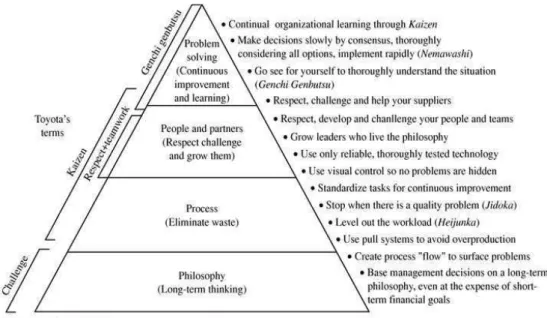
All in all, the entire Toyota way has been evolved around fourteen different principles (Figure
1), which together represent the real secret and the strategic infrastructure of such a lasting success in automotive industry. Those principles, testifying the serious enterprise commitment
to build up a new type of organization based on continuous improvement and efficient problem solving, support the Japanese company through four broad dimensions: Long-Term
Figure 1 - The Toyota 14 Management principles Source: Liker (2004)
2.3 The impact of Lean thinking on manufacturing: The Toyota Production System
On the other hand, the TPS (Toyota Production System), represents the Toyota shop floor approach to manufacturing and can be generally identified as the complementary structure of Toyota way in order to ultimately frame and figure out the company skeleton. In other words, it depicts the most effective and high-performance model of plant that a firm can pursue by strictly following practices and rules underlying the Toyota way. (Liker, 2004). Moreover, applying some or all of the Toyota principles does not necessarily guarantee a company to achieve the satisfactory lean targets it expected, since its most effective of such manufacturing approach definitely depends on several causal drivers, such as firm environment, type of industry, employees’ commitment, etc. (Liker, 2004)
Therefore, the lean mission to waste removal, beyond being included into the company bearing structure (the TPS) shows up its vivid potential by contributing to value creation and improved efficiency within each plant. Those last two goals can be achieved by following the TPS house diagram, legitimately recognized as the frame of reference of Toyota’s perspective (Liker, 2004). The reason for such domestic architecture in representing Toyota’s attitude to manufacturing, has to be found out in one significant interpretation: the strength and stability of the house, as well as the effectiveness of the Toyota way, depend on its foundation and pillars. In these terms, a place of special relevance is assumed by lowest cost, shortest lead time and best quality in product, along with high employees’ morale and satisfactory results in safety (Liker, 2004). Two other fundamental and necessary columns for the overall consistency of Toyota’s mission lie in just-in-time approach to production scheduling as much as the employees’ goal of making the product right the first time, in such a way as to prevent defects go through the production chain. Further elements that definitely enriched the quality of Toyota’s value proposition are then given by tension to standardization (in processes as well as in metrics), long-term philosophy, visual management and leveled production volumes (as a result of scheduling activities).
2.4 Lean Thinking at Toyota: What really makes difference from the other firms
According to McBride (2008), many firms have been largely attempted, over time, to adapt its operational policies to Toyota’s lean practices. In fact, the most common solutions have been regarded the reliance on the assistance and helpful support of an outside source as well as a
In fact, even though a certain company tries to replicate as much as possible the operational patterns developed by Toyota Production System, it still does not grasp the intimate nature of the combinations among its underlying components (Liker, 2004). Hence, lean dimensions are not simply stand-alone entities, but they trigger a satisfactory improvement as a result of their joint interrelation and fusion. In the same way, as loosely happens, the firm only mechanically put in place some of the lean pillars, thus failing to achieve the vivid comprehension of the most powerful principle: the continuous improvement as the driver to sustain lean production philosophy on the long run. (McBride, 2008)
Shifting the attention toward the best lean practitioner, it would be convenient to point out that, at Toyota, regardless the hierarchical level of belonging, every employee is deeply committed to work and learn, by daily figure out practical solutions as much as creative ones. In other words, within the Japanese firm, every person is constantly trained to both adopt a pragmatic perspective toward problems and concurrently lay the foundations for a fruitful creativity on the shop floor (McBride, 2008). Furthermore, in setting up the production chain, Toyota accurately select the most talented and brightest employees, and frequently challenges them to rise up throughout their career paths. In so doing, the entire organizational infrastructure and all functional branches, from human resources to sales, from finance to marketing, are then shaped in such a way as to ensure the faithful adherence to corporate identity and foster significant commitment to improve internal processes and the level of
responsiveness to final customers. For all these reasons, strongly investing in this direction, Toyota definitely proves to be a learning organization, whose cardinal points are represented by teamwork, discipline, high employees’ motivation and tireless tendency to improvement. Indeed, in contrast to firms’ traditional attitude to quickly move across different operational standards, Toyota clearly shows up to be a suitable example of learning company, which does not only carry out a continuous improvement mindset but it is especially focused on sustain it over time, thanks to the involvement and full participation of the whole workforce (McBride, 2008). As a proof of what stated so far, the natural result of a corporate entity which is continuously oriented to encourage and reward innovation and improvement, is actually testified by the fact that 90 percent of the ideas provided and brought by Toyota’s employees are effectively implemented (McBride, 2008).
If applied to manufacturing sector, lean thinking seems to assume the semblance of an innovative spirit striving for applying simple and cost effective solutions to factory shop floor, by observing the entire value stream flow, directly from the final customer perspective (Liker, 2004). In fact, only doing it this way, it would be feasible to both properly distinguish value adding activities from non-value adding ones, and take the correct countermeasures in order to rationalize and efficiently clean the whole enterprise operational process. As a matter of fact, lean thinking came out of the intention to change the route so far used in manufacturing and firmly establish a new way of both looking at the production cycle, so to keep distance from craft and mass production (Liker, 2004).
More specifically, the former approach bases its own functionality on skilled and experienced employees, relying on essential but flexible tools to exactly meet customers´ needs, whereas, according to the latter, big volumes, by far much higher than required, are made by unskilled employees through costly and inflexible means (Liker, 2004). Thus, counteracting and opposing the two positions described above, it would be also interesting to point out how the paradigm of lean was not framed as a well structured and methodical concept since its birth, but it has only undergone the appropriate adjustments and improvements over time, up to assume the most suitable shape to current industrial parameters and production metrics (Liker,
2004).
• Knowing organization, based on the awareness that there is only one optimal way to
succeed in manufacturing and it coincides with lean approach, achievable relying on the introduction of work cells and waste removal from the shop floor
• Understanding organization, mainly characterized by a strong attempt to reinforce
and enhance the culture of the firm, by defining the most relevant corporate values and managerial principles. Anyhow, within such improved organizational infrastructure, lean thinking maintain its role merely on the operational side yet
• Thinking organization, where lean begins to take on a larger surface of usage and application, becoming a crucial tool for making the enterprise rethink valuable and feasible solutions for the effective improvement across the entire production chain.
• Learning organization, that definitely comes out from the combination of the useful
statements underlined so far and finally contributes to shape the daily company improvement according to the appropriate reliance on lean practices in core business areas: in this case, the emphasis will be not only focused on assembly line, but on those fields which reveal to be fundamental for sustaining competitive advantage in the up coming future.
At all times, thanks to the effort towards one piece flow implementation, Toyota has been proven to successfully pass throughout those four steps, consistently incorporate the ideal model of the lean enterprise and root out the totality of waste from its factories’ shop floor (Liker, 2004). Moreover, up to now, a negligible number of firms has attempted to take, with partial and debatable results, such ambitious path which will turn out to be a relevant guideline to achieve a lasting success in a future economic juncture marked by aggressive, fierce and variegated competition, widespread tendency to cost reduction and continuous product innovation. In the following sections, the paper will go through the analysis of the core features which are at the base of lean thinking, by considering it not only as a new attitude toward operations but primarily as a new road map for overall firm improvement. In this way, the one-piece flow dynamics can then leave their exclusivity of use in
Therefore, a so brightening approach as lean thinking entered the industrial environment with some principles that deserved to be correctly and consistently applied on a daily basis so to purify as much as possible the value-added flow from all those activities that slowed down and hindered the transfer of materials from upstream to final customer downstream. As a matter of fact, the described wastes are deeply harmful to firms and need to be radically removed, in order to pursue a better effectiveness and a faster flow of materials within the plant. To do this, it would be important to rely on the concept of one-piece flow, as the revolutionary idea of optimizing all factory productive drivers (from people to machines, from facilities to materials) to the extent of achieving substantial results in terms of remarkable performance, higher product quality, cost reduction and resources saving (Liker, 2004).
For all these reasons, instead of being adopted by a single branch of the tree, it should be appropriate to approach lean thinking as a companywide dimension which could definitely achieve its deep functionality when applied to the whole firm, therefore making all its functional pieces work out and getting a satisfactory outcome in terms of total effectiveness. In other words, lean thinking can turn to strongly embrace all the company fields by shaping innovation and change within the corporate infrastructure, from back office activities to delivery management, from order taking to products development (Liker, 2004).
Moreover, such innovative attitude towards the way of manufacturing proves to underpin
strong cultural transformation inside the firm itself, since it both involves the active role of all elements that make it up and mainly entails a radical change of mindset.
2.6 How to become lean: A five-step process
Making a firm become lean requires a serious commitment to change and a natural abandonment of the previous perspective, represented by the mass production thinking. Then, the adoption of such new path can be better splitted up and developed by following five sequential stages (Lean Enterprise Institute, 2009):
• Assuming the final customer standpoint, while carefully finding out the real value for him and separating it from wasteful elements within the entire production chain.
by the activity of information management, particularly critical to orders collecting and delivery scheduling. Most of the time, the act of properly investigating, alerting to wasteful elements inside the value stream shows up countless weaknesses inside the manufacturing system and therefore underlines worthy chances of improvement.
• After detecting all the aspects that are worthy of being removed, the next step refers to ensure the purified value adding activities to flow. Of course, to achieve those results tends to be a function of a peculiar attention paid to every single detail into the entire production process, so to pursue the expected elimination of some barriers to fluent flow such as downtimes, waiting and some others.
• Moving forward, it would be worth establishing pull-based production systems, aiming to provide customer with desired products only when he places the order. In so doing, further sources of waste, like inventories and obsolete parts among all, can be easily cut out. As a matter of fact, this cleaning initiative definitely enables the firm to free up resources which can be wisely used in a logic of greater efficiency.
• Having achieved such significant gain in efficiency, the firm can then move along the path to quality excellence and perfection, attainable by continuously promoting the zero defects policy, focused on the steady and incremental improvement of each cause of defect.
2.7 From mass production to lean production approach: Reasons for transition and the evolution of lean concept
according to Liker (2004), the expected benefits of such operational framework can be summarized as it follows:
• Great flexibility observed in scheduling activities, in a way that the plant is able to afford
and cope with unpredictable variations in production volumes.
• The chance to gain economies of scale, due to company desire to achieve both maximum
equipment utilization and minimum cost per unit, therefore complying with productivity
optimization policies and best practices definition.
Beyond all the valuable contributions stated so far, one more aspect worthy of being analyzed, refers to the fact that, given a clear separation between areas and departments of the mass production-based factory, concurrently with each cycle time, materials as well as informative resources would be supposed to flow very frequently from one department to another, up to the point of necessarily establish one more field of employees specialized in products handling, material transportation and information transmission.
Nevertheless, according to efficiency metrics, the material transportation mode across department would only correspond to once-a-day single batch, so to cut out the overall cost of material transfer as much as possible (Liker, 2004). Thus, although all apparent benefits obtainable from mass production approach, having a look to such production system through lean eyes suddenly allows highlighting a huge rate of WIP (Work in Progress) inventory, mainly due to overproduction waste and long waiting times for material inside the factory area. All these factors considerably decrease the delivered value to the final customer, prevent the production chain from flowing regularly and conceal some drawbacks into the factory, like big batches, that are positioned in spaces which could have been more efficiently managed otherwise. All in all, as described so far, the high volumes to produce, the low unit cost and the effort to standardize necessarily require a company to rely on a large amount of
space as well as financial resources, low quality products, extreme standardization. All these factors obviously make the company quite inflexible to the variance of demand preferences and almost reluctant to the new (Liker, 2004).
through different departments during the cycle, since this only makes up non-value adding activities and lengthens the lead time of plant processes, above all. As a matter of fact, the natural result of such a disruptive innovation in manufacturing is represented by the creation of work cells, differentiated by product (Liker, 2004). In so doing, the vivid attention of plant managers definitely moves from traditional mass production focus on process to a deep emphasis recognized to the real lever of company results, the product and its value delivered to customers. Thus, cellular manufacturing, as one of the most prominent innovations brought by lean thinking, therefore represents an effective strategy, for a given firm, to firstly get rid of those wasteful operations within the production chain by modifying the plant layout and, secondly, remove all cost items due to the existence of inefficient stock takings (Liker, 2004). As done with mass production features, the same will be done with regard to lean thinking and one piece flow framework, so to briefly show up the most relevant strengths and impressive peculiarities of such waste-free attitude. Therefore, according to Liker (2004), to work in factory by following one-piece flow dimension means:
• Ensure quality production, by constantly monitoring and controlling the entire process, as well as detecting immediately eventual product irregularities and nip root causes in the bud, so to prevent them from occurring again in the future.
• Lay the foundations and support a higher productivity, by looking at a waste-free
operation flow within a single cell and more easily evaluating the correct allocation and utilization of work force, on the basis of an estimated level of production.
• Provide tangible flexibility to the whole system, by producing exactly what the customer asked and better reactively responding to unexpected and potential variations in terms of production mix, as a function of final consumer preferences.
Going in depth of lean dimension, one more distinctive feature within the model is related to takt-time. Such indicator basically sets the most efficient pace of production, obtained by dividing the monthly volume by the time actually worked per month, in such a way as to determining the approximate rhythm at which final customers acquire company products (Liker, 2004).
Thus, according to takt-time, an effective one piece flow based process should be supposed to run at a certain speed in order to comply with the estimated volume pulled by demand, therefore preventing the entire operational chain from the risk of overproduction and bottleneck. In other words, to make a company capable of performing the desired takt-time means to put it in a position to deeply streamline its operational cycle, by purifying it from countless wasteful activities, to discover and quickly fix points of inefficiency, and finally to more easily achieve satisfactory results in terms of cost per unit, lead and delivery time, high quality standards.
As a demonstration of what was said earlier, it is definitely disarming the truth that, only a few decades before the operational revolution brought by lean thinking, almost all of the business processes had only a meaningless and negligible quote of value adding activities (about 5%), whereas the big portion was represented by non-value added ones (about 95%).
(Liker, 2004). The main reason for that refers to the adoption of an awkward production system, better known also as batch-and-queue model in traditional mass production approach.
By applying such operational dynamics, considerable intervals of time, due to materials waiting between different factory departments, turned out to be unnecessarily wasted and the overall outcome can be inexorably summarized by the loss of value, both in terms of time and effort.
2.8 The Lean Way: A crucial driver for lasting success and steadily growing results
continuous improvement in processes and incremental innovation in products, above all. Both goals can be achieved by paying great attention to the following elements: improving processes and activities as much as possible, working for best quality in work environment, seeking for functional and cost effective solutions for technological improvement, sowing a company concept which is daily oriented to learn, and, lastly, banishing any nature of waste, in terms of resources, time and effort (Liker, 2004). As a matter of fact, although most of the companies would instead concentrate their daily emphasis on the highest return on investments and cost reduction on the short run, all those purposes described above are grown by Toyota on a long-term perspective, according to which it is by far more profitable to bring to success a company model, that incessantly strives to actively involve its employees, push them to the maximum result, and create value for all its surrounding stakeholders, from the economy to society, from customers to suppliers (Liker, 2004).
2.9 Waste in management work: How to root it out and create value
In Toyota workplace, waste can assume three different forms (muda, muri and mura) and
attempting to remove all of them is not only a plant´s current priority but also a fundamental duty for a better future improvement in the operational activities of the whole company. In particular, it would be convenient to go in depth of each of these three typologies and explore their most relevant features. Firstly, muda represents the most significant category of waste,
which most negatively impacts lead time, space for inventory, long waiting times and unnecessary movement of material within the plant area.
A further typology is depicted by muri, which regards the effect of maximizing the utilization
rate of both machinery equipment and human resources, by pushing them up to the limit, so to result in unpleasant results in terms of low-quality products and lack of safety. Moreover, the third important source of waste is given by mura, whose peculiarity can be traced to the
that can be functional to effectively meet a peak of maximum demand, so as to be also sufficient in easier circumstances.
Indeed, since the primary focus of Toyota lies in seeking for waste, detecting and banishing it, from the depths of its experience within the factory, the Japanese firm found out and theorized seven main typologies of muda, namely as non-value adding activities, which are listed below:
• Overproduction: it basically means to produce more than what results from customers
orders. It then triggers the creation of storage areas as well as the higher cost of transport of material across inventories and inside the factory
• Waiting: include all those time intervals that are not used for the realization of products,
then delivered to final customers. Such wasteful dimension can be due to a number of potential factors such as machines downtime, bottleneck or overproduction occurrences, and other negative cases like delays in process flow and stock-outs.
• Unnecessary transport: is particularly due to the huge effort made to carry out the entire
production process and, at the same time, move resources (raw materials, semi-finished and finished products) along the chain.
• Over-processing or incorrect processing: it occurs when a set of activities, although clearly wasteful for the purpose of final product, is implemented anyway, or alternatively,
when the process turns to be imperfect and inefficient, owing to poor equipment and tools available in the plant.
• Excess inventory: it arises from a series of criticalities ranging from high transportation
costs and risk of obsolescence to process potential delay, production instability toward demand variations and massive storage of materials.
• Unnecessary movement: regards the execution of useless efforts by employees within the
• Defects, whose creation is reflected on a series of tasks (like rework and replacement)
and their execution involves spending further kinds of effort, so that the firm would succeed in effectively recovering the quality of its products.
According to Liker, it would be worth adding one more type of waste, namely as the unused
employee creativity, which can be framed as a large period of company life, spent without
properly taking into consideration, valorizing and benefiting from both individuals’ creativity and countless chances for learning and profitably improving the enterprise as a whole. Such company’s lack of ability in effectively taking the best out of human potential can then generally lie in various causal factors such as high workforce turnover, clumsy hiring techniques, demotivating work environment, inadequate or inexistent orientation to on-job training, weak workflow.
Moreover, the source of waste that is evaluated as the most critical to root out, is represented
by overproduction, because its occurrence automatically requires the company to take corrective actions and initiatives in terms of new inventories construction and freed up areas provision, inside the factory. Indeed, such induced countermeasure, beyond building up storage buffers between production processes, plays a crucial role in undermining the organizational atmosphere and gives way to a significant reduction in employees´ motivation and commitment to make continuous improvement constantly happen in the operational field. In so doing, people within the firm tend to be content and satisfied with the current situation, good but not optimal at all, rather than rolling up their sleeves and striving to improve the daily life of the factory. All in all, waste removal necessarily represents the starting point to rethink value delivered to final customer, since the highest quality in products flows naturally from a better efficiency in processes and then a successful attempt in the reduction of operational costs.
2.10 Standard is the way: Creating value basing on daily routine management principles
given by the full awareness and belief, on the part of company users, about the usefulness of such standardization practices, which are supposed to be framed as a crucial tool for achieving high efficiency, quality excellence in products, prevention of accidents inside the factory. Thus, being standardized in Toyota seems to assume a different meaning from the common acceptation of a fix set of activities that have to be faithfully followed in a certain order of execution. In fact, according to the Japanese firm, a standardized task is basically made up of three prominent features such as stocked amount of products, defined sequence of processes and takt-time, which was previously described. In addition, a strong relevance tends to be taken by positive externalities and the propulsive thrust exerted by standardization factors towards the company employees, in terms of a more empowering and collaborative workplace rather than a conflicting and degrading corporate environment.
As a matter of fact, a standard in Toyota has not to be merely framed as a vehicle to achieve efficiency through repeatability induced on the shop floor, but, on the contrary, it actually belongs to each of its employees’ daily attitude to work, by taking on the traits of a key lever for achieving a defect-free production, and so in this way, high quality results reflected in the final product. In addition, implementing standardization practices on the shop floor, as well as in factory equipment or product design, shows up its great significance in properly setting down the process flow within all its features and underlying components, so to create a solid
surface of operational structuring and technical expertise that will turn to be valuable in triggering constant improvement and important initiatives for the better state of the whole
firm. In this sense, after having accurately ensured the definition of all the standardized dimensions of reference, there will be the chance to both make interesting upgrades to the organizational architecture and take corrective actions when potential shortcomings or inefficiencies are detected in the system.
company, and on the other hand, position itself in the middle of a continuum between organic and mechanistic organizational identity.
Besides, Toyota appears to be a self-balancing company in the surrounding environment and competitive landscape, since it well succeeds in coping with those two contrasting dimensions in such a way as to foster company improvement and enhance organizational identity, by consistently relying on bureaucratic and standardized metrics as much as more flexible levers for its daily management operations. In fact, being evaluated on two analytical criteria such as nature of bureaucracy inside the social infrastructure and rate of bureaucracy found out on its technical side (Adler, 1999), Toyota Production System can be framed as a “enabling bureaucracy”, since it constantly triggers employees’ empowerment and self-reliance, makes rules work as guidelines rather than imposing barriers and, finally, allows hierarchy to facilitate and promote company orientation to learning. Thus, enabling procedures practically serve to support the daily duties and tasks of each employee, by involving workforce in setting best practices, monitoring and checking their own activities in the enterprise.
Therefore, assumed the existence of such a dual inner identity inside the company, another long-standing and relevant issue, however critically related to company performance in the current scenario as well as in the short-term future, refers to the crucial decision on how to
properly define a favorable compromise between rigid standardized metrics for employees to be followed and bursts of boundless creativity, although always linked to appropriate and
feasible targets of quality and cost. Moreover, with regard to the effectiveness of standardization within company operations, standardized practices should be rather conceived both as useful guidelines for employees and necessarily adjusted according to the typology of process or company department to bring under a single parameter of execution and evaluation. In this sense, a most repetitive or static task would be differently regulated from a more flexible one, since company purposes still remain those designed to achieve overwhelming results, but through a constant adaptation to some peculiarities and distinctions observed within the organizational engine.
effectiveness lies in the firm ability to shape a collaborative work environment, within which employees reciprocally compare their ideas, provide personal insights and suggestions, feel deeply involved in a real change initiative. Farther, since the single employee starts taking an active role into the organizational infrastructure, imposition criteria and top-down decisions tend to fall into disuse, while the possible sources of contrast and friction can be concurrently replaced by a cooperative work environment, where individual motivation encourages fruitful knowledge exchange and sharing of best practices and ideas. All in all, each employee’s empowerment is the very starting point for ensuring the implementation and maintenance over the years of a corporate identity based on continuous improvement, personal growth and innovation (Liker, 2004).
2.11 Visual Management, Control and Discipline on the shop floor
Moving forward, another feature to be underlined in Toyota operational model is given by the development of a visual control approach, as a way to regularly keep under control all company features as much as performance indicators, educate employees at best practices and easily detect problems and irregularities on the shop floor as well as anywhere else throughout the firm. In other words, visual management devices deeply contribute to value creation by figuring out a comprehensive company road map, through which each employee can seek and obtain accurate information on how activities and operations have to be properly executed (Liker, 2004).
Besides, an higher clarity of the displayed information may thus allow not only to monitor over time the state of operations, equipment utilization rates and trend of factory indicators, but especially to find out possible performance gaps very quickly and take timely countermeasures to prevent future misalignments and deviations from the set standard.
Such Japanese attitude to the effective and detailed monitoring of business activities has its roots in 5S, which consist of a set of initiatives aiming at achieving quality excellence and
• Sort: consists of making an ordered list of everything available, then select only what
is really needed and throw out the rest. There is a bunch of things that only take up space that could be better managed otherwise.
• Straighten: achieving order in the organizational infrastructure, by properly
repositioning value-adding activities and cutting out the wasteful one.
• Shine: while cleaning and tuning the available space, it would be possible to detect and
underline possible defect and irregularities inside the plant. The latter represent serious sources of equipment failure and quality loss.
• Standardize: Set up systems that would be geared to examining and checking
company processes, by establishing uniformed best practices and, in doing so, outlining potential distortions and improvement solutions
• Sustain: Foster the maintenance of such procedures, strengthen their understanding by
employees and never stop triggering continuous improvement and growth. In such a way, it is possible to build up a workplace tailored to the defined standards. At this stage, it is necessary to make sure that every single procedure is so automatic as to seem completely natural in its occurrence
All in all, 5S program attempts to lay fruitful roots for incessant company advancement and represent a critical tool for making such enhanced orderliness a source of competitive and operational sustained advantage. Besides, the direct benefits deriving from 5S implementation are listed as follows:
• Make mistaken behaviors visible and clearly identifiable by any employee throughout the factory
• Reduce, as much as possible, unnecessary losses of time and use the space optimally
• Radically cut out equipment downtime and breakdowns
• Keep the workplace more orderly means therefore to increase its own safety
Doubtless, the way in which to ensure the achievement of this challenging goal lies in building up a cooperative environment, that should be mainly focused on both employees teamwork and frequent auditing inspections led by managers either on a regular basis or
randomly. Of course, it should be noted that 5S, visual control principles and any other communication tools used within the factory do not embody, on their own, the full essence and the unique key-factor for the outstanding success of lean thinking, but definitely need to be integrated with all the other tools, so to make production flow smoother and the Toyota way a truly reliable attitude to manufacturing.
2.12 The diffusion of lean practices as a knowledge transfer process
Beyond the implementation of lean manufacturing system, whose underlying and prominent features have been described so far, a further point of fundamental interest is represented by the activities put up by the firm, multinationals above all, for rolling-out the lean approach in various plants of their industrial complex (Camuffo, Paolino, Secchi, 2012). In fact, lean thinking has recently begun to entering the factories of an increasing number of players in manufacturing sector and such tendency was strongly intensified by modern competitive dynamics, mainly dictated and driven by global economic downturn, widespread boost to
Besides, as stated above, the ultimate and significant success in the implementation of a lean production system is not due to the careful and strict application of its underlying devices and tools, but especially to the vivid and deep adoption of a massive breakthrough in the way of conceiving manufacturing, growing work environment and leadership, strengthening employees’ morale and engagement, facilitating a long term strategy and, lastly, keeping alive a strong inclination to continuous improvement.(Womack and Jones, 1996; Meier and Liker, 2007; De Menezes, 2010; Fine, 2008). Therefore, as mentioned, there is a plenty of factors, in such a complex environment, which contribute somehow to the implementation of lean thinking in one company plant as much as into the other factories belonging to company’s industrial complex. As a matter of fact, relevant operational phases as the initial introduction of the lean way in one company’s plant, its effective implementation and functioning, and its subsequent attempt to establish it within its complex, can be all framed as the sequential stages of a knowledge management process, where the crucial trajectory of interest is given by the connecting bridge between the MNC and its industrial subsidiaries. Thus, the stability of such bond ends up to depend on the accurate management of this procedure between the two reference parties and determines most of the success of the entire lean implantation project. Farther, considering such procedure as a wide network of knowledge streams, mutually interchanged between firm’s headquarter and its controlled branches, definitely entails a deeper reflection on two core performance indicators, such as process efficiency and
effectiveness (Argote and Ingram, 2000; Szulanski, 1996; Minbaeva, 2003; Perez-Nordtvedt, 2008; Ciabuschi, 2011).
The former are set at headquarter level in agreement with the outlines of a particular expertise to expand, whereas the latter ensue from daily work experience and up to the point to represent a sort of company routines. In fact, by triggering knowledge development, the replication of templates builds up a set of optimal behaviors and practices that, mainly because of their nature of ideal patterns, can then be more easily transferred and applied into firm’s subsidiaries. Yet, most of the recent literature in this field disagree with the idea of relying on template in rolling-out lean production approach in multinational firms, since using such best routine practices do not effectively contribute to achieve a satisfactory result in knowledge transfer but, on the contrary, it does not only act as a significant barrier to local adaptation but also hinders actual assimilation and full understanding by each local branch (Zaheer and Kostova, 1999; Ghoshal and Bartlett, 1989; Doz and Prahalad, 1987). Furthermore, another enabler factor, raised by Levinthal and Cohen, relates to the necessary existence of knowledge background or notable absorptive capacity within the hosting subsidiary, as underlying condition to better facilitate proper follow-up and ultimate realization of the whole implantation process.
Besides, it would be convenient to assess a further dimension that is certainly worthy of attention: the degree of autonomy held by the subsidiary and its impact on the level of roll-out procedure effectiveness. As many researchers claimed, a higher level of autonomy, therefore
corresponding to a decentralized decision-making, positively impacts on the wealth of knowledge, knowhow and expertise that can be developed inside each of company´s
controlled branch (Van Wijk, 2008; Gupta and Govindarajan, 2000). In other words, shifting the ownership of authority from MNC center to the suburbs enables subsidiaries to take its own autonomous steps on the path of growth and, especially, feel much more engaged within a company-wide plan of knowledge generation and expansion. In addition, a further influential variable in determining the overall outcome of knowledge transfer process is represented by Headquarter discretionary decision on the amount of resources to provide, so to accomplish the whole set of described proceedings. Of course, the higher the quantity and conformity of resources made available at HQ level, the more likely the subsidiary’s absorptive capacity will be improved and supported by enhanced commitment and deeper effort of the involved parties.
involvement, whose critical role consists of frequently monitoring the whole process trend and fostering subsidiaries’ efforts by providing crucial contributions through its proficiency and prowess. Thus, sharing useful recommendations and practical tips for the better conduct of the various steps, head quarter’s intervention proves to be particularly critical in the overall transfer process satisfaction, since its balanced presence on stage aggregates value to company daily operations and generates positive externalities for the entire business environment.
2.13 Organizational ambidexterity: The importance of adapt to change and align capabilities
In the current economic landscape, it is undoubtedly critical, for any business entity in the market battlefield, grow an actual sense of adaptability to the fast and unpredictable changing of surrounding context. Hence, quickly taking appropriate and responsive countermeasures to competitors’ moves, investing in new disrupting opportunities and continuously striving for a
better result or a more challenging goal, are the three main abilities, which a company can not do without in order to maintain long-lasting results and remarkable performances in its business industry. Indeed, this priority need of reactivity to market fluctuations must be also associated to an equally significant level of alignment shown by the company. (Gibson and Birkinshaw, 2004). Put differently, the latter stands for the firm´s capacity to clearly grasp the sources of created value, in terms of the internal configuration of activities to be built up carefully, in such a way as to both effectively deliver lasting value to customers and entail commendable results in the inner integration of company engine.
Therefore, to shape the company according to an ambidextrous identity, basically means to narrowly balance those two described dimensions: in other words, it entails company orientation to concurrently implement present strategy and take into account possible future improvements and long-term projections, resulting from the constructive observation of the highly dynamic context.
Going further to analyze the underlying determinants and devices that enable the firm to be ambidextrous, structural and contextual are the two peculiar typologies of firm ambidexterity:
• Structural ambidexterity, according to which those business units intended for
exploitation are distinguished from the ones, instead, geared to exploration, in such a way as to separately allow the accomplishment of both goals of knowledge generation and development. Hence, in this case, much exploration as exploitation are kept apart and do not require individual´s discretionary decision on how to engage and deploy resources on the two fronts.
• Contextual ambidexterity, however, stems from a fully integrated process design, within which activities are connected and interrelated to such an extent as to enable each individual to take its own decisional path, in terms of time and effort to be allocated at each performed procedure. Indeed, such attitude naturally leads to a tough trade-off between the need of meeting market preferences and, on the other hand, the difficulty of acting in an unstable and constantly changing environment.
More in deep, the former, largely considered as the standard type, consists of creating distinct structures for the different activities to be undertaken during the company’s daily life: for example, the department devoted to research and market development would be kept separate from core functional branches, which are, instead, more directly connected to product cycle and its inner value proposition. However, an element of risk is represented by the fact that such serious attitude to disjunction among company’s components may inevitably lead to their extreme internal isolation, so as to impede and hinder the acceptance of decisions that should be fully supported and shared by the organization as a whole.
On the contrary, contextual ambidexterity calls for workers to deploy their efforts between
What stated so far has to be then enriched and complemented by March’s inferred considerations on the notions of exploration and exploitation, whose mutual balance, inside the firm, showed to be essential in acquiring the ambidextrous traits (O´Reilly and Tushman, 1996; Gibson and Birkinshaw, 2004). In fact, in 1991, March claims the critical and endless trade-off, existing within the organizational learning process, between the exploration of new horizons and future possibilities, and the exploitation of current tools and certainties. Farther, the former, mainly characterized by a risk-taking attitude, flexibility and experimentation, drives to long-term but uncertain results, while the latter, embodying higher propensity to efficiency and cost-efficiency, is more likely to lead to sub-optimal solutions, certain benefits and marked inability to adapt to a rapidly changing context.
March also emphasizes that, in competing for market leadership and lasting competitive advantage, a discrete number of companies opt for adaptive procedures that, departing from an exploitation based approach, tend to end up being fruitful in the short-term but hostile and counterproductive in the long run.
2.14 People: The driver to continuous improvement and long-term success
Indeed, the secret for this goal achievement lies in company’s ability to make its people follow a renewed manufacturing philosophy: anyhow, the thus described workforce, necessarily suited to the new firm’s identity, would require considerable effort and time to be properly planted and then developed. In effect, relying on valuable, motivated and effective human resources is not even remotely comparable to investments in production, logistics or marketing, while it is anything but a ready-made issue, mainly because the tricky aspect lies in acting on the columns that support the whole firm architecture both now and in the upcoming future. Furthermore, the new company’s attitude ends up assuming a twofold significance: on one hand, the underlying managerial modus has to be based on education, training and group work, whereas, on the other hand, such system has to necessarily integrate the social sphere with the technical one. Only in this way, concrete advantages and tangible benefits drawing from lean manufacturing, may ultimately reach a size of full objectivity, consistency and feasibility, by logically and sequentially relating the implementation of new practices, the development of standard behaviors and, finally, the establishment of a motivation-oriented conduct by employees.
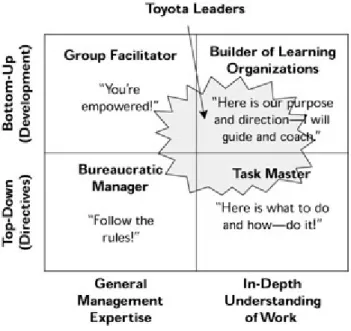
According to Toyota’s perspective, people definitely symbolize the most strategic weapon for company’s daily operation as well as incremental improvement, and therefore all programs and practices devoted to manage them need to be well structured and assessed both at head
quarter level and on the shop floor. Besides, a further demonstration of such an accurate and forward-looking attitude to people management, is depicted by firm’s orientation to breeding
in-house leaders rather than recruiting them from outside. Thus, trying to detect and remove the nature of waste causing unevenness (namely as muri), the Japanese firm relies on a policy which is mainly geared to always replace vacant managerial positions with suitable profiles internally found out. In this sense, the recipients of these high responsibility tasks are necessarily people who have been familiar over time with company’s daily routine and core dynamics underlying its overwhelming culture.