Approximate
analytic expression for
the
eigenenergies
of
the
anharmonic
oscillator
V(~)
=
A.~'+
H~'
A.de Souza Dutra* and A.
S.
de CastrotDepartmento de Eisica e quimica, Uniuersidade Estadual Paulista, Campus de Guaratingueta, Caiza Postal 205, 12500-000 Guaratingueta, Sao Paulo, Brazil
H. Boschi-Filho~
Instituto de Fxsica, Universidade Federal doRio de Janeiro, Cidade Universitaria, Ilha do Fundao,
|
aiba Postal 68588,219/5 970-Rio de Janeiro, Rio de Janeiro, Brazil (Received 1July 1994)
An approximate analytic expression for the eigenenergies of the anharmonic oscillator V(x)
=
Ax
+
Bx
is introduced, starting from particular analytic solutions which are valid when certainrelations between the parameters A.and
B
are held.PACS number(s): 03.65.Ge, 02.60.
—
x, 02.70.—
cI.
INTRODUCTION
A problem that has been challenging physicists and mathematicians for years is the search for analytic so-lutions for anharmonic oscillators. As
it
is well known,the general solution for this problem has not yet been found; however, particular analytic solutions have been
discovered when the potential parameters obey certain relations.
It
is importantto
notethat
these particular analytic solutions donot cover the entire spectrumof
theproblem even in the case
of
simpler examples. Potentialswith these characteristics are then called partially alge-brized or quasi-exactly-solvable [1—
21].
Since the complete spectra of anharmonic oscillators
are not analytically known it is usual
to
implementnu-merical methods
to
find the energy eigenvalues. This isquite satisfactory for
a
particular potential with all its parameters 6xedto
certain numerical values. The price paid in this approach isthat
one cannot in general writea
closed expression for the relevant functions relatedto
the solutions
of
the problem as the eigenenergies or wavefunctions even for
a
more restricted classof
potentials.Clearly there is
a
gap between these two approaches and in this paper we wantto
make some eKort in thedi-rection
of
connecting them. Todo this we will start withthe partial analytic solutions known for the double-well
potential
V(x)
=
Axe+
Hx~ (A & O,R
(
0) includingtheir energy spectrum but only in a recurrence relation
form and then obtain its numerical counterpart. From
these numerical data we establish relations between the
energy
E
and the parameters A andB.
Apart &om itsintrinsic interest, the double-well poten-tial also plays an important role inthe quantum study
of
the tunneling time problem [22],in spectra
of
molecules such as ammonia and hydrogen-bonded solids [23],and in field theory [24]. In fact, the double-well potential that will be focused on in this work might be used asa
potential model for quark con6nement in quantum chro-modynamics [25]. On the other hand, by performing suitable point-canonical transformations,
it
is possibleto
show that there isa
mapping from the potentialof
Rydberg atoms in uniform magnetic 6elds into that of
some double-well potentials [26].
Both
these problemsare generally studied in terms
of
standard perturbative approaches.It
should be very pro6tableto
obtain some analytical information, even though approximately, likethat
proposed here.This paper is organized as follows. In
Sec.
II
were-view the algebraic approach for the potential
V(x)
Ax
+
Bx
and determine the energy relations for the6rst
analytic eigenfunctions. InSec.
III
we take these energy relations, which are valid when A andB
satisfya
constraint relation, and interpolate them numerically.Then we obtain an expression for the energy as
a
functionof
A,B
and n, the principal quantum number, forn &3.
In
Sec. IV
we show that these results can be extendedto
higher excited states and in
Sec.
V we present our 6nal considerations.II.
ALGEBRAIC APPROACH
In this section we review the analytic properties
of
theSchrodinger equation
—
—0"
+
VO'=
E4'
2
for the sextic anharmonic potential [7,21]
V(z)
=
Axs+
Rx',
A &0,
(2)*Electronic address: dutragrtggg
.
uesp.ansp. brtElectronic address: castrogrtQQQ
.
uesp.ansp. br~Electronic address: boschiOufrj. bitnet
obtaining explicitly the expressions for the energy
corre-sponding
to
the ground and lowest excitedstates.
As iswell known, the Schrodinger equation for this potential can be solved by writting the wave function as
@(x)
@(x)
—42A e /4Ã
@even(x)
—
)
ajx
Oy2i~ ~~
(4)
or
N
4' gg(x)
=
)
a,
.x'.
1y3i~ ~ ~The exact solutions are only possible when certain
rela-tions among the coeffients a~'s are satis6ed, which can be written as recurrence relations
where the remaining function
4'(x)
must bea
polynomialof
definite parity:N=3,
N=4,
N=5,
N=6,
N=7,
N=8,
N=9,
N=11,
0
= E
—
6m2A,0
= E
E2
—
16
2A0=E
E
—
32 2AO
=
E'
—
6OE'v'2A+
36OA,0
= E
—
100E v'2A+
1512A,0
=
E
~E
—
180E
V2A+
58882),
0
= E E
—
240E
2A+
16128A0
= E
—
350E
v 2A+
41432E
A—
162000 ~2As1~,0
= E
—
490E
v 2A+
91160
E
A—
831600
&2A ~.
(11)
(12)
(13)
(i4)
(i5)
(16)
(17)
(18)
(19)
E
a~+
(N
+
2—
j
)+2A
a~(j
+
2)(j
+
1)
(6)
where
E
is the energy eigenvalue. Notethat
forj'
)
N
all a~1
=
0.
This equation can be usedto
obtain theenergy equation
aiv
E
—
2v'2A aN g—
—
0.
(7)These restrictions imply
that
the potential parameters A andB
must be related byB =
—
u'2A(N
+
~~),in order
to
ensureexact
solvability. One should observethat
the parameterB
is always negative. Therefore, wewould not expect any kind
of
harmonic oscillator limit, inthe case
of
arbitrary parameters, when A goesto
zero. In orderto
take into account the casewhereB
is positive, wesuppose that some sort
of
analytical continuation shouldbe done. Indeed,
a
particular case of the above mentionedpotential has been studied, regarding problems related
to
analytical continuations
of
their parameters by Benderand Turbirner [27].Moreover some discontinuities in the
eigenenergy spectra
of
some polynomial potentials havebeen reported by Panday and Varma [28]. Thus
it
is quite clearthat
any limit and extrapolations should bedone very carefully. In fact, the potential
V(x)
=
Axe+
Bx
belongsto
a
general familyof
quasi-exactly-solvablepotentials [7,21] for which partial analytic solutions are known when its parameters satisfy constraint conditions.
Choosing
a
certain value forN,
we fix also the numberof
exact levels
that
can be found in this approach: 1+
N/2levels when
N
is even and(1+
N)/2
levels whenN
isQdd.
The expressions for the energy eigenvalues for the first values
of N,
correspondingto
the potential(2),
may beexpressed as
III.
ANALYTIC-NUMERICAL
APPROACH
In order
to
6nd an analytic expression which gives ap-proximate values for the eigenenergies for arbitrary pa-rameters [not only for those satisfying(8)]
we usea
nu-merical methodof
adjustment and interpolation startingwith the analytical eigenenergies for parameters which satisfy
(8).
These two variables are then fitted througha
polynomialof
arbitrary degree which best fit resultedin one
of
third degree:E =
a+bB+eB
+dB
Noting that the coefficients
a,
b, c, and d must depend on the parameter A and the principal quantum numbern, we write
E
=a
(A)+b
(A)B+c„(A) B +d
(A.)B
.
(20) The next step isto
find out these dependences explic-itly. The best fit in this case is obtained by single power functions for each coefficient which reada„(A)
=
c5.„A
2b„(A)
=
P„A
(21)
(22)
c„(A)
=
p„A
(23)
This method may be applied for an arbitrary
N,
but inpractice this is difficult
to
handle. In this analysis, we6rst
confine ourselvesto
N
&11
with the advantageof
6nding algebraic equations for
E
which can be reducedto
the third power (for the energy squared) sothat
their exact roots may be easily obtained. Finally, we obtain the complete dependenceof
E
on the parameters A,B,
and
n.
InSec. IV
we extend this discussionto
N
=
20and
30,
when only numerical solutions are possible.N
=Oor1,
N=2,
0
=E,
0
= E
—
2V'2A,(9)
t'~
)'
+b„
A)
(25) The behavior
of
the coefficientsn, P,
p, and b against nresults in the polynomials
E„=
A ~n„+P„
A
(
A)
Keeping
Eqs.
(20) and(21)
—(24) in mind, it is possibleto state
that the energy can be written as a functionof
parameters A and
B
and the quantum nuxnbern:
The best fitting for these points leads
to
the equation—
0.
482986+
7.44313
x
10 2n—
3.
91992 x
10 n+
1.
30664x
10 n.
(3
Analogously, for
N
=
30 we find(/2A
=
10is)
a
polynomial equationof
eigth power for the energy squared, which leadsto
the eigenvalues also shown inTable
II.
These data leadto
the equationa
=
0.
2310
+
2.
995n—
1.
466n+
0.
4490n (26)E„~~2~
io,
e ——
—
8.
95776x
10P„=
(—
1.224+ 9.
067n—
4.919n
+
0.
9516n )x
10(27)
+
9.
16173 x
10 n—
3.
18989x 10
n+
7.
08864x 10
n.
(32)=
(—
11.
00—
3.
057n+ 9.
876n—
2.
562n )x 10
b„=
(—
1.
778—
1.
953n+
4.
176n—
1.
073n )x 10
(28) TABLE
I.
Comparison between the exact and
approx-imate results for the eigenenergies with A
=
1.
Theprecision of the approximate solutions is measured by
b
—
=
(@exact @ppraox)/@exact ~(29)
These results were obtained for range
of
values0.
01
& A &100
and—
12.
5 & &+—
&—
1.
5 (and 0 &N
&11).
The expression (25)isinexcellent agreement with the en-ergy levels obtained analytically for
n
&3.
In these cases the error was always less than1%,
except forn=
2,which presentsa
maximum discrepancythat
isstill smaller than4%.
This can be seen &om the TableI,
where we showthe energy eigenvalues, exact and approximate, for the case A
=
1.
-2.1213 -4.9497
-7.7782
-10.
6066-13.
4350-16.
2635@exact
0.0000
-1.
6818-4.7568
-8.
9651-14.0098
-19.
7569@approx
0.0037
-1.
6722-4.7557
-8.9482
-14.0272
-19.
75165.
7x
10-2.
3x
10-1.9x
101.
2x 10 2.6x
10IV.
EXTENSION TO
HIGHER
EXCITED
STATES
So far we have only considered the energy for the
ground state and the first three excited
states.
This wasso because we have chosen the order
N of
the polyno-mials (4) and (5)to
be no higher thanll.
In that case, the solutions for the energy equation were obtained ex-actly. With that choice we have varied the parametersA and
B
through large ranges. Asa
matterof
fact, thechoice
N
=
11
leadsto
six exact levels, but as we take the safe limitof
four valuesof
the eigenenergiesto
bein-terpolated, we have found the expression (24) for n &3
only.
In order
to
study the behaviorof
higher excited statesweincrease
N
for specific valuesof
the parameters AandH, satisfying relation
(8).
ChoosingN
=
20 and applyingEq. (6)
iteratively, similarlyto
what has been done forEqs.
(10)
—(19),
we find that the energy-squared levels y=
E2
obeys the equation (for/2A
=
10
)~g
(y
—
0.
44y+
0.
605299y—
2.99171 x
10 y+4.
58305x
10 y—
1.
25083x
10 ~)=
0,
(30)
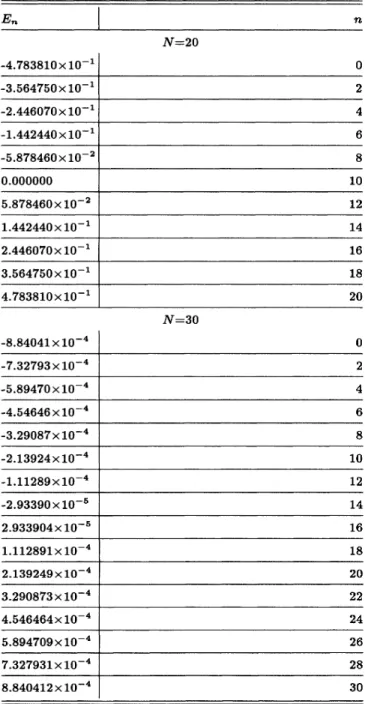
which leads
to
the energy eigenvalues shown in TableII,
with the corresponding principal quantum numbern.
-3.
5355-6.3640
-9.
1924-12.
0208-14.
8492-17.
6777-4.9497
-7.7782
-10.
6066-13.
4350-16.
2635-6.3640
-9.
1924-12.0208
-14.8492
-17.
67770.0000
-2.9130 -6.7272
-11.
3917-16.
8011-22.8680
1.
68180.0000
-2.1164 -5.4771
-9.
93452.9130
0.0000
-3.
4134-7.5588
-12.4725
-0.0016
-2.9076
-6.7324
-11.
3914-16.
7985 -22.86901.
66820.0548
-2.1984
-5.4223
-9.
94822.9101 0.0111
-3.
4302-7.5477
-12.4754
-1.8x
108.2x 10
-3.0x
10-1.
5x
105.
0x
10-8.
1x
103.9x
10 ~-1.0x
101.
4x
10-9.8x
104.
9x
10-1.5x
10Note
that Eqs. (31)
and (32)have the same form asEq.
(25),
since allof
these expressions are given by polynomi-alsof
third degree inn.
One should also note that theseequations have
a
scaling symmetry, sinceif
we choose, for example,/2A
=
1,
we find that the energy eigenvaluesof
TableII
are only shifted by the factors 10 and 10for
N
=
20 and30,
respectively. This scaling symmetry isa
consequenceof
the factthat
the energy eigenvaluesare proportional
to
A~~4, as could be observed. inEqs.
(10)
—(19)
or (25) as well. This exact dependence wasalso observed by Bender and Turbirner [27] by applying
a
variational method. Notethat
the reBectionsymme-try between the negative and positive energy
eigenval-TABLE
II.
Eigenenergies for N=
20and N=
30.¹ 20
ues appearing in Table
II
are due in partto
the method employed here and alsoto
the quasiexact symmetryof
potential
(2).
Analyzing the behavior
of
the higher excited states dis-cussed above forN
=
20 and30,
we expectthat
their properties will also be accompanied by situations witharbitrary
N.
In practice, however, asN
increases, thepower
of
the polynomial equation &om which we find theenergy eigenvalues also increases, leading
to
technical dif-ficulties incalculating itsroots.
In fact, the levels are notequally spaced and as the number
of
roots increases, onecan find
that
these differences may beof
many ordersof
magnitude, for whicha
numerical approach requires rapidly increasing precision.It
is importantto
remark that the behaviorof
E,
as always beinga
polynomialof
third degree in n, , appearsto
bea
kindof "exact
be-havior" in the case studied, becauseit
persists when thenumber
of
analytically obtained excited states increases.V.
CONCLUSIONS
-4.783810x10
-3.
564750x10-2.446070x10
-1.
442440x10-5.878460x10
0.000000
5.878460x10
1.
442440x10 2.446070x10³.
564750x104.783810x 10
-8.84041x10
-7.32793x10
-5.89470x 10 -4.54646x10 4
-3.
29087x10-2.13924x10
-1.
11289x10
4-2.93390x10
2.933904x10
1.
112891x102.139249x10
3.
290873x 10 4.546464x105.894709x10 4
7.327931x10
8.
840412x1010
14
18
20
10
12
14 16 18
24
28
30
Some final considerations are now in order.
First,
weobserve
that
the above developed method, apart &omtheobvious advantage
of
producing an approximate energyspectrum forarbitrary values (restricted
to a
given regionof
validity)of
the potentials parameters, permitsat
leastin principle an approximate analytical expression also for the wave function. This can be achieved by truncating the series appearing inthe wave function, defined through
the expressions (2)—
(4),
in a term such that(a
3)
Ev'2A
2)
)
(33)
ACKNOWLEDGMENTS
The authors acknowledge CNPq for partial financial
support and
FAPESP
(Contract No.93
j1476-3)
forcom-putational facilities.
where
R(x)
roundsx to
the nearest integer. In the casewhere the parameters A and
B
are suchthat
j
=
N,
weget the exact solutions. In the remaining cases we have
an approximation for the wave function, which in turn
permits us
to
have some information about theprobabil-ities
of a
given process, not only about its eigenenergies.There is another approach
that
gives an analytical ap-proximation for the wave function introduced byChha-jlany and Malnev [18]and improved by Fernandez. [29]
It
isbased on an approach whereexact
solutionsof
a
po-tentialof a
higher order are obtained and then, takingconvenient limits, one can restrict the power
of
this po-tentialto
the desired oneof
interest, for which noexact
solution could be found.
It
would be very interestingto
compare these two approaches.We intend
to
extend the approach developed here in or-derto
include other polynomial potentials. Furthermore,we are also improving the statistics with more points, for obtaining the full analytical energy expression for greater
values
of
the principal quantum numbern.
These andother questions are under study and we expect
to
report[2]
[41
[6] [7]
[8] [9]
[10]
[11
[12 [13]
[14]
[15 [16 [17]
G. P. Flessas, Phys. Lett. 72A, 289 (1979);
T8A.
19(1980);
81A,
17(1981);
J.
Phys. A14,
L209(1981).
E.
Magyari, Phys. Lett.81A,
116 (1981); G. P.Flessas,R. R.
Withehead, and A. Rigas,J.
Phys. A16,
85(1983).
P. G.L.Leach,
J.
Math. Phys. 25, 974 (1984);PhysicaD 1T,331(1985).
A. V.Turbiner, Commun. Math. Phys.
118,
467 (1988)A. de Souza Dutra, Phys. Lett. A
131,
319(1988).
R.
K.
Roychoudhury andY.
P.Varshni,J.
Phys. A21,
13025 (1988).
M. A. Shiffman, Int.
J.
Mod. Phys. A 4,2897(1989).
M. A. Shiffman, Int.
J.
Mod. Phys. A 4,3305(1989).
P.G.L.Leach,
J.
Math. Phys.30,
1525(1989).
P.Roy,
B.
Roy, andR.
Roychoudhury, Phys. Lett. A139,
1427
(1989).
R.
S.Kaushal, Phys. Lett. A142,
57(1989).
D. P.Jatkar, C.Naragaja, and A. Khare, Phys. Lett. A
142
200(1989).
R.
Adhikari,R.
Dutt, andY.
P.Varshni, Phys. Lett. A141
1(1989).R.
Roychoudhury,Y.
P.Varshni, and M.Sengupta, Phys.Rev. A 42, 184
(1990).
S.
K.
Bose and N.Varina, Phys. Lett. A 14T,85(1990).
H. H. Aly and A. O. Barut, Phys. Lett. A
145,
299(1990).
T. I.
Maglaperidze and A. G. Ushveridze, Mod. Phys.Lett. A
5,
1883 (1990);A. G. Ushveridze, Mod. Phys.Lett. A 5, 1891 (1990).
[18]
S.
C. Chhajlany and V. N. Malnev, Phys. Rev. A 42,3111
(1990).
[19]
S.
Ozgelik and M.Simsek, Phys. Lett. A152,
145(1991).
[20] L.D.Salem and
R.
Montemayor, Phys. Rev. A43,
1169(1991).
[21]A. de Souza Dutra and H. Boschi Filho, Phys. Rev. A
44, 4721
(1991).
[22] D.K.Roy, Quantum Mechanical Tunnelling and its Ap-plications (World Scientific, Singapore, 1986); L.A.
Mac-Coll, Phys. Rev. 40, 261(1932).
[23] D.M.Dennison and G.
E.
Uhlebeck, Phys. Rev.41,
261(1932);
F. T.
Wall and G. Glockler,J.
Chem. Phys. 5,314(1937);
R.
L.Somorjai and D.F.
Hornig, ibid.36,
1980(1962).
24] H. Thomas (unpublished).
25] C.Quigg and
J.
L.Rosner, Phys. Rep.56,
167(1979).
26] G. Wunner, U. Woelk,
I.
Zelch, G. Zeller,T.
Ertl,F.
Geyer, W. Schweitzer, and H. Ruder, Phys. Rev. Lett.57,
3161 (1986).[27]
C.
M. Bender and A. Turbirner, Phys. Lett. A173,
442(1993).
[28]