* Universidade Alcala de Henares, Madrid, Espanha. <[email protected]>.
PROMOVENDO A INTERAÇÃO FACE A FACE ATRAVÉS DE WEBQUESTS: UM ESTUDO DE CASO SOBRE INGLÊS COM PROPÓSITOS ESPECIFICOS PARA
TURISMO
FOSTERING FACE TO FACE ORAL INTERACTION THROUGH WEBQUESTS: A CASE STUDY IN ESP FOR TOURISM
JESUS GARCIA LABORDA*
ABSTRACT: Webquests have been used for some time to research a variety of topics. According to Lacina (2007), a webquest is an inquiry-based technology activity designed by Bernie Dodge and Tom March in which information is usually drawn from the Internet, and is a powerful instructional exercise both for teachers and students.Webquests enhance personal and experiential learning (WOODS et al.,
2004). This case study intends to illustrate the process and benefits of using webquests as a way to promote professional oral communication in training contexts. This paper reports on a study done at the Polytechnic University of Valencia during the 2006-2007 academic year of the use of webquests with sophomore students of Travel and Tourism. Three observations were carried out during November, February and May. The findings suggest the benefits of using webquests in the classroom for professional development and language achievement.
Keywords: webquest; motivation; tourism; social construtivism.
RESUMO: Os webquests têm sido utilizados para pesquisar uma variedade de temas. De acordo com Lacina (2007), um webquest é um tipo de atividade de pesquisa baseada no uso da tecnologia. Desenvolvida por Bernie Dodge e Tom March, extrai informação de Internet e é um exercício institucional poderoso tanto para os professores quanto para os estudantes. Webquests também contribuem para a aprendizagem e experiência pessoal (MADEIRAS et al., 2004). Este estudo pretende ilustrar o processo e os benefícios da utilização de webquests em contextos de formação para promover a comunicação oral em âmbitos profissionais. Os resultados foram obtidos em um experimento desenvolvido na Universidad Politécnica de Valencia durante o curso acadêmico de 2006-2007 com os estudantes do curso de Turismo. Durante o experimento, os resultados foram analisados a cada três meses (novembro, fevereiro e maio). As conclusões deste estudo sugerem diversos benefícios da utilização de webquests em classe para o desenvolvimento profissional e aprendizagem da língua.
Palavras-chave: webquest; motivação; turismo; construtivismo social.
INTRODUCTION
bookings, transport, destinations and so on. First and foreign language communication in this field is especially important to cope with the international customers’ needs (LESLIE, RUSSELL & GOVAN, 2004; LESLIE, RUSSELL & FORBES, 2002; SEONG, 2001; PETZOLD & BERNS, 2000). Professional communication can be done by letters, memos and e-mails and telephoning but face to face communication is still very highly regarded when instant negotiations or information is required. Of course, very often oral information must be supported by the latest information accessed on the Internet. Therefore, students should be able to connect the use of Internet and their own speech. Typically, oral interactions in travel and tourism are found in professional meetings, negotiations, presentations, information exchange and face to face bookings with customers.
This paper intends to show the efficacy and use of webquests in tourism studies to develop oral face to face communication and professional information search skills. Webquests are task-based research activities whose main purpose is to solve a problem by using the internet to obtain information. The typical webquest (as presented in the final appendix) is based on moving from one task to the following based on the information that is found on the net. For instance, when a student obtains some information, this information becomes the basis to continue the research. Further, this paper observed the types of in-class oral interactions between trainee students, their relation with the teacher, the problems and procedures in browsing and using the Internet. In-class interaction is done at three levels: Student to teacher, student to group (the class) and student to student.
When implementing webquests in the classroom, it is necessary to pay special attention to a number of key issues: (a) students should be able to improve both their written and oral skills, (b) reading input is fundamental in building new knowledge, (c) browsing the Internet is necessary for the travel business today, and (d) oral communication may prevail over written communication under certain conditions. Webquests can be very realistic but require cooperation among students and the teacher.
1. RELATING WEBQUESTS AND THE TOURISM CLASSROOM PRACTICES
Webquests have been used in Business English for some time. However, it is necessary to support their use to promote oral communication and development in educational contexts such as English for Tourism. Two main aspects support the use of webquests: being a professional development activity and being a constructivist language learning approach.
1.1 Constructivist language learning and webquests
Constructivist approaches to language learning consider that when students receive input, processes of accommodation and assimilation lead to construction of new knowledge. Webquests accommodate the features of a constructivist language learning approach in the following sense:
and expressions either by immediate transfer (for instance, “What class do you want? Coach, Advanced Business or Royal Class?” – none of the last two could be inferred from the regular classes but from reading about the company) or by the reinforcement of previously learned language (for instance, “What class do you want? Coach, Business or First Class?”). The webquest is an activity that activates and directs the student to engage with what is intended to be learned so the learner does not learn passively but is moved by the computer input in an interactive environment (YANG & LIU, 2007; LOWERISON et al., 2006). b. Webquests provide opportunities for experiential learning because the students
formulate their language hypothesis and construct as they read information about tourism companies or travel bureaus. Seeking information is a significant way of constructing meaning in the student’s mind, and to develop higher level thinking skills (CHATEL & NODELL, 2002). If the learner does not reinforce his knowledge through the reading and interaction with a peer, the learner may not communicate well and thus will not learn what needs to be learned through communicating. For example, when the student looks for information about the types of restaurants and gives information to his classmate, he may say:
-“New York has an excellent Japanese restaurant on 42nd Street.”
- “Do they have good sushi there?”
- “Let me see… what is sushi? Oh, yes, this white rice with something… fish, no?” It is the possibility of seeing the website that gives the opportunity to interact with the classmate and also construct a meaning for the word “sushi”.
any other comments that may foster conversation and meaning or information negotiation. As a consequence, students find positive social implications of what they learn for others especially if role plays are used as a reinforcing exercise for the oral interaction because part of the students may take the tourism professional role and the other part, the customer’s (who benefit from the information provided by a student to plan their trip and, in a way, enjoy an imaginary trip).
e. Webquests allow the contextualization of language learning (so necessary in so-called “Content Based Language Learning”). If students learn the vocabulary in context, they tend to learn it better because the vocabulary becomes an active part of what they really need to know.
f. Webquests require previous knowledge to learn (YOON, HO & HEDBERG, 2006; PATTERSON & PIPKIN, 2001). Students may not really understand the distinction between the different on-board classes if they have not learned previously that airplanes usually have different classes according to the services provided on board. In this way, previous knowledge is used as scaffolding for new foreign language learning (MACGREGOR & LOU, 2005). Additionally, the fact that students rehearse their practice, try them before the final task, and negotiate meanings with their classmates also permits the scaffolding of new knowledge based on the exposure to new language forms and personal thinking, hypothesizing and trying language forms.
g. Webquests are also motivating (APPEL & GILABERT, 2002). Positive feedback such as understanding and being understood, a sense of achievement in performing the task, learning new concepts, contextualizing learning and having life-related learning are all constructive reinforcing aspects of learning.
1.2 Webquests as a professional development activity
Webquests require solving a problem, a method that is well accepted by university students (GOSSMAN et al., 2007). Webquests should be realistic to be meaningful and lead to better learning (IKPEZE & BOYD, 2007; SEAMON, 1999). For instance, the fares obtained in the initial stages of a booking provide real quotes. In many circumstances, simulations through webquests have similar problems and working conditions that tourism professionals handle in their everyday life. For instance, if a travel agent needs to organize a conference in London, he or she will have to go through the same steps as indicated in the webquests one and two (see appendix). Webquests also have a professional training value as webquests facilitate real data that helps students to figure out how things (companies, bookings, prices, attractions, entertainment, Internet browsing and search skills and more) can be in real life and provide possible steps for how to approach their tasks and responsibilities in a real situation.
1.3 Fostering oral production
As seen, webquests in tourism lead to experiential learning. Experiential learning is also enhanced when students are urged to work cooperatively (MASON, 2006, NAUGHTON, 2006; DE FREITAS, 2006) especially when including specialized communicative acts such as meetings, negotiations and presentations. Computers and specific websites can provide the necessary input that, when supported by images and other contextual clues, may be a little above the students’ proficiency level (what Krashen called “i+1”) (KRASHEN, 1997). Webquests should also be organized in such ways that students can have the opportunity to grasp vocabulary and expressions that are hardly ever a part of the syllabus. Additionally, it would be advisable to include sub-tasks that may include both formal and non-formal oral interactions.
2. IMPLEMENTING WEBQUESTS FOR TOURISM STUDENTS
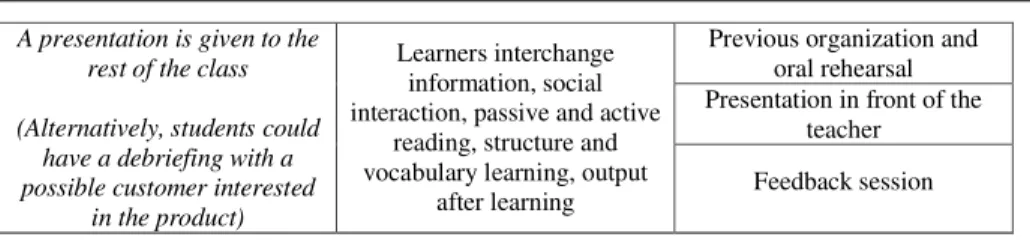
According to McCauley and McCauley (1992), reading input benefits oral performance. The question is how to integrate this comprehensible and incomprehensible input into the student’s knowledge. It is also necessary to show the stages, effects on learning and how webquests promote student interaction. The following diagram suggests the stages to implement a webquest for Tourism students:
Stage Effects on learning Effects on oral development Webquest is presented to the
students
Part of the language and structures are learned
Oral and written input is received from the teacher
Students meet and assign roles
Cooperative work, task assignment, social interaction,
motivation
If some part of this work is done in class they are likely
to do it in L2
Students seek information individually (but in contact)
Passive and active reading, structure and vocabulary learning, negotiation and
support (through cooperation), professional development (getting to know
the market)
New vocabulary is comprehended. It will probably be used in oral
performance later
Previous organization and oral rehearsal Presentation in front of the
teacher
Students have a meeting to propose the package (best done in class in front of the
teacher)
Learners interchange information, social interaction, passive and active
reading, structure and vocabulary learning, output
after learning Feedback session
The group produces a report / booklet
Learners interchange information, social interaction, passive and active
reading, structure and vocabulary learning, output
after learning
The written output will be incorporated into the final
Diagram 1 – Stages of webquest implementation for Tourism students (GARCÍA LABORDA, 2009)
Oral production is fostered through both reading and oral interaction and also by integrated dialogues, repetition, and rehearsal in contextualized situations (WEBBER, 1995; DE GUERRERO, 1987). Additionally, when students feel secure in the classroom context, they also tend to take language risks and overcome the natural anxiety of speaking a foreign language. As mentioned, controlled output may eventually be internalized and learned naturally (BADDELEY at al., 1997, SERVICE & CRAIK, 1993). Consequently, the student processes the input induced by the reading from websites and incorporates it into his or her speech.
3. WEBQUESTS AT WORK
In order to observe the use of webquests in Tourism, the researcher annotated the evolution of his students in a year long study. The two main questions were:
1) Do tourism students really improve their oral communication skills in their field of specialization by implementing webquests?
2) Which other positive outcomes arise from the use of webquests for Tourism students?
3.1 Background information
This study was carried out at the Polytechnic University of Valencia at Gandía. To collect the information two classes were observed for a full year and data collected three times. In that period of time students practiced their Internet browsing and booking skills, gathering information about different destinations, lodging and catering services. The data presented here only corresponds to the implementation of full webquests that required presentation and Internet skills together.
3.2 Tasks
Two observations were undertaken in the second semester while the other was undertaken at the beginning of the year. Observations were annotated in a log book. Each task had an expected duration of one hour. The tasks were:
Previous organization and oral rehearsal Presentation in front of the
teacher
A presentation is given to the rest of the class
(Alternatively, students could have a debriefing with a possible customer interested
in the product)
Learners interchange information, social interaction, passive and active
reading, structure and vocabulary learning, output
• Session (webquest) 1: (Appendix II): Booking a tour to three major destinations in Great Britain. Students were required to imagine themselves as travel agents. Students received basic information and needed to plan an imaginary itinerary together with the customer and to dialogue with two more classmates (as company assistants) and present all the information to the customer at the end.
• Session (webquest) 2: Given a destination, students would have to organize a full program for two days. The program would include the timetable, visits, local transportation and restaurants and entertainment. The final goal would be to choose an appropriate program for the accompanying persons of a two-day con-ference of the students’ choice. The final subtask would be a meeting with two other people of the same company also in charge of organizing this program.
• Session (webquest) 3: Considering themselves as travel agency administrators,
students would imagine that they had to prepare a trip around the world with five stopovers in English speaking countries (so that they mostly had to get the information in English and, whenever possible, avoiding their mother tongue). The final subtask would be a negotiation (or presentation) with a wealthy client.
3.3 Participants
The participants varied in number because attendance is not compulsory in Spain but run between 74 in the first observation, 60 in the second and 45 in the third (a 39% dropout rate). They were all students in the second year of English for Travel & Tourism at the Polytechnic University of Valencia (19 to 22 years old). In general, these students usually have a lower intermediate level but classes are of mixed ability. Most students in the college have a relatively low speaking ability while they usually excel in grammar and are quite good in reading. Thus, many instructors consider that the main goal in Travel & Tourism ESP is to facilitate the development of students’ oral skills.
The classes in the study had 38 and 36 students (19 and 26 at the time of the last observation) which met once a week for two hours. Classes usually consisted of reading and speaking tasks but most reading and grammar was done at home. Conversations were generally those included in the book, and additionally speaking tasks might be given by the teacher.
3.4 Observations on collection procedures
difficulties. Some students also volunteered to give a presentation of their findings to the whole class.
Overall, students also had some written interaction among them and with the teacher (indicated in diagram 1). This communication was also used as input to trigger further oral interaction. This interaction was in the form of letters, emails, reports and summaries. However, most of this written communication was electronic and thus can be considered as another element for further studies.
3.5 Collection criteria
Among the criteria used to classify the observations and evidenced in the observation described in the following pages were:
1) The activity and involvement shown by the students in the form of implication in the conversations, interest and motivation, conversation engagement, and leading role.
2) The amount of time involved in active practice in the classroom.
3) Language quality of the students’ production (especially considering the evolution along the period of observation).
4) Commitment in completing the assignments (considering the available time and space as well as the technical resources and requirements).
3.6 Findings and discussion
The findings of this qualitative research will refer to two main aspects with the first looking at the use of websites to trigger face to face communication both in the information search and results presentation processes, and the second as a tool for professional development. A summary of language and task observations is included as Appendix I. Overall, students expressed their satisfaction with the type of tasks and the way to obtain real online information in the discussions after the sessions. Most students also acknowledged that they felt these sessions would be meaningful for both their college studies and professional careers although some mentioned that they believed the booking systems in airlines and travel agencies would be more sophisticated and difficult to operate. Almost all considered these webquest tasks a good means of training although very few of them had ever done any before.
3.7 Face to face communication
oral debriefings with their imaginary clients, the teacher and the class. Students were uneasy about the fact that they had to learn two distinctive sets of words (British and American) according to where they sought the information. The teacher had an active role in explaining many lexical items. Of course, students were recommended to use online dictionaries but these dictionaries are not usually designed for travel and tourism studies, so not only explanations and rephrasing were necessary, but the teacher also had to help. During the information search, students used their first language more often than in any of the other sessions. The reasons seem to have been: students encountered more problems with the websites than expected, needing translation of difficult or key words; insecurity in some of the outcomes (at times, it was also necessary to redo some searches and students relied on their first language to solve functional problems); the feeling of not being controlled by the teacher; and the difficulty of speaking to other students in a foreign language in a free and natural way. The peer presentation with information was fully in English although, as mentioned, students required peer support and the use of personal notes more than the teacher had hoped. However, students acquired some expressions of pricing, quoting, commerce and transportation and apparently learned basic vocabulary for asking about times, classes and travel availability, and could express the features of the means of transportation and hotels. They failed, however, in remembering details of plan changes such as those requested by a customer due, for instance, to preference in time of travel or alternative hotels. Overall, by the end of the session students had acquired certain linguistic patterns like questioning, giving explanations and expressing suggestions that are necessary to deal with customers in the travel and tourism business, acquired vocabulary and expressions, and interacted with peers and the teacher. About six pupils did not complete the task but that was not considered relevant because they would have more sessions in the future and most did a considerable amount of oral (and reading) work.
Session 3: Given the limited number of students that attend classes (45) by the end of the year, it is essential to mention that students in the classes tend to be either very motivated (and generally more proficient in L2) and those weaker students who believe they cannot miss classes in order to obtain the desired grade in the class. This situation leads to uneven student groupings in which generally a more skilled student usually works with a less proficient one. This would be the case to see whether weaker students may perform (or simulate to perform) at the same level as their counterparts. In session three, almost all the students (37) proved that the hypothetical first interview with a customer in which basic information for the trip is obtained was routinized, and that made it possible to have realistic conversations from the beginning of the task. In-group assistance was fluent since not only the more proficient students helped the others but also there was a real interchange of common ideas among them. L1 use was limited and most students (15 groupings) interacted fluently in the information search. About two thirds of the students could organize the full trip and prepare a final presentation for the simulated board meeting. Most students enjoyed the volunteer presentations and suggested ways to improve the bookings, destinations, airlines, and so on. However, 11 students did not evidence the same improvement, partly because seven pupils had missed one or two of the previous webquests and partly because they did not acquire the necessary skills despite the extensive preparation done during the year.
3.8 Computer skills integration
At the beginning of the year, students reported diverse degrees of familiarity and comfort with computers. 80% of the students used computers to play, to communicate (synchronously and asynchronously), to browse the Internet and for academic writing. Only three of them had ever done a webquest and only one in English class in high school. Most felt that computers were challenging but a few mentioned anxiety in relation to computers. Only two reported that they felt stressed when working under time pressure. In general, students agreed on the positive effect of the Internet and information technologies in their professional field and careers.
webquest but they also mentioned the importance of learning these practical things that are not usually taught in any other class.
Session 2: As mentioned, the second webquest was linguistically a little simpler because it required less searches and the vocabulary both in the online readings and the interactions were not descriptive such as describing a city (which requires a higher competence than just for asking and answering simple questions). Besides, students only had to work with common daily tasks such as restaurants, local transportation, attractions and those tasks that usually require less ability in solving problems. This exercise mostly consists of collecting information that can usually be obtained through a choice of different websites with the same purpose (for instance, New York City has at least ten official websites with information of current activities, local restaurants, links to the city transport bureau, activities and more). In general, students could get more or less information and use a larger repertoire of websites.
Session 3: The observations of this session indicated serious differences among different groups of students. While three groups could finish the tour around the world, one group could hardly prepare two stages. The reasons may be related to previous experience, as some groups included members that had little experience in the tasks because they missed part of the year or were not present on the day of the webquests. However, the observations showed that six out ofnine finished. Students not only integrated the resources used in previous webquests but also came up with their own. Overall, in the final follow-up session students showed positive attitudes and recognized the validity of webquests. Additionally, two students mentioned they had learned about travelling overseas especially in countries with which they had not thought they would have any connection.
Although there is a great potential for webquests in English for Tourism, there are some potential drawbacks in this approach. Although this constructivist approach can be very amusing, students need to engage in the whole process. Missing part of the process of gathering information, reading instructions, structuring conversations, making bookings, and so on may result in missing vocabulary and language use and, in the end, may decrease fluency and communicative possibilities. When students do not participate or feel overwhelmed by the tasks in the sessions, they tend not to be able to cope with all the different subtasks that the exercise requires and gains in language and computer skills are lower than expected.
4. CONCLUSION
skills, observations indicate that more experienced students usually achieve more than their classmates because they take longer speaking turns, are more active, tend to assume more speaking risks and tend to engage with high proficiency students. When experienced students help the disadvantaged ones, both groups benefit from this cooperation. Overall, there is a need for further studies on oral development supported by the use of computers and the Internet in language for Specific Purposes that can support or reject the observations presented in this article.
___________ REFERENCES
ABRAMS, Z. I. (2003). The effect of synchronous and asynchronous CMC on oral performance in German. Modern Language Journal, 87(2), 157-167.
ANTON, M., & DICAMILLA, F. (1998). Socio-cognitive functions of L1 collaborative interaction in the L2 classroom. Canadian Modern Language Review, 54(3), 314-342.
APPEL, C. & GILABERT, R. (2002). Motivation and task performance in a task-based web-based tandem project. ReCALL, 14 (1), 16-31.
ARDOIN, S. P.; MCCALL, M. & KLUBNIK, C. (2007). Promoting Generalization of Oral Reading Fluency: Providing Drill versus Practice Opportunities. Journal of Behavioral Education, 16(1),
54-69.
BOHLKE, O. (2003). A comparison of students participation levels by group size and language stages during chatroom and face-to-face discussions in German. CALICO Journal, 21(1), 67-87. BOSWELL, N. (2003). A WebQuest for “because of Winn-Dixie”. Reading Online, 6(6).
CHANG, T. C. (2004). Transborder tourism, borderless classroom: Reflections on a Hawaii Singapore experience. Journal of Geography in Higher Education, 28(2), 179-195.
CHATEL, R. G., & NODELL, J. (2002). WebQuests: Teachers and students as global literacy explorers. Paper presented at the Annual Meeting of the Connecticut Reading Association (51st, November 14, 2002, Cromwell, CT). ERIC, Resources in Education (RIE), document number ED471843. DE FREITAS, S. I. (2006). Using games and simulations for supporting learning. Learning, Media &
Technology, 31(4), 343-358.
DE GUERRERO, M. C. M. (1987). The din phenomenon: Mental rehearsal in the second language.
Foreign Language Annals, 20(6), 537-548.
DUDENEY, G. (2003). The quest for practical web usage. TESL-EJ, 6(4).
FERNANDEZ-GARCIA, M., & MARTINEZ-ARBELAIZ, A. (2002). Negotiation of meaning in nonnative speaker-nonnative speaker synchronous discussions. CALICO Journal, 19(2), 279-294. FIDALGO, R. I., & VON SCHMIDT, W. (1995). Alternative assessment: The use of games in the
classroom. Paper presented at the Beijing-Xian International Conference on Foreign Language
GARCÍA LABORDA, J. (2009) Using webquests for oral communication in English as a foreign language for tourism studies. Educational Technology and Society, 12(1), 258-270.
GOSSMAN, P.; STEWART, T.; JASPERS, M., & CHAPMAN, B. (2007). Integrating web-delivered problem-based learning scenarios to the curriculum. Active Learning in Higher Education, 8(2), 139-153.
IKPEZE, C. H., & BOYD, F. B. (2007). Web-based inquiry learning: Facilitating thoughtful literacy with WebQuests. Reading Teacher, 60(7), 644-654.
KRASHEN, S. (1989). We acquire vocabulary and spelling by reading: Additional evidence for the input hypothesis. Modern Language Journal, 74, 440-464.
KRASHEN, S. (1997). The comprehension hypothesis: Recent evidence. English Teachers’ Journal
(Israel), (51), 17-29.
LACINA, J. (2007). Inquiry-based learning and technology: Designing and exploring WebQuests. Childhood Education, 83(4), 251.
LEE, C. (1999). An exploration of pedagogical implications of using networked-based computer mediated communication in the communicative language classroom. Interpersonal Computing and Technology, 7(1-2), 1-16.
LESLIE, D.; RUSSELL, H. & GOVAN, P.(2004). Foreign Language Skills and the Needs of the UK Tourism Sector. Industry and Higher Education, 18(1), 255-266.
LESLIE, D.; RUSSELL, H. & FORBES, A.(2002). Foreign Language Skills and Tourism Management Courses in the UK. Industry and Higher Education, 16(6), 403-414.
LIAO, X. (1997). Information gap in communicative classrooms. Paper presented at the Annual Meeting of the Teachers of English to Speakers of Other Languages (31st, Orlando, FL, March 11-15, 1997). Eric document number ED 411700.
LOWERISON, G.; SCLATER, J.; SCHMID, R. F., & ABRAMI, P. C. (2006). Are we using technology for learning? Journal of Educational Technology Systems, 34(4), 401-425.
MASON, K. (2006). Cooperative learning and second language acquisition in first-year composition: Opportunities for authentic communication among english language learners. Teaching English in the Two-Year College, 34(1), 52-58.
MACGREGOR, S. K., & LOU, Y. (2005). Web-based learning: How task scaffolding and web site design support knowledge acquisition. Journal of Research on Technology in Education, 37(2), 161-175.
MCCAULEY, J. K., & MCCAULEY, D. S. (1992). Using choral reading to promote language learning for ESL students. Reading Teacher, 45(7), 526-533.
NAUGHTON, D. (2006). Cooperative strategy training and oral interaction: Enhancing small group communication in the language classroom. Modern Language Journal, 90(2), 169-184. PATTERSON, N., & PIPKIN, G. (2001). Guiding readers to new understandings through electronic text.
Voices from the Middle, 8(4), 64-66.
PEAT, M.; TAYLOR, C. E., & FRANKLIN, S. (2005). Re-engineering of undergraduate science curricula to emphasise development of lifelong learning skills. Innovations in Education & Teaching International, 42(2), 135-146.
PETZOLD, R. & BERNS, M. (2000). Catching Up with Europe: Speakers and Functions of English in Hungary. World Englishes, 19(1), 113-124.
ROSELL-AGUILAR, F. (2005). Task design for audiographic conferencing: Promoting beginner oral interaction in distance language learning. Computer Assisted Language Learning, 18(5), 417-442.
SEAMON, M. P. (1999). Connecting learning & technology for effective lesson plan design. Paper presented at the Association for Supervision and Curriculum Development Conference (54th, San Francisco, CA, March 6-8, 1999). Eric document number ED 432982.
SEONG, M.-H. (2001). Tourism English Teaching Techniques Converged from Two Different Angles.
Journal of Pan-Pacific Association of Applied Linguistics, 5(1), 105-117.
STINSON, A. D. (2003). Encouraging the use of technology in the classroom: The WebQuest connection.
Reading Online, 6(7).
YANG, Z., & LIU, Q. (2007). Research and development of web-based virtual online classroom. Computers and Education, 48(2), 171-184
WEBBER, P. (1995). Speaking practice in the medical English classroom: Bridging the gap between medical English and the everyday world. IRAL, 33(1), 64-70.
WOODS, M. L.; KARP, G. G.; SHIMON, J. M., & JENSEN, K. (2004). Using webquests to create online learning opportunities in physical education. Journal of Physical Education Recreation and Dance JOPERD, 75(8), 41.
APPENDIX I: SUMMARY OF OBSERVATIONS
Date of
observation November 16 2006
15:00 – 17:00 hours
February 15 2007
15:00 – 17:00 hours
May 15 2007
15:00 – 17:00 hours
Task Booking a tour to three major
destinations in Great Britain Full program for two days A trip around the world Some students had problems
booking online. Bookings were interrupted when students found
the timetable and prices.
Since many students get to interact simultaneously in the classroom, some were bothered
by the noise and some were reluctant to do the exercise.
Some students browsed websites in Spanish and therefore did not get to read or deal with the lexis
in English.
Students collected information and finished the task according to the teacher’s instructions but in different quantities and quality. Students mentioned that the task was easier because they were more familiarized with getting this kind of
information.
Students focused on websites in English with a few exceptions. Use of online dictionaries was limited to the students’ needs but still excessive.
Anxiety was lower and students felt safer and with more options and resources to choose
from.
Group interaction was fluent and students helped one another despite their proficiency
level.
Students could handle reservations and trip organization with very
few problems.
Students volunteered easily for final
presentations.
Most students finished the task (6 groups out of
9) but the differences between two groups and
the rest was considerable.
Attitudes towards the validity of using webquests in the final recap were very positive.
Number of groupings
observed 35 28 19
Implications for oral development
Students who had never practiced speaking in real life? situations
had some communication and interaction problems but a cooperative and supportive atmosphere helped to overcome
them.
Students enjoy dealing with real topics they feel are significant to
them.
Grammar is a bit “rusty” but students seem to learn a great
amount of vocabulary.
On occasions, L1 is used but at the information gathering stage L1 may be accepted when limited
to the minimum.
Speaking routines were more numerous and varied. They were also
more natural, less hesitant and less controlled. Weaker students performed with
limited fluency but dialogued and worked
smoothly.
L1 use was more limited.
Realistic conversations in L2 were routinized.
There was almost no L1 use.
Bookings and information vocabulary was used fluently. Some weaker students had difficulties, but overall they all excelled except for a few students with particular problems or who had missed some
computer and presentations practice.
Grammar and vocabulary were adequate for the
APPENDIX II: A WEBQUEST SAMPLE
Booking a tour to three major destinations in Great Britain (Session / webquest 1)
Introduction
A large portion of the British economy is dependent on and derived from tourism. Although tourism in Great Britain has decreased due to weather changes, terrorism and politics, travelers are still attracted by the language and cultural heritage of the U.K. Travel agents face the difficulty of finding cities that may attract foreign travelers but do not get over-crowded with them (for example, Lincoln) and may still bring visitors at an attractive cost. The García Travel Agency has picked your team to plan an imaginary customer’s itinerary, plan it together with the customer to determine his or her interests, to dialogue with two more classmates (as your team) and present all the information to the customer at the end. Transport to be used: train, plane, boat (for half day excursions) and bus (for travel, transfer or commuting).
Information about cities: those visited including lodging and food, and also tourist attrac-tions, points of interest and places not to be missed.
Lodging: Try to use school dorms whenever possible. Do not use bookings through other travel agencies. If you select hotels, they should have 3-4 stars.
Quote the final price and state full schedules, service features and comfort classes.
Task
Each group must collect all the information, and after discussion with other team members, choose the cities that will appeal to potential travelers (mostly high-school students). Each member of the group will research either a dorm or hotel or, even better, a means of transpor-tation or local information sources. Additional information about activities and events would be welcome.
Process
Find the appropriate websites to make the bookings; find maps and places for your final oral report and presentation. Be sure to choose only the necessary means that will facili-tate your work. Not every fact will be appropriate. Write a report that is clear, attractive and persuasive. Because you will be producing a travel report, having one meeting and giving a presentation, it is necessary for you to keep notes of your information or maintain records of your research.
Resources
Inn are among the largest hotel chains in the world, and that British Railways, Virgin and local companies are part of the national railways network in the U.K.
Evaluation
The evaluation is done in relation to four criteria: group participation, training skills, cativity and the quality of the final product. Students will be evaluated on individual re-search components, their presentation and meeting, their final report and a justified self-evaluation.
Conclusion
You have done extensive research and learned much about the travel industry in Great Britain. You will have experienced the difficulties of both working on your own and having to work cooperatively. In your cooperative groups you were required to make difficult decisions about which possibilities were optimal. Your findings, decisions and analysis produced a report which had to be contrasted in a meeting and presented.