Escola
de
Pós-Graduação
em
Economia
- EPGE
Fundação
Getulio
Vargas
Essays
on
Asymmetric
Information
Problems
without
the
Single-Crossing
Property:
Applications
to
Corporate
Finance
Tese submetida à Escola de Pós-Graduação em Economia da Fundação
Getulio Vargas como requisito de obtenção do Título de Doutor em
Economia
Aluno: Marcos Hiroyuki Tsuchida
Professor Orientador: Aloisio Pessoa de Araújo
Rio de Janeiro
Escola
de
Pós-Graduação
em
Economia
- EPGE
Fundação
Getulio
Vargas
Essays
on
Asymmetric
Information
Problems
without
the
Single-Crossing
Property:
Applications
to
Corporate
Finance
Tese submetida à Escola de Pós-Graduação em Economia da Fundação
Getulio Vargas como requisito de obtenção do Título de Doutor em
Economia
Aluno: Marcos Hiroyuki Tsuchida
Banca Examinadora:
Professor
Aloisio
Pessoa
de
Araújo
(Orientador,
EPGE/FGV)
Professor
Humberto
Luiz
Ataide
Moreira
(EPGE/FGV)
Professor
Luis
Henrique
Bertolino
Braido
(EPGE/FGV)
Professor Fábio Kanczuk (FEA/USP)
Professor Walter Novaes (PUC/RJ)
Contents
List of Figures ii
Acknowledgements iii
Introduction 1
Chapter 1 Risk and incentives with multitask 5
Chapter 2 Do dividends signal more earnings? 31
Chapter 3 Debt as a signal 59
Conclusion 80
List
of
Figures
1.1
Optimal
contract.
a0
= 0.91,
\i =
1 and
6 =
[2.5,3.5].
27
1.2
Risk
x incentives.
<r0
= 0.91,
p = 1 and
O = [2.5,3.5].
27
1.3
Optimal
contract.
a0
= 0.91,
/x =
1 and
0 =
[0.5,1.4].
28
1.4
Risk
x incentives.
a0
= 0.91,
/z =
1 and
0 =
[0.5,1.4].
28
1.5
Optimal
contract.
<r0
= 0.91,
p =
1 and
0 =
[0.7,3.0].
29
1.6
Risk
x incentives.
cr0
= 0.91,
/x = 1 and
0 = [0.7,3.0].
29
Í.7 Exogenous risk x incentives. 30
2.1 CS split and discrete pooling region. 55
2.2 Discrete pooling paths. 55
2.3 Signaling equilibrium. 56
2.4 Signaling equilibria. 57
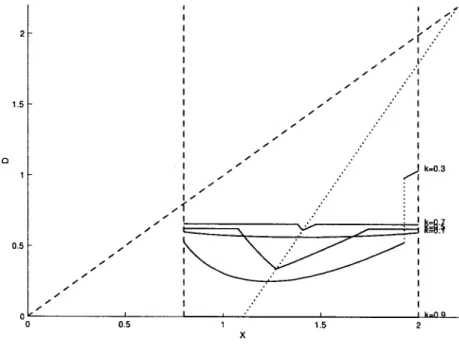
2.5 Equilibria for different values for k. 57
2.6 Equilibria for g = -0.2. 58
2.7 Equilibria for g = 0.2. 58
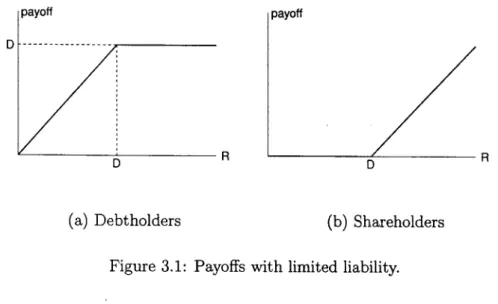
3.1 Payoffs with limited liability. 62
3.2
Separating
equilibrium.
k = 0.5,
A =
1 and
T =
[1,1.8].
78
3.3 Separating equilibrium. 78
3.4 Discrete pooling equilibrium. k = 0.5, A = 1 and T = [1,5]. 79
Acknowledgements
Ao orientador Aloisio Araújo, que fez de mim um doutor.
Ao co-autor Humberto Moreira, que me ensinou a resolver os proble
mas sem a propriedade do single-crossing.
A Walter Novaes, Heitor Almeida e Fábio Kanczuk pelos comentários
tão importantes para o futuro deste trabalho.
A Luis Braido, Daniel Ferreira, Paulo César Coimbra Lisboa e partici
pantes do workshop de microeconomia, no qual versões preliminares dos
capítulos da tese foram apresentadas e amadureceram.
A Samuel Pessoa, que me incentivou a fazer o doutorado nesta escola.
A Mônica
Viegas,
Joísa
Dutra,
Ricardo
Brito,
Márcia
Leon,
Ana
Lúcia
Vahia de Abreu e os muitos alunos que fizeram e fazem da EPGE uma
escola viva e de alta qualidade.
Aos professores da EPGE pelo contínuo estímulo intelectual.
Aos funcionários da EPGE, da Biblioteca Mário Henrique Simonsen
e da portaria da FGV, que, no dia-a-dia, tornaram agradável o meu tra
balho.
À CAPES
e à Fundação
Getulio
Vargas
o tão
necessário
apoio
finan
ceiro.
À minha
família
e aos
amigos
em
São
Paulo,
pela
paciência,
pelo
apoio
e pela compreensão.
Aos
muitos
amigos
que
fiz
no
Rio
de
Janeiro,
que
me
acolheram
e que,
desde os primeiros dias, me fizeram sentir em casa.
A todos
estes
que,
ao
longo
dos
quatro
anos
e meio
em
que
me
dediquei
ao
doutorado,
contribuíram
para
o sucesso
deste
projeto,
meus
sinceros
Essays
on
Asymmetric
Information
Problems
without
the
Single-Crossing
Property:
Introduction
Asymmetric .information plays an important role in a great number of situations
in corporate finance. Moral hazard, adverse selection and signaling models
produced many insights about how the economic players interact when some
information is not available to everyone. On the empirical side, researchers
test the implications of these models. Agency problems, information contents
of dividends, incentives in executive compensation, corporate governance, and
other concepts are, each one, large fields in corporate finance.
The objective of this dissertation is to re-examine classical issues in corpo
rate finance, applying a new analytical tool. The single-crossing property, also
called Spence-Mirrlees condition, is not required in the models developed here.
This property has been a standard assumption in adverse selection and signal
ing models developed so far. The classical papers by Guesnerie and Laffont
(1984) and Riley (1979) assume it. In the simplest case, for a consumer with
a privately known taste, the single-crossing property states that the marginal
utility of a good is monotone with respect to the taste. This assumption has
an important consequence to the result of the model: the relationship between
the private parameter and the quantity of the good assigned to the agent is
ordinary consumer, this property is frequently absent in the objective function
of the agents for more elaborate models. The lack of a characterization for the
non-single crossing context has hindered the exploration of models that
gener-ate objective functions without this property. The first work that characterizes
the optimal contract without the single-crossing property is Araújo and Moreira
(2001a) and, for the competitive case, Araújo and Moreira (2001b). The main
implication is that a partial separation of types may be observed. Two sets of
disconnected types of agents may choose the same contract, in adverse selection
problems, or signal with the same levei of signal, in signaling models.
In the three essays of this dissertation, three asymmetric information models
without the single-crossing property are developed. The first model examines
the trade-off between risk and incentives, which is a relevant issue in
execu-tive compensation literature. The traditional models of moral hazard imply a
negative relationship between risk and incentives, that is, when the owner of a
firm cannot observe the effort of the manager, the share of profits given to the
manager should be higher in riskier firms. This prediction is not supported by
the empirical work. In the model presented here, the manager is able to control
the mean and the variance of the profits. Additionally, the manager self-selects
his contract. In the resulting optimal contract, risk and incentives may have a
positive relation. Managers with higher risk aversion exert more effort in risk
reduction and selects contracts with lower incentives.
Signaling models provided many contributions to the corporate finance (see
Riley 2001). The determinants of corporate structure and dividend policy are
about the informational content of dividends. The traditional signaling models
assume the manager are better informed about the future prospects of the firm
and signal this knowledge using dividends. Empirical researches confirm the
prediction that the price of the shares and dividends are positively related.
However, a second prediction, the positive relationship between dividends and
earnings, is not empirically verified. In the signaling model presented here, a
correlation between current earnings and investment opportunities is introduced
and, in the resulting equilibrium, high-quality firms and low-quality firais can
signal with the same levei of dividends. Dividends and earnings may have an
ambiguous relationship, while, the relationship between prices and dividends
remains positive.
In the third model, a firm signals using debt. and the signal is observed by
the debt and stock markets. Although the separating equilibrium is possible,
partial separation equilibrium also arises. In this case, the two markets have
opposite interpretations about the signal. For the debt market, debt is a bad
signal, while, for the stock market, it is a good signal. The consequence from the
interaction of the two effects is that the benefit of the signaling is weaker. The
stock market is prone to give a good evaluation to the pool of firms that issues
debt, but the debt market demands a high discount. As the stock market takes
the debt market behavior into account, the value of the shares is reduced. As
is explained in the essay, the difference in the interpretations about the signal
is caused by the limited liability of the firm.
the traditional models does not hold without the single-crossing property. This
result has considerable consequences on the empirical work. Many tests are
based on the monotonic relationship implied by the traditional models, and an
insignificant correlation has been considered evidence that the information
is-sues has little importance in the situation analyzed. However, when the problem
does not have the single-crossing property, the asymmetry on the distribution
of information plays a role, even if the variables do not exhibit the monotonic
relationship.
The lack of a theory that characterizes contracts and equilibrium without
the single-crossing property has constrained the applied research. As this prop
erty may be naturally violated in economic problems, many relevant issues are
neglected by the current literature. The models presented here show that the
characterization in a more general context is tractable, insightful and changes
Chapter
1
Risk
and
incentives
with
multitask
Abstract
Standard models of moral hazard predict a negative relationship
be-tween risk and incentives, but the empirical work has not confirmed this
prediction. In this paper we propose a model with adverse selection
fol-lowed by moral hazard, where eífort and the degree of risk aversion are
private information of an agent who can control the mean and the
vari-ance of profits. As a consequence, the utility function of the agent may
not have the single-crossing property. In the resulting contract, the rela
tionship between risk aversion and incentives may not be monotone and
the relationship between incentives and observed variance of profits may
1.1
Introduction
Moral hazard plays a central role in problems involving delegation of tasks.
When the principal cannot perfectly observe the effort the agent exerts, the
payment must be designed taking into account the trade-off between incentives
and risk sharing.
Standard models of moral hazard predict a negative relationship between
risk and incentives. The central reference is the model presented in Holmstrom
and Milgrom (1987), that analyzes the conditions in which optimal contracts
are linear, that is, the agenfs payoff is a fixed part plus a proportion of profits.
In their model, the negative relationship between risk and incentives results
from the interaction between these two variables in the risk premium of the
agent. As the agent is risk averse and incentives put risk in agenfs payoff,
incentives incur a cost in utility. At the optimal incentive, an increase in risk
is balanced by a reduction in incentives.
The empirical work does not verify the negative relationship between risk
and incentives, and sometimes finds opposite results. Prendergast (2002) presents
a survey of empirical studies in three application fields, namely, executive
com-pensation, sharecropping and franchising. Positive or insignificant relationships
are found in the three fields and negative relationship is found only in studies
about executive compensation. The conclusion is that the evidence is weak.
Similarly, in the insurance literature, the monotone relationship between risk
and coverage is not verified as in Chiappori and Salanié (2000).
mod-eis, compatible with the observed facts. Prendergast (2002) suggests that in
centives are a substitute for monitoring in riskier projects, as monitoring is
harder in riskier environments. Ghatak and Pandey (2000) develop a model
with limited liability and moral hazard in effort and risk.
We propose a model with adverse selection, moral hazard and multitask.
Multitask models were first developed in Holmstrom and Milgrom (1991), but
in these models, effort controls exclusively the mean of the profits. In our
work, we consider the possibility of manager to control the variance of the
profits. Note that the observed variance is endogenous, and we can define
two types of risk: the exogenous risk is the intrinsic risk of the firm, and the
endogenous risk is the risk resulting from the effort of the agent in reducing
variance. Another feature in our model is the presence of adverse selection
before moral hazard. The principal does not know the risk aversion of the
agent and designs a menu of contracts so that self-selection reveals the type
of the agent. Sung (1995) shows that linear contracts are optimal in moral
hazard problem in which the agent controls risk. Sung (2002) shows that these
contracts are optimal in adverse selection with moral hazard, in a model with
more restrictive assumptions than the ours, and suggests that optimality is
valid in a more general setting. Although the optimality of liner contract is not
established for our model, we assume linearity and restrict the analysis to the
space of linear contracts.
In standard models, the agent cannot control the risk of the project and
However, when agents can exert effort in risk reduction, the direction of
selec-tion may change. An agent with high risk aversion may prefer a high incentive
contract, as he can reduce risk and the cost associated with risk. Technically
speaking, our model does not have the single-crossing property. Consequently,
the relationship between the incentives given to the agent and his risk aversion
is ambiguous. We computed the optimal contracts for representative situations
and found that the relationship between endogenous risk and incentives is am
biguous. For a set of agents with high risk aversion, incentives and observed risk
are negatively related. For a set of agents with low risk aversion, the relation
ship is positive. With respect to exogenous risk, the Holmstrom and Milgrom
result is preserved: the relationship between exogenous risk and incentives is
negative. In Araújo and Moreira (2001b), a model akin to the one presented
here is studied, applied to the insurance market.
In Section 1.2, we present the general model. In Section 1.3, we give two
examples. First, the single-task model is examined and the traditional relation
ship between risk and incentives is found. The multitask case is presented in
the second model. In Section 1.4, we compute the optimal contracts for
rele-vant cases of multitask model and we find positive and negative relationships.
Section 1.5 concludes. In Appendix l.A, we discuss implementability and
opti-mality without the single-crossing property, and, in Appendix l.B, we examine
the technical conditions for computing the optimal contract in the multitask
1.2
The
Model
The principal delegates the management of the firm to the agent, whose effort
can affect the probability distribution of the profits. Let e be the vector of
efforts
and
z be
the
profits,
with
normal
distribution
N (/j,(e),
a2 (e)).
Let
c(e)
denote the cost of the effort for the agent. The agent has exponential utility
with risk aversion 6 > 0, uniformly distributed on O = [6a,ôb\. At the time of
contracting, the agent knows his risk aversion, but the principal does not. We
will occasionally refer to 6 as the type of the agent. We assume the wage is a
linear function of the profits, that is, w = az + /?, 0 < a < 1. The contract
parameter a is the proportion of the profits received by the agent and is called
the incentive, or the power, of the contract. The parameter /? is the fixed part
of the contract which is adjusted in order to induce the agent to participate.
The timing of the problem is as follows: (1) the agent learns his type,
then
(2)
the
principal
offers
a menu
of contracts
{a(9),f3(9)}eee^
(3)
the agent
chooses a contract, and (4) exerts effort accordingly, (5) the firm produces profit
z and (6) the agent receives w az 4- f3 and the principal earns the net profit,
z w. The certainty equivalence of the agenfs utility is
a2
Vce((*,(3,9,e)
= f3 + a/i(e)
- c(e)
- 9o2{e),
that is, the expected wage, minus the cost of the effort and the risk premium.
The last term is the origin of the negative relationship between risk and incen
tives in purê moral hazard models. The risk premium acts as a cost because
the
principal
compensates
an
increase
of
o2
by
a reduction
of
a,
and
equates
the marginal cost and the marginal benefit of incentive. With adverse selection
preceding moral hazard, a similar effect exists: the principal has to compensate
the agent for the costs, in order to induce participation and truth-telling.
Let e*(a,9) denote the agent 0's optimal choice of effort, given a. Note that
e* is independent of (3. The resulting indirect utility is V(a,(3,9) f3 + v(a,6),
where
v(a,9)
= a/x(e>,0))
- c(e>,0))
- ±a29a2(e*(a,9)).
(I)
The problem is henceforth reduced to an adverse selection problem where
the agent has quasi-linear utility V(a,(3,6).
Assume the principal is risk-neutral. Her utility, given 9, is the expectation
of the net profit, that is, the profit after the wage is paid to the agent,
U(a,P,9)
= E[z
-w]
= (l-
a)/i(e>,0))
- 0,
where the expectation is taken with respect to the conditional distribution of
z, given the effort choice of the agent 9 under the contract (a, (3).
The adverse selection problem is to find the functions a(-) and /?() such
that
(<*(),/?()) G &Tgm3xE[U(a(9),P(9),9)} (2)
subject to
V(a(9),(3(9),8)
> V(a(ê),(3(9),9)M
ali 9,9
6,
(3)
)>O,forall0ee. (4)
The expectation in (2) is taken with respect to 9. The constraint (3) is the in
centive compatibility condition (IC). A function a(-) is called implementable, if
there is a function /?() that satisfies (IC). The constraint (4) is the participation
constraint (IR) where the reservation utility is normalized to be zero.
Guesnerie and Laffont (1984) fully characterize the optimal contract under
the assumption of single-crossing property, that is, the cross derivative vae has
constant sign. The solution of the model involves the definition of the virtual
surplus
f(a,9)
= M(e>,0))
- c(e*(a,0))
- i<*W(e>,0))
+ (9 - 9a)v9(a,9),
(5)
and the calculation of ai(0) = argmax/(<*,#). The optimal contract is a
combination of ai (9) and intervals of bunching.
In our model, the envelope theorem gives the marginal utility of incentive as
va(a,
9)
= /x(e*(a,
9))a9a2(e*(a,9)),
that
is,
the
mean
of the
profits
minus
the
marginal risk premium. As agents with higher risk aversion exert more effort in
risk reduction, the marginal risk premium term may increase or decrease with
agenfs risk aversion. Consequently, the cross derivative vag may have any sign.
The characterization of optimal contracts without the single-crossing property
is analyzed in Araújo and Moreira (2001a), and the Appendix l.A presents
some relevant results for the solution of our model.
1.3
Two
Examples:
Single-Task
and
Multitask
are under control of the agent. In the multitask case, the observed risk is
endogenous.
1.3.1 Single-Task
We first analyze the single-task specification where agenfs effort controls only
the mean of the profits. Let eM denote the effort and assume the mean of
the profits is linear in eM, /x(eM) = /xeM, and the cost of effort is quadratic,
c(e^)
= e2/2.
The
certainty
equivalence
is
Vce
=
P-The agent chooses e£ = a/z and the resulting indirect utility is V(a,(3,9) =
(3 + v(a,9), where
The
marginal
utility
of incentive
is va
= ctfi2
a.9a2.
An
increase
in incentives
has positive and negative effects on the utility of the agent. The positive effect
is the increase of the share of profits. The negative effect comes from the
increase of risk in the wage. The single-crossing property holds for this case,
since
vag
=
aa2
< 0.
An
agent
with
low
risk
aversion
has
high marginal
utility of incentive and may select a contract with high degree of incentives.
The
virtual
surplus
is /(a,
9) = a/x2
^a2/x2
\a29a2
+ (9
9a)vg
and
the
solution of the relaxed problem is given by the first-order condition fa(a, 9) 0,
that is,
«w
=
+ (29 - 9a)a2'The function a is decreasing in 6 and va$ is negative, therefore, the relaxed
solution
is the
optimal
contract
of the
original
problem.
The
variance
a2 has
also a negative effect on a, due to the two last terms in the virtual surplus, that
is, it increases the marginal cost from risk premium and informational rent.
The
relationship
between
a and
o2
is still
negative,
given
6.
Therefore,
adverse selection before moral hazard is not sufficient to change the traditional
risk-incentive trade-off. If agent controls only the mean of the profits, risk does
not affect the benefit of principal, because she is risk neutral, but increases the
marginal cost, because she has to compensate for the risk premium and has to
pay the informational rent. Consequently, the incentive offered is lower.
1.3.2 Multitask
We introduce the possibility for the agent to control the variance of the profits.
Let e^ and ea be the effort exerted in mean increase and in variance reduction,
respectively.
Let
fi(e)
= \xe^
cr2(e)
= (oq
ea)2
and
c(e)
\{e2L
+ e2,),
where
<7o is the exogenous variance. The certainty equivalence is
The optimal choices of effort are
e = afj., and ea = 9 a0 < a0.
The effort in mean, e^ is higher, the higher is the incentive. The effort in
variance reduction, ea, is higher, the higher is the incentive, the risk aversion
and
the
exogenous
variance
of
the
pronts.
The
observed
variance,
<r2(e*)
=
The envelope theorem gives the derivatives
va = /ieM
- aé>(<70
~ ea)2,
a2
.
.,
ve = -y(ffo-e<7)
< 0.
The first derivative states that the utility increases with a, due to the mean of
the profits, but decreases, due to the risk premium.
And the cross-derivative is
= fJ--^-
~ "(co
- eCT)2
+ 2a0(ero
-
ea)-^-=o <o >o
The first term is zero, that is, the marginal utility is not affected by the effort
in the mean of the profits. The other two terms derive from risk premium.
The
direct
effect,
a(<7o
eCT)2,
has
an
interpretation
similar
to the
single-task
case, the higher is the risk aversion, the higher is the effect of incentive in risk
premium.
The
effect
via
effort
is 2a6(ao
ea)^f-
and
acts
in opposite
direction.
Marginal utility increases with 0 because high risk-aversion agent exert more
effort in risk reduction. In our example,
and the function ao(9) = \/\/6 defines a decreasing border between vag > 0
and vag < 0 regions, with vag > 0, for a > ao- For low risk aversion agents, the
direct effect dominates and marginal utility of incentive decreases with type.
For high risk aversion agents, the effort has a opposite effect and the second
term dominates and vag > 0. This changes the self-selection direction, that is,
agent with a high type has a high marginal utility and chooses contracts with
more incentive.
The following expression is the virtual surplus of the problem,
2
The derivative with respect to a is
- a2ea)
+ (e-<
and the relaxed solution a\(9) is given by fa(cti(6),6) = 0 and /aa(<*i(#),#) <
0. Note that fa{0,6) > 0 and fa(l,õ) < 0, so relaxed problem has an interior
solution
and
fa(-,0)
has
at
least
one
root
in
the
interval
[0,1].
If /(-,#)
is not
concave in a, the incentive that maximizes the virtual surplus must be correctly
chosen among solutions of the first order condition.
The solution of the relaxed problem is the optimal contract if the incen
tive compatibility constraint is satisfied. As single-crossing does not hold, the
incentive compatibility is not obvious and, when ai(6) is not implementable,
the computation of optimal contract must follow the procedure presented in
Appendix l.A.
When vag(ai(6),6) is positive and negative, the optimal contract must
con-sider the possibility of discrete pooling. When 6 and 0 are discretely pooled,
the conjugation rule for the pooled types is
The discrete pooling segment, au(6), is given by the equation
(1 - a)(l
+ 0a2)2(l
+ 62aA)
= 2B2o?°\
A*
in Araújo and Moreira (2001a), as explained in Appendix l.B. The optimal
contract may have a complex form, that results from a combination of ai(9),
au(9) and bunching.
For a given ao, /x and [9a,9b], we compute the optimal contract a*(9) and
the
endogenous
risk
a2(e*(a*(9),9)),
and
plot
the
risk-incentive
curve
a x a2.
With respect to the endogenous risk, note that
2
When vaQ > 0, a(#) is increasing and risk is decreasing in 9. Consequently, risk
and incentives are negatively related. When vag < 0, a(9) is decreasing and
risk
and
incentives
may
be
positively
related
if 9a2
(9)
is increasing
in
9.
That
is, the endogenous risk decreases with risk aversion, provided that a(9) does
not decrease too fast.
1.4
Results
The equations above for the multitask example were numerically implemented
for the three cases listed in Appendix l.B. The parameter values, <xo = 0.91
and fi = 1, are the same for the three cases, and the values of 9a and 6f,
change. In Figure 1.1, for 9 [2.5,3.5], the relaxed solution is increasing, and
coincides with the optimal contract. Figure 1.2 is the corresponding plot for
risk and incentives. An agent with higher risk aversion chooses higher incentive
contracts, because he reduces the marginal cost from risk premium by exerting
more effort in risk reduction. The relationship between risk and incentive is
negative as in Holmstrom and Milgrom.
The contract for a set of types with lower risk aversion, 9 [0.5,1.4], is
shown in Figure 1.3. The relaxed solution is implementable as vae(ot\(6a),6b) <
0. The optimal contract coincides with the relaxed solution, but this time
the relationship is reversed. The higher types have higher marginal cost of
incentives, thus they prefer the lower incentive contracts. At the same time,
more risk-averse agents exert more effort in risk reduction and the variance is
lower. As is seen in Figure 1.4, the risk and incentives are positively related.
For a broader interval of types, that encompasses vag of both signs, the
discrete pooling is possible and the optimal contract presents a U-shaped form.
In Figure 1.5, the optimal contract for 6 [0.7,3.0] is plotted. As prescribed in
Appendix l.B, the validity of assumptions A2 and A3 were checked numerically.
Computational procedures found the optimal contract that combines ai, au and
bunching. Incentives and risk aversion are positively related in a higher risk
aversions subset and negatively related in a lower risk aversion subset. The
U-shape of the optimal contract is also present in risk-incentive graph, as we
can see in Figure 1.6.
The results above are concerned to the endogenous risk. The relationship
between exogenous risk and incentives was numerically calculated for the three
cases above. As shown in Figure 1.7, the sensitivity da/dao is negative, that
1.5
Conclusion
The negative relationship between risk and incentives is not preserved if the
agent can control the variance. A higher risk aversion agent exerts more effort
in reduction of risk. The relationship between risk and incentives is positive
if more risk averse agents select low powered contracts. This is true when the
marginal utility of incentive is decreasing with risk aversion. However, if risk
aversion is high enough, the possibility of risk reduction may reverse this effect
and the traditional negative relationship between risk and incentives may be
observed. The optimal contract may also be U-shaped, such that, agents with
intermediate risk aversion choose contracts with low incentives, and agents with
extremely high or extremely low risk aversion choose high-incentive contracts.
The numerical calculations suggest that the relationship between incentives and
exogenous risk remains negative.
Apendix
l.A
l.A
Adverse
Selection
without
the
Single-Crossing
Property
We report below the main results from optimal contract in non-single-crossing
context. Most of results are in Araújo and Moreira (2001a).
l.A.l Incentive Compatibility and Participation Constraint
When a(-) and /?() are differentiable, the incentive compatibility may be locally
checked by the first and second order conditions. These conditions are necessary
but not sufficient for incentive compatibility. The íirst order condition gives
va(a(e),e)a'(6)+l3'(e) = 0, (7)
which states that indiíference curves of type 0 agent must be tangent to an
implementable contract on a x f3 plane, at point (a(6), f3(0)).
The second order condition gives
vaa(a(9),e)[a'(e)]2
+ va(a(e),e)a"(e)
+ (3"(e)
< o,
(8)
and, after diíferentiating (7) with respect to 6, the expression (8) simplifies to
the condition
va9(a(8),e)a'(e)>0,
(9)
which implies the monotonicity of a(6), in the single-crossing context.
Define the informational rent of the agent 9, r(6), as the levei of utility
achieved by this agent, given the menu of implementable contracts (a(#),/?(#)),
that is, r(9) = v(a{0),0) +/?(#). Using (7), we get
r'(0) = ve(a(e),6), (10)
and
applying
the
envelope
theorem
on
(1),
we
have
ve(a,9)
= ^a2a2(e*)
<
informational
rent.
Thus,
the
participation
constraint
is active
for
the
highest
type, 6b, that is, r(6b) = 0.
The
fixed
component
of
the
wage
can
be
isolated
by
integration
of
r'(6),
ve(a(0),
ê)dÕ
- v(a(0),
6).
(11)
1.A.2
Implementability
without
the
Single-Crossing
Property
Since
the
single-crossing
property
is not
ensured,
the
first
and
the
second
order
condition are necessary but they are not sufncient. The following points must
be observed:
1. The function a(6) may be non-monotone. The same contract may be
chosen by a discrete set of agents. We call this situation as discrete
pooling. In this case, the pooled types follow the conjugation rule
va(a(e),e)
= va(a(e'),e'),
(12)
whenever a(6) = a(6'), which states that the indifference curves of 6 and
& are
both
tangent
to
the
menu
of contracts
on
a x (3 plane.
2. The incentive compatibility must be globally checked. When the
single-crossing property holds, the incentive compatibility may be only checked
locally. If types in the neighborhood of 6 is not better with the con
tract assigned to 6, no other type will be better. The first and second
order conditions are sufncient for global incentive compatibility. On the
other hand, if the single-crossing property is violated, types out of the
neighborhood of 6 may prefer the contract assigned to 9.
20
BIBLIOTECA
MÁRIO
HENRIQUE
SIMONSEN
-3. The function a(9) may be discontinuous. The possibility of discrete
pool-ing creates jumps in the optimal assignment of contracts, so we allow the
contract to be piecewise continuous. More precisely, we assume that the
functions are right continuous with limit from the left. When jump occurs,
the agent must be indifferent between the start and the end point of the
jump. For example, if there is a jump in 9 and agent 9 were strictly better
with the end point than the start point, then, for a small e > 0, the agents
with type in [9 - e, 9) would strictly prefer the end point, contradicting
the initial assumption of jump in 9.
1.A.3
Virtual
Surplus
and
the
Principal's
Problem
We
follow
the
standard
procedure
and
define
the
social
and
virtual
surplus,
S{a,9)
= /x(e>,0))
- c(e>,0))
- ^aW(e>,0)),
(13)
f(a,9)
= S(a,
9)+
{9-
6a)vg(a,
9).
(14)
The
expression
(13)
defines
the
social
surplus
S(a,6).
The
maximization
of
social
surplus
for
each
9 gives
the
first
best
of
the
model.
The
virtual
surplus,
defined in (14), is the social surplus plus the informational rent term. This term
is negative
and
represents
a cost
that
takes
into
account
the
rent
that
is paid
to
the agents
with
risk
aversion
in
[9a,
9],
in order
to
preserve
implementability
when agent 9 receives a(9).
Let p(0) and P{9) be the probability density and the cumulative of 9. The
expectation of integral term may be simplified by Fubini's theorem as,
where
^/
= 9
9a,
for
the
uniform
distribution.
Then,
the
principal's
objective
function
can
be
written
as
E[f(a(9),6)].
After the optimal incentive, a*(6), is found, the fixed part of optimal contract,
(3*(9), can be calculated using (11).
The maximizatiom problem of principal without the constraints is called
relaxed problem. Its solution, denoted a\(9), satisfies
fQ(a1{9),9) = 0 and faa(oti{9),9) < 0.
Since /a(ai(0),0) = Sa(ai(9),9) + (9- 9a)va6(ai(9),9), the relaxed solution
provides less incentive than the flrst best when vae < 0, and more incentive
when
vae
> 0.
This
distortion
occurs
because
the
cross
derivative
is associated
with
the
marginal
cost
of
informational
rent.
For
example,
when
vae
< 0,
the
cost of
informational
rent
is increasing
with
respect
to a,
therefore
the
principal
pays less incentive.
1.A.4
Optimality
without
the
Single-Crossing
Property
In the standard adverse selection model, the single-crossing property ensures
that
a\(9)
is the
optimal
contract
if (9)
is satisfied,
that
is,
a\(9)
is
non-increasing
when
vae
<
0,
or
non-decreasing
when
vae
>
0.
When
(9)
does
not
hold,
the
optimal
contract
is the
best
combination
of ol\{9)
and
intervals
of
bunching so that (9) is satisfied. That procedure is not suitable in the absence
of the single-crossing property. As before, a\{9) is the optimal contract if it is
implementable. However, monotonicity condition (9) is no more sufficient for
implementability and global incentive condition must be checked.
Moreover, when vag change its sign, the discrete pooling is possible and
ot\{Q) is not the optimal contract for the pooled types. The assignment of
contracts to the discretely pooled types must take into account the conjugation
of types according to the constraint (12). Let au(6) denote the assignment of
contracts in a discrete pooling. Then
'), (15)
fa(ç*u(e),e) = fa(au(e'),e>)
The optimal contract will be a combination of a\(9), bunching and au(6). We
follow Araújo and Moreira (2001a) and restrict the solution a* (6) to the closure
of the continuous functions. The optimal contract with discrete pooling can be
characterized under the following assumptions:
Al. vag(a,9) = 0 defines a decreasing function ao(9), vag is positive above
and negative below ao(9), for ali 9 ©.
A2. ai
is U-shaped,
crosses
ao
in
an
increasing
way,
ot\(9a)
< ai(0b),
fa(&,9)
is negative above and positive below a\(9), for ali 9 G 0.
A3. For each 9, the equations va{a\(),) = va(ai(-),9) have at most one
solution in the decreasing part of ai, on vae < 0 region.
Under these assumptions, the optimal contract, a*(9), will have one of the
following forms:
a* (9) =
au(9), i£9<9u
), ií9>9u
where 9\ is defined by otu(9\) = au(9a), or
<*(*)
=
(18)min{ã,au(9)}, ií9>92,
where ã is the incentive of the bunching and 92 is defined by ai (#2) = ã. The
set of bunched types, J = {9 G 9 : a(#) = ã}, satisfies
[ fa(ã,9)p(9)d9
= 0.
J
Apendix
l.B
l.B
Optimal
Contract
in
the
Multitask
Specification
As in the single-crossing case, the solution of relaxed problem, ac\(9), is the
optimal contract if it is implementable. However, condition (9) is not sufficient
for implementability.
The following definition will be useful for global analysis of incentive
com-patibility. For a given contract a(9) define the integral $(9,9) as
rê
rÔ f rctiê)
$(9,9)
= /
/
va6(ã,9)ò
Je Jate)
dê.
(19)
It can be shown, using (10), that $(6,6) = V(a(9),@(6),9) - V(a(9),(3(9),9),
thus $(9,9) is the difference for agent 9 between the utility of the contract
assigned to himself and the one assigned to 9. The (IC) constraint can be
stated as
$(9,9)
>0,
forallfl.êee,
that is, the agent with risk aversion 6 is not better pretending to be an agent
with risk aversion 6.
The numerical examples presented in Section 1.4 correspond to three cases
for which we can characterize the optimal contract.
(a) ai(9) is increasing and vag(ai(0),6) > 0.
Since ao(O) is decreasing, the region of integration in (19) is in vag > 0
region. Therefore $(9,6) > 0 and c*i(0) is the optimal contract.
(b) ai(0) is decreasing and vag(ai(6),6) < 0.
A sufficient
condition
for
implementability
is vae(ot\(6a),0b)
< 0-
As
ao(6)
is a decreasing
function,
the
region
if integration
in (19)
is in
vag
<
0
region. Then ${0,6) > 0 and c*i(0) is the optimal contract.
(c) vae(ai(6),e) has any sign.
In this case, the optimal contract can be computed by the procedure in
Appendix l.A, if assumptions Al, A2 and A3 hold. Assumption Al holds
since,
from
equation
(6),
the
function
ao(6)
= l/y/ô
defines
a decreasing
border between vag > 0 and vag < 0 regions, with vaQ > 0, for a > a0.
The following proposition shows that the first part of assumption A2
holds.
Proposition 1 Let 9X be defined byot\(6x) = ao(9x). If6x exists, a'x(^x) >
0.
function theorem,
>(0\-
f
ai{9)
~ -f
and, as second order condition states that faa(&i(9),9) < 0, a'i(9) has
the same sign as fao{oi\{9),9). Differentiating fa with respect to 9,
') =
and manipulating this expression, we conclude that a[(9) has the same
sign as
On
ao(e),a
=
1/y/Õ.
Then,
h(ao(ex),ex)
= 0X(1
- 0a/6x)(2
+ 6a/6x)t
which
is positive
for
6X
> 9a-
Therefore
a'x{9x)
> 0.
However, the second part of A2, and A3 is not valid for every value of
parameters and must be checked before the application of the procedure
in Appendix l.A.
1
0.95
0.9
0.85
0.8
0.75
0.7
0.65
\ \
XÁ
'.
0 0.5 1 1.5 2 25 3 3.5 4
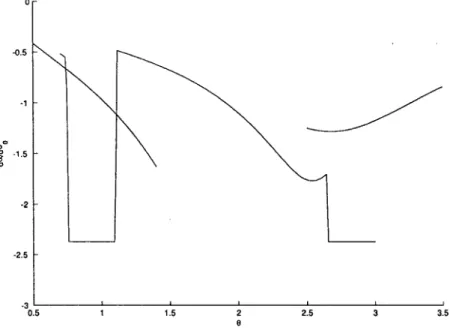
Figure
1.1:
Optimal
contract.
<r0
= 0.91,
\i = 1 and
0 = [2.5,3.5].
0.85
0.7
0.1 0.15
1
0.95
0.9
0.85
O.S
0.75
0.7
0.65
0.6
' \
-\
\ "o
\
i i i i
^
O 0.2 0.4 0.6 0.8 1 1.2 1.4 1.6 1.8
Figure 1.3: Optimal contract. oç> = 0.91, /x = 1 and © = [0.5,1.4].
0.2 0.3 0.4 0.5 0.6 0.7
Figure 1.4: Risk x incentives, <jq = 0.91, \i = 1 and 6 = [0.5,1.4].
0.75
0.65
1.5
Figure
1.5:
Optimal
contract.
oQ
= 0.91,
/x = 1 and
G = [0.7,3.0].
_i 1
0.05 0.1 0.15 02 025 0.3 0.35 0.4 0.45 0.5
Figure 1.7: Exogenous risk x incentives.
Chapter
2
Do
dividends
signal
more
earnings?
Abstract
Signaling models have contributed to the corporate finance literature
by formalizing "the informational content of dividends" hypothesis.
How-ever, these models are under criticism of empirical literature, as weak
evidences were found supporting one of the main predictions: the positive
relation between changes in dividends and changes in earnings. We claim
that the failure to verify this prediction does not invalidate the signaling
approach. The models developed up to now assume or derive utility
func-tions with the single-crossing property. We show that signaling is possible
in the absence of this property and, in this case, changes in dividend and
2.1
Introduction
The information content of dividends is a controversial issue in corporate
fi-nance. The research started when Miller and Modigliani (1961) suggested that
managers use dividend policy to convey their expectations of future prospects
of the firm. With this hypothesis they proposed to explain the effect of div
idend changes on the prices of shares. Since then. theoretical and empirical
research advanced. Signaling models were the main tool that formalized the
original intuition. Bhattacharya (1979), Miller and Rock (1985), and John and
Williams
(1985)
were
the
initiators
of a long
list
of signaling
models1.
The
basic
idea is that firm managers possess private information about future earnings
and they like to convey it to the market. However, they cannot simply announce
their expectations of future earnings publicly because every firm could imitate
them. The information is conveyed by a costly signal. In the cited models,
the respective costs are: financing of a committed levei of dividend, suboptimal
investment and tax on dividends.
On the empirical side, researchers tries to verify the testable implications
derived from the models. In ali these models the single-crossing property holds.
As a consequence, the models predict that dividends, market price and future
or current earnings are positively related. The correlation between dividend
and returns was a strongly established result even before the signaling models
have appeared. Aharony and Swary (1980) show that announcements of
divi-'See AUen and Michaely (1995) for a survey on theoretical and empirical issues on dividend
policy.
dend increases or decreases result in, respectively, positive or negative abnormal
returns.
The controversy lays on the relationship between dividends and subsequent
earnings. Watts (1973) analysis found the positive relation, however, the effect
was very small and not conclusive. Healy and Palepu (1988) found a
signif-icant relation, but they focused in the particular situation of initiation and
omission of dividend payment. Exploring a larger data set Benartzi, Michaely
and Thaler (1997) found no significant relation between dividends and future
earnings and concluded that dividends are more related to past and present
earnings. More recently, Nissim and Ziv (2001) using an improved measure of
future earnings concluded that dividends matters for earnings prediction. Many
other works contributed to this debate and a definitive conclusion seems far to
be reached.
We claim that the lack of a clear relation between dividends and earnings
is not incompatible with information content of dividends. Common to ali the
previous models of signaling is the existence of single-crossing in the objective
function of manager, i.e., the marginal cost of signaling is monotonic in the
type of firms. This property generates the monotonic relationship between
dividends and earnings. In this work, we drop this assumption and develop
a model employing the techniques presented in Araújo and Moreira (2001a).
In non-single-crossing signaling, a new kind of equilibrium may exist. In this
equilibrium the relation between firms earnings and dividends is U-shaped, so
types pretending to be high types. The market value of shares is an average of
the values of two types and increases with dividend. So, signaling models may
provide a positive relation between dividends and market price and, at same
time, an ambiguous relation between dividends and earnings.
The model is presented in Section 2.2 and it is similar to the model of Miller
and Rock (1985). For concreteness, we assume a quadratic production function,
in Section 2.3, and discuss an example. Computations are performed for a range
of parameters values and results are presented in Section 2.4. We comment the
connections with the empirical literature in Section 2.5. The conclusions are
presented in Section 2.6.
2.2
The
Model
This model builds on Miller and Rock (1985). There is a firm with production
function F(-). The usual properties, F'(-) > 0 and F"(-) < 0, are assumed. Let
X and Y be the earnings, respectively, at period 1 and 2. At the beginning
of period 1, managers know X and announce dividends, D. Then shareholders
may sell their shares, dividends are distributed and X D are invested. At the
end of period 1, the firm production is subject to a multiplicative shock, 6 > 0,
so that
Y = 6F(X - D),
where 0 < D < X. At period 2 the earnings are distributed and the firm is
disassembled. We assume the firm cannot issue debt and investments have to
be financed exclusively by internai resources. The information asymmetry is on
the
knowledge
of X,
which
we
assume
randomly
distributed
on
[Xi,.?^],
with
density p(X). Consistent with the terminology used in theory of contracts,
we
refer
to
X
as
the
type of
the
firm.
At
period
1, managers
know
X
before
the dividend announcement, but the market does not, and managers cannot
credibly
convey
their
private
information
to the
market.
The
shock
8 is unknown
to both manager and market, but may be correlated with X.
Both
X
and
8 affect
the
value
of firm.
Now
suppose
the
manager
has
an
estimate
of
5 based
on
private
information
in
period
1.
If managers
are
inter-ested
on
market
value
of firm,
they
would
like
to sign
X
and
8 when
the
implied
value
is high.
The
signaling
of
X
is clear.
If a firm
pays
more
dividends,
it
incurs
in increasing
costs
due
to
underinvestment.
Since
higher
type
firms
have
higher
earnings,
their
sacrifice
in output
is lower
for
the
same
levei
of dividend.
The
decreasing
cost
of
dividend
allows
signaling
in
a way
that
higher
types
signal
with
higher
dividends.
Also,
they
would
like
to
reveal
8 to
the
market
but,
in
this
case,
the
signaling
is not
possible.
They
cannot
signal
high
pro-ductivity
distributing
more
dividends,
as
high
8 firms
has
higher
marginal
cost
of
dividend
because
optimal
investment
levei
is higher
and
sacrifice
in
output
is higher.
On
the
other
side,
a high
8 firm
cannot
signal
higher
investment
opportunity
paying
less
dividends
because
low
8 firms
could
imitate
paying
low
dividends.
However,
we
will
show
that
if X
and
8 are
correlated,
the
shock
in
productivity
may
produce
a signaling
in
which,
for
a subset
of
firms,
dividend
Assumption 1 The shocks are correlated,
E[6\X] = e(X) > 0.
2.2.1 The Value of the Firm
At period 1, managers estimate the fundamental cum-dividend value of the firm
as the present value of dividend flow:
V(X,
D) = D + ^-
E[8F{X
- D)\X]
^D).
(1)
Under symmetric information, this would be the value of shares and the
manager would choose the investment in order to maximize V. The first-best
dividend levei, D*, would be given by the Kuhn-Tucker conditions:
= 0, if D* > 0,
F'(X - D*)
-e(X)
(2)
> 0, if D* = 0.
But under asymmetric information, the market value may not coincide with
V. Let Vm denote the market value. We will assume that Vm is determined as
a signaling equilibrium, that is, firms signal to the market by the choice of div
idend levei and market estimates the value observing the dividend choice. The
firms will choose dividend above the optimal levei, paying an underinvestment
cost for signaling.
Shareholders want to maximize V if they keep the share with them until
period 2. The ones who intend to sell at period 1 prefer the maximization of the
market value, Vm. As in Miller and Rock (1985), we assume the firm's managers
are maximizing a welfare function that aggregates the interests of shareholders
that
desire
to
sell
the
shares
and
the
ones
who
do
not.
Let
k
(0,1]
be
the
fraction of shareholders that sell at period 1. This fraction is exogenous and can
be motivated by necessity of liquidity by shareholders. The welfare function is
W(X, D, Vm) = kVm + (1 - k)V(X, D).
For the purpose of signaling analysis, we are interested on marginal rate of
substitution between Vm and D. Since W is quasi-linear with respect to Vm,
ali the properties are found in marginal welfare of D,
W
D(X,
D) = (l-
k) (l -
-^-The dependence of productivity shock on type may make Wq non-monotone
on
type.
More
precisely,
higher
X
increases
e,
but
reduces
F',
for
the
same
levei of dividend.
In terms of the cross-derivative of W,
WXD(X,
D) = \^
[s(X)F"(X
-D)-
e'(X)F'(X
- D)]
,
(3)
may
change
its
sign.
We
can
define
two
regions
in
X
x D
plane,
according
to
this sign.
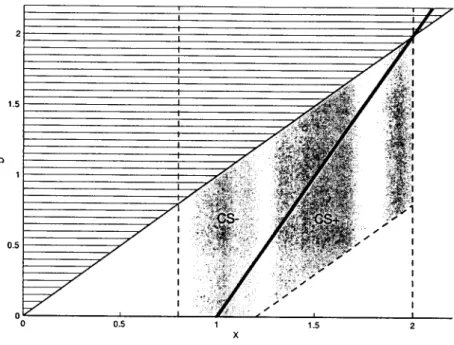
Definition 1 The CS+ region (resp. CS- region) is the set ofpoints inXxD
plane
such
that
Wxd
> 0 (resp.
Wxd
< 0).
In equation (3), the first term in the brackets is the investment effect. Firms
with higher earnings invest more and have lower marginal product.
Conse-quently, the marginal cost of dividend is lower for higher types. The second
Negative correlation between earnings and productivity
When e'(X) < 0, higher earnings reduce the expected productivity and the
cost of signaling is lower. Welfare function has the single-crossing property
since both productivity and investment effects collaborate on Wxd > 0. The
results are, therefore, similar to the ones found by Miller and Rock (1985).
Positive correlation between earnings and productivity
If e'(X) > 0, higher earnings correspond to a higher optimal investment levei
and dividend becomes costlier since more earnings should be retained for in
vestment. If, for some types and dividend levei, productivity effect dominates,
then Wxd < 0 and higher types will be more reluctant to pay dividends
be-cause of lost of investment opportunities. Conversely, Wxd > 0 holds when
investment effect dominates. In this case, lower types are more reluctant to pay
dividends because they have lesser investment resources. Note that from (2)
the first-best dividend as a function of types, D*(X), is increasing for Wxd > 0
and decreasing for Wxd < 0. If investment effect dominates, firms with higher
earnings may pay more dividends and, if productivity effect dominates, they
should invest more paying less dividends. When e'{X) > 0 is such that the
signal of Wxd is ambiguous, the single-crossing propriety does not hold. The
assumption on the constancy of sign (for instance in Riley (1979)) for
cross-derivative of objective function is then violated and we need another approach
developed in Araújo and Moreira (2001a,b).
An alternative setting, without the multiplicative shock, would be to assume
that the production function has increasing returns for low leveis of investment
and
decreasing
returns
otherwise.
In this
case,
Wxd
= \^F"{X
D)
and,
consequently, marginal cost of dividend increases with earnings only for firms
in increasing returns.
2.2.2 The Signaling Equilibrium
As usual, the signaling equilibrium is a perfect Bayesian one (the formal
de-finition is provided in appendix 2.A.1). The basic description remains. The
market generates a value function, Vm(-), and each type of firm, X, chooses a
dividend levei, D, that maximizes W. We have an equilibrium if zero expected
profit condition holds, that is,
Vm(D)
= Eli[V(X,D)\D],
(4)
where EM denotes the expectation taken on the Bayesian updated distribution
on X. The market value Vm should be the expected value of the firm with
respect to the probability distribution of X, resulting from the Bayesian update
given the choice of D by the firm.
Formally, the signaling problem consists in finding functions VTn{X) and
V{X) such that the type X firm chooses a dividend levei V{X) and is evaluated
as Vm(X)
by
the
market.
Since
dividends
and
market
value
are
linked
by
Vm(-),
these functions are related by Vm(X) = Vm{V{X)).
Define the welfare of type X firm that declares to be type X as
W(X,X) = W(X,V(X),Vm(V(X)))
In order to be incentive compatible, each firm should prefer to tell the truth,
that is
W(X,X)>W(X,X), (5)
for ali X,X G [Xi,^]. A differential equation for V is derived from the first
order condition
^X,X)
= 0.
(6)
It should be noted that the first order condition is not sufncient condition
for implementability when single-crossing property does not hold. Incentive
compatibility should be checked globally after a candidate for equilibrium is
obtained.
Additionally, the second order condition constrains V(X):
Proposition 1 In signaling equiHbrium, T>(X) is non-decreasing in CS+
re-gion and non-increasing in CS region.
Proof: See the appendix.
When single-crossing property is present, CS+ and CS do not show up
simultaneously and contracts should be monotone. As a consequence, types are
separated when V(X) ^ 0, or a interval of types is bunched when V{X) = 0.
When single-crossing property does not hold, monotonicity is not assured and
the relationship between type and signal may be, for example, U-shaped and a
disconnected set of types may signal with the same dividend levei.
2.2.3 Equilibria Diversity
In a equilibrium, the same signal, D, may be chosen by many types. We are
interested in classifying the equilibrium according to its degree of separability.
The following definition will be useful:
Definition 2 The pooling set, Q(D), is the set of types whose signal is D, that
In particular, in a separating equilibrium, Q(D) is singleton for every D
that is chosen by a firm.
Definition 3 The type X is separated ifQ(V(X)) {X}. A separating equi
librium is a signaling equilibrium such that every X is separated.
When X is separated, market correctly infers the type by the observation
of D. So Vm{D) = V(X,D), where X is the type that choose dividend levei
D.
Proposition 2 In an interval of separated types, V(X) follows the differential
equaüon
vD(x,v(x))
(7)
Proof: See the appendix.
As in the single-crossing case, a pooling equilibrium may be characterized
by a continuum of types that chooses the same signal levei.
Definition 4 The type X is continuously pooled, if QÇD(X)) is a continuous
In signaling games without single-crossing condition, a new kind of pooling
arises. As in the continuous pooling, some values of D will be chosen by more
than one type of firm. However, the number of pooling types may be finite.
Definition 5 The type X is discretely pooled, if Q(V(X)) is a discrete and
finite set.
The property aggregating the discretely pooled types is that they must have
the same marginal welfare
Proposition
3 IfXa
and
Xb
are
discretely
pooled
and
D = V{Xa)
= V{Xb)
^
0, then
WD(Xa,D)
= WD{Xb,D).
(8)
Proof: See the appendix.
Equation (8) gives e(Xa)F'(Xa - D) = e(Xb)F'(Xb - D). So different
types can choose the same levei of dividend when, for higher types, the higher
productivity shock compensates the reduction in marginal productivity resulted
from higher investment. In the discrete pooling, dividend choice does not fully
reveal the type of the firm. The market knows the set of possible types but
it cannot distinguish one type from the other. This fact is taken into account
when the market estimates the value, so EM[V(X,D)|D] is the average value of
types in the pool.
Assumption 2 The type X is uniformly distributed on the interval [X
With Assumption 2, each type has the same probability. In particular, when
there are only two types in the pool, the expected value of firms is
E»\y(X,D)\D]
= \v{Xa,D)
+ \v{Xb,D),
where Xa and Xb are the types that choose D.
Proposition 4 Under Assumption 2, in a interval with discretely pooled types,
if exactly two types chooses the same dividend, T>(X) follows the differential
equation
v
WX(X(X,V),V)XD(X,V)
where X(X,D), derived from (8), is the type pooled together with type X, when
dividend D is chosen.
Proof: See the appendix.
2.2.4 Equilibrium Refinement
The disturbing fact in any signaling model is the existence of many equilibria.
For the same parameters, different kinds of equilibrium may exist, and the
choice of initial conditions may generate a continuum of equilibria. At this point
a selection criterion is needed. The pro-separation equilibrium, defined below,
choose, among different kinds of equilibria, the one that minimizes pooling and
maximizes efHciency.
Assumption 3 Separability degree of a continuous pooled type, a discretely
Therefore 11(1) is the set of continuously pooled types, 11(2) is the set of
discretely pooled types and 11(3) is the set of separated types.
Definition 7 The separation floor of a signaling equilibrium is the lowest
sep-arability degree associated to a type in
[X\,X2]-Definition 8 A proseparation equilibrium is a signaling equilibrium with
sepa-rating floor cp, such that (a) there is no other equilibrium with higher separation
floor; (b) among equilibria with same separation floor, there is no other with
lower probability ofH((p), according to density p(-); and (c) among equilibria
with same separation floor and same probability ofH(ip), there is no other equi
libria with higher expected value, according to density p(-).
Therefore, pro-separation equilibrium criterion chooses an equilibrium
elim-inating poorly separated equilibria and taking the most efficient among the
surviving equilibria.
2.3
The
Quadratic
Case
For the computations we consider a quadratic production function
I), (10)
where 0 < I < 6/2, a > 0, and b > 0. We assume a linear expected productivity
shock
e(X)=g + hX, (11)
where h > 0.
![Figure 1.1: Optimal contract. <r0 = 0.91, \i = 1 and 0 = [2.5,3.5].](https://thumb-eu.123doks.com/thumbv2/123dok_br/15628200.108974/34.892.209.708.197.549/figure-optimal-contract-lt-r-and.webp)
![Figure 1.3: Optimal contract. oç> = 0.91, /x = 1 and © = [0.5,1.4].](https://thumb-eu.123doks.com/thumbv2/123dok_br/15628200.108974/35.892.206.659.203.542/figure-optimal-contract-oç-gt-and.webp)
![Figure 1.6: Risk x incentives. a0 = 0.91, /x = 1 and 0 = [0.7,3.0].](https://thumb-eu.123doks.com/thumbv2/123dok_br/15628200.108974/36.892.204.664.679.1042/figure-risk-x-incentives-a-x.webp)