International Journal of Engineering Research ISSN:2319-6890)(online),2347-5013(print) Volume No.4, Issue No.4, pp : 203-205 01 April 2015
IJER@2015 Page 203
To Determine Impact of Shape of Course Aggregate on DBM Mix
Vaniyapurackal Jilu Joseph
Infrastructure Engineering, LDRP-ITR , Gandhinagar, Gujarat.
[email protected]
Abstracts: Aggregates are the principal material in pavement construction. The shape of aggregate particle has significant influence on performance of the Bitumen pavement. The strength serviceability requirements of Bitumen mixes such as stability, flow, voids in mineral aggregate , voids filled with bitumen and air voids are highly depend on the physical properties of aggregate.
Key Words: coarse aggregate, aggregate shape, DBM ,VMA,VFB
I. I nt r o d uc t i o n
The shape of aggregate particle has a significant influence on the performance of the bituminous pavement. Particle shape can be described as cubical, flat, elongated and round. The presence of flaky aggregates is considered as undesirable in bituminous mixtures because of their tendency to break down during construction and subsequent traffic operations. The voids present in a compacted mix depend on the shape of aggregates. Highly flaky aggregates have more voids and reduce the workability. Hence it was felt that the study on the effect of the flaky aggregates on bituminous mixtures is relevant and essential. Need of study: For the academic purpose studies and experiment has revealed that aggregate shape has effect on percentage voids ratio, percentage bitumen content and performance of the mix under applied load condition.
To evaluate the influence of shape of aggregate on Dense Bituminous Macadam the various individual properties of materials (Aggregates & Bitumen) are determined.
Objectives: To study the shape effect of aggregate particles & to examine their influence on the behaviour and performance characteristics of Dense Bituminous Macadam mix.
Scope Of Work: In order to this study, the performance behaviour of DBM mix with coarse aggregate of different shape experimental work need to be conducted is as bellow.
Marshall Stability
Marshall Flow
Density
%Voids in mix
% Voids in mineral aggregate
% Voids fill with bitumen
II. Material and Methodology 1. Selection of Materials
2. Test on aggregate & bitumen 3. Preparation of JMF (MoRTH-2004) 4. Marshall Mix Design (MS-2) 5. Experimental Work and Analysis
Bitumen content vs Marshall Stability
Bitumen content vs Marshall Flow
Bitumen content vs Density
Bitumen content vs VIM
Bitumen content vs VMA
Bitumen content vs VFB 6. Optimum Bitumen Content 7. Conclusion and Suggestion
Experimental Work: The aggregates used in this study were 16-25 mm, 7-16 mm, 4-7 mm and 0-4. Bitumen of penetration grade 60/70 was used. The properties of the materials used are given in Table 1 and Table 2.
Marshal Stability: The variation of stability with increase in Binder content is shown below. It is observed that stability increases to certain point, further increase in bitumen content the stability decreases in all case.
Marshall Flow
The variation of flow value with increase in binder content is shown below It is observed that flow value increases with increase in proportion of binder content.
Percentage Air Voids:The variation of Va with increase in binder content is shown below. It is observed that Va decreases
International Journal of Engineering Research ISSN:2319-6890)(online),2347-5013(print) Volume No.4, Issue No.4, pp : 203-205 01 April 2015
IJER@2015 Page 204
Voids in Mineral Aggregate :
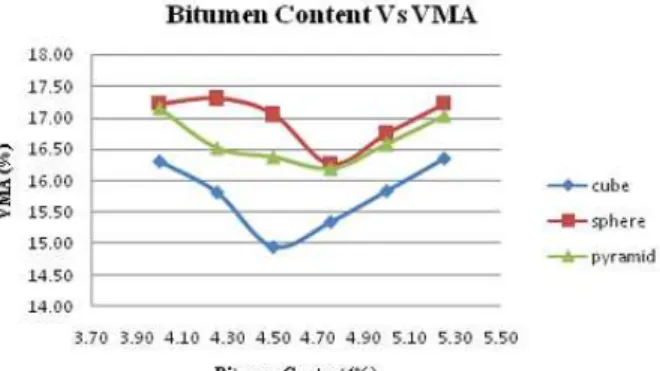
The variation of VMA with increase in binder content is shown below It is observed that VMA decreases with increase in proportion of binder content to the certain point then after it is increase with increase in proportion of bitumen content.
Conclusion:
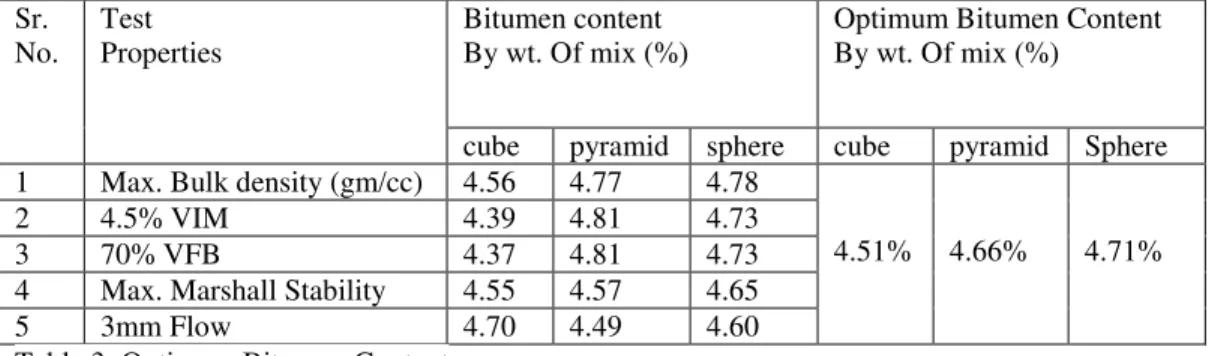
To achieve economy considering minimum % bitumen content with maximum stability, bulk density and optimum flow (3mm to 6mm) the most suitable shape of aggregate appears to be cubical through our experimental study.
Acknowledement
This is the place to admit that while there appears only one author on the cover, this work is a product of the interaction and support from many people. I am thankful to all of them specially my parents & friends for their help and support during my entire work.
References:
i. MINISTRY OF ROAD TRANSPORT AND
HIGHWAY (2004)
ii. MS 2
iii. IS 2386 (part-1)-1997, Methods of test for aggregate for concrete, part 1, particle size and shape.
iv. IS 2386 (part-3)-1997, Methods of test for aggregate for concrete, part 3, specific gravity, voids, absorption and bulking.
v. IS 2386 (part-4) – 1997, Methods of test for aggregate for concrete, part 4, mechanical properties.
vi. IS 73 - 1998, Paving Bitumen – Specification. vii. IS 1202 – 1978, Methods for Testing Tar and Bituminous Materials: Determination of Specific Gravity.
viii. IS 1203 – 1978, Methods for Testing Tar and Bituminous Materials: Determination of Penetration.
ix. IS 1205 – 1978, Methods for Testing Tar and Bituminous Materials: Determination of Softening Point.
x. IS 1206 – 1978, Method fot Testing Tar and Bituminous Materials: Determination of Viscosity.
xi. IS 1208 – 1978, Methods for Testing Tar and Bituminous Materials: Determination of Ductility.
xii. IS 1209 – 1978, Methods for Testing Tar and Bituminous Materials: Determination of Flash Point and Fire Point.
xiii. IS 2386 (part 5) – 1963, Method of test for Aggregates for concrete.
xiv. IS 6241 – 1971, Method of Test for Determination of Stripping Value For Road Aggregate.
xv. OVERSEAS ROAD NOTE 31
Sr no.
Test Test
method
unit Test results (mm)
16-25 7-16 4-7 0-4
1 Aggregate Impact value
IS:2386 % - - - -
2 Water Absorption IS:2386 % 0.445 0.698 0.972 1.760 3 Specific gravity IS:2386 - 2.869 2.846 2.822 2.675 4 FI & EI IS:2386 % 21.07
Table 1 Physical Properties Of Aggregate
1 Penetration IS:1203 Mm 63
2 Ductility IS:1208 Cm 82.33
3 Specific Gravity IS:2386 - 1.020
4 Softening Point IS:1203 0C 50.5
5 Flash Point IS:1209 0C 239
International Journal of Engineering Research ISSN:2319-6890)(online),2347-5013(print) Volume No.4, Issue No.4, pp : 203-205 01 April 2015
IJER@2015 Page 205
Sr. No.
Test Properties
Bitumen content By wt. Of mix (%)
Optimum Bitumen Content By wt. Of mix (%)
cube pyramid sphere cube pyramid Sphere 1 Max. Bulk density (gm/cc) 4.56 4.77 4.78
4.51% 4.66% 4.71%
2 4.5% VIM 4.39 4.81 4.73
3 70% VFB 4.37 4.81 4.73
4 Max. Marshall Stability 4.55 4.57 4.65
5 3mm Flow 4.70 4.49 4.60