Assessing the Utility of Hydrogen, Carbon
and Nitrogen Stable Isotopes in Estimating
Consumer Allochthony in Two Shallow
Eutrophic Lakes
Jari Syväranta1,2*, Kristin Scharnweber1,3, Mario Brauns1,4, Sabine Hilt5, Thomas Mehner1
1Department of Fish Biology and Ecology, Leibniz-Institute of Freshwater Biology and Inland Fisheries, Berlin, Germany,2Lake Ecology Section, Department of Bioscience, Aarhus University, Silkeborg, Denmark,3Evolutionary Biology Centre, Department of Ecology and Genetics; Limnology, Uppsala University, Uppsala, Sweden,4Department of River Ecology, Helmholtz Centre for Environmental Research -UFZ, Magdeburg, Germany,5Department of Ecosystem Research, Leibniz-Institute of Freshwater Biology and Inland Fisheries, Berlin, Germany
Abstract
Hydrogen stable isotopes (δ2H) have recently been used to complementδ13C andδ15N in food web studies due to their potentially greater power to separate sources of organic mat-ter in aquatic food webs. However, uncertainties remain regarding the use ofδ2H, since little is known about the potential variation in the amount of exchangeable hydrogen (Hex)
among common sample materials or the patterns ofδ2H when entire food webs are consid-ered. We assessed differences inHexamong the typical sample materials in freshwater
studies and usedδ2H,δ13C andδ15N to compare their effectiveness in tracing allochtho-nous matter in food webs of two small temperate lakes. Our results showed higher average amounts ofHexin animal tissues (27% in fish and macroinvertebrates, 19% in zooplankton)
compared to most plant material (15% in terrestrial plants and 8% in seston/periphyton), with the exception of aquatic vascular plants (23%, referred to as macrophytes). The amount ofHexcorrelated strongly with sample lipid content (inferred from C:N ratios) in fish
and zooplankton samples. Overall, the three isotopes provided good separation of sources (seston, periphyton, macrophytes and allochthonous organic matter), particularly theδ2H followed byδ13C. Aquatic macrophytes revealed unexpectedly highδ2H values, having more elevatedδ2H values than terrestrial organic matter with direct implications for estimat-ing consumer allochthony. Organic matter from macrophytes significantly contributed to the food webs in both lakes highlighting the need to include macrophytes as a potential source when using stable isotopes to estimate trophic structures and contributions from allochtho-nous sources.
a11111
OPEN ACCESS
Citation:Syväranta J, Scharnweber K, Brauns M, Hilt S, Mehner T (2016) Assessing the Utility of Hydrogen, Carbon and Nitrogen Stable Isotopes in Estimating Consumer Allochthony in Two Shallow Eutrophic Lakes. PLoS ONE 11(5): e0155562. doi:10.1371/journal.pone.0155562
Editor:Rafael Vazquez-Duhalt, Center for Nanosciences and Nanotechnology, MEXICO
Received:October 16, 2015
Accepted:April 29, 2016
Published:May 11, 2016
Copyright:© 2016 Syväranta et al. This is an open access article distributed under the terms of the Creative Commons Attribution License, which permits unrestricted use, distribution, and reproduction in any medium, provided the original author and source are credited.
Data Availability Statement:All relevant data are within the paper and its Supporting Information files.
Funding:This study was financed by the TERRALAC-project of the
Wissenschaftsgemeinschaft Leibniz (WGL) to SH and TM. JS was supported by the IGB Fellowship program in Freshwater Science and by the Marie Skłodowska-Curie actions fellowship (660655) under the EU Horizon 2020 funding programme.
Introduction
Stable isotope analysis (SIA) is now routinely used to study food webs and energy flow within
aquatic ecosystems. Carbon isotope ratios (δ13C) are often used as tracers of sources of energy
fueling the food webs, while nitrogen isotope ratios (δ15N) are mainly used to quantify trophic
levels of organisms and sources of inorganic nitrogen [1]. SIA studies have provided invaluable
information on the contributions of allochthonous resources [2–6] and methane-derived
car-bon to animal consumers in freshwater food webs [7–10], both features that would be difficult
or often impossible to study using more conventional methods, such as gut content analyses. However, many studies are faced with substantial difficulties in separating potential sources
with sufficient precision due to their overlappingδ13C andδ15N values and/or too many
sources to be separated with only two isotopes. In some cases, enrichment studies, using for
example13C-bicarbonate [4,11–12] or C4plant material such as cane sugar or maize (Zea
mays) [13–15], are a useful way to alter the naturally occurring isotope ratios within the sources
to enhance separation. Unfortunately, these methods are not always applicable due to high costs and effort, and alternative measures are needed.
Following recent advances in methodological issues [16–17], stable hydrogen isotopes (δ2H
orδD) have now become well established tracers, for example in studies of animal migrations,
particularly in terrestrial systems [18–19]. Doucett et al. [20] proposedδ2H as a potential
alter-native toδ13C in tracing allochthonous organic matter contributions in aquatic food webs by
showing that theδ2H provided a greater separation between terrestrial and aquatic production
in arid lotic systems. This stems from the fact thatδ2H values in terrestrial plants are
consider-ably elevated due to additional discrimination during the transpiration [21], which is not
observed in aquatic plants. Differences inδ2H values between terrestrial and aquatic
produc-tion can exceed 100‰, particularly in arid environments [20], but substantial separation is also
possible in more mesic environments [22–23]. Therefore,δ2H values are currently widely
employed in many aquatic food web studies, but particularly in tracing allochthonous
contri-butions in freshwater ecosystems [23–27].
However, the use ofδ2H has several caveats that can reduce its robustness in food web
stud-ies. Over 20% of the H bound in organic sample material can be freely exchangeable with H in
ambient water vapor [16]. While the issue of exchangeable H (Hex) in analytical procedures
can now efficiently be controlled for, there is still substantial lack of knowledge about
differ-ences in the amount ofHexamong sample materials. The amount ofHexin some tissues, like
keratin, is rather well known and consistent [17] but less is known about the fraction in many
other tissues, even though these are continuously used inδ2H studies. This uncertainty in the
amount ofHexpotentially has serious implications for sample treatment, standardization and
results interpretation [28]. Consumers also acquire part of their tissue H from
dietary/environ-mental water, as shown in several controlled experiments [29–33], which complicates
infer-ences of the origin of organic matter supporting consumers. Particular uncertainties remain on the influence of environmental water when whole food webs and multiple trophic levels are considered, as the influence of environmental H may multiply at higher trophic levels. In fact,
studies usingδ2H on an entire food web scale are still very rare. Furthermore, there is
consider-able debate on whether and to what extent discrimination inδ2H values occurs during trophic
transfers [18,22,30–31]. Discrimination likely results from the increased intake of
environ-mental water but can potentially be masked by the substantial influence of lipids on tissueδ2H
values. Lipids are highly depleted in2H [34–35] and may haveδ2H values as much as 100‰
lower compared to other body tissues [18,32], having a substantial influence on bulk tissue
[16,36] potentially complicating sample preparation procedures among samples with variable lipid contents.
Another potential concern arises from recent evidence of surprisingly elevatedδ2H values
in aquatic macrophytes [37–38]. The significance of macrophytes (aquatic vascular plants) as
an energy source for aquatic consumers has long been debated [39–41], and strong evidence
exists for their dietary role especially for benthic consumers [41–44]. Reportedδ2H values of
macrophytes have been considerably higher than those in algal (phytoplankton or attached
algae) production in the same system, approaching theδ2H values analyzed from terrestrial
plants. Such overlappingδ2H values between autochthonous macrophytes and allochthonous
terrestrial primary producers might severely undermine the robustness of using H isotopes to trace the contributions of allochthonous matter in aquatic food webs, particularly in systems with potentially significant contribution of macrophyte-derived organic matter to consumers.
Here we first compared the amounts ofHexamong all our sample materials to assess
whether the commonly used keratin standards are suitable for analyzes ofδ2H of typical
aquatic organisms. We then elucidated entire food web structures using stable isotopes of hydrogen, carbon and nitrogen and assessed their suitability in tracing the contributions from allochthonous organic matter in food webs of two small temperate lakes. We estimated allochthonous contributions to consumers using isotope mixing models and employed either
δ13C andδ15N values orδ13C,δ15N andδ2H values to assess the added value ofδ2H in
temper-ate lowland lakes. In addition, we evalutemper-ated the importance of macrophytes in estimating allochthonous organic matter contributions by running mixing models with and without mac-rophytes as one potential source.
Materials and Methods
Samples were collected from two eutrophic, shallow lakes located in North-Eastern Germany during summer 2010. Kleiner Gollinsee (hereafter referred to as Gollinsee) has an area of 3.3
ha, mean depth of 1.7 m, total phosphorus (TP) concentration of 42μg l-1and dissolved
organic carbon (DOC) concentration of 12.3 mg l-1. Gollinsee is turbid (light attenuation:
1.2 ± 0.1 m-1) and dominated by phytoplankton whereas Schulzensee (3.9 ha, 2.3 m, TP 34μg
l-1and DOC 11.3 mg l-1, respectively) has higher water clarity (light attenuation: 0.7 ± 0.1 m-1)
and approximately 22% of the lake area is colonized by submerged macrophytes (
Ceratophyl-lum submersum) [45]. Both lakes are surrounded by alder trees (Alnus glutinosa) and reed
stands (Phragmites australis), the latter contributing significantly to the C influx of both lakes
[44]. Floating-leaved macrophytes (Nymphaea albaandNuphar lutea) are growing in both
lakes and cover 3% of the lake area in Gollinsee and 12% in Schulzensee [46]. Roach (Rutilus
rutilus) was the dominant fish species in both lakes accounting for almost two-thirds of fish
biomass, while sunbleak (Leucaspius delineatus) was highly abundant only in the turbid lake
after a partial winterkill [47].
Aquatic plant samples (phytoplankton/seston, attached algae and macrophytes,n= 13) and
terrestrial plant material (n= 6) were collected in June 2010 to analyze H, C and N stable
iso-tope values in potential sources of organic matter to the lake food webs. Seston was collected by
hauling a small mesh size (30μm) net slowly behind the boat, picking out all larger
zooplank-ton and detritus, diluting the cleaned sample into larger volume of water followed by further separation by sedimentation and drying in an oven. Periphyton was collected by scraping sam-ples from floating and submerged macrophytes and from artificial polypropylene slides sub-mersed into the lake. Periphyton samples were then picked clean from all visible animal and
detritus particles, and dried in an oven. Aquatic macrophyte samples (C.submersum,N.alba
clean and cut into smaller pieces, and dried in an oven. Samples from allochthonous organic
matter (allo-om) were taken from birch (Betula pendula) and alder trees and included fresh
and conditioned leaves from the lake littoral (detritus). Fresh and conditioned samples were analyzed separately but did not differ in their isotope values; hence they were all pooled to
rep-resentallo-om.
Zooplankton samples (n= 19) were collected three times (April, June and September 2010)
during summer with several vertical hauls using zooplankton nets (mesh sizes 100 and 55μm)
and replicate samples were collected during each sampling period from different sites. Samples were then brought to the laboratory and left overnight in clean tap water to allow gut evacua-tion. The next day these samples were identified, sorted and dried in an oven for later prepara-tion for SIA. All zooplankton isotope values reported here represent samples of Cladocera comprising almost entirely of Daphniidae and Bosminidae. Benthic macroinvertebrate samples
(n= 33) were collected in spring and summer with sweep-nets from depths of 0.5−1.0 m,
identified visually to either family or genus level, sorted and placed into plastic jars with clean tap water for gut evacuation overnight.
Samples (n= 72) of fish, mainly roach, rudd (Scardinius erythrophthalmus), sunbleak, perch
(Perca fluviatilis) and pike (Esox lucius) were collected throughout the summer with Nordic multi-mesh gillnets. In addition, young-of-the-year (YOY) cyprinid fish juveniles were col-lected with electrofishing in May. Fish were killed after capture and frozen for transport to the laboratory. Fishing was conducted by persons holding the official license for professional fish-ermen in Germany and hence followed the ethical standards and no further permits were needed. Access to and permission to fish in Schulzensee was provided by the Förderverein Feldberg-Uckermärkische Seen e.V. and by the Stiftung Pro Artenvielfalt in Gollinsee. Length and weight were measured and a small muscle sample was dissected from each individual fish. The muscle samples were then dried in an oven for later processing for SIA. In addition to all solid samples, four replicates of approximately 2 ml of lake water were sampled in June ~0.5 m below the lake surface from both lakes, and stored in 2 ml glass vials with air tight caps for later
δ2H analysis of water.
All solid isotope samples were dried in an oven at 60°C and ground into homogenous pow-der using a mortar and pestle. A small subsample (0.6 mg) was then weighed into a tin cup for
the analysis ofδ13C andδ15N at the University of Jyväskylä, Finland, using a FlashEA 1112
ele-mental analyzer coupled to a Thermo Finnigan DELTAplus Advantage mass spectrometer (Thermo Electron Corporation, Waltham, MA, U.S.A.) following standard protocols and
ana-lytical precision better than 0.2‰for bothδ13C andδ15N. Two subsamples (0.4 mg) of each
solid sample were also accurately weighed into silver cups forδ2H analyses. The two different
sample sets forδ2H analysis were used to assess the amount ofH
exin different tissues types.
Since significant part of the tissue H can be exchangeable [16],Hexneeds to be taken into
account when analyzingδ2H from organic materials. Therefore one sample set was
equili-brated in Colorado Plateau Stable Isotope Laboratory (CPSIL) ambient lab air withδ2H value
-91 ± 8‰(monthly average for given analysis month) and the other set under water vapor
with aδ2H value +354 ± 1.3‰following Wassenaar & Hobson [17]. The fraction ofHexwas
then calculated fromf(Hex) = (δ2Hsample1—δ2Hsample2) / (δ2Hwater1—δ2Hwater2), where sample1
and sample2 are theδ2H values for the same sample after equilibration in water vapor with
two differentδ2H values and water1 and water2 are theδ2H values of the water vapor [16,36,
48–49].
All hydrogen isotope analyses from organic sample material were performed at CPSIL.
Sam-ples of organic materials were pyrolized to H2and the isotope ratio was measured on the H2
gas [20]. Organic matter samples forδ2H were analyzed with a Thermo-Finnigan TC/EA and
(Caribou hoof) and KHS (Kudo horn) as normalization standards [16–17], and several
second-ary standards (Moose hair, Baleen BWB-II, Chitin TCI, Colorado River algae and IAEA-085). Hydrogen isotopes from water samples were analyzed by Laser Water Isotope Analyzer V2 (Los Gatos Research, Inc., Mountain View, CA, USA) at UC Davis Stable Isotope Facility. All
values are reported in per mil notation (‰) and are in relation to the international standard of
Vienna Standard Mean Oceanic Water (δ2H
VSMOW). Analytical precision forδ2H of solid
sam-ples was<3‰and for water<1‰.
We used R 2.15.2 [50] and Bayesian mixing models in the SIAR (Stable Isotope Analysis in
R) package [51] to calculate the proportion of different carbon sources to consumer tissues.
We calculated allochthonous organic matter contributions using both a two-isotope (CN,δ13C
andδ15N) and a three-isotope model (HCN,δ2H,δ13C andδ15N) with periphyton, seston,
allo-om and macrophytes as sources for primary consumers, and a HCN model with and with-out aquatic macrophytes as one potential source, to compare the results and the impact of using more isotopes and sources. While we were primarily interested in assessing the utility of
hydrogen isotopes to trace the flow of allochthonous organic matter in aquatic food webs [20],
we did not simply divide the potential energy sources into autochthonous and allochthonous origins but rather wanted to use all three isotopes to illustrate the structure of the entire food
web in these lakes. For these models, we assumed no trophic discrimination forδ2H, but
con-servative 0.5 ± 0.2‰forδ13C and 3.0 ± 0.5‰discrimination forδ15N [52]. However, the H in
environmental (or dietary) water directly influences consumerδ2H [18,30], which needs to be
accounted for in the model. We corrected for the dietary water using a modelωcompound= 1—
(1—ω)tfrom Solomon et al. [30], whereωcompoundis the total H contribution from dietary
water to consumer tissueδ2H at trophic levelt, andωis the proportion of tissue H derived
from environmental water (see Wilkinson et al. [28] for a recent review on the potential effects
of selecting suitableω). We usedω= 0.173 from Solomon et al. [30] for all consumers and
esti-mated trophic leveltfor each fish individual from a linear relationship between primary
con-sumer (all invertebrates were assignedt= 2)δ13C andδ15N values in littoral and pelagic
habitats following a model outlined in Karlsson and Byström [53]. The model first estimates
the fraction of littoral carbon in a consumer (LFcons) from pelagic and littoral isotope baselines
(here means of zooplankton/bivalves in pelagic and gastropods/isopods in littoral) from: LFcons
= [δ13Ccons—δ13Cpel−(δ15Ncons—δ15Npel) × TS](1—TS × BS) / (δ13Clit—δ13Cpel), where TS
is the slope of trophic discrimination forδ13C andδ15N (same values as for SIAR above) and
BS is the slope of the linear relationship between the pelagic (pel) and littoral (lit) baselines.
The trophic position of a consumer (t) can then be calculated from:t= 2 + ([δ15N
cons—
δ15Npel—(δ13Clit—δ13Cpel) × BS × LFcons] /ΔN), whereΔN is the discrimination factor for
δ15N. Fish were assumed to acquire allo-om indirectly through their prey and therefore mixing
models of fish used invertebrates (for non-piscivorous fish) and invertebrates and prey fish (for piscivorous fish, i.e. large perch and pike) as prey sources. The estimates of allo-om
contribu-tion were then calculated using ratio calculacontribu-tion from each individual prey source [54,55].
Differences in the amount ofHexamong sample types, and differences in mean
allochtho-nous source contributions using either CN, HCN or no-macrophyte models, were examined using paired t-tests, after testing for normality of paired differences. In cases where the assump-tions for normality and homoscedasticity were violated, we used a non-parametric Kruskal-Wallis test with pairwise comparisons. Multivariate analysis of variance (MANOVA) with
effect size (partialη2) was used to assess how well the isotopes separated sources in these lakes
and overall which isotope had the greatest separating power (strongest effect). Since lipids have
less or negligible amount ofHexcompared to other tissues (e.g. [16,36]), we used sample tissue
ratio and the fraction ofHexwith Pearson’s correlation. All statistical tests were done using
IBM SPSS Statistics 20.0 (IBM Company, Armonk, NY, U.S.A.)
Results
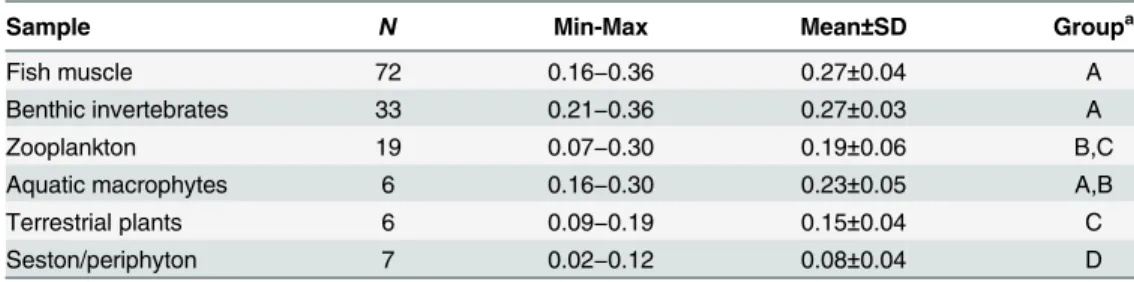
Fish and macroinvertebrates had consistently moreHexin their tissues compared to
zooplank-ton (F5,141= 37.7,p<0.001), while the amount in plant material was highly variable between
aquatic and terrestrial plants (Table 1). Aquatic vascular plants (macrophytes) had significantly
(p<0.05,Table 1) moreHexcompared to both terrestrial plant material and
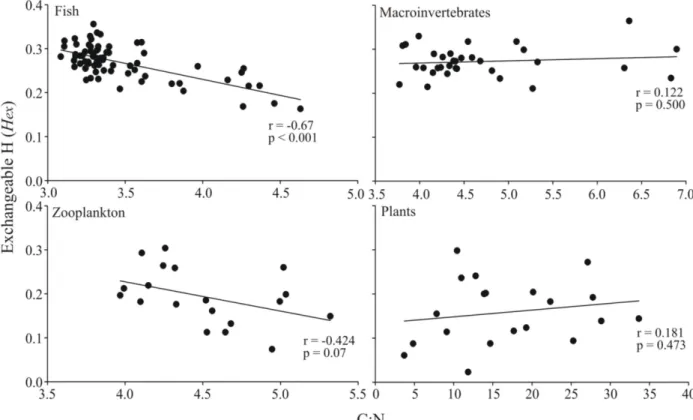
seston/periphy-ton. There was a strong negative correlation (Pearson’sr= -0.67,p<0.001,n= 72) between
the amount ofHexand the C:N ratio of fish muscle tissue (Fig 1), indicating that tissues with
higher lipid content (C:N ratio) have lessHex. Zooplankton had a similar negative correlation
between C:N andHex, but due to lower sample size this correlation was not significant (r=
-0.42,p= 0.07,n= 19). In contrast, both benthic macroinvertebrates and plants showed no
cor-relation between C:N and the amount ofHex(Fig 1).
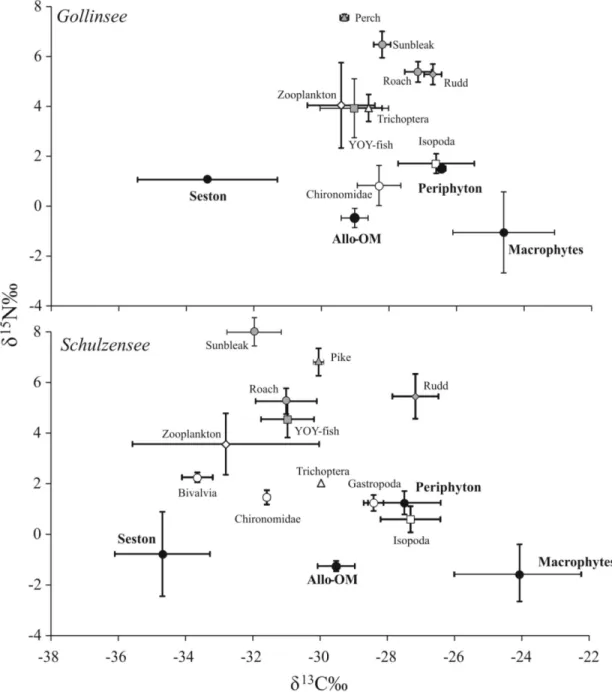
Carbon stable isotope values in Gollinsee and Schulzensee food webs varied roughly by 10‰
with lowestδ13C values (-33 to -35‰) observed in pelagic seston and highest (-24 to -25‰) in
aquatic macrophytes in both lakes (Fig 2). Theδ15N values similarly varied by almost 10‰
from producers to consumers with slightly higher values in pelagic consumers (zooplankton, planktivorous fish) than in more littoral consumers (benthic macroinvertebrates, benthivorous
fish), a pattern often observed in eutrophic lakes (e.g. [58]). The mean isotope values of sources
(i.e. seston, periphyton, allo-om and macrophytes) were similar between the two lakes
(MAN-OVA;p= 0.438) but differed from each other particularly inδ13C andδ2H values. In fact, the
meanδ2H values were clearly distinct and separated (Fig 3), except between seston and
periphy-ton, andδ2H clearly had the highest effect size (F
3,11= 41.5;p<0.001; partialη2= 0.93). Mean
δ13C values also provided a reasonable separation, particularly among seston, allo-om and
mac-rophytes (F3,11= 19.9;p<0.001; partialη2= 0.84), but could not separate periphyton from
allo-om or macrophytes. Only periphyton was separated by its meanδ15N values from other
sources (F3,11= 6.1;p= 0.011; partialη2= 0.62) and overall the values were strongly
overlap-ping. In general, seston and periphyton had the lowest and nearly identical mean (± SD)δ2H
values at -161 ± 0.1‰to -174 ± 3.6‰with very little variation around the mean values.
Allo-om had meanδ2H values ~30‰elevated to seston/periphyton at -143 ± 11‰in Gollinsee and
-137 ± 2‰in Schulzensee, while the most elevated meanδ2H values were observed in aquatic
macrophytes (-107 ± 18‰in Gollinsee and -100 ± 16‰in Schulzensee).δ2H values were not
significantly different among submerged (C.submersum), floating-leaved (N.alba) and
emerged (reed) macrophytes.
Table 1. Fraction ofHexin different sample types.
Sample N Min-Max Mean±SD Groupa
Fish muscle 72 0.16−0.36 0.27±0.04 A
Benthic invertebrates 33 0.21−0.36 0.27±0.03 A
Zooplankton 19 0.07−0.30 0.19±0.06 B,C
Aquatic macrophytes 6 0.16−0.30 0.23±0.05 A,B
Terrestrial plants 6 0.09−0.19 0.15±0.04 C
Seston/periphyton 7 0.02−0.12 0.08±0.04 D
aTissues are grouped (A
−D) into homogeneous subgroups according to multiple comparisons test (Tukey, α= 0.05).
Consumers in both lakes were positioned as expected within theδ13C-δ15N-δ2H space, after
accounting for the environmental water on consumer H, which in Gollinsee had a meanδ2H
value of -33 ± 0.3‰and in Schulzensee -28 ± 0.6‰. The more pelagic consumers were clearly
aligned towards sestonδ13C andδ2H values while the more littoral benthic invertebrates had
higher values and some clearly approached the values of aquatic macrophytes (Fig 3). Rudd, a
known herbivorous fish [59], differed from other fish by its isotope values, particularly in
mac-rophyte-rich Schulzensee (Figs2and3), having isotope values indicative of its consumption of
macrophytes and periphyton, and the highest estimates of allo-om contribution (Table 2).
Calculating mean allochthonous carbon contributions to different consumers in both food
webs using either the CN (δ13C andδ15N) or the HCN (δ13C,δ15N andδ2H) models resulted
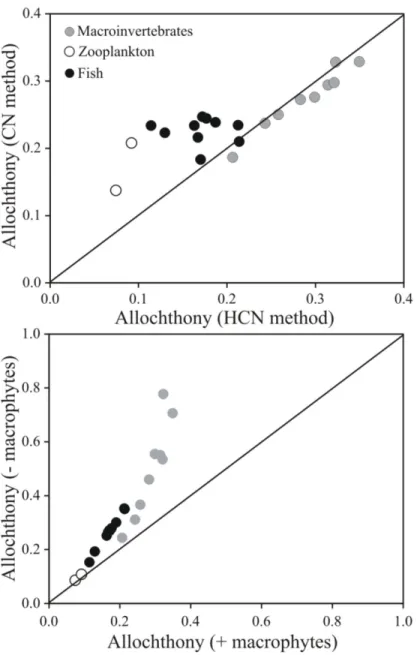
in small and insignificant differences for the macroinvertebrate consumers (paired t-test;
p= 0.85,Fig 4upper panel). Mean allo-om contributions (± SD) to benthic macroinvertebrates
in Gollinsee were 27 ± 5% using CN and 26 ± 7% using HCN and equal in Schulzensee at
28 ± 3% with CN and 28 ± 7% with HCN model (Table 2). Though not statistically significant,
there was more difference in mean allo-om contribution between the two models within zoo-plankton samples; 21% and 14% in Gollinsee and Schulzensee using CN but only 9% and 7%
using HCN, respectively (Fig 4,Table 2). Full mixing model results and reliance of invertebrate
consumers from other carbon sources are provided in a supplementaryS1 Table. Using only C
and N isotopes resulted in similarly higher estimates of mean allo-om contribution to fish
com-pared to HCN (t9= -5.37,p<0.001). Using C and N, the mean contribution of allo-om was
24 ± 1% and 21 ± 2% to fish biomass in Gollinsee and Schulzensee whereas using HCN, the
val-ues decreased to 16 ± 3% and 18 ± 4%, respectively. Includingδ2H values in the model also
Fig 1. Correlation ofHexand lipid content in sample tissues.Relationship between the fraction of exchangeable H (Hex) (0−1) and the C:N ratios (as proxy for lipid content) in sample materials. Values for Pearson’s correlation coefficients and p-values are given in each corresponding panel.
increased the precision of mixing models, particularly at higher trophic levels, by decreasing
the variation in observed probability distributions (Table 2).
Comparing the HCN mixing models with and without aquatic macrophytes as one
poten-tial source for consumers resulted in more striking differences in allo-om contributions (Fig
4, lower panel,Table 2). While there was little difference in the estimates of allo-om
contribu-tion to zooplankton biomass with or without macrophytes, the impacts on macroinvertebrate
and thereby fish estimates were significant (t9= -2.92,p= 0.017 for macroinvertebrates and
Fig 2. Isotope biplots ofδ13C andδ15N values of the food webs in Gollinsee (upper panel) and Schulzensee (lower panel).The figures illustrate sufficient separation but considerable overlap inδ13C andδ15N values among the sources in both lakes.
t9= -2.20,p= 0.049 for fish). Excluding macrophytes from the model increased the allo-om
contribution to benthic macroinvertebrates to 47 ± 24% (from 26 ± 7%) and 52 ± 13% (28 ± 7%) in Gollinsee and Schulzensee. The highest contribution of allo-om was found in
detritivorousAsellus aquaticus(Isopoda) in Gollinsee, which approached 80%. For fish, the
estimates increased to 29 ± 7% (16 ± 3%) and 25 ± 6% (18 ± 4%), respectively.
Fig 3. Isotope biplots ofδ2H andδ13C values of the food webs in Gollinsee and Schulzensee.H and C isotopes
reveal a distinct separation of sources in both lakes and the typical pattern of low and identicalδ2H values in pelagic and littoral algal production, higherδ2H values in terrestrial organic matter but the highestδ2H values in aquatic macrophytes.
Discussion
This study underlines key issues that require more attention when using stable isotopes of hydrogen with carbon and nitrogen to study the structure and energy flow in freshwater
eco-systems. Specifically, studies combiningδ2H withδ13C andδ15N to trace allochthonous
contri-butions in lake food webs need to be more aware of the possibleδ2H values in different sources
of organic matter in lakes and therefore carefully consider the choice of end-members (sources)
in their mixing models. Most previous studies have not analyzed or reportedδ2H of
macro-phytes, but instead used phytoplankton and/or attached algae as sole representatives forδ2H of
autochthonous production [20,23,25–27,60–61], assuming either insignificant contributions
from aquatic macrophytes (or no presence of macrophytes) or equalδ2H values for all
autoch-thonous production. Many of these studies assessed the allochthony of zooplankton to which macrophyte-derived organic matter might not significantly contribute independent of their presence in the lake, as shown in this study. However, terrestrial particulate organic matter
(POM) has been shown to substantially support zooplankton [6] in more oligotrophic systems
and therefore POM from macrophytes could be a significant source for zooplankton in these
systems, assuming direct consumption of POM (but see Brett et al. [62]).
Table 2. Mean allo-om contributions to consumers in Gollinsee and Schulzensee.
HCN model CN model HCN no
macrophytes
Lake Taxa t±SDa Mean SD Mean SD Mean SD
Gollinsee Zooplankton 2 0.09 0.08 0.21 0.13 0.11 0.08
Bivalvia 2 0.17 0.14 0.22 0.13 0.24 0.15
Trichoptera 2 0.24 0.14 0.24 0.14 0.31 0.19
Chironomidae 2 0.31 0.16 0.29 0.15 0.55 0.22
Isopoda 2 0.32 0.13 0.33 0.14 0.78 0.19
YOY-fish 2.5±0.3 0.11 0.12 0.23 0.33 0.15 0.12
Sunbleak 3.1±0.2 0.16 0.13 0.23 0.24 0.25 0.13
Rudd 3.0±0.2 0.18 0.15 0.24 0.28 0.28 0.15
Roach 2.8±0.4 0.17 0.08 0.25 0.20 0.27 0.08
Perch 3.4±0.0 0.19 0.28 0.24 0.29 0.30 0.28
Schulzensee Zooplankton 2 0.07 0.06 0.14 0.11 0.09 0.07
Bivalvia 2 0.18 0.14 0.26 0.14 0.46 0.12
Trichoptera 2 0.26 0.14 0.25 0.14 0.37 0.18
Chironomidae 2 0.30 0.15 0.28 0.15 0.55 0.19
Isopoda 2 0.32 0.14 0.30 0.14 0.53 0.23
Gastropoda 2 0.35 0.16 0.33 0.16 0.71 0.19
YOY-fish 3.0±0.2 0.13 0.21 0.22 0.33 0.19 0.21
Sunbleak 3.6±0.1 0.17 0.17 0.18 0.30 0.27 0.17
Rudd 3.6±0.2 0.21 0.14 0.23 0.27 0.35 0.14
Roach 3.2±0.4 0.17 0.08 0.22 0.26 0.26 0.08
Pike 3.8±0.1 0.21 0.21 0.21 0.22 0.35 0.21
The models refer to a three-isotope model (HCN), a two-isotope model (CN) and a three-isotope model without macrophytes as one source (HCN no macrophytes). Standard deviation (SD) for allo-om contribution is calculated from the variance of probability distribution for allo-om source (zooplankton and macroinvertebrates) and from a sum of variances from multiple resources (fish) [54,55].
atis the assigned (invertebrates) or estimated (
fish) trophic position used to correct for the environmental hydrogen.
Our results show thati) macrophytes are an important dietary source for many aquatic
con-sumers and, together with similar findings from previous studies [37–38], alsoii) indicate that
δ2H of higher aquatic plants can vary substantially from that of algae, with important
implica-tions for estimating allochthonous matter contribuimplica-tions derived from stable isotope mixing
models. Further, the experimental equilibration of samples done here under two distinctδ2H
of water vapor revealed differences in the amount ofHexin our sample materials which call for
further examination.
Fig 4. A comparison of consumer allochthony values from different models.Models used eitherδ13C andδ15N values orδ13C,δ15N andδ2H values (CN and HCN methods, upper panel) or a HCN mixing model with either macrophytes excluded from the model (y-axis, -macrophytes) or macrophytes included (x-axis, +macrophytes) to estimate consumer allochthony. The lines indicate a 1:1 fit. More detailed values with uncertainties are provided inTable 2.
H
exin sample materials
While there was practically no difference between the meanHexin fish and benthic
macroin-vertebrates, both had significantly moreHexthan the zooplankton samples. Similarly, the
amount ofHexwas low, but more variable, in all our seston and terrestrial plant samples. It is
important to understand the potential implications of varying amount ofHexin sample
materi-als, particularly when choosing suitable standards for analyses ofδ2H from organic materials.
As the exchangeable part of H in sample tissues is freely exchangeable with the H in water
vapor, the standard materials should ideally have similar amounts ofHexas the samples. The
δ2H values in air can fluctuate seasonally and differ markedly from those in the samples and
therefore both differences inHexand variation inδ2H of air will introduce bias into the final
analysis results.
At present, keratin standards (such as powdered hair, horn, hoof, and whale baleen) are
pri-marily used and available for reliableδ2H analyses. While keratin in feathers for example can
theoretically have as much as 40%Hex[18], experimental studies have shown that these
materi-als typically contain less than 20%Hex[16–17,36] and biological materials generally contain
between 10–30% [36]. Our fish muscle and macroinvertebrate samples contained on average
27%Hexwhich is somewhat higher than expected, but within the typical ranges. It is possible
that theδ2H value used in our calculations (laboratory air moisture -91 ± 8‰, taken from the
seasonal average values for precipitation at Flagstaff, Arizona, for the analysis time), is not
entirely accurate. But even assuming a more negative value for the same area, such as -110‰
reported in Doucett et al. [20], would reduce the average %Hexvalue by only 1% unit for both
fish and macroinvertebrates. Zooplankton as well as terrestrial and aquatic plants had on
aver-age 15–23%Hexfitting relatively well with the ~20%Hexof keratin standards, while seston/
periphyton samples had much lessHex, on average just 8%. However, even though the
differ-ences in %-values may seem rather high, the impact on the finalδ2H values may not be as
dra-matic when considering the expected differences among organic matter sources in fresh water
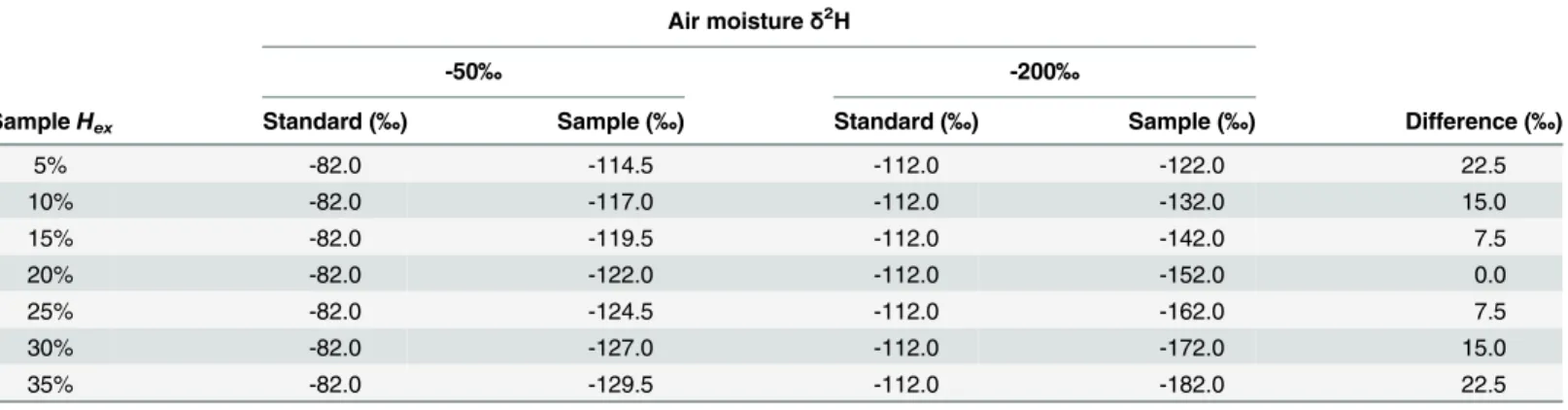
systems, and other uncertainties associated with the meanδ2H values (Table 3). A difference
<10‰would probably not have a significant impact in systems with sufficient differences
among the sourceδ2H values but needs to be considered when sources are less well separated
and theHexbetween the sample and the standard are more considerable (but see discussion in
Table 3. Potential influence of changingδ2H in air moisture onδ2H values in a sample with variableHex.
Air moistureδ2H
-50‰ -200‰
SampleHex Standard (‰) Sample (‰) Standard (‰) Sample (‰) Difference (‰)
5% -82.0 -114.5 -112.0 -122.0 22.5
10% -82.0 -117.0 -112.0 -132.0 15.0
15% -82.0 -119.5 -112.0 -142.0 7.5
20% -82.0 -122.0 -112.0 -152.0 0.0
25% -82.0 -124.5 -112.0 -162.0 7.5
30% -82.0 -127.0 -112.0 -172.0 15.0
35% -82.0 -129.5 -112.0 -182.0 22.5
The standard material is assumed to contain 20%Hexand the difference indicates the potential bias observed when a sample (with givenHex) and the standard are equilibrated under air moistureδ2H of -50‰and -200‰.
Wilkinson et al. [28]). Based on results presented here, the commonly used standard materials seem appropriate for aquatic consumer tissues but care must be taken when selecting standard materials for producer samples (such as those used here as sources).
Of greater importance is unquestionably the sample lipid content [22,32]. Lipids are known
to be extremely (-100‰) depleted in2H [34–35] and therefore could strongly influence the
observed bulk sampleδ2H values [32], being analogous to bulk sample lipid content andδ13C
values [54]. Also, lipids contain very littleHex[16,36]; hence samples with high lipid content
may have much lessHex[16,22,48] with subsequent implications beyond the immediate effect
onδ2H values of bulk samples. Using the bulk sample C:N ratio as a proxy for lipid content
[56–57], the amount ofHexcorrelated strongly with fish muscle tissue and a weak relationship
was also evident between zooplankton C:N ratios andHex, indicating that the samples with
higher lipid content had lessHex. Fish and zooplankton can both accumulate appreciable
amounts of lipids in their body tissues and our results here demonstrate that in addition to the
direct impacts on sampleδ2H values, this will influence the amount ofH
exin sample materials.
However, the C:N ratio does not seem to correlate as strongly with the lipid content in benthic macroinvertebrates or in plant material, likely due to variable amounts of chitin in whole body
invertebrate samples [56] and plasticity in nitrogen uptake and allocation in plants [63], which
is likely the reason for no correlation between the amount ofHexand these sample materials
here. It is strongly recommended that future food web studies usingδ2H values either extract
lipids from their samples (see further recommendations in Soto et al. [32] and Wilkinson et al.
[28]) or work towards developing suitableδ2H normalization models similar toδ13C based on
sample lipid content.
δ
2H in primary producers
As expected, theδ2H values of water from both studied lakes were similar and fit well into the
global isoscapes ofδ2H in precipitation for North-Eastern Germany [64] and the observed
values in precipitation for summer months in this region (www.waterisotopes.org). These
values were therefore considered to representδ2H in lake water for the entire summer. The
δ2H values in pelagic phytoplankton (or seston) and attached algae/periphyton were ~130‰
more negative than the surrounding water, a value very similar to those found in many other
studies [20,23,26,38]. However, terrestrial vegetation (alder and birch leaves) hadδ2H
val-ues only ~30‰elevated from those of algae creating far less separation betweenδ2H values
of allochthonous organic matter and algae than reported for example from more arid
envi-ronments [20], or even from boreal humic lakes of northern Sweden [23]. Rather
surpris-ingly, the macrophytes in our lakes had even higherδ2H values than terrestrial vegetation,
being roughly another 30‰enriched in2H and we observed no differences inδ2H values
among submerged, floating-leaved and emerged macrophytes. While surprising, a few other
studies have also reported unexpectedly highδ2H values for macrophytes [37–38].
Photosyn-thesis is assumed to involve a discrimination inδ2H, making plants 160–170‰more negative
in theirδ2H values than the environmental water [38, and references therein] and terrestrial
plants with an additional transpiration process are expected to be considerably elevated in
their finalδ2H values compared to aquatic plants. At present it is difficult to explain the
observedδ2H patterns in aquatic vegetation (but see discussion in [38]), but the distinctδ2H
values of macrophytes in our lakes helped to verify their importance for lake consumers. The
δ13C values often overlap among benthic algae, macrophytes and terrestrial sources, while
theδ15N can be highly variable in aquatic systems [56,65] due to the many potential sources
of inorganic N [66], making these less efficient in separating multiple sources for mixing
Estimates of allochthonous contributions
The importance of including macrophytes as one potential source of organic matter in the mix-ing models when estimatmix-ing allochthonous contributions was highlighted in the comparison of
models with and without macrophytes (Fig 4, lower panel). While the difference in the estimates
of allochthony for zooplankton was minimal between the two models, including macrophytes considerably reduced allochthony in fish, and particularly in benthic macroinvertebrates.
With-out macrophytes, allochthony of the isopodA.aquaticusand gastropods was as high as 70–80%,
similar to the very high contributions reported in some previous studies [6,67]. However,
allochthony declined to 32–35% when macrophytes were added to the model, confirming the
importance of macrophytes as one source of organic matter to consumers. In fact, Brothers et al.
[45–46] made a detailed study on C fluxes in these lakes, including C flux from reeds and other
macrophytes. Detailed measurements of macrophyte areas, densities and biomass with direct measurements and literature data of C content revealed high C influx from reeds and other
macrophytes in both lakes (86% of C influx in Gollinsee i.e. 214 g C m-2yr-1and 72% i.e. 119 g
C m-2yr-1in Schulzensee) [45,54], indicating high autochthonous production. Therefore the
lower estimates of allochthony in this study seem more realistic for these lakes. The importance of this finding is highlighted by the fact that in many studies using H (HC/HCN) isotopes only
algae or periphyton are used as autochthonous mixing model end-member (20, 22–25, 61).
While primary production in many lakes may indeed be dominated by algae, and macrophyte and reed abundance is low, in other lakes (such as those studied here) macrophytes contribute
substantially to primary production [45]. Our calculations illustrate the potential implications
of excluding macrophytes in the mixing models when they are present. As the macrophyteδ2H
values in both our lakes were considerably elevated compared to other sources of organic matter, even rather small amounts of organic matter derived from macrophytes can significantly bias the estimates, if only algae and terrestrial matter were assumed as sources. Therefore, macro-phytes should be included as one source in mixing models for lakes where they are present (including reeds in the littoral).
Estimates of consumer allochthony using either CN or HCN mixing models (Fig 4, upper
panel) were more similar than those comparing HCN model with and without macrophytes. In fact, for benthic macroinvertebrates the CN and HCN models resulted in almost equal mates of allochthony. In contrast, fish and particularly zooplankton allochthony were esti-mated higher using the traditional CN model but the difference could partly relate to the
impacts of lipids on consumerδ2H values. Since lipids have very lowδ2H values, even small
amounts of storage lipids can have significant impact on the bulk sampleδ2H values. We did
not remove lipids from our samples but in particular zooplankton is known to accumulate appreciable amounts of lipids, considerably affecting the isotope values analyzed from bulk
samples [57]. Therefore, removing lipids would certainly have elevated theδ2H values of
zoo-plankton and would have increased the allochthony in HCN mixing models. In addition, very little is known about the potential discrimination of H isotopes in trophic transfers from prey to consumers. In our mixing models we used the common practice of assuming no real trophic discrimination, but did assume ~17% contribution from environmental water at each trophic
level [30]. While our results do not point to any major additional trophic discrimination, these
assumptions can influence the outcome particularly at the higher trophic levels [28] and
there-fore more laboratory work is urgently needed to verify the robustness of these assumptions.
Conclusions
Our results highlight the benefits of combiningδ2H values withδ13C andδ15N in food web
of multiple sample materials for differences inHexrevealed significantly higher proportions of
Hexin animal tissues compared to plant tissues (excluding macrophytes). In general, however,
the results fit to expected ranges relatively well and align with those of most common standard
materials (such as keratin). Nonetheless, we concur with previous studies [28,32–33] urging
for greater caution when interpretingδ2H results before more laboratory and field studies on
the effects of environmental water, lipids andδ2H patterns in ecosystems are available.
Further-more, the importance of aquatic macrophytes as a dietary source for lake consumers was
detected more clearly when usingδ2H. Due to the highδ2H values of macrophytes, estimates of
allochthony by mixing models were largely dependent on whether macrophytes were included or not. We therefore strongly recommend future studies to include macrophytes as a potential
resource when usingδ2H withδ13C andδ15N in aquatic food web studies.
Supporting Information
S1 Dataset. Stable HCN isotope data used in this study. (XLSX)
S1 Table. Mixing model source contributions to invertebrate consumers in Gollinsee and Schulzensee.
(PDF)
Acknowledgments
We thank A. Türck, C. Helms, S. Oksanen, A. Vogt, and T. Wanke for their help in the field and laboratory. R. Mauersberger (Förderverein Feldberg-Uckermärkische Seen e.V.) and R. Tischbier (Stiftung Pro Artenvielfalt) kindly provided background information and access to the lakes. Shawn Devlin kindly checked the English of the manuscript.
Author Contributions
Conceived and designed the experiments: JS SH TM. Performed the experiments: JS KS MB SH TM. Analyzed the data: JS KS MB. Contributed reagents/materials/analysis tools: JS TM. Wrote the paper: JS KS MB SH TM.
References
1. Peterson BJ, Fry B. Stable isotopes in ecosystem studies. Ann. Rev. Ecol. Syst. 1987; 18:293–320. doi:10.1146/annurev.es.18.110187.001453
2. Jones RI, Grey J, Sleep D, Quarmby C. An assessment, using stable isotopes, of the importance of allochthonous organic carbon sources to the pelagic food web in Loch Ness. Proc. R. Lond. B. 1998; 265:105–11. doi:10.1098/rspb.1998.0270
3. Grey J, Jones RI, Sleep D. Seasonal changes in the importance of the source of organic matter to the diet of zooplankton in Loch Ness, as indicated by stable isotope analysis. Limnol. Oceanogr. 2001; 46:505–13. doi:10.4319/lo.2001.46.3.0505
4. Pace ML, Cole JJ, Carpenter SR, Kitchell JF, Hodgson JR, Van de Bogert MC, et al. Whole-lake car-bon-13 additions reveal terrestrial support of aquatic food webs. Nature 2004; 427:240–3. doi:10. 1038/nature02227PMID:14724637
5. Carpenter SR, Cole JJ, Pace ML, Van de Bogert MC, Bade DL, Bastviken D, et al. Ecosystem subsi-dies: Terrestrial support of aquatic food webs from C-13 addition to contrasting lakes. Ecology 2005; 86:2737–50. doi:10.1890/04-1282
6. Cole JJ, Carpenter SR, Pace ML, Van de Bogert MC, Kitchell JF, Hodgson JR. Differential support of lake food webs by three types of terrestrial organic carbon. Ecol. Lett. 2006; 9: 558–68. doi:10.1111/j. 1461-0248.2006.00898.xPMID:16643301
8. Jones RI, Carter CE, Kelly A, Ward S, Kelly DJ, Grey J. Widespread contribution of methane-cycle bac-teria to the diets of lake profundal chironomid larvae. Ecology 2008; 89:857–64. doi:10.1890/06-2010. 1PMID:18459348
9. Ravinet M, Syväranta J, Jones RI, Grey J. A trophic pathway from biogenic methane supports fish bio-mass in a temperate lake ecosystem. Oikos 2010; 119:409–16. doi:10.1111/j.1600-0706.2009.17859.x
10. Jones RI, Grey J. Biogenic methane in freshwater food webs. Freshwater Biol. 2011; 56:213–29. doi: 10.1111/j.1365-2427.2010.02494.x
11. Taipale S, Kankaala P, Jones RI. Contributions of different organic carbon sources to Daphnia in the pelagic foodweb of a small polyhumic lake: Results from mesocosm (DIC)-C-13-additions. Ecosystems 2007; 10:757–72. doi:10.1007/s10021-007-9056-5
12. Devlin SP, Saarenheimo J, Syväranta J, Jones RI. Top consumer abundance influences lake methane efflux. Nature Commun. 2015; in press
13. Kankaala P, Peura S, Nykanen H, Sonninen E, Taipale S, Tiirola M, et al. Impacts of added dissolved organic carbon on boreal freshwater pelagic metabolism and food webs in mesocosm experiments. Fund. Appl. Limnol. 2010; 177:161–76. doi:10.1127/1863-9135/2010/0177-0161
14. Scharnweber K, Vanni MJ, Hilt S, Syväranta J, Mehner T. Boomerang ecosystem fluxes: organic car-bon inputs from land to lakes are returned to terrestrial food webs via aquatic insects. Oikos 2014; 123:1439–48. doi:10.1111/oik.01524
15. Scharnweber K, Syväranta J, Hilt S, Brauns M, Vanni MJ, Brothers S, et al. Whole-lake experiments reveal the fate of terrestrial particulate organic carbon in benthic food webs of shallow lakes. Ecology 2014; 95:1496–505. doi:10.1890/13-0390.1PMID:25039215
16. Wassenaar LI, Hobson KA. Improved method for determining the stable-Hydrogen isotopic composition (delta-D) of complex organic materials of environmental interest. Environ. Sci. Technol. 2000;
34:2354–60. doi:10.1021/es990804i
17. Wassenaar LI, Hobson KA. Comparative equilibration and online technique for determination of non-exchangeable hydrogen of keratins for use in animal migration studies. Isot. Environ. Healt. S. 2003; 39:211–17. doi:10.1080/1025601031000096781
18. Hobson KA. Tracing origins and migration of wildlife using stable isotopes: a review. Oecologia 1999; 120:314–26. doi:10.1007/s004420050865
19. Hobson KA. Using stable isotopes to trace long-distance dispersal in birds and other taxa. Diversity Dis-trib. 2005; 11:157–64. doi:10.1111/j.1366-9516.2005.00149.x
20. Doucett RR, Marks JC, Blinn DW, Caron M, Hungate BA. Measuring terrestrial subsidies to aquatic food webs using stable isotopes of hydrogen. Ecology 2007; 88:1587–92. doi:10.1890/06-1184PMID: 17601150
21. Smith BN, Ziegler H. Isotopic Fractionation of Hydrogen in Plants. Bot. Acta 1990; 103:335–42. doi:10. 1111/j.1438-8677.1990.tb00171.x
22. Jardine TD, Kidd KA, Cunjak RA. An evaluation of deuterium as a food source tracer in temperate streams of eastern Canada. J. N. Am. Benthol. Soc. 2009; 28:885–93. doi:10.1899/09-046.1
23. Karlsson J, Berggren M, Ask J, Bystrom P, Jonsson A, Laudon H, et al. Terrestrial organic matter sup-port of lake food webs: Evidence from lake metabolism and stable hydrogen isotopes of consumers. Limnol. Oceanogr. 2012; 57:1042–48. doi:10.4319/lo.2012.57.4.1042
24. Babler AL, Pilati A, Vanni MJ. Terrestrial support of detritivorous fish populations decreases with water-shed size. Ecosphere 2011; 2:art76. doi:10.1890/ES11-00043.1
25. Cole JJ, Carpenter SR, Kitchell JF, Pace ML, Solomon CT, Weidel BC. Strong evidence for terrestrial support of zooplankton in small lakes based on stable isotopes of carbon, nitrogen, and hydrogen. Proc. Natl. Acad. Sci. U.S.A. 2011; 108:1975–80. doi:10.1073/pnas.1012807108PMID:21245299
26. Solomon CT, Carpenter SR, Clayton MK, Cole JJ, Coloso JJ, Pace ML, et al. Terrestrial, benthic, and pelagic resource use in lakes: results from a three-isotope Bayesian mixing model. Ecology 2011; 92:1115–25. doi:10.1890/10-1185.1PMID:21661572
27. Wilkinson GM, Carpenter SR, Cole JJ, Pace ML, Yang C. Terrestrial support of pelagic consumers: pat-terns and variability revealed by a multilake study. Freshwater Biol. 2013; 58:2037–49. doi:10.1111/ fwb.12189
28. Wilkinson GM, Cole JJ, Pace ML. Deuterium as a food source tracer: Sensitivity to environmental water, lipid content, and hydrogen exchange. Limnol. Oceanogr. Methods 2015; 13:213–23. doi:10. 1002/lom3.10019
30. Solomon CT, Cole JJ, Doucett RR, Pace ML, Preston ND, Smith LE, et al. The influence of environmen-tal water on the hydrogen stable isotope ratio in aquatic consumers. Oecologia 2009; 161:313–324. doi:10.1007/s00442-009-1370-5PMID:19471971
31. Soto DX, Wassenaar LI, Hobson KA, Catalan J. Effects of size and diet on stable hydrogen isotope val-ues (delta D) in fish: implications for tracing origins of individuals and their food sources. Can. J. Fish. Aquat. Sci. 2011; 68:2011–19. doi:10.1139/f2011-112
32. Soto DX, Wassenaar LI, Hobson KA. Stable hydrogen and oxygen isotopes in aquatic food webs are tracers of diet and provenance. Funct. Ecol. 2013; 27:535–43. doi:10.1111/1365-2435.12054
33. Graham CT, Harrison SSC, Harrod C. Differences in the contributions of dietary water to the hydrogen stable isotope ratios of cultured Atlantic salmon and Arctic charr tissues. Hydrobiologia 2014; 721:45– 55. doi:10.1007/s10750-013-1636-0
34. Smith B, Epstein S. Biogeochemistry of Stable Isotopes of Hydrogen and Carbon in Salt Marsh Biota. Plant Physiol. 1970; 46:738–42. doi:10.1104/pp.46.5.738PMID:16657539
35. Sessions AL, Burgoyne TW, Schimmelmann A, Hayes JM. Fractionation of hydrogen isotopes in lipid biosynthesis. Org. Geochem. 1999; 30:1193–200. doi:10.1016/S0146-6380(99)00094-7
36. Chesson LA, Podlesak DW, Cerling TE, Ehleringer JR. Evaluating uncertainty in the calculation of non-exchangeable hydrogen fractions within organic materials. Rapid Commun. Mass Sp. 2009; 23:1275– 80. doi:10.1002/rcm.4000
37. Cole JJ, Solomon CT. Terrestrial support of zebra mussels and the Hudson River food web: A multi-iso-tope, Bayesian analysis. Limnol. Oceanogr. 2012; 57:1802–15. doi:10.4319/lo.2012.57.6.1802
38. Hondula KL, Pace ML, Cole JJ, Batt RD. Hydrogen isotope discrimination in aquatic primary producers: implications for aquatic food web studies. Aquat. Sci. 2014; 76:217–29. doi: 10.1007/s00027-013-0331-6
39. France RL. Stable isotopic survey of the role of macrophytes in the carbon flow of aquatic foodwebs. Vegetatio 1995; 124:67–72. doi:10.1007/BF00045145
40. Hecky RE, Hesslein RH. Contributions of benthic algae to lake food webs as revealed by stable isotope analysis. J. N. Am. Benthol. Soc. 1995; 14:631–53. doi:10.2307/1467546
41. Mendonca R, Kosten S, Lacerot G, Mazzeo N, Roland F, Ometto JP, et al. Bimodality in stable isotope composition facilitates the tracing of carbon transfer from macrophytes to higher trophic levels. Hydro-biologia 2013; 710:205–18. doi:10.1007/s10750-012-1366-8
42. Newman RM. Herbivory and detritivory on fresh-water macrophytes by invertebrates: a review. J. N. Am. Benthol. Soc. 1991; 10:89–114. doi:10.2307/1467571
43. Batt RD, Carpenter SR, Cole JJ, Pace ML, Cline TJ, Johnson RA, et al. Resources supporting the food web of a naturally productive lake. Limnol. Oceanogr. 2012; 57:1443–1452. doi:10.4319/lo.2012.57.5. 1443
44. de Kluijver A, Ning J, Liu Z, Jeppesen E, Gulati RD, Middelburg JJ. Macrophytes and periphyton carbon subsidies to bacterioplankton and zooplankton in a shallow eutrophic lake in tropical China. Limnol. Oceanogr. 2015; 60:375–85. doi:10.1002/lno.10040
45. Brothers S, Hilt S, Meyer S, Köhler J. Plant community structure determines primary productivity in shallow, eutrophic lakes. Freshwater Biol. 2013; 58:2264–76. doi:10.1111/fwb.12207
46. Brothers S, Hilt S, Attermeyer K, Grossart H-P, Kosten S, Mehner T, et al. A regime shift from macro-phyte to phytoplankton dominance enhances carbon burial in a shallow, eutrophic lake. Ecosphere 2013; 4:art137. doi:10.1890/ES13-00247.1
47. Hilt S, Wanke T, Brauns M, Brothers A, Gaedke U, Köhler J, et al. Contrasting response of shallow eutrophic lakes to winterkill of fish. Hydrobiologia 2015; 749:31–42. doi:10.1007/s10750-014-2143-7
48. Schimmelmann A, Lewan MD, Wintsch RP. D/H isotope ratios of kerogen, bitumen, oil, and water in hydrous pyrolysis of source rocks containing kerogen types I, II, IIS, and III. Geochim. Cosmochim. Acta. 1999; 63:3751–66. doi:10.1016/S0016-7037(99)00221-5
49. Qi H, Coplen TB. Investigation of preparation techniques for delta H-2 analysis of keratin materials and a proposed analytical protocol. Rapid Commun. Mass Sp. 2011; 25:2672–72.
50. R Development Core Team. R: A language and environment for statistical computing. R foundation for statistical Computing. 2010; Vienna, Austria.
51. Parnell AC, Inger R, Bearhop S, Jackson AL. Source partitioning using stable isotopes: coping with too much variation. PLOS One 2010; 5:e9672. doi:10.1371/journal.pone.0009672PMID:20300637
53. Karlsson J, Bystrom P. Littoral energy mobilization dominates energy supply for top consumers in sub-arctic lakes. Limnol. Oceanogr. 2005; 50:538–43. doi:10.4319/lo.2005.50.2.0538
54. Mehner T, Attermeyer K, Brauns M, Brothers S, Diekmann J, Gaedke U, et al. Weak response of animal allochthony and production to enhanced supply of terrestrial leaf litter in nutrient-rich lakes. Ecosys-tems. Forthcoming 2015
55. Brauns M, Gücker B, Wagner C, Garcia X-F, Walz N, Pusch MT. Human lakeshore development alters the structure and trophic basis of littoral food webs. J. Appl. Ecol. 2011; 48:916–25. doi:10.1111/j. 1365-2664.2011.02007.x
56. Kiljunen M, Grey J, Sinisalo T, Harrod C, Immonen H, Jones RI. A revised model for lipid-normalizing δ13C values from aquatic organisms, with implications for isotope mixing models. J. Appl. Ecol. 2006; 43:1213–22. doi:10.1111/j.1365-2664.2006.01224.x
57. Syväranta J, Rautio M. Zooplankton, lipids and stable isotopes: importance of seasonal, latitudinal, and taxonomic differences. Can. J. Fish. Aquat. Sci. 2010; 67:1721–29. doi:10.1139/F10-091
58. Syväranta J, Hämäläinen H, Jones RI. Within-lake variability in carbon and nitrogen stable isotope sig-natures. Freshwater Biol. 2006; 51:1090–102. doi:10.1111/j.1365-2427.2006.01557.x
59. Prejs A, Jackowska H. Lake macrophytes as the food of roach (Rutilus rutilusL.) and rudd (Scardinius erythrophthalmusL.). I. Species composition and dominance relations in the lake food. Ekol. Pol. 1978; 26:429–37.
60. Finlay JC, Doucett RR, McNeely C. Tracing energy flow in stream food webs using stable isotopes of hydrogen. Freshwater Biol. 2010; 55:941–51. doi:10.1111/j.1365-2427.2009.02327.x
61. Wilkinson GM, Pace ML, Cole JJ. Terrestrial dominance of organic matter in north temperate lakes. Global Biochem. Cy. 2013; 27:43–51. doi:10.1029/2012GB004453
62. Brett MT, Kainz MJ, Taipale SJ, Seshana H. Phytoplankton, not allochthonous carbon, sustains herbiv-orous zooplankton production. Proc. Natl. Acad. Sci. USA 2009; 106:21197–201. doi:10.1073/pnas. 0904129106PMID:19934044
63. Post DM, Layman CA, Arrington DA, Takimoto G, Quattrochi J, Montaña CG. Getting to the fat of the matter: models, methods and assumptions for dealing with lipids in stable isotope analyses. Oecologia 2007; 152:179–89. doi:10.1007/s00442-006-0630-xPMID:17225157
64. Terzer S, Wassenaar LI, Araguas-Araguas LJ, Aggarwal PK. Global isoscapes for delta O-18 and delta H-2 in precipitation: improved prediction using regionalized climatic regression models. Hydrol. Earth Syst. Sc. 2013; 17:4713–28. doi:10.5194/hess-17-4713-2013
65. Peipoch M, Garcia E, Blesa A, Ribot M, Riera JL, Martí E. Contrasts among macrophyte riparian spe-cies in their use of stream water nitrate and ammonium: insights from 15N natural abundance. Aquat. Sci. 2014; 76:203–15. doi:10.1007/s00027-013-0330-7
66. Mjelde M, Faafeng BA.Ceratophyllum demersumhampers phytoplankton development in some small Norwegian lakes over a wide range of phosphorus concentrations and geographical latitude. Freshwa-ter Biol. 1997; 37:355–65. doi:10.1046/j.1365-2427.1997.00159.x