Dispelling Black Hole Pathologies Through Theory and Observation
Robin James Spivey
Biological Sciences, Bangor University, Brambell, Deiniol Road, Bangor, Gwynedd, Great Britain E-mail: [email protected]
Astrophysical black holes are by now routinely identified with metrics representing eter-nal black holes obtained as exact mathematical solutions of Einstein’s field equations. However, the mere existence and discovery of stationary solutions is no guarantee that they can be attained through dynamical processes. If a straightforward physical caveat is respected throughout a spacetime manifold then the ingress of matter across an event horizon is prohibited, in accordance with Einstein’s expectation. As black hole forma-tion and growth would be inhibited, the various pathological traits of black holes such as information loss, closed timelike curves and singularities of infinite mass density would be obviated. Gravitational collapse would not terminate with the formation of black holes possessing event horizons but asymptotically slow as the maximal time dilation between any pair of worldlines tends towards infinity. The remnants might be better described as dark holes, often indistinguishable from black holes except in certain as-trophysically important cases. The absence of trapped surfaces circumvents topological censorship, with potentially observable consequences for astronomy, as exemplified by the remarkable electromagnetic characteristics, extreme energetics and abrupt extinc-tion of quasars within low redshift galaxies.
1 Introduction
Quasars are exceptionally luminous objects located at cos-mological distances [1]. Rapid fluctuations in their emissions arguably provide the most compelling hints that black holes of some description exist in nature. The empirically deter-mined “M-sigma relation” points to a causal kinematic con-nection between black hole growth and galactic evolution, with motions of nearby gas and stars providing irrefutable evidence that 106∼109M⊙black hole candidates are present [2]. This has led many researchers to conclude that the uni-verse is home to a multitude of black holes conforming to one of the stationary, asymptotically flat, black hole metrics – in accordance with the claim of a leading relativist that the “black holes of nature are the most perfect macroscopic ob-jects that are in the universe” [3].
Potentially pre-dating the earliest stars, quasars may have fostered galaxy formation [4]. However, the question of how their central engines operate remains clouded in considerable uncertainty. Furthermore, astronomical observations have not been satisfactorily reconciled with theory. For instance, the abrupt cessation of quasar activity during the early universe calls for some efficient shutdown mechanism [5]. It is now generally believed that virtually all galactic nuclei harbour a supermassive black hole, most galaxies have undergone a pe-riod of quasar activity in the past, black holes have at present scarcely lost any mass through Hawking radiation and a heal-thy fraction of galaxies are still rich in gas. It is therefore puz-zling that the temporary revival of quasar activity is not occa-sionally observed, especially within gas-rich galaxy clusters. A glaring inconsistency arises with the currently in vogue gas-starvation model of quasar extinction.
Karl Schwarzschild provided the first solution to the field equations of general relativity (GR), obtaining a spherically symmetric metric describing an eternal black hole∗with an event horizon [6]. After lengthy deliberation, Einstein re-mained dismissive of the notion that objects with an event horizon might actually exist in nature, pointing out that a clock arriving at an event horizon would totally cease to ad-vance compared to more remotely situated clocks [7]. The more interesting case of dynamic gravitational collapse with-in GR, abandonwith-ing the assumption of stationary geometry, was tackled analytically that same year by Oppenheimer & Snyder [8]. The mathematical results, as valid now as they ever were [9], establish that from the perspective of a dis-tant observer the implosion initially accelerates until the con-traction becomes relativistic, whereupon the implosion rate declines – ultimately halting just as the critical radius is ap-proached. From this vantage, an event horizon only forms in an asymptotic sense, after the infinite passage of time.
Oppenheimer & Snyder also commented on their results from the perspective of the infalling matter. They found that as external time approaches infinity, the proper time along the worldline of an infalling particle tends towards some fi-nite value. They then considered what might happen at later proper times of the infalling particle, apparently without pau-sing to consider whether time could physically continue to advance for the infalling particle: “after this time an observer comoving with the matter would not be able to send a light signal from the star”. It is currently fashionable to ignore Einstein’s objection regarding infinite time dilation. But is
∗The term “black hole” was not coined until some years after Einstein’s
that wise? The field of black hole physics is by now plagued by a variety of serious difficulties. Closed timelike curves seem to be unavoidable within rotating black hole spacetimes, with potentially disturbing connotations for causality and he-nce physics at its most fundamental level. The notion that information might be captured and destroyed by black holes has also troubled theoretical physicists for decades [10, 11]. This “information paradox” recently led to the suggestion that black holes only possess apparent horizons [12] as opposed to genuine event horizons: features traditionally regarded as the defining hallmarks of true black holes [13].
There is also a widespread expectation that naturally oc-curring black holes lack “hair” and comply with the princi-ple of topological censorship [14], rapidly settling down ei-ther to a Kerr-Newman or, more realistically, a Kerr geome-try corresponding to an electrically uncharged, rotating black hole. As will be discussed, astronomical observations cast significant doubt on the reliability of this common assump-tion. Moreover, due to the generality of results obtained in dynamical collapse scenarios such as Oppenheimer & Sny-der consiSny-dered, there is a suspicion that Einstein was right: it may be difficult or impossible to produce stationary black holes through physically realistic processes.
The goal of this work is to argue that these various con-ceptual problems can vanish, without departing from Ein-stein’s gravitational theory, if a straightforward physical con-sideration is respected throughout a spacetime manifold. This caveat does not impinge upon general covariance and the ma-thematical apparatus of general relativity is unchanged. A discussion then follows of why quasar observations support the contention that black holes lack event horizons and might be better described asdark holes.
2 The Schwarzschild black hole
The Schwarzschild metric represents a non-rotating eternal black hole with the spherically symmetric spacetime
ds2=
1−rs
r
c2dt2−
1−rs
r −1
dr2−r2(dθ2+sin2θdφ2) (1) whereds is the spacetime interval, t represents the proper time of a stationary clock at spatial infinity, (r,θ,φ) are the usual spherical coordinates (2πrbeing the circumference of a circle at radiusr). The event horizon is located atr = rs =
2Gm/c2, known as the Schwarzschild radius of a black hole. The gravitating mass of the black hole,m, is concentrated at the origin.
As is well-known, if the metric is expressed in this way it has a coordinate singularity at r = rs, the (critical) radius
of the event horizon, despite the lack of matter there (the spacetime itself is only singular atr = 0). The exterior so-lution,r>rs, accurately approximates the spacetime outside
a spherically symmetric star [15]. This region is well-behaved and suffices for the present discussion.
For a particle following a timelike worldline,ds2≡c2dτ2 whereτis the proper time of the particle anddτ≡0 for null particles (light rays). Therefore, along the worldline of any particle,ds2>0, and the following inequality must hold:
1−rs
r
c2dt2>
1−rs
r −1
dr2+r2(dθ2+sin2θdφ2). (2) It is convenient to rearrange this expression to obtain
1 (1−rs
r)2
dr dt 2
+ r 2
1−rs
r
dθ dt 2
+r 2
sin2θ 1−rs
r
dφ dt 2
6c2. (3)
The Schwarzschild metric is asymptotically flat and, for regions far outside the event horizon,r ≫ rs, the effects of
gravitational time dilation are negligible. One then finds that (dr/dt)2+r2 (dθ/dt)2+r2sin2
θ (dφ/dt)2 6c2 which, con-sidering the spherical coordinate system, confirms the expec-tation that the speed of light is insurmountable in special rel-ativity, with the possible exception of tachyonic particles.
3 Spacetime coherency
Spacetime is a four-dimensional continuum, a differentiable and connected Lorentzian manifold. In general relativity it is dynamically acted upon by gravitation so as to alter the geodesics of motion. General relativity is a global theory: the presence of mass-energy does not merely influence the local spacetime, but the entire spacetime manifold. Thus, grav-ity’s range is limited only by the size of the universe. Gen-eral relativity abides by the principle of genGen-eral covariance allowing its physical laws to be expressed independently of coordinates.
The order in which events occur is observer-dependent in both special and general relativity. Nevertheless, therelative rate at which time elapses along two worldlines(i.e. time di-lation/contraction) can be uniquely defined whether the sep-aration between the worldlines is timelike, null or spacelike. Time dilation is a non-local, coordinate-independent quantity encoding genuine physics which is necessary for global con-sistency. For an arbitrary numbern of distinct test particles with proper timesτ1, τ2. . . τn, it must hold that
dτ1 dτn
×
n−1 Y
i=1 dτi+1
dτi
=1. (4)
If general relativity is applied to the universe then the proper elapsed time,τ, along any worldline cannot exceed the time since the big bang, even if the universe is spatially infi-nite. Hence, along any worldline, the proper timeτ <∞and the proper distanceℓ <∞. Recognising that proper timeτis an affine parameter along the worldlinexα(τ), for a specified
spacetime manifold the demand of finite proper time along all worldlines within the universe can be formally stated as
It should be self-evident that this constraint will be sat-isfied by any physically realistic spacetime manifold. Non-compliance, as would occur once the advancement of proper times along any pair of worldlines could not proceed in tan-dem, would break the global coherency and connectedness of the spacetime continuum. Such a basic physical requirement must have priority over all “philosophical” concerns, an issue returned to in the discussion. Spacetime is not merely a local union of space and time but a global one. Failure to appre-ciate that localised physics can have wider implications for a spacetime manifold may be at the root of some persistent confusions in current black hole research.
4 Time dilation between arbitrary particles
For lightlike particles, the Schwarzschild metric provides a relationship involving two time coordinatestandτ
dτ dt 2
=αc2−1
α dr dt 2
−r2 dθ dt 2
−r2sin2θ dφ dt 2 . (6) The parameterαis defined asα≡1−rs/rfor the range
r > rs so that αis strictly positive with 0 < α 6 1. This
expression allows the time dilation relative to Schwarzschild timet, a coordinate independent physical quantity, to be de-termined for an arbitrarily moving test particle located any-where outside the event horizon.
Although particles travelling at the speed of light experi-ence no passage of proper time (dτ =0), photons travelling radially towards the event horizon are eventually brought to a halt since the original metric then reduces to (dr/dt)2=α2c2 and, in the limit asr→rs, one sees thatα→0. This
repre-sents a worst case scenario since, for non-radial motion of the photon, (dr/dt)2 < α2c2. For a purely radial ingoing photon, dr/dt=−αcand so the minimum Schwarzschild time,∆tmin, required for a photon to travel from an initial radiusr0 to a final radiusr∗, withr0>r∗>rs, is given by
∆tmin=t∗−t0= Z r∗
r0
dt dr !
dr= Z r0
r∗
dr αc
= 1 c
Z r0
r∗
r dr r−rs
=r0−r∗
c +
rs
c ln r0−rs
r∗−rs
!
. (7)
Due to the denominator in the logarithm term, as r∗ → rs, this time interval grows without limit. Hence,
regard-less of the location at which photons are emitted outside the black hole, gravitational time dilation prohibits them reach-ing the event horizon in finite time accordreach-ing to the clock of a Schwarzschild observer.
In order to broaden this result, a quantityvis now defined such that
v2= 1 α2 dr dt 2 +r 2 α dθ dt 2 +r 2sin2θ
α dφ
dt 2
. (8)
With reference to (3), it is apparent that one can write v2 6 c2. This is consistent with v representing a physical
velocity whose magnitude, corrected for relative motion and gravitational time dilation, remains bounded by the speed of light. It can then be seen from (6) that
(dτ/dt)2=α(c2−v2)
and consequently 06(dτ/dt)261. The time dilation relation between two arbitrary worldlines with proper timesτ1 and τ2exploring the exterior Schwarzschild geometry can there-fore be obtained from formula (9) whereα1 =1−rs/r1 and
α2 =1−rs/r2with subscripts referring to worldlines 1 and 2
respectively. Thus,α1andα2have the same range asαsuch that consideration is strictly restricted to the region external to the event horizon. Sincev21 6c2 andv22 6 c2, neither the numerator nor denominator of (9) can be negative under any circumstances.
If a timelike particle following worldline 2 approaches the event horizon,r2 → rs, thenα2 → 0 with the numerator of
(9) remaining positive. For a timelike observer moving along worldline 1 sufficiently distant from the event horizon that α1 ≫α2 it is then apparent thatdτ2/dτ1 →0, meaning that proper time ceases to advance along worldline 2. Noting that timelike particles take longer to approach the event horizon than light rays and thatdτ1/dt remains finite for any time-like observer comfortably outside the event horizon, one may conclude that
According to any external observer following a timelike worldline, light rays and timelike par-ticles require infinite proper time to reach the event horizon of a Schwarzschild black hole.
Because (5) must be respected it follows that Since infalling particles cannot experience the passage of time beyond that corresponding to in-finite proper time along all other worldlines, they are incapable of penetrating the event horizon of a Schwarzschild black hole.
These statements are completely independent of the (arbi-trary) choice of coordinate system. Furthermore, they do not require that observers be either stationary or infinitely remote. Indeed, observers could be relatively close to the event hori-zon without violating the assumption thatα1 ≫α2. There is no optical illusion at play associated with the time of flight of photons – the conclusion holds for inanimate clocks lacking the faculty of vision just as well as it does for conventional observers.
Note also that there is no need for any special synchroni-sation procedure between the two particles: infinite time di-lation prevents the ingress of matter across an event horizon as long as external clocks continue to mark time. Ifτ2 = 0 at the commencement of worldline 2 and the event horizon is approached asτ2 → τh, a finite proper time, then regardless
dτ2 dτ1 2 = dτ2 dt 2 ÷ dτ1 dt 2 =
α2c2− 1
α2
dr2
dt
2
−r2 2
dθ2
dt
2
−r2 2sin
2θ2dφ2
dt
2
α1c2− 1
α1
dr1
dt
2
−r2 1
dθ1
dt
2
−r2 1sin
2θ1dφ1
dt
2 =
α2(c2−v22) α1(c2−v2
1)
. (9)
τ1→ ∞asτ2 →τh. This is manifestly so because
τ1(τ2→τh)=
Z τh
0 dτ1 dτ2 ! dτ2 = Z τh
0 dτ2 dτ1
!−1
dτ2→ ∞. (10)
Proper times separating events along worldlines are in-variant quantities, as are infinitesimal proper times. Thus, the same can be said of the ratio of the rate of passage of proper times along distinct worldlines. If the previous calculation were to be repeated using so-called horizon-penetrating coor-dinates (e.g. Lemaˆıtre, Novikov, Gullstrand-Painlev´e, Krus-kal-Szekeres, ingoing Eddington-Finkelstein [16]) the same results would of course be obtained by virtue of general co-variance. The fact that the time dilation approaches infinity asr2 → rshas nothing to do with the Schwarzschild
coordi-nate singularity atrs, the coordinates being regular and
well-behaved for allr>rs, a range that was entirely adequate for
the purposes of this analysis.
Therefore, contrary to some common assertions, an as-tronaut could not fall into a black hole without incident. Al-thoughτ2would remain finite in such circumstances,τ1 wo-uld approach infinity as τ2 → τh. The astronaut
encoun-ters no immediate physical impediment at the event horizon but, due to the demand of global coherency and the need for proper times along worldlines to remain finite in (5), the conditionτ2 6 τh must be respected. Thus, the worldline
of the astronaut would terminate as τ2 → τh,
correspond-ing to a situation in which the spacetime manifold totally ceases to evolve. The astronaut simply would not experience proper times later thanτhwhich, in effect, would be the
mo-ment when his or her worldline reaches future timelike infin-ity within the Schwarzschild spacetime. Timesτ2 > τhwould
necessarily be fictitious and unphysical due to violation of (5). For allτ2 < τh, there is no consistency problem. One is
not obliged to make aneither orselection, exclusively choos-ing between the infallchoos-ing or remote observer perspectives – they are mutually compatible projections of a globally coher-ent spacetime manifold. However, if one insists on abandon-ing coherency to consider the physically impossible caseτ2> τh, a choice is then mandatory but the results are physically
meaningless. That infalling matter indefinitely hovers above the horizon from the perspective of a distant Schwarzschild observer is a well-established result [15, 17]. In order to fur-ther clarify matters, it has been extended here to arbitrarily situated and potentially moving external observers who may be in quite close proximity to the event horizon.
The impermeability of the event horizon due to time dila-tion effects has in recent years been highlighted in the context of the black hole information paradox [18]. Furthermore, sev-eral core arguments promulgating that belief that event hori-zons are traversable have been dispelled [19]. While it is well-known that nothing can escape from a black hole, this anal-ysis suggests that event horizons cannot be traversed inany direction whilst offering a readily comprehensible explana-tion as to why that is. Although angular momentum has been ignored here for simplicity, one would not expect its influ-ence to alter the conclusions. Rotation would only represent an additional barrier, further hindering the arrival of particles at the event horizon of a Kerr black hole.
5 Dynamically formed black holes
A classic general relativity textbook originally published four decades ago argued that eternal black holes provide an ex-cellent approximation to the outcome of gravitational col-lapse [15]. This advice may have been taken a tad too lit-erally. Clearly, if event horizons are bidirectionally imperme-able then the black hole information paradox would be triv-ially resolved. The interior geometry of the Schwarzschild metric may satisfy the field equations, but the constraint (5) suggests it cannot be arrived at through gravitational collapse, it is merely a hypothetical arrangement. Spacetime coherency issues aside, the equivalent rest mass energy of the Schwarz-schild singularity goes no way towards counterbalancing its gravitational potential energy which, by any realistic assess-ment, is infinitely negative. Therefore, a Schwarzschild black hole and a collapsing star of the same mass forming a dark hole frozen in time have vastly different energies and are hen-ce inequivalent on energy conservation grounds.
hypo-thetical black holes could in principle expand in anticipation of infalling matter so that time dilation halts the ingress of matter sooner than it might otherwise do. Notice that such expansion need not involve any increase in the gravitational potential of infalling matter since the potential near the event horizon is independent of black hole mass.
Hawking radiation arises due to separation of virtual par-ticle pairs in the vicinity of a black hole event horizon [20], causing eternal black holes to evaporate with a perfect ther-mal spectrum, devoid of information content. Conversely, frozen stars with their rich, history-dependent structure, are able to radiate in the regular black body manner – thus avoid-ing information loss [21]. However, this issue is of lesser importance to the present discussion than the need for space-time to remain coherent and connected. Black hole research has not led to many testable predictions but this consideration can have readily observable astronomical implications.
6 Topological admissibility
Trapped surfaces are defined as surfaces from which light rays initially pointing outwards are obliged to converge in-wardly. The existence of a trapped surface is a precondition of several well-known theorems in general relativity. The event horizon of a Schwarzschild black hole is a null surface inside which surfaces equidistant from the horizon are all trapped. According to the Penrose-Hawking singularity theorems [22– 24], a trapped surface inevitably leads to a geodesically in-complete spacetime manifold, implying the imminent forma-tion of a singularity. However, if time dilaforma-tion and global spacetime considerations prohibit the formation of event hori-zons then trapped surfaces cannot naturally arise and the sin-gularity theorems have no physical relevance. By the same logic, the closed timelike curves of rotating eternal black ho-les would be avoided. Speculations concerning the physics internal to an event horizon are invulnerable to falsification and hence, strictly speaking, outside the scope of empirical science. However, although the presence of event horizons cannot be directly verified [13], evidence of their non-existen-ce could in principle be obtained.
Like the singularity theorems, the principle of topological censorship [14] assumes the presence of a trapped surface. Therefore, if time dilation guards against event horizon for-mation, the gravitational collapse of a rapidly spinning cloud of gas would be capable of forming an axisymmetric structure of toroidal topology. Due to its dynamic nature, this scenario also falls outside the scope of earlier constraints on black hole topology [25, 26]. If physically realistic astrophysical black holes can be toroidal, the astronomical implications could be observable from afar.
Amongst the most energetic phenomena of the universe, quasars outshine galaxies by as many as three orders of mag-nitude. They were most abundant at redshifts ofz∼2 when the universe was less than 20% its present age and are
sig-nificantly more scarce by now [27]. They create bipolar out-flows [28], axially aligned relativistic jets penetrating inter-galactic space and ultimately forming gigantic radio lobes as their energy is dissipated. Often chaotically turbulent, the jets are comprised of electrically charged particles which can form knots via magnetohydrodynamic processes. The ori-entation of the jets exhibits long-term stability, hinting at a direct dependency on the angular momentum vector of a su-permassive black hole as opposed to that of an accretion disk of relatively low mass which is vulnerable to significant dis-ruption by the assimilation of roving stars. This is another weakness of models seeking to account for jet formation in terms of a magnetised accretion disk.
The discovery of various metrics describing stationary sp-acetimes in which black holes are completely described by mass, angular momentum and electromagnetic charge alone led to the “no-hair conjecture”. Though the Schwarzschild and Kerr-Newman metrics are lacking in “follicles”, it is very natural to expect macroscopic departures from these metrics during realistic collapse scenarios. Furthermore, since the formation of trapped surfaces would violate spacetime co-herency (5), crucial assumptions underpinning the singularity theorems and the principle of topological censorship may not apply.
Providing its assumptions are satisfied, topological cen-sorship requires the central aperture of a toroidal black hole to seal up so rapidly that a ray of light lacks sufficient time to traverse it. Numerical simulations have provided some sup-port for this [29]. However, computational approaches almost invariably adopt horizon-penetrating coordinates and fail to enforce the physical requirement (5). Instead, event horizons are located retrospectively after simulations terminate, with-out global consistency checks.
Theoretically, metrics describing black holes with toroi-dal event horizons have been obtained for anti-de Sitter back-grounds with a negatively valued cosmological constant. In such situations,Λcan be arbitrarily small [30]. Thus, toroidal event horizons are only marginally prohibited when consid-ering eternal black holes in asymptotically flat spacetimes. However, if trapped surfaces cannot realistically form dur-ing gravitational collapse then topological censorship is by-passed entirely, leaving the toroidal dark hole (TDH) a viable possibility. Most stars capable of undergoing core collapse are massive, hence rapidly reaching the ends of their life-cycles. They are likely to retain sufficient angular momen-tum from their formation that during implosion their cores will adopt a toroidal geometry, if only transiently. A toroidal core can be supported by degeneracy (electron/neutron) pres-sure but, for very massive and rapidly rotating stars, direct collapse to a TDH is conceivable. Any of these eventuali-ties could have potentially explosive consequences, scattering ejecta deep into space [31].
thermodynam-ics, the temperature at which the event horizon radiates is proportional to its surface gravity. This vanishes for an ex-tremal black hole, implying exex-tremality is unattainable by the third law of black hole thermodynamics. However, for a TDH lacking an event horizon, angular momentum should approxi-mately scale with the major radius of the torus. Thus, the Kerr bounds,−GM2/c< J <GM2/c, could easily be exceeded. Accumulation of angular momentum beyond the Kerr limit may buffer TDH topology, even if accretion is erratic. Ev-idence has recently emerged of a supermassive black hole within a galactic nucleus rotating at a near extremal rate [32]. Nature possesses only two long range forces and, of the two, electromagnetism is far stronger than gravity. Further-more, gravity is purely attractive, making it ill-suited as a mechanism for launching relativistic jets of charged parti-cles flowing directly away from a supermassive black hole. Therefore, it is virtually certain that electromagnetism is pri-marily responsible for jet production. There are no magnetic monopoles in nature but electrically charged particles make up all atoms. That ultrarelativistic jets of charged particles can be sustained for millions of years strongly suggests that the central black hole must itself be electrically charged.
Traditional models have nevertheless taken black holes to be electrically neutral due to common assumptions regarding their topology and the fact that plasma of a surrounding accre-tion disk can swiftly neutralise any electrical charge accumu-lating on a spheroidal black hole. A charged (Kerr-Newman) black hole would necessarily possess a magnetosphere due to its rotation but its flux lines would lead directly to the event horizon: oppositely charged particles would be strongly at-tracted to it, spiralling along the lines of magnetic flux to swiftly neutralise the black hole. Hence, theorists have strug-gled to explain the extreme energetics of quasars. The pop-ular Blandford-Znajek mechanism [33] appeals to a strongly magnetised accretion disk whose flux lines thread the event horizon of an electrically neutral, Kerr black hole, enabling some coupling to its rotational energy. However, the model has been criticised because one would not expect an accre-tion disk to become strongly magnetised and the degree of magnetisation required seems infeasibly large [34].
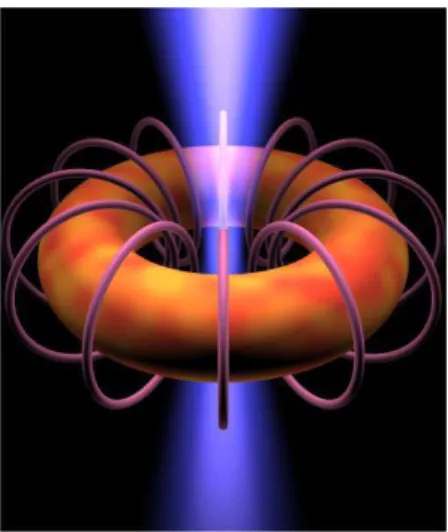
The difficulty is overcome in the TDH case, a strong can-didate for the central engine of quasars [31]. It has been previously proposed that a toroidal black hole might be sta-bilised by quantum gravitational effects [35] but in the present work there is no need for any departure from classical gen-eral relativity. If a TDH amasses an electrical charge, e.g. via the proton-electron charge/mass ratio disparity, neutrali-sation processes involving ambient plasma particles will be suppressed due to topological considerations. Flux lines of the induced dipolar magnetosphere along which charged par-ticles tend to spiral would not lead towards the TDH. Instead, they would locally run parallel to its surface, as depicted in figure 1. Plasma from an orbiting accretion disk would be channelled along the flux lines towards the central aperture,
Fig. 1: A rotating toroidal black hole with a non-zero electrical charge generates a magnetic field whose flux lines are capable of resisting a neutralising flow of charged particles from the plasma of an orbiting accretion disk or imploding star. Flux lines point away from the black hole along the rotation axis where, due to extraction of the black hole’s rotational energy, biaxial jets may be launched from the central aperture.
the region where the magnetic flux density is highest: the only location where the flux lines lead directly away from the TDH. Conditions for particle ejection are likely to be most favourable at a small displacement along the rotation axis ei-ther side of the symmetry plane. There, the magnetic field remains strong and aligned with the observed jets – but grav-itational time dilation is less pronounced [31]. The relatively gentle decline in flux with axial displacement can be seen, for example, by considering the magnetic field strength,B(z), of a current,I, flowing along a circular path of radiusrat a distancezalong the axis from the centre of symmetry:
B(z)= µ0Ir 2
2(z2+r2)3/2 ≈
µ0I
r(2+3z2/r2) for z≪r. (11) For a current loop spread over a toroidal surface, the flux density within the central aperture, Bap, whose radius is a
can, due to the conservation of charge on the torus and the integrated flux threading the aperture, be approximated by Bap≈(r/a)2B(0)≈µ0Ir/2a2. Thus, the magnetic field would
emerge in cones around the rotation axis, their convergence assisted by magnetohydrodynamic focusing. A population of neutral atoms and free neutrons in the accretion flow could feed TDH growth and support its long-term rotation against angular momentum losses.
Additional support for this model comes from the ob-served dichotomy between active and quiescent galaxies and the curious fact that quasars have distinctly finite lifetimes. Given that many galaxies still have ample reserves of gas to sustain accretion disks around supermassive black holes, and that the masses of these black holes cannot have decreased appreciably with time, it is puzzling that quasar activity is in such steep decline in the low redshift universe. One would expect nearby supermassive black holes, in particular those present in galaxy clusters, to at least feast upon stray mat-ter sporadically. Only∼10% of the primordial gas in galaxy clusters has so far been utilised by star formation. For com-parison, the figure for the Milky Way is closer to 90%. Nearly all galaxies harbour supermassive black holes so one wonders where are the vestigial traces of radio lobes caused by fleet-ing flares? Observational data suggests that once a quasar becomes quiescent there is little or no prospect of activity being revived: the galactic nucleus not only seems dormant, but utterly defunct. With regards to this finite lifetime riddle and the apparent lack of even temporary revival of quasar ac-tivity in quiescent galaxies, a topological transition offers a very natural and appealing hysteresis mechanism [31, 38, 39]. It has long been appreciated that this is a difficulty for more conventional models [40].
Once a dark hole grows too large, even a steadily sup-plied accretion disc cannot maintain sufficient influx of an-gular momentum to sustain the geometry. In addition, the angular momentum of the TDH is continually being sapped by jet generation. Closure of the central aperture is not eas-ily reversed, especially as the ensuing charge neutralisation is rapid when flux lines lead directly to the dark hole. A po-tential explanation can also be found here for the gamma-ray burst phenomenon, relatively short-lived affairs compared to most supernovae. Such events may correspond to the tempo-rary formation of a TDH/toroidal neutron degenerate struc-ture during the core collapse of a massive spinning star.
7 Discussion
The development of general relativity was one of the great-est triumphs not only of theoretical physics but of all science, providing a description of gravitation compatible with the no-tion that space and time are part of a unified four dimensional continuum with experimentally verifiable implications. How-ever, as with any intrinsically mathematical theory of physics, its interpretation must be guided by physical considerations and one should not lose sight of the scientific method. In-deed, some existing solutions in general relativity are already widely regarded as unphysical. Examples include the Tipler
cylinder and the G¨odel metric, which exhibits closed timelike curves threading all events within its spacetime. It is possi-ble that Einstein’s intuition was correct and that all metrics describing eternal black holes should be similarly regarded with a healthy degree of scepticism and replaced with a new dark hole paradigm.
The present work has attempted to reconcile astronomi-cally observed characteristics of quasars, which have inspired suggestions that their central engines may not abide by topo-logical censorship, with a theoretical understanding of why that might be. A global constraint has been highlighted whi-ch, if respected everywhere within a spacetime manifold, ho-lds considerable promise for resolving other long-standing problems in black hole research. It requires merely that the advancement of proper time along any worldline never ne-cessitates the physically impossible advancement of proper time along any other worldline. In many circumstances this is trivially satisfied, but the situation changes radically within a spacetime containing pairs of timelike worldlines for which the relative time dilation grows without limit. Some parti-cle worldlines will then reach future timelike infinity in finite proper time, much as light rays/photons do. Worldlines of timelike particles can thereby be truncated. In the case of par-ticles approaching the event horizon of an eternal black hole, this is a consequence of their asymptotically approached ap-parent velocity – particles moving at the speed of light expe-rience no passage of time. On the other hand, if a spacetime manifold is initially free of event horizons or singularities, it will always remain free of them. A picture emerges of gen-eral relativity as a remarkably benign theory of gravitation gracefully accommodating all eventualities. Analytical solu-tions to the field equasolu-tions of general relativity are confined to highly idealised situations. More complex and realistic sce-narios can only be studied numerically. Nevertheless, the ba-sic conclusions drawn here concerning the non-formation of event horizons for spherically symmetric situations are likely to carry through to more general circumstances.
The present proposal differs significantly from the grav-astarmodel [41] which invokes new physics, replacing the interior black hole region with a de Sitter spacetime blend-ing into the exterior Schwarzschild geometry via a carefully-tailored transition layer [42]. It is also distinct from the eter-nally collapsing object(ECO) scenario [43, 44] in that grav-itational collapse can be stabilised without recourse to ra-diation pressure. Furthermore, there is no need to invoke the presence of some “firewall” or exotic new physics at or near the horizon in order to overcome the information para-dox [45].
must not overlook the fact that general relativity is a theory in which global relationships exist between observers. By tracing the progress of an infalling observer beyond the event horizon, as Oppenheimer & Snyder did, one forsakes con-cern for external observers. In such situations, the worldlines of external observers must magically transcend what is, for them, future timelike infinity – and indeed, therefore, future timelike infinity for the entire spacetime manifold. Thus, the original notion of a “democracy” amongst observers is na¨ıve if one interprets it in a purely local manner, eschewing the original spirit of relativity.
The proper times along all worldlines should remain finite in any physically realistic spacetime manifold. Whilst self-evidently true, this has profound repercussions for gravita-tional collapse. Global relationships within a spacetime man-ifold override local considerations. This can arrest dynam-ical collapse, prohibiting both the initial formation of event horizons and the ingestion of matter across pre-existing event horizons. Hence, any theorems reliant on the presence of trapped surfaces may have no physical bearing. Prevailing ex-pectations that gravitational collapse inevitably leads to sin-gularities and event horizons appear to be in error and fears that black holes destroy information misplaced. Furthermore, if topological censorship is circumvented, then electrically-charged toroidal dark holes could form the central engines of quasars, consistent with astronomical observations. Thus, quasars may already provide intriguing hints that nature’s bla-ck holes labla-ck event horizons, and that various physically dis-turbing pathologies associated with traditional black hole mo-dels are obviated in realistic situations – without need for any adjustment to Einstein’s theory of gravitation.
Submitted on August 23, 2015/Accepted on August 25, 2015
References
1. Schmidt M. 3C 273: a star-like object with large red-shift.Nature, 1963, v. 197 (4872), 1040.
2. Ferrarese L. and Merritt D. A fundamental relation between super-massive black holes and their host galaxies.ApJ, 2000, v. 539 (1), L9. 3. Chandrasekhar S. The mathematical theory of black holes. 1983. Ox-ford University Press (International Series of Monographs on Physics. Volume 69), 663.
4. Silk J. and Rees M. J. Quasars and galaxy formation.Astron. Astro-phys, 1998, v. 331, L1.
5. Hopkins P. F. and Hernquist L. Quasars are not light bulbs: testing models of quasar lifetimes with the observed Eddington ratio distri-bution.ApJ, 2009, v. 698 (2), 1550.
6. Schwarzschild K. On the gravitational field of a mass point according to Einstein’s theory, 1916. (Translation by Antoci S. and Loinger A. arXiv:physics/9905030v1).
7. Einstein A. On a stationary system with spherical symmetry con-sisting of many gravitating masses.Annals of Mathematics, 1939, v. 40, 4.
8. Oppenheimer J. R. and Snyder H. On continued gravitational contrac-tion.Phys. Rev., 1939, v. 56 (5), 455.
9. Novikov I.D. and Frolov V.P. Black holes in the universe. Physics-Uspekhi, 2001, v. 44 (3), 291.
10. Preskill J. Do black holes destroy information? 1992, arXiv: hep-th/9209058.
11. Hawking S. W. Information loss in black holes.Phys. Rev. D, 2005, v. 72 (8), 084013.
12. Hawking S. W. Black holes and the information paradox. Pro-ceedings 17th Int. Conf. Dublin, 2004, Gen. Rel. & Grav.,
doi:10.1142/9789812701688 0006; arXiv: 1401.5761 (2014); doi:10.1038/nature.2014.14583.
13. Abramowicz M. A., Kluzniak W. and Lasota J. P., No observa-tional proof of the black-hole event-horizon,Astron. Astrophys,2002, v. 396, L31.
14. Friedman J. L., Schleich K. and Witt D. M. Topological censorship.
Phys. Rev. Lett., 1993, v. 71 (10), 1486.
15. Misner C. W., Thorne K. S. and Wheeler J. A. Gravitation. Macmillan. 1973.
16. Finkelstein D. Past-future asymmetry of the gravitational field of a point particle.Phys. Rev., 1958, v. 110 (4), 965.
17. Landau L. D. and Lifshitz E. M. The classical theory of fields (Vol. 2), 1975, Butterworth-Heinemann.
18. Vachaspati T., Stojkovic D. and Krauss L. M. Observation of incipi-ent black holes and the information loss problem.Phys. Rev. D, 2007, v. 76 (2), 024005.
19. Weller D. Five fallacies used to link black holes to Einstein’s relativis-tic space-time.Progress in Physics, 2011, v. 1, 93.
20. Hawking S. W. Black hole explosions.Nature, 1974, v. 248 (5443), 30.
21. Chafin C. E. Globally causal solutions for gravitational collapse. 2014. arXiv :1402.1524v1
22. Penrose R. Gravitational collapse and space-time singularities.Phys. Rev. Lett., 1965, v. 14 (3), 57.
23. Hawking S. W. The occurrence of singularities in cosmology. III. Causality and singularities.Proc. Roy. Soc. A, 1967, v. 300 (1461), 187.
24. Hawking S. W. and Penrose R. The singularities of gravitational col-lapse and cosmology.Proc. Roy. Soc. A, 1970, v. 314 (1519), 529.
25. Hawking S. W. Gravitational radiation from colliding black holes.
Phys. Rev. Lett., 1971, v. 26, 1344.
26. Hawking S. W. Black holes in general relativity. Commun. Math. Phys., 1972, v. 25, 152.
27. Shaver P. A., Wall J. V., Kellermann K. I., Jackson C. A. and Hawkins M. R. S. Decrease in the space density of quasars at high redshift.
Nature, 1996, v. 384, 439.
28. Ganguly R. and Brotherton M. S. On the fraction of quasars with out-flows.ApJ, 2008, v. 672 (1), 102.
29. Shapiro S. L., Teukolsky S. A. and Winicour J. Toroidal black holes and topological censorship.Phys. Rev. D, 1995, v. 52 (12), 6982.
30. Galloway G. J., Schleich K., Witt D. M. and Woolgar E. Topological censorship and higher genus black holes.Phys. Rev. D, 1999, v. 60 (10), 104039.
31. Spivey R. J. (2000). Quasars: a supermassive rotating toroidal black hole interpretation.MNRAS, 2000, v. 316 (4), 856.
32. Risaliti G., Harrison F. A., Madsen K. K., Walton D. J., Boggs S. E., Christensen F. E., . . . and Zhang W. W. A rapidly spinning super-massive black hole at the centre of NGC 1365.Nature, 2013, v. 494 (7438), 449.
33. Blandford R. D. and Znajek R. L. Electromagnetic extraction of en-ergy from Kerr black holes.MNRAS, 1977, v. 179 (3), 433.
35. Bambi C. and Modesto L. Can an astrophysical black hole have a topologically non-trivial event horizon? Phys. Lett. B, 2011, v. 706 (1), 13.
36. Butterworth E. M. and Ipser J. R. On the structure and stability of rapidly rotating fluid bodies in general relativity.ApJ, 1976, v. 204, 200.
37. Penrose R. and Floyd R.M. Extraction of rotational energy from a black hole.Nature, 1971, v. 229 (6), 177.
38. Pompilio F., Harun-or-Rashid S. M. and Roos M. A toroidal black hole for the AGN phenomenon. arXiv: astro-ph/0008475;Astron.& Astrophys., 2000, v. 362, 885.
39. Harun-or-Rashid S. M. Cosmological parameters and black holes, Univ. Helsinki PhD thesis, 2002, arXiv: astro-ph/0210253.
40. Hopkins P. F., Hernquist L., Martini P., Cox T. J., Robertson B., Di Matteo T. and Springel v. A physical model for the origin of quasar lifetimes.ApJ Lett., 2005, v. 625 (2), L71.
41. Mazur P. O. and Mottola E., Gravitational vacuum condensate stars,
Proc. Nat. Acad. Sci., 2004, v. 101, 9545.
42. Martin-Moruno P., Garcia N. M., Lobo F. S. and Visser M. Generic thin-shell gravastars.JCAP, 2012, v. 3, 034.
43. Mitra A. Radiation pressure supported stars in Einstein gravity: eter-nally collapsing objects.MNRAS, 2006, v. 369 (1), 492.
44. Mitra A. and Glendenning N. K. Likely formation of general relativis-tic radiation pressure supported stars or “eternally collapsing objects”.
MNRAS Lett., 2010, v. 404 (1), L50.