P. C. ¨Olveczky (Ed.): First International Workshop on Rewriting Techniques for Real-Time Systems (RTRTS’10) EPTCS 36, 2010, pp. 26–45, doi:10.4204/EPTCS.36.2
of Orc with Formal Analysis
Musab AlTurki
The University of Illinois at Urbana-Champaign, Urbana IL 61801, USA
Jos´e Meseguer
The University of Illinois at Urbana-Champaign, Urbana IL 61801, USA
Orc is a theory of orchestration of services that allows structured programming of distributed and timed computations. Several formal semantics have been proposed for Orc, including a rewriting logic semantics developed by the authors. Orc also has a fully fledged implementation in Java with functional programming features. However, as with descriptions of most distributed languages, there exists a fairly substantial gap between Orc’s formal semantics and its implementation, in that: (i) programs in Orc are not easily deployable in a distributed implementation just by using Orc’s formal semantics, and (ii) they are not readily formally analyzable at the level of a distributed Orc imple-mentation. In this work, we overcome problems (i) and (ii) for Orc. Specifically, we describe an implementation technique based on rewriting logic and Maude that narrows this gap considerably. The enabling feature of this technique is Maude’s support for external objects through TCP sockets. We describe how sockets are used to implement Orc site calls and returns, and to provide real-time timing information to Orc expressions and sites. We then show how Orc programs in the resulting distributed implementation can be formally analyzed at a reasonable level of abstraction by defining an abstract model of time and the socket communication infrastructure, and discuss the assumptions under which the analysis can be deemed correct. Finally, the distributed implementation and the formal analysis methodology are illustrated with a case study.
1
Introduction
Concurrent languages for new application areas such as web services pose interesting challenges. The usefulness of such languages is quite clear, but their correctness, both that of a language implementation and of specific programs in the language, is crucial for their safety and security. In particular, one would like to have, among other things: (i) a clear, semantics-preserving path from a language specification to a distributed language implementation; (ii) furthermore, this distributed implementation path should come withformal correctness guarantees; and (iii) it should be possible toformally verifythat specific programs written in such a language, and implemented according to the above path from a language specification, satisfy appropriate formal requirements. However, the distributed nature of such languages makes tasks (i)–(iii) more challenging than for sequential languages.
This paper addresses all these issues for the Orc programming language [1], an elegant and powerful language for orchestration of web services. Orc has a well-developed theoretical basis [1, 2, 3, 4, 5] and also a well-engineered language implementation [6, 7]. But as for any other language, there is a substantial gap between a language’s theoretical description and its implementation. Ideally, we would like to reason, and obtain formal guarantees about, Orc programs in their implemented form, but this is not a trivial matter.
implementation. Our method is semantics-based and builds on our earlier work on a rewriting logic semanticsof Orc [8], in which we showed how subtle issues about the Orc semantics, including its real-time nature, and the essential priority that internal events in an Orc expression should have over external communication, could be faithfully modeled in our real-time rewriting semantics. It also builds on our subsequent work giving to Orc a more efficientreduction semantics[9, 10], which brought the Orc lan-guage definition closer to an actual distributed implementation while preserving semantic equivalence. The third step, taken in this paper, is to pass from arewriting-based reduction semanticsto a rewriting-based implementationof such a semantics in a seamless way. Since the original SOS-like semantics of Orc and the reduction semantics are semantically equivalent [10], this substantially narrows the gap between the language’s formal semantics and its implementation.
How is this correct-by-construction implementation accomplished? The key idea is that concurrent rewriting isbotha theoretical model and a practical method of distributed computation. Specifically, in the Maude language [11], a high-performance implementation of rewriting logic, asynchronous message-passing between distributed objects is accomplished by concurrent rewriting via sockets. For Orc, the objects are either Orc expressions, which play the role of clients, or web sites, which play the role of servers. But since for Orc real time is of the essence, an important issue that must be addressed is how real time is supported in the implementation. Here, the key observation is that Orc programs assume an asynchronous and possibly unreliable distributed environment such as the Internet, and therefore implicitly rely on theirlocalnotion of time for their computations. As a consequence, time is supported bylocal ticker objects, that interact in a tightly-coupled way with their co-located Orc objects.
How about formal verification of Orc programs? Specifically, how can we model check the formal re-quirements of an Orc program running in the rewriting-based distributed implementation just described? The answer is that we cannot model check such a program directly with existing tools, but that we can however model check itindirectly. The idea is in a sense quite simple, namely, we can formally specifyboth the internet sockets supporting the actual distributed implementation, and the ticker objects supporting the real-time behavior of Orc expressions. In this way, both distributed message-passing com-putation between Orc expression clients and web sites, and time elapse are faithfullysimulatedin the formal specification, in which our desired program can then be model checked. As we explain in the paper, under reasonable assumptions about the granularity of time chosen for the tickers and the code of the Orc expressions, this simulated formal analysis gives us corresponding guarantees about the actual Orc programs running in the actual distributed Orc implementation.
Our Contributions. Our first contribution is thecorrect-by-constructionnature of our distributed Orc implementation, henceforth referred to as DIST-ORC. This contribution builds on the semantic equivalences already proved in [9] between the SOS, reduction semantics, and object-based semantics levels. In this way, a seamless path from formal language definition to a correct distributed implementa-tion is obtained.
Oursecondcontribution is to show for the first time how a rewriting logic specification of an object-oriented real-time system can be naturally transformed into an actualdistributed implementationof such a system in physical time. For untimed object-based systems it was known that Maude sockets could be used for this purpose; but no technique was known for seamlessly passing from real-time specifications to their implementations. This is shown here for DIST-ORC, but the method is much more general and
has already been applied to other real-time systems, like medical devices, in recent work by Sun and Meseguer [12].
Orc program ::= d¯; f d∈Declaration ::= E(x¯) =de f f
f,g∈Expression ::= 0|M(p¯)|E(p¯)| f |g | f>x>g | g<x<f p∈Actual Parameter ::= x|c|M
Figure 1: Syntax of Orc
real-time systems for the first time.
The paper is organized as follows. In Section 2, we give an overview of the Orc theory and its in-formal semantics, and describe in some detail the AUCTION example in Orc. In Section 3, we briefly review Orc’s rewriting semantics previously developed that form the basis of the distributed implementa-tion DIST-ORC, which is presented and discussed in Section 4, along with a distributed implementation
Dist-Auctionof the auction example. Section 5 describes the formal model of DIST-ORC in Real-Time Maude, with which formal analysis of distributed Orc applications, such asDist-Auction, can be carried out. The paper is concluded with a summary and a brief discussion of future work.
2
An Overview of Orc
Orc is a theory of orchestration of services that provides an elegant model for describing concurrent computations. Orc uses the notion of a site to represent a general service, which may vastly range in complexity from a simple function to a complex web search engine. A site may also represent the interaction with a human being, most commonly within the context of business workflows [13]. A site, when called, produces at most one value. A site may not respond to a call, either by design or as a result of a communication problem. For example, ifCNNis a site that returns the news page for a given dated, thenCNN(d)might not respond because of a network failure or it may choose to remain silent because of an invalid valued. When a site responds to a call with a valuec, it is said topublishthe valuec. Site calls arestrict, in that a site call cannot be initiated before its parameters are bound to concrete values.
Orc’s computation model is timed. Different site calls may occur at different times. A site call may be purposefully delayed using the internalsite rtimer(t), which publishes a signal after exactly t time units. Furthermore, responses from calls to external sites may experience unpredictable delays and communication failures, which could affect whether and when other site calls are made. Unlike external sites, however, responses from internal sites, such as rtimer, are assumed to have completely predictable timed behaviors. Orc also assumes a few more internal sites, which are needed for effective programming. They are: (1) the if(b) site, which publishes a signal if b is true and remains silent otherwise, (2)let(x¯), which publishes a tuple of the list of values in ¯x, and (3)clock, which publishes the current time value.
and may publish up to two values depending on the publication behavior of the individual sites.
Sequential composition, f>x>g, executes f, and for every valuecpublished by f, a fresh instance of g, with x bound to c, is created and run in parallel with f >x>g. This generalizes sequencing
expressions in traditional programming languages, where f publishes exactly one value. For example, ifEmail(a,x)is a site that sends an e-mail message given byxto a fixed addressa, then the expression CNN(d)>x>Email(a,x)may cause a news page to be sent toa. IfCNN(d)does not publish a value,
Email(a,x)is never invoked. Similarly, the expression(CNN(d)|BBC(d))>x>Email(a,x)may result in sending zero, one, or two messages toa.
Asymmetric parallel composition, f <x<g, executes f andgconcurrently but terminatesgonce it has published its first value, which is then bound toxin f. For instance, the expressionEmail(a,x)<
x<(CNN(d)|BBC(d))sends at most one message toa, depending on which site publishes a value first. If neither site publishes, the variablexis not bound to a concrete value, and the call toEmailis not made. To minimize use of parentheses, we assume that sequential composition has precedence over sym-metric parallel composition, which has precedence over asymsym-metric composition. We also use the syn-tactic sugar f≫gfor sequential composition when no value passing from f togis taking place, which corresponds to the case of a sequential composition f >x>gwherexisnot a freevariable ofg. For
example, the Orc expressionlet(x)<x<(M|rtimer(t)≫let(0) )specifies a timeout on the call to a site M. Upon executing it, both sitesM andrtimer are called. If Mpublishes a value cbeforet time units, thencis the value published by the expression. But ifMpublishescin exactlyt time units, then either cor 0 is published. Otherwise, 0 is published. Another example is the two-branch conditional ifbthen f elseg, which can be succinctly specified in Orc as the expressionif(b)≫ f | if(¬b)≫g. Given the behavior of the internal siteif, only one of f andgis executed, depending on the truth value ofb. These examples and many more can be found in [1].
The Auction Example. This section concludes with a description of a larger example in Orc, namely AUCTION, which will be the basis for a case study illustrating DIST-ORC in Section 4, and its formal
analysis in Section 5. The Orc program AUCTION, which was originally inspired by the auction example in [1], is a simplified online auction management application that manages posting new items for auction, coordinates the bidding process, and announces winners.
AUCTION assumes the following sites: (1) A Sellersite, which maintains a list of items to be auc-tioned and responds to the messagepostNextby publishing the next available item, (2) aBidderssite, which maintains a list of bidders and their bids, and responds to the messagenextBidList, which solicits a list of bids higher than the current bid for the auctioned item, (3) aMaxBidsite, which is a functional site that publishes the highest bid of a list of bids, and (4) anAuctionsite, which maintains a list of avail-able items and responds topostandgetNextfor adding and retrieving an item from the list, respectively. TheAuctionsite also keeps a list of winners and the respective items won, and responds to the message
won, which declares a bidder as the winner for the auctioned item.
Figure 2 lists Orc expressions used by AUCTION. ThePostingexpression recursively queries a given seller site for the next item available for auctionx, and then posts it to the auction by calling theAuction site. The call toAuctionblocks until bidding onxhas ended. ThePostingexpression then waits for one more time unit before querying the seller for the next item.
The Biddingexpression recursively queries the auction site for the next item available for auction and collects bids for the item in rounds from the bidders site for the duration of the auction, where each round lasts for a maximum of one unit of time. Once the bidding ends, the Biddingexpression then announces the winning bidder before proceeding to the next item. An item is a tuple(id,d,m), withid
Posting(seller) =de fseller(“postNext”)>x>Auction(“post”,x)≫rtimer(1)≫Posting(seller)
Bidding=de f Auction(“getNext”)>(id,d,m)>Bids(id,d,m,0)>(wn,wb)> (if(wn=0)≫Bidding()
|if(wn6=0)≫Auction(“won”,wn,id,wb)≫Bidding() )
Bids(id,d,wb,wn) =de f (if(d≤0)≫let(wb,wn)
|if(d>0)≫clock()>ta>min(d,1)>t>TimeoutRound(id,wb,t)>x> (if(x=signal)≫Bids(id,d−t,wb,wn)
|if(x6=signal)≫rtimer(1)≫clock()>tb>Bids(id,d−(tb−ta),x0,x1) ) )
TimeoutRound(id,bid,t) =de f
let(x)<x<(rtimer(t) | Bidders(“nextBidList”,id,bid)>bl>MaxBid(bl) )
Figure 2: Orc expressions in the AUCTIONprogram
The declarations in Figure 2 along with the expressionPosting(s)|Bidding, for a given seller sites, fully specify in Orc theAuctionprogram:
Posting;Bidding;Bids;TimeoutRound; Posting(s)|Bidding
3
Rewriting Semantics of Orc
Rewriting logic [14] is a general semantic framework that is well suited for giving formal definitions of programming languages and systems, including their concurrent and real-time features (see [15, 16, 17] and references there). Furthermore, with the availability of high-performance rewriting logic implemen-tations, such as Maude [11], language specifications can both be executed and model checked.
In previous work [9], we have developed an executable specification giving a formal semantics to Orc in rewriting logic. The specification was shown to capture Orc’s intendedsynchronoussemantics [10], where actions internal to an Orc expression, namely site calls, expression calls, and publishing of values, are given priority over interactions with the environment (processing responses from external sites), while also capturing its timed behaviors. Furthermore, our specification went through three main semantics-preserving refinements [8, 10, 9] in order to achieve greater efficiency and expressiveness.
The distributed implementation presented in this paper builds on the object-based semanticsROrc, which was first introduced in [9]. This semantics generalizes the previous semantics to multiple Orc expressions and makes explicit the interactions between Orc site and expression objects. The extension to object-based semantics enabled defining arbitrarily complex applications in Orc. We give a quick overview of the object-based semantics below.
¯
d in an attributeenv, and the expression f to be evaluated in an attributeexp. An Orc site object has a nameattribute for the site’s name, and maintains the site’s state in astateattribute.
In keeping with the philosophy of the Orc theory, expression objects are modeled as active objects with one or more threads of control (given as an Orc expression), and are capable of initiating (asyn-chronous) message exchange. Site objects, on the other hand, are reactive objects having internal states but are only capable of responding to incoming requests. In order to capture timing behaviors, an addi-tional simpleClockobject is also included in the configuration.
Messages in an Orc configuration are either site call or site return messages. Within an expression objectO, a site call expressionM(C)causes a site call message of the formM←sc(O,C,R)to be emitted into the configuration, withRa non-negative value representing the delay of the message; that is, the time it takes for the message to reach the siteM. Once the message is received and processed byM, the site may reply back with a site return messageO←sr(M,c,R′), withcthe value published byM, andR′ a message transmission delay.
Timed behaviors are specified using atickrule that advances logical time and manages the effect of time elapse by appropriately updating message delays. To provide proper timing guarantees for internal sites and to rule out uninteresting behaviors, a rule application strategy that gives time ticking the lowest priority among all rules in the specification is used. For the analysis to be mechanizable, we also assume Orc programs with “non-Zeno” behaviors [18], such that only a finite number of instantaneous transitions are possible within any finite period of time [9].
In the rewriting semantics of Orc outlined above, although many of the concepts and techniques re-lated to specifying timed behaviors in rewrite theories were borrowed from work onreal-time rewrite the-ories[17] and their implementations in Real-Time Maude [19], the tools and infrastructure provided by Core Maude were enough for our modeling and analysis purposes. However, in Section 5, we use Real-Time Maude to arrive at a more flexible and expressive formal model for the distributed implementation presented in the next section, and use its formal analysis tools, such as time-bounded model-checking.
4
A Distributed Implementation of Orc
The Orc theory was designed to specify, in a structured manner, concurrent computations, with emphasis on distribution through the notion of (external) sites. Furthermore, in practical applications it is typically the case that an Orc expression combines (through the use of Orc combinators) several subexpressions that independently orchestrate different but related tasks. For example, an online auction management expression may be composed of subexpressions managing: (1) seller inventories and product auction announcements, (2) bid collection and winner announcements, and (3) payments and shipping coordi-nation. Such subexpressions need not be located on the same machine for the orchestration effort to be completed, but are, in fact, more often run on physically distributed autonomous agents spread across the web. We, therefore, describe an extension of the Orc theory to a distributed programming model that is both natural and useful in specifying and analyzing distributed computations with explicit treatment of external sites and messages. The extension encapsulates the Orc programming model as the underlying model for Orc expressions, and in this respect, its rewriting specification builds on the Orc rewriting semantics specificationROrcoutlined in Section 3.
In general, the method of transforming a real-time, object-based rewriting semantics into a real-time distributed implementation consists of three fundamental steps:
2. Specifying the rewriting semantics of the underlying communication model for distributed objects in the system.
3. Devising a mechanism for capturing real, wall clock timing information and extending the rewrit-ing semantics of time to incorporate this information.
As explained below, a crucial enabling feature for steps (2) and (3) above is Maude’s support for socket-based communication [11]. We give a brief overview of Maude’s implementation of sockets below. We then discuss in some detail how this method is applied to Orc’s rewriting semantics, outline the design and implementation choices in DIST-ORCand explain how they are specified in Maude. The full specification is available online athttp://www.cs.illinois.edu/homes/alturki/dist-orc.
4.1 Sockets and External Objects in Maude
Maude provides a low-level implementation of sockets, which effectively enables a Maude process to exchange messages with other processes, including other Maude instances, according to the connection-oriented TCP communication protocol. More specifically, a configuration CF that contains a socket portal, which is a predefined constant<>of sortPortal(which is a subsort ofConfiguration), may communicate with objects external to the Maude process executingCFthrough a set of special messages defining an interface to Maude sockets. Assuming that O is an identifier for an object in CF, these messages are as follows:
1. createClientTcpSocket(socketManager, O, ADDRESS, PORT), which asks Maude’s socket manager, a factory for socket objects, for a client socket to a server located atADDRESS:PORT. Maude then responds with either acreatedSocket(O, socketManager, SOCKET) message, indicating successful creation of the client socketSOCKET, or asocketError(O, socketManager, S)message, withSa string briefly describing the reason for failure.
2. send(SOCKET, O, S), which asks for the string S to be sent through SOCKET. This message elicits either a messagesent(O, SOCKET), when the string is successfully sent, or a message
closedSocket (O, SOCKET, S), if an error occurred.
3. receive(SOCKET, O), which solicits a response throughSOCKET. When a response is received, Maude issues the messagereceived(O, SOCKET, S), withSthe string received. In case of an error, the socket is closed with the messageclosedSocket(O, SOCKET, S).
4. createServerTcpSocket(socketManager, O, PORT, BACKLOG), which asks Maude’s socket manager to create a server socket at portPORT, withBACKLOGa positive integer specifying the max-imum allowed number of queue requests. The message elicits either a messagecreatedSocket(O, socketManager, SERVER-SOCKET), or a messagesocketError(O, socketManager, S).
5. acceptClient(SERVER-SOCKET, O), which causes Maude to listen for incoming connections atSERVER-SOCKET. If a client connection is accepted, Maude responds back with the message
acceptedClient (O, SERVER-SOCKET, ADDRESS, SOCKET), whereADDRESS is the client’s address andSOCKETis a newly created socket for communicating with the client. The message
socketError(O, socketManager, S)is issued in case of failure.
6. closeSocket(SOCKET, O), which causes Maude to close the socket and issue the message
closedSocket(O, SOCKET, S).
4.2 Distributed Orc Configurations
In the distributed implementation, an Orc configuration may span multiple nodes in an interconnected network, and is thus called a distributedOrc configuration. Both expression and external site objects in a distributed configuration are identified partly by their location(a term of the sort Loc), which is defined as a combination of an address (such as a URI or an IP address) and a port number. To fully identify expression and external site objects, expression object identifiers, of sortEOid, and external site identifiers, of sortXSOid, also include a locally unique sequence number:
op loc : String Nat -> Loc . op s : Loc Nat -> XSOid . op e : Loc Nat -> EOid .
Internal site objects, such asif andrtimer, are identified simply by their names, since their locations are implicit.
Within a distributed Orc configuration, alocal configurationat some node, or simply aconfiguration, is managed by an independent instance of Maude. In addition to expression and site objects, each such configuration contains a clock object for maintaining local time and a socket portal for exchanging mes-sages with external objects in other configurations. Local configurations are encapsulated by an operator
op [ ] : Configuration -> LocalSystem to support managing time and its effects.
4.3 Sockets and Messaging
In agreement with the Orc theory, the communication model between Orc expressions and sites follows very closely that of the client-server architecture, where Orc expressions are client objects requesting and using services from sites as server objects. In particular, when an expression objectOmakes a site call with actual parametersCto an external site identified bys(loc(SR, PT), N), a site call message of the forms(loc(SR, PT), N) <- sc(O, C, H)is created within the configuration, whereHis a temporary handle that uniquely identifies the call. This message then triggers a request for creating a client socket to the called site through the following equation:
eq s(loc(SR, PT), N) <- sc(O, C, H)
= < p(O, H) : Proxy | param : C, response : "" >
createClientTcpSocket(socketManager, p(O, H), SR, PT) .
In addition, the equation creates a temporaryproxyobject identified byp(O, H), which manages external communication for this particular site call on behalf of the expression objectO. The proxy object also serves as a buffer for the site’s response, since TCP sockets do not preserve message boundaries in general.
If a client socket to loc(SR, PT) is successfully created, the message createdSocket(OP, socketManager, SC), targeted to the proxy OP, is introduced into the configuration. This causes the proxy to send the site call message to the external site object through the socketSC, as specified by the rewrite rule (the variableASdenotes the rest of the attributes in the object):
rl [SendExtCall] :
createdSocket(OP, socketManager, SC) < OP : Proxy | param: C, AS >
wheretoStringis a function that properly serializes Orc constants into strings that can be transmitted through sockets. The function uses a separatorsepto distinguish message boundaries. At the other end, Orc constants are built back from such strings using another functiontoConst.
There is also the possibility of an unsuccessful client socket creation attempt due, for example, to an unavailable server or a network failure. In this case, Maude reports the error by issuing the
socketError(OP, socketManager, S)message. Such an error is a run-time error, which, for sim-plicity, is considered fatal in DIST-ORC, so that the site call and any subsequent transitions that depend
on it will fail.
Once the site call message is sent, the reply sent(OP, SC) appears in the configuration and the proxy object waits for a response by introducing areceive(SC, OP)message.
rl [RecExtResponse] :
sent(OP, SC) < OP : Proxy | AS > => < OP : Proxy | AS > receive(SC, OP) .
When some stringSis received through the socket, the messagereceived(OP, OD, S)appears, and the proxy object storesSin its buffer and waits for further input.
rl [AccumExtResponse ] : received(OP, SC, S)
< OP : Proxy | param: C, response: S’ >
=> < OP : Proxy | param: C, response: S’ + S > receive(SC, OP) .
The proxy will keep accumulating input through the socket until it is remotely closed by the site, when the reply closedSocket appears. The site response is then reconstructed and handed in to its expression object:
rl [ProcessExtResponse] : closedSocket(p(O,H), SC, S)
< p(O,H) : Proxy | response: S’ , AS > => O <- sr(toConst(S’), H) .
On the server side, when a site is first initialized, it creates a server TCP socket, through which it keeps listening for incoming connections. Once a client has been connected, the site receives the request (which contains the actual parameters for the site call), processes it, and, if appropriate, emits a response back to the client and closes the socket. Site objects employ a similar mechanism for message handling as the one described above.
It is worth noting that, just like any other distributed communication mechanism, messaging through sockets is inherently prone to various potential communication problems, including connection initiation errors, dropped connections, lossy channels and unpredictably long delays. In DIST-ORC, such problems are dynamic errors that might be exposed while executing a distributed Orc program, and typically cause the Orc objects in which they appear to fail.
4.4 Timed Behavior
Maude Instance [ ... < Orc Expr > ... ] Ticker
Node A
Maude Instance [ ... < Orc Site > ... ]
Ticker Node B
Figure 3: A diagram illustrating the general structure of a distributed Orc configuration. Dashed rect-angles represent node boundaries, solid rounded rectrect-angles represent local configurations, and darkened circles represent endpoints of TCP sockets.
local clock, which also emphasizes Orc’s philosophy of having the communicating entities as loosely coupled as possible. Furthermore, for all the applications we have so far specified in Orc, distributed clock synchronization mechanisms, such as Lamport counters [20] or vector clocks [21, 22], are not required for programs correctness. This is primarily due to the fact that in most applications clocking information is used either locally (for example with the localrtimersite) or to time incoming responses. Since in Maude there is no direct support for accessing the system clock, we employ sockets as a means of transmitting clock time ticks to Maude from atickerobject external to Maude, but with access to the node’s real-time system clock. Thus, for each node in the distributed configuration, the clock of the local Orc configuration is indirectly managed by a corresponding ticker object within the same node. It is important to note that, although we use sockets to implement it, the ticker object is local to the node and is thus guaranteed to provide fairly accurate clocking information. Figure 3 illustrates schematically the deployment architecture of a distributed Orc configuration with timing.
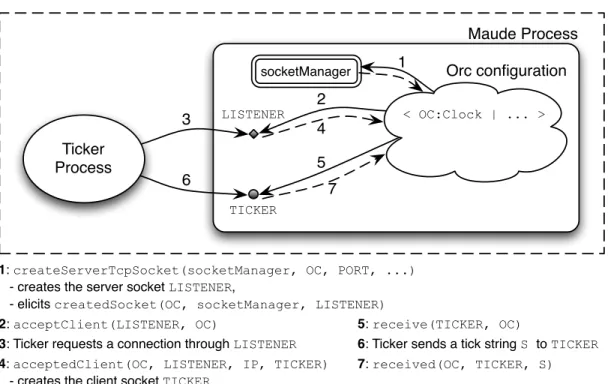
The diagram in Figure 4 outlines the steps involved in initializing a connection with the co-located ticker object and receiving the first clock tick.
Upon initialization, the clock object within an Orc configuration requests a server socket, by issuing the messagecreateServerTcpSocket(...), to be used for listening for a connection from the local ticker process, which is a Java process that is run in every node of a distributed configuration. The ticker process uses the built-in Java classes TimerandSocketto generate and send a tick message everyt milliseconds to its corresponding Maude process, wheretis a positive integer value. The clock object waits for a connection as soon as the server socket is created:
rl [InitClockSocket1] :
createdSocket(OC, socketManager, LISTENER) < OC : Clock | AS >
=> < OC : Clock | AS >
acceptClient(LISTENER, OC) .
where LISTENER is the newly created clock server socket. Once the ticker object is connected, the message acceptedClient(OC, LISTENER, IP, TICKER)appears, with IP the originating address of the ticker object, and TICKER the newly created client socket for communicating with the ticker object. This causes the clock object to become ready for incoming clock ticks according to the following rule:
Maude Process
Ticker Process
Orc configuration
< OC:Clock | ... >
socketManager 1
2
5 3
6
1: createServerTcpSocket(socketManager, OC, PORT, ...)
- creates the server socket LISTENER,
- elicits createdSocket(OC, socketManager, LISTENER) LISTENER
TICKER
2: acceptClient(LISTENER, OC)
3: Ticker requests a connection through LISTENER
4: acceptedClient(OC, LISTENER, IP, TICKER)
- creates the client socket TICKER
5: receive(TICKER, OC)
6: Ticker sends a tick string S to TICKER
7: received(OC, TICKER, S) 4
7
Figure 4: Establishing a connection with the ticker object and receiving clock ticks.
acceptedClient(OC, LISTENER, IP, TICKER) < OC : Clock | AS >
=> < OC : Clock | AS > receive(TICKER, OC) .
Upon receiving a clock tick, the clock object updates its clock and reflects the effect of time elapse on the rest of the Orc configuration equationally using the time-updating functiondelta, which decrements the relative time delays in pending messages (see [17] for an explanation of thedeltamethodology).
crl [tick] :
[received(OC, TICKER, S) < OC : Clock | clk: c(N) > CF]
=> [< OC : Clock | clk: c(N + 1) > receive(TICKER, OC) delta(CF)] if ...
The variable CF denotes the rest of the local configuration. Recall that the operator[ ] encapsulates the local configuration. The process of receiving and processing time ticks repeats as long as the ticker object is supplying ticks through the clock socket.
applications, it is enough to make sure that the application is designed so that a one-second clock tick is long enough for the application.
4.5 Dist-Auction: A Distributed Implementation of AUCTION
To illustrate our distributed implementation, we describe a distributed implementationDist-Auction
of the online auction management application in Orc, AUCTION, which was introduced in Section 2. The
distributed configuration of the auction application contains two expression configurations: one with the Postingexpression object, which is responsible for retrieving and posting items for sale by a given seller, and the other contains theBiddingexpression object for managing the bidding process. For instance, the initial local configuration for thePostingexpression object has the form:
[ <>
< C : Clock | clk : c(0) >
createServerTcpSocket(socketManager, C, 54200, 10) < e(loc("10.0.0.2", 44200), 0) : Expr |
env: Posting s := s("postNext") > x > AUCTIONID("post",x) >> rtimer(1) >> Posting(s),
exp: Posting(SELLERID), ... > ... ]
whereSELLERIDandAUCTIONIDare object identifiers for theSellerandAuctionsites, respectively. The Postingexpression declaration is stored in the environment attributeenvof the expression object, while the attributeexpkeeps the actual expression to be evaluated. The configuration also includes objects for internal (fundamental) sites, such asif andlet, which are omitted here for brevity.
In addition to thePostingandBiddingexpression configurations, there are four site object configura-tions in the distributed configuration ofDist-Auction, one configuration for each of the sites assumed by AUCTION, namelySeller,Bidders,MaxBid, andAuction. For example, the initial local configuration for aSellersite with two items for auction (identified by numbers1910and1720) may have the form:
[ <>
< C : Clock | clk : c(0) >
createServerTcpSocket(socketManager, C, 54800, 10) < s(loc("10.0.0.4", 44800), 0) : Site |
name : ’seller, state : (item(1910, 5, 500), item(1720, 7, 700)) , ... > createServerTcpSocket(socketManager, s(loc("10.0.0.4", 44800), 0), 44800, 10)]
The site attempts to create two server sockets: one for listening to expression object requests and the other for listening to the local ticker object.
Each local configuration inDist-Auctionmay run on a different node in a communication network. The diagram in Figure 5 depicts a physical deployment ofDist-Auction, with bidirectional arrows representing communication patterns. A physical deployment can be conveniently achieved using an appropriate shell script to run Maude, load the DIST-ORCmodule andDist-Auction, and execute the external rewrite commanderew. For example, withinitAuctionan operator that creates the initial state of the Auction site configuration, the following command executes the Auction site:
echo "erew initAuction ." | maude orc-distributed.maude auction-manager.maude
Posting Expr Bidding Expr
Seller Auction Bidders MaxBid
10.0.0.2:44200 10.0.0.3:44300
10.0.0.4:44800 10.0.0.5:44600 10.0.0.6:44400 10.0.0.7:44700
Figure 5: The deployment architecture of theDist-AuctionOrc program
00 erewrite in DIST-AUCTION : initAuction .
01 Site "10.0.0.5":44600 0 initializing... Site is ready. 02 Clock server socket created.
03 Awaiting connection from ticker ... 04 Ticker connected.
05 Received "post" 06 Item 1910 posted 07 Received "getNext" 08 Bidding to start for 1910 09 Tick! ... (5 time ticks) 10 Received "won"
11 Item 1910 won by Bidder 3 12 Received "getNext" 13 Tick!
14 Received "post" 15 Item 1720 posted
16 Bidding to start for 1720 17 Tick! ... (6 time ticks) 18 Received "won"
19 Item 1720 won by Bidder 3 20 Received "getNext" 21 ...
In this run, the auction site receives apostrequest from thePostingexpression object and posts item
1910. Meanwhile, a request for the next item to be auctioned is received from the Biddingexpression object. The auction site then publishes the item details back to theBiddingexpression, which takes care of orchestrating the bidding process for this item. After five time units (the duration of the auction on item1910), Bidder 3 is announced as the winner and a similar process is repeated for the second item
1720.
5
Formal Analysis of Distributed Orc Programs
5.1 Formal Specification of TCP Sockets
Maude’s TCP sockets can be formally specified by defining abstractions of Maude instances, sockets, and their behaviors. We develop a rewriting specificationRSocket of sockets, which is based on previ-ous work in [23, 24]. The specification abstracts Maude instances with objects of the class Process, and server and client sockets with objects ofServerSocket andSocket classes, respectively, which me-diate communication between processes. A process object has the formhPID:Process|sys:Si, with PIDan object identifier and San encapsulated local configuration. A client socket object of the form
hSID:Socket|end points:[PIDa,PIDb]iabstracts a bidirectional client TCP socket set up between pro-cesses PIDa and PIDb, while a server socket object simply maintains the server’s address and port: hSID:ServerSocket|address:A,port:Ni. Server socket objects are created using aManager object,
hsocketManager:Manager|counter:Ni, abstracting Maude’s socket manager and maintaining a counter for generating fresh socket object identifiers. Finally, messages inRSocket have formats that are almost identical to those used by Maude sockets.
Different useful abstractions of socket behaviors can be defined. For the formal model of DIST -ORC, we choose an abstraction level that captures most interesting behaviors and yet can be efficiently analyzed. The abstraction essentially considers potential client socket creation errors and a somewhat limited form of communication delays and failures. This design choice abstracts away uninteresting behaviors, such as server socket creation problems, and approximates actual messaging problems, such as unavailable or unreachable servers, and unreliable networks. The main features ofRSocket are explained below.
Server socket creation is straightforward, and is modeled with the following rewrite rule:
rl [CreateServerTcpSocket] :
< PID : Process | sys : [createServerTcpSocket(socketManager, O, PT) CONF] > < socketManager : Manager | counter : N >
=> < PID : Process | sys : [createdSocket(O, socketManager, server(N)) CONF] > < socketManager : Manager | counter : (N + 1) >
< server(N) : ServerSocket | address : "localhost", port : PT > .
The rule creates a server socket object, identified byserver(N), with an arbitrary address and a given port, and transforms the socket creation request message into an appropriate response.
When an Orc object within a process attempts to create a client socket to a server by issuing the mes-sagecreateClientTcpSocket(socketManager, O’, SR, PT), two different transitions are possi-ble depending on whether the client socket creation is successful or not. The success case is modeled by the following rule:
rl [CreateClientSocketSuccess] :
< PID : Process | sys : [acceptClient(server(N), O) CONF] >
< PID’ : Process | sys : [createClientTcpSocket(socketManager, O’, SR, PT) CONF’ ] > < socketManager : Manager | counter : M >
< server(N) : ServerSocket | address : SR, port : PT >
=> < PID : Process | sys : [acceptedClient(O, server(N), SR, socket(M)) CONF] > < PID’ : Process | sys : [createdSocket(O’, socketManager, socket(M)) CONF’] > < socketManager : Manager | counter : (M + 1) >
< server(N) : ServerSocket | address : SR, port : PT > < socket(M) : Socket | endpoints : [PID : PID’] > .
The rule also creates a socket objectsocket(M)that will mediate communication between the client and the server.
Client socket creation may also fail, representing situations where the server is unreachable or un-available. This case is modeled by the following rule, where the client process gets thesocketError(O’, socketManager, "")message from the socket manager, and no new socket object is created.
rl [CreateClientSocketFail] :
< PID : Process | sys : [acceptClient(server(N), O) CONF] >
< PID’ : Process | sys : [createClientTcpSocket(socketManager, O’, SR, PT) CONF’ ] > < socketManager : Manager | counter : M >
< server(N) : ServerSocket | address : SR, port : PT >
=> < PID : Process | sys : [acceptClient(server(N), O) CONF] >
< PID’ : Process | sys : [socketError(O’, socketManager, "") CONF’] > < socketManager : Manager | counter : M >
< server(N) : ServerSocket | address : SR, port : PT > .
Once a socket is successfully created, a connection through this socket is established, and bidirec-tional message exchanges may take place usingsend(...) andreceive(...) messages.
crl [exchange] :
< PID : Process | sys : [send(SOCKET, O, C) CONF] > < PID’ : Process | sys : [receive(SOCKET, O’) CONF’] > < SOCKET : Socket | endpoints : [PID : PID’] >
< DID : Delays | ds : DS >
=> < PID : Process | sys : [sent(O, SOCKET) CONF] >
< PID’ : Process | sys : [received(O’, SOCKET, C, R) CONF’] > < SOCKET : Socket | endpoints : [PID : PID’] >
< DID : Delays | ds : DS > if DS’ R DS’’ := DS .
Thesendandreceivemessages are respectively transformed into asent(O, SOCKET)message, ac-knowledging the send action to the sender, and areceived(O’, SOCKET, C, R)message, signaling delayed delivery of the sent message to the receiver inR time units. The delay value for a transmit-ted message is non-deterministically extractransmit-ted using a matching equation in the condition from a finite, non-empty set of delaysDSmaintained by a special objectDID. A delay set for a given distributed Orc application can be specified as part of its initial state. Different behaviors may result by giving different delay sets. Two special cases of interest are: (1)DS={0}, in which case messages are assumed to ex-perience no delays, and (2)∞∈DS, which represents the case of a lossy communication channel. As we will see in Section 5.2, the real-time semantics of the model will eventually make such delayed messages available to the receiver for processing.
Finally, closing a socket is straightforwardly modeled by the following equation:
eq [close] :
< PID : Process | sys : [closeSocket(SOCKET, O) CONF] > < PID’ : Process | sys : [receive(SOCKET, O’) CONF’] > < SOCKET : Socket | endpoints : [PID : PID’] >
= < PID : Process | sys : [closedSocket(O, socketManager, "") CONF] > < PID’ : Process | sys : [closedSocket(O’, socketManager, "") CONF’] > .
5.2 Global Logical Time
Time and its effects on the distributed Orc configuration are formally specified using the standard and general technique of capturing logical time in real-time rewrite theories [25], and facilitated by Real-Time Maude [19]. Essentially, the time domain is represented by a sortTimeInf (time with infinity), and aglobal tickrewrite rule is used to synchronously advance time and propagate its effects across the encapsulated global configuration, a term of the sortGlobalSystem, of the form{Conf}, whereConf is the Orc configuration consisting of all process and socket objects. Furthermore, the tick rule, which plays the role of the ticker objects in the distributed implementation, is defined globally as follows (with
R’a variable ranging over the positive rational numbers):
crl [tick] :
{CONF} => {delta(CONF, R’)} in time R’
if eagerEnabled({CONF}) =/= true /\ R’ <= mte(CONF) [nonexec] .
The tick rule computes on the global Orc configuration the function delta, which advances time for all clock objects and updates time delays in all site calls and returns in the configuration. For example, clocks and delayed external messages are updated, respectively, by the following two equations (plus
andmonusdefine addition and subtraction on time domains):
eq delta(< O : Clock | clk : c(R) > CF, R’)
= < O : Clock | clk : c(R plus R’) > delta(CF, R’) .
eq delta(received(O, O’, C, R) CF, R’) = received(O, O’, C, R monus R’) delta(CF, R’) .
The tick rule above is not immediately executable (which is indicated by the[nonexec]attribute), as it introduces a new variableR’representing the amount of time elapse on its right hand side. A strategy for sampling time needs to be specified for the rule to be executable. We assume a general maximal strategy that in each tick advances time by themaximum time elapse, which is defined by the function
mteas the minimum delay across all site call messages and returns in the global Orc configuration. This ensures that time is advanced as much as possible in every tick but only enough to be able to capture all events of interest. To properly capture the synchronous semantics of Orc [8, 9], the tick rule is also made conditional on the fact that no other instantaneous transition is possible. This is precisely captured by the
eagerEnabledpredicate, which is true on configurations with enabled internal transitions or pending message exchanges. This imposes a precedence of rule application, where time ticks have the lowest priority among all transitions.
It is important to note that the abstraction of time and how it affects the global Orc configuration as specified by the tick rule is consistent with the real-time distributed implementation DIST-ORCin that, in DIST-ORC, we assumed that the granularity of a single time tick in real-time is always large enough for instantaneous transitions within a configuration to complete. Furthermore, the tick rulesynchronously updates all clock objects in all processes. This defines yet another abstraction over DIST-ORC, where individual clocks are not necessarily synchronized. However, since clock synchronization is not required for DIST-ORC, as was discussed in Section 4.4, the abstraction considers only those behaviors in DIST -ORCthat make sense under these assumptions about time.
5.3 Formal Analysis ofDist-Auction
The formal specification of sockets and logical time provides a formal model of DIST-ORCthat can be
the auction case study. In particular, we perform time-bounded linear temporal logic model checking with commands of the form(mc term |=t formula in time <= timeLimit .), and timed search us-ing(find earliest term =>* pattern such that condition .), which finds a state reach-able within the shortest possible time that matches the given pattern and satisfies the given condition. Verification is applied on a closed system specification that includes definitions of all required sites (servers) and expressions (clients) in the AUCTIONapplication.
In our analysis, we assume a single seller site with two items for sale, labeled1910and1720, and offered for auction for 5 and 7 time units, respectively. The functioninitial(DS)constructs an initial state forDist-Auctionin which the set of possible message transmission delays is DS, which, in the analysis examples below, is the singleton set{0.1}, unless otherwise indicated. The atomic predicates used are:
1. commError, which is true in states with communication errors:
op commError : -> Prop .
eq {< PID: Process | sys: [socketError(O, O’, S) CF] > CF’} |= commError = true .
2. sold(id), which is true in states where the itemidhas been sold:
op sold : Nat -> Prop . eq {< PID : Process |
sys : [< O : XSite | name : ’auction,
state : won(winner(N, id, M), WN) OST > CF] > CF’} |= sold(id) = true .
where the termwinner(N, id, M)matches a winning bidMon itemidby theNth bidder.
3. hasBid(id), which is true when the itemidhas been bid on:
op hasBid : Nat -> Prop . eq {< PID : Process |
sys : [< O : XSite | name : ’bidders,
state : bidders(b(N, [id, M] IBS) BS) OL > CF] > CF’} |= hasBid(id) = true .
where the termb(N, [id, M] IBS)matches a bidMon itemidby theNth bidder.
4. conflict(id), which is true when itemidhas two different winners:
op conflict : Nat -> Prop . eq {< PID : Process |
sys : [< O : XSite | name : ’auction ,
state : won(winner(N, id, M), winner(N’, id, M’), WN) OST > CF] > CF’}
|= conflict(id) = true .
op commit : Nat -> Formula .
eq commit(id) = hasBid(id) -> <> sold(id) . op commitAllNoErrors : -> Formula .
eq commitAllNoErrors = ([] ~ commError) -> [] (commit(1910) /\ commit(1720)) .
The property is then verified with the time-bounded model checking command:
Maude> (mc initial(1/10) |=t commitAllNoErrors in time <= 15 .)
rewrites: 7052663 in 14413ms cpu (14420ms real) (489317 rewrites/second) ... Result Bool : true
The property is satisfied with a communication delay of 0.1 time units. In fact, the property is satisfied when communication delays are bounded by 0.25 time units. This is because the timeout value for collecting bids in a single bidding round in theTimeoutRound expression is 1.0, while a delay of 0.25
translates into a cumulative round trip delay of 1.0 for its two sequential site calls, which may result in an uncommitted bid. This can be verified by the resulting counterexample when executing the command above but withinitial(1/4).
Another property an auction management system must guarantee is that every item sold has a unique winner: ✷Vi¬conflict(idi). This property can be shown satisfiable in Dist-Auction regardless of communication errors. The property is specified in Real-Time Maude as the formulauniqueWinnerAll:
op uniqueWinner : Nat -> Formula . eq uniqueWinner(id) = ~ conflict(id) . op uniqueWinnerAll : -> Formula .
eq uniqueWinnerAll = [] (uniqueWinner(1910) /\ uniqueWinner(1720)) .
The property is verified by the following command :
Maude> (mc initial(1/10) |=t uniqueWinnerAll in time <= 15 .)
rewrites: 8613539 in 19627ms cpu (19800ms real) (438843 rewrites/second) ... Result Bool : true
Finally, given a delay of 0.1, one can verify that the first item cannot be won before 5.5 time units have passed using the following command:
Maude> (find earliest initial(1/10) =>* {C:Configuration} such that {C:Configuration} |= sold(1910) .)
rewrites: 268287407 in 1525921ms cpu (1544117ms real) (175819 rewrites/second) ... Result: {< did : Delays | ds : 1/10 > ... } in time 11/2
6
Conclusion and Future Work
We have presented DIST-ORC, a rewriting-based, real-time, distributed implementation of the Orc
lan-guage allowing different Orc expressions at different locations to interact by asynchronous message passing with different sites in an object-based manner. We have also shown how a DIST-ORCreal-time implementation can be easily obtained from a rewriting logic semantic definition of Orc in a correct-by-construction way using Maude sockets and ticker objects. And we finally demonstrated with an auction example that Orc applications running in DIST-ORCcan still be formally analyzed by model checking once we model the distributed infrastructure at a reasonable level of abstraction.
the techniques presented here that can automatically synthesize a real-time, distributed implementation from the formal semantics; (ii) making DIST-ORCmore user-friendly, by providing a user interface for interacting with DIST-ORC-based web orchestration applications; and (iii) endowing DIST-ORCwith a security infrastructure, and formally verifying the security of certain types of web orchestration services that use such an infrastructure against general classes of attacks.
Acknowledgements
We thank Jayadev Misra, William Cook, David Kitchin, Adrian Quark and Andrew Matsuoka for very fruitful discussions on Orc and its Java implementation, and the anonymous reviewers and Peter ¨Olveczky for helpful comments on an earlier version of the paper. This work has been partially supported by NSF grant NSF CNS 07-16638, King Fahd University of Petroleum and Minerals, and King Abdullah Uni-versity of Science and Technology.
References
[1] Misra, J., Cook, W.R.: Computation orchestration: A basis for wide-area computing. Journal of Software and Systems Modeling6(1) (March 2007) 83–110
[2] Hoare, T., Menzel, G., Misra, J.: A tree semantics of an orchestration language. Engineering Theories of Software Intensive Systems (2005) 331–350
[3] Kitchin, D., Cook, W.R., Misra, J.: A language for task orchestration and its semantic properties. In: CONCUR 2006. Volume 4137 of Lecture Notes in Computer Science., Springer (2006) 477–491
[4] Rosario, S., Kitchin, D., Benveniste, A., Cook, W., Haar, S., Jard, C.: Event structure semantics of Orc. In: WS-FM 2007. Volume 4937 of Lecture Notes in Computer Science., Springer (2008) 154–168
[5] Wehrman, I., Kitchin, D., Cook, W.R., Misra, J.: A timed semantics of Orc. Theor. Comput. Sci.402(2-3) (2008) 234–248
[6] Kitchin, D., Quark, A., Cook, W., Misra, J.: The Orc programming language. In Lee, D., Lopes, A., Poetzsch-Heffter, A., eds.: Formal techniques for Distributed Systems; Proceedings of FMOODS/FORTE. Volume 5522 of LNCS., Springer (2009) 1–25
[7] Cook, W.R., Misra, J.: Implementation outline of Orc. http://orc.csres.utexas.edu(2005)
[8] AlTurki, M., Meseguer, J.: Real-time rewriting semantics of Orc. In: PPDP ’07: Proceedings of the 9th ACM SIGPLAN international symposium on Principles and practice of declarative programming, New York, NY, USA, ACM Press (2007) 131–142
[9] AlTurki, M., Meseguer, J.: Reduction semantics and formal analysis of Orc programs. Electron. Notes Theor. Comput. Sci.200(3) (2008) 25–41
[10] AlTurki, M., Meseguer, J.: Rewriting logic semantics of Orc. Technical Report UIUCDCS-R-2007-2918, University of Illinois at Urbana Champaign (November 2007)
[11] Clavel, M., Dur´an, F., Eker, S., Lincoln, P., Mart´ı-Oliet, N., Meseguer, J., Talcott, C.: All About Maude - A High-Performance Logical Framework. Volume 4350 of LNCS. Springer-Verlag, Secaucus, NJ, USA (2007) [12] Sun, M., Meseguer, J.: Distributed real-time emulation of formally-defined patterns for safe medical device control. In: The 1st International Workshop on Rewriting Techniques for Real-Time Systems (RTRTS), Longyearbyen, Spitsbergen, Norway (April 2010)
[13] van der Aalst, W.M.P., ter Hofstede, A.H.M., Kiepuszewski, B., Barros, A.P.: Workflow patterns. Distrib. Parallel Databases14(1) (2003) 5–51
[15] Meseguer, J., Ros¸u, G.: Rewriting logic semantics: From language specifications to formal analysis tools. In: Proc. Intl. Joint Conf. on Automated Reasoning IJCAR’04, Cork, Ireland, July 2004, Springer LNAI 3097 (2004) 1–44
[16] Meseguer, J., Rosu, G.: The rewriting logic semantics project. Theor. Comput. Sci.373(3) (2007) 213–237 [17] ¨Olveczky, P.C., Meseguer, J.: Semantics and pragmatics of Real-Time Maude. Higher-Order and Symbolic
Computation20(1-2) (2007) 161–196
[18] ¨Olveczky, P.C., Meseguer, J.: Abstraction and completeness for Real-Time Maude. Electron. Notes Theor. Comput. Sci.176(4) (2007) 5–27
[19] ¨Olveczky, P.C.: Real-Time Maude 2.3 manual (August 2007) http://heim.ifi.uio.no/~peterol/ RealTimeMaude/.
[20] Lamport, L.: Time, clocks, and the ordering of events in a distributed system. Commun. ACM21(7) (1978) 558–565
[21] Mattern, F.: Virtual time and global states of distributed systems. In et al., C.M., ed.: Proc. Workshop on Parallel and Distributed Algorithms, North-Holland / Elsevier (1989) 215–226 (Reprinted in: Z. Yang, T.A. Marsland (Eds.), ”Global States and Time in Distributed Systems”, IEEE, 1994, pp. 123-133.).
[22] Fidge, C.J.: Timestamps in message-passing systems that preserve partial ordering. In: Proceedings of the 11th Australian Computer Science Conference. (February 1988) 56–66
[23] Dur´an, F., Riesco, A., Verdejo, A.: A distributed implementation of Mobile Maude. Electron. Notes Theor. Comput. Sci.176(4) (2007) 113–131
[24] Riesco, A., Verdejo, A.: Distributed applications implemented in Maude with parameterized skeletons. In Bonsangue, M.M., Johnsen, E.B., eds.: FMOODS. Volume 4468 of Lecture Notes in Computer Science., Springer (2007) 91–106