Combinatorics at Electronic Circuit Realization
in FPAA
György Györök, Margit Makó, József Lakner
Regional Education and Innovation Center Budapest Tech
Budai út 45, H-8000 Székesfehérvár, Hungary {gyorok, mako, lakner}@roik.bmf.hu
Abstract: Our present work is to examine and offer an automatic electronic circuit construction solution which – using electronic devices and Field Programmable Analog Arrays (FPAA) – enables us to form analogue circuits. The automatic computer-assisted construction is an old endeavor in the electronic development of electronic circuit constructional tasks. The currently used constructional systems are integrated devices which contain simulation modules based on circuit drawings and component parameters. It is relevant in printed circuit construction as well, where wiring geometry can be modified depending on the examined (EMC, thermo-technical, transmission\ldots, etc.) parameters. To achieve this goal, new simulation and circuit generation processes are required, which select the most appropriate solutions regarding the parametrical description of electronic topology.
1 Introduction
The two basic steps of analog electronic circuit construction are the provision of topology and their of the component parameters. Besides most extensive computer assistance, necessaries heuristic approaches in circuit arrangement. As a result of our development the prototypical circuit and its parametrical examination can result in the modification of the component parameters and the change of the to-pology. This process – reducing the number of iterations – can be accelerated if circuit simulation programs are applied. We reveal a process using of informatics resources facilitates the automatization of the construction [3] [6] [5] [4].
1.1 Circuit Description, Construction
The electronic circuit the connection matrices (Kc) are used for a network’s
tion between the nodes and its direction. The columns of the matrix contain the branches beginning there end from the single node while the rows write the single branches being attached to junctions down [2].
Figure 1
Graph and nodes of an electronic circuit
Likewise the cited from literature we know that it is a Figure 1 and for its graph and its branches an electronic component writes the relation of current down in Equation (1). The computerized electronic circuit simulation means the calculation of voltages to the single branch of the graph. Widespread procedures which can be applied well stand onto a provision in this direction.
A random generated electronic circuit differing with a given parameters the simu-lation results of the transfer of an amplitude frequency of the Figures 2, on below visible of the properly circuit and its frequency-transfer [11] [12] [13] [17] [18].
Figure 2
2 Circuit Definition in FPAA by Combinatoric Vote
The number of functional units in a particular FPAA device (Figure 3) is limited, since each of the four CABs has a limited elemental circuit. The number of inputs and outputs of FPAA is expected to be set. The various connect condition of I puts and outputs also narrows the number of possibilities due to the general rule of connecting the functional units.
Figure 3
Inner structure of Anadigm’s FPAA circuit
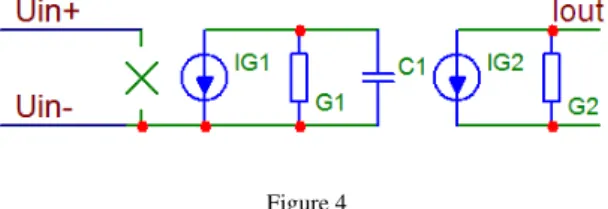
Figure 4 describes the simplified model of a potential operation amplifier in one of the branches. The model, in this case, describes the relation between branch volt-ages and branch circuits [13] [17].
Figure 4
Equivalent circuit of operating amplifier
FPAA (AN221E04) mentioned in the introduction programmable like that elec-tronic circuit, in which the elecelec-tronic circuit details which can be developed with electronic circuit macros can be realized. These his quality and his quantity auto-matically the used depends of FPAA. On Figure 5 in Anadigm FPAA circuit mac-ros visible.
The Kirchhoff-equation 4, deciding of the constructed circuit. The equation it was thawing out on Figure 5 from the possible CAMs different combinations which can be developed writes it down [10] [14] [1].
The Equation (3) pays attention to the quantity of the CAMs which can be worked up bar, the figure right being table based on the column of Weight as follows
⎟⎟ ⎠ ⎞ ⎜⎜ ⎝ ⎛ = s CAM m r
q (2)
and
∑
≤ < ≤ < = 8 0 3 0 ), , ( CA CLBCAM r A C
r (3)
where A is the used amplifiers in CAMs, C is the used capacitors in CAMs.
The Equation (4), and (5) give the number of the possible connections.
The value of q decides the Equation (4)
8 0 3 0 )! ( ! ' ≤ < ≤ < − = C A CAM s CAM s r m r m
q (4)
where q is the number of abilities functional circuit (Configurable analog modules, CAM) in FPAA, ms is the number of abilities different CAM in FPAA, rCAB is the
Figure 5
left; List of the ability FPAA’s functional circuit and their properties (Anadigm), right; Number of inputs, and outputs of analog macros, and number in their used amplifiers and capacitors
The number of theoretical possibilities writes down the Equation (5)
, 2 2
b
cir n
t ⎥
⎦ ⎤ ⎢ ⎣ ⎡
⎟⎟ ⎠ ⎞ ⎜⎜ ⎝ ⎛
= (5)
(
)
[
1]
b,cir nn
t = − (6)
where n is the nodes of circuit, b is the used branches in circuit.
Onto a general, maximum case, the number of the branches thins out less, than that number of the nodes Equation (7) as below,
, 1
− =n
On the other hand, the number of the accesses of the raffled branch electronic circuits and the general who and access defines the number of the nodes Equation (8) in the next,
(
+)
+2,=
∑
rCAM−in rCAM−outn (8)
where rCAM¡inis the number of inputs of branch-circuits, rCAM¡outis the number of
out-puts of branch-circuits
'.
q t
s= cir (9)
In the Equation (9) s is the number of theoretical abilities of the voted circuits.
We may avail ourselves of similar conditions with additional limitations. The Figure 5 is the Out column of his table and his In column with in conformity with additional bindings in this manner [15] [16]. The Figure 6 the proposed electronic circuit generating process exemplifies it. As first step normalized component we make the calculations with parameters, in this manner the character of the function of the electronic circuit can be judged.
Let us make a choice as an example who the possible from 28 electronic circuits three in that manner, that let the conditions (0<ΣA≤3 and 0<ΣC≤8) come true. So the Equation (4) gives 3276 different abilities circuit. Each of these electronic circuits are one input and one outputs and in FPAA there are two general inputs or outputs, so the Equation (8) gives n=8, and maximal number of branches from Equation (7) gives 7 value. It is the number of the possible connections in this manner according to the Equation (6) gives 1,72·1012. In this manner from the equation 9 the possible full number of attempts will be 5,65·1015.
Conclusions
We emphasize that present paper contains a lot of hypothetic elements, our find-ings are not elaborated. However, the interim results are promising. Integrating the circuit description algorithm and the combinatorial processes, and also the simula-tion assisted decision procedure regarding the analogue circuit-construcsimula-tion proc-ess in FPAA circuits, can be considered as a novelty in our effort.
Figure 6
References
[1] J. M. Birkner, H-T. Chua. Programmable Array Logic Circuit. US Patent, 1970
[2] L. O. Chua, P. M. Lin. Computer-aided Analysis of Electronic Circuit. Prentice-Hall, 1975
[3] S. Hauck. The Future of Reconfigurable Systems.
http://www.ee.washington.edu/people/-faculty/hauck/publications/ReconfigFuture.PDF
[4] Gy. Györök M. Makó, J. Lakner. Combinatorics at Electronic Circuit Re-alization in FPAA, in Proceedings of 6th International Symposium on Intel-ligent Systems and Informatics (SISY 2008), September 26-27, 2008, Subotica, Serbia, ISBN 978-1-4244-2407-8, IEEE Catalog Number CFP0884-CDR, Library of Congress 2008903275
[5] F. Scott, L. Kemper, S. Afreen, O.L. Weck. Flexible and Reconfigurable Systems: Nomenclature and Review. In Proceedings of the ASME 2007 In-ternational DesignEngineering Technical Conferences Computers and In-formation in Engineering Conference, volume IDETC/CIE, 2007, Las Ve-gas, Nevada, USA
[6] H. Scott. The Future of Reconfigurable Systems. In Proceedings of 5th Canadian Conference on Field Programmable Devices, Montreal, June 1998, The Future of Reconfigurable Systems, Volume IDETC/CIE, 1998, LEvanston, IL 60208-3118 USA
[7] Anadigm the dpASP Company. Dinamically Programmable Analog Signal Processing. http://www.anadigm.com/
[8] J. F. Wakerly. Digital Design: Principles and Practices. Prentice-Hall, 1987
[9] S. Zebulum, R, A. Stice, K. Didier. The Design Process of an Evolutionary-oriented Reconfigurable Architecture. www.coe.uncc.edu/ kdatta/papers/The/20Design/20Process/ 20_urable/20Architecture.pdf
[10] Gy. Györök. Self Organizing Analogue Circuit by Monte Carlo Method. In Proceedings of International Symposium on Logistics and Industrial Infor-matics (LINDI 2007) September 13-15, 2007 Wildau, Germany, ISBN 1-4244-1441-5, IEEE Catalog Number 07EX1864C, Library of Congress 2007930060, pp. 34-37
[12] Gy. Györök. Programmable Analog Circuit in Reconfigurable Systems. In Proceedings of5th Slovakian-Hungarian Joint Symposium on Applied Ma-chine Intelligence (SAMI 2007) January 25-26, 2007, Poprad, Slovakia, ISBN 978-963-7154-56-0, pp. 151-156
[13] Gy. Györök. Self Configuration Analog Circuit by FPAA. In Proceedings of 4th Slovakian-Hungarian Joint Symposium on Applied Machine Intelli-gence (SAMI 2006) January 20-21, 2006, Herlany, Slovakia, ISBN 963 7154 44 4, pp. 34-37
[14] Gy. Györök. The Function-controlled Input for the IN CIRCUIT Equip-ment. In Proceedings of IEEE International Conference on Intelligent En-gineering Systems (INES 2004) Cluj-Napoca, Romania, September 19-21, 2004, ISBN 973-662-120-0, pp. 443-446
[15] Gy. Györök, M. Makó. Self Configuration Analog Circuits. 17th Kandó Conference 2006 ,,In memoriam Kálmán Kandó” Budapest Tech Kandó Kálmán Faculty of Electrical Engineering, January 12-14 2006, ISBN 963 7154 426
[16] Gy. Györök, M. Makó. Acoustic Noise Elimination by FPAA. In Proceed-ings of 3rd Romanian-Hungarian Joint Symposium on Applied Computa-tional Intelligence (SACI 2006) May 25-26, 2006, Timisoara, Romania, ISBN 963 7154 46 9,pp. 571-577
[17] Gy. Györök. Reconfigurable Security Sensor by CCD Camera. In Proceed-ings of 6th International Symposium of Hungarian Researches on Computa-tional Intelligence, November 18-19, 2005, Budapest, ISBN 963 7154 43 4, pp. 585-588
[18] Gy. Györök, M. Makó. Configuration of EEG Input-Unit by Electric Cir-cuit Evolution. In Proceedings of 9th International Conference on Intelli-gent Engineering Systems (INES 2005) September 16-19, 2005 Cruising on Mediterranean Sea, ISBN 0-7803-9474-7, IEEE 05EX1202C