RESUMEN
Estudio descripivo y retrospecivo de abor -daje cuanitaivo, cuyo objeivo fue analizar los diagnósicos de enfermería (DE) formula -dos en los registros de niños de 0 a 36 meses de edad atendidos en la consulta de enfer -mería en Puericultura. Se uilizó el análisis documental y la técnica de mapeo cruzado, encontrándose 188 diferentes diagnósicos de enfermería, de los cuales 33 (58,6%) cor -respondían a diagnósicos contenidos en la Nomenclatura de Diagnósicos e Interven -ciones en Enfermería adoptada en la red básica de Curiiba, y 23 (41,1%) eran prove -nientes de la CIPE® Versión 1.0. De los 56 DE, se encontraron 43 (76,8%) diagnósicos de desviación de la normalidad. Se concluyó que las consultas de enfermería infanil per -miten ideniicar situaciones de normalidad y anormalidad, destacándose los diagnósi -cos de desviación de la normalidad y que la estandarización del lenguaje de enfermería favorece la documentación de enfermería, contribuyendo con el cuidado del paciente y facilitando la comunicación entre los enfer -meros y otros profesionales de la salud.
DESCRIPTORES
Diagnósico de enfermería Niño
Clasiicación Salud del niño
Atención Primaria de Salud
RESUMO
Estudo descriivo e retrospecivo, com abordagem quanitaiva, que objeivou analisar os diagnósicos de enfermagem constantes de prontuários de crianças de 0 a 36 meses de idade atendidas em consulta de enfermagem em puericultura. Uilizou-se a análiUilizou-se documental e a técnica de mapeamento cruzado. Foram encontrados 188 diferentes diagnósicos de enferma -gem, dos quais 33 (58,9%) correspondiam a diagnósicos conidos na Nomenclatura de Diagnósicos e Intervenções de Enfer -magem e 23 (41,1%) eram provenientes da CIPE® Versão 1.0. Dos 56 diagnósicos de enfermagem, 43 (76,8%) foram considera -dos de desvio de normalidade. Conclui-se que as consultas de enfermagem à criança permitem ideniicar situações de normali -dade e anormali-dade, com destaque para os diagnósicos de desvio de normalidade. A padronização da linguagem favorece a documentação de enfermagem, contri -buindo para o cuidado ao paciente e facili -tando a comunicação entre os enfermeiros e outros proissionais de saúde.
DESCRITORES
Diagnósico de enfermagem Criança
Classiicação Saúde da criança Atenção Primária à Saúde
ABSTRACT
This was a descripive, retrospecive stu -dy, with a quanitaive method, with the aim of analyzing the nursing diagnoses contained in the records of children of 0 to 36 months of age who atended infant health nursing consults. A documentary analysis and the cross-mapping techni -que were used. One hundred eighty-eight diferent nursing diagnoses were encoun -tered, of which 33 (58.9%) corresponded to diagnoses contained in the Nomencla -ture of Nursing Diagnoses and Interven -ions and 23 (41.1%) were derived from ICNP® Version 1.0. Of the 56 nursing diagnoses, 43 (76.8%) were considered to be deviaions from normalcy. It was concluded that the infant health nursing consults enabled the ideniicaion of si -tuaions of normalcy and abnormality, with an emphasis on the diagnoses of deviaions from normalcy. Standardized language favors nursing documentaion, contribuing to the care of the paient and facilitaing communicaion between nurses and other health professionals.
DESCRIPTORS
Nursing diagnosis Child
Classiicaion Child health Primary Health Care
Cross mapping of nursing
diagnoses in infant health using
the International Classification
of Nursing Practice
*O
riginal
a
rticle
Thaís Savini Luciano1, Maria Miriam Lima da Nóbrega2, Eliana Campos Leite Saparolli3,
Alba Lucia Bottura Leite de Barros4
MAPEAMENTO CRUZADO DE DIAGNÓSTICOS DE ENFERMAGEM EM PUERICULTURA UTILIZANDO A CLASSIFICAÇÃO INTERNACIONAL DE PRÁTICAS DE ENFERMAGEM
MAPEO CRUZADO DE DIAGNÓSTICOS DE ENFERMERÍA EN PUERICULTURA UTILIZANDO LA CLASIFICACIÓN INTERNACIONAL DE LAS PRÁCTICAS DE ENFERMERÍA
INTRODUCTION
The infant health nursing consult is a strategy of care directed toward monitoring the growth and development of the infant, with a view toward promoion, protecion and health recuperaion of the child. This care pracice is a private acivity of the nurse, supported by the leg
-islaion, Professional Pracice of Nursing (Law 7.498/86),
and assured by COFEN (Resoluion 358/2009)(1). The reso
-luion, conducted in a systemaic and coninuous manner, allows the diagnosis of health needs, nursing prescripion and the provision of outcomes and qualiied care(1).
The nursing consultaion is usually inserted within the local programming and should be combined with other
aciviies, of an individual or collecive character, to en
-sure the completeness and resolvability of the care(2). In the Resoluion of COFEN already cited, the nursing process in extra-hospital care corresponds to the usually named nursing consult, and is organized in ive interre
-lated, interdependent and recurring steps, namely: data collecion or nursing history, nursing diagnosis, planning,
implementaion and evaluaion(1). This systemaized pro
-cess of nursing care provides condiions to individualize and administer nursing care, enabling greater integraion of the nurse with the user, the family and community(3-4).
The COFEN resoluion no. 358/09 considers that the operaionalizaion and documentaion of the nursing process provides evidence of the contribuion of nursing in the care of the populaion, increasing professional vis
-ibility and recogniion.
The nursing diagnosis step can be understood as a process of clinical judgment, therefore, in the tradiional
pracice of nursing, or as a term that expresses the con
-clusion of the clinical judgment that is focused on re
-sponses presented by the clients. What takes on a certain novelty are the iniiaives to construct a language system shared by nurses(5-6). The literature shows that the lack of a universal language, which establishes the deiniion and descripion of professional pracice, has compromised the development of nursing as a science(7).
Various specialists airm that standardizaion of language provides diverse beneits for the profession,
among these: providing a uniform language for commu
-nicaion between nurses and other health professionals;
enabling documentaion of nursing informaion, contrib
-uing to the care of the paient; and allowing the devel
-opment of electronic nursing informaion systems(8).
Nursing has sought uniformity of its language
through various initiatives for the development of clas
-sifications for its professional practice. One of these classifications, which was used as reference in this study, is the International Classification for Nursing
of Nurses (ICN), and defined as a classification of phe
-nomena (or diagnoses), actions (or interventions), and nursing outcomes.
THE ICNP® is a dynamic and changeable instrument, and is in constant evaluation. The first version was the Alpha (1996), which was subsequently reviewed during the preparation of the Beta Version (1999) and the Beta 2 Version (2001), which, in turn, was reformulated, and the ICNP® Version 1.0 was developed, in 2005, and the ICNP® Version 2.0 in 2009, which was translated and published in Brazil in 2011. On the ICN website, version 2013 is available. It is presented as a unifying frame
-work for all systems of classification of elements of nursing practice available worldwide, which facilitates cross-mapping among local terms and classifications and existing vocabulary, sufficiently broad, and sensi
-tive to cultural diversity(9).
Revisions and innovaions incorporated into ICNP® are
a process in construcion, with a view to reducing the am
-biguity and redundancy in the language of nursing(10). In this process of construcion of the ICNP®, it was noiced
that while some exising classiicaion systems already in
-corporate terms related to these ields of pracice, there
was sill a need to idenify and include new terms associ
-ated with primary health care (PHC) and the pracice of nursing in community health services(11-12).
Beginning with this consideraion, the Internaional Classiicaion of Nursing Pracice Project was designed and implemented in Brazil in public health (CIPESC), which produced a vocabulary inventory of community health nursing, staring from the ideniicaion of terms related to nursing phenomena and acions. At the end of the study, 99 terms and their respecive deiniions were validated by a panel of judges and suggested to the ICN to be added on the pracice focus axis of the ICNP®(11).
The utilization of the different classification systems within Brazil is still embryonic, restricted to research,
especially in graduate school, and some deployment at
-tempts in education and health care practice(7). Despite
its benefits, the standardized nursing terminologies in the Brazilian daily practice are still underused(7). What is observed many times is that the records are com
-pleted, but without the adoption of a uniform system, which is based on a classification(8).
Among the experiences that have been developed in Brazil using the ICNP®, the incorporaion of the ICNP® Beta 2 version, of 2002, and the outcomes of CIPESC in the computerized medical record that is used throughout the basic network of the Municipal Health Secretariat of Curiiba-Paraná deserves to be highlighted. The nurses from Curiiba, to construct the nursing diagnoses and prescripions in the areas of child health and women’s
-Municipality of Curiiba(13). This experience proved that it was possible to use the ICNP® language in the APS, as an instrument for systemaizing nursing pracice in public health and, consequently, to increase the professional vis
-ibility and recogniion of the nurse(7).
In this study, the Nomenclature of Nursing Diagno
-ses and Intervenions of the Basic Health Network of the Municipality of Curiiba and the ICNP® Version 1.0(14), of
2005, were deined as the reference systems of classiica
-ion(13). The reasons for this choice were due to the fact of the ICNP® and the outcomes of CIPESC containing terms
frequently used in pracice by nurses to name the situa
-ions encountered in their clinical work, whether they are deviaions from normalcy or even its inexistence. It was also due to the fact that infant health nursing consultaion performed in the outpaient clinic of the Cruz de Malta Care Center (CACM), where the research was conducted, were characterized as systemaic nursing care within the primary care environment.
Given the situaion presented, the quesion was: - Do the diagnosic terms found in the infant health nursing consultaion, provided to children aged 0 to 36 months in the CACM, have similariies with the diagnoses of the Nomenclature of Nursing Diagnoses and Intervenions of the Basic Health Network in Curiiba, and with the ICNP® version 1.0?
The study had as its overall objecive to analyze the nursing diagnoses listed in the medical records of children 0 to 36 months of age treated in infant health nursing con
-sultaions at an outpaient clinic. Its speciic objecives were: to idenify the most frequent diagnoses established
by the nurses and to compare these most frequent diag
-noses with the Nomenclature of Nursing Diag-noses and Intervenions of the Basic Health Network of Curiiba and the ICNP® Version 1.0.
METHOD
The populaion of this study consisted of the 400 re
-cords of the children in the age range of 0 to 36 months of age, atended in nursing consults during the year of 2008. For the deiniion of the sample, the value of 20% of the total of the medical records of children atending the nurs
-ing consultaion dur-ing the period from June to December of 2008 was established, resuling in a total of 80 records, with analysis of one consult of each record selected.
The technique used for data collecion was document analysis in order to verify the registraion of diagnoses described in the care pracice. These records were ana
-lyzed by means of cross-mapping, which is a method used to analyze data contained in the nursing process through the comparison between the exising informaion in the records of the paients and the reference classifications
In its utilization, four major steps were followed: 1) randomly recover 20% of the records of the pa
-tients seen in six months (June to December of 2008) in the CACM; 2) list all nursing diagnoses identi
-fied in those records; 3) group together all nursing diagnoses with similar concepts; and 4) cross map the similar nursing diagnoses to the diagnoses con
-tained in the Nomenclature of Nursing Diagnoses and Interventions of the Basic Health Network of the Municipality of Curitiba and the ICNP® Version 1.0.
In addition to these four steps, the process of cross-mapping implies the establishment of rules that can be determined to measure what was being delineated(8). The six rules for cross-mapping in this research were: 1) selecting a diagnosis of the Nomenclature of Curi
-tiba, based on similarity and on the same conceptu
-alization of nursing diagnoses recorded in medical records; 2) determine a term (word used in the con
-struction of a diagnosis) contained in the prescribed
nursing diagnosis, which would assist in the identifica
-tion of the most appropriate nursing diagnosis in said nomenclature; 3) to preferentially use the diagnosis (constructed by terms of the focus and judgment axes) employed in the nursing diagnosis prescribed, to se
-lect the correspondent diagnosis in the Nomenclature of Curitiba that used the ICNP® Beta 2 version; 4) to map the nursing diagnoses that used two concepts that suggested two diagnoses, when the actions were dif
-ferent; 5) to utilize the ICNP® version 1.0 in the case of the inability to perform the cross-mapping with the nomenclature, and choose the focus practice term of the ICNP® 1.0 that had conceptual similarity with the recorded diagnosis in the medical record and, then, to combine the terms of the focus of practice and judg
-ment axes for the description of the nursing diagnosis; and, 6) to identify the nursing diagnoses prescribed that, for whatever reason, could not be mapped.
The study was submited for review and approval by the Ethics in Research Commitee of UNIFESP (CEP 1564/08), as well as for authorizaion by CACM Outpaient Coordinaion.
RESULTS
It was found that the majority of the children (57.5%) were of the female sex, in the age range between 0 and 12 months (53.7%). With regard to the maternal age ranges, it was noted that 37.5% were between 20 and 29 years. In regard to the level of educaion, the majority of them (37.5%) had not completed elementary school. It was veriied that they had all completed prenatal care.In
the cross mapping, 450 nursing diagnoses were encoun
-tered recorded in the 80 nursing records analyzed in the period of six months, which corresponded to 20% of the total of the consults conducted monthly in the outpa
-diagnoses; 33 (58.9%) corresponded to the Nomencla
-ture of Curiiba and 23 (41.1%) corresponded to the focus terms of pracice and judgment of ICNP® 1.0. For example: normal growth of the child (ICNP® 1.0) corresponded with the following nursing diagnoses registered in the charts: eutrophic child, adequate growth, child with upward growth curve. Of the 56 equivalent diagnoses encoun
-tered, 43 (76.8%) were considered diagnoses of deviaion from normalcy and 13 (23.2%) were considered diagnoses of normalcy.
In Table 1 it is veriied that the diagnosis of normalcy most recorded in the nursing consultaions was adequate
child growth, which appeared 56 imes in diferent consul
-taions, equivalent to 26.3% of the total number of posi
-ive diagnoses, followed by the diagnosis of dequate child development (25.4%), which appeared 54 imes.
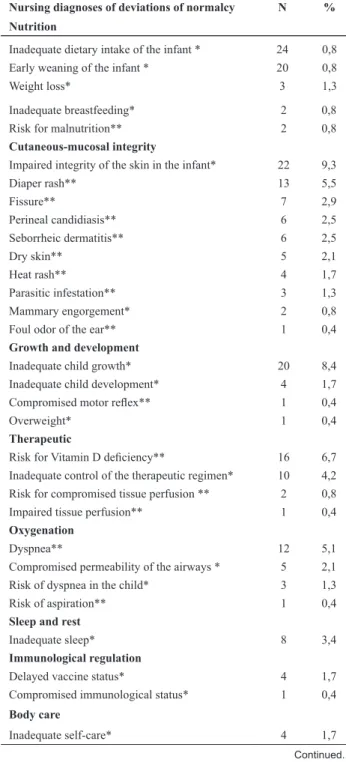
Among the diagnoses of deviaion from normalcy, it can be seen in Table 2 that the most frequent were the diagnoses of cutaneous - mucosal integrity, responsi
-ble for 29.0% of the negaive diagnoses encountered in the analyzed consultaions, appearing 69 imes. In this group of diagnoses, the most recorded was the impaired
Table 1 - Distribution of the nursing diagnoses of normalcy en-countered in the infant health nursing consults in the Cruz de Malta Care Center - São Paulo, 2009
Nursing Diagnoses of Normalcy N %
Growth and development
Adequate child growth * 56 26,3
Adequate child development * 54 25,4
Immunological regulation
Adequate vaccination status* 44 20,6
Nutrition
Adequate dietary intake of the infant
* 21 9,9
Adequate breastfeeding * 15 7,0
Adequate breastfeeding *
Adequate breastfeeding * 7 3,2
Therapeutic
Adequate control of the therapeutic
regimen * 6 2,8
Body care
Adequate self-care* 4 1,9
Gregariousness 1 0,5
Family bond present*
Bond between mother and child
preserved * 2 0,9
Elimination 1 0,5
Adequate bowel elimination*
Adequate sleep* 1 0,5
Cutaneous mucosal integrity
Normal dentition** 1 0,5
Total 213 100
* Nursing diagnoses contained in the Nomenclature of Curitiba. **Nursing diagnoses contained in ICNP® 1.0.
cutaneous-mucosal integrity, recorded 22 imes (9.3%). The nursing diagnosis most encountered, relaive to skin
problems, which speciied the type of injury was the diag
-nosis of diaper rash, which appeared 13 imes, corres
-ponding to 5.5% of the diagnoses of abnormaliies. The
second most frequent diagnosis of abnormality was ina
-dequate dietary intake of the infant (10.1%), appearing 24 imes, followed by the diagnosis of early weaning of the infant (8.4%), which appeared 20 imes (Table 2).
Table 2 - Distribution of the diagnoses of deviations of normalcy encountered in the infant health nursing consults in the Cruz de Malta Care Center - São Paulo, 2009
Nursing diagnoses of deviations of normalcy N %
Nutrition
Inadequate dietary intake of the infant * 24 0,8
Early weaning of the infant * 20 0,8
Weight loss* 3 1,3
Inadequate breastfeeding* 2 0,8
Risk for malnutrition** 2 0,8
Cutaneous-mucosal integrity
Impaired integrity of the skin in the infant* 22 9,3
Diaper rash** 13 5,5
Fissure** 7 2,9
Perineal candidiasis** 6 2,5
Seborrheic dermatitis** 6 2,5
Dry skin** 5 2,1
Heat rash** 4 1,7
Parasitic infestation** 3 1,3
Mammary engorgement* 2 0,8
Foul odor of the ear** 1 0,4
Growth and development
Inadequate child growth* 20 8,4
Inadequate child development* 4 1,7
Compromised motor relex** 1 0,4
Overweight* 1 0,4
Therapeutic
Risk for Vitamin D deiciency** 16 6,7
Inadequate control of the therapeutic regimen* 10 4,2
Risk for compromised tissue perfusion ** 2 0,8
Impaired tissue perfusion** 1 0,4
Oxygenation
Dyspnea** 12 5,1
Compromised permeability of the airways * 5 2,1
Risk of dyspnea in the child* 3 1,3
Risk of aspiration** 1 0,4
Sleep and rest
Inadequate sleep* 8 3,4
Immunological regulation
Delayed vaccine status* 4 1,7
Compromised immunological status* 1 0,4
Body care
Nursing diagnoses of deviations of normalcy N % Nutrition
Altered genital hygiene* 3 1,3
Altered body hygiene* 1 0,4
Elimination
Intestinal constipation** 3 1,3
Gastrointestinal colic** 2 0,8
Regurgitation** 2 0,8
Presence of intestinal parasite** 1 0,4
Enuresis** 1 0,4
Gregariousness
Conlictual family relationship* 3 1,3
Compromised bond with father** 2 0,8
Compromised mother-child bond* 2 0,8
Risk for pregnancy ** 2 0,8
Impaired family support* 1 0,4
Total 237 100
* Nursing diagnoses contained in the Nomenclature of Curitiba. **Nursing diagnoses contained in ICNP® 1.0.
DISCUSSION
More than half of the nursing diagnoses that appeared in the nursing consultaions analyzed had correspondence
with the diagnoses contained in the Nomenclature of Nurs
-ing Diagnosis and Intervenions adopted in the basic net
-work of Curiiba, which was based on the ICNP® Beta 2 ver
-sion, published in 2002.
The others were mapped to ICNP® Version 1.0, pub
-lished in 2005, due to the fact they were not included in said nomenclature, which does not contain the totality of
infant health nursing diagnoses. Moreover, the ICNP® ver
-sion 1.0 introduces focus terms of pracice and more specif
-ic judgments that were not contained in the Beta 2 version, which was used to build the Nomenclature of Curiiba.
The analysis of these results was performed consider
-ing the 43 diagnoses of deviaion from normalcy and the 13 diagnoses of normalcy. Interesingly, both in situaions of normalcy and in those of abnormality, 77 (96.0%) of the 80 infant health nursing consultaions analyzed in this study
were concerned to assess and record the condiion of in
-fant growth, in accordance with the standard of reference recommended by the Ministry of Health (MOH).
The diagnosis of development was cited in 60 consulta
-ions, corresponding to 75% of cases. This inding is impor
-tant, because it shows that the nurses in the clinic studied complied with the recommendaion of the MOH to meet one of the established basic acions, which is to monitor the growth and development of children under ive years of
...Continuation It is known that infant growth is considered one of the best indicators of health of the child, due to its close depen
-dency on social factors related to: type of food in quanity and quality; occurrences and types of diseases; health care and vaccinaion; afecionateness of the family with the child; living condiions, especially housing and basic sanita
-ion; and access to health services(15). Therefore, adequate
monitoring of child growth is recognized and recommend
-ed as an important health acion.
It was also possible to perceive the preoccupaion of the nurses to assess and record the vaccinaion status of the children being seen. The diagnosis of adequate
vac-cinaion status and delayed vaccinaion status were cited
in 48 consultaions, corresponding to 60.0% of the visits. The result shows the need for nurses to idenify, orient and register the vaccinaion status in all visits performed, in ac
-cordance with the recommendaion of the Immunizaion
Programs that encourage protecion against immunopre
-ventable diseases, aimed at increasing vaccinaion coverage. It was further found that in 36 (45.0%) visits, the chil
-dren were aged equal to or less than six months, a period in which there is a need for assessment of breasfeeding. The diagnosis of early weaning was found in 20 consultaions, highlighing the need for encouragement and guidance about breasfeeding in prenatal and infant health consulta
-ions, as well as promoing relactaion.
Dietary intake of infants appeared in 45 of the analyzed consultaions; in 24 of them the infant’s food intake was in
-adequate and in 21 the feeding was saisfactory. Diagnoses related to food ingesion and exclusive breasfeeding were cited in 62 (77.5%) consultaions, as it is important for the promoion of child health that they are recorded in all visits in order to deine possible efecive nursing intervenions.
It is worth menioning the results regarding the evalu
-aion of cutaneous and mucosal integrity, which, although not considered a basic acion by the MOH, was found very frequently in the nursing consultaions analyzed. Diagnoses related to this problem appeared 70 imes in the 80 well child nursing consultaions analyzed, and in 69, deviaions from normalcy were ideniied. Studies have demonstrated the high prevalence of these clinical indings in nursing con
-sultaions aimed at monitoring growth and development, which conirms the relevance of idenifying cutaneous-mucosal problems in infants, for the determinaion of early and adequate nursing intervenion(16).
The nursing diagnoses most oten found related to as
-pects of nutriion, growth and development, and vaccinaion status, which are addressed in the child health programs de
-veloped by the Municipal Health Secretary of São Paulo. One study conducted in Curiiba with respect to the
nursing pracices executed by professional nurses in pri
diagnoses of normalcy, which appeared in a higher num
-ber than those of deviaions in normalcy(17).
It is worth remembering that nursing diagnoses are indicators of necessary nursing care, and they favor the development of the body of nursing knowledge, to the extent that they generate intervenions and the need for research about them(17). Due to the importance of recog
-nizing nursing care and its respecive intervenions, we must regard as a rouine the descripion of the nursing diagnoses during nursing consultaions(18).
Classiicaion systems enable visualizaion of nursing pracices, and relect on daily care, both for the individual as well as for the community(19).
CONCLUSION
In this study it was possible to perceive that nursing consultations for the child brought a great amount of
content for well child care, both situations of normalcy
and abnormality, with emphasis on the diagnosis of de
-viation from normalcy.
The use of the cross-mapping method allowed for the comparison of the informaion from exising records of children seen in nursing consultaion , with nursing diagnoses standardized by the ICNP®, which may con
-tribute to the implementaion of the classiicaion sys
-tem in the clinic where the children were assisted.
The standardization of language allows the docu
-mentation of nursing information, contributing to pa
-tient care and facilitating communication among nurses and other health professionals. The use of ICNP® as a unifying framework for all systems of classification of elements of professional practice can help to system
-atize nursing care in the Unified Health System (SUS), in order to profile the quality of professional care, leading to significant benefits for the profession.
REFERENCES
1. Saparolli ECL, Adami NP. Avaliação da qualidade da consulta de enfermagem à criança no Programa de Saúde da Família. Acta Paul Enferm. 2007;2(1):55-61.
2. Costa CR, Fracolli LA. O processo de enfermagem em aten -ção primária à saúde. In: Santos AS, Miranda SMR, organiza -dores. A enfermagem na atenção primária à saúde. Barueri: Manole; 2007. p. 147-65.
3. Cunha SMB, Barros ALBL. Análise da implantação da Siste -maização da Assistência de Enfermagem, segundo modelo conceitual de Horta. Rev Bras Enferm. 2005;58(5):568-72.
4. Souza MF, Barros ALBL, Michel JLM. Bases teórico-metodo -lógicas para a coleta de dados de enfermagem. In: Barros ALBL, organizadora. Anamnese e exame ísico: avaliação diagnósica de enfermagem no adulto. Porto Alegre: Art -med; 2002. p.19-35.
5. Cruz DALM. A inserção do diagnósico de enfermagem no processo assistencial. In: Cianciarullo, organizadora. Sistema de Assistência de Enfermagem: evolução e tendências. São Paulo: Ícone; 2001. p. 63-84.
6. Cruz DALM. Diagnósicos de enfermagem. In: Garcia TR, Egry EY, organizadoras. Integralidade da atenção no SUS e Sistemaização da Assistência de Enfermagem. Porto Ale -gre: Artmed; 2010. p.111-7.
7. Nobrega MML, Garcia TR. Perspecivas de incorporação da Classiicação Internacional para Práica de Enfermagem (CI -PE) no Brasil. Rev Bras Enferm. 2005;58(2):227-30.
8. Lucena AF, Barros ALBL. Mapeamento cruzado: uma alter -naiva para a análise de dados em enfermagem. Acta Paul Enferm. 2005;18(1):82-8.
9. Garcia TR, Cubas MR, Almeida MA. Resultados de enferma -gem. In: Garcia TR, Egry EY organizadoras. Integralidade da atenção no SUS e Sistemaização da Assistência de Enferma -gem. Porto Alegre:Artmed; 2010. p. 125-34.
10. Silva RR, Malucelli A, Cubas MR. Classiicações de enferma -gem: mapeamento cruzado entre termos do foco da práica. Rev Bras Enferm. 2008;61(6):835-40.
11. Garcia TR, Nobrega MML, Sousa MCM. Validação das deini -ções de termos ideniicados no projeto CIPESC para o eixo foco da práica de enfermagem da CIPE. Rev Bras Enferm. 2002;55(6):52-63.
12. Garcia TR, Nobrega MML. Inventário vocabular resultante do Projeto CIPESC CIE- ABEn. In: Garcia TR, Egry EY, organi -zadoras. Integralidade da atenção no SUS e Sistemaização da Assistência de Enfermagem. Porto Alegre: Artmed; 2010. p. 192-317
13. Albuquerque LM, Cubas MR, organizadores. Cipescando em Curiiba: construção e implementação da nomenclatura de diagnósicos e intervenções de enfermagem na rede básica de saúde. Brasília: ABEn; 2005.
15. Brasil. Ministério da Saúde; Secretaria de Políicas de Saúde, Área temáica de Saúde da Criança. Fundamentos teórico-cieníicos e orientações práicas para o acompanhamento do crescimento e desenvolvimento. Brasília; 2000.
16. Saparolli ECL, Andrade PR. Principais dermatoses na infân -cia. In: Fujimori E, Ohara CVS, organizadoras. Enfermagem e a saúde da criança na atenção básica. Barueri: Manole; 2010. p. 417-40.
17. Apostólico MR, Cubas MR, Alino DM, Pereira KCM, Egry EY. Contribuições da CIPESC na execução das políicas de aten -ção à saúde da criança no Município de Curiiba. Texto Con -texto Enferm. 2007;16(3):417-40.
18. Nóbrega MML, Garcia TR, Chianca TCM, Almeida MA. Estru -tura da CIPE, da NANDA, da NIC e da NOC. In: Garcia TR, Egry EY organizadoras. Integralidade da atenção no SUS e Sistemaização da Assistência de Enfermagem. Porto Alegre: Artmed; 2010. p. 157-71.