RAFAEL GONÇALVES TONUCCI
SEQUESTRO E DISCRIMINAÇÃO ISOTÓPICA DE CARBONO EM SISTEMAS AGROSSILVIPASTORIS
Tese apresentada à Universidade Federal de Viçosa, como parte das exigências do Programa de Pós-Graduação em Zootecnia, para obtenção do título de Doctor Scientiae.
VIÇOSA
“Posso ouvir o vento passar assistir a onda bater mas o estrago que faz a vida é curta pra ver....” (O Vento, Marcelo Camelo)
À minha filha Lara, pessoa mais importante na minha vida,
motivo de tudo que faço.
Dedico
Agradecimentos
Aos meus pais pelos exemplos e apóio incondicional em todos os momentos, principalmente naqueles mais difíceis.
À minha filha Lara por existir e fazer de mim uma pessoa muito melhor e compreender que a ausência se fez necessária (EU TE AMO).
À Universidade Federal de Viçosa, em especial ao Departamento de Zootecnia pela oportunidade de realização do curso.
Ao Conselho Nacional de Pesquisa (CNPq) pela concessão da bolsa de estudo. À FAPEMIG (Fundação de Amparo à Pesquisa do Estado de Minas Gerais) pelo financiamento do projeto que custiou a realização das análises.
À Capes (Coordenação de Aperfeiçoamento de Pessoal de Nível Superior) pela concessão da bolsa PDEE.
Ao Prof. Rasmo Garcia, pela liberdade me dada para que eu pudesse crescer como pesquisador e por todos os ensinamentos.
Ao Prof. Júlio César Lima Neves pela paciência, aprendizado e sua eterna serenidade mostrando que as coisas dão certo quando se trabalha.
Aos Prof PK Nair e Vimala Nair pela oportunidade de trabalhar com eles e aprender um pouco mais sobre agrofloresta, e pela confiança em mim depositada.
Ao zootecnista e amigo Fernando Salgado Bernardino por aceitar participar da banca e pela ajuda incondicional em todos os momentos, desde a coleta das amostras até a redação final da tese.
Aos meus irmãos Erico, Andréia e Ana Laura pelas alegrias e ensinamentos na vida.
Aos meus amigos Fellipe, Denis e Tofe por fazer de Viçosa um lugar melhor durante esses anos que vivemos aqui, por serem minha família aqui, meu muito obrigado.
Aos amigos de Gainesville em especial Solomom, Andrew, David pela ajuda incondicional no laboratório, nas análises e na redação dos textos em inglês.
Ao Gustavo, à Patrícia, à Cida, à Elen, à Rô e à moçada do Soil and Water Lab em fazer minha estadia na UF muito prazerosa e me ajudar a superar a distância com mais facilidade, muito obrigado.
Aos amigos Gabriel, Henrique, Livia, Tati, Igor, Deico e Paulo pelos momentos de entretenimento e mostrar que a vida é bem mais do que artigos científicos.
À Isis por sempre estar ao meu lado e ser sempre um ponto de apoio quando precisei. Não tenho outra palavra à dizer que não seja MUITO OBRIGADO.
Aos colegas Kátia e Américo pelos momentos de aprendizado.
À moçada da forragem Celly, Andréia, Francisco, João Paulo pelos bons momentos dentro e fora da sala de aula.
Ao Google por facilitar, e muito, a minha vida e ao Pandora por sempre escolher uma boa música.
Biografia
RAFAEL GONÇALVES TONUCCI, filho de Erico Tonucci Filho e Ana Maria Oliveira Gonçalves Tonucci, nasceu em Belo Horizonte, Minas Gerais, em 17 de junho de 1978.
Em julho de 2004, graduou-se em Zootecnia pela Universidade Federal de Viçosa. Em agosto de 2004 entrou para o curso de mestrado em zootecnia pela UFV defendendo sua dissertação em outubro de 2006.
Sumário
Resumo ... xi
Abstract ... xiii
Introdução Geral ... 1
Referência ... 13
Chapter 1 ... 18
Soil Carbon Storage in Silvopasture and Related Land-use Systems in Brazilian Cerrado ... 18
Abstract ... 18
Introduction ... 19
Materials and Methods ... 21
Study Area ... 21
Soil Sampling ... 23
Soil Fractionation ... 24
Soil Analysis ... 24
Statistical Analysis ... 26
Results ... 26
Soil Characteristics ... 26
SOC Stock in the Whole Soil ... 27
SOC Stock in Macro-Sized Fraction (2000 to 250 µm) ... 27
SOC Stock in Micro-Sized Fraction (250 to 53 µm) ... 28
SOC Stock in the Silt+Clay-Sized Fraction (<53 µm) ... 30
Discussion ... 30
Soil Carbon Stock ... 30
Carbon Stock in Soil Size-Fractions ... 31
Stabilization of Soil Organic Carbon ... 32
Conclusions ... 36
Acknowledgments ... 37
References ... 38
Chapter 2 ... 44
Abstract ... 44
Introduction ... 45
Materials and Methods ... 47
Study Area ... 47
Soil Sampling ... 49
Soil Fractionation ... 50
Soil Analysis ... 50
Statistical Analysis ... 51
Results ... 52
Whole Soil ... 52
Soil Fraction sizes ... 53
Discussion ... 58
Whole Soil ... 58
Sized Fractions ... 60
Conclusions ... 61
Resumo
TONUCCI, Rafael Gonçalves, D.Sc., Universidade Federal de Viçosa, maio de 2010. Sequestro e discriminação isotópica de carbono em sistemas agrossilvipastoris. Orientador: Rasmo Garcia. Co-Orientadores: Júlio Cesar Lima Neves e Dilermando Miranda da Foncesa.
Abstract
TONUCCI, Rafael Gonçalves, D.Sc., Universidade Federal de Viçosa, May, 2010. Carbon sequestation and isotopic discrimination in agrosilvopasture. Adviser: Rasmo Garcia. Co-Advisers: Júlio Cesar Lima Neves and Dilermando Miranda da Foncesa.
Introdução Geral
A emissão de gases na atmosfera terrestre é um problema que cada vez mais preocupa a sociedade. O aumento da frota de veículos, o desenvolvimento econômico concentrado em algumas regiões do mundo e a utilização de queimadas para abrir novas fronteiras agrícolas, principalmente em países em desenvolvimento, têm aumentado significativamente a emissão dos gases de efeito estufa (GEE) na atmosfera terrestre, com destaquepara o metano (CH4), o dióxido de carbono (CO2) e o óxido nitroso (N2O). Esses gases têm capacidade de absorver parte da radiação solar que é refletida pela superfície terrestre. Como consequência a energia da radiação emitida sobre a Terra fica retida e não é liberada ao espaço, permanecendo maior do que seria na ausência desses gases.
Os GEE absorvem parte da radiação infravermelha emitida pela superfície da Terra e irradiam, por sua vez, parte dessa energia absorvida de volta à superfície. Essa conservação da energia promovida por esses gases tem um lado positivo que é tornar a temperatura do planeta compatível com a vida, mas nos últimos 200 anos tem-se observado um aumento crescente na emissão dos GEE, tornando esse aquecimento muito pronunciado acarretando uma série de mudanças no clima do planeta.
Dos gases causadores do efeito estufa o CO2 e o CH4 foram os que tiveram seus níveis mais aumentados nos últimos dois séculos. Esse aumento é creditado principalmente à queima de combustíveis fosseis e à praticas agrícolas não conservacionistas, que tem levado a alterações no reservatório de carbono (C) terrestre.
forma de CO2. O estoque de C na biota é bastante incerto, mas estimado entre 400 e 600 Pg C, sendo que 75% deste valor estão em florestas (IPCC, 2001).
Em ambientes terrestres, o maior reservatório de C ativamente ciclável é o solo. Na camada da superfície até 1 metro, o solo contém 1500-2000 Pg C (IPCC, 2001) em diferentes formas orgânicas, desde “litter” de uma planta recém-caída até carvão vegetal bastante antigo. Aproximadamente 1/3 do C orgânico do solo ocorre em áreas florestais, mais 1/3 em áreas de pastagens e campos nativos e o restante encontra-se em terras alagadas e em solos de culturas agrícolas (Janzen, 2004).
O carbono orgânico do solo (COS) é derivado, principalmente, da biomassa da vegetação e constitui um elo fundamental para o ciclo do C. Esse componente pode conter entre 50 e 80% do carbono de uma floresta madura e mais de 95% do carbono de área de pastagem (Ogle et al., 2005). O estoque de C no solo reflete o balanço entre as entradas de C via resíduos vegetais e outros compostos orgânicos e as saídas (perdas) provenientes da decomposição, erosão e lixiviação (Cowie et al., 2006). Assim pode-se observar que a taxa de reciclagem e mineralização da matéria orgânica (MO) leva a um maior estoque de C em florestas temperadas de clima frio e pântanos devido a uma menor atividade da microbiota do solo do que em regiões de clima tropical onde a reciclagem da MO é muito rápido (Bolin et al., 2000).
O uso da terra e o sistema de manejo agrícola aplicado em uma área podem alterar o armazenamento do COS devido à variação de tecnologias como a irrigação, fertilização, aração dentre outras. Consequentemente o uso e o manejo da terra podem ser utilizados como capturadores de GEE, principalmente o CO2, fazendo do solo um sumidouro de CO2 (Lal et al., 1998; Ogle et al., 2005).
atmosférico em 0,47ppm (Lal, 2007). O COS é rapidamente perdido pela conversão de ecossistemas naturais em ecossistemas agrícolas. A magnitude dessas perdas pode variar entre 50 a 70% depois de 5 a 20 anos do desflorestamento em solos tropicais e de 25 a 50% depois de 20 a 50 anos em solos de clima temperado (Lal, 2004). Em resumo, a magnitude dessas perdas é sempre maior quando o aporte de C no sistema for menor do que as exportações.
A depleção do COS tem efeito positivo, mas adverso, no aumento da concentração de CO2 atmosférico. Uma perda severa de COS leva ao declínio na qualidade do solo provocado pelo balanço negativo dos nutrientes do solo, balanço negativo da água do solo, devido ao maior escoamento superficial e consequente aumento da erosão e redução da biodiversidade de microfauna do solo. Esse declínio na qualidade reduz a produção primária líquida (PPL), decrescendo a quantidade e a qualidade da biomassa que será retornada ao solo, acentuando ainda mais essa depleção do COS (Lal, 2007).
O carbono do solo é estimulado por práticas que maximizam as entradas de MO e minimizam suas perdas. Assim, técnicas como as que permitem que os resíduos culturais permaneçam no campo; a aplicação de fertilizantes que irá favorecer a PPL e por consequência o acumulo de C; a escolha de espécie com uma taxa de composição mais lenta ou ainda a mistura de espécies que irão potencializar o acúmulo de C e o manejo de culturas com distúrbios mínimos, que tem dentre outros objetivos, minimizar a perda de solo por erosão são técnicas bastante indicadas na tentativa de maximizar os valores de COS e aumentar das taxas de mitigação de CO2 atmosférico.
O manejo agrícola é iniciado com a conversão de um ecossistema natural (pastagem ou floresta) em uma plantação. Esta conversão requer a utilização de técnicas como a aração que levam a perdas do COS, devido a um intenso distúrbio que promove a ruptura das estruturas dos agregados do solo, aumentando a decomposição.
A produtividade de uma cultura individual influencia o acúmulo de carbono no solo devido a diferença na qualidade de resíduo cultural deixado no campo e que será incorporado na matéria orgânica do solo (MOS). Eghball et al. (1994) demonstraram maior produção de resíduos em um plantio contínuo de milho quando comparado com um plantio rotacionado entre milho e soja. Essa maior produção de resíduo levou a um maior acúmulo de C no solo.
Os efeitos do manejo e do uso da terra determinam de forma bastante significativa o balanço de C em solos agrícolas. Deve-se, entretanto, ressaltar que o potencial dos solos em servir como absorvedores de CO2 da atmosfera via técnicas de uso e manejo da terra muda com o clima (tropical ou temperado), com o regime hidrológico (seco ou úmido), com o tipo de solo bem como sua textura e a profundidade.
A mudança do uso da terra de uma floresta ou pastagem para uma plantação agrícola irá, provavelmente, levar a uma perda no COS (Cowie et al., 2006). Guo e Gifford (2002), realizando uma meta análise, encontraram que o estoque de C no solo foi reduzido em 50% ou mais quando pastagens foram convertidas em agricultura. Por outro lado a substituição de uma área onde existia uma agricultura por uma pastagem ou floresta é normalmente acompanhada de um incremento no C do solo. Nos trópicos onde a reciclagem do C é mais rápido, Binkley e Resh (1999) não observaram impacto da conversão de uma cultura de cana de açúcar para uma floresta de eucalipto, após 32 meses, no C total do solo. Entretanto observou-se uma forte queda na participação do C advindo da cana.
Barrett, 1999; Turner e Lambert, 2000). O carbono do solo decresce inicialmente, como resultado do declínio do aporte de “litter” oriundo das pastagens e depois volta a aumentar quando as entradas provenientes da floresta começam a serem adicionados ao sistema (Jonhson, 1992; Grigal e Berguson, 1998). Com o crescimento o C é restabelecido pela queda do “litter” e do reciclagem de raízes, normalmente atingindo os níveis de C original em 30 anos (Paul et al., 2002).
De uma maneira geral as florestas possuem mais da metade de todo o C terrestre e são responsáveis por cerca de 80% da troca de carbono entre o ecossistema terrestre e a atmosfera. O ecossistema florestal tem uma absorção anual de C estimada em 3 Pg (Montagnini e Nair,2004). Entretanto nas últimas décadas, esse balanço tem sofrido algumas alterações devido ao grande número de desmatamentos que ocorreram, principalmente, nos trópicos.
Sendo assim promover a agrofloresta é uma alternativa bastante interessante e uma excelente oportunidade para solucionar os problemas relacionados com o uso da terra e a emissão de CO2 que induz ao aquecimento global.
Sistemas agroflorestais têm papel central no ciclo global do C e contém aproximadamente 12% do C terrestre mundial (Dixon, 1995). A degradação do solo como resultado de uma má utilização da terra tem sido apontada como uma das maiores causas de perda de C e consequente acúmulo de CO2 na atmosfera. A agrofloresta pode envolver práticas que favoreçam a emissão de GEE, tais como controle da pastagem com fogo, aplicação de adubos nitrogenados e a produção animal que contribui para a produção de metano (Dixon, 1995). Entretanto, vários estudos têm mostrado que a inclusão de árvores em ambientes agrícolas comumente melhora a produtividade do sistema além de proporcionar uma oportunidade de mitigação do CO2 atmosférico, funcionando como dreno de C (Dixon et al.1994; Dixon, 1995).
silvícolas. A segunda seria a conservação do carbono através da conservação da biomassa e do carbono do existente nas florestas, melhorando as técnicas de colheita com a redução dos impactos do carregamento e um melhor uso do fogo tanto em sistemas agrícolas quanto florestais. A terceira é a substituição do carbono que é o aumento da conversão da biomassa florestal em produtos de madeira de vida longa na forma de móveis, aumento da utilização de biocombustíveis (Bass et al., 2000). A agrofloresta pode se enquadrar na categoria de sequestradores de C devido à sua aplicabilidade em recuperar áreas agrícolas degradadas, assim como em reflorestamentos.
Essencialmente o sequestro de carbono é a diferença entre o C adquirido pela fotossíntese e o carbono perdido ou liberado pela respiração de todos os componentes do sistema. A maioria do C entra no ecossistema via fotossíntese ocorrida nas folhas e o seu acúmulo é mais óbvio quando ocorre na biomassa que se acumula acima do solo. Entretanto, mais da metade do carbono acumulado é transportado para o solo via crescimento e reciclagem de raízes, decomposição do “litter” e por consequência o solo contêm o maior estoque de C no ecossistema.
Práticas que aumentam a produção primária líquida e/ou retornam uma grande proporção da biomassa para o solo têm o potencial de aumentar o estoque e C no solo (Montagnini e Nair, 2004).Com o manejo adequado das árvores em áreas agrícolas ou pastoris uma fração significativa do C atmosférico pode ser capturada e armazenando na biomassa das plantas ou no solo. Entretanto, aumentar o estoque de C por um período de tempo é apenas uma etapa e o que determina que o C está de fato sequestrado é o seu armazenamento por um período grande de tempo (Albrecht e Kandji, 2003).
novamente liberado para a atmosfera (Dixon, 1995). Assim, só existirá um sequestro efetivo se o balanço líquido de C do estoque final e inicial for positivo após algumas décadas (Albrecht e Kandji, 2003). Pode-se sumarizar que três fatores são necessários para determinar a quantidade de carbono sequestrada: (1) o incremento da quantidade de C na biomassa remanescente devido à mudança no uso da terra e do aumento da produtividade; (2) a quantidade de C recalcitrante remanescente acima do solo ao final da colheita das árvores; (3) a quantidade de C sequestrado em produtos pela madeira colhida, incluído o seu destino final (Johnson et al., 2001).
A grande maioria das estimativas do potencial de sequestro de carbono pelos sistemas agroflorestais são originadas dos trópicos úmidos. Estimativas baseadas no projeto “Alternativas para as derrubadas e queimadas” do ICRAF, concluíram que para os trópicos úmidos os sistemas agroflorestais têm um melhor potencial de sequestro de carbono acima do solo (através do acúmulo de biomassa das árvores) e não abaixo do solo. Segundo a conclusão do projeto isso se daria com a implantação de sistemas baseados em árvores em regiões de pastagens degradadas e pastagens nativas. Entretanto as savanas tropicais armazenam aproximadamente 1/3 do C na forma de vegetação, assim como as florestas tropicais úmidas, mas esse bioma também apresenta um alto estoque de C no solo, assim como as florestas boreais (Montagnini e Nair, 2004).
Estudos comparando o sequestro de C em um sistema árvore-cutura e a cultura solteira mostraram que o sistema árvore-cultura foi muito mais eficiente em acumular C do que a monocultura, mas acumulou menos C do que a floresta sozinha. Quando se compara diferentes tipos de sistemas agroflorestais como o plantio de árvores em faixas, dentro da cultura, utilização de culturas perenes combinadas com árvores, essa última pode ser considerada uma boa sequestradora de C, no entanto quando é intensamente manejada, esse potencial de mitigar o CO2 é bastante reduzido, mostrando que quanto mais intenso é o manejo do solo maiores são as chances de perda de C do sistema (Montagnini e Nair, 2004).
uma boa alternativa como acumulador de C, uma vez que o manejo na pastagem estabelecida na floresta é bem conservador e as gramíneas também apresentam, assim como as árvores, grande potencial de armazenar C. As pastagens podem acumular tanta MO quanto as florestas (Corre et al., 2000), mas sua contribuição é normalmente menos enfatizada porque a maior parte do que é armazenado no sistema radicular. Taylor e Lloyd (1992) postularam que as gramíneas de clima temperado e as florestas são essencialmente iguais em seu papel como sumidouros de C, mas diferem fundamentalmente em como o C é armazenado no ecossistema. A maior parte do carbono absorvido em pastagens temperadas é estocada na forma de MOS, enquanto em florestas maduras mais da metade do C esta na forma de biomassa lenhosa e o restante como MOS.
Potencialmente sistemas silvipastoris podem acrescentar mais carbono nos sistemas que florestas e pastagens exclusivas. A maior eficiência em compartilhar os recursos do meio entre as árvores e as gramíneas; a fixação de N pelas leguminosas e o microclima criado pelas árvores pode aumentar significativamente a produção liquida total da fitomassa disponível para armazenamento (Sharrow e Ismail, 2004). Sistemas silvipastoris podem ser eficientes em sequestrar C e N com o passar do tempo porque apresentam duas vias de sequestro ativas, tanto das árvores quanto das gramíneas inseridas no sub-bosque (Sharrow et al., 1996). Isto pode ser manifestado em um maior estoque de C e N quando as gramíneas estão mais vigorosas no sub-bosque e a floresta ainda é jovem e com o passar do tempo esse C passa a ser também armazenado na biomassa das árvores em materiais que irão compor a MOS.
de C foi maior para o sistema silvipastoril (109,3 kg.ha-1) quando comparado à pastagem solteira (103,5 kg.ha-1) e à floresta plantada (101,2 kg.ha-1).
Em outro experimento avaliando o estoque de C e N em um sistema silvipastoril formado por três espécies de árvores (Acácia nilótica, Dalbergia sissou e Prosopis juliflora) e duas espécies de gramíneas (Desmostachya bpinnata e Sporobolus manginatus), Kaur et al. (2002) observaram que o acúmulo de C foi de 1,18 a 18,55 Mg C ha-1 e o input de C na produção primária liquida variou entre 0,98 e 6,50 Mg C ha-1 ano. O fluxo de carbono na produção primária líquida aumentou significativamente devido à interação dos gêneros Prosopis e Dalbergia com as gramíneas. Comparado com o sistema de pastagem solteira a MOS a produtividade biológica e o estoque de carbono foram melhores nos sistemas silvipastoris. Esses mesmos autores observaram que o total de C inserido no sistema 38 a 42% estava associada com o C abaixo do solo e que 62 a 58% esta associado com a parte aérea.
Esse estudo também mostrou que a alocação dos produtos da produção primaria no solo foi maior nas pastagens solteiras (1,33 a 3,88 Mg C ha-1.ano-1) do que no sistemas silvipastoris (1,00 a 2,93 Mg C ha-1 ano). Os autores concluíram que a associação de árvores com gramíneas promoveu um aumento no input de resíduos de plantas no solo e que este apresenta um papel importante no incremento da ciclagem de nutrientes e da produtividade biológica dos sistemas baseados em árvores.
Em estudo bem completo tentando mostrar o impacto do desflorestamento e sua conversão em pastagens nos teores de C e na dinâmica da MOS em diferentes tipos de solo, Desjardins et al. (2004) observaram que em solos mais argilosos o teor de carbono na camada superficial é maior e aumenta após a conversão para pastagem de 43,6 g kg-1 sobre solo de floresta para 54,6 g kg-1 em pastagem de 15 anos. Em solos arenosos os teores de C no solo foram bem menores, mas apresentaram o mesmo comportamento passando de 14,4 g kg-1 para 18,5 g kg-1 quando em floresta e em pastagem de 15 anos, respectivamente. Esse aumento nos teores de C nos dois tipos de solo é devido a um aumento deste elemento na camada superficial (0 a 5 cm) do solo. Neste mesmo estudo os autores utilizaram o δ13 C para avaliar a contribuição relativa do C derivado da floresta e do C derivado das pastagens nas diferentes frações da MOS. Nos solos com maiores teores de argila a proporção de C derivado das pastagens foi maior na fração fina quando comparada com a fração mais grossa, após 15 anos de pastagens cerca de 26 a 35% do C na fração fina é originário das gramíneas dos pastos. Em solos arenosos a incorporação do C das pastagens é mas rápida e varia de 42 a 48% de acordo com fração, com menores valores observados para as frações mais finas.
explicação para esse fato é a maior produção de biomassa pelas gramíneas e por consequência maior incorporação desta biomassa na MOS. Os autores concluíram que pastagens degradadas ou com algum nível de degradação podem deixar de ser drenos do CO2 atmosférico para ser fonte, contribuindo ainda mais para o aumento dos GEE na atmosfera terrestre.
A relação de isótopos estáveis em compostos orgânicos e inorgânicos da natureza frequentemente mostram informações relacionadas ao tipo de processo de formação desses compostos; a taxa na qual esses processos ocorreram e; as condições ambientais no período em que esses componentes foram formados. Essas informações assim como a variação natural desses compostos são extremamente úteis em identificar e quantificar as fontes e as taxas dos fluxos entre os ciclos biogeoquímicos desses elementos, em especial o C e o N.
No que diz respeito ao sistema solo-planta a relação do isótopo natural estável (13C/12C) do carbono orgânico do solo contêm informações a respeito da presença ou ausência de espécies com o ciclo fotossintético C3 (baixa 13C/12C) e C4 (alta 13C/12C) nas comunidades de plantas existentes e a sua contribuição para a produção primária liquida no tempo. Assim as mensurações de carbono orgânico no solo tem sido utilizadas para documentar os efeitos do uso da terra na estrutura do ecossistema, para quantificar as taxas e a dinâmica de vegetações em ecossistemas naturais.
O carbono é encontrado naturalmente na natureza em duas formas: o 12 C e o 13C. Aproximadamente 99% de todo o carbono da natureza se apresenta na forma de 12
C4 não se sobrepõem , diferenciando um do outro por um valor médio de 14‰ (Boutton, 1996) o que faz das análises de carbono isótopo um mecanismo muito poderoso e útil no estudo da dinâmica do carbono em ambientes naturais.
Referência
ALBRECHT, A & KANDJI, S. T. Carbon sequestration in tropical agroforestry systems. Agriculture, Ecosystems & Environment. v.99 p.15-27, 2003.
BANERJEE, M., BURTON, D.L., McCAUGHEY, W.P.P. et al. Influence of pasture management on soil biological quality. Journal of Range Management v.53 p.127-133, 2000.
BASS, S., DUBOIS, O. MOURACOSTA, P. et al. Rural livelihood and carbon mamagement. IIIED Natural Resourses Paper No 1 International Institute for economic Development, 2000.
BERG, W.A., BRADFORD, J.A. & SIMS, P.L. Long-terms soil nitrogen and vegetation changes and sandhill rangeland. Journal of Range Management v.50 p.482-486, 1997.
BINKLEY, D & RESH, S.C. Rapid changes in soil following eucalyptus afforestation in Hawaii. Soil science Society of America Journal. v.63 p.222-225, 1999.
BOLIN, B., SUKUMAR, R., CIAIS, P. et al. Global Perspectives, In: R. Watson, I.R. Noble, B. Bolin, et al. Land use changes, and forestry: a special report of the intergovernmental panel climate changes, Cambridge Press. p.23-51, 2000
BOUTTON, T.W. Stable carbon isotope ratios of soil organic matter and their use as indicator of vegetation and climate change. In: Boutton, T.W. and Yamasaki, S. (ed) Mass Spectrometry of Soil. New York, 1996.
BROOKES, P.C., LANDMAM, A., PRUDEN, G. et al. Chloroform fumigation and the release os soil nitrogen: a rapid extraction method to measure microbial biomass nitrogen in soil. Soil Biology Biochemistry v.17 p.837-842, 1985.
CHONÉ, T., ANDREUX, F. CORREA, J.C. et al. Changes in organic matter in an Oxisol from the Central Amazonia forest during eight years as pasture determined by 13C isotopic composition. In: Berthelin, J (ed), Diversity of Environment Biogeochemistry. p.397-405, 1991.
CORRE, M.D., SCHNABEL, R.R. & SHAFFER, J.A. Evolution of soil organic carbon under forests, cool season grasses and warn season grasses in the northeastern US. Soil Biology and Biochemistry v.31 p. 1531-1539, 2000.
DA SILVA, J.E., RESCK, D.V.S., CORAZZA, E.J. et al. Carbon storage in clayey Oxisol cultivated pastures in the “Cerrado” region, Brazil. Agriculture, Ecosystems & Environment v.103 p.357-363, 2004.
DEFELIPO, B.V.; RIBEIRO, A.C. Análise química do solo. Viçosa, MG: Imprensa Universitária, 1981, 15p.
DESJARDINS, T., ANDREUX, F., VOLKOFF, B. et al. Organic carbon and 13C contents in soil and soils size fractions, and their changes due to deforestation and pasture installation in eastern Amazonia. Geoderma v.61 p.103-118, 1994
DESJARDINS, T., BARROS, E. SARRAZIN, M. et al. Effects of forest conversion to pasture on soil carbon content and dynamics in Brazilian Amazonia. Agriculture, Ecosystems & Environment v.103 p.365-373, 2004.
DIXON, R.K. Agroforestry systems: sources or sinks of greenhouse gases? Agroforestry Systems v.31 p.99-116, 1995
DIXON, R.K., WINJUM, J.K., ANDRASKO, K.J. et al. Integrated systems: a assessment of promising agroforest and alternative land use practices to enhance carbon conservation and sequestration. Climate Changes v.30 p.1-23, 1994.
DORMAAR, F.J. & WILLMS, W.D..Effect of forty years of grazing on fescue grassland soil Journal of Range Management v.51 p.122-126, 1998.
EGHBALL, B.MIELKE, L.N., McCALLISTER, D.L. et al. National scale estimation of changes in soil carbon stocks on agricultural lands. Environment Pollution v.116 p.431-438, 2002
EIVAZI, F. & TABATABAI, M.A. Glucosidases and galactosidases in soils. Soil Biol. Biochem., 20:601-606, 1988.
EMBRAPA CERRADO, Embrapa Cerrado: conhecimento, tecnologia e compromisso ambiental. 34p (Documento No 34), 1999.
GARCIA, M.R.L., NAHAS, E. Biomassa e atividade microbiana em solo sob pastagem com diferentes lotações de ovinos. Revista Brasileira de Ciência do Solo v.31 p.269-276, 2007
.GIFFORD, R.M. & BARRETT, D.J. The carbon content of soil and vegetation in selected areas: forests. Final NGGI Inventory Development Project Report to Environment Australia. 81p, 1999.
GRIGAL, D.F. & BERGUSON, W.E. Soil carbon changes associated with short rotation systems. Biomass and Bioenergy. v.14 p.371-377, 1998.
HETCH, S.B. Deforestation in Amazonia Basin: magnitude, dynamics and soil resources effects. Stud Third World Society v.13 p. 61-101, 1982.
HOLT, J.A. Grazing pressure and soil carbon, microbial biomass and enzyme activities in semi arid northeastern Australia. Apply Soil Ecology v.5 p.143-149, 1997.
IPCC (INTERGOVERNMENTAL PANEL ON CLIMATE CHANGE), 2001
JANZEN, H.H. Carbon cycling in earth systems – a soil science perspective. Agriculture, Ecosystems & Environment. v.104 p.399-417, 2004
JOHNSEN, K.H, WEAR, D., OREN, R. et al. Meeting global policy commitments: Carbon sequestration and southern pine forests. Journal of Forest v.99 p.14-21, 2001.
JOHNSON, D.W. Effects of forest management on soil carbon storage. Water, Air and Soil Pollution. v.64 p.83-120, 1992.
KAUR, B., GUPTA, S.R., SINGH, G. Carbon storage and nitrogen cycling in silvopastoral systems on sodic soil in northwestern India. Agroforestry Systems. v 54 p.21-29, 2002.
KEELING, C.D., WHORF, T.P. Atmosphere CO2 records from sites in the SIO air sampling network. In: Trends: A compendium of data on global changes. 2002. KEENEY, D.R. & NELSON, D.W. Nitrogen-inorganic forms. Methods of soil analyses
chemical and microbiological properties. American Society of Agronomy p.643-698, 1982.
KOUTIKA, L.S., BARTOLI, F., ANDREUX, F. et al. Organic matter dynamics and aggregation in soil under forest and pasture of increasing age in the eastern Amazonia Basin. Geoderma v.76 p.87-112, 1997.
LAL, R. Carbon management in agricultural soils. Mitigation and Adaptation Strategies for Global Changes. v.12 p.303-322, 2007.
LAL, R. Is crop residue a waste? Journal of Soil Water Conservation. v.59 p. 136-139, 2004
LAL, R., KIMBLE, J.R.,FOLLERTT, R.F. et al. The potential of US cropland to sequester carbon and mitigate the greenhouse effect. Sleeping Bear Press, Chelsea, MI,1998.
LEARY, M.H. Carbon Isopotes in Photosynthesis. BioScience v.38 p.328-336. 1988. LECAIN, D.R., MORGAN, J.A., SCHUMAN, G.E. et al. Carbon exchange rates in
grazed and ungrazed pasture of Wyoming. Journal of Range Management v.53 p.199-206, 2000.
McGARITY, J.W. & MYERS, M.G. A survey of urease activity in soil of Northern South Wales. Plant Soil v.27 p.285-293, 1967.
McNAUGHTON, S.J. Grazing as an optimization process: Grass ungulate relationships in the Seringeti. The American Naturalist v.113 p. 691-703, 1979.
MILCHUNAS, S.J., LAUENROTH, W.K. Quantitative effects of grazing on vegetation and soil over global range of environments. Ecology Monoculture v.63 p.327-366, 1998.
MONTAGNINI, F., NAIR, P.K.R. Carbon sequestration: An underexploited environmental benefit of agroforestry systems. Agroforestry Systems v.61 p. 281-295, 2004.
NANNIPIERI, P., PEDRAZZINI.F., ARCARA, P.G. et al. Changes in amino acids, enzyme activities and biomasses during soil microbial growth. Soil Science v. 127 p.26-34, 1979.
OGLE, S.M., BREIDT, F.J., PAUSTIAN, K. Agricultural management impacts on soil organic carbon storage under moist and dry climatic conditions of temperate and tropical regions. Biogeochemistry v.72 p. 87-121, 2005.
PAUL, K.I., POLGLASE, P.J., NYAKUENGAMA, J.G., et al. Changes in soil carbon following afforestation. Forest Ecology and Management. v.168 p.241-257, 2002. RAO, I.M., AYARZA, M.A. & THOMAS, R.J. The use of carbon isotope ratios to
evaluate legume contribution to soil enhancement in tropical pastures. Plant and Soil v.162 p.177-182, 1994
SCHMIDT.E.L. & BELSER, L.W. Autotrophic nitrifying bacteria In. In: WEAVER, R.W.; AUGLE, S; BOTTOMLY, P.J.; BEZDICEK, D.; SMITH, S.; TABATABAI, A. & WOLLUM, A., eds. Methods of soil analysis. Part 2. Microbiological and biochemical properties. Madison, SSSA, p.159-177, 1994.
SCHUMAN, G.E., REEDER, J.T., MANLEY, R.H. et al. Impact of grazing management on the carbon and nitrogen balance of a mixed grass prairie. Ecology Apply v.9 p.65-71, 1999
SERRÃO, E.A.S., FALESI, I.C., DA VEGA, J.B. et al. Productivityof cultivated pasture na low fertility soils of the Amazon regions of Brazil. In: Sanchez, P.A., Tergat, T.E. (Ed) Pature Production on Acid Soils of the Tropics p. 195-225, 1979.
SHARROW, S.H. & ISMAIL, S. Carbon and nitrogen storage in agroforests, tree plantation, and pasture in western Oregon, USA. Agroforetry Systems v.60 p.123-130, 2004.
.SILVA, D.J.; QUEIROZ, A.C. Análise de alimentos: métodos químicos e biológicos. Viçosa, MG: UFV, Impr. Univ, 2002. 235p.
SIMS, P.L., & SINGH, J.S. The structure and function of ten western North American grassland II. Intra seasonal dynamics in primary producer compartment. Journal of Ecology v.66 p.547-572, 1978.
SWIFT, R.S. Method for extraction of IHSS soil fulvic and humic acids. In D.L.S.E. AL. (Editor), Organic matter characterization. Part 3. Chemical methods. Soil Science Society of American Journal, p.1018-1020, 1996
TABATABAI, M.A. Soil enzymes. In: WEAVER, R.W.; AUGLE, S; BOTTOMLY, P.J.; BEZDICEK, D.; SMITH, S.; TABATABAI, A. & WOLLUM, A., eds. Methods of soil analysis. Part 2. Microbiological and biochemical properties. Madison, SSSA, 1994. v.5. p.775-833
TAYLOR, J.A. & LlOYD, J. Sources and sinks of atmospheric CO2. Australian Journal of Botanic v.40 p.407-418, 1992.
TEDESCO, M.J.; VOLKWEISS, S.J.; BOHNEN, H. Análises de solo, plantas e outros materiais. Porto Alegre: UFRGS, 1985. 188p. (Boletim técnico de solos, 5)
TURNER, J. & LAMBERT, M. Changes in soil carbon in forest plantation soil in eastern Australia. Forest Ecology and Management. v.133 p. 231-247, 2000.
VANCE, E.D., BROOKES, P.C. & JENKINSON, D.S. an extraction method for measuring soil microbial biomass C. Soil Biology Biochemistry v.19 p.703-707, 1987.
WEST, T.O. & MARLAND, G. Net carbon flux from agriculture: carbon emissions, carbon sequestration, crop yield, and land use change. Biogeochemistry v.63 p.73-83, 2003.
Chapter 1
Soil Carbon Storage in Silvopasture and Related Land-use Systems in
Brazilian Cerrado
Abstract
Introduction
The average surface temperature is reported to have risen globally by 0.55º C since 1970 due to anthropogenic enrichment of greenhouse gases (GHG) such as carbon dioxide (CO2) in the atmosphere (IPCC, 2007). Possible implications of this unprecedented global warming include increases of extreme weather events, sea level rise, and precipitation changes (Allen and Ingram, 2002; Trenberth et al., 2007). Recognizing the role of soils as a potential sink for atmospheric C (Ogle et al., 2004; Feller and Bernoux, 2008), there is a growing interest in methods to store C in soils for mitigating GHG emissions. Since agroforestry systems (AFS) fall under the afforestation and reforestation programs that have been approved by the Kyoto Protocol of the United Nations Framework Convention on Climate Change (UNFCC) as a GHG offset activity, soil C storage potential of AFS is of special significance (Nair et al., 2009; 2010).
Globally, land-use changes in forestry and agriculture are responsible for 25% of GHG emissions (Weyant et al., 2006), but in Brazil, these sectors are reported to be responsible for more than two thirds of the emissions (Comunicação Nacional, 2004). Most of these agricultural areas are grasslands, of which at least 60% are in some stage of degradation (IBGE, 2006). Silvopasture, an agroforestry practice that combines trees with forage (pasture or hay) and livestock production, has recently gained prominence as an ecologically sustainable and environmentally desirable approach to managing degraded pasture lands (Mosquera-Losada et al., 2005; Haile et al., 2008; Nair et al., 2008). This system of tree plantation development on pasture lands is now becoming popular in Brazil.
eucalyptus (Eucalyptus sp.) cultivation on land cleared from its native Cerrado vegetation (Corazza et al., 1999) as well as the losses of 0.4 Mg C ha-1 yr-1 (0 to 60 cm soil depth) under a 20-yr-old stand of pine (Pinus sp.) on an Oxisol and 1.3 Mg C ha-1 yr-1 under a 7-yr-old eucalyptus stand on an Entisol, both in the Cerrado (Zinn et al., 2002). However, lack of uniformity in methods for soil sampling and C determination in these different studies make it difficult to compile and compare the reported data. Based on a study of silvopasture stands of 11-yr-old Douglas-fir (Pseudotsuga menziesii (Mirb.) Franco) with perennial ryegrass (Lolium perenne L.) and clover (Trifolium sp.) in Oregon, USA, Sharrow and Ismail (2004) reported that the combination of pasture and trees stored more C in aboveground biomass compared to tree stand or pasture alone, and pointed out the need for conducting research on silvopastures rather than deriving or extrapolating results from research on tree plantations or pasture.
The primary objective of the research reported here was to determine the extent of soil carbon storage in various aggregate-size fractions at different depths under eucalyptus-based silvopastoral systems in comparison with sole stands of eucalyptus, open pasture as well as a native forest, in the Cerrado biome in Minas Gerais, Brazil.
Materials and Methods Study Area
The study was conducted on an 80,000 ha commercial forestry and wood charcoal enterprise in the municipality of Paracatu, Minas Gerais, Brazil (Latitude 17o 36’ 09”S and Longitude 46o 42’ 02”W). The area receives an average precipitation of 1,350 mm (mainly in the summer months from November to March), has an annual average temperature of 22º C and average air humidity around 72.5%. It is located in the Cerrado biome that includes vegetation of different physiognomy, forming a gradient from completely open Cerrado, an open field dominated by grass, to the closed and dense Cerrado “Cerradão" (high Cerrado), a closed canopy forest (Ratter et al., 1997). Intermediate Cerrado, which is an open arboreal savanna (also called Cerrado sensu stricto), is the dominant type in the study area. All the study sites were on Oxisols.
Out of the several parcels (designated as “blocks” in the company’s records), each extending over thousands of hectares and planted to different LUS, six LUS described below were selected for the study.
1. Forest (Native local forest): An intermediate Cerrado with trees that have characteristic twisted trunks covered by a thick bark, and broad and rigid leaves; the major tree species include Dalbergia spp., Machaerium scleroxylon Tul. and Vateria spp. The site, approximately 300 ha in area, is one of the 10 permanent native forest reserve sites on the enterprise.
to 2.5 animal ha-1 in the wet season; the site was fertilized with urea at the rate of 75 kg ha-1 every three years until 2005.
3. Old eucalyptus (OEC): This 160-ha eucalyptus plantation was established in 1985 following slash-and-burn by which all the native forest was burned and all residues removed from the area. The eucalyptus saplings were planted at a density of 1090 plants ha-1. The site was fertilized with 450 kg ha-1 NPK (8–30–4 mixture) and an additional 50 kg ha-1 ammonium sulfate, both mixed with soil in the entire area (as opposed to spot application) before planting. No fertilizer has been applied since planting the eucalyptus.
4. Old agroforestry (OAF): A 70-ha silvopasture established in 1994, as follows: the natural forest was cleared by removing large trees by chain saw and burning the remaining vegetation. Limestone was applied to raise base saturation to 50% and superphosphate was added at the rate of 150 kg ha-1. Eucalyptus seedlings were planted in rows 10 m apart in an East – West direction with 4 m between plants giving a density of 250 plants ha-1. In the beginning of the rainy season (October – November), rice (Oryza sativa L.) was planted between the eucalyptus rows after applying 300 kg ha-1 of fertilizer (NPK 5–25–15). After rice harvest (mechanical) in year 1, soybean (Glycine max (L.) Merr.) was grown between tree rows with fertilizer application (NPK, 2–30–15) of 450 kg ha-1.Zinc (zinc sulphate), boron (boric acid), cobalt (cobalt sulfate), and molybdenum (sodium molybdate) were applied as one time only applications at rates of 10, 1, 2 and 1 kg ha-1, respectively. In the third year, seeds of the grass species (Brachiaria brizantha cv. Marandu) were sown at the beginning of the rainy season between the eucalyptus rows, with fertilizer application of 150 and 200 kg ha-1 of superphosphate and phosphate rock, respectively, and urea at the rate of 75 kg ha-1 of N. Animals were allowed to graze the area 90 days after sowing grass seeds; the average animal stocking rates were 0.6 and 2.5 animal ha-1 in the dry and wet seasons, respectively.
1650 plants ha-1 after an initial (one-time only) application of a fertilizer mixture (NPK, 10–28–6), 100 g per plant.
6. New agroforestry (NAF): Similar to OAF, except that NAF was established in 2004 on 180 ha area; the average stocking rates were 1.0 and 2.8 animal ha-1 in the dry and wet seasons, respectively.
Soil Sampling
Soil samples were collected in July 2008 from all six LUS from four randomly selected sampling sites in four parcels of each. The selected parcels of each LUS were > 500 m apart from each other. At each sampling site for both silvopasture (OAF and NAF) and eucalyptus (OEC and NEC) systems, the samples were collected from two positions (locations) each: near the tree (50 cm from the tree trunk) and far from the tree (5 m from the trunk in the silvopasture treatments and 1.5 m from the trunk in the eucalyptus stands), giving a total of 32 sampling locations in these four LUS sites (2 positions x 4 LUS sites x 4 replications). There were four replicates for the forest and pasture systems giving a total of eight sampling locations for these two systems (2 LUS x 4 replications). At each sampling location, samples were collected from four depths (0–10, 10–20, 20–50, and 50–100 cm), which were chosen in accordance with the protocol used for a multi-country study at the University of Florida (UF) on soil C sequestration in AFS (Nair et al., 2010). Thus there was a total of (32 + 8) x 4 = 160 samples. Each sample was a composite of four sub-samples collected from the specific location and depth.
Soil Fractionation
The soil samples were manually fractionated into three aggregate size classes (2000 to 250 µm, 250 to 53 µm, <53 µm) at the Soil and Water Science Department laboratory, UF, according to a procedure from Elliott (1986) adapted by the above-mentioned protocol used for a multi-country study at UF on soil C sequestration in AFS. Soil samples were physically fractionated by wet-sieving through a series of two sieve sizes (250 and 53 µm) to obtain three fraction size classes: macro- (2000 to 250 µm), micro- (250 to 53 µm) and silt+clay-sized (<53 µm) fractions. The procedure, modified by Haile et al. (2008), consisted of submerging a subsample of 100 g of the composite soil sample in a 500 mL beaker of deionized water for about 5 min before placing it on the top of 250 µm sieve to release the air that is trapped inside soil pores. An attempt was made to use comparable energy input by moving the sieve up and down approximately 50 times in 2 minutes; the fraction remaining on the top of a 250 µm sieve was collected in a hard plastic pan, oven dried at 65oC and weighed. Water plus soil <250 µm was poured through a 53 µm sieve, and the same sieving procedure was repeated. The overall procedure yielded water-stable, macro-, micro-, and silt+clay-sized fractions (2000 to 250, 250 to 53, and <53 µm, respectively). The average recovery mass percentage of soil fractions after the sieving procedure for this study ranged from 96% to 99% of the initial soil mass.
Soil Analysis
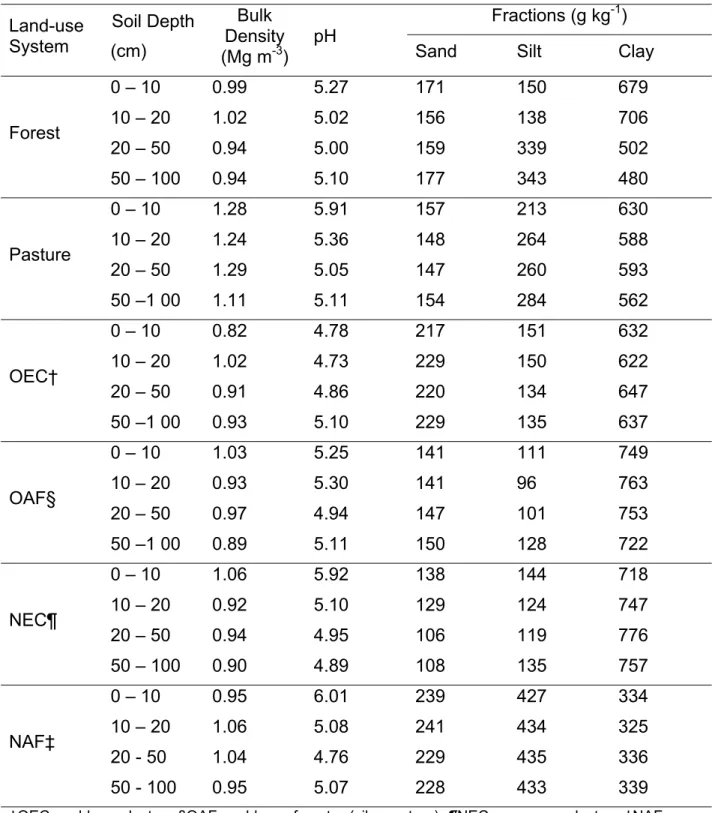
Table 1. Bulk density, pH, and textural composition of soils at different depths to 1 m in six land-use systems in the Cerrado biome, Minas Gerais, Brazil
Land-use System Soil Depth (cm) Bulk Density (Mg m-3)
pH
Fractions (g kg-1)
Sand Silt Clay
Forest
0 – 10 0.99 5.27 171 150 679
10 – 20 1.02 5.02 156 138 706
20 – 50 0.94 5.00 159 339 502
50 – 100 0.94 5.10 177 343 480
Pasture
0 – 10 1.28 5.91 157 213 630
10 – 20 1.24 5.36 148 264 588
20 – 50 1.29 5.05 147 260 593
50 –1 00 1.11 5.11 154 284 562
OEC†
0 – 10 0.82 4.78 217 151 632
10 – 20 1.02 4.73 229 150 622
20 – 50 0.91 4.86 220 134 647
50 –1 00 0.93 5.10 229 135 637
OAF§
0 – 10 1.03 5.25 141 111 749
10 – 20 0.93 5.30 141 96 763
20 – 50 0.97 4.94 147 101 753
50 –1 00 0.89 5.11 150 128 722
NEC¶
0 – 10 1.06 5.92 138 144 718
10 – 20 0.92 5.10 129 124 747
20 – 50 0.94 4.95 106 119 776
50 – 100 0.90 4.89 108 135 757
NAF‡
0 – 10 0.95 6.01 239 427 334
10 – 20 1.06 5.08 241 434 325
20 - 50 1.04 4.76 229 435 336
50 - 100 0.95 5.07 228 433 339
The carbon storage was calculated as: Cs= Cconc. x BD x Depth X Fraction weight where,
Cs = C storage expressed in Mg ha-1 (per unit cm unless specified otherwise) in each fraction for a given depth
Cconc. = C concentration in size fraction, g kg-1 of soil of that fraction size BD = Bulk density, Mg m-3
Depth = Depth of soil profile, cm and
Fraction weight = % weight of the fraction in the whole soil.
Statistical Analysis
The data were analyzed by ANOVA as a completely randomized design with four replicates. Tukey’s studentized range test was used to compare the mean differences among LUS in SOC in whole soil, macro-sized, micro-sized, and silt+clay-sized fractions. Statistical analyses were performed using SAS (SAS Institute, 2004), separately for all depths, and differences were considered significant at p < 0.05.
Results
Soil Characteristics
SOC Stock in the Whole Soil
In general, soil C stock values (Mg ha-1) near and far (away) from the trees were not significantly different; therefore those values were averaged for the respective plots. Overall, in all land-use systems, SOC stock declined with increase in soil depth at all sampling sites, with the exception of the NEC and NAF sites, where higher SOC values were observed in the 10-to-20-cm depth than in the top layer (Table 2). The amount of SOC in the whole soil varied among LUS (Fig. 1). In terms of the total SOC values to 1m depth (all depths combined), the LUS were in the order: OAF ≥ NEC ≥ Forest = NAF ≥ OEC ≥ Pasture the highest and lowest values being 148 and 116 Mg C ha-1 for OAF and pasture, respectively.
The SOC stock values within the depth classes also showed similarities with the overall ranking results of the LUS (Table 2). In the top layer (0 to10 cm), forest and OEC had higher stocks of SOC than NAF. In the mid-top layer (10 to 20 cm), forest and NEC had higher SOC values compared to OEC and pasture. No differences were observed among LUS in the mid-lower layer (20 to 50 cm) and in the lower layer (50 to 100 cm). Although no statistical differences were observed OAF had the highest (1.57 Mg ha-1) and pasture the lowest (1.13 Mg ha-1) SOC stock in the mid-lower layer. The same tendency was observed in the lower layer where OAF had a SOC stock of 1.10 Mg ha-1 and pasture a SOC stock of 0.82 Mg ha-1 (Table 2).
SOC Stock in Macro-Sized Fraction (2000 to 250 µm)
Figure 1. Total soil organic carbon (SOC) content in the whole (non-fractionated, 2 mm-sieved) soil to 1 m depth in six land-use systems in the Cerrado biome of Minas Gerais, Brazil. Lowercase letters indicate differences (at the 0.05 probability level) in SOC among land-use systems.
OEC = old eucalyptus; OAF = old agroforestry (silvopasture); NEC = new eucalyptus; NAF = new agroforestry (silvopasture).
SOC Stock in Micro-Sized Fraction (250 to 53 µm)
Table 2. Soil organic carbon (SOC) stock in the whole (non-fractionated) soil and
aggregate-size fractions at different depth classes to 1 m in six land-use systems in the Cerrado biome, Minas Gerais, Brazil
Land-use System
SOC stock (Mg ha-1) in soil layers at various depths (cm)
0–10 10–20 20–50 50–100
Whole soil
Forest 2.87 a 2.53 a 1.35 a 0.85 a
Pasture 2.34 ab 1.74 bc 1.13 a 0.82 a
OEC† 2.93 a 1.45 c 1.19 a 0.84 a
OAF§ 2.60 ab 2.04 abc 1.57 a 1.10 a
NEC¶ 2.37 ab 2.63 a 1.51 a 0.96 a
NAF‡ 2.03 b 2.16 ab 1.48 a 0.87 a
Macroaggregate fraction (2000 to 250 µm)
Forest 1.88 a 1.64 ab 0.81 a 0.42 a
Pasture 1.22 bc 0.84 cd 0.54 a 0.37 a
OEC† 1.47 abc 0.68 d 0.55 a 0.33 a
OAF§ 1.52 ab 1.26 bc 0.95 a 0.53 a
NEC¶ 1.55 ab 1.71 a 0.94 a 0.51 a
NAF‡ 1.06 c 1.33 ab 0.89 a 0.46 a
Microaggregate fraction (250 to 53 µm)
Forest 0.42 c 0.40 b 0.31 b 0.32 ab
Pasture 0.51 bc 0.43 b 0.32 b 0.27 b
OEC† 1.05 a 0.57 a 0.47 a 0.35 ab
OAF§ 0.62 b 0.48 ab 0.42 ab 0.41 a
NEC¶ 0.40 c 0.47 ab 0.31 b 0.31 ab
NAF‡ 0.64 b 0.49 ab 0.36 ab 0.28 ab
Silt + clay fraction (<53 µm)
Forest 0.54 ab 0.49 a 0.22 a 0.11 a
Pasture 0.61 a 0.47 ab 0.27 a 0.18 a
OEC† 0.41 bc 0.20 c 0.17 a 0.16 a
OAF§ 0.46 bc 0.30 c 0.20 a 0.15 a
NEC¶ 0.42 bc 0.45 ab 0.25 a 0.15 a
NAF‡ 0.33 c 0.33 bc o.23 a 0.13 a
Means followed by different letters in same column within each section (sub-heading) are significantly different, p= 0.05.
SOC Stock in the Silt+Clay-Sized Fraction (<53 µm)
Pasture had the highest SOC value at the top layer and forest in the mid-top soil layer; at the top layer, pasture SOC value was 0.61 Mg ha-1, at the mid-top layer forest SOC value was 0.49 Mg ha -1. The lowest values were in the OEC, NAF, and NEC systems (Table 2). In the mid-top layer (10 to 20 cm) the same tendency was observed where forest had the highest SOC value; pasture and NEC had an intermediary value and OEC and OAF had the lowest values. At the lower layers (below 50 cm) too, no statistical differences were observed among LUS.
Discussion
Soil Carbon Stock
disturbance, and crop removal, which are known to cause soil degradation and decline in soil C. Furthermore, the clay content in these soils is fairly high (Table 1), and it is well known that clayey soils contain more C than lighter-textured soils (Feller and Beare, 1997; Corazza et al., 1999; Lardy et al., 2002; Six et al., 2002; Desjardins et al., 2004).
Carbon Stock in Soil Size-Fractions
Distribution of aggregate-size classes showed the predominance of macroaggregate fraction in all LUS (Table 3). In general, C concentrations in the different aggregate-size fractions did not vary considerably within the same depth (Table 3); consequently, total C stock (Mg ha-1) was highest in the macroaggregate fraction, which is the general trend in most tropical soils under various agroforestry systems (Nair et al., 2010). However, exceptions to this general trend have also been reported. Zotarelli et al. (2005), Zotarelli et al. (2007), and Oades and Waters (1991) found no differences in C and N content across aggregate-size fractions in the top 20 cm layers of Oxisols under crop and pasture systems in southern Brazil. Arevalo et al. (2010) noted in a study involving five LUS in north central Alberta, Canada (not tropics), that the general trend for C stocks in soil particle-size fractions decreased in the order: fine > medium >
coarse. However, the fraction sizes reported in that study are fractions after sonication
and since microaggregates retained in macroaggregates will be separated out by
sonication, the fraction sizes in that study may not correspond to silt+clay-,
microaggregate- and macroaggregate size-fractions, respectively, of our study.
Considering that soil disturbance may alter the stability of macroaggregates (Angers and Chenu, 1998), the absence of tillage and use of machinery (no-till) in the systems in this study, coupled with the constant addition of organic materials via litter fall may have helped maintain the binding effect and increased the number of macroaggregates in the present study.
pasture due to soil compaction caused by cattle trampling. The low level of soil disturbance may have enhanced the formation of microaggregates (Angers and Chenu, 1998).
Stabilization of Soil Organic Carbon
Chemical stabilization of SOM is understood to be the result of the chemical or physicochemical binding between SOM and soil minerals (Six et al., 2002). The macroaggregate-sized fraction contains the more active pool of C and is more susceptible to land use and soil management. This pool is formed by recent C depositions in soil (Carter, 1996); therefore, it is sensitive to changes in organic matter dynamics with time (Saha et al., 2009). On the other hand, the SOC content in silt+clay-sized fraction is considered to be more stable than in larger soil fractions (Six et al., 2002); this stability comes from the interaction between clay minerals and organic matter such as humic substances (Brady and Weil, 2008). Organic matter is stored within the micropores created by clay particles and can remain unreachable to decomposers (Jastrow and Miller, 1998).
The formation and stability of microaggregates depend mostly on the strength by which clays and other inorganic components of the soil are sorbed to soil organic matter (SOM), microbial debris, and a variety of other organic colloids and compounds primarily of microbial origin (Jastrow and Miller, 1998). Zotarelli et al. (2007) noted that although Oxisols did not exhibit the aggregate hierarchy as found in temperate soils (Oades and Waters, 1991; Six et al., 2002), stabilization of POM (particulate organic matter)-C within macroaggregates was likely in less disturbed soils as in no-till systems that included legume crops. In clayey soils, C derived from pasture appears to be highest in the fine fraction (Desjardins et al., 2004). In some situations, grassland-derived soils are reported to have a higher potential for C stabilization than forest-derived soils, probably because pasture-forest-derived C is rapidly associated in the fine fraction (Collins et al., 2000).
fraction was not specifically evaluated in this study, it is known that in LUS with no-tillage, a slow macroaggregate turnover allows time for the formation of fine occluded POM that gradually becomes encrusted with clay particles and microbial products to form microaggregates (containing young crop-derived C) within macroaggregates (Six et al., 1998; 1999; 2000). Gama-Rodrigues et al. (2010) reported based on fractionation and sonication of slaking-resistant aggregates in an Oxisol under cacao (Theobroma cacao L.)-based agroforestry systems in Bahia, Brazil, that about 70% of SOC in the whole soil was located inside the macroaggregates at all soil depths studied (to 1 m). Furthermore, they found that the proportion of soil C occluded in aggregates was considerably higher than that of other systems reported in the literature, e.g. Sarkhot et al. (2007). Gama-Rodrigues et al. (2010) argued that the constant replacement of organic matter, as in the land-use systems in the present study, maintained the binding effect and increased the number of water stable macroaggregates (John et al., 2005). Moreover, high concentrations of fine roots that are likely to be present in the surface soil to 15 cm depth in these relatively undisturbed (no-till) soils and lignified coarse roots at the subsurface soils to 100 cm contribute substantially to belowground C stocks in these systems. Thus, this study supports the notion that clay content alone is not necessarily an appropriate measure for protection of C in Oxisols, which do not show the same aggregate hierarchy as temperate-zone soils (Oades and Waters, 1991; Six et al., 2002), and high levels of organic matter could lead to a change in the dominant binding agents of aggregates from oxides to organic molecules in Oxisols as suggested also by Gama-Rodrigues et al. (2010).
Table 3. Soil organic carbon (SOC) content in soil aggregate size-fractions at different depths to 1 m in six land-use systems in the Cerrado biome, Minas Gerais, Brazil
Land-use System Soil Depth (cm)
Size Fractions (µm) (% of total soil by weight)
SOC content (g kg-1 soil) in aggregate size-fractions(µm)
2000 to 250 250 to 53 < 53 2000 to 250 250 to
53 < 53
Forest
0 – 10 62.8 15.8 18.2 54.8 53.7 62.3
10 – 20 61.1 15.4 18.6 53.5 46.9 53.4
20 – 50 57.9 22.4 16.0 44.2 41.5 44.2
50 –1 00 47.8 36.5 12.6 39.2 38.3 40.4
Pasture
0 – 10 49.4 21.4 25.4 48.4 44.6 45.8
10 – 20 46.3 23.5 26.1 43.9 41.7 43.9
20 – 50 45.1 27.6 22.3 38.7 38.2 39.2
50 –1 00 42.6 31.8 20.9 37.6 37.2 38.2
OEC†
0 – 10 53.9 26.8 15.0 57.2 51.9 54.6
10 – 20 51.1 30.8 14.6 44.9 43.9 49.1
20 – 50 47.1 33.3 14.8 41.9 41.5 44.6
50 –1 00 37.7 40.7 17.6 38.8 39.0 40.4
OAF§
0 – 10 55.7 23.3 16.5 54.4 48.6 53.5
10 – 20 58.6 23.0 14.2 51.3 45.7 51.0
20 – 50 57.9 25.4 12.4 45.2 43.7 47.1
50 –1 00 46.2 36.0 13.3 42.1 41.0 42.7
NEC¶
0 – 10 63.1 16.4 17.0 55.3 55.7 59.4
10 – 20 62.5 17.1 16.5 53.3 51.6 55.6
20 – 50 59.8 20.2 16.2 45.5 44.3 46.6
50 –1 00 50.8 30.6 14.8 40.6 38.7 41.2
NAF‡
0 – 10 56.2 22.4 16.3 50.0 46.7 53.8
10 – 20 58.6 22.6 14.5 49.1 45.4 51.7
20 – 50 55.2 25.6 14.6 43.6 41.8 45.3
50 –1 00 45.7 35.3 14.1 39.3 38.0 40.6
†OEC = old eucalyptus; §OAF = old agroforestry (silvopasture); ¶NEC = new eucalyptus; ‡NAF = new agroforestry (silvopasture).
Conclusions
Acknowledgments
References
Allen, M.R., and W.J. Ingram. 2002. Constraints on future changes in climate and hydrologic cycle. Nature 419:224–232.
Arevalo, C.B.M., J. S. Bhatti, S. X. Chang, and D. Sidders. 2009. Ecosystem carbon stocks and distribution under different land-uses in north central Alberta, Canada. For. Ecol. Manage. 257:1776–1785.
Angers, D.A., and C. Chenu. 1998. Dynamics of soil aggregation and C sequestration. p. 199–206. In R. Lal et al. (ed.) Soil processes and the carbon cycle. CRC Press, Boca Raton, FL.
Bernoux, M., B.J. Feigi, C.C.Cerri, A.P.A. Geraldes, and S.A.P. Fernandes. 1999. Carbono e nitrogênio em solo de uma cronosequência de floresta tropical- pastagem de Paragominas. Sci. Agric. 56:777–787.
Brady, N.C., and R.R. Weil. 2008. The nature and properties of soil (14th edition). Prentice Hall, NY.
Bronick, C.J., and R. Lal. (2005). Soil structure and management: a review. Geoderma 124:3–22.
Bustamante, M.M.C., M. Corbeels, E. Scopel, and R. Roscoe. 2006. Soil carbon storage and sequestration potential in the Cerrado region of Brazil. p. 28–43. In R. Lal et al. (ed.) Carbon Sequestration in Soils of Latin America. Food Products Press, Binghamton, NY.
Carter, M.R. 1996. Analysis of soil organic matter storage in agroecosystems. p. 3–14. In M.R. Carter, and B.A. Stewart (ed.) Structure and organic matter storage in agricultural soil. CRC Press, Boca Raton, FL.
Collins, H.P., E.T. Elliott, K. Paustian, L.G. Bundy, W.A. Dick, D.R. Huggins, A.J.M. Smucker, and E.A. Paul. 2000. Soil carbon pools and fluxes in long-term corn belt agroecosystems. Soil Biol. Biochem. 32:157–168.
Comunicação Nacional. 2004. Comunicação nacional inicial do Brasil à conservação – quadro das nações unidas sobre mudanças do clima. Coordenação-Geral de Mudanças Globais de Clima. Ministério da Ciência e Tecnologia, Brasília., Brasil. Corazza, E.J., J.E. Silva, D.V.S. Resck, and A.C. Gomes. 1999. Comportamento de diferentes sistemas de manejo como fonte ou depósito de carbono em relação a vegetação de cerrado. Rev. Bras. Ciênc. do Solo 23:425–432.
Day, P.R. 1965. Particle fractionation and particle-size analysis. In C.A. Black (ed.) Methods of soil analysis, Part 1. ASA, Madison, WI.
Desjardins, T., E. Barros, M. Sarrazin, C.Girandin, and A. Mariotti. 2004. Effects of forest conversion to pasture on soil carbon content and dynamics in Brazilian Amazonia. Agric. Ecosyst. Environ. 103:365–373.
Elliott, E.T. 1986. Aggregate structure and carbon, nitrogen and phosphorus in native and cultivated soils. Soil Sci. Soc. Am. J. 50:627–633.
Elliott, E.T., and D.C. Coleman. 1988. Let the soil work for us. Ecolog. Bull. 39:23–32. Feller, C., and N.H. Beare. 1997. Physical control of soil organic matter dynamics in the
tropics. Geoderma 79:69–116.
Feller, C., and M. Bernoux. 2008. Historical advances in the study of global terrestrial soil organic carbon sequestration. Waste Manage. 28:734–740.
Gama-Rodrigues, E.F., P.K.R. Nair, V.D. Nair, A.C. Gama-Rodrigues, V.C. Baligar, and R.C.R. Machado. 2010. Carbon storage in soil size fractions under two cacao agroforestry systems in Bahia, Brazil. Environ. Manage. 45:274–283.
Haile, S.G., V.D. Nair, and P.K.R. Nair. 2010. Contribution of trees to carbon storage in soils of silvopastoral systems in Florida. Glob. Change Biol. 16:427–438.
IBGE (Instituto Brasileiro de Geografia e Estatística). 2006. Censo Agropecuário 2006: resultados preliminares. Instituto Brasileiro de Geagrafia e Estatística, Rio de Janeiro, RJ, Brazil.
IPCC (Intergovernmental Panel on Climate Change). 2007. Fourth Assessment Report, Climate Changes 2007: Synthesis Report. Cambridge Univ. Press, Cambridge, UK.
Jastrow, J.D., and R.M. Miller. 1998. Soil aggregate stabilization and carbon sequestration: Feedbacks through organomineral associations. p. 207–224. In R. Lal et al. (ed.) Soil processes and the carbon cycle. CRC Press, Boca Raton, FL. John, B., T. Yamashita, B. Ludwig, and H. Flessa. 2005. Storage of organic carbon in
aggregate and density fractions of silty soils in different types of land use. Geoderma 128:63–79.
Lardy, L.C., M.Brossard, M.L. Lopes, and J.Y. Laurent. 2002. Carbon and phosphorus stock of clayey Ferralsoils in cerrado native and agroecossystems, Brazil. Agric. Ecosyst. Environ. 92:147–158.
Maia, S.M.F., S.M. Ogle, C.E.P. Cerri, and C.C. Cerri. 2009. Effect of grassland management on soil carbon sequestration in Rondônia and Mato Grosso states, Brazil. Geoderma. 149:84–91.
Moraes, J.F.L., B. Volkoff, C.C. Cerri, and M. Bernoux. 1996. Soil properties under Amazon forest and changes due to pasture installation in Rondônia, Brazil. Geoderma 70:63–81.
Mosquera-Losada, M.R., J. McAdam, and A. Rigueiro-Rodríguez. (ed.). 2005. Silvopastoralism and Sustainable Land Management, CABI, Wallingford, U. K. Nair, P.K.R., B.M. Kumar, and V.D. Nair. 2009. Agroforestry as a strategy for carbon
Nair, P.K.R., V.D. Nair, B.M. Kumar, and J.M. Showalter. 2010. Carbon sequestration in agroforestry systems. Adv. Agron. 108 (in press).
Neil, C., J.M. Melillo, B.J. Feigl, P.A. Steudler, J.F.L. Moraes, and M.C. Piccolo. 1998. Stock and dynamics of soil carbon following deforestation in Rondônia. p. 9–28. In R. Lal et al. (ed.) Soil processes and the carbon cycle. CRC Press, Boca Raton, FL.
Oades, J.M. 1984. Soil organic matter and structural stability: mechanisms and implications for management. Plant Soil 76:319–337.
Oades, J.M., and A.G. Waters. 1991. Aggregate hierarchy in soils. Aust. J. Soil Res. 29:815–828.
Ogle, S.M., R.T. Conant, and K. Paustian. 2004. Deriving grassland management factors for a carbon accounting method developed by the intergovernmental panel on climate change. Environ. Manage. 33:474–484.
Ratter, J.A., J.F. Ribeiro, and S. Bridgewater. 1997. The Brasilian Cerrado vegetation and threats to its biodiversity. Botan. Briefi. 80:223–230.
Saha, S., P.K.R. Nair, V.D. Nair, and B.M. Kumar. 2009. Soil carbon stock in relation to plant diversity of homegardens in Kerala, India. Agrofor. Syst. 76:53–65.
Saha, S.K., P.K.R. Nair, V.D. Nair, and B.M. Kumar. 2010. Carbon storage in relation to soil size-fractions under tropical tree-based land-use systems. Plant Soil 328:433–446.
Sarkhot, D., N.B. Comerford, E.J. Jokela, J.B. Reeves III, and W.G. Harris. 2007. Aggregation and aggregates carbon in a forested south-eastern Coastal Plain Spodosol. Soil Sci. Soc. Am. J. 71:1779–1787.
Sharrow, E.D., and S. Ismail. 2004. Carbon and Nitrogen storage in agroforestry, tree plantation, and pasture in western Oregon, USA. Agrofor. Syst. 60:123–130. Silva, J.E., D.V.S. Resck, E.J. Corazza, and L. Vivaldi. 2004. Carbon storage in clayey
Oxisol cultivated pasture in the “cerrado” region, Brazil. Agric. Ecosyst. Environ. 103:357–363.
Six, J., E.T. Elliott, K. Paustian, and J.W. Doran. 1998. Aggregation and soil organic matter accumulation in cultivated and native grassland soils. Soil Sci. Soc. Am. J. 63:1350–1358.
Six, J., E.T. Elliott, and K. Paustian. 1999. Aggregate and soil organic matter dynamic under conventional and no tillage systems. Soil Sci. Soc. Am. J. 63:1350–1358. Six, J., E.T. Elliot, and K. Paustian. 2000. Soil macroaggregate turnover and
microaggregate formation: A mechanism for C sequestration under no-tillage agriculture. Soil Boil. Biochem. 32:2099–2103.
Six, J., R.T. Conant, E.A. Paul, and K. Paustian. 2002. Stabilization mechanisms of soil organic matter: Implications for C-saturation of soil. Plant Soil 241:155–176. Six, J., H. Bossuyt, S. Degryze, and K. Denef. 2004. A history of research on the link
between (micro)aggregate, soil biota, and soil organic matter dynamics. Soil Tillage Res. 79:7–31.
Tisdall, J.M., and J.M. Oades. 1982. Organic matter and water-stable aggregate in soils. J. Soil Sci. 33:141–163.
Veldkamp, E., A. Becker, L. Schwendenmann, D. A. Clark, and H. Schulte-Bisping. 2003. Substantial labile carbon stock and microbial activity in deeply weathered soils below a tropical wet forest. Glob. Change Biol. 9:1171–1184.
Weyant, J.P., F.C. de la Chesnaye, and G.J. Blanford. 2006. Overview of EMF-21: Multigas mitigation and climate policy. Energy Journal, Multi-Greenhouse Gas Mitigation and Climate Policy (Special issue #3), 1–32.
Zinn, Y.L., D.V.S. Resck, and J.E. Silva. 2002. Soil organic carbon as affected by afforestation with Eucalyptus and Pinus in the cerrado region of Brazil. For. Ecol. Manage. 166:285–294.
Zotarelli, L., B.J.R. Alves, S. Urquiaga, R.M. Boddey, and J. Six. 2005. Impact of tillage and crop rotation on light fraction and intra-aggregate soil organic matter in two Oxisols. Soil Sci. Soc. Am. J. 69:482–491.
Chapter 2
Effects of Land-use Systems on
δ
13C in Brazilian Cerrado Soil
Abstract
Silvopastoral management of fast-growing tree plantations is becoming popular in the Brazilian Cerrado (savanna). While soil particle-size and land management practices are known to influence carbon (C) storage in soils, such information is lacking for the Brazilian savanna, especially the recent silvopastoral systems. We studied total δ13