Programa de Pós-graduação em Psicobiologia
COMPORTAMENTO SOCIAL E TERRITORIALIDADE
ALIMENTAR NA GARÇA-AZUL, Egretta caerulea (L.)
COMPORTAMENTO SOCIAL E TERRITORIALIDADE ALIMENTAR NA GARÇA-AZUL, Egretta caerulea (L.)
Dissertação apresentada à Universidade Federal do Rio Grande do Norte, para obtenção do título de Mestre em Psicobiologia.
Orientador: Flávio José de Lima Silva
Autor: EMMANUEL MORALEZ DA SILVA
Data da defesa: 28 de março de 2008.
Banca Examinadora:
___________________________________ Profa. Celine de Melo
Universidade Federal de Uberlândia, MG
___________________________________ Prof. Arrilton Araújo
Universidade Federal do Rio Grande do Norte, RN
___________________________________ Prof. Flávio José da Lima Silva
Agradeço a:
( V ) Deus;
( V ) Família;
( V ) Amigos;
past or worrying about the future dissolve in the perpetual and sweet contact with the divine and always renewed joy of the Spirit - the Eternal Present, the only Reality.”
A utilização do habitat é parte importante da biologia de uma espécie. Um dos recursos importantes para a sobrevivência e reprodução de um indivíduo é o recurso alimentar. Desta forma, as interações sociais que um animal mantém durante as atividades de forrageio são de suma importância dentre seus aspectos comportamentais, os quais, por sua vez, representam a parte de um organismo através da qual este interage com o ambiente, adaptando-se as variações e mudanças no meio. Garças são conhecidas por formar agregações alimentares que podem conter até milhares de indivíduos, nas quais componentes sociais do forrageio têm sido identificados e estudados para várias espécies. Estudos mais aprofundados destes aspectos ainda são escassos para a garça-azul, Egretta caerulea. Desta forma, o objetivo deste estudo foi descrever o comportamento social (posturas de exibição, vocalizações e interações co-específicas) e a territorialidade da espécie durante o período de forrageio em uma área de baixio lodoso no sistema estuarino de Cananéia, litoral sul do estado de São Paulo, Brasil. Observou-se a defesa de uma área fixa e exclusiva, próxima ao manguezal, através da expulsão; algo que ainda não tinha sido registrado com dados concretos para a espécie. Registraram-se taxas de captura e sucesso maiores para indivíduos forrageando na área correspondente ao território defendido, assim como menores taxas de investimento no forrageio. Desta forma, esta pode ser uma das razões pelo estabelecimento de territórios pela espécie no local. Registraram-se quatro posturas de exibição para a espécie, das quais duas são novas na literatura e são utilizadas nas interações entre indivíduos. Registrou-se uma vocalização, que aparentemente é importante no contexto social do forrageio para a espécie e, possivelmente, tem função de advertência e proclamação da posição de dominância ocupada pelo indivíduo territorial dentro do grupo. Um indivíduo territorial utiliza-se de três comportamentos, dos descritos: expulsão, vocalização e encontro (encontro agonístico entre indivíduos, sem agressão física). Destes, aparentemente a expulsão é utilizada na defesa ativa; enquanto que os outros dois comportamentos são utilizados de uma forma mais passiva, na manutenção da posição de dominância do indivíduo, ajudando-o na defesa de seu território de uma forma menos direta. Assim, com os resultados apresentados neste trabalho, identificaram-se novos componentes do comportamento social da utilização do recurso alimentar pela garça-azul, incorporando-se aspectos do comportamento territorial para um futuro entendimento de sua possível significância adaptativa. Reforça-se também a importância das interações sociais de garças que forrageiam em agregados contendo milhares de indivíduos, em áreas ecologicamente importantes.
7 -importance for the survivor and reproduction of an individual is the food resource. Thus, the social interactions an animal has during the feeding activities are of extremely importance within its behavioral aspects, which represents the part of an organism trough which it interacts with the environment, adapting to changes and variations. Herons are known to form feeding aggregations of even more than thousands of individuals, in which social components of foraging have been identified and studied for several species. More profound studies of these aspects are yet to poor for the Little Blue Heron, Egretta caerulea. Therefore, the aim of this study was to describe the social behavior (display postures, vocalizations and co-specific interactions) and the territoriality of the specie during the feeding period in an area of mud bank in the estuarine system of Cananéia, south coast of São Paulo state, Brazil. The defense of a fixed and exclusive area, closest to the mangrove, trough expulsion was observed; some thing that have not yet been registered with concrete data for the specie. Higher capture and success rates, and lower investment rates (steps/min and stabs/min) were registered for individuals foraging in areas corresponding to the defended territory. This could be one of possible reasons for the establishment of territories in the area. Four display postures were registered for the specie, two of then new in the literature, which are used in the interactions between individuals; one vocalization, that apparently is important in the social context of foraging for the specie and, possibly, has a function of advertising and proclaiming the dominance position of the territorial individual within the group. A territorial individual uses three behaviors, of the ones described: expulsion, vocalization and encounter (agonistic encounter between individuals, without physical aggression). Of these, the expulsion is apparently used in the actual defense, actively; while the other two behaviors are used in a more passive way, in the maintenance of the dominance position of the individual, helping it in the defense of its territory in a less direct manner. Therefore, with the results presented in here, new components of the social utilization of the feeding resource for the Little Blue Heron were identified, incorporating aspects of the territorial behavior for a future understanding of its possible adaptive significance. And it also reinforces the importance of the social interactions of herons foraging in great aggregations, in areas ecologically important.
Resumo vi.
Abstract viii.
Introdução Geral 10.
Objetivos do estudo 14.
Manuscrito 1 - Territorialidade Alimentar na garça-azul, Egretta caerulea, em
Cananéia, Brasil 15.
Manuscrito 2 - Comportamento Social de Garças–azuis, ao Forrageio, no Sudeste do
Brasil 44.
Manuscrito 3 - Comportamento Territorial da Garça-azul, Egretta caerulea 69.
Discussão/Conclusão Geral 96.
O estudo do comportamento animal é uma ponte entre os aspectos moleculares e fisiológicos da biologia e da ecologia. O comportamento é a ligação entre organismos e o ambiente, e entre o sistema nervoso e o ecossistema. É uma das propriedades mais importantes da vida animal e tem um papel fundamental nas adaptações das funções biológicas. (Snowdon 1999). Snowdon demonstra por alguns ângulos a importância do entendimento do comportamento de um organismo, grupo, espécie, no estudo de sua biologia. Desta forma, o presente estudo vem contribuir para um melhor conhecimento da biologia de uma espécie tão importante quanto todas as outras existentes, agora ou no passado.
Um indivíduo pode apresentar comportamentos dirigidos a si mesmo, ou comportamentos dirigidos a outros indivíduos, sejam estes da mesma espécie ou não, podendo estes também ser de diversas naturezas. Assim, pode-se dizer que este indivíduo está engajado em uma interação social. Porém, o termo social nem sempre foi empregado a indivíduos simplesmente interagindo entre si. Distinção entre grupos sociais e agregações foi tema de discussão durante algum tempo entre etólogos e ecólogos. Os etólogos acreditavam que grupos sociais formavam-se pela genuína atração entre indivíduos, enquanto que agregações eram meramente coincidências estatísticas de indivíduos convergindo para um mesmo recurso (Giraldeau & Caraco 2000). Já os ecólogos propuseram uma distinção em nível funcional: grupos sociais são compostos por indivíduos que tem vantagens evolutivas pela presença de outros, enquanto que agregações não (Giraldeau & Caraco 2000). Hoje em dia o termo social é empregado de uma forma mais abrangente; e o conceito utilizado por Giraldeau & Caraco (2000), o qual aponta social como sendo qualquer conjunto de indivíduos que podem ser ligados por relações mutuas, é adotado aqui para compreender as interações alimentares da espécie estudada.
As agregações podem ser mono-específicas ou conter várias espécies, as quais podem se diferenciar quanto ao tamanho, morfologia de bico, comportamento alimentar e também ocupar as agregações em tempos variados, levando-as a diferentes formas de ocupação e utilização dos recursos em uma mesma área (Battley et al. 2003, Master 1992, Kersten et al. 1991, Kushlan et al. 1985, Erwin 1983, Kushlan 1976b). Estas agregações podem trazer benefícios alimentares para os indivíduos, como o aumento das taxas de captura e sucesso (Smith 1995, Master et al. 1993, Götmark et al. 1986, Krebs 1974). Custos também podem estar associados a estas grandes concentrações de indivíduos, como o aumento na competição por recursos, o aumento da evidência em relação a predadores e o aumento de doenças e transmissão parasitária como resultado da proximidade entre os indivíduos (Alcock 2005, Krebs & Davis 1997). Desta forma, estas convergências de indivíduos para a mesma área não são ao acaso, e os indivíduos envolvidos desenvolvem relações mutuas que afetam uns aos outros de forma específica.
A seleção e a utilização do habitat são importantes dentro da biologia de uma espécie, podendo levar a conseqüências que atuam diretamente nas interações entre espécies e indivíduos em uma comunidade, assim como em uma determinada área alimentar (Morin 1999). Desta forma, quando indivíduos forrageiam juntos, em uma mesma área e utilizando-se dos mesmos recursos, pode haver uma sobreposição de nicho entre eles; e ambos acabam por buscar os mesmos recursos e uma competição pode se estabelecer.
Diferentes formas de competição são reconhecidas (Ricklefs 2001, Krebs & Davis 1997). Na forma mais simples, a exploração, ambos os indivíduos predam sobre o mesmo recurso, diminuindo as chances de sucesso de cada um; em outra forma os indivíduos tentam ser o mais rápido na captura da mesma presa, porém sem agressão (“scramble”); e na disputa direta, os indivíduos interagem agressivamente para capturar o recurso (Milinski & Parker 1991). Uma das formas de utilização do recurso é pela defesa deste, levando a uma distribuição despótica, na qual poucos indivíduos excluem os outros de uma área rica em recursos (Krebs & Davis 1997).
Assim, o comportamento social de uma espécie está intimamente relacionado ao seu comportamento de forrageio, determinando suas tendências nas interações durante o período alimentar e, por conseqüência, influenciando na utilização do habitat pela espécie. Desta forma, tornam-se interligados o comportamento social e a utilização despótica do recurso alimentar.
específicos, relacionados à defesa territorial e que transmitam ao oponente a mensagem específica. Tais comportamentos podem agir de forma ativa ou passiva no oponente. A forma ativa de defesa é pela perseguição e luta, contato físico agressivo entre os indivíduos (Hoem et al. 2007, Sogge et al. 2007, Oliver et al. 2006, Moulton et al. 2004, Gese 2001, Turner 1994); de uma forma mais sucinta, os indivíduos podem manter áreas exclusivas mandando sinais como cheiros através da urina, das fezes ou de substancias produzidas em glândulas especializadas (Mertl-Millhollen 2006, Barja et al. 2005, Gautier et al. 2004, Shelly 2004, Gautier & Miaud 2003, Blanchard et al. 2001, Sillero-Zubiri & Macdonald 1998, Peters & Mech 1975), cantos ou vocalizações (Ripmeester et al. 2007, Searcy et al. 2006, Aubin et al. 2004, Bee & Gerhardt 2002, Jaeger et al. 1996, Kroodsma & Byers 1991) ou exibições sinalizando ameaça (Kohn et al. 2005, Markus 2002, Gese 2001, Savalli 1993, Schwab & Stout 1991, Simpson 1968); aspectos estes revisados em Stamps 1994 e Davis & Houston 1984.
Diferentes espécies de aves apresentam comportamento de defesa territorial fora do período reprodutivo, defendendo uma porção de área que contém o recurso alimentar. Estes territórios são considerados territórios de inverno, ou tipo E (Wilson 1975, Nice 1941). Entre as espécies que tiveram este tipo de territorialidade registrado, temos vários Passeriformes (Koronkiewicz et al. 2006, Brotons 2000, George 1987, Lederer 1977, Daves 1976), diferentes espécies de aves marinhas (Trippi & Collazo 1997, Turpie 1995, Mayers et al. 1979), entre outras. Dentre os Ciconiiformes, apenas a Egretta garzeta (Nota 2003, Yamada 1994), a Egretta sacra (Recher 1972) e a Ardea cinerea (Marion 1989, Richner 1986) tiveram territórios de inverno registrados.
1. Descrever a territorialidade alimentar da garça-azul, Egretta caerulea, em uma área estuarina (manuscrito 1):
a. Averiguar a defesa de território para a espécie;
b. Caracterizar a distribuição e o uso de área para a alimentação;
c. Analisar as influências da defesa territorial sobre o investimento e o sucesso de forrageio.
2. Descrever os comportamentos realizados pela espécie durante as interações sociais durante o forrageio (manuscrito 2):
a. Descrever as posturas de exibição realizadas durante o período de forrageio; b. Descrever as vocalizações realizadas durante o período de forrageio;
c. Descrever as interações entre indivíduos no período de forrageio.
3. Caracterizar os comportamentos associados à defesa territorial em Egretta caerulea (manuscrito 3):
a. Verificar a freqüência de ocorrência dos comportamentos expressos pelos indivíduos territoriais;
Manuscrito 1
Título – Territorialidade Alimentar na Garça-azul, Egretta caerulea, em Cananéia, Brasil.
Autores - Emmanuel Moralez-Silva1, Flávio José de Lima Silva2 e Emygdio Leite de Araujo Monteiro-Filho3.
1 – Pós-Graduação em Psicobiologia – Estudos do Comportamento, Universidade Federal do
Rio Grande do Norte, Brazil. Instituto de Pesquisas Cananéia (IPeC), 199 Tristão Lobo, Centro, Cananéia, SP, 11.990-000, Brazil.
2 - Laboratório de sistemática e Ecologia Animal, Dept. de Ciências Biológicas, Universidade
do Estado do Rio Grande do Norte. Mossoró-RN.
3 - Departamento de Zoologia, Setor de Ciências Biológicas, Centro Politécnico, Universidade
Federal do Paraná, PO Box 19020, Curitiba, PR, 81.531-990, Brazil. Instituto de Pesquisas Cananéia (IPeC), 199 Tristão Lobo, Centro, Cananéia, SP, 11.990-000, Brazil.
Periódico – Journal of Animal Ecology, QUALIS A.
1. O uso do habitat pela garça-azul, Egretta caerulea, e a descoberta da territorialidade alimentar na mesma é apresentado neste trabalho.
2. Os resultados mostraram a existência de um indivíduo territorial defendendo uma área (2564,46 ± 943,56m²) próxima ao manguezal; e indivíduos não-territoriais (9,17 ± 2,54) no restante da área demarcada (área: 893,25 ± 676,72).
3. Uma correlação positiva fraca (r=0,47, df=46, p<0,05) foi encontrada entre o número de sobreposições entre o indivíduo territorial e os não-territoriais (2,85 ± 3,07) e a média de área sobreposta para o indivíduo territorial (171,41 ± 131,40 m²).
4. Maiores taxas de captura (1,52 ± 1,14 x 1,00 ± 1,37 capturas/min) e sucesso (0,45 ± 0,31 x 0,21 ± 0,27), e menores taxas de gasto de energia (45,21 ± 14,96 x 51,22 ± 14,37 passos/min; e 3,65 ± 2,55 x 4,94 ± 3,28 tentativas de captura/min) foram observadas para indivíduos forrageando em áreas mais próximas à margem.
Title Page
Title - Feeding Territoriality in the Little Blue Heron, Egretta caerulea, in Canaéia, Brazil. Authors - Emmanuel Moralez-Silva1, Flávio José de Lima Silva2 and Emygdio Leite de Araujo Monteiro-Filho3.
1 – Pós-Graduação em Psicobiologia – Estudos do Comportamento, Universidade Federal do Rio Grande do Norte, Brazil. Instituto de Pesquisas Cananéia (IPeC), 199 Tristão Lobo, Centro, Cananéia, SP, 11.990-000, Brazil.
2 - Laboratório de sistemática e Ecologia Animal, Dept. de Ciências Biológicas, Universidade do Estado do Rio Grande do Norte. Mossoró-RN.
3 - Departamento de Zoologia, Setor de Ciências Biológicas, Centro Politécnico, Universidade Federal do Paraná, PO Box 19020, Curitiba, PR, 81.531-990, Brazil. Instituto de Pesquisas Cananéia (IPeC).
Corresponding Author - Emmanuel Moralez-Silva, 3460 Alameda dos Bosques, Parque das Nascentes, Pinhais, PR, 83.320-970, Brazil, [email protected].
1. The use of the habitat by the Little Blue Heron, Egretta caerulea (Linnaeus 1758), and the discovery of the feeding territoriality for the specie is brought here.
2. The results showed the existence of a territorial individual defending in an area (2564.46 ± 943.56m²) closest to the mangrove, and non-territorial individuals (9.17 ± 2.54) in the rest of a demarcated area (area: 893.25 ± 676.72).
3. A week positive correlation (r=0.47, df=46, p<0.05) was found between the number of overlapping between the territorial individual and the non-territorial ones (2.85 ± 3.07) and the mean of overlapped area for the territorial individual (171,41 ± 131,40 m²). 4. Higher capture (1.52 ± 1.14 x 1.00 ± 1.37 catches/min) and success rates (0.45 ± 0.31
x 0.21 ± 0.27) and lower energy expenditure rates (45.21 ± 14.96 x 51.22 ± 14.37 steps/min; and 3.65 ± 2.55 x 4.94 ± 3.28 stabs/min) were observed for individuals foraging in areas closest to the mangrove.
5. Our results suggest that the territorial behavior observed has more relation to some food parameters than to the intruder’s pressure, and also that the territoriality observed might be related to the defense of areas with higher availability of prey.
Introduction
The Little Blue Heron, Egretta caerulea, is a specie that is found in all the American continent, and that has a more coastal distribution in South America, and yet very related to estuarine systems (Sick 1997). Its behavior and ecology have been well studied in other parts of the continent (Recher & Recher 1969; Kushlan 1978a; Werschkul 1979,1982; Rodgers 1980a, b, 1987; Erwin 1983; Caldwell 1986; Pyle & Howell 2004; and others); but specific studies of its foraging behavior, as to the dynamics and not the foraging strategies (Kushlan 1976, 1978b; Willard 1977; Rodgers 1983; Kelly, Gawlik & Kieekbusch 2003), have not yet been very well accessed; and also, studies on this specie in the latest years are few, especially in South America (Olmos, Silva e Silva & Prado 2001; Olmos & Silva e Silva 2002).
The use of the feeding site is related to its physical as well as to its biological features, in which the characteristics of the prey are a very important factor (Kushlan 1981). According to Kushlan (1981), ciconiiforms aggregate in an area of hight prey availability, are more or less attracted by other birds, specially the white species (Kushlan 1977, 1979; Caldwell 1981; Smith 1995), and have certain advantages for this. Thus, the relationships that an individual has with others (Ricklefs 2001) are very important to the outcome of its behavioral success, therefore its survival and reproduction acting on its fitness (Alcock 2005).
and observed for different groups of birds (Maher and Lott 2000).
It is well known for colonially breeding birds, including the Ciconiiformes, the defense of the surroundings of the nest (Nice 1941). And the observation of these territories has been made for almost every species that has had its breeding biology studied. On the other hand, the feeding territoriality of this group has not been much documented. Two of the few species that have had its territorial behavior better studied are the Grey Heron, Ardea cinerea, by Richner (1986) and Marion (1989), and the Little Egret, Egretta garzeta, by Yamada (1994) and Nota (2003). Thus, in this study the aim was to describe the feeding territoriality of the Little Blue Heron in an estuarine system in Brazil, investigating the territorial defense for the specie; characterizing its distribution and use of feeding habitat, and analyzing the influences of the territorial defense over the foraging investment and success.
Materials and methods
Study area - The study was conducted in the Complexo Estuarino Lagunar de
Iguape-Cananéia, which is a great estuarine-lagoon system, of approximately 110Km of extension, in the south coast of São Paulo state in southeastern Brazil (from 25° 00` to 25° 04` S and 47° 54` to 47° 56` E). This system is formed by three islands: Ilha de Cananéia, Ilha Comprida and Ilha do Cardoso, which forms channels and lagoons that are connected to the open sea (Fig 1a).
regions (Schaeffer-Novelli, Mesquita & Conturón-Molero 1990). These mud banks are under the influence of the tidal cycles, been exposed by the low tide and covered by the hight tide.
A specific mud bank in the island Ilha de Cananéia, called Brocuanha mud bank, was used for this study. It is located in the south portion of the island, close to the city, and it has approximately 1500m of extension by 110m width (▲, in Fig 1a). This area is used as a
feeding site by different species of herons and egrets throughout the year.
Determination of the actuation areas - To determine the actuation area of different
individuals, an area of approximately 12600m² of the Brocuanha mud bank was demarcated with 24 wood stacks – with dimensions of 1.50m or 2.50m of extension and 5cm of thickness – painted with minium for durability. A small wood plaque – 15x10x4cm – also recovered with minium and painted and numbered with oil ink was placed on the point of each stack.
Figure 1.a) Map of part of the Iguape-Cananéia estuarine lagoon system, southeastern Brazil, sowing the Brocuanha mud bank (▲). b) Scheme of the demarcated area with the two lines of
seven quadrants (30x30m). The three sectors are represented by the areas between the horizontal lines.
The procedures to determine the actuation areas of different individuals were as follows. The observation was divided into 30min period sessions (chosen arbitrarily because it was a period of time which allowed a significant quantity of data to the analysis, without
1 2 3
9 10 11
4 5 6
12 13 14 15
7 8
16
24 23
22 21
20 19
18 17
OBSERVATION POINT SECTOR 1
SECTOR 2 SECTOR 3
being overwhelming on the observer). In each session, the individuals using the demarcated area (mean=9.17, Lower95%=8.45, Uper95%=9.89) to forage were accompanied, simultaneously and by naked eyes (during the whole time the individual stayed inside the area), and its trajectory would be continuously registered in a sheet with the quadrants disposition. This is possible doe to the foraging method of the specie, that is by a continuously slow walking (locomotion of ≤ 1 step/sec, cf. Rodgers 1983). By the beginning of the session,
each individual inside the demarcated area received an identification number, for its identification on the work sheet, and its trajectories were registered until the end of the session or until the individual leaved the demarcated area. When an individual would leave the demarcated area, it would no longer be registered, and every time a new individual would enter the demarcated area, it would begin to be registered. It is important to establish that the individuals were not captured and marked artificially; they were only differentiated from each other by the observer by its location in the demarcated area. Combining up the low number of individuals simultaneously foraging inside the demarcated area (mean=9.17, Lower95%=8.45, Uper95%=9.89) and the slow walking method of foraging by the specie, the accompaniment of the individuals foraging simultaneously in the demarcated area and the registration of their trajectories was possible. As the individuals were not marked, it could be possible that one individual that eventually lived the demarcated area and returned yet in the same session would be registered twice, and this probably has happened a few times during the study.
20min, of the session time (30min) foraging inside the demarcated area, to have a significant quantity of data for each individual.
Determination of foraging parameters - According to Kushlan (1978a) the foraging effort,
and consequently the energy expenditure of foraging Little Blue Heron can be assessed by the number of steps that an individual takes in one minute and also by the number of stabs that it gives in one minute. And the foraging success of an individual can be assessed by the number of catches in one minute and by the rate of catches per stabs. Following this method, we collected data for all these parameters from the Little Blue Herons foraging in the Brocuanha mud bank. These data were collected from individuals foraging in three different areas in the mud bank. The first was the area between the first and second lines of stacks of the demarcated area, and designated sector 1. The second was the area between the second and third lines of stacks, been it the sector 2. And the area behind the third line of stacks comprehended the sector 3 (e.g., Fig. 1b). The sectors 1 and 2 together comprehend about half of the mud bank width, and the sector 3 about the other half.
Results
m j j a s o n d j f 0 50 100 150 200 250
Months of study
M e a n num b e r of i ndiv id u a ls
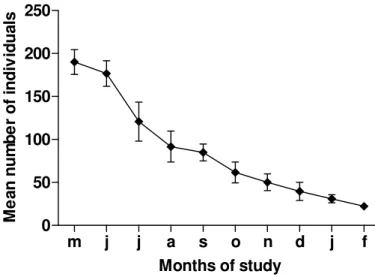
Figure 2. Mean ± SD number of Little Blue Herons present in the mud bank area trough the ten studied months.
Foraging Parameters - For all four foraging parameters it was performed the Kruskal-Wallis one way ANOVA test to comparisons between the three sectors, with statistical significance considered at α=0.05.
A
1 2 3
0 20 40 60 80 100 Sectors N u m b er o f s tep s / m in B
1 2 3
0 5 10 15 20 Sectors N u m b e r of st abs / m in C
1 2 3
0 2 4 6 8 Sectors N um be r of c a tc he s / m in D
1 2 3
0.0 0.5 1.0 1.5 Sectors N u m b e r o f c at ch e s / st ab s
Figure 3.a) Number of steps from the individuals of Little Blue Heron foraging in the three different sectors in the mud bank, in the Cananéia estuary. b) Number of stabs from the individuals of Little Blue Heron foraging in the three different sectors in the mud bank. c) Number of catches from the individuals of Little Blue Heron foraging in the three different sectors in the mud bank. d) Success rate (catches/stabs) from the individuals foraging in the three different sectors in the mud bank. Values are given as median, with the whiskers representing minimum to maximum value.
particular area, never leaving this area, until the end of the feeding period, when the hight tide had already covered the mud bank.
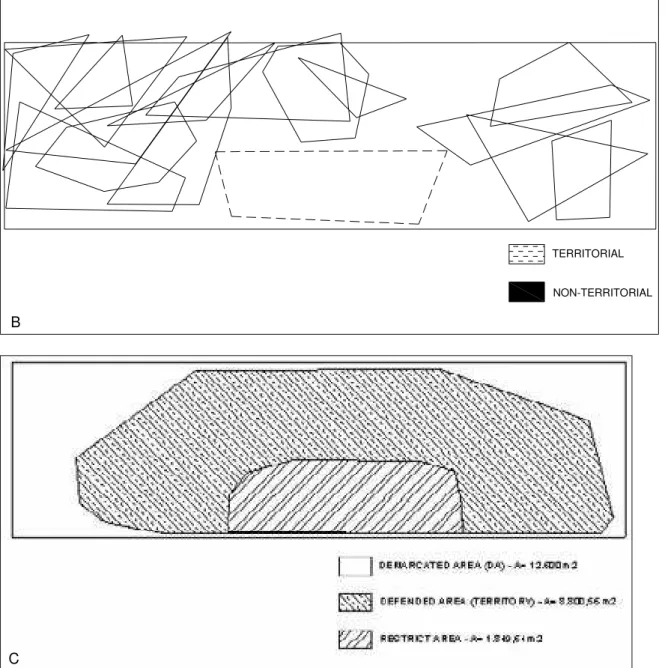
All the other individuals in the demarcated area would not exhibit this kind of behavior, been non-territorial. These individuals would also arrive in the beginning of the feeding period and stay until its end, but they would occupy the same areas, simultaneously and not exhibiting a defense behavior. The territorial individual expelled any other individuals that would enter on the patrolled area (Fig. 4c), being adults as well as immature ones. In the Figures 4a and b there are the representation of two of the 30min observation periods, in with are represented in black the territorial individual, and in grey the non-territorial individuals that utilized the area in these observational sessions. The area defended by the territorial individual was in the mud bank area closest to the mangrove, occupying the sector 1 and part of the sector 2.
TERRITORIAL
NON-TERRITORIAL
TERRITORIAL
NON-TERRITORIAL
Figure 4. a/b) The results of two 30min observation sessions taken to determine the actuation areas of different Little Blue Heron individuals foraging in the demarcated area, in the Cananéia estuary. c) Representation of the entire area occupied by the territorial individual trough the study period and the area of most exclusive use.
In table 1 are presented the results for the sizes of the actuation areas of the territorial and non-territorial individuals, as well as the sizes and percentages of the overlapped areas between the territorial individual and the non-territorial, and between the non-territorial individuals themselves. It was chosen to perform the non-parametric Wilcoxon test, because
B
the variances between the two groups were considered too different (Bartlett test F=176.47, P<0.05) and the N of the groups were also very different. It can be observed that the total area for the territorial individual is bigger than that of the non-territorial ones (n=1096, Z=-10.01, P<0.05), and that the overlapping percentage of area is small for the territorial individual than for the non-territorial ones.
The total area patrolled by the territorial individual was of approximately 8800.56m². The defended area, the one it was successful in keeping others entirely out was of about 1849.64m². The area patrolled by the territorial individual corresponds to approximately 5.87% of the mud bank area (approximately 150000m²) (see Fig 4c). If we consider the average number of individuals feeding in the mud bank (137 individuals) from May to August (the months that had more individuals), than the area per individual, out the 1849.64m² of the territorial one, is about 1081.39m².
Pearson’s correlation was performed (n=120, r=0.03, df= 46, P>0.05) between the average number of individuals in the demarcated area (mean=9.17, lower95%=8.45, uper95%=9.89) and the average of overlapped area for the territorial individual (Table 1), and the average number of overlapping between the territorial individual and the non-territorial ones (mean=2.85, lower95%=2.33, uper95%=3.38) (n=120, r=0.14, df=46, P>0.05). A week correlation between the number of overlapping between the territorial individual and the non-territorial ones and the average of overlapped area for the non-territorial individual was observed (n=120,r=0.47,df=46,P<0.05).
Table 1. Values on the sizes of actuation areas for the territorial and non-territorial individuals (average total area); average overlapped
area between the non-territorial individuals and the territorial, and between the non-territorial among each other; and the overlapping
percentage for the territorial and non-territorial individuals. For the feeding Little Blue Heron in Cananéia, southeastern Brazil. The n
values regard the 30 min period sessions of data collection.
n average
total area
(m²) SD lower
95%
uper
95%
average
overlapped
area ( m²) SD
lower
95%
uper
95%
overlapping
percentage
(%) SD lower
95%
uper
95%
territorial 120 2564.46 943.56 2375.71 2753.21 171.41* 131.40 144.78 198.03 8.48 5.90 7.30 9.66
non-territorial 976 893.25 676.72 830.99 957.51 633.98 560.67 580.58 687.37 66.80 22.71 64.65 68.96
It is know for the populations of Little Blue Heron of the North hemisphere that migration occurs from feeding sites to colony sites, and the other way around (Dusi 1967). Richner (1986) observed the abandonment of feeding territories at the start of the breeding season for the Grey Heron. Therefore, the decreasing in the number of individuals, especially from August might be related to a migration to the reproductive areas. This specie is yet starting to be better studied in Brazil, and the colony sites and the dislocation of individuals from different areas as to feeding sites or colony sites, it is not know. But this hypothesis seems to be very plausible, because as the observed in the results of the present study, there is a possible abandonment of a territorial individual from the area in the reproductive months (September to December) and a possible return in the end of the reproductive period (January). The territorial individual was always an adult, and so, probably a reproductive one.
The colony sites are not know yet, but from our observations of the decreasing in the number of individuals and the absence of a territorial individual in the reproductive months, it can be argued that probably the colony sites are too distant from the Brocuanha mud bank; since it is accepted that the proximity to the feeding areas is an important factor for the selection of breeding sites in herons and egrets (Gibbs et al. 1987). According to Custer and Osborn (1978), herons must feed within a certain range of the colony; a distance at which it is energetically feasible for they to fly between foraging areas and the colony. Then, since there is an abandonment of the area during the reproductive period, it is possible that the new feeding area is close to the colony.
and from a very close distance of the feeding site and the birds. This is probably because the behavior of the species in the area is very docile in the sense of permitting the presence of the observer, and also because of the very fixed way of using the feeding site by the territorial individual.
The method of stakes can give us a size of the territory very close to the real, since the points used to create the polygon are taken from the observation of the trajectory of one individual been accompanied by the observer eyes at a whole period of time. Different from the territory and home range sizes established from spot observations of the male or the reproductive pair of a bird species or the various capture points of a mammal (Odum & Kuenzler 1955).
Our observations here lead to define the territorial individual as such for its behavior is attending the three simultaneous conditions proposed by Brown and Orians (1970) as necessary to be met when attempting to show territoriality. The first says that a territory must show a slow change over time, or be fixed; what was very clear for the Little Blue Heron in here. The second is about exclusivity and that was another condition verified here. And the third condition, which was also observed in our study, is the active or passive defense of the area against rivals.
Since the territorial behavior of the Little Blue Heron was observed out of the reproductive station, corresponding to the winter, it can be suggested that this territory is a kind of winter territory (or type E), and it is used in the feeding ground (Nice 1941; Wilson 1975).
contribution to the next generation’s gene pool, or its inclusive fitness (Alcock 2005). As said by Davis and Houston (1984), “the concept of economic defendability states that we would only expect an animal to spend time and energy interacting with others to defend a territory when this yields greater net benefits than an alternative behavior, for example ignoring others in the population and spending the whole time exploiting the resource”. If, aside the defended area (restrict use) of the territorial individual, the other individuals feeding in the mud bank have been left with approximately 1081.39m² of area per individual foraging; and if, as observed by us, more territorial individuals would exist in the mud bank, then these areas could be even smaller and almost totally overlapped (increase of overlapping in the use of resources among individuals). Thus, the territorial behavior of a territorial individual could actually be paying off, since it defends an area of exclusive use bigger than the area available for each non-territorial individual, and in an area within the mud bank that could have more prey available (see discussion below).
that the areas closest to the margin (or the mangroves) have greater numbers of polychaetes, mollusks, isopods, decapods, among others. These organisms form a rich prey source for herons and other bird species. Our data on the foraging parameters shows that the area comprehending the sectors 1 and 2, what correspond to approximately half of the mud bank width, brings to the individuals foraging inside it greater gains with less energy expenditure than the individuals foraging in the other half, comprehending the sector 3. The area of the territorial individual extends from the sector 1 to a part of the sector 2, what comprehends exactly the area pointed for Varoli and Souza (1990) as the area with more availability of prey in the mud banks. This suggests that territorial birds defend patches of abundant food resources which might confer unique energetic benefits to the territorial individual, as observed by Turpie (1995) and Tripp and Collazo (1997). This can be one of many possible explanations to account the reasons for why an individual defends an area in the Brocuanha mud bank, as observed by us and exhibited in here.
territorial individuals area. These results might suggest that the intruder density does not have such an important role in the territorial behavior of the Little Blue Heron; and that some characteristics of the preys play a more expressive role (see discussion on this subject in Myers, Connors & Pitelka 1979; Hixon 1980; Tripp & Collazo 1997).
The territoriality in colonial birds is wide accepted (Nice 1941), principally concerning the reproductive period, considering the area surrounding the nest the territory. But true feeding territories have been prove to exist for the Little Egret (Yamada 1994; Nota 2003), the Grey Heron (Richner 1986; Marion 1989), the Reef Heron (Recher 1972), as we also found for the Little Blue Heron. Hancock and Kushlan (1984) affirm that the Goliath Heron, Ardea goliath, the Black Heron, Egretta ardesiaca, the Tricolored Heron, Egretta tricolor, and the Black-crowned Night Heron, Nycticorax nycticorax, also exhibits feeding
territoriality. And Lowe (1983) observed also the White-faced Heron, Egretta novaehollandiae, defending feeding territories in mudflat areas. But actual data confirming
these observations is unclear. Yet, Kushlan et al. (1982) suggests possible holding of feeding territories by Whistling Herons, Sirigma sibilatrix. For the Little Blue Heron, Palmer (1962) wrote that individuals vigorously defend feeding territories out of the reproductive period. As in the cases above, this is yet too little information to affirm the true existence of feeding territories for the species. But with the results in here, this existence became real.
We thank the Instituto de Pesquisas Cananéia (IPeC) for all the support, with material, field assistance and logistic. And we also thank the engineer Thelicia Silva for the support with the AutoCAD LT 2004 software. Finantial support, in form of a scholarship, is acknowledged from the Coordenação de Aperfeiçoamento de Pessoal de Nível Superior (CAPES).
References
Alcock, J. (2005) Animal Behavior: An Evolutionary Approach. Sinauer Associates Inc., Sunderland, Massachusetts.
Brown, J. L. (1964) The evolution of diversity in avian territorial systems. Wilson Bulletin,
76, 160-169.
Brown, J. L. & Orians, G. H. (1970) Spacing patterns in mobile animals. Annual Revue of Ecological Syztematics, 1, 239-262.
Caldwell, G. S. (1981) Attraction to tropical mixed-species heron flocks: Proximate mechanisms and consequences. Behavioural Ecology Sociobiology, 8, 99-103.
Caldwell, G. S. (1986) Predation as selective force on foraging herons: Effect of plumage color and flocking. Auk, 103, 494-505.
Custer, T. W. & Osborn, R. G. (1978) Feeding habitat use by colonially-breeding herons, egrets and ibises in North Carolina. Auk, 95, 733-743.
Davis, N. B. (1978) Ecological questions about territorial behaviour. Behavioural Ecology: An Evolutionary Approach (eds J. R. Krebs & N. B. Davis), pp. 245-281. Blackwell Scientific
Publications, Oxford.
Davis, N. B. & Houston, A. I. (1984) Territory economics. Behavioural Ecology: An Evolutionary Approach (eds J. R. Krebs & N. B. Davis), pp. 148-169. Blackwell Scientific
111, 588-595.
Dusi, J. L. (1967) Migration in the Little Blue Heron. Wilson Bulletin, 79, 223-235.
Erwin, R. M. (1983) Feeding habitats of nesting wading birds: Spatial use and social influences. Auk, 100, 960-970.
Ewald, P. W., Hunt, G. L., Jr. & Warner, M. (1980) Territory size in Western Gulls: Importance of intrusion pressure, defense investments, and vegetation structure. Ecology, 61,
80-87.
Gibbs, J. P., Woodward, S., Hunter, M. L. & Hutchinson, A. E. (1987). Determinants of Great Blue Heron colony distribution in coastal Maine. Auk, 104, 38-47.
Hixon, M. A. (1980) Food production and competitor density as the determinants of feeding territory size. The American Naturalist, 115, 510-530.
Kelly, J. F., Gawlik, D. F. & Kieekbusch, D. K. (2003) An updated account of wading bird foraging behavior. Wilson Bulletin, 115, 105-107.
Krebs, J. R. & Davies, N. B. (1993) An Introduction to Behavioural Ecology. Blackwell Scientific Publications, Oxford.
Kushlan, J. A., Hancock, J. A., Pinowski, J. & Pinowska, B. (1982) Behavior of Whistling and Capped Herons in the Seasonal Savannas of Venezuela and Argentina. Condor, 84,
255-260.
Kushlan, J. A. (1976) Feeding behavior of North American herons. Auk, 93, 86-94.
Kushlan, J. A. (1977) The significance of plumage colour in the formation of feeding aggregations of Ciconiiforms. Ibis, 119, 361-364.
Kushlan, J. A. (1978a) Commensalisms in the Little Blue Heron. Auk, 95, 677-681.
389.
Kushlan, J. A. (1981) Resource use strategies of wading birds. Wilson Bulletin, 93, 145-163.
Lowe, K.W. (1983) Feeding behaviour and diet of the White-faced Heron Ardea novaehollandiae in Westernport Bay, Victoria. Corella, 7, 101-108.
Maher, C. R. & Lott, D. F. (1995). Definitions of territory used in the study of variation in vertebrate spacing system. Animal Behaviour, 49, 1581-1597.
Maher, C. R. & Lott, D. F. (2000) A review of ecological determinants of territoriality within vertebrate species. American Midland Naturalist, 143, 1-29.
Marion, L. (1989) Territorial feeding and colonial breeding are not mutually exclusive: The case of the Grey Heron (Ardea cinerea). Journal of Animal Ecology, 58, 693-710.
Myers, J. P., Connors, P. G. & Pitelka, F. A. (1979) Territory size in wintering sanderlings: The effect of prey abundance and intruder pressure. Auk, 96, 551-561.
Nice, M. M. (1941) The role of territory in bird life. American Midland Naturalist, 26,
441-487.
Noble, G. K. (1939) The role of dominance in the life of birds. Auk, 56, 263-273.
Norton, M. E., Arcese, P. & Ewald, P. W. (1982) Effect of intrusion pressure on territory size in Black-chinned Hummingbirds (Archilochus alexandri). Auk, 99, 761-764.
Nota, Y. (2003) Effects of body size and sex on foraging territoriality of the Little Egret (Egretta garzeta) in Japan. Auk, 120, 791-798.
Odun, E. P. & Kuenzler, E. J. (1955) Measurement of territory and home range size in birds. Auk, 72, 128-137.
Olmos, F., Silva e Silva, R. & Prado, A. (2001) Breeding season diet of Scarlet Ibises Eudocimus ruber and Little Blue Herons Egretta caerulea in a Brazilian mangrove.
caerulea) in southeastern Brazil. Ornitologia Neotropical, 13, 17-30.
Palmer, R. S. (1962) Handbook of North American Birds, Vol I: Loons through Flamingos. Yale University Press, New Haven.
Pyle, P., & Howell, S. G. (2004) Ornamental plume development and the “prealternate molts” of herons and egrets. Wilson Bulletin, 116, 287-292.
Recher, H. F. (1972) Territorial behaviour of the Reef Heron Egretta sacra. Emu, 72,
126-130.
Recher, H. F. & Recher, J. A. (1969) Comparative foraging efficiency of adult and immature Little Blue Heron (Florida caerulea). Animal Behaviour, 17, 320-322.
Richner, H. (1986) Winter feeding strategies of individually marked herons. Animal Behaviour, 34, 881-886.
Ricklefs, R. E. (2001) The Economy of Nature. W. H. Freeman, New York.
Rodgers, J. A., Jr. (1980a). Breeding ecology of the Little Blue Heron on the west coast of Florida. Condor, 82, 164-169.
Rodgers, J. A., Jr. (1980b) Little Blue Heron breeding behavior. Auk, 97, 371-384.
Rodgers, J. A., Jr. (1983). Foraging behavior of seven species of herons in Tampa Bay, Florida. Colonial Waterbirds, 6, 11–23.
Rodgers, J. A., Jr. (1987) Breeding chronology and reproductive success of Cattle Egrets and Little Blue Herons on the west coast of Florida, USA. Colonial Waterbirds, 10, 38–44.
Schaeffer-Novelli, Y., Mesquita, H. S. L. & Cinturón-Molero, G. (1990) The Cananéia Lagoon Estuarine System, São Paulo, Brazil. Estuaries, 13, 193-203.
Sick, H. (1997) Ornitologia Brasileira, Uma Introdução. Editora Nova fronteira S. A., Rio de Janeiro, Rio de Janeiro.
Wilson Bulletin, 109, 630-642.
Turpie, J. K. (1995) Non-breeding territoriality: Causes and consequences of seasonal and individual variation in grey plover Pluvialis squatarola behaviour. The Journal of Animal Ecology, 64, 429-438.
Varoli, F. M. F. & Suosa, E. C. P. M.. (1990) Macrofauna e biomassa microfitobentônica da região estuarino-lagunar de Iguape-Cananéia (25º00’S – 48º00’W), São Paulo, Brasil. II Simpósio de Ecossistemas da costa Sul e Sudeste Brasileira: Estrutura, Função e Manejo, 2,
95-107.
Verner, J. (1977) On the adaptive significance of territoriality. The American Naturalist, 111,
769-775.
Werschkul, D. F. (1979) Nestling mortality and the adaptive significance of early locomotion in the Little Blue Heron. Auk, 96, 116-130.
Werschkul, D. F. (1982) Nesting ecology of the Little Blue Heron: Promiscuous behavior. Condor, 82, 381-384.
Wilson, E. O. (1975) Sociobiology. Belknap Press, Harvard.
Willard, D. E. (1977) The feeding ecology and behavior of five species of herons in southeastern New Jersey. Condor, 79, 462–470.
Wronski, T. & Plath, M. 2006. Mate availability and intruder pressure as determinants of territory size in male bushbuck (Tragelaphus scriptus). Acta Ethologica, 9, 37-42.
Ajudando com a elaboração do projeto, assim como da dissertação e dos manuscritos, contribuindo para a discussão dos resultados encontrados e suas relações com espectos comportamentais e ecológicos. Esteve sempre presente, disponibilizando na forma de sua pessoa ou do Instituto de Pesquisas Cananéia (IPeC), material bibliográfico e ajuda com a logistica do trabalho de campo.
Journal of Animal Ecology – Formatação.
Standard Papers
A standard paper should not normally be longer than 10 printed pages (8500 words). (A page of printed text, without figures/tables carries c. 800 words.) The passive voice is preferred in describing methods and results. The active voice may be used occasionally to emphasize a personal opinion (typically in Introduction and Discussion sections). The typescript should be arranged as follows, with each section starting on a separate page.
Title page. This should contain:
1. A concise and informative title (as short as possible). Do not include the authorities for taxonomic names in the title. Titles with numerical series designations (I, II, III, etc.) are acceptable provided the editors agreement is sought and that at least Part II of the series has been submitted and accepted before Part I is sent to the printer. Such series must begin in one of the journals of the BES.
2. A list of authors' names with names and addresses of Institutions.
3. The name, address and e-mail address of the correspondence author to whom proofs will be sent.
4. A running headline of not more than 45 characters.
Summary. This should list the main results and conclusions, using simple, factual, numbered statements. It must not exceed 350 words.
Key-words. A list in alphabetical order not exceeding five words or short phrases. Please pay attention to the keywords you select. Keywords should not already appear in the title or abstract. Rather they should be selected to draw in readers from wider areas that might not otherwise pick up your paper when they are using search engines.
work to be repeated. Do not describe or refer to commonplace statistical tests in Methods but allude to them briefly in Results.
Results. This should state the results, drawing attention in the text to important details shown in tables and figures.
Discussion. This should point out the significance of the results in relation to the reasons for doing the work, and place them in the context of other work.
Acknowledgements
References (see Specifications).
Tables (see Specifications). These should be referred to in the text as Table 1, etc. Do not present the same data in both figure and table form.
Figure legends (see Specifications). Figures should be referred to in the text as Fig. 1, etc. (note Figs 1 and 2 with no period).
Illustrations (see Specifications) should be referred to as Figures.
Figure legends
Legends should be grouped on a separate sheet. Furnish enough detail so that the figure can be understood without reference to the text. In the full-text online edition of the journal, figure legends may be truncated in abbreviated links to the full screen version. Therefore, the first 100 characters of any legend should inform the reader of key aspects of the figure.
Tables
Each table should be on a separate page, numbered and accompanied by a title at the top.
References
440.
Warham, J. (1996) The Behaviour, Population Biology and Physiology of the Petrels. Academic Press, London.
Título – Comportamento Social da Garça–azul, ao Forrageio, no Sudeste do Brasil.
Autores - Emmanuel Moralez-Silva1, Flávio José de Lima Silva2 and Emygdio Leite de Araujo Monteiro-Filho3.
1 – Pós-Graduação em Psicobiologia – Estudos do Comportamento, Universidade Federal do
Rio Grande do Norte, Brazil. Instituto de Pesquisas Cananéia (IPeC), 199 Tristão Lobo, Centro, Cananéia, SP, 11.990-000, Brazil.
2 - Laboratório de sistemática e Ecologia Animal, Dept. de Ciências Biológicas, Universidade
do Estado do Rio Grande do Norte. Mossoró-RN.
3 - Departamento de Zoologia, Setor de Ciências Biológicas, Centro Politécnico, Universidade
Federal do Paraná, PO Box 19020, Curitiba, PR, 81.531-990, Brazil. Instituto de Pesquisas Cananéia (IPeC), 199 Tristão Lobo, Centro, Cananéia, SP, 11.990-000, Brazil.
Periódico – Journal of Ethology, QUALIS A.
Emmanuel Moralez-Silva1, Flávio José de Lima Silva2 and Emygdio Leite de Araujo Monteiro-Filho3.
1 – Programa de Pós-graduação em Psicobiologia – Estudos do Comportamento, Universidade
Federal do Rio Grande do Norte (UFRN), PO Box 1511, Natal, RN, 59078-970, Brazil. Instituto de Pesquisas Cananéia (IPeC), 199 Tristão Lobo, Centro, Cananéia, SP, 11.990-000, Brazil.
2 – Programa de Pós-graduação em Psicobiologia – Estudos do Comportamento, Universidade
Federal do Rio Grande do Norte (UFRN).
Laboratório de sistemática e Ecologia Animal, Dept. de Ciências Biológicas, Universidade do Estado do Rio Grande do Norte, Mossoró, RN, Brazil.
3 – Departamento de Zoologia, Setor de Ciências Biológicas, Centro Politécnico,
Universidade Federal do Paraná, PO Box 19020, Curitiba, PR, 81.531-990, Brazil. Instituto de Pesquisas Cananéia (IPeC).
Total text pages: 24
Number of tables and figures: 5
The social behavior of the Little Blue Heron, Egretta caerulea, has been studied only during the breeding period (displays associated to the breeding behavior). The displays associated to the interactions of foraging herons in the feeding grounds have not yet been studied more detailed. Therefore, the aim of this study is to present a descriptive analysis of the interactions between conspecifics feeding in an aggregation, in a mud bank, in southeast Brazil. The methods of ad libitum and behavioral sampling were used to describe the behaviors. Four types of display postures were identified, two previously described in the literature (Spread-wings and Withdraw Crouch) and two new ones (Extended and Wings Lined-up). One vocalization, the Ahh-ahh-ahh call. And four types of interactions between two or more individuals, involving or not the display postures: i) Encounter; ii) Fight; iii) Expulsion, and iv) Kleptoparasitism. All these behaviors are related, direct or indirectly, to the dominance of a particular area of food resource by one individual. And then, pointing out to the importance of the social interactions between foraging herons, as they feed in great numbers on aggregations in ecologically important areas.
Key words: Cananéia estuarine system, Display postures, Dispute, Description, Herons,
The term social can have several connotations, and different researchers use it in slightly different manners. For ones, this term is used in a restrict sense, to animals that exhibit a certain amount of familial dependence, those bearing elaborate behavioral displays, or those living within demographically structured groups (Giraldeau and Caraco 2000). Others use the term more widely, and consider being social any animal that spends a good part of its life in groups that are open, unstructured and temporary (Giraldeau and Caraco 2000).
This discussion was most vigorous with the flowering of the classic Ethology, and ethologists as Lorenz and Tinbergen tended to distinguish really social groups from aggregations (gatherings of nonsocial animals). These aggregations would form accidentally; while true social groups would form as a result of a genuine attraction between individuals (Giraldeau and Caraco 2000).
Latter in the twenty century, the incorporation of the evolutionary perspective in the study of the behavior, and the emerging of the Behavioral Ecology, bringing a more ecological-evolutionary approach, this form of using the term social became more bonded to the functional level (Krebs and Davis 1993). This evolutionary perspective of social groups is more concerned that individuals in a group are interdependent and their actions has consequences on their fitness gains and pay offs, operating on the costs and benefits of their choices (Krebs and Davis 1991).
Therefore, and take to account that herons are known to form feeding aggregations at proper sites (Kushlan 1981), these interactions can be considered as having a strong social component. Various studies on the social feeding by herons and egrets had been done; referring to its formation, structure and dynamics (Smith 1995, Master 1992, Erwin 1983, 1984, Kushlan et al. 1985, Kushlan 1976b, 1977).
nycticorax – Noble et al. 1938 and Palmer 1962; Yellow-crowned Night Heron, Nyctanassa
violocea – Bagley and Grau 1979; Snowy Egret, Egretta thula – Meyerriecks 1960 and
Palmer 1962; Reddish Egret, Egretta rufescens - Meyerriecks 1960; Tricolored Heron, Egretta tricolor – Rodgers 1977, 1978b; Cattle Egret, Bubulcus ibis – Blaker 1969 and
Lancaster 1970; and Green Heron, Butorides virescens - Meyerriecks 1960).
The behaviors related to the foraging activities are well described (Kushlan 1976a, 1978a) and studied (Papakostas et al. 2005, Battley et al. 2003, Richardson et al. 2001, Powel 1987, Rodgers 1983, Hafner et al. 1982, Willard 1977). Yet, the behavioral interactions of foraging herons at the intra-specific level are not much studied, although some workers do consider it in their work (Blaker 1969, Pratt 1980, Garrido et al. 2002, Lekuona 2002, González 1996, Wiggins 1991, Kushlan 1978b, 1981, Krebs 1974, Custer and Osborn 1978). Only Bayer (1984a, b) have focused a study on the foraging ground displays and associated vocalizations with the Great Blue Heron.
For the Little Blue Heron, Egretta caerulea, the sexual behavior and the related vocal array were well studied by Rodgers (1978a, 1980), and also by Meanley (1955), Meyerriecks (1960), Palmer (1962) and Werschkul (1982). The species has also had the foraging behavior well studied, as cited above for the other species; but the behavioral interactions of conspecifics at feeding grounds have not been studied more detailed.
The study was made from May 2005 to February 2006, in a mud bank in the Cananéia-Iguape estuarine lagoon system, in the south coast of São Paulo state, southeastern Brazil (from 25° 00` to 25° 04` S and 47° 54` to 47° 56` E). The system is composed by three islands, forming a series of channels and lagoons, connected to the open sea; been then under the influence of the daily tidal cycles. The mangroves are the predominant vegetation in the system, and in the margins of the channels a series of mud banks are exposed by the low tides, serving as feeding sites for the avifauna (more detailed description and map in Moralez-Silva et al. manuscrito 1). Aggregations of foraging Little Blue Heron are common in these sites, varying from approximately 20 to 200 individuals throughout the year (Moralez-Silva et al. manuscrito 1).
Methods
The methods of ad libitum and behavioral sampling (Martin and Bateson 1993, Altmann 1974) were used to describe the behaviors here presented. The observations were made in a fixed point (an existent pier), during the day, in the full or new moon and in the hours of low tide, by naked eye or using a 10x50 binoculars. During the observational period, every time two or more individuals were engaged in any sort of interaction, these would become center of the attention, and its behaviors were registered. The description was a mist of the empirical and functional method (cf. Lehner 1998); and also in terms of the individuals spatial relation to features of the environment or to other individuals (Martin and Bateson 1993). The observed behaviors were photographed and video recorded when possible as well.
spectrograms. From these spectrograms the physical parameters were obtained: frequency, time of duration (both from the entire call, and the notes and intervals between notes) and number of notes and visible harmonics. Frequency modulation, intensity and the distribution of the energy in the vocalization could also be obtained.
Results
There were a total of 150 hours of behavioral observations during the nine months of study.
Four types of display postures and four types of interactions between two or more individuals were identified, involving or not the display postures.
Display postures
Extended (n – number of observations of such behavior=63) – the individual keeps the body erect, almost on the vertical, with the head and neck extended and the head in line with the neck, slightly up, with the bill closed. The wings are held very close to the body. No feather erection is observed (Fig. 1).
Wings-lined-up (n=31) – the individual keeps the body horizontally to the ground, the neck stretched and the head up, with the bill pointing upwards. One of the wings is lowered (the one closest to the other individual), not passing the tarsometatarsus, and the other is pulled up the back line. The rectrices are spread out on a medial length. No erection of the feather is observed (Fig. 2).
Figure 2. Wings-lined-up posture of Little Blue Heron in the Cananéia estuary feeding site.
Spread-wings (cf. Bayer 1984b) - The heron maintain the body in a position as in the Extended posture, and keeps the wings outstretched from the body. No dragging of the substrate during the motion of the display was observed. This display was observed a few times, and in all of them, the individual displaying it was fleeing from another.
We distinguished these last two displays because they happened in distinct contexts. The Wings-lined-up was observed preceding a fight, and the Spread-wings, in the few times observed, was performed by a heron fleeing from a conflict. It was never observed a transition from one to the other, both happening separately and in distinct interactions.
this, part of the back is exposed. Feather erection dos not occur.
All postures are used in the context of interaction with other individual; not used alone. In all of these postures, no vocalizations were associated, and these could not be missed since the observer was generally closer then 30 m from the displaying herons.
Vocalizations
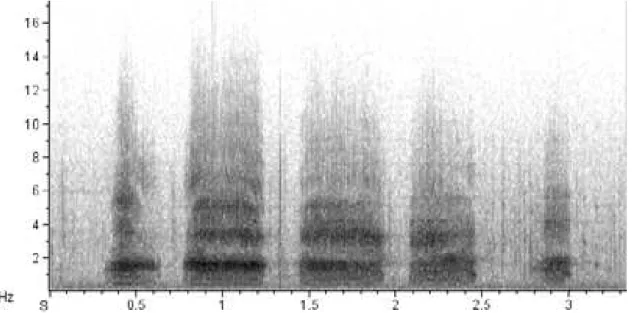
Calls of low frequency and variable in intensity were recorded. These calls, named Ahh-ahh-ahh call, can contain three to 10 notes of similar duration and with distinct frequency
modulation, spaced by each other in a low variable interval duration (Table 1, Fig. 3). The energy is concentrated in the first harmonics, and not in the fundamental note. These results were gathered by analyzing 25 recorded vocalizations from different individuals.
It is used primarily by territorial herons, but can also be used by non-territorial ones. It can be observed that approximately only 10 to 15% of the individuals foraging in the mud bank utilize this vocalization. Two instances of its use were identified, after an Expulsion and after a short flight within the foraging area of the individual.
foraging in the Cananéia estuary, southeastern Brazil, with numbers of notes and physical parameters (frequency (Hz), time (s), and numbers of visible harmonics). Values are given as the mean ± SE.
Frequency range (Hz)
Average visible harmonics
Average notes
Average duration of the
call (s)
Average notes (s)
Average intervals between notes (s)
693.02±164.98 1243.76±331.19
4.88±2.26 4.83±1.83 2.90±1.56
0.36± 0.14
0.26±0.08
Interactions between individuals
Figure 4. Encounter between two Little Blue Heron in the Cananéia estuary feeding site. The individual in the right is assuming the Extended posture, and the individual in the left is assuming the Withdrawn Crouch posture.
Fight (n=13) - Fights between individuals are the most rare interaction. They can evolve from an Encounter or begin directly as the individuals met each other. Both individuals assume the Wings Lined-up posture, with the wing down side turned to the opponent, and then walk in circle turned one to the other. They start to jump towards each other, with the legs stretched and beating the wings. Both individuals try to hit the other with the feet and peck on each other, reminding the fight behavior of domestic rosters. The fight finishes with the loser running away, and the winner might promote a little chase.
expels one individual at a time, but a few observations of it expelling two individuals at a time were made too. During the flight, the heron dislocates with a more “patterned” wing beats. Kleptoparasitism (n=42) – The stealing behavior was observed when an individual captured a prey with more than 7cm, such as a crab (Callinectes sp.) or a fish (Synbranchus sp.), that demands more handling time, and another one would came flying in its direction and attempt to steal the captured prey. This behavior has a success of approximately 25%; in 11 of the 42 observations the individual managed to steal the prey.
Discussion
Two display postures, the Extended and the Wings-lined-up, are new both for the Little Blue Heron behavior, as for the literature. For both, similar postures, from breeding and foraging herons, as to the position of the body parts have been described (eg. Stretch, Alert, Upright and Spread-wings – Bayer 1984b, Mock 1976, Meyerriecks 1960). The other two postures, the Withdraw Crouch and the Spread-wings, were already described in the literature (Bayer 1984b, Meyerriecks 1960), and have been observed in foraging herons also by Bayer (1984b).
al. 1993). In here, the displays would be used in this manner, as the initial stage in the
agonistic escalate.
Since the breeding behavior of the Little Blue Heron has not yet been studied in Brazil, the displays associated to the pair formation and to the breeding cycle are not known. Then, it is not possible to do a comparison of the displays and interactions between the foraging and nesting periods (as did Bayer 1984b) of the populations that use the estuarine areas in the coast. But if we compare it with the nesting behavior described by Rodgers (1980) for the species in North America, only the Withdraw Crouch can be considered as corresponding to the nesting displays. We do have similarities, but it seams that the behaviors performed at feeding sites are distinct from the ones performed during the nesting period.
A complex of displays that have an extended neck position, with the bill held above the horizontal (Vertical, Bittern Stance, Upright, Spread-wings, Vocal Rise and Stretch), is suggested by Bayer (1984b). The Extended and the Wings-lined-up displays could then be included in this complex. It could be possible that all these displays have the same evolutionary origin, been specialized during the evolutionary process to different environments and contexts. As suggested by Bayer (1984b), the Vertical and Bittern Stance are related to signaling potential predators. The Strectch and Spread-wings serves as appeasement and/or threat towards another individual during an agonistic encounter (Mock 1976, Bayer 1984b). But they are used in different contexts, the first occurring in nesting areas and the second in foraging areas (Bayer 1984b). It is possible that the Extended and the Wings Lined-up displays, both appearing to signal appeasement and/or threat, occurs for the Little Blue Heron in the foraging areas, as the Spread-wings for the Great Blue Heron.
the displays of the Little Blue Heron in here. Bayer (1984b) also did not observed erection of feathers for the Spread-wings, exclusive foraging ground display of the Great Blue Heron. Since the foraging ground displays we identified for the Little Blue Heron seem to be distinct from the nesting ones, the displays exclusive of foraging activities might have lost this morphological characteristic during the evolutionary process.
Different from Bayer (1984a) that registered seven vocalizations (although part of them is corresponding to the ones used during the reproductive behavior) for foraging Great Blue Heron, we observed and registered only one vocalization for the foraging Little Blue Heron. Its characteristics, frequency and duration of notes and intervals between notes, are similar to the vocalizations of the Great Blue Heron (Bayer 1984b). The restrict use of the Ahh-ahh-ahh call suggest that it might be an important component of the social organization of the species during the foraging period. The low frequency of the sound is another characteristic of this call that can be related to its social use; since by it’s been of low frequency, it can be dissipated for long distances, reaching the goal of transmitting the massage it contains.
Bayer (1984d) has described a very similar vocalization, the Roh-roh-roh call, of similar frequency range, number and duration of notes, and duration of the intervals between the notes (of low variance). The Roh-roh-roh call is yet used more by territorial, than by non-territorial herons, and is also given spontaneously by non-territorial herons. These characteristics suggests that the Roh-roh-roh call and the Ahh-ahh-ahh call might be a similar, or even practically a same call, with intrinsic specific differences, but that has evolved together with the feeding territorial behavior of non-breeding herons.
visual channel (Mock 1976). All the displays we identified for the Little Blue Heron would happen during an interaction with another individual (reactive displays, cf. Mock 1978); they would never be performed by an individual that was alone, with no other in its surroundings. This might explain the poor vocal array found, since it was not necessary for an individual to drawn attention to it self by vocalizing, when the need of a display would appear only when another individual would approach. This reinforces the possible function of the Ahh-ahh-ahh call as a vocalization used in the social context of foraging, been related only to the Expulsion interaction and not to any of the display postures.
Meyerriecks (1960) believes that the amount of neck extension reflects the degree of escape tendencies. This might not be the case here, since as in the Encounter, the heron does not show escape tendencies when performing the Extended posture, but does so when performing the Withdrawn Crouch. Thus, in the social context of foraging in the Little Blue Heron, the degree of extension of the neck might not be related to escape tendencies, been more related to an attempt to appear bigger to the opponent. Appearing bigger in an agonistic encounter is a valuable weapon for the individual, that might be able to end it before it escalates to a more stressful and damaging physical dispute (Alcock 2005).