Wearable Enhanced Learning for Healthy Ageing:
Conceptual Framework and Architecture of the
“Fitness MOOC”
Ilona Buchem¹, Agathe Merceron3, Jörn Kreutel2
Beuth University of Applied Sciences Berlin
2
Marten Haesner4, Anika Steinert5
Geriatrics Research Group, Charité Universitätsmedizin Berlin
Abstract. Physical activity is one of the key factors of ageing healthy and at the same time one of the key motivational challenges for the elderly. Supporting healthy ageing through physical fitness requires interventions that promote healthy levels of physical activity as part of the daily routine. Although wearable devices, such as activity trackers or smart wristbands, have been used by younger adopters to optimize physical fitness, little is known so far about how such emerging technologies may be used to improve well-being and overall health of senior users. In this paper we present the conceptual framework and the architecture of wearable-technology enhanced learning for healthy ageing as part of an R&D project called “Fitness MOOC - interaction of seniors with wearable fitness trackers in the fitness MOOC (fMOOC)”, founded by the German Federal Ministry of Education and Research (BMBF). The fMOOC project is a cooperation between Beuth University of Applied Sciences Berlin and the Geriatrics Research Group, Charité - one of the largest medical universities in Europe. The project aims at developing a wearable-technology enhanced learning solution combining the MOOC (Massive Open Online Course) approach with embodied and creative learning experience with support of activity trackers. fMOOC integrates an LMS backend with wearable fitness trackers, mobile user interface, gamification and analytics to promote healthy ageing through learning and interacting with senior users.
1 Introduction
Wearable Enhanced Learning (WELL) is beginning to emerge as one of the earmarks of the transition from the desktop age through the mobile age to the age of wearable, ubiquitous computing [6]. Whilst wearable devices such as activity or fitness trackers (e.g. Jawbone, Fitbit, Nike, Garmin) have been used by younger audiences to measure and monitor physical activity, little is yet known how senior users interact with such devices. Moreover, recent studies points out that most wearable trackers fail to drive long-term sustained engagement for the majority of users independent of age [21]. One of the reasons is that currently available trackers provide only basic health metrics such as steps taken and calories burnt. Another reason is that fitness trackers lack mechanisms for long-term use, social interaction and goal reinforcement, often failing to provide a sustained impact on users’ fitness habits. Therefore one of the key research questions in this area is how wearable fitness technologies may be used to ensure sustained physical practice as part of the daily routine, enhancing habit formation and making a long-term impact on users’ health and well-being [21]. In this paper we present an approach for applying wearable activity trackers to enhance embodied and creative learning experiences in order to promote engagement and an impact on health and well-being of seniors. Embodied learning has been only recently considered as an important form of learning, enhancing the learning process through sensor-motor experiences [18]. Creative learning has been been considered as an important element of healthy ageing. Research in this area has shown that creative learning practice may have a highly engaging and sustaining impact on well-being [12]. As we are not aware of any project so far implementing wearable activity trackers as part of a learning/training program for seniors, little empirical evidence has been available to us to support the design and implementation of wearable-technology enhanced learning solution for healthy ageing. In view of the current research gap, the conceptual framework and the technical architecture described in this paper presents a substantially novel approach, which seeks to define relevant research fields and research questions to guide the development of wearable-technology enhanced learning for healthy ageing through an interdisciplinary approach. The first part of this paper discusses the potential of wearable enhanced learning for healthy ageing, exploring the links between creativity, learning and healthy ageing. The second part describes the conceptual framework of the fMOOC, building upon the concepts of health, learning and technology and highlighting some of the key research questions of the fMOOC project. The third part presents the fMOOC architecture and outlines some of the challenges we faced in the process of technical development.
2 Background
brief, introductory overview of the key concepts and discuss potentials for promoting healthy ageing.
2.1 Concepts of Health
The traditional understanding of health would be the absence of illness. However, health has been also defined as a state of physical, mental and social well-being. One of the key definitions of health has been provided by the World Health Organization. According to WHO [30] health can be defined as “a complete state of physical, mental and social well-being, and not merely the absence of disease or infirmity.” Bircher [4] defines health not as a complete but as a dynamic state of well-being “characterized by a physical and mental potential, which satisfies the demands of life commensurate with age, culture, and personal responsibility”. This perspective frames health as a set of individual capabilities. The capability approach to health offers a relevant framework for exploring the links between creativity, learning and healthy ageing. This approach views health as a set of learnable capabilities which can change depending on the context [20]. From this perspective, a person can develop capabilities to live healthy (e.g. learning how to enhance physical fitness, learning how to deal with stress). From a similar perspective, healthy ageing can be defined as “the process of optimising opportunities for physical, social and mental health to enable older people to take an active part in society without discrimination and to enjoy an independent and good quality of life” [14]. Active participation and enjoyment have been considered as key indicators of health.
Health and ageing healthy are closely related to motivation to retain physical activity and to the concept of resilience, which refers to the capacity to recover from a physical, emotional or social challenge [27]. Motivation and resilience are considered critical factors in ageing [27]. Resilient individuals tend to have better quality of life and are less likely to succumb to illness [27]. Especially health resilience, i.e. the capacity to maintain good health, is a relevant concept for promoting healthy ageing. As individuals note physical impairments with age, such as problems with climbing stairs, the ability to accept changes in own physical fitness and managing everyday challenges are important factors for ageing healthy. Older adults may be helped to remain resilient and motivated to engage in regular physical activity by focusing on personal abilities and resources to strengthen determination, efficacy and self-esteem [27].
2.2 Concepts of Creativity
relation to physical and psychosocial well-being. During a creative activity an individual experiences a state of consciousness called flow, which manifests itself in complete absorption with the activity and deep enjoyment leading to a sense of well-being [11]. From this process-oriented perspective, well-being creative provides the opportunity to experience well-being and derive pleasure from an activity itself. Consequently, improving well-being can be reached by engaging in flow activities, which can have the form of an intellectual or a physical activity. These positive internal effects of a creative activity are associated with health.
Research in this area shows that healthy ageing may be enhanced through creativity and that creative learning practice has a highly engaging and thereby sustaining quality [12]. The longitudinal creativity and ageing study by Cohen et al. [13] revealed positive effect of creativity-oriented and community-based interventions on improved ratings of physical health, reduced medication use, improved social interactions and less loneliness, and even fewer health problems compared to the control group. The study by Cohen et al. [13] measured the impact of community-based, participatory art programs on physical and mental health of individuals aged 65 and older. This and other studies, e.g. art therapy studies measuring the effects of music, visual art or theatre on well-being, implicate that engaging in creative activities has positive impact on health and health risk reduction [35][36].
Also, the developmental research on psychological growth in the second half of life provides a valuable perspective on the potential of creative expression to enhance health and well-being of seniors. Promoting healthy ageing by tapping into the positive impact of creativity has been addressed by Cohen [12][13] in her research on creativity and ageing. This research has specifically focused on the question of how creative expression and the arts promote healthy ageing. As people move from the phase of midlife reevaluation (40s to late 50s) to the phases of liberation (50s to mid 70s), summing-up (60s to 80s) and encore (late 70s to the end of life), the desire to live well and have a positive impact advances [13]. The study by Cohen et al. [13] revealed significant positive impacts of engagement in intensive participatory art programs on health and well-being. In particular, the study demonstrated that being socially creative, e.g. participating in art programs, fosters health and well-being.
2.3 Healthy Aging and Learning
Studies on ageing show that when (a) older persons experience a sense of control, e.g. a sense of mastery when engaging in creative activities, and (b) meaningful social engagement with others, e.g. sharing sense of achievement, positive health outcomes may be observed [13]. Both sense of ownership and social engagement which play a crucial role for promoting healthy ageing also belong to core educational and developmental concepts. Social engagement has been considered as the key mechanism for learning by social learning theories including the Social Development Theory by Vygotsky [32], the Social Cognitive Theory by Bandura [3] and Situated Learning Theory by Lave & Wenger [19]. These and other social learning theories view social context and social environment as central for learning, expanding the traditional behavioural and cognitive theories considering learning as inner processes of a single person. Social learning theories, especially the theory by Bandura [3], emphasise self-efficacy as a perception of own competence. From the developmental psychology perspective, self-efficacy and sense of ownership are closely linked together. The sense of ownership is viewed as an innate human motive to control objects, demonstrated in experiencing a psychological connection between the self and various targets of possession such as home, territory, objects, and other people [26]. In particular, motivation to control can be explained as an innate need for experiencing self-efficacy [25].
The concept of control and ownership outlined above underlie some of the current approaches to technology-enhanced learning, such as Personal Learning Environments (PLE), which emphasize the role of learner control and ownership for learning [7]. Learner control encompasses learners taking responsibility for creating and developing their own learning environment, granting learners more independence in their choices related to the goals, process and outcomes of learning, as well as supporting learners in taking decisions about connecting to other learners and communities. Learner control is related to tangible and intangible elements of a learning environment. The study on psychological ownership and control in context of Personal Learning Environments conducted by Buchem [8] showed that control of intangible elements of a learning environment, e.g. personal data, contributes more to the feeling of ownership and responsibility for learning than the control of tangible elements, e.g. technical tools. This study also showed that learners may achieve better learning results if they feel to be owners of a learning environment and in control of learning, e.g. taking own decisions about the learning process, feeling in control of personal data.
The results presented above imply that designing learning to promote healthy ageing means to:
• provide opportunities to learn about healthy living and to develop capabilities to live healthy, focusing on health as a set of individual capabilities,
• focus on community-based interventions enhancing meaningful social engagement and sense of control including a sense of mastery and a sense of achievement,
• enable learners to control elements of their learning environment (e.g. data) and their learning process (e.g. decision-making) to promote a sense of ownership.
These and related considerations inform the conceptual framework in the fMOOC project. The fMOOC framework combines insights from creativity, learning and health theories with the aim of enhancing healthy ageing. The fMOOC project is in-line with another emerging research area which focuses on using technology to support proactive health [29].
3 Wearable Enhanced Learning (WELL)
Wearable Enhanced Learning (WELL) is beginning to emerge as one of the earmarks of the transition from the desktop age through the mobile age to the age of wearable, ubiquitous computing [6]. In line with the current usage patterns of digital technologies forming the backdrop of personal communications [5], wearable enhanced learning is enabled by connected, portable devices and digital media accessible on these devices, all forming extended Personal Learning Environments [9]. In the sections below we discuss some of the affordances and potentials of wearable technologies for learning.
3.1 Wearable Technologies and Learning
The development of wearable devices, such as smart wristbands, smart glasses, smart watches, smart gloves or even smart balls, drives the development of new scenarios and opportunities for learning. These include:
• Supporting contextual information by delivering and capturing personalised, instant and location specific information, e.g. by means of location-based services;
• Supporting contextual interaction by bringing multiple, spatially distributed learners together, e.g. by providing context-based access to other learners;
• Supporting contextual participation by triggering opportunities for personal learning, e.g. by utilising user information such as goals and preferences.
and services. Also, current uses of wearable devices focus on a limited set of physical activities, mostly targeting personal training of running and cycling. While these physical activities may appeal to younger and middle-age users, little is known about whether senior users perceive the wearable support of these physical activities as meaningful and enjoyable. One of the challenges in applying wearable technologies for learning is designing embodied and creative learning.
3.2 Definition of Wearable-Technology Enhanced Learning
While mobile devices are carried to a location and used in a state of temporal stationarity (e.g. standing, sitting), wearable, body-worn devices are used when the user is moving or engaging in other tasks (e.g. running, riding) [5]. In consequence Mobile Learning (ML) and Wearable Enhanced Learning (WELL) may be differentiated by the type of the relationship between the technical device and the learner. While mobile learning may require the learner to take a state of temporal stationarity and a device used for learning is not fixed to the body of the learner, wearable enhanced learning is possible in the state of physical activity while the device is body-worn. Thus wearable enhanced learning may be defined as learning in a state of physical mobility with support of devices which are body-worn. These unique affordances of wearable technologies may be leveraged to design new opportunities for learning. The concept of affordances coined by Gibson [17] refers to qualities or features of an object which open possibilities for certain actions. Wearable technologies such as fitness trackers generate unique affordances for learning including embodied learning as outlined in the section below.
3.3 Wearable Technologies and Embodied Learning
The concept of embodiment is based on the assumption that thoughts, feelings, and behaviours are grounded in bodily interaction with the environment [22]. Specifically, theory of embodied cognition grants the body a central role in shaping the mind [37].
Computer-mediated communication has been observed to enhance conscious experiences without self-reference which can be described as disembodiment [33]. Specifically, disembodiment is experienced as a disconnection of thought and body in a virtual environment with the sensation of thoughts being disconnected from the body existing and experiencing separately [2]. For example, a person can create a virtual self in a selected virtual environment which is disconnected from the real self and the real body [1]. Wearable technologies, on the contrary, enhance embodied experience with a strong self-reference [33]. Embodied learning can be enhanced by wearable devices through gathering and transmitting bodily information onto a physical display.
“disappearing tools” which extend the sensorial experience and allow for new embodied forms of the learning experience.
3.4 Potentials of Wearable-Technology Enhanced Learning
Although wearable devices have limited multi-modal interfaces they can act as clients to embedded services [5]. Connected services and devices equipped with mechanisms for context and location awareness, activity tracking, monitoring and sharing of data, multimedia information capture and multiple communication channels, open new opportunities for learning, creating and collaborating. Mobile and wearable devices specifically support multi-channel, multi-objective and multi-context learning [24]. Multi-channel learning describes an active and participatory process engaging diverse learners and multi-directional conversations. Multiple-objective enables learners to follow personal, idiosyncratic objectives and learning patterns. Multi-context learning enables not only learning anywhere and anytime, but also combining physical and virtual spaces transforming physical and virtual elements into learning resources. The potential of networked mobile and wearable technologies lies in particular in enabling learning practice beyond a single contextual setup or educational episode. This is especially supported by mechanisms for information retrieval, information capture and communication based on context awareness related to the physical environment (e.g. current location, physical conditions), the user information (e.g. goals, preferences) and the social environment (e.g. co-location of others). The fMOOC project aims at exploring the potential of wearable technologies for healthy ageing by designing and evaluating a wearable enhanced learning environment.
4 Conceptual Framework
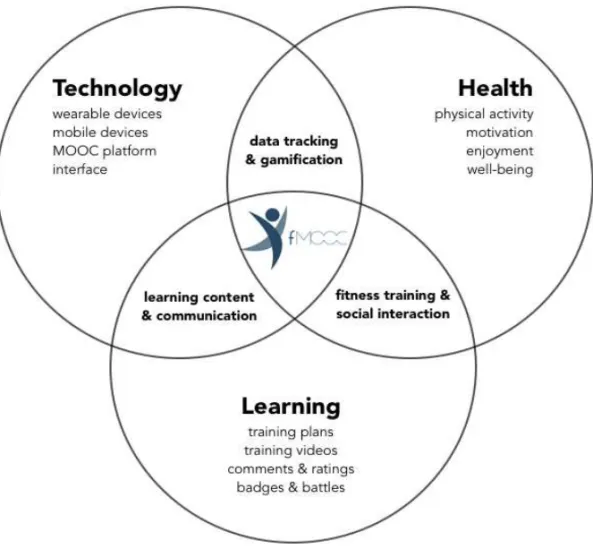
Fig. 1.. The fMOOC Framework - Wearable Enhanced Learning for Healthy Ageing
The three domains in the fMOOC are represented as three circular layers with overlapping areas representing specific, interdisciplinary R&D aspects (Fig. 1):
• Learning: The central element of the fMOOC is learning in a blended learning environment with online and offline components. The online components are embedded in the fMOOC platform and include digital content and online communication with other learners. The focus here is on developing digital content such as training plans and training videos, designing learner interactions, e.g. in form of comments or ratings, and gamification elements, e.g. badges and battles, with the aim of supporting seniors in developing healthy ageing skills and retaining physical practice as a daily routine. The offline components are embedded in the physical context of senior learners who engage in physical activities such as walking and strength training in real life. Offline components also include pre and post workshops for fMOOC participants. The two overlaps are with (a) the health layer as described above and with (b) the technology layer. The key research question in this area is: How to design and combine offline and online elements of the MOOC to enhance embodied learning experience promoting healthy ageing?
• Technology: The key element of the wearable enhanced learning environment is wearable and mobile technology which forms the backdrop of the fMOOC for senior users. The focus here is on the integration of wearable fitness trackers with mobile services for learning. One of the key developments in this area is the integration of fitness data from fitness trackers through an Application Programming Interface (API) with the fMOOC Learning Management System (LMS) and using the data to create a learning experience. The focus here is on the integration of the LMS Moodle as the backend system with the backend of the fitness trackers and developing an own mobile application as a senior-friendly user interface. The two overlaps here are with (a) the learning layer and (b) the health layer as described above. The key research question in this area is: How to integrate wearable devices with the LMS backend and the senior-friendly mobile interface for optimal user experience and user engagement?
The three fields with specific research questions form the basis for the evaluation of the fMOOC.
5 Architecture
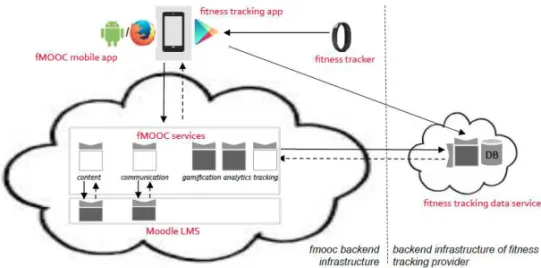
Fig. 2.Integrated fMOOC architecture
The fMOOC uses an own mobile application for user interface and the LMS Moodle as the backend system. The user interface has been implemented on the basis of the frameworks AngularJS and Bootstrap. Senior learners access fMOOC via the “fMOOC App” using any chosen device, e.g. laptop, tablet, smartphone. The fMOOC user interface is designed to be accessible for senior users making use of the key usability principles such as large fonts, high-contrast elements, clear labels and uniform navigation menus. The functionalities of the software are realised by a number of services. The content service connects to the Learning Management System (LMS) Moodle where the content, such as training plans and videos, is stored. The communication service also uses the communication facilities of the LMS Moodle.
Furthermore, a tracking service has been developed for the fMOOC which communicates with the backend of the fitness tracker and enables to integrate different fitness tracking devices into the fMOOC. The tracking service connects with the fitness tracking data service of the wearable devices to retrieve appropriate data such as the number of steps as measured by an activity tracker. The learning analytics module displays an overview of their fitness data to learners including the exercises of the training plans they have completed. This module makes use of the interactions data stored by Moodle and by the wearable devices. Finally the fMOOC software includes a gamification service to incorporate rewards and playful elements in the course including badges and battles.
For application in the fMOOC system it appeared necessary to obtain an individual view of the tracking data, independently of the existing evaluations of the tracking provider, and to integrate evaluations of tracking data in the fMOOC user interface. Therefore it was necessary to foresee a backend-side integration of the data service of the tracking provider for accessing raw tracking data and for making them available for evaluation in the fMOOC.
The second challenge we faced was the integration of the LMS Moodle. The requirements analysis showed that although Moodle enabled some key fMOOC functionalities, it restrained the intuitive usage and senior-friendly user interface. Therefore it was decided to develop a mobile fMOOC UI independent of Moodle and to integrate Moodle as a backend service, mainly for content management and communication of fMOOC participants. This strategy of using LMS Moodle as the backend system for MOOCs and combining it with an own interface have been already successfully implemented in other projects, such as the German MOOC plattform MOOIN which implemented LMS Moodle as backend for MOOCs. Some further requirement such as content creation, e.g. individual training plans for each user based on a common set of exercises for all users, seemed neither technically straightforward nor intuitive in Moodle. Therefore, software development in fMOOC included system components for complementing Moodle functionalities, including learning analytics. As Figure 2 shows, the fMOOC mobile UI communicates with a layer of fMOOC backend services, which are either realised by fMOOC specific components themselves or by delegating operation calls to Moodle services or the infrastructure of the tracking provider. For the mobile UI, however, this delegation of service realisation is not transparent. Hence, services might even be replaced by alternative realisations at a later stage, ensuring flexibility of the fMOOC architecture.
The fMOOC prototype has been developed following the user-centered design and agile development approaches. Specifically, the SCRUM methodology has been applied to design sprints in which specific functionalities have been developed in an interdisciplinary team and tested with senior users. A number of different user-tests have been applied in the process of design and development, including requirements elicitation, psychological tests, physical fitness test, A/B testing of mock-ups and iterative pre-tests of prototypes. The user study of the final prototype is planned for summer 2015 with two cohorts of 20 seniors followed by post-tests.
6 Conclusions
instructional design and methods of fitness training could not be discussed in this paper due to length restrictions. These and other designs will be tested in the fMOOC user study and provide empirical insights into potentials of wearable enhanced learning for healthy ageing.
References
1. Ajana B. Disembodiment and Cyberspace: A Phenomenological Approach Electronic Journal of Sociology (2005) ISSN: 1198 3655.
2. Akter, T., Kocak, S., & Fuat, N. ‘Looking Glass Self’ and Disembodiment in Virtual environment: Exploratory study of the Turkish Cypriot Facebook users and isolation from bodies.International Conference on Communciation, Media, technology and Design (ICCMTD), May 09-11, 2012. Istanbul, Turkey.
3. Bandura, A. (1977). Social Learning Theory. New York: General Learning Press.
4. Bircher J. (2005). Towards a dynamic definition of health and disease. Med. Health Care Philos, 8: 335-41.
5. Bowskill, J., & Dyer, N. (1999). Wearable Learning Tools. Association for Learning Technology Journal, 7(3), 44-51.
6. Buchem, I.; Klamma, R. & Wild, F. (2014). Special Interest Group on Wearable-technology Enhanced Learning (SIG WELL) of the European Association of Technology-Enhanced Learning (EA-TEL). Retrieved from: http://ea-tel.eu/special-interest-groups/well/
7. Buchem, I., Attwell, G., Torres, R. (2011). Understanding Personal Learning Environments: Literature review and synthesis through the Activity Theory lens. pp. 1-33. Proceedings of the The PLE Conference 2011, 10th – 12th July 2011, Southampton, UK.
8. Buchem, I. (2012). Psychological Ownership and Personal Learning Environments. Do possession and control really matter? Proceedings of the PLE Conference 2012, 12 July 2012, Aveiro, Portugal, ISSN: 2182-8229.
9. Buchem, I.; Pérez-Sanagustín, M. (2014). Personal Learning Environments in Smart Cities: Current Approaches and Future Scenarios. eLearning Papers, 35, November 2013.
10.Conn VS, Hafdahl AR, Brown LM. (2009). Meta-analysis of quality-of-life outcomes from physical activity interventions. Nurs Res., June: 58(3),175–183.
11.Csikszentmihalyi, M. (1996). Creativity: Flow and the Psychology of Discovery and Invention. HarperCollins Publishers.
12.Cohen, G. (2006). Research on creativity and aging: the positive impact of the arts on health and illness. Generations 30, 1: 7-15.
13.Cohen, G. D., Perlstein, S., Chapline, J., Kelly, J., Firth, K. M., & Simmens, S. (2006). The impact of professionally conducted cultural programs on the physical health, mental health, and social functioning of older adults. Gerontologist, 46, 726–734.
14.European Commission (2006). Healthy Ageing - A Challenge for Europe, The Swedish National Institute of Public Health, 29.
15.Fischer, G. (2004). Social creativity: turning barriers into opportunities for collaborative design. Paper presented at the Proceedings of the eighth conference on Participatory design: Artful integration: interweaving media, materials and practices - Volume 1.
16.Gibbs, R. W. Jr (2006). Embodiment and cognitive science. NY: Cambridge University Press.
17.Gibson, J. J. (1979). The ecological approach to visual perception. Boston, MA: Houghton Mifflin.
19.Lave, J. & Wenger, E. (1990). Situated Learning: Legitimate Peripheral Participation. Cambridge, UK: Cambridge University Press.
20.Law, I. & Widdows, H. (2007). Conceptualising health: Insights from the capability approach. Health Care Analysis. University of Birmingham.
21.Ledger, D.: McCaffrey, D. (2014). Inside Wearables How the Science of Human Behavior Change Offers the Secret to Long-Term Engagement. Endeavour Partners LLC.
22.Meier, B. P., Schnall, S., Schwarz, N., & Bargh, J. A. (2012). Embodiment in social psychology. Topics in Cognitive Science, 4(4), 705-716.
23.Miller, Patricia H. (2011). Theories of developmental psychology. New York: Worth Publishers.
24.Pérez-Sanagustín, M., Buchem, I., Kloos, D. C. (2013). Multi-channel, multi-objective, multi-context services: The glue of the smart cities learning ecosystem. In: Interaction Design and Architecture Journal (IxD&A), Special Issue on Smart City Learning - Visions and practical Implementations: toward Horizon 2020 edited by C. Giovannella & A. Martens, 16, 2013.
25.Pierce, J. L., Kostova, T., Dirks, K. (2001). Toward a theory of psychological ownership in organizations. Academy of Management Review, 26, 298–310.
26.Pierce, J. L., Kostova, T., Dirks, K. T. (2003). The state of psychological ownership: integrating and extending a century of research. Review of General Psychology, 7, 84–107. 27.Resnick, B. (2011). The Relationship between resilience and motivation. In: B. Resnick, L.
Gwyther, & K. A. Roberto (Eds.), Resilience in aging: Concepts, research, and outcomes, 199-215. New York: Springer.
28.Rodin, J. (1986). Ageing and health: Effects of the sense of control. Science, 233, 1271-1276.
29.Schraefel, M.C. & Churchill, E.F. (2014). Wellth Creation: Using Computer Science to support Proactive Health. Computer Magazine November 2014, IEEE, 70-72.
30.WHO (1946). Preamble to the Constitution of the World Health Organization as adopted by the International Health Conference, New York, 19-22 June 1946.
31.Torrance, P. E. (1993). Understanding Creativity: Where to Start? Psychological Inquiry, 4(3), 232-234.
32.Vygotsky, L.S. (1978). Mind in Society: The development of higher psychological processes. Cambridge, MA: Harvard University Press.
33.Uğur, S. (2013). A Design Practice on Emotional Embodiment Through Wearable Technology. In: Wearing Embodied Emotions SpringerBriefs in Applied Sciences and Technology 2013, pp 61-74
34.Weiser, M. (1991). The Computer for the 21st Century. Scientific American, 265(3), 94-104.
35.Wikstrom, B.M., Theorell, M. T., & Sandstrom, S. (1993). Medical health and emotional effects of art stimulation in old age: A controlled intervention study concerning the effects of visual stimulation provided in the form of pictures. Psychotherapy and Psychosomatics, 60 (3-4), 195-206.
36.Wikstrom, B. M. (2002). Social interaction associated with visual art discussions: A controlled intervention study. Ageing & Mental Health, 6(1), 82-87.