Fault Tolerance in Asynchronously Operated
Machines Allowing Temporary Violation of
Normal Specification
Jung–Min Yang and Seong Woo Kwak
Abstract—A novel scheme of fault tolerance for input/state asynchronous sequential machines is presented in this pa-per. The machine may undergo unauthorized state transitions caused by adversarial inputs. The considered faults have the feature of intermittency in their influences so that the adverse effect persists for some finite time after initial occurrence. Since strong fault tolerance is impossible, we define the notion of weak fault tolerance and propose a fault tolerant control law for which the closed-loop system recovers the nominal input/state behavior with a bounded delay. The existence condition and design procedure for a controller are addressed based on corrective control theory for asynchronous sequential machines. An illustrative example is provided for demonstrating the proposed fault tolerant control scheme.
Index Terms—asynchronous sequential machines, corrective control, state feedback, intermittent faults, fault tolerance.
I. Introduction
In this paper, we study the problem of fault tolerance for asynchronous sequential machines. Governed by no global synchronizing clock, asynchronous machines offer several advantages over synchronous machines such as fast response, low power consumption, less emission of electro-magnetic noise, etc [1]. On the other hand, asynchronous machines are more difficult to design than synchronous machines since we need to realize handshaking between the components of asynchronous machines in order to perform the necessary synchronization, communication, and sequencing of oper-ations. Thus, a majority of the previous studies on asyn-chronous machines were mainly about their design principles and related problems [1]–[3].
Our study takes an alternative view on asynchronous machines: a control theoretic technique to compensate the behavior of an existent asynchronous machine without resort to re-design of its inner logic. This scheme,corrective control
theory as it is often called, can be said to lay a novel
foundation on asynchronous machines, because it proves, both theoretically and experimentally, that the asynchronous machine is also controllable in a similar way to continuous-time systems in the framework of feedback control. Notice that the controlled behavior of an asynchronous machine
This work was supported by the National Research Foundation of Korea grant funded by the Korea government (MSIP) (No. NRF–2011–0027705), and in part by Basic Science Research Program through the National Research Foundation of Korea (NRF) funded by the Ministry of Education (No. NRF–2010–0007271).
J.–M. Yang is with the School of Electronics Engineering, Kyung-pook National University, Daegu, 702-701, Republic of Korea. E-mail: [email protected].
S. W. Kwak is with the Department of Electronic Engineering, Keimyung University, Daegu, 704-701, Republic of Korea. E-mail: [email protected] (corresponding author).
must be interpreted in the aspect of stable-state operations. In corrective control, the original definition of state transitions of a machine is intact, as the inner logic of the machine remains the same throughout the control algorithm. Instead, the controller accelerates the feedback trajectory to the limit—ideally, in zero time—in asynchronous mechanism so that any control procedure is completed instantaneously. Thus, the closed-loop system can show the desired behavior while the interaction between the system and the controller is unnoticeable.
For the past decade, corrective control has been success-fully applied to the problem of eliminating various defi-ciencies in the operation of asynchronous sequential ma-chines. [4]–[7] address the model matching problem for asyn-chronous machines with critical races. [8] presents dynamic feedback controllers for input/output asynchronous machines in which the information on the output values of the machine is unavailable to the controller. In [9] and [10], state feedback controllers are used to eliminate the effects of infinite cycles on asynchronous sequential machines. [11]–[14] develop corrective controllers for diagnosing and tolerating transient faults that cause a violation of state transition character-istics of asynchronous machines. [15] and [16] apply the foregoing theoretic results on asynchronous digital systems implemented in FPGA. In [17], a corrective controller is presented to realize model matching with the constraint that some external input characters are uncontrollable. A similar study with the application to error counters can be found in [18]. [19] and [20] present fault tolerant corrective control schemes for tolerating permanent faults occurring to input/output machines. Finally, [21] addresses identification and corrective control of asynchronous machines with un-specified transition parts based on an adaptive control law.
control scheme.
Since strong fault tolerance is infeasible in our setting, we propose the notion of weak fault tolerance, namely the closed-loop system recovers the normal input/state behavior within a bounded delay after fault occurrence. Note that [23], [24] present a similar subject, namely the system recovers from any fault within a bounded delay. But, as their studies are based on supervisory control of discrete-event systems [25], they cannot be applied to asynchronous machines. We propose a novel structure of corrective controllers that realize bounded-delay fault tolerance. To this end, analyses on stable reachability of the controlled machine are conducted to characterize the fault tolerance capability of the machine. Until accomplishing perfect input/state matching, the closed-loop system must endure some interval in which the normal specification of the machine’s behavior is violated. An illus-trative example is provided for demonstrating the proposed fault tolerant control scheme.
II. Notation andBasics
We represent an input/state asynchronous machine Σ as the following finite state machine:
Σ“ pA,X,x0,fq,
where A is the input set, X is the state set, x0 P X is the initial state, and f :XˆAÑXis the state transition function defined as a partial function ontoXˆA.Σoperates according to the recursion
xk`1“ fpxk,ukq, k“0,1,2, . . . ,
whereu0u1u2. . . is the input sequence and x0x1x2. . . is the state sequence generated byΣstarting from the initial state
x0. The step counter k advances by one upon a change of input or state.
A sate–input pairpx,uq PXˆAis valid if f is defined at
px,uq.px,uqis a stable combination if it is a fixed point of
f, i.e., if fpx,uq “ x. Σstays at px,uq indefinitely as long as the external input remains unchanged.px,uqis a transient combination if fpx,uq,x. Consider a case where Σis at a stable combination px,u1q
when the external input switches tou for whichpx,uqis a transient combination. This change gives rise to a chain of transient transitions
x1“fpx,uq, x2“fpx1,uq,
.. .
In asynchronous mechanism, Σpasses through the transient states x1,x2, . . . very quickly (in zero time, ideally). Assum-ing that no infinite cycles exist in the behavior ofΣ,Σreaches a stable state xk “ fpxk,uq. xk is termed the next stable state ofpx,uq[5]. Since the transient states underlying in the chain of transitions are unnoticeable, we properly exclude all transient states and express only the stable transition from a stable state to its next stable state. The stable recursion function
s:XˆAÑX
embodies all the stable transitions ofΣ. For a valid pairpx,uq,
spx,uqis defined as the next stable state ofpx,uq.sis often extended from input characters to sequences recursively: for
xPX andu1u2¨ ¨ ¨ukPA`, whereA` is the set of all non-empty strings of characters ofA,
spx,u1u2¨ ¨ ¨ukq:“spspx,u1q,u2¨ ¨ ¨ukq.
To include the set of intermittent faults, we partition the input setAinto two mutually exclusive subsets
A:“ANY9AT,
where AN is the normal input set and AT is the set of intermittent fault inputs. Suppose thatΣhas been staying at a stable combination px,uq PXˆAN, when an intermittent fault wPAT defined at the state x infiltrates intoΣ.Σ then undergoes an unauthorized state transition, namely its state is switched without any change of the external input. As the result of the fault occurrence, Σ will move to the deviated statespx,wq. For immediate fault tolerance,Σmust be driven to return to the original state x instantaneously after the fault occurrence, i.e., before further change of the external input. However, such an objective is impossible to achieve in this case, because the intermittent fault imposes a restraint that its adverse effect lasts for some finite time after initial occurrence. Thus even ifΣcould return to the original statex
right after the fault occurrence, it would experience another unauthorized transition tospx,wq.
Σ
C
v
u
x
w
x
Σ
cFig. 1. Corrective control system.
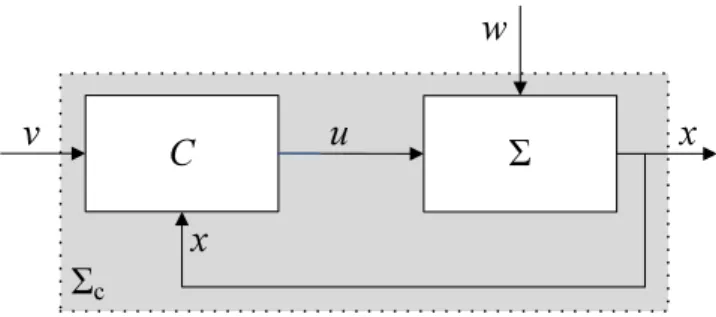
Fig. 1 is the structure of the corrective control system for an input/state asynchronous machine Σ, adapted from the former researches [5], [11]. C is the corrective controller that has the form of an input/output asynchronous sequential machine.vPAN is the external input,uPAN is the control input generated by C, and xPX is the state (or output) of Σ delivered to C as the state feedback. We denote by Σc the closed-loop system represented by the diagram. wPAT is the intermittent fault occurring to Σ. Complying with the feature of adversarial entities, we suppose thatw is neither observable nor disable by the controllerC. Upon occurrence,
woverrides the present value of u. Hence, the input toΣis determined as one of u andw whose value changes at the last.
the exact state at which the input change occurs, switching the input while a machine is in transitions may result in an unpredictable outcome.
To avoid such potential uncertainty, a common operating policy for asynchronous machines is to preserve the principle of fundamental mode operation [26], namely to prohibit changes to the input while a machine is in transition. Under this operating policy, input changes are allowed only when the machine is in a stable state. Then, the state of the machine at which the input change occurs is well defined, and, as a result, so is the effect of the input change on the response of the machine. Adopting the former studies on the system configuration [12], [21], we write the following condition for the closed-loop systemΣcof Fig. 1 to guarantee fundamental mode operation.
Condition 1. The closed-loop system Σc of Fig. 1 operates in fundamental mode when all the following conditions are valid:
i) Σ stays at a stable state while C undergoes transient transitions.
ii) C stays at a stable state while Σ undergoes transient transitions.
iii) The external input v and the intermittent fault w change only whenΣand C are both in stable states, and only one at a time.
Parts i) and ii) of Condition 1 must be implemented during the design of the controllerC; part iii) on the other hand, is a restriction on the operation of the closed-loop system Σc. We should expect that w, an independent adversarial entity, enters into Σ only when both Σ andC are at stable states. Nonetheless, as transitions of asynchronous machines occur very quickly, this assumption does not impose a burdensome requirement on the system.
III. StableReachability
The existence condition for a corrective controller de-pends on the stable reachability of the machine Σ. Given Σ“ pA,X,x0,fq, letX:“ tx1, . . . ,xnu.
Definition 1. Given Σ“ pA,X,x0,fqwith A “ ANY9AT, a
state xjPX is said to be stably reachable from xiPX if there
exists a string of nominal input characters t “v1v2¨ ¨ ¨vk P
A`
N such that spxi,tq “xj [5].
To quantify the stable reachability, we introduce a numer-ical matrix, called the skeleton matrix [5], as follows.
Definition 2. GivenΣ“ pA,X,x0,fqwith A“ANY9AT, the
one-step skeleton matrix K1pΣq is an nˆn matrix of zeros and ones with the entries
Ki,1jpΣq “
"
1 DvPAN s.t. xj“spxi,vq 0 else
@i,jP t1, . . . ,nu.
The skeleton matrix KpΣq is an nˆn matrix of zeros and ones with the entries
Ki,jpΣq “ "
1 DtPA`
N s.t. xj“spxi,tqand1ď |t| ďn´1 0 else
@i,jP t1, . . . ,nu,
where A`
N is the set that includes all nonempty strings of
characters of AN and|t|denotes the length of the string t.
Ki,j1pΣq “ 1 implies that xj can be reachable from xi by a unit input character inAN, whereasKi,jpΣq “1 represents that xj can be reachable fromxi by an input sequence, i.e., by multiple steps of stable transitions. Stable reachability is a crucial requirement for guaranteeing a corrective controller for asynchronous machines [5]. In elucidating stable reach-ability, it is sufficient to consider input strings whose length is less than or equal to n´1, where n is the cardinality of the state setX [5].
For a state xiPX, define R1pxiqandRpxiq as the sets of states that are one-step stably reachable and stably reachable fromxi, respectively. We can expressR1pxiqandRpxiqusing
K1pΣqand KpΣqas follows.
R1pxiq “ txjPX|Ki,j1pΣq “1u
Rpxiq “ txjPX|Ki,jpΣq “1u. Clearly,R1pxiq ĎRpxiqfor any state xi.
Lemma 1. For a state xi PX of Σ“ pA,X,x0,fq with the
state set X“ tx1, . . . ,xnu,
Rpxjq ĎRpxiq, @xjPRpxiq.
Proof: If xk PRpxjq, there exists an input string t1 PA
` N such thatspxj,t1q “xk. SincexjPRpxiq, there exists an input stringt2 PA
`
N such that spxi,t2q “xj. Then,spxi,t2t1q “xk wheret2t1 is the concatenation of t2 ant1. By definition, xk is stably reachable fromxi and we have xkPRpxiq. l Lemma 1 implies that the set of stably reachable states from the present state decreases asΣproceeds normal state transitions. In other words, the ranges of states that can be reached by Σ cannot be enlarged by state transitions. This property will be used in designing fault tolerant controllers later in this paper.
In a similar manner to the one-step skeleton matrixK1pΣq
with respect to the normal input set AN, we define the skeleton matrix with respect to the adversarial input setAT as follows.
Definition 3. GivenΣ“ pA,X,x0,fqwith A“ANY9AT, the
adversarial skeleton matrix KdpΣqis an nˆn matrix of zeros
and ones with the entries
Ki,djpΣq “
"
1 DwPAT s.t. xj“spxi,wqand i, j 0 else
@i,jP t1, . . . ,nu.
Kd
IV. ControllerDesign
Referring to Fig. 1, C has the following form of an input/output asynchronous machine:
C:“ pXˆAN,AN,Ξ, ξ0, φ, ηq,
whereXˆAN is the input set,AN is the output set,Ξis the state set,ξ0PΞis the initial state,
φ:ΞˆXˆANÑΞ is the state transition function, and
η:ΞÑAN
is the output function (assuming C is a Moore machine [26]). Since the information on the intermittent fault w is unavailable, C must conduct fault diagnosis and tolerance by observing the change of the state feedback x.
Cbegins with the initial stateξ0 in the first. Suppose that
Σ reaches a state xi for which there exists at least a state
xj with Ki,jdpΣq “ 1, i.e., an intermittent fault can occur to Σat xi.C then transfers to the transition state ξt. Since the intermittent fault may happen only whenΣis at a stable state,
C prepares possible occurrences of faults at the state ξt. To this end, set the recursion function φas
φpξ0,x,vq “ξt @px,vq P txiu ˆUpxiq φpξt,x,vq “ξt @px,vq P txiu ˆUpxiq
φpξ0,x,vq “ξ0 @px,vq PXˆANztxiu ˆUpxiq whereUpxiq ĂAN denotes the set of nominal input charac-ters that make a stable combination with xi. Since no actual control is executed at either ξ0 or ξt, C relays the present
external inputvto the control input channel u:
ηpξ0q “v,
ηpξtq “v.
Suppose further that while the external input remains unchanged, the state feedback is observed to switch from xi to xj. We deduce that an intermittent fault w has happened to Σ, causing the unauthorized transition to xj “ spxi,wq. Since immediate return to the original state xi is infeasible, Σmust endure temporary violation of the normal input/state specification by staying at the state xj. C waits for the subsequent change of the external input and determines the next control input according to the incoming external input and stable reachability of the states. The following definition of φ makes Σremain at the deviated state xj after the fault occurrence.
φpξt,xj,vq “ξt @xj s.t. Ki,jdpΣq “1,
wherevmeans that the present external input remains fixed. Recall that R1pxqandRpxqare the sets of the states that are stably reachable from a state xin one or more steps. The control behavior after the fault occurrence depends on the relation between R1px
iq and Rpxjq. First, consider the case of
R1pxiq ĎRpxjq. (1)
This means that every state that is stably reachable from xi in one-step is also stably reachable from xj. Hence, we can find a feedback trajectory from the deviated state xj to any
state that would be reached in response to the new external input. Suppose that the external input changes tov1
after Σ reaches xj by fault. Were it not for the occurrence of the intermittent fault, Σwould stay at the stable state xi and in response to the new external input v1
, would undergo the normal stable transition to spxi,v1q
:“xk. Since xkPR1pxiq,
xkPRpxjqandKj,kpΣq “1 by (1), and there exists a normal input string tj,k “ v1¨ ¨ ¨vm P AN` such that spxj,tj,kq “ xk. Usingtj,k, we can design a corrective controller module that takes Σ from xj to xk upon receiving the external input v1 [5], [8].
Since|tj,k| “m, the controllerC needsmauxiliary states, termedξ1, . . . , ξmPΞ. The correction procedure from xj to
xkis realized by the following recursive assignment ofφand η.
φpξt,xj,v1
q “ξ1 @v1PAs.t. spxi,v1q “xk ηpξhq “vh
φpξh,xh´1
,v1
q “ξh (2) φpξh,xh,v1
q “ξh`1
h“1, . . . ,m´1, where
xh“spxh´1,vhq,
x0:“xj, h“1, . . . ,m´1,
denote the intermediate stable states Σ passes through the feedback trajectory characterized bytj,k.
Atξm, finally,Σreaches the state xk, achieving the normal input/state specification with one step delay, i.e., after the external input changes once. C then returns to the initial stateξ0. To this end, we set
ηpξmq “vm φpξm,x,v1
q “ξm @x,xk (3) φpξm,xk,v1
q “ξ0.
Provided that condition (1) is held true, we can design a feedback trajectory for any other external input that will enter into the system right afterΣreaches the deviated state
xj.
Now suppose that condition (1) is not valid, i.e.,
R1pxiq*Rpxjq. (4)
Then, there exists a nonempty state set
Dpxi,xjq:“R1pxiqzRpxjq
whose members are stably reachable from xi but not from
xj. Continuing to use the foregoing notation, let v1 be the changed external input and let xk “ spxi,v1q be the state thatΣis supposed to move to in the normal behavior. IfxkP
To signify that the external input changes,C moves to the second transition stateξ1
t in response to v 1
, as follows.
φpξt,xj,v1
q “ξ1 t @v
1
PDpxi,xjq ηpξ1tq “vs
where vs PUpxjq is an input character that makes a stable combination with xj. Receivingvs,Σ maintains the present state xj.
The behavior of C at ξ1
t is similar to the case of the transition state ξt. Since Σ is supposed to stay at xk, the next input character will make a valid pair with xk and Σ would move to a state of R1pxkq if it had the normal behavior. If R1pxkq Ď Rpxjq, for every incoming input character, there exists a corrective controller module that takes Σ to the desired state. In particular, let v2
P AN be the changed input character, and let xl :“ spxk,v2q be the state that Σ is supposed to reach in the normal behavior. Since xlPR1pxkqandR1pxkq ĎRpxjq,xl is stably reachable from xj (Kj,lpΣq “1) and thus there exists an input string
tj,l:“r1r2¨ ¨ ¨rpPA ` N.
As |tj,l| “ p, C needs p more auxiliary states, termed ξ1
1, . . . , ξ
1
p P Ξ. In a similar fashion to (2), we design the control behavior initiating fromξ1
t as follows.
φpξt1,xj,v 2
q “ξ11 @v2
PAs.t. spxk,v2
q “xl ηpξ1
hq “rh φpξ1
h,z h´1,v2
q “ξ1
h (5)
φpξ1 h,z
h,v2
q “ξ1 h`1
h“1, . . . ,p´1, where
zh“spzh´1
,rhq,
z0:“xj, h“1, . . . ,p´1,
denote the intermediate stable states Σ passes through the feedback trajectory characterized by tj,l. Also adapting the foregoing assignment (2), we complete the controller design at the final stateξ1
p:
ηpξ1pq “rp φpξ1p,x,v
2
q “ξ1p @x,xl (6) φpξ1
p,xl,v 2
q “ξ0.
On the other hand, if R1px
kq * Rpxjq, it is possible that recovery to the normal input/state specification is not achievable if the changed input character v2
invokes the stable transition to a state that is stably reachable from
xk but not from xj. Then, like the former case, C must advance forward to the third transition state. Σ must again endure temporary violation of the normal behavior and will restart the correction procedure according to the next input character. In this way, the corrective controller C realizes fault tolerance against the intermittent fault with a bounded delay. As the steps of delay increase, so does the number of transition states ofC.
V. Example
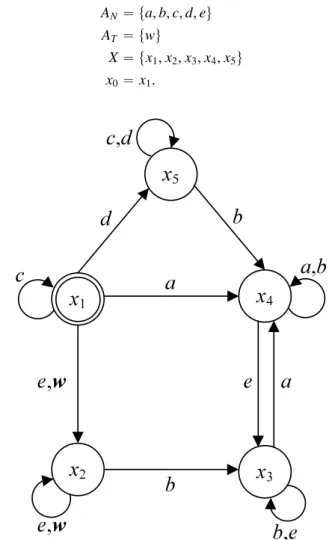
As an example instance, consider an input/state asyn-chronous machine Σ “ pA,X,x0,fq whose state flow dia-gram is shown in Fig. 2. For the simplicity’s sake, we set
fpx,uq “spx,uqfor all valid pair px,uq PXˆA.Σhas the following components:
AN“ ta,b,c,d,eu
AT “ twu
X“ tx1,x2,x3,x4,x5u
x0“x1.
c
x
1x
2x
3b
,
e
x
4a
,
b
x
5c
,
d
e
,
w
b
a
d
b
a
e
e
,
w
Fig. 2. State flow diagram ofΣ.
Referring to Fig. 2, we see that the intermittent faultwmay occur toΣwhen the machine stays at the stable combination
px1,cq. Whenever w infiltrates into Σ, Σ undergoes the
unauthorized state transition to spx1,wq “ x2. In order to
investigate whether there exists a corrective controller that realizes fault tolerance within a bounded delay, we first derive
R1px1qandRpx2qas
R1px1q “ tx1,x2,x4,x5u Rpx2q “ tx2,x3,x4u.
Since R1px1q * Rpx2q, one-step recovery to the normal
input/state behavior may not be successful depending on the next external input character. From R1px1q and Rpx2q, we
induce the difference set
Dpx1,x2q “R1px1qzRpx2q “ tx1,x5u.
We first select the control input sequences for the input characters ta,eu. Referring to Fig. 2, spx1,aq “ x4 and spx1,eq “x2. For each state pair, we select the control input
sequences as
x2Ñx2 ::t2,2“∅ x2Ñx4 ::t2,4“ba.
In the above strings, t2,2 “ ∅ implies that the corrective
controller executes no control action when it receives e. Note that the present state of the machineΣwill be x2after undergoing the unauthorized transition. As the present state
x2 complies with the normal input/state specification with respect to e, no additional correction procedure is required for e. The controller construction using the sequence t2,4
can be conducted based on the assignments (2) and (3). The discussion in the previous section leads us to that the controller C “ pXˆAN,AN,Ξ, ξ0, φ, ηq will involve the
states ξ0, ξt, ξ1, ξ2 for materializing the fault tolerant control
procedure up to this phase.
Secondly, consider the situation that after the occurrence ofw, the external input changes to one oftc,du. Specifically, assume that the external input changes tod. Then, in view of Fig. 2,Σshould go to spx1,dq “x5 if it were in the normal status. As analyzed before, x5 is not stably reachable from the present state x2. Hence, Σ must endure the temporary violation of the normal specification, whileC transfers from the transition state ξt to the second transition state ξ1
t. In Fig. 2, we know that
Rpx5q “ tx3,x4,x5u
in whichΣwill move tox4in response to the input character
b, and will stay at x5 if the input character switches to c
(‘switch to d’ is meaningless in the operation ofΣ because the previous character is identical to d). If the next input character becomes c, Σ must still endure violation of the normal specification by maintaining the present state. If, on the other hand, it changes to b, Σ is supposed to move to
x4. As x4 P Rpx2q, we can design a feedback path that
drives Σ from x2 to x4. In fact, we already elucidate that t2,4 “ ba can serve as the control input sequence that
can realize the feedback trajectory. In a similar fashion to the foregoing design,C needs two more auxiliary statesξ1
1
and ξ1
2 for this correction procedure. The detailed design
algorithm can be implemented using (5) and (6). Hence the proposed corrective controller achieves recovery to the normal input/state specification within two steps of input changes.
VI. Conclusion
A fault tolerant control methodology for asynchronous sequential machines has been presented in this paper. Since the considered adversarial entity is the intermittent fault, immediate recovery to the normal behavior is impossible. Instead, we have proposed a corrective control scheme that makes the closed-loop system recover the nominal specifica-tion of input/state behavior within a bounded delay. After a fault occurrence, the controller records the reference state that the machine must reach. According to the incoming input character, the controller provides an appropriate control input sequence for which the machine can reach the desired
state. Temporary violation of the normal specification must be endured for finite steps of input changes. The investigation on the controller existence has been demonstrated in a case study.
References
[1] J. Sparsø and S. Furber,Principles of Asynchronous Circuit Design — A Systems Perspective, Kluwer Academic Publishers, 2001.
[2] C. J. Myers,Asynchronous Circuit Design, New York: John Wiley & Sons, 2001.
[3] R. F. Tinder,Asynchronous Sequential Machine Design and Analysis, Morgan & Claypool Publishers, 2009.
[4] T. E. Murphy, X. Geng, and J. Hammer, “Controlling races in asyn-chronous sequential machines,” inProc. 15th IFAC World Congress, Barcelona, Jul. 2002.
[5] T. E. Murphy, X. Geng, and J. Hammer, “On the control of asyn-chronous machines with races,”IEEE Trans. Autom. Control, vol. 48, no. 6, pp. 1073–1081, 2003.
[6] J. Peng and J. Hammer, “Input/output control of asynchronous sequen-tial machines with races,”Int. J. Control, vol. 83, no. 1, pp. 125–144, 2010.
[7] J. Peng and J. Hammer, “Bursts and output feedback control of non-deterministic asynchronous sequential machines,”European J. Control, vol. 18, no. 3, pp. 286–300, 2012.
[8] X. Geng and J. Hammer, “Input/output control of asynchronous sequen-tial machines,”IEEE Trans. Autom. Control, vol. 50, no. 12, pp. 1956– 1970, 2005.
[9] N. Venkatraman and J. Hammer, “Stable realizations of asynchronous sequential machines with infinite cycles,” inProc. 2006 Asian Control Conf., Bali, Indonesia, pp. 45-51, 2006.
[10] N. Venkatraman and J. Hammer, “On the control of asynchronous sequential machines with infinite cycles,”Int. J. Control, vol. 79, no. 7, pp. 764–785, 2006.
[11] J.–M. Yang, “Corrective control of asynchronous sequential machines in the presence of adversarial input,”IET Control Theory Appl., vol. 2, no. 8, pp. 706–716, 2008.
[12] J.–M. Yang and J. Hammer, “State feedback control of asynchronous sequential machines with adversarial inputs,”Int. J. Control, vol. 81, no. 12, pp. 1910-1929, 2008.
[13] J.–M. Yang, “Corrective control of input/output asynchronous sequen-tial machines with adversarial inputs,” IEEE Trans. Autom. Control, vol. 55, no. 3, pp. 755–761, 2010.
[14] J.–M. Yang and J. Hammer, “Asynchronous sequential machines with adversarial intervention: the use of bursts,”Int. J. Control, vol. 83, no. 5, pp. 956–969, 2010.
[15] J.–M. Yang and S. W. Kwak, “Realizing fault-tolerant asynchronous sequential machines using corrective control,”IEEE Trans. Control Syst. Technol., vol. 18, no. 6, pp. 1457–1463, 2010.
[16] J.–M. Yang and S. W. Kwak, “Model matching for asynchronous sequential machines with adversarial inputs using state bursts,”Int. J. Control, Autom., Syst., vol. 8, no. 5, pp. 985–993, 2010.
[17] J.–M. Yang and S. W. Kwak, “Model matching for asynchronous sequential machines with uncontrollable inputs,”IEEE Trans. Autom. Control, vol. 56, no. 9, pp. 2140–2145, 2011.
[18] J.–M. Yang and S. W. Kwak, “Corrective control of asynchronous machines with uncontrollable inputs: application to single-event-upset error counters,” IET Control Theory Appl., vol. 4, no. 11, pp. 2454– 2462, 2010.
[19] J.–M. Yang, “Fault tolerance in asynchronous sequential machines using output feedback control,”IEEE Trans. Autom. Control, vol. 57, no. 6, pp. 1604–1609, 2012.
[20] J.–M. Yang and S. W. Kwak, “Fault diagnosis and fault-tolerant control of input/output asynchronous sequential machines,”IET Control Theory Appl., vol. 6, no. 11, pp. 1682–1689, 2012.
[21] J.–M. Yang, T. Xing, and J. Hammer, “Adaptive control of asyn-chronous sequential machines with state feedback,”European J. Con-trol, vol. 18, no. 6, pp. 503–527, 2012.
[22] C. M. Krishina and K. G. Shin, Real-Time Systems, New York: McGraw-Hill, 1997.
[23] C. M. ¨Ozveren, A. S. Willsky, and P. J. Antsaklis, “Stability and stabilizability of discrete event dynamical systems,”J. ACM, vol. 38, no. 3, pp. 730–752, 1991.
[24] Q. Wen, R. Kumar, J. Huang, and H. Liu, “A framework for fault-tolerant control of discrete event systems,”IEEE Trans. Autom. Control, vol. 53, no. 8, pp. 1839–1849, 2003.
[25] C. G. Cassandras and S. Lafortune, Introduction to Discrete Event Systems. Norwell, MA: Kluwer, 1999.