57
[Notes from the Field]
An International Workshop on Lake Hövsgöl Area Ecosystem Modeling
Bazartseren Boldgiv
1and Clyde E. Goulden
21Department of Biology, University of Pennsylvania, Philadelphia, PA 19104-4207, USA,
Present address: Department of Ecology, National University of Mongolia, Ulaanbaatar 210646, Mongolia, E-mail: [email protected]
2Hövsgöl GEF/WB Project, Geo-Ecology Institute-301, Baruun Selbe-13, Ulaanbaatar 211238, Mongolia and
the Institute for Mongolian Biodiversity and Ecological Studies, Academy of Natural Sciences of Philadelphia, 1900 Benjamin Franklin Parkway, Philadelphia, PA 19103, USA,
E-mail: [email protected]
Introduction
A ten-day international workshop on Lake Hövsgöl area ecosystem modeling was held at Hustai National Park May 14 - May 23, 2006. The workshop was organized by and for the Dynam-ics of Biodiversity Loss and Permafrost Melt in Lake Hövsgöl National Park, Mongolia Project (hereafter Hövsgöl GEF/WB Project, http://www. hovsgolecology.org) with the aim to develop a functional ecosystem model that can be used for addressing research and management questions studied by the project. The goal of the Hövsgöl GEF/WB Project is to identify impacts of climate change, permafrost dynamics, grazing and for-est cutting on the ecosystem dynamics, including forest, steppe, riparian zones and streams, and to determine the sustainable resource use practices. The Hövsgöl GEF/WB Project conducts its re-search in six stream valleys at the northeastern corner of Lake Hövsgöl National Park. It is the
fi rst program for the Mongolian Long Term Eco-logical Research (MLTER) Network.
In a modeling effort, relationships among components of the ecological system need to be found by statistical analyses of data. Then, the system components and their relationships can be brought together with simplifying assumptions about the ecosystem to develop an integrated eco-system model. The Hövsgöl GEF/WB Project has placed a great deal of emphasis on appropriate ex-perimental design and statistical analysis in all its research efforts. Developing an ecosystem model was the next logical step not only for scientifi c and management purposes, but also for evaluat-ing potential consequences of future management policy changes and possibly predicting environ-mental changes that will have signifi cant impact on local and national economy.
During the workshop, scientists and experts from national and international institutions worked together to develop an ecosystem model consist-ing of an array of submodels that would facilitate our understanding of the ecosystem function. This workshop was the second half (Phase II) of a two-phase ecosystem modeling workshop organized by the Hövsgöl GEF/WB Project. Phase I was held as a one-week model formulation workshop in April 2005. In these two phases of the workshop, Hövs-göl GEF/WB Project researchers worked through a 16-step modeling process starting from model-ing issues, identifymodel-ing key factors (a.k.a. system drivers), determining spatial and temporal resolu-tions, identifying system performance indicators, and formulating conceptual models in Phase I to submodel designs and development; then in Phase II testing submodels as stand-alone models, and synthesis of submodels based on an information
fl ow matrix defi ning interactions among model compartments.
Participants. The main forces in the workshop
were all Hövsgöl GEF/WB Project researchers. The workshop was coordinated and run by Dr. Martyn Murray, Director of MGM Environmen-tal Solutions Ltd., Edinburgh, Scotland, UK and Dr. Julian F. Derry, Research Fellow at the School of Biological Sciences, University of Edinburgh, Edinburgh, Scotland, UK. Dr. Anthony Whit-ten (Biodiversity Specialist of the World Bank) and the Hövsgöl GEF/WB Project Director Dr. J. Tsogtbaatar (Director of Geoecology Institute, Mongolian Academy of Sciences) were present. Managerial supports for organizing the workshop were provided by Munhtuya Goulden. Other inter-national advisors on model development included Dr. Clyde E. Goulden (International Consultant for the Hövsgöl GEF/WB Project and Director of Institute for Mongolian Biodiversity and
Boldgiv & Goulden. Hovsgol Ecosystem Modeling
58
logical Studies, Academy of Natural Sciences of Philadelphia, USA), Dr. Jayne Belnap (Research Ecologist, Biological Resources Division, United States Geological Survey, Moab Utah, USA), Dr. Ingrid Burke (Professor, Department of Forest, Rangeland and Watershed Stewardship, Colorado State University, Ft. Collins, Colorado, USA), Dr. Scott Greene (Assistant Professor and Associate Director of Environmental Verifi cation and Anal-ysis Center, College of Geosciences, Department of Geography, University of Oklahoma, Norman, Oklahoma, USA), Dr. Michael L. Jones (Professor, Department of Fisheries and Wildlife, Michigan State University, East Lansing, Michigan, USA), Dr. William K. Lauenroth (Professor, Department of Rangeland Ecosystem Sciences, Colorado State University, Fort Collins, CO, USA), Derek Ludlow (Management School and Economics, University of Edinburgh, Edinburgh, Scotland, UK), Dr. Michael W. Sears (Assistant Professor, Department of Zoology, Southern Illinois Univer-sity, Carbondale, Illinois, USA) and Bazartseren Boldgiv (Department of Biology, University of Pennsylvania, Philadelphia, PA, USA).
Representatives from different academic in-stitutions in Mongolia, such as the Ecology De-partment of the National University of Mongolia, Hustai National Park, Geoecology Institute, tute of Biology, Institute of Geography and Insti-tute of Hydrometeorology also contributed to and benefi ted from the workshop.
Preliminary outcome of the workshop.
Partici-pants agreed on the following main purposes of the model:
a. to assess the effect of environmental change (whether arising from climate, management ac-tions, policy directions or external human infl u-ence) on biodiversity, habitat and water quality, and ecosystem stability within the six valleys of Lake Hövsgöl;
b. to assess the effect of environmental change in the six valleys of Lake Hövsgöl as a World Her-itage site;
c. to assist in the development of sustainable solutions for natural resource use; and
d. to assist in understanding the dynamics of the ecosystem.
Although modeling is not a new concept for Mongolian researchers, many academics and pro-fessors lack suffi cient knowledge about modeling concepts and their importance in ecological re-search. As such, ecology programs in this country
do not have an acceptable level of introduction to ecological modeling in their curriculum. There-fore, the workshop had to inherently include a training component, even though the development of a working model was the targeted outcome. In this context, programming and simulation of mod-els in MS Excel and Visual Basic environments were demonstrated. They were important exercis-es as they illustrated that ecological procexercis-essexercis-es are dynamic by nature, not static snapshots in time. Choice of model implementation software is also an important consideration in modeling effort. At the outset of Phase II, it was decided that using Visual Basic was the best approach due to its ac-cessibility and its less steep learning curve.
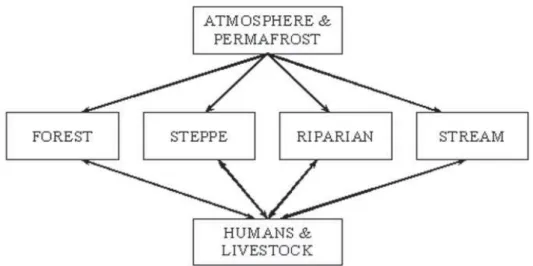
The 2005 Phase I of the workshop was devoted to introducing modeling concepts to the Hövsgöl GEF/WB Project researchers and to developing conceptual maps of interactions. As a result, the overall “box-and-arrow” model for the Hövsgöl ecosystem was constructed, submodels for each ecosystem compartment were defi ned, data were revisited, data gaps identifi ed and some of the di-rections for the 2005 fi eld season were determined to fi ll in the gaps and to further our understanding about the system. Six main compartments of the Hövsgöl area ecosystem were identifi ed by habi-tat during Phase I, and this ecosystem partitioning was kept in Phase II (Figure 1). In this conceptual model, the atmosphere and permafrost compart-ment and the human and livestock compartcompart-ment affect, and are affected by, all habitats. For ex-ample, the weight gained by livestock depends on time spent in terrestrial habitats and biomass available, which in turn is dependent on other environmental factors, such as weather and soil characteristics.
Sub-model teams worked on formal submodel constructions under the direction of external sci-entists: a submodel on climate and permafrost (Dr. Scott Greene), submodel on forest, steppe, and riparian systems (Drs. Ingrid Burke and Wil-liam Lauenroth), submodel on land use of herders and livestock (Drs. Martyn Murray and Michael Sears), and submodel on stream systems (Dr. Mi-chael Jones). All these submodels included a ma-trix of simultaneously interacting models (Figure 2). For example, the stream compartment of the ecosystem model included fi sh population size,
taxa) bioindication model and so on.
Although some parts of the model, such as net primary productivity and human population dy-namics needed to be on a seasonal or annual basis, it was decided that the model should be developed for a single generalized valley in a spatially-im-plicit fashion with mostly daily temporal resolu-tion. Once modeling of such a generalized valley
is done, it is possible to defi ne any of the six val-leys by simply changing model parameters and variables and to validate the model against data. At the end of the workshop, submodels for eco-system components were developed. Some of the models were tested against data, e.g.: the model predicting soil thawing depth, and the model us-ing diatom species for water quality indicators by
Figure 1. Main compartments and their linkages in the Hövsgöl ecosystem model.
Figure 2. An example of data pathways connecting separate components of the Hövsgöl ecosystem model. Arrows indicate the direction of effects and grey arrows indicate external sources that are not included in this
particular example.
Livestock
Fish population size
Runoff Herbivory
Litter
Atmospheric data
Gypsy moths
Air tem
pe ratu
re
Plant biomass
Soil organic carbon Soil
temperature
Active layer depth
Soil moisture
Grasshopper
Daily temp erature Annua
l preci pitation
& tem peratu
re
Boldgiv & Goulden. Hovsgol Ecosystem Modeling
60
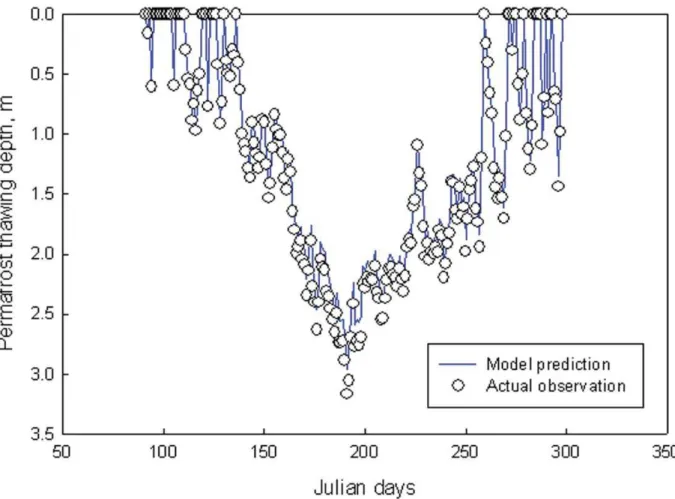
training an artifi cial neural network, appeared to work remarkably well based on data-validation. Soil thawing depth was predicted from three main variables (soil bulk density, soil moisture and air temperature) and other variables derived from
the three. Actual data and model-predicted values were almost perfectly correlated (Figure 3).
Incorporating permafrost dynamics in the Hövsgöl ecosystem model was important. Effects of permafrost dynamics, while scientifi cally
inter-esting, were shown to have a great deal of impli-cation on management of the area. In the model, permafrost was not only one of the system driv-ers, but also one of the system performance indi-cators. Permafrost condition is affected not only by climate change, but also by land use practices such as grazing pressure and herd composition. Permafrost degradation in turn has adverse effect on biodiversity and primary productivity of the area as it leads to overall soil moisture loss. Such a negative feedback of permafrost on carrying ca-pacity and biodiversity via intermediate mecha-nisms requires more attention if conservation and sustainable use of natural resources are the long term goal for the region (especially if Lake Hövs-göl is to be considered as a World Heritage site).
To conclude, all the submodels were developed and fully coded. Unfortunately, there were some issues that became apparent in the programming stage of the Hövsgöl ecosystem model when in-terfacing these submodels together. The problems arose due to disparity between submodels, such as inconsistency in temporal resolutions, difference in measurement units, and data gaps. Although these problems were suffi cient enough to slow down the programming progress, they are not fa-tal to development of the overall ecosystem model and can be solved with some targeted effort. Given the success of submodels and great deal of prog-ress made during Phase II, we do expect that the ecosystem model will be fully developed and used for research, as well as for management purposes.
Support. The workshop was made possible by the generous support of the Environmental Re-form in Mongolia (Trust Fund 054416) provided by the Ministry for Development Cooperation of the Netherlands to the Hövsgöl GEF/WB Proj-ect and the Scientifi c Exchanges for Cooperative Research in Long Term Ecological Research in Mongolia by the Trust for Mutual Understanding granted to Clyde E. Goulden.
Acknowledgments
We would like to thank all the “external” sci-entists who provided their expertise and worked hard to achieve the fully functional ecosystem model. We are indebted to people who worked hard to organize this workshop and make it suc-cessful. Thanks also go to all the staff at Hustai National Park for their hospitality.