CPD
3, 1021–1035, 2007Solar minima and coral carbon isotopes
T. Ourbak et al.
Title Page
Abstract Introduction
Conclusions References
Tables Figures
◭ ◮
◭ ◮
Back Close
Full Screen / Esc
Printer-friendly Version
Interactive Discussion
EGU
Clim. Past Discuss., 3, 1021–1035, 2007 www.clim-past-discuss.net/3/1021/2007/ © Author(s) 2007. This work is licensed under a Creative Commons License.
Climate of the Past Discussions
Climate of the Past Discussionsis the access reviewed discussion forum ofClimate of the Past
Potential imprint of Sp ¨orer and Maunder
solar minima on coral skeleton carbon
isotopes
T. Ourbak1,2,*, B. Malaiz ´e1, and T. Corr `ege1,2
1
Universit ´e Bordeaux 1, UMR CNRS 5805 EPOC, Avenue des facult ´es, 33405 Talence cedex, France
2
UR055 Paleotropique, Institut de Recherche pour le d ´eveloppement (IRD), 32 avenue Henri Varagnat, 93143 Bondy cedex, France
*
now at: College of Marine Science, University of South Florida, 140 7 Avenue South, St. Petersburg, Fl 33701, USA
Received: 6 September 2007 – Accepted: 18 September 2007 – Published: 27 September 2007
CPD
3, 1021–1035, 2007Solar minima and coral carbon isotopes
T. Ourbak et al.
Title Page
Abstract Introduction
Conclusions References
Tables Figures
◭ ◮
◭ ◮
Back Close
Full Screen / Esc
Printer-friendly Version
Interactive Discussion
EGU
Abstract
Despite being routinely measured with δ18O in corals, records of δ13C are seldom
presented in paleoceanographic studies. Numerous factors influence the biologically-mediated fractionation of carbon isotopes during skeletogenesis, resulting in a complex behaviour of this tracer. Here we present a long coralδ13C series, dating back to 1475,
5
and showing the potential impact of solar activity. We note a significant decrease of
δ13C during the Sp ¨orer and Maunder minima. We argue for a change in metabolical
processes, from an autotrophical pattern to a more heterotrophical mode of feeding guided by change in sun irradiation. In addition, nearby volcanic eruptions might also have an impact and causeδ13C shifts, depending on the dust load associated with the
10
eruption. Following previous work, we advocate the systematic presentation ofδ13C vs. δ18O plots in coral studies to identify whether isotopic fractionation might have
been affected by change in mode of feeding.
1 Introduction
Aragonite deposited by hermatypic corals is usually depleted in13C relative to ambient 15
seawater as a result of kinetic and metabolic fractionation (Kieth and Weber 1965). Despite numerous field and laboratory investigations over the years, variations of coral
δ13C is still difficult to interpret, chiefly because it is influenced by complex physiological
and environmental parameters. Photosynthetic activity of zooxanthellae and respira-tion (Swart 1983; McConnaughey 1989), level of zooplankton availability (Reynaud-20
Vaganay et al., 2001; Grottoli 2002), insolation (Swart et al., 1996), cloud cover (Fair-banks and Dodge, 1979), spawning (Gagan et al., 1994), plankton blooms (Felis et al., 1998) or depth (Carriquiry et al., 1994) may be responsible forδ13C change in corals. In addition the thermo-dependence of carbon isotopes partitioning between solution and solid should also be taken into account (Fairbanks and Dodge, 1979).
25
CPD
3, 1021–1035, 2007Solar minima and coral carbon isotopes
T. Ourbak et al.
Title Page
Abstract Introduction
Conclusions References
Tables Figures
◭ ◮
◭ ◮
Back Close
Full Screen / Esc
Printer-friendly Version
Interactive Discussion
EGU
ways. δ13C is affected by the two principal feeding modes of the animal: capture of
zooplankton by polyps (heterotrophic process) and receipt of photosynthetic products from the endosymbiotic algae, i.e. the zooxanthellae (autotrophic process).
Concerning heterotrophy, we will follow the hypothesis that ingestion of zooplankton decreaseδ13C values in coral skeleton because zooplankton has depletedδ13C values
5
(typically−15 to−25‰ Rau et al., 1990; Grottoli, 2002).
Autotrophy is related to photosynthesis activity, a light-driven metabolic reaction that causes isotopic fractionation via zooxanthellae. It has been shown that carbon isotopes in corals were strongly influenced by solar irradiance levels (McConnaughey, 1989; Mc-Connaughey et al., 1997; Boiseau et al., 1998; Reynaud-Vaganay et al., 2001). The 10
more important the photosynthetic activity is the more12C will be used by zooxanthel-lae. Consequently, the more13C (relative to 12C) will be available for calcification and the more positive theδ13C might be recorded in coral skeleton. The hypothesis
de-scribed above is widely accepted (Swart, 1983; McConnaughey, 1989; Grottoli, 2000), but the complexity lies in the fact that numerous factors can affect light availability. 15
Thus, on top of processes occurring in the atmosphere, water depth (Carriquiry et al., 1994), turbidity (Anthony and Fabricius, 2000) or coral topography (Cohen and Hart, 1997) could influence carbon uptake.
Past studies on coralδ13C dealt with daily (Weber and Woodhead, 1971) to seasonal
variation (Swart et al., 1996) in light level, but no record was long enough to study the 20
possible effect of long-term solar variations. We propose to test the relative influence of past solar variability over a long continuous record ofδ13C beginning circa 1475.
2 Study area, material and methods
The studied coral comes from Ile des Pins (22.3◦S, 167.2◦E), the southernmost island of New-Caledonia, in the southwest Pacific Ocean. Large coral heads and relatively 25
CPD
3, 1021–1035, 2007Solar minima and coral carbon isotopes
T. Ourbak et al.
Title Page
Abstract Introduction
Conclusions References
Tables Figures
◭ ◮
◭ ◮
Back Close
Full Screen / Esc
Printer-friendly Version
Interactive Discussion
EGU
1998; Corr `ege et al., 2001; Ourbak et al., 2006).
A 7 m high massivePoritescoral was sampled in August 1999 and February 2003 on Ile des Pins reef. The core recovered in 2003 was primarily used to sample the years necessary to calibrate coral data against local environmental parameters. Chronol-ogy of the longest core was established by growth bands counting on X-radiographs, 5
which also helped to choose the optimal sampling transects. Coral skeleton powder was recovered at quasi-monthly resolution for calibration purpose over 6 years, then 2 samples per year were extracted for the whole core. Analyses were conducted on a Micromass Optima isotope ratio mass spectrometer at UMR 5805 EPOC (Universit ´e Bordeaux 1). All values are reported in standard delta notation relative to the VPDB 10
isotopic standard using the conventional notation. Precision calculated for 373 repli-cates of NBS 19 international standard was better than 0.05‰ forδ13C and 0.07‰ for
δ18O (1σ).
3 Results and discussion
3.1 Modern behaviour 15
Figure 1 shows six years ofδ18O andδ13C record, together with daily solar irradiance
measured since 1996 at Mou ´e, less than 10 kilometres from the coring site. Chronol-ogy was established usingδ18O record for which clear annual variations mainly driven
by change in sea surface temperature and salinity are visible. Both solar radiation and
δ13C reveal the same seasonal-shaped pattern, although some discrepancies are vis-20
ible (Fig. 1). Table 1 presents correlation coefficients (r) between the data, including SST. For example, regression betweenδ13C and solar irradiation yields a correlation
coefficient (r) of 0.54 (n=74; p<0.001), denoting a significant relationship between so-lar activity and carbon isotope signal in coral skeleton. One has to keep in mind that the annual cycle inflates the correlation between the two series (computed anomalies 25
influ-CPD
3, 1021–1035, 2007Solar minima and coral carbon isotopes
T. Ourbak et al.
Title Page
Abstract Introduction
Conclusions References
Tables Figures
◭ ◮
◭ ◮
Back Close
Full Screen / Esc
Printer-friendly Version
Interactive Discussion
EGU
ence C incorporation. Nevertheless, this result confirms previous studies (Boiseau et al., 1998, among others) and indicates that this New Caledonia coral has the potential to bring information on past solar activity.
3.2 Paleoclimatic interpretations
3.2.1 Long trend 5
Raw δ13C measurements ranged from −3.43‰ to 0.67‰ with a mean of −1.17‰.
Figure 2 presents δ13C variations along the core together with reconstructed solar
irradiance from Bard et al. (2000) and Lean et al. (1995) together with aδ13C record
form Amedee Island (Quinn et al., 1998).
The first striking feature is the relationship between centennial increase of solar ir-10
radiance (∼1.13 W.m2/century) and long termδ13C increase between 1475 and about 1860 (∼0.18‰ /century). Then, one can see a ∼0.7‰ decrease of the δ13C signal which could be a coral response to the isotopically light carbon from CO2 added to the atmosphere from fossil fuel burning (oceanic Suess effect). This decrease is ex-pected from the Suess effect in the subtropical surface ocean (∼0.8‰ Gruber et al.,
15
1999). Similar decreases are reported in New Caledonia after the pre industrial period, ∼0.9‰ is recorded in a nearbyPoritescoral from Amedee lighthouse (22.3◦S, 166.3◦E (Quinn et al., 1998), Fig. 2 and discussion below) and in a demosponge at Touho, on the other side of New Caledonia main island (20.4◦S, 165.1◦E, Bohm et al., 1996). In addition, the Suess effect has also been recorded in Australian coral (17.5◦
S, 148.3◦ E, 20
Pelejero et al., 2005) and in a coralline sponge from Vanuatu (13.8◦
S, 167.5◦
E, Fallon et al., 2003) arguing for a regionalδ13C signal.
Early marine diagenesis could complicate the interpretation of the δ13C record in corals, especially when dealing with Suess effect (M ¨uller et al., 2004) but SEM images and XRD (not shown here), together with geochemical cross-plot ofδ13C vs. δ18O
25
CPD
3, 1021–1035, 2007Solar minima and coral carbon isotopes
T. Ourbak et al.
Title Page
Abstract Introduction
Conclusions References
Tables Figures
◭ ◮
◭ ◮
Back Close
Full Screen / Esc
Printer-friendly Version
Interactive Discussion
EGU
3.2.2 Centennial event.
We find on Fig. 2 a first broad negativeδ13C peak near 1515 (0.78‰ from the mean)
and a second one (0.94‰ from the mean) at the beginning of the 1650’s. These peaks are situated at changeover from solar maxima to solar minima. The lowδ13C
values in the coral skeleton might have been driven by low solar activity periods such 5
as the Sp ¨orer minimum (which lasted from about 1420 to 1570 AD) and the Maunder minimum (1645–1715), knowing that insolation is one of the main factors controlling photosynthesis.
We propose that, because of insufficient light availability, metabolic processes changed from an autotrophical driven pattern into a more heterotrophical driven pat-10
tern, decreasingδ13C value. However, we note that the Dalton minimum (1800–1820),
which was a shorter and less significant period of lower solar activity, has a less marked
δ13C signature in our coral record. In theory,δ13C values might have stayed low
dur-ing the entire Sp ¨orer and Maunder minima, if metabolic processes had remained the same. Instead, in Fig. 2, δ13C signature shows a gradual change to more positive
15
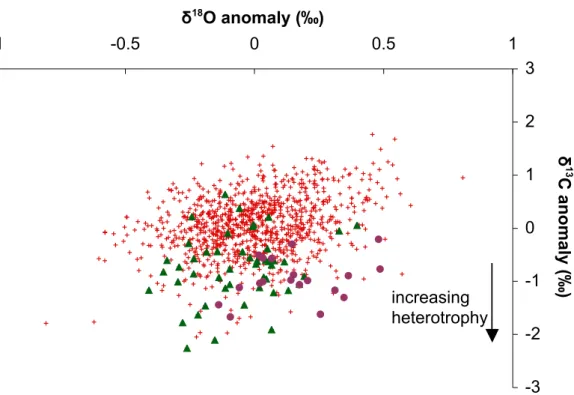
values, arguing for a recovery to more classical conditions of feeding for our coral. To differentiate the preferential metabolic processes, one can plotδ13C againstδ18O
(Fig. 3). According to McConnaughey’s model (McConnaughey 1989) metabolic pro-cesses shift values along the carbon axis, independent of oxygen. Therefore, quasi-systematic shifts toward more negative values ofδ13C corresponding to solar minima
20
denote increase of heterotrophy (Fig. 3). Following this method, Risk et al. (2003) showed a specificδ13C vs. δ18O signature of ‘haze’ events on Indonesian corals pro-duced by wildfires during an intense El Ni ˜no event. Figure 3 confirms that minima in solar activity had an impact on coral mode of feeding. Quantitatively, the mean value for Sp ¨orer and Maunder minima (as presented on Fig. 3) are 0.66 and 0.72‰ far from 25
theδ13C mean while they are only 0.06 and 0.12‰ far from theδ18O mean.
CPD
3, 1021–1035, 2007Solar minima and coral carbon isotopes
T. Ourbak et al.
Title Page
Abstract Introduction
Conclusions References
Tables Figures
◭ ◮
◭ ◮
Back Close
Full Screen / Esc
Printer-friendly Version
Interactive Discussion
EGU
MTM cross spectrum (Ghil et al., 2002) conducted over detrended, normalised (re-move the mean and divided by standard deviation over the common 1658–1992 pe-riod) Amedee and Ile des Pins δ13C series have been conducted. Analyses show
that the two series share common periodicities centred on 32, 21 and 15 years (at the 90% interval confidence). In addition, Ile des Pins serie shows 11.6 and a broad 5
60–100 year peaks. This exercise confirms the potentiality for this core to record the Schwabe (11 years), Hale (22 years), and Gleissberg (70–100 years) solar cycles, in addition to other frequencies. The reason why the two coral records do not show the same exact answer to common forcing is not clear. Difference in chronology could be part of the answer. Moreover, it has been shown that over twoδ13C corals records from
10
Nauru, western tropical Pacific, only one could reflect light level variability (Guilderson and Schrag, 1999). δ13C signals in corals have also shown less reproducible
pat-terns than oxygen isotopes or elemental ratios (Guilderson and Schrag, 1999; DeLong et al. 2007). Nevertheless, on a same colony mean δ13C value is not significantly changed by sampling resolution (forthnightly to seasonal sampling) or the site of the 15
slice chosen (DeLong et al., 2007). Moreover, the date of settlement of the Amedee coral in 1657 is just after the lowestδ13C value of our record for the Maunder minima and one could argue that the nubbin settlement has been facilitated after a period of relative low light availability and a return to more classical conditions.
3.2.3 Rapid events 20
In addition to the low frequency changes in δ13C at Ile des Pins, short-term events are visible (Fig. 2). We note particularly lightδ13C values in 1590, 1815, 1895, 1925
and 1949. A comparison with Volcanic Eruption Index of tropical events (Smithsonian Catalogue (Simkin and Sibert 1994)) shows a nice fit with these periods. Eruptions in Vanuatu and Indonesia in the years preceding 1590, the Tambora (1815 Indonesia) and 25
CPD
3, 1021–1035, 2007Solar minima and coral carbon isotopes
T. Ourbak et al.
Title Page
Abstract Introduction
Conclusions References
Tables Figures
◭ ◮
◭ ◮
Back Close
Full Screen / Esc
Printer-friendly Version
Interactive Discussion
EGU
mechanism to alter photosynthesis andδ13C in corals. Our result confirms the work of
Crowley et al for volcanic impact in isotopes contained in corals (Crowley et al., 1997) even if all the eruptions present in theδ18O record in their studies do not have a direct impact on our core.
4 Conclusions 5
This study presents the potential impact of long-term solar radiation variations over metabolic processes in a coral from the southwest Pacific Ocean. The δ13C results
show a long term increase following solar radiation increase from 1475 until about 1860. Since 1860, δ13C decreased probably due to the Suess effect. During two periods of low solar activity (namely the Sp ¨orer and Maunder minima), a rapid change 10
in coral metabolic activity from autotrophy towards heterotrophy happened, when light availability became insufficient. Biological recovery lasted few years. Some otherδ13C negative peaks can be correlated with tropical volcanic eruptions, confirming the link between light levels and mode of feeding in corals. We also support the idea that systematic presentation of δ13C vs. δ18O plots would give relevant information on 15
heterotrophical versus autotrophical patterns.
Acknowledgements. This work was supported by the Institut de Recherche pour le
Developpe-ment (IRD). The authors would like to thank K. Charlier for help in analyses, S. Reynaud and K. DeLong for comments on a previous version of the manuscript and M ´et ´eo France for insola-tion data.
20
References
CPD
3, 1021–1035, 2007Solar minima and coral carbon isotopes
T. Ourbak et al.
Title Page
Abstract Introduction
Conclusions References
Tables Figures
◭ ◮
◭ ◮
Back Close
Full Screen / Esc
Printer-friendly Version
Interactive Discussion
EGU
Bard, E., Raisbeck, G., Yiou, F., and Jouzel, J.: Solar irradiance during the last 1200 yr based on cosmogenic nuclides, Tellus B 52, 985–992, 2000.
Beck, J. W., Edwards, R., Ito, E., Taylor, F., Recy, J., Rougerie, F., Joannot, P., and Henin, C.: Sea surface temperature from coral skeletal Strontium/Calcium ratios, Science, 257,644– 647, 1992.
5
Bohm, F., Joachimski, M. M., Lehnert, H.,Morgenroth, G., Kretschmer, W., Vacelet J., and Dullo, W.-C.: Carbon isotope records from extant Caribbean and South Pacific sponges: Evolution of [delta]13C in surface water DIC, Earth Planet Sc. Lett., 139, 1–2, 291–303, 1996.
Boiseau, M., Juillet-Leclerc, A., Yiou, P., Salvat, B., Isdale, P., and Guillaume, M.: Atmospheric and oceanic evidences of El Ni ˜no-Southern Oscillation events in the south central Pacific 10
Ocean from coral stable isotopic records over the last 137 years, Paleoceanography, 136, 671–685, 1998.
Carriquiry, J., Risk, M. J., and Schwarcz, H. P.: Stable isotope geochemistry of corals from Costa Rica as proxy indicator of the EL Ni ˜no/Southern Oscillation (ENSO), Geochim. Cos-mochim. Ac., 58(1), 335–351, 1994.
15
Cohen, A. L. and Hart, S. R.: The effect of colony topography on climate signals in coral skeleton, Geochim. Cosmochim. Ac., 61(18), 3905–3912, 1997.
Corr `ege, T., Quinn, T., Delcroix, T., Le Cornec, F., R ´ecy, J., and Cabioch, G.: Little Ice Age sea surface temperature variability in the southwest tropical Pacific, Geophys. Res. Lett., 28 18, 3477–3480, 2001.
20
Crowley, T., Quinn, T., Taylor, F. W., Henin, C., and Joannot, P.: Evidence for a volcanic cooling signal in a 335-year coral record from New Caledonia, Paleoceanography, 12(5), 633–639, 1997.
DeLong, K., Quinn, T. M., and Taylor, F. W.: Reconstructing 20th Century SST Variability in the Southwest Pacific: A Replication Study Using Multiple Coral Sr/Ca Records from New 25
Caledonia, Paleoceanography, doi:10.1029/2007PA001444, accepted, 2007.
Fairbanks, R. G. and Dodge, R. E.: Annual periodicity of the18O/16O and13C/12C ratios in the coral Montastrea annularis, Geochim. Cosmochim. Ac., 43, 1009–1020, 1979.
Fallon, S. J., Guilderson, T. P., and Caldeira, K.: Carbon isotope constraints on vertical mixing and air-sea CO2 exchange. Geophys. Res. Lett, 30(24), 2289, doi:10.1029/2003GL018049, 30
2003.
CPD
3, 1021–1035, 2007Solar minima and coral carbon isotopes
T. Ourbak et al.
Title Page
Abstract Introduction
Conclusions References
Tables Figures
◭ ◮
◭ ◮
Back Close
Full Screen / Esc
Printer-friendly Version
Interactive Discussion
EGU
30 731–30 739, 1998.
Gagan, M. K., Chivas, A. R., and Isdale, P. J.: High-resolution isotopic records from corals using ocean temperature and mass-spawning chronometers, Earth Planet Sc. Lett., 121, 549–558, 1994.
Ghil, M., Allen, R. M., Dettinger, M. D., Ide, K., Kondrashov, D.,Mann, M. E., Robertson, 5
A.,Saunders, A., Tian, Y., Varadi, F., and Yiou, P.: Advanced spectral methods for climatic time series, Rev. Geophys, 40(1), 3.1–3.41, doi:10.1029/2000GR000092, 2002.
Grottoli, A. G.: Stable Carbon isotopes (δ13C) in coral skeletons, Oceanography, 13(2), 93–97, 2000.
Grottoli, A. G.: Effect of light and brine shrimp on skeletal δ13C in the Hawaiian coral Porites 10
compressa: a tank experiment, Geochi mica et Cosmochimica Acta, 66(11), 1955–1967, 2002.
Gruber, N., Keeling, C., Bacastow, R., Guenther, P., Lueker, T., Wahlen, M., Meijer, H., Mook, W., and Stocker, T.: Spatiotemporal patterns of carbon-13 in the global surface oceans and the oceanic Suess effect, Global Biogeochem. Cy., 13, 307–335, 1999.
15
Guilderson, T. P. and Schrag, D. P.: Reliability of coral isotope records from the western Pacific warm pool: A comparison using age-optimised records, Paleoceanography, 14(4), 457–464, 1999.
Kieth, M. L. and Weber, J. N.: Systematic relationships between carbon and oxygen isotopes in carbonates deposited by modern corals and algae, Science, 150, 498–501, 1965.
20
Lean, J., Beer, J., and Bradley, R.: Reconstruction of Solar Irradiance since 1610: Implications for Climate Change, Geophys. Res. Lett., 22(23), 3195–3198, 1995.
McConnaughey, T. A.: 13C and18O isotope disequilibria in biological carbonates. 1. Patterns, Geochim. Cosmochim. Ac., 53, 151–162, 1989.
McConnaughey, T. A., Burdett, J., Whelan, J. F. and Paull, C. K.: Carbon isotopes in biological 25
carbonates: Respiration and photosynthesis. Geochim. Cosmochim. Ac., 61(3), 611–622, 1997.
M ¨uller, A., Gagan, M., and Lough, J. M.: Effect of early marine diagenesis on coral reconstruc-tions of surface-ocean 13C/12C and carbonate saturation state, Global Biogeochem. Cy., 18, 2004.
30
CPD
3, 1021–1035, 2007Solar minima and coral carbon isotopes
T. Ourbak et al.
Title Page
Abstract Introduction
Conclusions References
Tables Figures
◭ ◮
◭ ◮
Back Close
Full Screen / Esc
Printer-friendly Version
Interactive Discussion
EGU
Pelejero, C., Calvo, E., McCulloch, M. T., Marshall, J. F., Gagan, M. K., Lough, J. M., and Opdyke, B. N.: Preindustrial to Modern Interdecadal Variability in Coral Reef pH., Science, 309(5744), 2204—2207, 2005.
Quinn, T. M., Crowley, T. J., Taylor, F. W., Henin, C., Joannot, P., and Join, Y.: A multicentury stable isotope record from a New Caledonia coral: Interannual and decadal sea surface 5
temperature variability in the southwest Pacific since 1657 A.D., Paleoceanography, 13(4), 412–426, 1998.
Rau, G. H., Tessie, J. L., Rassoulzadegan, F., and Fowle, S. W.: 13C/12C and 15N/14N varia-tions among size-fractionated marine particles: Implicavaria-tions for their origin and trophic rela-tionships, Mar. Ecol. Prog. Ser., 59, 33–38, 1990.
10
Reynaud-Vaganay, S., Juillet-Leclerc, A., Jaubert, J., and Gattuso, J.-P.: Effect of light on skeletal d13C and d18O, and interaction with photosynthesis, respiration and calcification in two zooxanthellate scleractinian corals, Palaeogeography, Palaeoclimatology, Palaeoecol-ogy, 175, (1–4), 393–404, 2001.
Risk, M. J., Sherwood, O. A., Heikoop, J. M., and Llewellyn, G.: Smoke signals from corals: 15
isotopic signature of the 1997 Indonesian “haze” event, Mar. Geol., 202, (1–2), 71–78, 2003. Simkin, T. and Sibert, L.: Volcanoes of the World: a Regional Directory, Gazetteer and
chronol-ogy of Volcanism during the last 10 000 years, Tuscon, Arizona, Geoscience Press, 1994. Swart, P. K.: Carbon and oxygen isotope fractionation in scleractinian corals: a review,
Earth-Sci. Rev., 19, 51–80, 1983. 20
Swart, P. K., Leder, J. J., Szmant, A. M., and Dodge, R. E.: The origin of variations in the isotopic record of scleractinian corals: II. Carbon, Geochim. Cosmochim. Ac., 60(15), 2871– 2885, 1996.
Weber, J. N. and Woodhead, P. M. J.: Diurnal variations in the isotopic composition of dissolved inorganic carbon in seawater from coral reef environments, Geochim. Cosmochim. Ac., 35, 25
CPD
3, 1021–1035, 2007Solar minima and coral carbon isotopes
T. Ourbak et al.
Title Page
Abstract Introduction
Conclusions References
Tables Figures
◭ ◮
◭ ◮
Back Close
Full Screen / Esc
Printer-friendly Version
Interactive Discussion
EGU
Table 1. Correlation coefficient (r) between stable isotopes in Ile des Pins coral (δ18O and δ13C) and environmental variables (solar radiation and SST) n=74, p<0.001 for the 1996– 2002 period. One can note the weak r value between SST and solar radiation which is due to ≈2 months lag (thermal inertia of ocean waters).
δ13C δ18O Solar radiation SST
δ13C 1
δ18O 0.28 1
Solar radiation 0.54 −0.33 1
CPD
3, 1021–1035, 2007Solar minima and coral carbon isotopes
T. Ourbak et al.
Title Page
Abstract Introduction
Conclusions References
Tables Figures
◭ ◮
◭ ◮
Back Close
Full Screen / Esc
Printer-friendly Version
Interactive Discussion
EGU
1600 1200 800 400
solar radiation (J/cm
2
)
2002 2001
2000 1999
1998 1997
1996
year
-4.8 -4.4 -4.0 -3.6 δ 18
O (‰)
-3.0 -2.5 -2.0 -1.5 -1.0 -0.5 0.0
δ
13 C (‰)
28
26
24
22
IGOSS SST (°C)
CPD
3, 1021–1035, 2007Solar minima and coral carbon isotopes
T. Ourbak et al.
Title Page
Abstract Introduction
Conclusions References
Tables Figures
◭ ◮
◭ ◮
Back Close
Full Screen / Esc
Printer-friendly Version
Interactive Discussion
EGU
-3 -2 -1 0 1
δ
13C (‰)
1950 1900 1850 1800 1750 1700 1650 1600 1550 1500 1450 1400
year
1368
1367
1366
1365
1364
1363
Total irradiance (W/m
2)
-3 -2 -1 0 1
Maunder Minimum
Spörer Minimum
Dalton Minimum
photosynthesis
CPD
3, 1021–1035, 2007Solar minima and coral carbon isotopes
T. Ourbak et al.
Title Page
Abstract Introduction
Conclusions References
Tables Figures
◭ ◮
◭ ◮
Back Close
Full Screen / Esc
Printer-friendly Version
Interactive Discussion
EGU
-3 -2 -1 0 1 2 3
-1 -0.5 0 0.5 1
δ18
O anomaly (‰)
δ
13
C anomaly (‰)
increasing heterotrophy