Association effects of glyphosate and phosphite in maize plants
1Efeitos da associação de glyphosate e fosfito em plantas de milho
Giovanna Larissa Gimenes Cotrick Gomes2; Edivaldo Domingues Velini3; Caio Antonio
Carbonari4; Maria Lucia Bueno Trindade5
Abstract -
The objective of this study was to evaluate the effects of glyphosate herbicideassociation with potassium phosphite in maize plants. The experiment was accomplished in green house conditions, with seeding of Pioneer 30F53H simple hybrid in vases. Experimental design used was entirely randomized with six treatments and four replications. Treatments application was made with plants in V7 developmental stage. Evaluations of electron transport rate (ETR) in photo system II were conducted during periods of 1, 2, 5, 32, 56, 80, 104, 128, 152, 176, 200 and 360 hours after application (HAA), as well as visual determinations of intoxication in the same plants at 2, 4, 6, 10 and 15 days after application (DAA). At the end of experiment (15 DAA) it was determined plants height with a graduated ruler from soil level as far as the insertion of last leaf fully expanded, and leaves and stalks dry mass. Glyphosate association with potassium
phosphite Fosway® (3.0 L ha-1, with 30% of P2O5 and 20% of K2O) with 72 g a.e. ha-1 dose
increased the levels of plant intoxication. Maize plants submitted to 72 g a.e. ha-1 dose alone
showed higher growth than control. ETR of treated plants showed an increase in the first hours after application, and subsequent reduction in plants exposed to higher doses of glyphosate associated or not with potassium phosphite.
Keywords: electron transport rate, phytotoxicity, Zea mays L.
Resumo
- O objetivo deste estudo foi avaliar os efeitos da associação do herbicida glyphosatecom fosfito de potássio em plantas de milho. O experimento foi conduzido em casa-de-vegetação, com a semeadura do híbrido simples Pioneer 30F53H em vasos. O delineamento experimental utilizado foi inteiramente casualizado com seis tratamentos e quarto repetições. A aplicação dos tratamentos foi realizada com as plantas em estágio V7. Foram realizadas avaliações da taxa de transporte de elétrons (TTE) no fotossistema II nos períodos de 1, 2, 5, 32, 56, 80, 104, 128, 152, 176, 200 e 360 horas após a aplicação (HAA) e também se efetuou determinações visuais de intoxicação das mesmas plantas aos 2, 4, 6, 10 e 15 dias após a aplicação (DAA). No final do experimento (15 DAA) determinou-se a altura das plantas com régua graduada rente ao solo até a inserção da última folha totalmente expandida, e a massa seca de folhas e colmos. A associação
do fosfito de potássio Fosway® (3,0 L ha-1, com 30% de P2O5 e 20% de K2O) com o glyphosate
na dose de 72 g e.a. ha-1 aumentou os níveis de intoxicação das plantas. As plantas de milho
submetidas à dose de 72 g e.a. ha-1 isolada, apresentaram maior crescimento do que as da
1
Recieved for publication in 12/07/2012 and accepted in 21/10/2012. 2
Doctor Science Academic from Programa de Pós-Graduação em Agronomia (Agricultura) da Faculdade de Ciências Agronômicas (FCA/UNESP), Botucatu/SP. E-mail: <[email protected]>. (Corresponding Author). 3
Adjunt Professor, FCA/UNESP Botucatu/SP. 4
Assistent Professor, FCA/UNESP Botucatu/SP. 5
Rev. Bras. Herb., v.12, n.1, p.78-86, jan./abr. 2013
testemunha. O TTE das plantas tratadas apresentou incremento nas primeiras horas após a
aplicação, e posterior redução nas plantas submetidas a 720 g e.a. ha-1 de glyphosate associada ou
não ao fosfito de potássio.
Palavras - chave: taxa de transporte de elétrons, fitotoxicidade, Zea mays L.
Introduction
Brazilian agribusiness, relative to
cultivated area with maize crop, stands out in second place, with soybean crop reaching the first one. Brazil produced 54 million tons in 2009/2010 agricultural year, being the fourth largest world producer. Countries with the biggest productions are United States and China, with 324 and 162 million tons, respectively (AGRIANUAL, 2010).
Among registered herbicides for weeds control in maize crop, glyphosate applied in maize crop pre-planting and in weeds post-emergence points out. This product belongs to the chemical group of replaced glycine, classified as non-selective and systemic action, with action mechanism that inhibits 5-enolpiruvil chiquimato 3-phosphate synthase
(EPSPs) enzyme with consequent
accumulation of shikimic acid (Franz et al., 1997).
EPSPs enzyme inhibition by glyphosate action, affects metabolic pathway of shikimic acid that produces the three aromatic amino acid, phenylalanine, tyrosine and tryptophan. Besides it, this pathway is responsible for the synthesis of phenolic compounds that may represent up to 35% of vegetal biomass (Boudet et al., 1985).
Shikimic acid accumulation in plants exposed to glyphosate represents an expressive carbon drain in Calvin cycle, by the deviation of erythrose-4-phosphate that would be
employed in ribulose-1,5-bisphosphate
regeneration. This is an important effect of the inhibition caused by glyphosate, drastically reducing the photosynthetic production (Geiger et al., 1986; Geiger et al., 1987; Serviates et al., 1987; Shieh et al., 1991).
Due to the fact that glyphosate is considered a non-selective herbicide, it may
cause injury in crops without resistance. Thus some authors have shown a possible effect of phosphite in intoxication reducing of some crops when applied with glyphosate herbicide (Castro, 2007; Ibrahim et al., 2010a; Ibrahim et al., 2010b). However, Lucas et al. (1979), observed severe intoxication in maize plants when treated with phosphite and injuries were very similar to those that glyphosate causes on the plants. This fact may be explained by the study of Mitchell & Adams (2004), which asserted that glyphosate has a phosphite group in its structural formula that could cause injury in plants.
This study aimed to evaluate the association effects of glyphosate herbicides with potassium phosphite in maize plants.
Material and Methods
Experiments were conducted in
greenhouse conditions, at Núcleo de Pesquisas
Avançadas em Matologia (NUPAM),
belonging to Faculdade de Ciências
Agronômicas campus de Botucatu/SP da Universidade Estadual “Julio de Mesquita Filho” (FCA/UNESP), during August and December, 2010.
Maize genotype used in the experiments was Pioneer 30F53H simple hybrid, cultivated in vases containing 5 L of Bioplant substrate (organic material of vegetable origin and distended vermiculite) with pH 5.7 (± 0.5). Maize sowing was accomplished on August 25, 2010, seeding six seeds per vase. At 14 days after sowing, plants were submitted to roughing, maintaining only two plants in each experimental unit.
Experimental design used was entirely randomized with six treatments and four
replications. Studied treatments were:
Rev. Bras. Herb., v.12, n.1, p.78-86, jan./abr. 2013
a.e. ha-1); glyphosate (72 g a.e. ha-1) +
potassium phosphite (3 L ha-1 c.p.); glyphosate
(720 g a.e. ha-1) + potassium phosphite (3 L ha
-1
c.p.); potassium phosphite (3 L ha-1 c.p.) and
a check without application. Commercial products used for spray solution preparation
were Roundup Original (360 g a.e. L-1) and
potassium phosphite Fosway®, with 30% of
P2O5 and 20% of K2O.
When plants reached seven fully expanded leaves (V7 developmental stage), at 57 days after sowing, occurred treatments application, by using a stationary spray, consisting of metallic structure (spray bar), with 2.0 m wide, that travels through an useful
area of 6.0 m2 in the direction of its length. The
bar was equipped with four spray nozzles XR 110.02 VS, spaced at 0.5 m from each other, and willing to 0.5 m tall in relation to maize plants. Operating pressure used by the
equipment was 2.0 kgf cm-2, with a speed of
3.6 km h-1 and spray solution consumption of
200 L ha-1.
Evaluations of electron transport rate (ETR) in photo system II during periods of 1, 2, 5, 32, 56, 80, 104, 128, 152, 176, 200 and 360 hours after application (HAA) were conducted. Equipment used in this evaluation was a portable fluorometer (Multi-Mode
Chlorophyll Fluorometer OS5p – Opti
Sciences®), with readings accomplished in six
points of two leaves per plant, one mature and one young, using Yield Protocol.
Visual assessments of intoxication were also carried out in the same plants at 2, 4, 6, 10 and 15 DAA, by using a notes percentage scale of notes, where "0" corresponds to any injury and "100" means plant death. At the end of the experiment it was determined plant height with a graduated ruler from soil level as far as the insertion of last leaf fully expanded. Leaves and stalks of each plant were collected and packed in paper bags, and dried in forced air chamber at 60°C for seven days. Subsequently,
dry material was weighed on accuracy electronic scales (0.001 g) for determination of dry matter from aerial part.
For the results of electron transport rate (ETR) in distinct periods, it was established the confidence intervals for t test at 10% probability. In order to determine confidence interval, it was used the following equation: CI = (t x stdev)/nr root, where: CI = confidence interval; t = t value tabled, at 10% probability level; stdev = standard deviation; root nr = square root of repetitions number.
Results of dry mass, plant height, and phytotoxicity of maize plants were submitted to variance analysis by "F" test at 5% probability and when it was significant, means were compared by t test at 10% probability.
Results and Discussion
According to the results, it was
observed that at 72 g ha-1 of glyphosate dose
plants were little affected with small chlorotic spots in young leaves. The association of this dose with phosphite, disagreeing with results presented by Ibrahim et al. (2010a,b) in pupunha palm cabbage plants, caused greater
intoxication in maize plants than the
application of isolated glyphosate. At 15 DAA, plants submitted to glyphosate application (72
g ha-1) showed intoxication around 1.3%,
however, when it was associated with phosphite, intoxication was 16.3%.
Plants showed high levels of
intoxication when subjected to 720 g ha-1 dose
Rev. Bras. Herb., v.12, n.1, p.78-86, jan./abr. 2013
Table 1. Percentage of maize plants intoxication submitted to glyphosate and phosphite
application associated or isolated.
Treatments Intoxication (%)
2 DAA1 4 DAA 6 DAA 10 DAA 15 DAA
Check/Control 0,0 a 0,0 a 0,0 a 0,0 a 0,0 a
glyphosate (72 g ha-1) 3,0 b 3,0 a 0,5 a 1,3 a 1,3 a
glyphosate (72 g ha-1)+phosphite (3 L ha-1) 5,0 b 9,3 b 7,5 b 21,3 b 16,3 b glyphosate (720 g ha-1) 14,3 d 17,5 c 23,8 c 53,8 c 84,3 d glyphosate (720 g ha-1)+phosphite (3 L ha-1) 11,3 c 20,8 c 28,5 d 65,0 d 70,0 c
Phosphite (3 L ha-1) 0,0 a 0,0 a 0,0 a 0,0 a 0,0 a
F treatment 36,587** 39,940** 79,602** 100,757** 87,133**
C.V. (%) 35,19 33,90 28,72 24,65 28,69
D. M. S. 2,404 3,498 3,537 7,116 10,071
** Significant by F test at 1% probability level; * significant by F test at 5% probability level; 1Days after treatments application. Means followed by the same letter in column do not differ by t test at 10% probability level.
It was observed greater accumulation of stalk dry mass, and plant height from those
submitted to 72 g ha-1 of isolated glyphosate,
when compared to plants without application (Table 2). For the association of this same dose with phosphite, it was verified significant reduction of plant height, around 54% in relation to the check, evidencing high levels of phytotoxicity. Several papers demonstrate stimulation of plant growth in relation to low doses glyphosate herbicide (Schanbenberger et
al., 1999; Wagner et al., 2003; Cedergreen et al., 2007; Velini et al., 2008). Partial blockage of EPSPs, through the application of glyphosate reduced doses, implicated in growth stimulation of various plant species including eucalyptus, pines, maize and soybean (no transgenic and susceptible to glyphosate). The stimulation of plant growth by low doses of a toxic compound is called "hormesis" (Velini et al., 2010).
Table 2. Stalks and leaves dry mass (g) and height (cm) of maize plants submitted to glyphosate
and phosphite application with and without association.
Treatments Leaves dry mass (g)
Stalks dry mass
(g) Height (cm)
Check/Control 20,0 a 28,8 b 104,3 b
glyphosate (72 g ha-1) 21,3 a 44,5 a 136,0 a
glyphosate (72 g ha-1) + phosphite (3 L ha-1) 20,3 a 31,8 b 47,8 c
glyphosate (720 g ha-1) 10,8 c 12,5 c 41,5 c
glyphosate (720 g ha-1) + phosphite (3 L ha-1) 12,8 bc 14,3 c 42,5 c
phosphite (3 L ha-1) 17,5 ab 34,8 ab 114,5 b
F treatment 3,210* 6,191** 52,916**
C.V. (%) 28,48 35,74 14,25
D. M. S. 5,965 12,162 14,172
** Significant by F test at 1% probability level; * significant by F test at 5% probability level. Means followed by the same letter in column do not differ by t test at 10% probability level.
Although the stimulation of plant growth reported in these works occur due to the application of glyphosate low doses of (1.8
to 36 g ha-1), growth stimulation observed for
maize in this work was for 72 g ha-1 dose.
Rev. Bras. Herb., v.12, n.1, p.78-86, jan./abr. 2013
including weather, genotype, development stage and glyphosate formulation. However, Magalhães et al. (2001) did not observe increase in variables related to growth and development of maize plants (height, leaf area and dry matter) submitted to sub doses of glyphosate application.
Plants subjected to the application of
glyphosate higher dose (720 g ha-1) associated
with phosphite showed inferior losses of stalk and leaves dry mass, although not statistically significant, than to those who were submitted to the same herbicide dose not associated with phosphite. This behavior confirms the minor intoxication observed in plants subjected to this dose associated with phosphite and, in this way, it promoted a protection of these plants against herbicide phytotoxicity effect.
Phosphite isolated application did not result in significant differences for stalks and leaves dry mass and plants height, when compared with the check (Table 2).
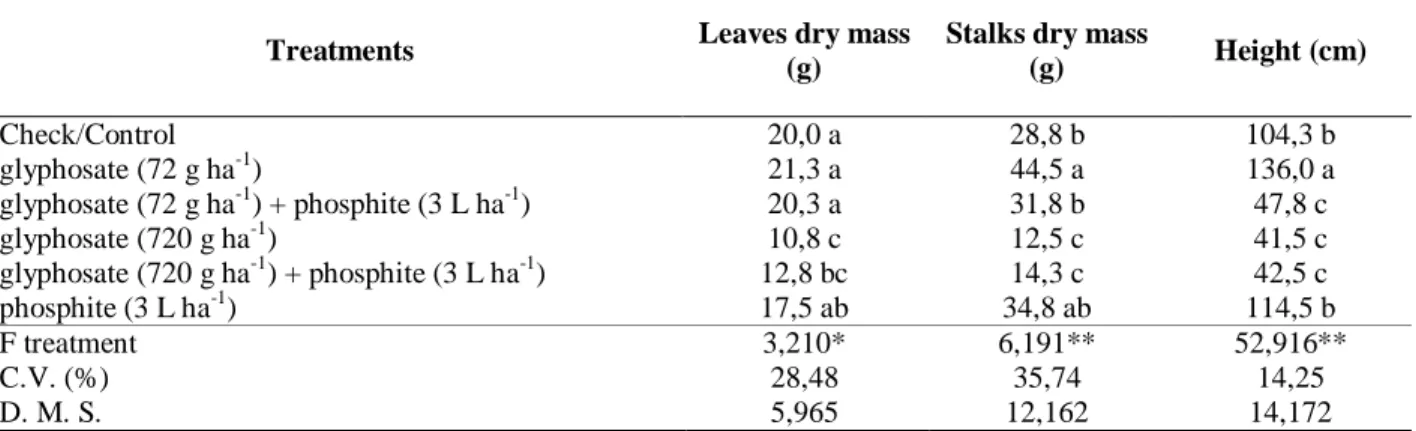
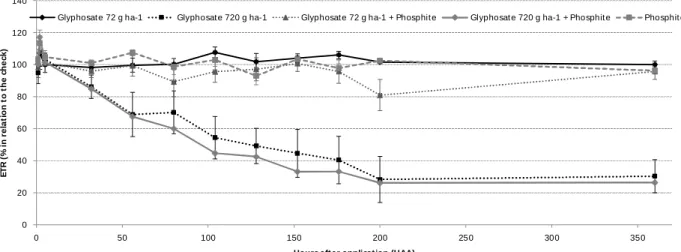
In Figures 1 and 2 are presented the electron transport rate (ETR) in photo system II of young and mature leaves, respectively, after glyphosate and phosphite application. Values are expressed as a percentage in relation to
control. Young leaves were the first to show
intoxication symptoms after glyphosate
application (720 g ha-1) isolated and in
association with phosphite, occurring reduction of 20% for electron transport rate at 2 DAA. Maximum reduction of ETR occurred 200 hours after application (HAA), approximately 8 DAA, with reduction around 70% in relation to the check, remaining until the last evaluated period.
In study conducted by Zobiole et al. (2010), it was observed reduction of pants photosynthetic rate reduction of soybean plants glyphosate-resistant after the application of this herbicide, with more pronounced decrease with doses increasing used in the experiment (450,
675, 900, 1350 and 1800 g ha-1).
For glyphosate application (72 g ha-1)
associated with phosphite, it was observed a reduction of 20% in ETR, with subsequent recovery until 350 HAA (15 DAA). However when applying the same dose of glyphosate reported previously, not associated with phosphite, authors did not observe ETR reductions in relation to the check or control during the evaluated period.
Figure 1. Electron transport rate (ETR) of young leaves from maize plants submitted to
glyphosate and phosphite application associated and isolated.
In relation to mature leaves (Figure 2), it was observed a reduction in ETR, around
20%, five days after glyphosate application
(720 g ha-1), isolated and in association with
0 20 40 60 80 100 120 140
0 50 100 150 200 250 300 350
E
T
R
(
%
i
n
r
e
la
ti
o
n
t
o
t
h
e
c
h
e
c
k
)
Hours aft er applicat ion (HAA)
Rev. Bras. Herb., v.12, n.1, p.78-86, jan./abr. 2013
phosphite. For the application of isolated glyphosate, it was observed greater reduction (70%) at final period of the experiment, when compared with combined application with phosphite, with maximum reduction of ETR, in approximately 45%. All other treatments did not differ from the check/ control, and this way, there was not change in electrons transportation rate in maize plants. It was observed that ETR reduction, both in young and mature leaves (Figures 1 and 2), was
accompanied by increased of plants
intoxication during the evaluated period (Table 1).
Shieh et al. (1991), reported for Beta vulgaris, that the accumulation of shikimic acid resulting from the action of glyphosate may represent an expressive drain of carbon in Calvin cycle, by redirecting erythrose-4-phosphate, severally reducing photosynthetic rate. Fuchs et al. (2002) also showed a drastic reduction in carbon dioxide assimilation after glyphosate application in Abuthilon teophrasti.
Figure 2. Electron transport rate (ETR) of mature leaves from maize plants submitted to
glyphosate and phosphite application associated and isolated.
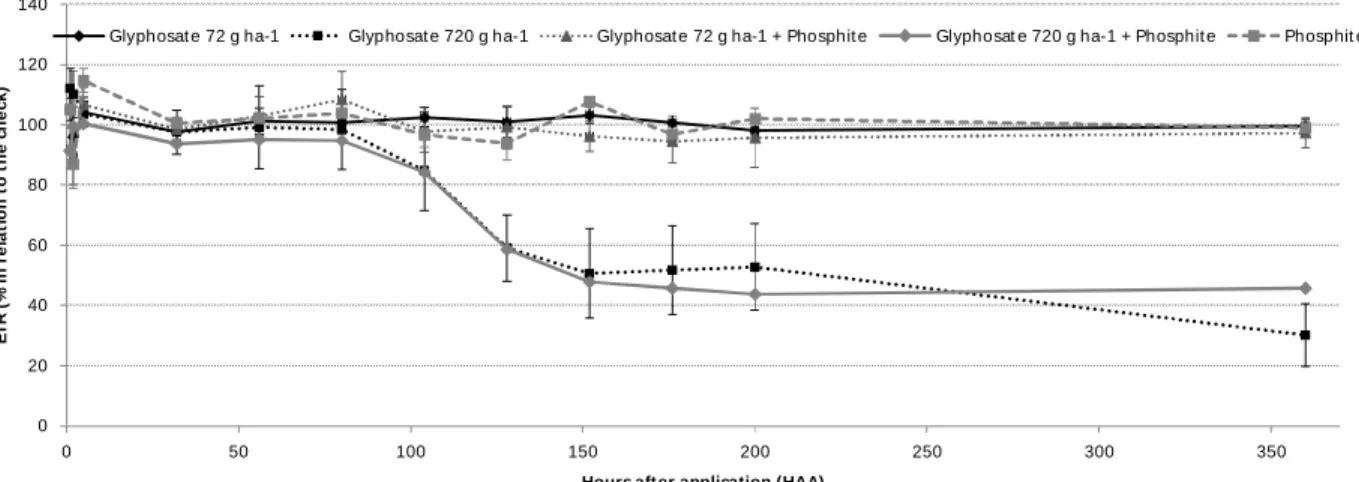
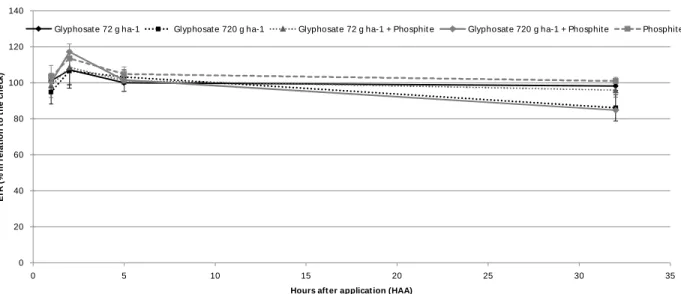
In the early hours after treatments application (2 HAA), there was an increase in ETR of young leaves when comparing with the check/control (Figure 3). In Figure 4 it is possible to observe an increase in ETR of mature leaves, five hours after treatments application. Cedergreen and Olesen (2010) observed increased in photosynthetic rate of
barley plants subjected to 22 and 45 g ha-1
doses just a few hours after application. This
effect on ETR may be related to an increase in the growth of these plants (Table 2) because second these authors, to achieve an increase in dry mass that ranges from 10 to 25% in one week or more, plants should increase photosynthetic rate or decrease respiration rate in response to low doses of glyphosate.
However the physiological mechanism
involved in this apparent process of growth change is currently unknown.
0 20 40 60 80 100 120 140
0 50 100 150 200 250 300 350
E
T
R
(
%
i
n
r
e
la
ti
o
n
t
o
t
h
e
c
h
e
c
k
)
Hours aft er application (HAA)
Rev. Bras. Herb., v.12, n.1, p.78-86, jan./abr. 2013
Figure 3. Electron transport rate (ETR) of young leaves from maize plants submitted to
glyphosate and phosphite application associated and isolated until 32 hours after application (HAA).
Figure 4. Electron transport rate (ETR) of mature leaves from maize plants submitted to
glyphosate and phosphite application associated and isolated until 32 hours after application (HAA).
In the treatments that glyphosate was applied on the lowest dose, there was no ETR reduction, and in most evaluation periods, these plants showed bigger ETR than check/control without application. Gravena et al. (2009) reported that photosynthesis of lemon clove was little affected by application
glyphosate doses (180, 360 and 720 g ha-1) and
that chlorophyll levels increased during the
evaluation period and were not affected by the
herbicide. CO2 assimilation rate followed by
chlorophyll content showed a tendency to increase daily, without significant effect of herbicide.
Potassium phosphite applied alone did not cause toxic effect on maize plants. Maize
plants subjected to 72 g ha-1 dose of isolated
potassium phosphite, presented higher growth
0 20 40 60 80 100 120 140
0 5 10 15 20 25 30 35
E
T
R
(
%
i
n
r
e
la
ti
o
n
t
o
t
h
e
c
h
e
c
k
)
Hours aft er applicat ion (HAA)
Glyphosat e 72 g ha-1 Glyphosat e 720 g ha-1 Glyphosat e 72 g ha-1 + Phosphit e Glyphosat e 720 g ha-1 + Phosphit e Phosphit e
0 20 40 60 80 100 120 140
0 5 10 15 20 25 30 35
E
T
R
(
%
i
n
r
e
la
ti
o
n
t
o
t
h
e
c
h
e
c
k
)
Hours after applicat ion (HAA)
Rev. Bras. Herb., v.12, n.1, p.78-86, jan./abr. 2013
than control (without glyphosate application). When associated with the highest glyphosate
dose (720 g ha-1), phosphite was responsible
for reducing plants toxicity and ETR increase, when compared with the application of isolated glyphosate.
Electron transport rate showed an increase in treated plants a few hours after glyphosate application associated or not to phosphite, and during later evaluating periods, only plants subjected to higher glyphosate dose
(720 g ha-1) in association or not with
potassium phosphite, was observed an ETR
reduction in young leaves first, and
subsequently in the mature ones. This increase in photosynthetic efficiency already in early hours may be related with growth stimulus effect on the lowest dose.
Conclusions
In the conditions the experiments were conducted it was possible to conclude that potassium phosphite in association with
glyphosate in 72 g ha-1 dose was responsible
for increased levels of visual intoxication of
maize plants; maize plants subjected to 72 g ha
-1
glyphosate dose isolated, presented a higher growth than the ones that received the application associated with phosphite and the check (without glyphosate application); and electron transport rate suffered change only in plants subjected to highest glyphosate dose
(720 g ha-1) in association or not with
potassium phosphite.
References
AGRIANUAL 2010. Anuário estatístico da
agricultura brasileira. São Paulo: FNP, 2010.
496 p.
BOUDET, A.M.; GRAZIANA, A.;
RANJEVA, R. Recent advances in the regulation of the prearomatic pathway. In: VAN SUMERE, C.F.; LEA, P.J. (Eds.),
Annual Proceedings of the Phytochemical
Society of Europe, 25. Clarendon Press,
p.135-159, 1985.
CASTRO, P.R.C. A rota do ácido chiquímico e a sua importância na defesa da planta.
Informações Agronômicas, n.119, p.3, 2007.
CEDERGREEN, N. et al. The occurrence of hormesis in plants and algae. Dose-response, v.5, n.2, p.150-162, 2007.
CEDERGREEN, N.; OLESEN, C.F. Can glyphosate stimulate photosynthesis? Pesticide
Biochemistry and Phisiology, v.96, n.3,
p.140-148, 2010.
FRANZ, J.E.; MAO, M.K.; SIKORSKI, J.A.
Glyphosate: a unique global herbicide.
Washington DC: American Chemical Society, 1997. 653p.
FUCHS, M.A. et al. Mechanisms of glyphosate toxicity in velvetleaf (Abutilon theophrasti Medikus). Pesticide Biochemistry
and Physiology, v.74, n.1, p.27-39, 2002.
GEIGER, D.R.; KAPITAN, S.W.; TUCCI, M.A. Glyphosate inhibits photosynthesis and allocation of carbon to starch in sugar beet leaves. Plant Physiology, v.82, n.2, p.468-472, 1986.
GEIGER, D.R.; TUCCI, M.A.; SERVIATES, J.C. Glyphosate effects on carbon assimilation and gas exchange in sugar beet leaves. Plant
Physiology, v.85, n.2, p.365-369, 1987.
GRAVENA, R. et al. Low glyphosate rates do not affect Citrus limonia (L.) Osbeck seedlings. Pest Management Science, v.65, n.1, p.420-425, 2009.
IBRAHIN, F.N. et al. Efeito da interação glyphosate e fosfito-K no manejo de plantas daninhas na cultura da pupunha. Anais.... XXVII Congresso Brasileiro da Ciência das Plantas Daninhas, 2010b.
Rev. Bras. Herb., v.12, n.1, p.78-86, jan./abr. 2013
Brasileiro da Ciência das Plantas Daninhas, 2010a.
LUCAS, R.E.; WARNCKE, D.D.; THORPE, V.A. Phosphite injury to corn. Agronomy
Journal, v.71, n.6, p.1063-1065, 1979.
MAGALHÃES, P.C. et al. Efeito de doses reduzidas de glyphosate e paraquat simulando deriva na cultura do milho. Planta Daninha, v.19, n.2, p.247-253, 2001.
SCHANBENBERGER, O.; KELLS, J.J.; PENNER, D. Statistical tests for hormesis and effective dosage in herbicide dose-response.
Agronomy Journal, v.91, n.4, p.713-721,
1999.
SERVIATES, J.C.; TUCCI, M.A.; GEIGER,
D.R. Glyphosate effects on carbon
assimilation, ribulose biphosphate carboxylase activity, and metabolite levels in sugar beet leaves. Plant Physiology, v.85, n.2, p.370-374, 1987.
SHIEH, W.J.; GEIGER, D.R.; SERVIATES, J.C. Effect of N-(Phosphonomethyl) glycine on carbon assimilation and metabolism during a simulated natural day. Plant Physiology, v.97, n.3, p.1109-1114, 1991.
VELINI, E.D. et al. Glyphosate applied at low doses can stimulate plant growth. Pest
Management Science, v.64, n.4, p.489-496,
2008.
VELINI, E.D. et al. Growth regulation and other effects of herbicides. Weed Science, v.58, n.3, p.351-354, 2010.
WAGNER, R.; KOGAN, M.; PARADA, A.M. Phytotoxic activity of root absorbed glyphosate in corn seedlings (Zea mays L.). Weed Biology
and Management, v.3, n.4, p.228-232, 2003.
WHITE, A.K.; METCALF, W.W. Microbial
metabolism of reduced phosphorous
compounds. Annual Rewiew Microbiology, v.61, n.1, p.379-400, 2007.
ZOBIOLE, L.H.S. et al. Glyphosate affects lignin content and amino acid production in
glyphosate-resistant soybean. Acta Physiology