Phylogeny of Trechitae... 229
Phylogeny of minute carabid beetles and their relatives
based upon DNA sequence data
(Coleoptera, Carabidae, Trechitae)
David R. Maddison1, Karen A. Ober2
1 Department of Entomology, University of Arizona, Tucson, AZ 85721, USA; Current address: Department of Zoology, 3029 Cordley Hall, Oregon State University, Corvallis, OR 97331, USA 2 Department of Ento-mology, University of Arizona, Tucson, AZ 85721, USA; Current Address: Department of Biology, College of the Holy Cross, Worcester, MA 01610, USA
Corresponding author: David R. Maddison ([email protected])
Academic editor:T. Erwin | Received 30 July 2011 | Accepted 25 August 2011 | Published 16 November 2011
Citation: Maddison DR, Ober KA (2011) Phylogeny of minute carabid beetles and their relatives based upon DNA sequence data (Coleoptera, Carabidae, Trechitae). In: Erwin T (Ed) Proceedings of a symposium honoring the careers of Ross and Joyce Bell and their contributions to scientiic work. Burlington, Vermont, 12–15 June 2010. ZooKeys 147: 229–260. doi: 10.3897/zookeys.147.1871
Abstract
he phylogeny of ground beetles of supertribe Trechitae is inferred using DNA sequences of genes that code for 28S ribosomal RNA, 18S ribosomal RNA, and wingless. Within the outgroups, austral psydrines are inferred to be monophyletic, and separate from the three genera of true Psydrina (Psydrus, Nomius, Laccocenus); the austral psydrines are formally removed from Psydrini and are treated herein as their own tribe, Moriomorphini Sloane. All three genes place Gehringia with Psydrina. Trechitae is inferred to be monophyletic, and sister to Patrobini.
Within trechites, evidence is presented that Tasmanitachoides is not a tachyine, but is instead a mem-ber of Trechini. Perileptus is a member of subtribe Trechodina. Against Erwin’s hypothesis of anillines as a polyphyletic lineage derived from the tachyine genus Paratachys, the anillines sampled are monophyletic, and not related to Paratachys. Zolini, Pogonini, Tachyina, and Xystosomina are all monophyletic, with the latter two being sister groups. he relationships of the subtribe Bembidiina were studied in greater detail. Phrypeus is only distantly related to Bembidion, and there is no evidence from sequence data that it belongs within Bembidiina. hree groups that have been recently considered to be outside of the large genus Bembidion are shown to be derived members of Bembidion, related to subgroups: Cillenus is related to the Ocydromus complex of Bembidion, Zecillenus is related to the New Zealand subgenus Zeplataphus, and Hydrium is close to subgenus Metallina. he relationships among major lineages of Trechitae are not, however, resolved with these data.
doi: 10.3897/zookeys.147.1871 www.zookeys.org
Copyright David R. Maddison, Karen A. Ober. This is an open access article distributed under the terms of the Creative Commons Attribution License, which permits unrestricted use, distribution, and reproduction in any medium, provided the original author and source are credited.
ReseARCh ARTiCle
Keywords
ground beetles, DNA, molecular phylogeny, Bembidiini, Trechinae, Carabidae, Trechitae
introduction
he supertribe Trechitae comprises over 5,300 described species (Lorenz 2005) of ground beetles. Although this is comparable to the number of mammal species (Wil-son and Reeder 2005), trechites are much more poorly known. Trechites are diverse on all continents except Antarctica. Most adults of this group are relatively small (less than 10 mm in length), and include the smallest known carabids, about 0.7 mm in length (Erwin 1973; Jeannel 1963). Division of this group into suprageneric taxa var-ies among authors, with most North American authors favoring four tribes: Trechini and Bembidiini, with over 2,500 species each, and the smaller groups Pogonini and Zolini, with about 85 and 55 species respectively (Lorenz 2005). Trechini includes many troglobitic species, and is most speciose in temperate areas. Bembidiini is world-wide, with many species living along bodies of water; it includes the smallest adults. his tribe includes the largest carabid genus, Bembidion, with over 1,200 recognized species (Lorenz 2005). Most pogonines are halobiontic; the majority live in the Old World. he Zolini is a strictly south-temperate lineage, except for the monotypic genus Sinozolus from China (Deuve 1997). A brief review of the diversity within each tribe is given in Grebennikov and Maddison (2005).
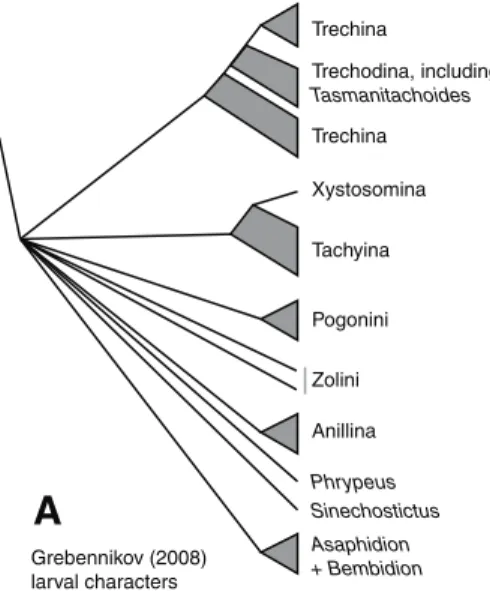
he basic structure of the phylogeny of trechites is not well known. he only explicit, modern analyses have been based upon limited characters of adult and larval structure (Grebennikov 2008; Grebennikov and Maddison 2005; Roig-Juñent and Cicchino 2001); these have inferred a few aspects of the phylogeny (Fig. 1).
We present here the irst detailed examination of relationships within Trechitae based upon DNA sequences, using portions of genes for small (18S) and large (28S) subunits of ribosomal RNA, as well as the nuclear protein-coding gene wingless.
his paper has been over a decade in gestation, and some results have already been reported in other publications. For example, the discovery from the DNA sequence data reported herein of Tasmanitachoides place in Trechini rather than in Tachyina was the inspiration for Grebennikov’s search for Tasmanitachoides larvae, which as he recently reported (Grebennikov 2008) conirms its placement in Trechini.
Methods
Phylogeny of Trechitae
distant relatives are less clear. We include representatives of carabid groups that are of a similar grade as trechites, that is, they are members of Carabidae Conjunctae but are not members of Harpalinae or Brachininae. hese include all three genera of Psydrini (s.str.), as well as six genera of Moriomorphini. he latter is the group referred to as “austral psydrines” in Maddison et al. (1999a), and includes all traditional psydrines except for Psydrini in the strict sense. In addition, as Gehringiini has been proposed to be a psydrine relative (Erwin 1985), or potentially within Trechitae (Erwin 1984), we
Anillina Trechina
Trechina
Trechodina, including
Tasmanitachoides
Xystosomina
Tachyina
Zolini
Asaphidion + Bembidion Phrypeus
Pogonini
Sinechostictus
Anillina Trechina
Trechodina, including
Tasmanitachoides
Xystosomina
Tachyina
Zolini
Asaphidion + Bembidion Phrypeus
Pogonini
Sinechostictus
analysis 1: all characters unordered
Grebennikov (2008) larval characters
Trechina
Xystosomina
Tachyina Zolini
Bembidiina Pogonini
Roig-Juñent + Cicchino (2001) adult characters
analysis 2: characters unordered & ordered
Grebennikov (2008) larval characters
A
B
C
include one member of Gehringiini, Gehringia olympica Darlington. We also include one representative of Harpalinae, Pterostichus, as the most-distant outgroup.
Within Trechitae, 64 species in 40 genera are sampled, with all tribes represented, and an emphasis on subtribe Bembidiina (Table 2). he classiication used here is modiied version of Lorenz’s (2005), with ranks similar to those typically used in North America (e.g., Lindroth 1963). he sequences obtained for Trechus came from two dif-ferent specimens from Montana; one of these is Trechus oregonensis Hatch, the other, a female, cannot be identiied with certainty to species, but belongs to the T. chalybeus species group, to which T. oregonensis also belongs. In analyses combining diferent genes, sequences from these two individuals were combined into a chimeric taxon.
Locality information for the specimens newly sequenced in this paper is given in the Appendix. Voucher specimens are deposited in the David Maddison voucher col-lection in the Oregon State Arthropod Colcol-lection at Oregon State University.
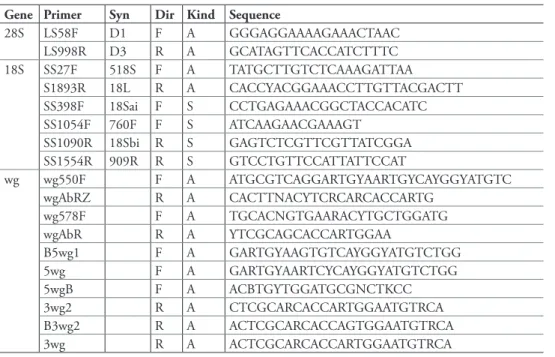
DNA sequencing. Methods for obtaining DNA sequences, including extraction methods and cycling reactions, are described in Maddison et al. (2008). Primers used are listed in Table 3; see Maddison et al. (2008) for information about original source of primer sequences. In brief, we obtained ca. 2000 bases of sequence data of 18S ribo-somal DNA (18S rDNA or 18S), about 1000 bases in the D1 through D3 domains of
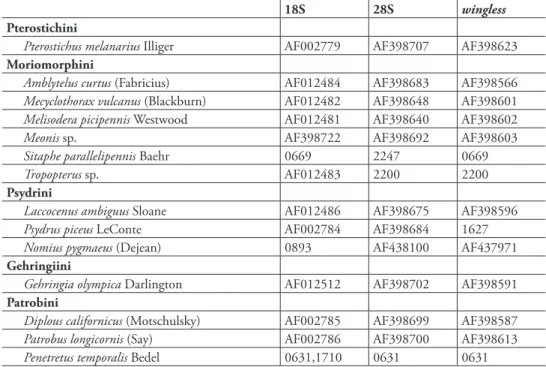
Table 1. Outgroup taxon sampling. Four-digit numbers in entries are D.R. Maddison voucher numbers; further information on the specimens is given in the Appendix; where two numbers are listed, the sequence was formed by combining data from both specimens. Other entries are GenBank numbers of previously published sequences from Maddison et al. (1999a, 1999b), Ober (2002), and Ober and Maddison (2008).
18S 28S wingless
Pterostichini
Pterostichus melanarius Illiger AF002779 AF398707 AF398623
Moriomorphini
Amblytelus curtus (Fabricius) AF012484 AF398683 AF398566
Mecyclothorax vulcanus (Blackburn) AF012482 AF398648 AF398601
Melisodera picipennis Westwood AF012481 AF398640 AF398602
Meonis sp. AF398722 AF398692 AF398603
Sitaphe parallelipennis Baehr 0669 2247 0669
Tropopterus sp. AF012483 2200 2200
Psydrini
Laccocenus ambiguus Sloane AF012486 AF398675 AF398596
Psydrus piceus LeConte AF002784 AF398684 1627
Nomius pygmaeus (Dejean) 0893 AF438100 AF437971
Gehringiini
Gehringia olympica Darlington AF012512 AF398702 AF398591
Patrobini
Diplous californicus (Motschulsky) AF002785 AF398699 AF398587
Patrobus longicornis (Say) AF002786 AF398700 AF398613
Phylogeny of Trechitae
Table 2. Taxon sampling of trechites. Four-digit numbers in entries are D.R. Maddison voucher num-bers; further information on the specimens is given in the Appendix; where two numbers are listed, the sequence was formed by combining data from both specimens. Other entries are GenBank numbers of previously published sequences from Maddison et al. (1999a, 1999b), Ober (2002), and Ober and Mad-dison (2008).
18S 28S wingless
Trechini: Trechodina
Cnides sp. 1808 0691
Pachydesus sp. 0678 AF438112 AF437978
Perileptus areolatus (Creutzer) 1707 0824 1707
Perileptus sloanei Moore 0767
halassophilus longicornis (Sturm) 0823 0823
Trechodes bipartitus (MacLeay) 0705 0705 0705
Trechodes jeanneli jeanneli Mateu 0606
Trechosiella sp. 1709 0723 1709
Tasmanitachoides itzroyi (Darlington) 1575 0762
Trechini: Trechina
Trechus chalybeus species group AF002793
Trechus oregonensis Hatch AF398673 0587
Omalodera limbata Blanchard 0571 0571 0571
Homaloderodes germaini Jeannel 1066
Kenodactylus audouini (Guérin-Méneville) 0670 0670
Paratrechus sp. 1076
Trechinotus lavocinctus Jeannel 0575 0575 0575
Zolini
Merizodus angusticollis Solier AF012487 0453 0453
Oopterus sp. AF012488 0387 0387
Oopterus helmsi (Sharp) AF002787 0354 0354
Sloaneana tasmaniae (Sloane) AF002788 0339 0339
Pogonini
Diplochaetus planatus (G.H. Horn) AF002789 AF438060 AF437938
Pogonus (Pogonus) chalceus (Marsham) 1711 0679 0679
halassotrechus barbarae (G.H.Horn) 0703 0530
Bembidiini: Tachyina
Lymnastis sp. 0988 0988 0988
Micratopus sp. 0605 0605
Paratachys vorax (LeConte) 0410 0410
Elaphropus obesulus LeConte 0411 0411 0411
Elaphropus cf. nigrolimbatus Peringuey 0761
Elaphropus sp. 3 0713 0713
Pericompsus laetulus LeConte AF002790 0429 0429
Polyderis rufotestacea (Hayward) 0717, 0718 0718
Tachys vittiger LeConte 0760
Tachys corax LeConte 0604 0604
18S 28S wingless Bembidiini: Xystosomina
Erwiniana hilaris (Bates) AF012489 0409 0409
Erwiniana crassa (Erwin) 0989 0989
Mioptachys lavicauda Say 0684 0684 0684
Philipis bicolor Baehr 0592 0592
Bembidiini: Anillina
Anillinus (langdoni group) sp. 0690 0690
Serranillus sp. 1084 1084
Typhlocharis armata Coifait 0572,1718 0572 0572
Nesamblyops sp. 0696
Bembidiini: Bembidiina
Asaphidion alaskanum Wickham 0585 0585
Asaphidion championi Andrewes 0574
Asaphidion curtum (Heyden) AF002792 0267 0267
Amerizus (Amerizus) sp. 0576 0576
Ocys harpaloides (Audinet-Serville) 0569 0569
Phrypeus rickseckeri Hayward 0776 0692
Sinechostichus solarii (G. Müller) 0603 0603
Bembidion (Antiperyphanes)sp. nr. chilense
Solier
0714 0714
Bembidion (Hoquedela) cf. csikii Jedlicka 0916 0916
Bembidion (Cillenus) laterale (Samouelle) 0602 0602
Bembidion (Notaphus) insulatum (LeConte) 0444 0444
Bembidion (Bracteon) balli Lindroth EF648613 EF648838 EF649474
Bembidion (Odontium) coxendix Say EF648618 EF648837 EF649481
Bembidion (Metallina) dyschirinum LeConte 0896 0896
Bembidion (Pseudoperyphus) integrum Casey EF648659 EF649056 EF649609
Bembidion (Bracteon) levettei carrianum Casey EF648620 EF648842 EF649480
Bembidion (Hydrium) levigatum Say 0763 0763
Bembidion (Ocydromus) mexicanum Dejean AF012490 0260 0262
Bembidion (Phyla) obtusum Audinet-Serville 0895 0895
Bembidion (Melomalus) planatum (LeConte) 0601 0601
Bembidion (Bembidion) quadrimaculatum dubitans (LeConte)
0676 0676 0676
Bembidion (Zeplataphus) tairuense Bates 0607 0607 0607
Bembidion (Zecillenus) sp. 0595 0595 0595
28S ribosomal DNA (28S rDNA, or 28S) and about 450 bases of the nuclear protein-coding gene wingless (wg). Ampliied products were cleaned, quantiied, and sequenced at the University of Arizona’s Genomic and Technology Core Facility using either a 3730 or 3730 XL Applied Biosystems automatic sequencer.
pack-Phylogeny of Trechitae
age (Maddison and Maddison 2009a; Maddison and Maddison 2009b), with subse-quent modiications by Chromaseq and manual inspection. Multiple peaks at a single position in both reads were coded using IUPAC ambiguity codes.
Newly obtained sequences have been deposited in GenBank with accession num-bers GU556024 through GU556153.
Alignment and resulting matrices. he two ribosomal genes, 18S and 28S, were aligned using ClustalW 1.8.3, with a gap opening cost of 10, gap extension of 0.1, then adjusted by eye; areas of uncertain alignment were excluded.
he amino acid translation of the wingless gene was aligned using Clustal W version 1.83 (Chenna et al. 2003) using gap opening cost of 5, gap extension cost 0.2, and a Gonnet series matrix. he central region of the wingless alignment evidently had a rich his-tory of insertion and deletions; the alignment of this region was adjusted by eye in Mac-Clade (Maddison and Maddison 2005). An alignment of nucleotides was then created, with the nucleotides forced to match the amino acid alignment using MacClade. here were two wingless matrices produced, one with the alignment-ambiguous region included (“all nucleotides”), and another with that region excluded (“well-aligned nucleotides”).
Phylogenetic inference. Each of the four matrices (28S, 18S, and the two wingless
matrices) were subjected to parsimony, Bayesian, and maximum likelihood analyses.
Table 3. Primers used for DNA ampliication and sequencing. Dir: direction of primer, either forward (F) or reverse (R). Syn: primer synonym. Kind: primer used for original PCR ampliication and sequenc-ing (A) or primer used only for sequencsequenc-ing (S). Original references for primer sequences are given in Mad-dison et al. (2008). Primer pairs used in earlier PCR reactions for wingless were 5wg-3wg, 5wgB-3wg2, and B5wg1-B3wg2; more recent, and reliable, reactions used the pairs wg550F-wgABRz or wg578F-wgABR.
Gene Primer Syn Dir Kind Sequence
28S LS58F D1 F A GGGAGGAAAAGAAACTAAC
LS998R D3 R A GCATAGTTCACCATCTTTC
18S SS27F 518S F A TATGCTTGTCTCAAAGATTAA
S1893R 18L R A CACCYACGGAAACCTTGTTACGACTT
SS398F 18Sai F S CCTGAGAAACGGCTACCACATC
SS1054F 760F F S ATCAAGAACGAAAGT
SS1090R 18Sbi R S GAGTCTCGTTCGTTATCGGA
SS1554R 909R R S GTCCTGTTCCATTATTCCAT
wg wg550F F A ATGCGTCAGGARTGYAARTGYCAYGGYATGTC
wgAbRZ R A CACTTNACYTCRCARCACCARTG
wg578F F A TGCACNGTGAARACYTGCTGGATG
wgAbR R A YTCGCAGCACCARTGGAA
B5wg1 F A GARTGYAAGTGTCAYGGYATGTCTGG
5wg F A GARTGYAARTCYCAYGGYATGTCTGG
5wgB F A ACBTGYTGGATGCGNCTKCC
3wg2 R A CTCGCARCACCARTGGAATGTRCA
B3wg2 R A ACTCGCARCACCAGTGGAATGTRCA
Most-parsimonious trees were sought using PAUP* (Swoford 2002). For each search, 2000 replicates were conducted, each beginning with a starting tree formed by the random addition sequence option, with subsequent TBR branch rearrangement. he number of most parsimonious trees (MPTs) ranged from 15 to 502 across the four matrices, and for each matrix the MPTs were found in at least 460 of the 2000 replicates.
For parsimony bootstrap analyses in PAUP*, 1000 bootstrap replicates were con-ducted, each of which used a heuristic search with ive replicates, each beginning with a starting tree formed by the random addition sequence option, with TBR branch rearrangement, with each replicate saving no more than 25 trees.
Models of nucleotide evolution chosen with the aid of ModelTest (Posada 2005), with the aid of PAUP* (Swoford 2002). For 18S and 28S genes, the model chosen by the Akaike Information Criterion (AIC) was a General Time Reversible rate ma-trix with a proportion of sites being invariant and the remainder following a gamma distribution (the GTR+I+Γ model). For the wingless gene, the GTR+I+Γ model was chosen for the region without extensive insertions and deletions, but for the indel-rich region a GTR+Γ model was preferred. When codon positions were allowed separate models, GTR+I+Γ was preferred for irst positions, GTR+Γ for second positions, and HKY85+I+Γ for third positions.
Bayesian analyses were conducted using MrBayes (Huelsenbeck and Ronquist 2005). Two runs of four chains each were run for between 8 million and 30 million generations, with trees sampled every 1,000 generations. Runs were terminated once the average standard deviation of split frequencies went below 0.01 (Huelsenbeck and Ronquist 2005). For each analysis, the trees in a burn-in period were excluded, and the majority-rule consensus tree of remaining trees was calculated by PAUP to determine Bayesian Posterior Probabilities (BPP) of clades. he burn-in period was at least 25% of the total length of the run (as only the remaining 75% were used to calculate the average standard deviation of split frequencies used as a convergence diagnostic), and extended until the likelihood scores and all parameter values reached a stable plateau, as judged by visualization tools in Tracer (Rambaut and Drummond 2004). he burn-in period ranged from 3 million generations to 25 million generations. he number of trees sampled for each analysis varied from 10,000 to 30,000.
Likelihood analyses of nucleotide data were conducted using RAxML version 7.0.4 (Stamatakis 2006). For each matrix, 1000 search replicates were conducted to ind the maximum likelihood trees. 2000 non-parametric bootstrap replicates were used to calculate bootstrap values for groups of interest.
Several of the analyses of 18S rDNA yielded trees with the trechine Cnides, whose terminal branch was extremely long, well outside of Trechitae. As morphological data indicates deinitively that Cnides is a trechite, some analyses were performed that forced it to reside within Trechitae. Two full suites of constrained analyses were conducted, one with Trechitae constrained to be monophyletic, and other with Trechini constrained to be monophyletic. For the latter, the position of Tasmanitachoides was not constrained in likelihood and parsimony analyses, allowing it to move anywhere on the tree.
Phylogeny of Trechitae
Grebennikov’s (2008) larval morphological data were reanalyzed using TNT ver-sion 1.1 (Golobof et al. 2008). Most parsimonious trees were found using the follow-ing commands: rseed[, hold 1000, xmult: hits 100 ratchet 5 norss nocss, xmult. his caused TNT to do multiple searches, each beginning with a tree with taxa added in random order, with up to 1000 trees held in memory, with each search using ive cycles of ratcheting; enough searches were done until the best trees found were found 100 times. 332 equally parsimonious trees of length 140 were found.
Results of phylogenetic analysis
Phylogenetic trees inferred from individual genes are shown in Figs 2–4, and from the merged matrix in Fig. 5. Support values for various hypotheses are shown in Tables 4 and 5. Summaries of supported phylogenetic hypotheses are presented in Figs 6–7.
Support values for various groups in analyses of 18S constrained to keep Trechitae or Trechini monophyletic are shown in Table 6.
Results for the reanalysis of Grebennikov’s (2008) larval data are presented in Fig. 1B, and described in more detail in the text, below.
Discussion
We here discuss in turn the evidence available for various relationships within trechites. As signiicant results have been found within the outgroups sampled, we will discuss these irst.
Outgroup structure: Monophyly of Moriomorphini
Among the carabids currently considered to belong to Psydrini (sens. lat.), only three genera belong to Psydrina in the strict sense: Psydrus (North America), Nomius (Hol-arctic and Africa), and Laccocenus (Australia). he remaining genera are arrayed in multiple subtribes (Baehr 1998; Moore 1963), and are restricted to the Southern Hemisphere, primarily in temperate areas, except for members of the genus Mecyclo-thorax, which occur as far north as Hawai’i (Liebherr 2006; 2008; 2009). Sequences of 18S rDNA indicate that all psydrines other than Psydrus, Nomius, and Laccocenus belong to a clade, termed the “austral psydrines” by Maddison et al. (1999a). hree apomorphies of adult structure (Baehr 1999) also indicate monophyly of the austral psydrines. In addition, 18S rDNA indicated that austral psydrines were not closely related to psydrines in the strict sense (Maddison, et al. 1999a).
Pterostichus Meonis Melisodera Sitaphe Mecyclothorax Amblytelus Tropopterus Laccocenus Gehringia Psydrus Nomius Diplous Patrobus Penetretus Phrypeus Sinechostichus Bembidion dyschirinum Bembidion levigatum Nesamblyops Typhlocharis Anillinus Serranillus Ocys Asaphidion alaskanum Asaphidion championi Asaphidion curtum Amerizus Sloaneana
Oopterus sp.
Merizodus Oopterus helmsi Bembidion insulatum Bembidion quadrimaculatum
Bembidion sp. nr. chilense Bembidion tairuense
Bembidion (Zecillenus) Bembidion cf. csikii Bembidion obtusum Bembidion laterale Bembidion mexicanum Bembidion coxendix Bembidion levettei Bembidion integrum Bembidion planatum Bembidion balli Diplochaetus Pogonus Thalassotrechus Tasmanitachoides Cnides Trechinotus Kenodactylus Homaloderodes Omalodera Paratrechus Trechus Pachydesus Thalassophilus Perileptus areolatus Perileptus sloanei Trechosiella Trechodes bipartitus Trechodes jeanneli Philipis Mioptachys Erwiniana crassa Erwiniana hilaris Lymnastis Micratopus Paratachys Pericompsus Polyderis Tachys corax Tachys vittiger Tachyta Elaphropus obesulus Elaphropus cf. nigrolimbatus
Elaphropus sp. 3
BPP 90, MLBoot 90, parsBoot 90
BPP 90, MLBoot 75, parsBoot 50
BPP 90, MLBoot 50, in MPTs
BPP 75, MLBoot 50 or in MLTs, in MPTs
BPP 50 28S rDNA
0.1
Phylogeny of Trechitae
Pterostichus
Cnides Meonis
Amblytelus Mecyclothorax
Tropopterus Melisodera
Sitaphe
Gehringia Laccocenus
Nomius
Psydrus Diplous
Patrobus Penetretus
Omalodera Trechinotus Trechus Pachydesus
Perileptus areolatus
Tasmanitachoides Trechodes bipartitus
Trechosiella Serranillus
Diplochaetus Pogonus
Typhlocharis
Asaphidion curtum Bembidion mexicanum Bembidion tairuense
Bembidion quadrimaculatum Bembidion (Zecillenus) Bembidion balli
Bembidion levettei Bembidion coxendix
Bembidion integrum Elaphropus obesulus Tachyta
Pericompsus Lymnastis
Erwiniana hilaris Mioptachys
Sloaneana Merizodus
Oopterus sp.
Oopterus helmsi
0.1
BPP 90, MLBoot 90, parsBoot 90
BPP 90, MLBoot 75, parsBoot 50
BPP 90, MLBoot 50, in MPTs
BPP 75, MLBoot 50 or in MLTs, in MPTs
BPP 50
18S rDNA
Figure 3. Majority-rule consensus tree of trees sampled in Bayesian analysis, with branch lengths pro-portional to average branch lengths across trees that contain that branch, for 18S rDNA data. See caption of Fig. 2 for additional details.
psydrines, is not monophyletic (Figs 2–5). Combined with evidence provided by the more extensive 18S rDNA taxon sampling of Maddison et al. (1999a), and the mor-phological data (Baehr 1999), these two groups should be in separate taxa. We there-fore remove austral psydrines from Psydrini, and place them in their own tribe. he valid name for this tribe is Moriomorphini Sloane (1890: 646).
Paratachys Pterostichus Sitaphe Melisodera Amblytelus Tropopterus Mecyclothorax Meonis Nomius Psydrus Gehringia Laccocenus Diplous Patrobus Penetretus Anillinus Typhlocharis Trechus Omalodera Kenodactylus Trechinotus Perileptus areolatus Thalassophilus Pachydesus Trechodes bipartitus Trechosiella Philipis Mioptachys Erwiniana crassa Erwiniana hilaris Lymnastis Elaphropus obesulus
Elaphropus sp. 3
Tachyta Micratopus Pericompsus Polyderis Tachys corax Sloaneana Merizodus Oopterus sp.
Oopterus helmsi Phrypeus Diplochaetus Pogonus Thalassotrechus Amerizus Ocys Sinechostichus Asaphidion alaskanum Asaphidion curtum Bembidion obtusum Bembidion insulatum Bembidion quadrimaculatum Bembidion sp. nr. chilense
Bembidion tairuense Bembidion (Zecillenus) Bembidion cf. csikii
Bembidion dyschirinum Bembidion levigatum Bembidion planatum Bembidion laterale Bembidion mexicanum Bembidion levettei Bembidion balli Bembidion coxendix Bembidion integrum
BPP 90, MLBoot 90, parsBoot 90
BPP 90, MLBoot 75, parsBoot 50
BPP 90, MLBoot 50, in MPTs
BPP 75, MLBoot 50 or in MLTs, in MPTs
BPP 50
wingless
0.1
Figure 4. Majority-rule consensus tree of trees sampled in Bayesian analysis, with branch lengths propor-tional to average branch lengths across trees that contain that branch, for the complete wingless data. See caption of Fig. 2 for additional details.
Outgroup structure: relationship of Gehringiini
Phylogeny of Trechitae Pterostichus Meonis Melisodera Sitaphe Tropopterus Amblytelus Mecyclothorax Laccocenus Gehringia Psydrus Nomius Diplous Patrobus Penetretus Nesamblyops Typhlocharis Anillinus Serranillus Homaloderodes Omalodera Kenodactylus Trechinotus Paratrechus Trechus Cnides Pachydesus Thalassophilus Perileptus areolatus Perileptus sloanei Tasmanitachoides Trechosiella Trechodes bipartitus Trechodes jeanneli Diplochaetus Pogonus Thalassotrechus Philipis Mioptachys Erwiniana crassa Erwiniana hilaris Pericompsus Polyderis Lymnastis Micratopus Paratachys Elaphropus obesulus Elaphropus cf. nigrolimbatus Elaphropus sp. 3
Tachyta Tachys corax Tachys vittiger Phrypeus Sloaneana Merizodus Oopterus sp.
Oopterus helmsi Amerizus Ocys Sinechostichus Asaphidion alaskanum Asaphidion championi Asaphidion curtum Bembidion cf. csikii Bembidion obtusum Bembidion insulatum Bembidion quadrimaculatum Bembidion sp. nr. chilense Bembidion tairuense Bembidion (Zecillenus) Bembidion dyschirinum Bembidion levigatum Bembidion laterale Bembidion mexicanum Bembidion planatum Bembidion balli Bembidion levettei Bembidion coxendix Bembidion integrum 90 75 50
contradictory clade present in optimal present in optimal
contradictory clade supported 50
parsimony ML Bayesian Moriomorphini Psydrini+Gehringia Patrobini Anillina Trechina Trechodina (with Cnides and
Tasmanitachoides) Pogonini Xystosomina Tachyina Zolini Bembidiina (excluding Phrypeus)
Figure 5. Majority-rule consensus tree of trees sampled in Bayesian analysis for all three genes analyzed together. Ovals on branches indicate support for the clade based upon Bayesian (left), maximum likeli-hood (center), and parsimony (right) analyses. Darkest tones indicate strongest support for (grays and black) or against (pinks) the clade, with values indicating posterior probability expressed as a percentage (Bayesian), or bootstrap percentage (likelihood and parsimony).
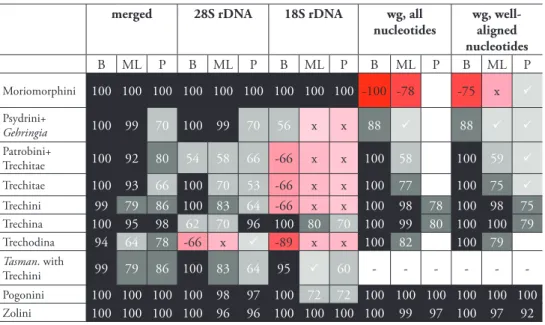
Table 4. Support values for various groups outside of Bembidiini (sensu lat.): B: Bayesian posterior probability, expressed as a percentage; ML: Maximum likelihood analysis; P: parsimony analysis. For maximum likelihood and parsimony analyses, numbers indicate the bootstrap support expressed as a percentage; check marks indicate that the clade is present in the optimal (maximum likelihood or post parsimonious) trees but with bootstrap value below 50; x indicates that a contradictory clade was present in the optimal (maximum likelihood or post parsimonious) trees but with bootstrap value below 50; nega-tive values indicate Bayesian posterior probability or bootstrap support for a contradictory clade. Boxes in gray to black indicate support for the clade; boxes in pink to red indicate support against that clade, with darker colors indicating stronger support. Dashes indicate no support for or against the clade because of insuicient taxon sampling for that gene; blank boxes indicate no support for or against the clade because of lack of resolution in the inferred trees. Abbreviations: “inc.” = “including”, “exc.” = “excluding”.
merged 28S rDNA 18S rDNA wg, all
nucleotides
wg, well-aligned nucleotides
B ML P B ML P B ML P B ML P B ML P
Moriomorphini 100 100 100 100 100 100 100 100 100 -100 -78 -75 x Psydrini+
Gehringia 100 99 70 100 99 70 56 x x 88 88
Patrobini+
Trechitae 100 92 80 54 58 66 -66 x x 100 58 100 59 Trechitae 100 93 66 100 70 53 -66 x x 100 77 100 75 Trechini 99 79 86 100 83 64 -66 x x 100 98 78 100 98 75 Trechina 100 95 98 62 70 96 100 80 70 100 99 80 100 100 79 Trechodina 94 64 78 -66 x -89 x x 100 82 100 79 Tasman. with
Trechini 99 79 86 100 83 64 95 60 - - - -Pogonini 100 100 100 100 98 97 100 72 72 100 100 100 100 100 100 Zolini 100 100 100 100 96 96 100 100 100 100 99 97 100 97 92
deinitive test. However, it is remarkable that separate analyses of each of the three genes, plus the combined analyses, indicate at least some level of support for having Gehringia belonging to a clade with the true Psydrini (Figs 2–5, Table 4), echoing the placement “as a basal psydrite group” by Erwin (1985).
Relationships of Patrobini to Trechitae
Phylogeny of Trechitae
Consistent with most morphological data, our 28S and wingless data support monophyly of Patrobini plus Trechitae (Table 5), as does 18S if Trechini is constrained to be monophyletic (Table 6).
Monophyly of Trechitae
Shared derived characters that provide evidence for monophyly of Trechitae are found in multiple character systems. Protarsomeres of adult males are uniquely dentate and dilat-ed on the mesal side (Roig-Juñent and Cicchino 2001). here are derivdilat-ed traits of larval structure (Arndt 1993; Grebennikov and Maddison 2000; 2005). Males lack chiasmata in meiosis (Serrano 1981), although this has been examined in relatively few genera, and in no zolines. Males of almost all other carabids, including patrobines, are chiasmatic (Galián et al. 1994; Serrano and Galian 1998), with the possible exception of isolated separate origins within the distantly-related Carabini (Yadav and Burra 1987) and Har-palini (Serrano 1981). he lack of chiasmata in trechites is thus a notable synapomor-phy. 18S rDNA has also provided evidence of monophyly (Maddison, et al. 1999a).
Trechitae is strongly supported as monophyletic in 28S, wingless, and the merged matrix (Table 5). In contrast, because of the placement of Cnides outside of Trechitae (Fig. 3), as discussed in the next section, 18S provides evidence against the monophyly of Trechitae. If Cnides is forced to stay within Trechini, however, 18S provides no clear signal for or against monophyly (Table 6).
Pterostichus
Moriomorphini Psydrini+Gehringia
Patrobini
Anillina Trechina
Trechodina
Xystosomina
Tachyina Trechitae
Zolini
Other Bembidiina Tasmanitachoides
Sinechostictus Phrypeus Cnides
Pogonini
28S
A B 18S C wingless
Tachyina Pterostichus
Moriomorphini Psydrini+Gehringia
Patrobini
Anillina Trechina
Trechodina+
Xystosomina
Zolini
Bembidiina Tasmanitachoides Cnides
Pogonini
Tachyina Pterostichus
Moriomorphini
Psydrini+Gehringia
Patrobini
Anillina Trechina
Trechodina
Xystosomina
Trechitae Trechitae
+ Patrobini
Zolini
Other Bembidiina Phrypeus Pogonini
Figure 7. Summary of relationships in Trechitae and related taxa. Branches (including those subtended by triangles) indicate monophyletic groups supported by the combined analyses and at least two of the genes; quadrangles indicate groups whose status is unresolved.
Pterostichus
Moriomorphini
Psydrini+Gehringia
Patrobini
Anillina Trechina
Trechodina
Xystosomina
Tachyina Trechitae
Zolini
Bembidion cf. csiki Bembidion obtusum
Bembidion dyschirinum Bembidion (Hydrium) levigatum
Bembidion (Bembidion) Series (including Zecillenus, Notaphus, etc.)
Tasmanitachoides
Asaphidion, Amerizus, Ocys, Sinechostictus Phrypeus
Cnides
Bembidion (Odontium) Series
+ B. (Cillenus) laterale + B. mexicanum
+ B. planatum
Phylogeny of Trechitae
Monophyly and phylogeny of Trechini
he primary synapomorphy suggesting the monophyly of Trechini is the presence of deep furrows on the dorsal surface of the head (Jeannel 1926). In its extreme form, this state is unique within carabids, but there are also trechines with relatively shallow, less extensive furrows that are not dissimilar to those found in other carabids. here are, however, several derived states in larval characters that indicate monophyly of Trechini (Grebennikov 2008; Grebennikov and Maddison 2005).
Our results from 28S, wingless, and the merged matrices indicate strong support for monophyly of Trechini (Table 4), if Tasmanitachoides is included within the tribe (as discussed in the next section). In contrast, 18S provides moderate evidence against the monophyly of trechines, because of the placement of Cnides outside of Trechitae (Fig. 3). However, the exceedingly divergent Cnides 18S sequence (note the length of its branch in Fig. 3) makes artiicial attraction of the long branch (Felsenstein 1978) to distantly related outgroups a reasonable explanation.
In Jeannel’s great work (1926; 1927; 1928; 1930) trechines are divided into ive groups. One of most distinctive groups are the trechodines, a predominately Southern-Hemisphere group, characterized by a basal bulb of the male aedeagus that is open dorsally, as opposed to the closed basal bulb found in other trechines. Among the taxa we have sequenced, trechodines are represented by Pachydesus, halassophilus, Cnides, and Trechodes. Jeannel’s other four groups are each represented in our data: his aepines by Kenodactylus, his homaloderines by Omalodera, Homaloderodes, and Trechinotus, his
Table 5. Support values for various groups of Bembidiini (sens. lat.). See legend of Table 4 for more explanation.
merged 28S rDNA 18S rDNA wg, all
nucleotides
wg, well-aligned nucleotides
B ML P B ML P B ML P B ML P B ML P
Bembidiini (sens. lat.) -88 x x -85 x x -98 x x -100 -63 x -100 -56 x
Tachyina+Xystosomina 100 92 85 100 72 66 -62 x x 68 x x 80
Tachyina 100 88 x 99 67 x -62 x x 99 x 87 x
Xystosomina 100 99 100 100 80 75 89 71 69 99 88 85 100 88 89
Anillina (inc.
Nesam-blyops) 87 93 - - -
-Bembidiina inc.
Phrypeus x x x x - - - - x 51 x x
Bembidiina exc.
Phrypeus 91 x x 100 76 78 100 89 x x
Bembidion (sens. lat.) 75 x x -54 x -57 89 83 x
Zecillenus in Bembidion 100 91 89 91 100 98 98 100 98 96 100 95 93
B. taiurense + Zecillenus 100 91 89 52 -100 -91 -91 100 98 96 100 95 93
Bembidion series 100 87 88 91 100 98 98 98 60 67 97 57 66
perileptines by Perileptus, and with Paratrechus and Trechus representing his trechines in the strict sense.
Trechini is a diverse group, with complex patterns of morphological variation, and has been subject to many diferent classiication schemes. For example, some classiica-tions view homaloderines as members of Trechina proper (e.g., Casale and Laneyrie 1982; Lorenz 2005). All classiications consider trechodines to be a distinct group, although the placement of Perileptus has varied. Jeannel (1926; 1927; 1928; 1930), Casale and Laneyrie (1982), and Lorenz (2005) treated perileptines as a group distinct from trechodines. Uéno (1989), however, considered Perileptus and related genera to be a trechodines, citing a misunderstanding by other authors of the structure of the male aedeagus in Perileptus. None of these classiications are based upon explict phylo-genetic analyses, however.
In recent years larval structure and DNA sequences have been used in a few ex-plicit phylogenetic studies within trechines. he most complete available larval data (Grebennikov 2008; Grebennikov and Maddison 2005), suggests that neither tre-chodines nor trechines are monophyletic, with tretre-chodines forming a grade within Trechina. However, this result is not robust to the alternative assumptions employed by Grebennikov (2008). We have reanalyzed his data using his initial ordering as-sumptions, and ind that relationships within trechines are more ambiguous than those shown in Grebennikov’s (2008) Fig. 3 (our Fig. 1B). Notably, some most-parsimonious trees have Trechodina and Trechina each monophyletic, and sister to each other (not shown). he only other paper to explicitly examine the phylogeny of trechines using modern analytical methods is that of Faille et al. (2010), which used 28S, 18S, and mitochondrial genes to infer the phylogeny of some European trechines, a very diferent question, with diferent taxon sampling, from the question of worldwide relationships examined here.
Table 6. Support values for various groups outside of Bembidiini (sensu lat.): comparison of results for 18S rDNA between unconstrained and constrained analyses. For the “Trechitae constrained” analyses, all of Trechitae was constrained to be monophyletic. For the “Trechini constrained analyses”, all of Trechini was constrained to be monophyletic for the Bayesian analysis; for the remaining analyses, Trechini was constrained to be monophyletic, except that Tasmanitachoides was unconstrained, and could move any-where in the tree if that were optimal. “n/a” indicates that support values for that group are irrelevant as the group was forced to be monophyletic; for meaning of other symbols and colors, see legend of Table 4.
No Constraints Trechitae constrained Trechini constrained
B ML P B ML P B ML P
Psydrini+Gehringia 56 x x 59 x -63 50 x
Patrobini+Trechitae -66 x x 99 95 94 94 53
Trechitae -66 x x n/a n/a n/a x
Trechini -66 x x -85 x n/a n/a n/a
Trechina 100 80 70 99 82 69 99 82 70
Trechodina -89 x x -85 x 64 3 x
Phylogeny of Trechitae
Our results (Figs 2–5, Table 4) conirm or refute several previous proposals. Trechi-na (including Jeannel’s homaloderines and the aepiine Kenodactylus) is monophyletic, supported by all three genes individually, and by analyses of the combined data. Per-ileptus is a trechodine, as supported by all three genes, and by the combined data, as predicted by Uéno (1989). here is weak evidence that trechodines are monophyl-etic, with wingless and the merged data in support, 28S ambiguous, and 18S speaking against monophyly.
Relationships of Tasmanitachoides
In the original description of Tasmanitachoides, Erwin (1972) considered the genus to be “an early of-shoot of the tachyine lineage which gave rise to the Anillina”. He notes that they “show similarities to the trechines”, but view those similarities as sym-plesiomorphies. he genus’s placement in trechites has been examined in detail only once since then, in Grebennikov’s (2008) paper on larval characters. As Grebennikov reports, our DNA data indicates (as does his larval data) that Tasmanitachoides is not a tachyine, but instead shows ainity to trechines (Figs 2, 3, 5; Table 4). In our data, this relationship is supported by both ribosomal genes; we did not manage to acquire wingless sequence from Tasmanitachoides, and so that gene is at the moment mute on relationships of the genus.
Monophyly of Zolini
Liebherr & Will’s (1999) study of female genitalic characters suggested that zolines were not monophyletic, with Oopterus and Merizodus appearing separately on their inferred phylogeny. However, as they note, the number of characters used was small enough to confer limited conidence in that result. Roig-Juñent and Chicchino’s (2001) study of adult structure, which included members of all subtribes of zolines, weakly supported monophyly of the group. 18S rDNA strongly supports monophyly of Oopterus+Merizodus+Sloaneana (Maddison, et al. 1999a; note that in that paper, Oopterus helmsi is referred to as “Zolus helmsi”).
Although our study cannot be a strong test of the monophyly of zolines, as we do not have members of two subtribes (Sinozolina and Chalteniina), the three genera we have examined (Oopterus, Merizodus, and Sloaneana) are strongly supported as a clade, in all three genes and in all analyses (Table 4).
Monophyly of Pogonini
the monophyly of the tribe is not in question. Grebennikov and Bousquet (1999) found three synapomorphies in larvae that suggest monophyly of the tribe. Our results conirm this, with all genes and all analyses indicating that Pogonus + Diplochaetus + halassotrechus form a clade (Table 4).
Monophyly of Bembidiini
As delimited in this paper, Bembidiini includes four subtribes: Bembidiina, a large group of over 1,200 species primarily found in temperate regions, and which includes the larger bembidiines; Tachyina, the second large group, mostly ground-dwelling, centered in warmer regions; Xystosomina, a primarily arboreal group most abundant in the Neotropics; and Anillina, containing very small, often blind, mostly soil-dwell-ing carabids. In some classiications, these groups are treated as separate tribes, in part as there is only one derived character that suggests that the group is monophyletic (the small terminal article of the maxillary and labial palps of adults, a character that occurs in some trechines, e.g., Perileptus), and in part as the subtribes are relatively uniform within themselves, but with several characters that distinguish them one from another. An analysis of larval characters (Grebennikov and Maddison 2005) gives no indication of monophyly of the tribe.
Our results are consistent with the view that Bembidiini is a heterogeneous group, with all three genes and the combined analysis indicating non-monophyly (Table 5), although with no consistent pattern of particular subgroups of Bembidiini being re-lated to non-bembidiines. More details are provided under the discussions of each subtribe, below.
Monophyly of Xystosomina
his subtribe was established by Erwin (1994) for six New World genera (four of which have arboreal members some species of which also use leaf-litter, and two having subcortical members) and one arboreal genus, Philipis, from tropical Aus-tralia. While no explicit phylogenetic analysis supporting monophyly of this group has been published, our data (which includes three of the more divergent genera) supports monophyly, with all three genes and the combined analyses indicating that xystosomines form a clade (Table 5).
Monophyly of Tachyina
Phylogeny of Trechitae
in anillines (as discussed below). his result is not consistent with larval data, which suggests that Tachyta (a tachyine) is more closely related to Mioptachys (a xystosomine) than it is to other tachyines (Grebennikov and Maddison 2005).
Bayesian analysis of 28S, wingless, and the merged matrix supports the monophyly of Tachyina (Table 5). However, this is result is not supported by Bayesian analysis of 18S rDNA, and parsimony analyses of all genes speak against monophyly of tachyines. A denser taxon sampling of both tachyines and xystosomines is needed to resolve this conlict.
Monophyly and origin of Anillina
Most anillines are minute, blind, wingless, pale inhabitants of soil and deep leaf litter; members of a few genera have small eyes, e.g., Nesamblyops from New Zealand (Moore 1980) and Microdipnodes from Africa (Jeannel 1963). As most of the distinctive char-acteristics of anillines are expected to evolve in small beetles that live in soil, it is pos-sible that anillines represent a grade that has repeatedly and independently evolved from above-ground trechites as those lineages went underground (Erwin 1982). Erwin proposed in particular that anillines may represent “a grade of numerous parallel line-ages derived from Paratachys and allies.”
If Erwin (1982) is right that polyphyletic origin of anillines explains how these pre-sumably slowly-dispersing beetles would be present on multiple continents and remote islands, then our sample of anillines from North America, Europe, and New Zealand should be a good test of his hypothesis. he only gene for which we have data from all four sampled genera is 28S. hese data refute Erwin’s hypothesis, as the anillines are strongly supported as monophyletic (Fig. 2 and Table 4).
he exclusion of anillines from the Tachyina + Xystosomina clade (Fig. 7) suggests that the obliquely notched anterior tibia in anillines and Tachyina (Erwin 1982) arose independently in the two groups.
Monophyly of Bembidiina
Relationships within Bembidiina
he majority of species within subtribe Bembidiina belong to the genus Bembidion.
Bembidion was regarded by Carl Lindroth (1963; 1980) and (as a result) most North American carabidologists as a very large genus comprising all non-tachyine, non-xys-tosomine, non-anilline bembidiines that possess a distinctive brush in the internal sac of the male genitalia, and with male foretarsomeres with adhesive setae arranged in a rows. hree groups of Bembidiina without a brush (Phrypeus, Zecillenus, Bembidarenas Erwin) have been excluded by Lindroth and from Bembidion on this basis, although the same was not done for some South American species also lacking a brush (e.g., members of the subgenus Antiperyphanes), which were still maintained within Bem-bidion. A similar brush is present in two groups outside Bembidion (in this classiica-tion): Asaphidion and some Xystosomina (Erwin 1994). he brush in xystosomines is likely convergent, as they share apomorphies that place them with a group that lacks a brush, the tachyines. Asaphidion, while having the brush, has distinctive dorsal texture and is unique within Trechitae of having adhesive setae on the foretarsomere of males arranged randomly, not in rows (Maddison, 1993). However, these traits are likely autapomorphies of Asaphidion, and thus not signiicant as evidence of relationships to other groups.
More recently, other groups have been excluded from Bembidion in most clas-siications, including Ocys, Cillenus, Amerizus, Sinechostictus, Orzolina Machado, and Caecidium Uéno. hus, current classiications have a very large, poorly-deined genus Bembidion surrounded by a number of small “satellite” genera that are each deined in good part based upon autapomorphies. Bembidion in either the tradi-tional or modern senses has no known synapomorphies of its members, and thus it would not be surprising if some of these satellite genera were found to be de-rived lineages within Bembidion. However, as there have been no comprehensive phylogenetic analyses at this level within Bembidiina, the lack of known derived states does not indicate that Bembidion as currently deined is non-monophyletic. Only some recent papers on larval characters (Grebennikov 2008; Grebennikov and Maddison 2005) employ cladistic analyses or numerical analyses of character matrices, and they do not have dense-enough taxon sampling to address most of these issues. hus, there is little existing published evidence for or against the monophyly of Bembidion or other major subgroups within Bembidiina.
Phylogeny of Trechitae
Perrault (1981) and Ortuño and Toribio (2005) considered Sinechostictus to be a group distinct from Bembidion based on spermathecal and aedeagal structures. Grebennikov (1997) found that Sinechostictus larvae lack some synapomorphies of Bembidion + Asaphidion, a result supported by further larval studies (Grebennikov 2008; Grebennikov and Maddison 2005). Our results corroborate this result, with wingless (Fig.4) and the merged data (Fig. 5) suggesting that Sinechostictus falls outside of Bembidion.
On the other hand, some of the groups that have been recently considered outside of Bembidion are evidently derived members of that genus.
Hydrium, considered by most as a subgenus of Bembidion (e.g., Bousquet and Larochelle 1993; Lindroth 1963), has recently been removed from Bembidion (Lorenz 2005). Our results strongly indicate that Bembidion (Hydrium) levigatum is a Bembid-ion, and, among the taxa sampled, the sister group of Bembidion (Metallina) dyschiri-num, with which it shares a number of characteristics, including an angulate shoulder margin.
Cillenus was considered by Lindroth (1980) and Toledano (2000) to be within Bembidion, but most current authors treat it as a separate genus (Lorenz 2005; Marggi et al. 2003; Ortuño and Toribio 2005; Perrault 1981). his separation from Bembid-ion is based in part on the unusual morphological traits of adult Cillenus, including a wide head and long mandibles. hese features are likely derived features resulting from adaption to feeding on amphipods in their intertidal habitat (Green 1956; Lindroth 1980). Our results (Figs 2, 4, 5; Table 5) strongly support Cillenus as a member of Bembidion, near the Ocydromus complex.
When described, Lindroth (1980) separated Zecillenus, a lineage from New Zea-land, from Bembidion because of the lack of a brush in the male aedeagus of Zecil-lenus. hese beetles are rather distinct in general form, and have a number of unique characteristics, including unusual langes on the elytra (Lindroth 1980). Our results indicate that they are highly derived Bembidion: among the taxa we sampled, they are strongly supported as belonging to Bembidon by all three genes and the merged matrix (Table 5), and are sister group to Bembidion (Zeplataphus) tairuense in 28S, wingless, and merged matrices. B. tairuense is the only other Bembidion we have sampled from New Zealand, and we propose that Zecillenus is part of an endemic radiation of New Zealand Bembidion.
Relationships of the major lineages of trechites
Conclusions
While our results have clariied the position of a number of enigmatic lineages within Trechitae, including Tasmanitachoides, Cillenus, and Zecillenus, our data have surpris-ingly little to say about deep relationships within Trechitae (Fig. 7). his is perhaps a result of the shortness of the deep branches in ribosomal gene trees (Figs 2, 3). Whether these might indicate a rapid radiation or limited ribosomal evolution during that period, they make inference of the relationships diicult.
Future work should increase taxon sampling, to split long branches in the tree, and add missing lineages. Additional genes, especially those with relatively longer lengths for the deeper branches (such as those seen in wingless, Fig. 4), are also needed. hese eforts should increase our understanding of the phylogeny of this diverse group of small beetles.
Acknowledgments
Our heartfelt thanks go to Ross and Joyce Bell, who have provided inspiration over the years to both of us, through their excellent work and generous natures.
Many people aided this project by providing valuable specimens, and we thank them all: David Kavanaugh, Alfred Newton, Margaret hayer, Wendy Moore, Geof Monteith, Wayne Maddison, Konjev Desender, Betsy Arnold, Julia Amerongen Mad-dison, A.S. Gerber, P.M. Johns, Allan Ashworth, Matthias Hartmann, J. M. Pérez Zaballos, J.I. Townsend, Wolfgang Dormann, Dietrich Mossakowski, D.J. Cook, S. Endrödy-Younga, O. Junco, W. Reeves, Rich Leschen, Chuck Bellamy, Karl Kjer, Rog-er Blahnik, Vasily Grebennikov, and Kipling Will.
For help in identifying specimens, we thank Terry Erwin, Konjev Desender, J. M. Pérez Zaballos, Matthias Hartmann, Paolo Bonavita, Geof Monteith, Igor Sokolov, and Vasily Grebennikov.
I thank Vasily Grebennikov for making the original data matrix available from his 2008 study. hanks as well to the Willi Hennig Society for making TNT available through its sponsorship.
his project was funded primarily by NSF grants 9420219 and DEB-9981935 to DRM, as well as funds generously provided by the University of Arizona, and the Harold E. and Leona M. Rice Endowment Fund at Oregon State University.
References
Antoine M (1955) Coléoptères carabiques du Maroc. Première partie. Mémoires de la Société des sciences naturelles et physiques du Maroc, Nouvelle série 1: 1–77.
Phylogeny of Trechitae
Arndt E (1998) Phylogenetic investigation of Carabidae (Coleoptera) using larval characters. In: Ball GE, Casale A, Vigna Taglianti A (Eds) Phylogeny and classiication of Caraboidea (Coleoptera: Adephaga) Proceedings of a symposium (28 August, 1996, Florence, Italy) 20 International Congress of Entomology. Museo Regionale di Scienze Naturali, Torino, 171–190.
Baehr M (1998) A preliminary survey of the classiication of Psydrinae (Coleoptera: Carabi-dae). In: Ball GE, Casale A, Vigna Taglianti A (Eds) Phylogeny and classiication of Car-aboidea (Coleoptera: Adephaga) Proceedings of a symposium (28 August, 1996, Florence, Italy) 20 International Congress of Entomology. Museo Regionale di Scienze Naturali, Torino, 359–367.
Baehr M (1999) A preliminary survey of the classiication of Psydrinae (Coleoptera: Carabi-dae). In: Ball GE, Casale A, Vigna Taglianti A (Eds) Phylogeny and Classiication of Car-aboidea (Coleoptera: Adephaga). Museo Regionale di Scienze Naturali, Atti, Torino, Italy, 359–368.
Baehr M, Schüle P, Lorenz W (2009) Afrogehringia endroedyi, a new genus and species of Gehringiini from southwestern Africa (Coleoptera: Carabidae). Annals of the Transvaal Museum 46: 101–107.
Bell RT (1967) Coxal cavities and the classiication of the Adephaga (Coleoptera). Annals of the Entomological Society of America 60: 101–107.
Beutel RG (1992) Phylogenetic analysis of thoracic structures of Carabidae (Coleoptera, Adephaga). Zeitschrift Fur Zoologische Systematik Und Evolutionsforschung 30: 53–74. doi: 10.1111/j.1439-0469.1992.tb00390.x
Bousquet Y, Grebennikov V (1999) Description of adults and larvae of Platypatrobus lacustris
Darlington (Coleoptera: Carabidae: Patrobini) with notes on relationships of the genus. Fabreries 24: 1–13.
Bousquet Y, Laplante S (1997) Taxonomic review of the New World Pogonini (Coleoptera: Carabidae). Canadian Entomologist 129: 699–731. doi: 10.4039/Ent129699-4
Bousquet Y, Larochelle A (1993) Catalogue of the Geadephaga (Coleoptera: Trachypachidae, Rhysodidae, Carabidae including Cicindelini) of America north of Mexico. Memoirs of the Entomological Society of Canada 167: 1–397. doi: 10.4039/entm125167fv
Casale A, Laneyrie R (1982) Trechodinae et Trechinae du monde: tableau des sous-families, tri-bus, séries phylétiques, genres, et catalogue général des espèces. Memoires de Biospeologie 9: 1–226.
Chenna R, Sugawara H, Koike T, Lopez R, Gibson TJ, Higgins DG, hompson JD (2003) Multiple sequence alignment with the Clustal series of programs. Nucleic Acids Research 31: 3497–3500. doi: 10.1093/nar/gkg500
Darlington PJ Jr. (1933) A new tribe of Carabidae (Coleoptera) from the western United States. Pan-Paciic Entomologist 9: 110–114.
Deuve T (1993) L’abdomen et les genitalia des femelles de Coléoptères Adephaga. Mémoires du Muséum National D’Histoire Naturelle 155: 1–184.
Erwin TL (1972) Two new genera of bembidiine carabid beetles from Australia and South America with notes on their phylogenetic and zoogeographic signiicance (Coleoptera). Brevoria 383: 1–19.
Erwin TL (1973) Studies of the subtribe Tachyina (Coleoptera: Carabidae: Bembidiini). Part 1.: a revision of the Neotropical genus Xystosomus Schaum. Smithsonian Contributions to Zoology 140: 1–39. doi: 10.5479/si.00810282.140
Erwin TL (1982) Small terrestrial ground-beetles of Central America (Carabidae: Bembidiina and Anillina). Proceedings of the California Academy of Sciences 42: 455–496.
Erwin TL (1984) Composition and origin of the ground beetle fauna (Coleoptera, Carabidae). Monographiae Biologicae: 371–389.
Erwin TL (1985) he taxon pulse: a general pattern of lineage radiation and extinction among carabid beetles. Series Entomologica (Dordrecht): 437–472.
Erwin TL (1994) Arboreal beetles of tropical forests: the Xystosomi group, subtribe Xysto-somina (Coleoptera: Carabidae: Bembidiini). Part 1. Character analysis, taxonomy, and distribution. Canadian Entomologist 126: 549–666. doi: 10.4039/Ent126549-3
Faille A, Ribera I, Deharveng L, Bourdeau C, Garnery L, Queinnec E, Deuve T (2010) A mo-lecular phylogeny shows the single origin of the Pyrenean subterranean Trechini ground beetles (Coleoptera: Carabidae). Molecular Phylogenetics and Evolution 54: 97–106. doi: 10.1016/j.ympev.2009.10.008
Felsenstein J (1978) Cases in Which Parsimony or Compatibility Methods Will Be Positively Misleading. Systematic Zoology 27: 401–410. doi: 10.2307/2412923
Galián J, Ortiz AS, Serrano J (1994) Karyotypic Data on 13 Species of Nearctic Carabid Beetles (Coleoptera). Entomological News 105: 111–118.
Golobof PA, Farris JS, Nixon KC (2008) TNT: a free program for phylogenetic analysis. Cla-distics 24: 774–786. doi: 10.1111/j.1096-0031.2008.00217.x
Grebennikov VV (2008) Tasmanitachoides belongs to Trechini (Coleoptera: Carabidae): discov-ery of the larva, its phylogenetic implications and revised key to Trechitae genera. Inverte-brate Systematics 22: 479–488.
Grebennikov VV, Bousquet Y (1999) Larvae of Pogonini (Coleoptera: Carabidae): genera Pogo-nus, Pogonistes, Cardiaderus, and halassotrechus. Acta Societatis Zoologicae Bohemicae 63: 427–441. doi: 10.1071/IS07051
Grebennikov VV, Maddison DR (2000) Larvae of Bembidiini (Coleoptera : Carabidae): Sub-tribes Tachyina and Xystosomina. European Journal of Entomology 97: 223–240. Grebennikov VV, Maddison DR (2005) Phylogenetic analysis of Trechitae (Coleoptera :
Car-abidae) based on larval morphology, with a description of irst-instar Phrypeus and a key to genera. Systematic Entomology 30: 38–59. doi: 10.1111/j.1365-3113.2004.00259.x Green J (1956) he mouthparts of Eurynebria complanata (L.) and Bembidion laterale (Sam.)
(Col., Carabidae). Entomologists’ Monthly Magazine 92: 110–113. Green P (1999) Phrap. Version 0.990329. http://phrap.org.
Green P, Ewing B (2002) Phred. Version 0.020425c. http://phrap.org.
Phylogeny of Trechitae
Halpern AL (Eds) Carabid Beetles: heir Evolution, Natural History, and Classiication. Dr. W. Junk bv, he Hague, 113–180.
Houston WWK, Luf ML (1975) he larvae of the British Carabidae (Coleoptera). III. Patro-bini. Entomologist’s Gazette 26: 59–64.
Huelsenbeck J, Ronquist F (2005) MrBayes. Version 3.1.2. http://www.mrbayes.net.
Jeannel R (1926) Monographie des Trechinae. Morphologie comparée et distribution d’un group de Coléoptères. Première livraison. L’ Abeille 32: 221–550.
Jeannel R (1927) Monographie des Trechinae. Morphologie comparée et distribution d’un group de Coléoptères. Deuxième livraison. L’ Abeille 33: 1–592.
Jeannel R (1928) Monographie des Trechinae. Morphologie comparée et distribution d’un group de Coléoptères. Troisième livraison. L’ Abeille 34: 1–808.
Jeannel R (1930) Monographie des Trechinae. Morphologie comparée et distribution d’un group de Coléoptères. Troisième livraison. L’ Abeille 34: 59–122.
Jeannel R (1941) Coléoptères Carabiques. Part 1. Faune de France 39: 1–571.
Jeannel R (1963) Monographie des “Anillini”, Bembidiides endogés. Mémoires du Muséum National D’Histoire Naturelle, Nouvelle Série Série A, Zoologie 28: 33–204.
Komarov EV (1996) A new genus and species of carabids (Coleoptera, Carabidae) of the tribe Pogonini from Turkmenia. Russian Entomological Journal 5: 31–33.
Kryzhanovskij OL (1976) An attempt at a revised classiication of the family Carabidae (Co-leoptera). Entomological Review of Japan 55: 56–64.
Liebherr JK (2006) Taxonomic revision of the Mecyclothorax beetles (Coleoptera: Carabi-dae, Psydrini) of Molokai, Hawaii and recognition of areas of endemism on Kama-kou Volcano. Journal of the New York Entomological Society 114: 179–281. doi: 10.1664/0028-7199(2007)114[179:TROTMB]2.0.CO;2
Liebherr JK (2008) Taxonomic revision of Mecyclothorax Sharp (Coleoptera, Carabidae) of Hawaii Island: abundant genitalic variation in a nascent island radiation. Deutsche Ento-mologische Zeitschrift 55: 19–78. doi: 10.1002/mmnd.200800004
Liebherr JK (2009) Taxonomic revision of the Mecyclothorax beetles (Coleoptera: Carabidae) of Oahu: epithets as epitaphs for an endangered fauna? Systematic Entomology 34: 649–687. doi: 10.1111/j.1365-3113.2009.00477.x
Liebherr JK, Will KW (1999) Inferring phylogenetic relationships within Carabidae (Insecta, Coleoptera) from characters of the female reproductive tract. In: Ball GE, Casale A, Vigna Taglianti A (Eds) Phylogeny and Classiication of Caraboidea (Coleoptera: Adephaga). Museo Regionale di Scienze Naturali, Atti, Torino, Italy, 107–170.
Lindroth CH (1963) he ground-beetles (Carabidae, excl. Cicindelinae) of Canada and Alaska. Part 3. Opuscula Entomologica Supplementum XXIV: 201–408.
Lindroth CH (1969) he ground-beetles (Carabidae, excl. Cicindelinae) of Canada and Alaska. Part 6. Opuscula Entomologica Supplementum XXV: 1–48.
Lindroth CH (1980) A revisionary study of the taxon Cillenus Samouelle, 1819 and related forms (Coleoptera: Carabidae, Bembidiini). Entomologica Scandinavica 11: 179–205. doi: 10.1163/187631280X00509
Second edition. Published by the author, Hörmannstrasse 4, D-82327 Tutzing, Germany, i-iii, 1–530 pp.
Maddison DR, Baker MD, Ober KA (1999a) Phylogeny of carabid beetles as inferred from 18S ribosomal DNA (Coleoptera: Carabidae). Systematic Entomology 24: 103–138. doi: 10.1046/j.1365-3113.1999.00088.x
Maddison DR, Baker MD, Ober KA (1999b) A preliminary phylogenetic analysis of 18S ribo-somal DNA of carabid beetles (Insecta: Coleoptera). In: Ball GE, Casale A, Vigna Taglianti A (Eds) Phylogeny and Classiication of Caraboidea (Coleoptera: Adephaga). Museo Re-gionale di Scienze Naturali, Atti, Torino, Italy, 229–250, Sinauer Associates, Sunderland, Massachusetts.
Maddison DR, Maddison WP (2005) MacClade 4: Analysis of phylogeny and character evolu-tion. Version 4.08, Sinauer Associates, Sunderland, Massachusetts.
Maddison DR, Maddison WP (2009a) Chromoseq: a Mesquite module for analyzing sequence chromatograms. Version 0.97. http://mesquiteproject.org/packages/chromaseq.
Maddison DR, Moore W, Baker MD, Ellis TM, Ober KA, Cannone JJ, Gutell RR (2008) Monophyly of terrestrial adephagan beetles as indicated by three nuclear genes (Coleop-tera: Carabidae and Trachypachidae). Zoological Scripta 38: 43–62. doi: 10.1111/j.1463-6409.2008.00359.x
Maddison WP, Maddison DR (2009b) Mesquite: a modular system for evolutionary analysis. Version 2.71. http://mesquiteproject.org.
Marggi W, Huber C, Müller-Motzfeld G, Hartmann M (2003) Carabidae: Trechinae: Bembi-diini: Bembidiina. In: Löbl I, Smetana A (Eds) Catalogue of Palaearctic Coleoptera. Apollo Books, Stenstrup, 241–273.
Moore BP (1963) Studies on Australian Carabidae (Coleoptera). 3. he Psydrinae. Transac-tions of the Royal Entomological Society of London 115: 277–290. doi: 10.1111/j.1365-2311.1963.tb00810.x
Moore BP (1980) A synopsis of the New Zealand Anillini (Coleoptera: Carabidae: Bembi-diinae), with descriptions of new genera and species. New Zealand Journal of Zoology 7: 399–406.
Müller G (1975) Zur Phylogenie der Bembidiini. Entomologische Nachrichten 19: 7–12. Ober KA (2002) Phylogenetic relationships of the carabid subfamily Harpalinae (Coleoptera)
based on molecular sequence data. Molecular Phylogenetics and Evolution 24: 228–248. doi: 10.1016/S1055-7903(02)00251-8
Ober KA, Maddison DR (2008) Phylogenetic relationships of tribes within Harpalinae (Co-leoptera: Carabidae) as inferred from 28S ribosomal DNA and the wingless gene. Journal of Insect Science 8: 1–32. doi: 10.1673/031.008.6301
Ortuño VM, Toribio M (2005) Carabidae de la Peninsula Ibérica y Baleares, Vol. I. Trechinae, Bembidiini. Argania Editio, Barcelona, 455 pp.
Perrault GG (1981) Études sur la tribu des Bembidiini (Coleoptera, Carabidae). I. - Notes sur la classiication supraspéciique. Nouvelle Revue d’Entomologie 11: 237–250.
Phylogeny of Trechitae
Rambaut A, Drummond A (2004) Tracer. Version 1.3. http://evolve.zoo.ox.ac.uk/software. html?id=tracer.
Roig-Juñent S, Cicchino AC (2001) Chaltenia patagonica, new genus and species belonging to Chalteniina, a new subtribe of Zolini (Coleoptera: Carabidae). Canadian Entomologist 133: 651–670. doi: 10.4039/Ent133651-5
Serrano J (1981) Male achiasmatic meiosis in Caraboidea (Coleoptera, Adephaga). Genetica 57: 131–137. doi: 10.1007/BF00131238
Serrano J, Galian J (1998) A review of karyotypic evolution and phylogeny of carabid beetles (Coleoptera). In: Ball GE, Casale A, Vigna Taglianti A (Eds) Phylogeny and classiication of Caraboidea (Coleoptera: Adephaga) Proceedings of a symposium (28 August, 1996, Florence, Italy) 20 International Congress of Entomology. Museo Regionale di Scienze Naturali, Torino, 191–228.
Sloane TG (1890) Studies in Australian Entomology, No.IV.–New genera and species of Car-abidae. Linnean Society of New South Wales (2nd Series) 5: 641–653.
Stamatakis A (2006) RAxML-VI-HPC: maximum likelihood-based phylogenetic analyses with thousands of taxa and mixed models. Bioinformatics 22: 2688–2690. doi: 10.1093/bioin-formatics/btl446
Swoford DL (2002) PAUP*. Phylogenetic Analysis Using Parsimony (*and Other Methods). Version 4.0b10, Sinauer Associates, Sunderland, Massachusetts.
Toledano L (2000) Systematic notes on the Palaearctic Bembidiini with particular reference to the fauna of China (Coleoptera Carabidae). Memorie della Societa Entomologica Italiana 78: 5–70.
Uéno S-I (1989) Systematic position of the trechine genus Eocnides (Coleoptera, Trechinae). Elytra 17: 9–18.
Wilson DE, Reeder DM (Eds) (2005) Mammal Species of the World. John Hopkins University Press, Baltimore, 2142 pp.
Yadav JS, Burra MR (1987) Chromosomes of Calosoma Weber (Caraboidea: Coleoptera) with comments on achiasmate meiosis. Genética Ibérica 39: 9–16.