A new species of
Neomida
Latreille from Colombia,
with additional records and a complementary
description for
Neomida suilla
(Champion)
(Coleoptera, Tenebrionidae, Diaperini)
Sergio Aloquio1, Cristiano Lopes-Andrade2
1 Programa de Pós-Graduação em Biologia Animal, Departamento de Biologia Animal, Universidade Federal de Viçosa, 36570-900, Viçosa, MG, Brasil 2 Departamento de Biologia Animal, Universidade Federal de Viçosa, 36570-900, Viçosa, MG, Brasil
Corresponding author:Sergio Aloquio ([email protected])
Academic editor:P. Bouchard | Received 12 October 2014 | Accepted 18 March 2015 | Published 8 April 2015
http://zoobank.org/F3854E21-4038-4FF4-BEDE-454302483B3A
Citation: Aloquio S, Lopes-Andrade C (2015) A new species of Neomida Latreille from Colombia, with additional records and a complementary description for Neomida suilla (Champion) (Coleoptera, Tenebrionidae, Diaperini). ZooKeys 495: 133–142. doi: 10.3897/zookeys.495.8737
Abstract
Neomida diminuta sp. n. is described, based on a single male specimen from Colombia, and a redescrip-tion of N. suilla (Champion) is given. Data on the morphology of the aedeagus for both species, and on the female abdominal terminalia for N. suilla are provided. New records of N. suilla from Atlantic Forest remnants in the states of Espírito Santo and Minas Gerais, Brazil are given.
Keywords
Tenebrionidae, Diaperini, Neomida, new species, redescription, new records, Brazil, Colombia
Introduction
Species of the genus Neomida Latreille, 1829 (Coleoptera: Tenebrionidae: Diaperini) are strict fungivorous beetles that dwell in hard conks of Polyporales and Hymenochaetales hosts. Neomida has approximately 50 described species, most from tropical and subtropi-cal regions (Schawaller 2002). In America, the genus is most diversiied in the neotropics; it does not occur in the Andean region, and has only three Nearctic species, N. bicornis
http://zookeys.pensoft.net
Copyright Sergio Aloquio, Cristiano Lopes-Andrade. This is an open access article distributed under the terms of the Creative Commons Attribution License (CC BY 4.0), which permits unrestricted use, distribution, and reproduction in any medium, provided the original author and source are credited.
(Fabricius), N. occidentalis (Champion) and N. ferruginea (LeConte). Members of Neo-mida are diagnosed by the following features (taken from Triplehorn 1965): antennal club loose and with seven antennomeres; eyes emarginate anteriorly close to antennal insertions, forming a lower portion at least twice as long as the upper portion; head of males usually bearing horns or tubercles on frons or clypeus, or both; prosternal process convex; elytral punctation seriate; basal tarsomere of hind tarsi short. However, these fea-tures are usually subject to exceptions or shared with species of other Diaperini genera. For instance, Neomida acera Triplehorn is devoid of secondary sexual features on male head; the long and loose antennal club of Neomida is similar to those of Diaperis Geofroy,
Ulo-moides Blackburn and Pentaphyllus Dejean (Triplehorn 1965); and species of Platydema
Laporte and Brullé also have seriate elytral punctation. Neomida and Platydema are highly diversiied and use similar fungi as hosts, but can be easily distinguished at a glance: the body of Neomida is distinctly convex and subparallel-sided, while Platydema are compara-tively more lattened and ovoid, with male horns on the head often asymmetric. he Neo-tropical fauna of Neomida comprises 30 described species, 16 restricted to the northern and three to the southern neotropics, and 11 species are found in both (Triplehorn 2006).
In recent ield collections in southeast Brazil we found N. suilla, a species known from a few named specimens in museum collections and amongst the least studied Neotropical Neomida. Additionally a small undescribed Neomida erroneously identi-ied as Cis Latreille (Ciidae) was recognized among the material borrowed from the Muséum national d’Histoire naturelle in Paris. he aims of the present work are to provide new records and a complete description for N. suilla, and describe a new spe-cies belonging to the same genus.
Material and methods
Specimens of N. suilla were found in basidiomes of Ganoderma sp. (Ganodermataceae) collected in Rio Doce, in the state of Minas Gerais, and Linhares, in the state of Espírito Santo. Both localities are in the Brazilian Atlantic Forest. he beetles were reared in the laboratory, in the same fungi in which they were found, so as to obtain a high number of specimens for dissecting and depositing in scientiic collections. Five adults were pre-served in absolute alcohol, which are prepre-served below -22 °C for future molecular analy-ses. Forty specimens are dry mounted and several others are preserved in 70% alcohol.
Discovery V8 stereomicroscope with a Zeiss AxioCam MRc digital camera (Figs 1–2) and a Zeiss Discovery V20 stereomicroscope with a Zeiss AxioCam 506 (Figs 5–6, 10). Final images were the result of montaging 25 to 125 image slices at diferent focal lengths using the extended focus module of Zeiss Axiovision 4.8 software (Figs 1–2) and Zeiss ZEN 2012 (Figs 5–6, 10).
We based the redescription of N. suilla on a male plesiotype (a specimen used for a redescription, supplementary description, or illustration published subsequent to the original description; sensu Evenhuis 2008), and the description of N. diminuta sp. n. on a single male from Colombia. Terms for external morphology, including sclerites of abdominal terminalia, follow Lawrence et al. (2011). he term basale refers to the phal-lobase, and apicale to the fused parameres (Lawrence et al. 2011). he following symbols are used for measurements (in mm) and ratios: EL, elytral length (at midline, from base of scutellum to elytral apex); EW, greatest elytral width; GD, greatest depth of the body (from elytra to metaventrite); PL, pronotal length along midline; PW, greatest pronotal width; TL, total length (=EL+PL; head not included). he ratio GD/EW was recorded as an indication of degree of convexity; TL/EW indicates degree of body elongation.
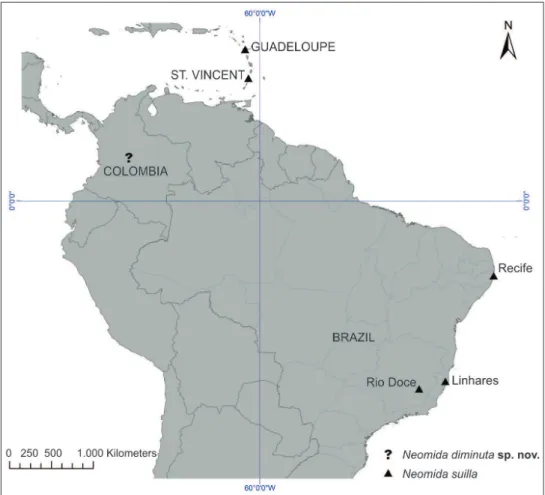
he distribution map (Fig. 13) was created using latitude and longitude coordi-nates estimated by tracking localities in the online database GeoNames (Wick 2010) and plotting them in a map using DIVA-Gis 7.5.
Labels were printed in white paper, unless otherwise speciied. Label data are cited verbatim in quotation marks; a backslash separates diferent labels. Square brackets are used to denote our comments on label data. he number and gender of specimens bearing these labels are stated immediately before the label data.
Acronyms of depositories
ANIC Australian National Insect Collection, CSIRO Ecosystem Sciences
(Can-berra, Australia)
CELC Coleção Entomológica do Laboratório de Sistemática e Biologia de Co-leoptera, Universidade Federal de Viçosa (Viçosa, Minas Gerais, Brasil)
MNHN Muséum national d’Histoire naturelle (Paris, France)
OSUC he Ohio State University Insect Collection (Columbus, Ohio, USA)
Taxonomy
Neomida diminuta sp. n.
http://zoobank.org/74A4E927-BEA1-4763-857E-20A3899F26B1 Figs 1–4
from N. suilla and N. picea in the possession of two clypeal tubercles instead of one, from N. cioides in the subcylindrical and straight frontal horns, and from N. inermis by its subtle clypeal sinuosity instead of conspicuous and cylindrical tubercles. Neomida
diminuta sp. n. males have eyes, body shape and cephalic horns similar to those of N.
occidentalis, but the latter are twice as long. In N. diminuta sp. n., the epipleura extends
from base to apex of elytra, a feature observed only in other six species of Neomida: N.
cioides (Champion), N. deltocera Triplehorn, N. occidentalis, N. pentaphyllodes
(Cham-pion), N. picea (Laporte and Brullé) and N. suilla.
Etymology. he name “diminuta” means small, referring to its minute size.
Description. Male. Body moderately convex, opaque, glabrous; length 1.74 mm; elytra, pronotum and head reddish-brown; antennae and legs golden-yellow. Head
to antennal insertions. Eyes with anterior portion emarginated by antennal insertion, forming a lower lobe approx. four times as large as upper lobe. Antennae with
anten-nomeres 5–11 expanded forming a club. Pronotum strongly transverse, approx. twice
as wide as long, widest and longest at middle, sides subparallel and narrowed anteri-orly; lateral edges explanate, visible for their entire lengths from above; anterior edge truncate. Elytra approx. twice as long as pronotum, widest at middle and narrowing to apex, epipleura extending to apex. Hind wings developed, apparently functional. Ventral surface slightly darker than dorsum, punctation sparser; prosternal process
subparallel. Protibiae with outer edge serrate; apex bearing a row of spines; inner api-cal angle with two long spines. Hind tarsi with basal tarsomere approx. as long as the following three together. Aedeagus with basale approx. three and a half times as long as apicale, curved at base, sides subparallel, a bit wider in the second third; apicale with sides subparallel, narrowing near middle to apex; penis about as long as basale, cylin-drical, expanded at apex, with struts converging and fusing at basal one-ifth; internal sac not observed (possibly lost during dissection). Female unknown.
Measurements. Male holotype (in mm): TL 1.74, PL 0.49, PW 0.89, EL 1.17, EW 0.98, GD 0.69; ratios: PL/PW 0.55, EL/EW 1.19, EL/PL 2.39, GD/EW 1.70, TL/EW 2.46.
Type specimen. Male holotype (MNHN) labeled: “Dup Colomb 41 [sic] {circu-lar green label}\ ♂ {small green label}\ Neomida diminuta, HOLOTYPUS, Aloquio & Lopes-Andrade {handwritten in red label}”.
Comments.Neomida diminuta sp. n. was collected in 1841 and remained unrec-ognized as a tenebrionid beetle in the Muséum national d’Histoire naturelle of Paris, France, until recently. It was found among specimens identiied as Cis Latreille (Cii-dae), possibly confounded due to its small size and head bearing horns. he great age certainly afected important morphological features, such as body vestiture, pronotal and elytral punctation and integrity of membranous structures as the internal sac of aedeagus. Information on host fungus was not available. he extension of exposed epi-pleura and other conspicuous characters need to be more carefully observed, because they can be important for proposing species-groups or even subgenera for Neomida, in order to facilitate the work with such a speciose genus.
Neomida suilla (Champion, 1896)
Figs 5–12
Arrhenoplita suilla Champion 1896: 11
Hoplocephala suilla (Champion): Blackwelder 1945: 527
Neomida suilla (Champion): Triplehorn 1965: 375; Marcuzzi 1984: 87; Triplehorn
2006: 313
Figures 5–9. Neomida suilla male. 5 Dorsal view, tuft of bristles on horn tip (arrow) 6 diagonal view of head 7 Detail of aedeagus apicale showing the ala (arrow) 8 Ventral view of aedeagus 9 Lateral view of aedeagus. is – internal sac. Scale bars: 0.5 mm (Figs 5–6), 0.1 mm (Figs 7–9).
(Triplehorn 2006). Neomida suilla difers from N. picea by its shorter length, and males in having triangular-shaped cephalic horns with a tuft of bristles at their tips (Fig. 5, arrow).
Supplementary description. Male. Body moderately convex, opaque, with
antennae, legs and mouthparts golden-yellow. Head with clypeus bearing a single prominent tubercle near the middle of anterior edge; frons armed with a pair of long, lattened, subtriangular, broad horns, each rising close to an eye and directed upward; horns with a row of bristles extending from about the middle of anterior edge to apex (Fig. 5, arrow); vertex deeply concave; Eyes with anterior portion emarginate by anten-nal insertion, forming a lower lobe about three times larger than upper lobe. Anten-nae with antennomeres 5–11 expanded forming a club; antennomeres 6–11 bearing
multi-pronged sensilla (sensillifers) at the upper portion. Pronotum strongly transverse,
twice as wide as long, widest posteriorly and longest at middle; lateral edges explanate, visible for their entire lengths from above; anterior edge slightly curved outward. Elytra
approx. two and a half times as long as pronotum; sides subparallel at basal half, then narrowing to apex, epipleura extending to apex. Hind wings developed, apparently
functional. Ventral surface slightly darker than dorsum, punctation sparser; prosternal
process subparallel, narrowest at apex. Protibiae with outer edge serrate; apex bearing a row of spines; inner apical angle with two long spines. Aedeagus with basale about three times as long as apicale; basale most expanded near its base; apicale strongly narrowed at apex and with two lateral projections (ala) directed anteriorly and itting the basale (Fig. 7, arrow); penis about as long as basale, cylindrical, expanded at apex, with struts converging and fusing at basal one-seventh of the length; internal sac narrow, elongated, about twice as long as penis. Females similar to males except for the following features: head without clypeal tubercle and frontal horns, and vertex devoid of concavity; eyes with lower lobe twice as long as upper one. Female abdominal terminalia with bursa
copulatrix approx. one and a half time as long as gonocoxites together; common oviduct approx. as long as window of bursa; window of bursa about four times as long as sper-matheca; spermatheca (Fig. 11) with check valve small, oval, bearing an invagination from upper portion to about middle; paraprocts about as long as gonocoxites together; baculi of basal gonocoxites perpendicular in relation to baculi of paraprocts; gonocox-ites transversely divided into three parts; gonostyli inserted at top of apical gonocoxgonocox-ites.
Variation. Males (n = 30), measurements (in mm): TL 1.90–2.20 (2.10 ± 0.09), PL 0.45–0.60 (0.56 + 0.04), PW 0.90–1.05 (1.00 + 0.04), EL 1.00–1.40 (1.28 + 0.08), EW 0.95–1.10 (1.05 + 0.04), GD 0.70–0.80 (0.74 + 0.03); ratios: PL/PW 0.50–0.60, EL/EW 1.00–1.35, EL/PL 2.00–2.67, GD/EW 0.64–0.75, TL/EW 1.82– 2.15. Females (n = 10), measurements (in mm): TL 1.85–2.20 (2.08 + 0.10), PL 0.45–0.60 (0.56 + 0.05), PW 0.90–1.05 (1.00 + 0.04), EL 1.25–1.40 (1.32 + 0.05), EW 0.95–1.10 (1.06 + 0.05), GD 0.70–0.75 (0.74 + 0.02); ratios: PL/PW 0.50–0.60, EL/EW 1.18–1.35, EL/PL 2.17–2.78, GD/EW 0.68–0.74, TL/EW 1.91–2.10.
Material examined. 15 males and ive females (1♂ and 1♀ ANIC, 13♂ and 3♀
CELC, 1♂ and 1♀ OSUC) labeled: “BRASIL: MG, Rio Doce, Lago da Candonga; área de mata, 16.ix.2009, leg. E.F. Barbosa”. 15 males and ive females (1♂ and 1♀
ANIC, 13♂ and 3♀ CELC, 1♂ and 1♀ OSUC) labeled: “BRASIL: ES, Linhares, Mata do Lago, 16.vii.2010, leg. S.Z. Aloquio Jr.”.
Comments. All specimens of N. suilla were found in basidiomes of Ganoderma
Figure 13. Distribution map for Neomida diminuta sp. n., represented by an interrogation symbol (?), without speciic locality, and Neomida suilla, represented by a triangle (▲).
lected in two localities of the Brazilian Atlantic Forest (Fig. 13) separated by approx. 500 linear km, each at an extreme of the Doce River. hese two localities are the most southern records for the species, which was known from only two localities in the Lesser Antilles (St. Vincent and Guadeloupe) and one in Recife (in the state of Pernambuco, Brazil). Its occurrence in the Lesser Antilles and in distant localities of the Brazilian Atlantic Forest suggests a wide distribution throughout the east coast of tropical South America.
Acknowledgments
was provided by Fundação de Amparo à Pesquisa do Estado de Minas Gerais (FAPE-MIG: Universal APQ-00653-12; PPM-00026-14), Conselho Nacional de Desenvolvi-mento Cientíico e Tecnológico (CNPq: PROTAX 52/2010 nº 562229/2010-8; Uni-versal nº 479737/2012-6, research grant to CLA nº 302480/2012-9), Coordenação de Aperfeiçoamento de Pessoal de Nível Superior (CAPES: master degree grant to the senior author; PVE nº 88881.030447/2013-01), Secretaria de Estado de Ciência, Tecnologia e Ensino Superior de Minas Gerais (SECTES-MG), Projeto Floresta-Es-cola, and the Graduate Program in Animal Biology of Universidade Federal de Viço-sa (UFV). We thank Dr. Charles A. Triplehorn, Dr. Roland Grimm and Dr. Patrice Bouchard for the revision of the manuscript and for improving it with their comments.
References
Blackwelder RE (1945) Checklist of the coleopterous insects of Mexico, Central America, the West Indies, and South America, part 3. United States National Museum Bulletin 185: 343–550.
Champion GC (1896) On the heteromerous Coleoptera of St. Vincent, Grenada, and Grenadines. Transactions of the Entomological Society of London, 1–54, illus.
Evenhuis NL (2008) A compendium of zoological type nomenclature: A reference source. Bishop Museum Technical Report 41, 23 pp.
Lawrence JF, Ślipiński A, Seago AE, hayer MK, Newton AF, Marvaldi AE (2011) Phylogeny of the Coleoptera based on morphological characters of adults and larvae. Annales Zoologici 61(1): 1–217. doi: 10.3161/000345411X576725
Marcuzzi G (1984) A catalogue of tenebrionid beetles (Coleoptera: Heteromera) of the West Indies. Folia Entomologica Hungarica Rosartani Kozlemenyak XLV 1: 69–108.
Schawaller W (2002) Taxonomic notes on Paleartic and Oriental species of Neomida Latreille, 1829 (Coleoptera, Tenebrionidae), with description of a new species from southern India. Entomoligica Basiliensia 24: 281–287.
Triplehorn CA (1965) Revision of Diaperini of America north of Mexico, with notes on ex-tralimital species (Coleoptera: Tenebrionidae). Proceedings of the Unites States National Museum 3515: 349–458. doi: 10.5479/si.00963801.117-3515.349
Triplehorn CA (2006) Studies in Neotropical Neomida: A synopses of the genus Neomida
(Coleoptera: Tenebrionidae: Diaperini) from America north of Colombia with notes on other western hemisphere species. Proceedings of the Entomological Society of Washington 108(2): 312–334.