PARAMETERS OF THE IMMUNOLOGICAL PROFILE IN CHICKENS TREATED
WITH A
CALENDULA OFFICINALIS
EXTRACTION
PARAMETRI AI PROFILULUI IMUNOLOGIC LA PUI DE GAINA TRATATI CU
UN EXTRACT DIN CALENDULA OFFICINALIS
DUMITRU C., SPÎNU* M., BRUDAOC
Ă
G.F., DOBREAN V., OPRIO A., ANDRU C.
REZUMAT
Testarile s-au efectuat pe treizeci de pui metisi Rock x Cornish in varsta de 42 zile, repartizati in trei loturi experimentale: I - martor, inoculat cu ser fiziologic, II - inoculat cu un extract de Calendula officinalis suplimentat cu Bayol si III - tratat cu Bayol. S-au investigat efectele tratamentului in vivo si ale stimularii antigenice simultane cu 0.5 ml/pasare dintr-o suspensie de hematii de oaie 5 % asupra raspunsului imun umoral (lizozim, anticorpi anti-hematie) si mediat celular (transformare blastica leucocitara). Concentratiile lizozimului (51.50 ± 32.30, 56.80 ± 41.27, 29.50 ± 22.73 µg/ml)(p<0.05) si ale anticorpilor (2.35 ± 0.86, 2.05 ± 0.65 and 1.90 ± 0.55) au fost minime la lotul tratat cu Bayol. Indicele de stimulare spontana a fost influentat pozitiv de terapia cu Bayol in vivo (57.20 ± 8.88 %) in comparatie cu celelate loturi (31.06 ± 18.93 group I, 33.37 ± 19.26 group II).
ABSTRACT
Tests were carried out on thirty, 42 days old Rock x Cornish chickens, divided into three experimental groups: I - control injected with saline, II - injected with a Calendula officinalis extraction supplemented with Bayol and III - treated with Bayol. The effects of the in vivo treatments and simultaneous antigen priming (0.5 ml of a 5 % suspension of SRBC) on their humoral (lysozyme, anti-SRBC antibodies) and cell-mediated (leucocyte blast transformation) responses were investigated. Lysozyme (51.50 ± 32.30, 56.80 ± 41.27, 29.50 ± 22.73 µg/ml)(p<0.05), and anti-SRBC antibody titers (2.35 ± 0.86, 2.05 ± 0.65 and 1.90 ± 0.55) were the lowest in Bayol treated group. Spontaneous stimulation index was positively influenced by the in vivo Bayol therapy (57.20 ± 8.88 per cent), when compared to that recorded for the other groups (31.06 ± 18.93 group I, 33.37 ± 19.26 group II).
DETAILED ABSTRACT
The aim of this work was to evaluate the effects of an acetone – petrol ether - methanol extraction of Calendula officinalis on some of the immunological parameters in chickens. Tests were carried out on thirty, 42 days old Rock x Cornish chickens, divided into three experimental groups: I - control injected with saline, II - injected with a Calendula officinalis extraction supplemented with Bayol and III - treated with Bayol. The effects of the in vivo treatments and simultaneous antigen priming (0.5 ml of a 5 % suspension of SRBC) on their humoral (lysozyme, anti-SRBC antibodies) and cell-mediated (leucocyte blast transformation) responses were investigated.
INTRODUCTION
Carotenoids play an important role on retinol and A vitamin metabolism and they are also known to have a variety of beneficial effects in both humans and animals. Biological actions of carotenoids where elegantly defined as functions, as A provitamin, actions, as protectants, enhancers of fertility and/or immune response and associations for example with cancer prevention [2, 8]. The influence exerted by carotenoids on diverse immune functions has been attributed to A provitamin activity, although there are reports indicating that several immune functions where modulated by use of carotenoids lacking this feature [7]. Thus, β-carotene restores the NK-function and proliferative responses in smokers and maintains the delayed type hypersensitivity in UV-immunosuppressed humans [1]. Meanwhile lutein and astaxantine, carotenoids without provitamin A activity, enhance the in vitro antibody production to a thymus dependent antigen in normal mice and in humans but not to a thymus independent one [4, 7, 8]. Although chickens have been used as experimental animals for studies on the immune system due to their well defined sites of T and B cell maturation, the studies on carotenoids influence on chicken immune effectors have been less well studied compared to mammals. Different plant extractions are currently used as immune modulators (either stimulators or suppressors of the immune response) in humans or different animal species. For example, extractions of shosaikoto, an oriental herbal mixture alleviated stress and induced inhibition of humoral immune responses [8]. Angelica sinensis and Cynanchus auriculatus extractions influenced the secretion of IL 2 in mice [7], while a Viscum album preparation exerted a positive effect on human large granular lymphocytes and monocytes [2]. The aim of this work was to evaluate the effects of an acetone – petrol ether - methanol extraction of Calendula officinalis on some of the immunological parameters in chickens.
MATERIALS AND METHODS
The crossbred chickens (Rock x Cornish, n=30) used in this experiments were housed in cages and fed ad libitum a mash diet according to their age (42 days and were equally divided into three groups and injected s.c. as follows: group I, a control injected
acetone- petrol ether- methanol extraction of Calendula officinalis supplemented with Bayol as an adjuvant, and group III, as a Bayol (0.2 ml/bird) treated control. A 5 % SRBC suspension (0.5 ml) was used for priming all birds, twice, on days 1 and 8 of the experiment. Blood samples were taken before (day 0) and after antigen priming (days 9 and 14). Non-specific immune response was monitored by lysozyme levels (radial difussion test using Micrococcus lysodeicticus as a test strain). Specific immune responses were recorded as whole blood leukocyte blast transformation indices and anti-SRBC antibody levels in a hemagglutination test. The effects of thymus (6 µl/well), of the solvent (acetone – petrol ether- methanol -1,5µl/well) as well as those of the same Calendula extraction (1,5 µll/well) were investigated in vitro. PHA M was used as a standard mitogen (1 µl/well). Cell growth was evaluated by glucose consumption test and stimulation indices were calculated compared to controls. Total anti-SRBC as well as ME-resistent (Ig G) and ME-sensitive (Ig M) antibodies were monitored. Titers were expressed as the ln of the reciprocal of the highest dilution producing complete hemagglutination. Data were analyzed by ANOVA for average, standard variation and variance. The statistical significance of the differences between the experimental groups and variants was estimated by Student t-test.
RESULTS
The mean values calculated for lysozyme levels in the experimental groups before antigen priming ranged between 26.16 and 32.8 µg/ml (Figure 1). The final sampling revealed lysozyme levels similar to those recorded in the beginning of the experiment for group III, while for the other two experimental groups the concentrations were two times higher than those calculated before antigen priming.
Figure 1. Lysozym e levels in the experim ental groups (m icrog/m L)
0 50 100
1 2 3
Sam plings
mi
c
rog
/m
L Group I
Group II
Total anti-SRBC antibody titers were very similar for all groups at the first sampling; by the final sampling, both in vivo treatments lead to antibody titers lower than those recorded in the control chickens (2.05 ± 0.65 in group II and 1.89 ± 0.55 in group III) (Figure 2).
Figure 2. Anti-SRBC antibody titers (ln)
0 2 4
1 2 3
Sam plings
ln
Group I Ig tot. Group I IgG Group I IgM Group II Ig tot. Group II IgG Group II IgM Group III Ig tot Group III IgG Group III IgM
Although the IgG titers calculated before the SRBC injection were similar, the first antigen priming induced for group I and II levels that were twice as high as those recorded in chickens injected with Bayol (0.63 - group I, 0.69 - group II and 0.33 - group III). Anti SRBC Ig M levels were slightly higher in groups II and III at the first sampling (0.81 in group II, 0.84 in group III and 0.78 in group I).
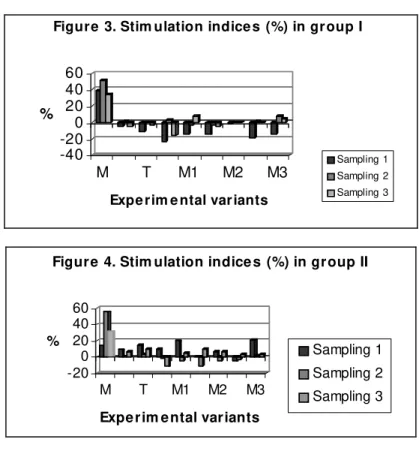
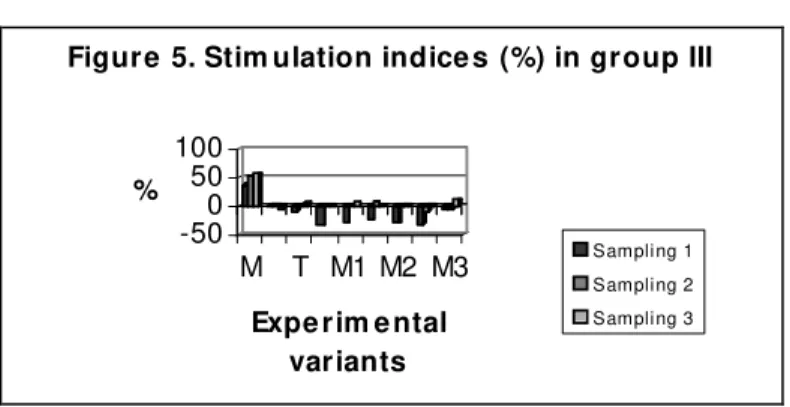
Most of the in vitro treatments lead to negative stimulation indices (Figure 3) in the control group. Leukocyte growth was inhibited even in the experimental variant supplemented with the policlonal activator (PHA-M) (-5.07, 1.53 and – 4.20% respectively). Birds in group II showed negative indices, mainly for the in vitro variants supplemented with the herbal extraction after the first antigen priming (Figure 4). Initial stimulation indices calculated for the variants treated with thymus extract, ethylic alcohol and acetone-petrol ether-methanol were higher than that calculated for the control (14.67, 20.02, and 21.01% respectively, against 13.67%). None of the vegetal extracts added in vitro induced leukocyte growth, compared to their solvent controls. There was an inhibition of leukocyte blast transformation (Figure 5) for all the in vitro treatments, except the index calculated for the control variant during the first sampling. Although for several variants, the stimulation indices obtained during the study slightly increased, their values were obviously lower than those calculated for the in vitro controls (52.64% at the second sampling and 57.2% at the third sampling). Neither the mitogen nor the thymus extraction induced in vitro stimulation of the leukocytes.
-40 -20 0 20 40 60
%
M T M1 M2 M3
Expe rim e ntal var iants
Figure 3. Stim ulation indice s (%) in gr oup I
Sampling 1 Sampling 2
Sampling 3
-20 0 20 40 60
%
M T M1 M2 M3
Expe rim e ntal variants
Figure 4. Stim ulation indice s (%) in group II
Sampling 1
-500 50 100 %
M T M1 M2 M3
Expe rim e ntal variants
Figure 5. Stim ulation indice s (%) in group III
Sampling 1 Sampling 2 Sampling 3
DISCUSSION
Lysozyme concentration during the experiment was similar in the control group to that in chickens treated with Calendula. The serum levels were at maximum by the end of the experiment and dropped after the first injection of SRBC. Bayol treatment showed a negative effect on lysozyme levels, also proved by the minimal value calculated in this group after the booster antigen priming (p<0.05). These results strongly suggest that Calendula officinalis extractive principles positively influenced this indicator of humoral response, counteracting the negative activity of the oil injected simultaneously.
Anti – SRBC antibody titers similarly increased in groups I and II, less in group III. An immediate effect of both Calendula and Bayol on antibody forming cells was indicated by high antibody titers. This stimulating activity did not last for any of these treatments, by the end of the experiment the birds from group II and III developing lower anti-SRBC antibodies titers than those calculated for the control group.
Interestingly, the structure of anti-SRBC antibodies was dominantly of Ig M type, independently of the moment of the study. The level of ME-resistant antibody gradually increased in the experimental groups, except for the one treated with Calendula. The vegetal extractions induced a stimulation of Ig G anti-SRBC antibody production after the first priming, but then altered the synthesis of this isotype. Therefore, in group II the increase of total antibody levels relied on stimulation of ME-sensitive (Ig M) antibodies. This activity was not found for group III and it indicates that specific immunoglobulin switch in this case was completely due to the herbal extraction therapy. Both Ig G and Ig M anti-SRBC
negatively influenced the function of antibody forming cells or the co-operation between different cells within the specific immune response.
The best spontaneous stimulation index was observed in group III suggesting that in vivo therapy with Bayol positively influence leukocyte blast transformation. This effect appeared right after the first inoculation of the thymus-dependent antigen and lasted till the end of the experiment. Therefore, Bayol treatment proved to stimulate spontaneous growth of the immune cells from blood cultures, showing a long lasting activity.
In the other experimental groups the blast transformation of leukocyte was decreased in the end of the study. This may indicate an inhibitory effect of the herbal extract on in vitro leukocyte proliferation. Still, the same extract showed a stimulatory immediate effect. On the other hand, the same spontaneous blast transformation inhibition phenomena were revealed for the control group and that may point out effects independent of the in vivo performed therapies.
Interestingly, the in vitro supplementation of whole blood cultures with PHA-M did not stimulate blast transformation of leukocytes in any experimental group. This comes to a contradiction with literature data stressing that this mitogen stimulates the proliferation of both T and B lymphocyte and a B and/or T cell deficiency would have been obvious in control variants as well.
REFERENCES
[1] Bendich A. , 1992. The role of carotenoids on the immune response, Voeding, Jaargang 53/Juli-Augustus Nr.7-8.
[2] Davies, B.H., 1991. Carotenoid metabolism as a preparation for function, Pure & Applied Chem.Vol.63, No.1, 131-140.
[3] Jyonouchi Harumi, Lei Zhang, Myron Gress, Yoshifumi Tanuta, 1994. Immunomodulating Actions of Carotenoid Euhaneement of in Vivo and in Vitro Antibody Production to T-dependent Antigens, Nutr.Cancer 21, 47-58.
[4] Jyonouchi Harumi, Lei Zhang, Yoshifumi Tanuta, 1993. Studies of Immunomodulating Actions of Carotenoides II Astaxantin Euhances in Vitro Antibody Production to T – dependent Antigens without Faciliting Polyclonal B – Cell Activation, Nutr.Cancer 19, 269-280.
[5] Jyonouchi Harumi, Roberta J. Hill, Yoshifumi Tanuta, R.A.Good, 1991. Studies of
Immunomodulating Actions of Carotenoids I Effects of β – Carotene and Astaxantin on Murine Lymphocyte Functions and Cell Surface Marker Expression in Vitro Culture System, Nutr.Cancer 16, 93-105.
[6] Jyonouchi Harumi, Sining Sun, Myron Gress, 1995. Effects of carotenoids on in Vitro Immunoglobulin Production by Human Peripheral Blood Mononuclear Cells: Astaxantin, a Carotenoid Without Provitamin A Activity, Euhances in Vitro Immunoglobulin Production in Response to a T – dependent Stimulant ant Antigen, Nutr. Cancer, 23, 171-183.
[7] Schwartz I., Shkelar G., 1987. Regression of Experimental Hamster Cancer by Beta Carotene and Algae extracts, J.Coral Maxillofac. Surg., 45, 510-515.
[8] Wataru Miki, 1991. Biological functions and activities of animal carotenoids, Pure & Applied Chem.Vol.63, No.1, 141-146.
Spînu Marina, [email protected], Dumitru Catalin,
Brudaocã Gheorghe Florinel, Dobrean Victor,
Oprio Anca, Andru Carmen,