www.epjournal.net – 2008. 6(2): 303-315 ¯ ¯ ¯ ¯ ¯ ¯ ¯ ¯ ¯ ¯ ¯ ¯ ¯ ¯ ¯ ¯ ¯ ¯ ¯ ¯ ¯ ¯ ¯ ¯ ¯ ¯ ¯ ¯
Original Article
Parent-Offspring Conflict over Mating: The Case of Beauty
Menelaos Apostolou, Department of Psychology, University of Warwick, Coventry, UK. Email:
Abstract: In pre-industrial societies parents exercise a strong influence over the mating decisions of their offspring. As modern pre-industrial societies approximate the way of life in ancestral human societies, human mating behavior should be seen as the outcome of a co-evolutionary process between parental and offspring’s mating choice. Both parents and offspring have evolved mating preferences, which enable them to select those mates and in-laws who maximize their inclusive fitness. Following Trivers’ (1974) theory of parent-offspring conflict, it is hypothesized that in-law and mating preferences substantially overlap, but also differ with respect to the beauty trait of a mating candidate. This hypothesis is tested on a sample of 292 parents. It is found that the two sets of preferences are strongly correlated, while beauty is preferred significantly more in a mating partner than in an in-law.
Keywords: parent-offspring conflict, parental choice, mating preferences, in-law preferences, mating behavior
¯ ¯ ¯ ¯ ¯ ¯ ¯ ¯ ¯ ¯ ¯ ¯ ¯ ¯ ¯ ¯ ¯ ¯ ¯ ¯ ¯ ¯ ¯ ¯ ¯ ¯ ¯ ¯ ¯ ¯ ¯ ¯ ¯ ¯ ¯ ¯ ¯ ¯ ¯ ¯ ¯ ¯ ¯ ¯ ¯ ¯ ¯ ¯ ¯ ¯ ¯ ¯ ¯ ¯ ¯ ¯ ¯ ¯ ¯ ¯ ¯ ¯ ¯ ¯ ¯ ¯ ¯ ¯ ¯ ¯ ¯ ¯ ¯
Introduction
In the majority of human societies parents exercise a strong control over the mating decisions of their offspring (e.g. Apostolou, 2007b; Broude and Greene, 1983; Frayser, 1985; Minturn, Grosse, and Haider, 1969; Whyte, 1978). However, parents and offspring do not necessarily share identical interests with respect to mating (Trivers, 1974). As a consequence, each party attempts to manipulate the other towards its own ends. Parents attempt to impose their own mating choices on their offspring through various means, such as chaperoning or early marriage (Goode, 1964). On the other hand the offspring attempt to escape from this control and exercise their own mating choice through divorce or extramarital relationships (Apostolou, 2007b). Effectively, the behavior of each party exercises evolutionary pressure on the behavior of the other.
it was also typical of the period of human evolution (Apostolou, 2007b). Accordingly, human mating behavior should be seen as a product of a co-evolutionary process between parental and individual mating choice. If this co-evolution is to be understood, it is essential to explore the degree to which parents and offspring agree or disagree over mating decisions.
Apostolou (2007a) hypothesized that parent-offspring conflict exists over the genetic quality of a prospective mating candidate: individuals are expected to value genetic quality more in their spouses than in their in-laws. In this study, parents were asked to rate a set of traits in an in-law and their ratings were compared with the ratings that individuals gave for the same set of traits in a mating partner in other studies. Consistent with this hypothesis, it was found that traits such as beauty, which are associated with genetic quality, rank higher in a mating partner than in an in-law. However, the results from this study are limited as the differences in the ranks can be attributed to differences between samples rather than differences in preferences between parents and offspring. Buunk, Park, and Dubbs (2008) tested a similar hypothesis and found that individuals consider a mating candidate who is not good looking more unacceptable than they think that their parents would. Nonetheless, this study is limited by the fact that it is based only on what the offspring think that their parents would prefer in an in-law. Consequently, their results may reflect only the offspring’s perceptions of the differences in the preferences between them and their parents rather than real differences in preferences between parents and offspring.
The purpose of this paper is to develop further the argument of parent-offspring conflict over mating. More specifically, the degree of overlapping between in-law and mating preferences is explored and the hypothesis is tested that parents and offspring are in conflict over the genetic quality of a mating candidate.
Parent-Offspring Conflict over Mating
Agreement or disagreement over mating decisions can be examined in the context of the theory of parent-offspring conflict as it was originally formulated by Trivers (1974). More specifically, in-law and spouse selection have important fitness consequences for both parents and offspring. In-laws and spouses provide not only their genes, but also material resources and social support that are necessary for survival and reproduction. However, as parents and offspring are not genetically identical, the traits of a mating candidate which maximize the inclusive fitness of parents do not necessarily maximize the inclusive fitness of the offspring. This being the case, conflict arises between the two: the in-law that parents select may not be considered the optimal choice as a spouse by the offspring, and conversely, the spouse the offspring selects may not be considered optimal by the parents as an in-law. Consequently, each party attempts to impose their own choices on the other. If such conflict arises, is there going to be a winner?
allow a marriage to be consummated. (We know of no successful suicide attempts, and in all cases the marriage was called off)” (Lee, 1984, p. 79).
Nonetheless, parents can also use psychological means to manipulate their offspring. They may advise their children on traits which are desirable in a spouse. Or in cases where parents are very old, they may use their age and fragile health to undermine a marriage that they do not favor. Other methods that modern parents use to control the mating decisions of their offspring include: “cajolery, persuasion, appeals to loyalty, and threats” (Sussman, 1953, p. 80). Finally, theoretical models indicate that parents may evolve alleles that completely counterbalance the effects of the selfish alleles in their offspring (e.g. Stamps, Metcalf, and Krishnan, 1978).
As both parties can use psychological means to manipulate each other but only parents are in control of parental investment, a more plausible equilibrium is where parents have the upper hand and most times they win, but sometimes their offspring win (see also Parker and Macnair, 1978). In other words there is space for both parties to exercise their mating choice.
Asymmetric Benefits Result into Asymmetric Preferences
Parent-offspring conflict over mating is manifested at the behavioral level in asymmetrical in-law and mating preferences. More specifically, parents and offspring have evolved specific mating preferences that guide their mating choice. For instance, younger females are more fertile than older ones, thus men usually date younger women because they have evolved a preference for youth in a female (Kenrick and Keefe, 1992). Similarly, hard-working individuals can provide more resources to the parents and their family than lazy ones and that is why industriousness is highly valued in an in-law (Apostolou, 2007a). Thus, if a trait in a mating candidate is more beneficial to the offspring than it is to its parents it is preferred more by the former than the latter.
Genetic quality is such a trait. Spouses with genes that enable them to resist the harmful effects of parasites, pathogens, toxins etc. increase the fitness of a mate seeker in terms of healthier offspring (Gangestad, Thornhill, and Yeo, 1994; Grammer and Thornhill, 1994). Genes that make a spouse particularly attractive also provide fitness benefits to mate seekers in terms of the higher success their offspring will enjoy in the mating market (Fisher, 1958). Genetic quality in a mating candidate is, then, beneficial to both parents and their offspring. It is beneficial for the offspring, because they share their genes with good or attractive genes; it is beneficial for the parents because the offspring’s genes are their genes.
Conflict over Beauty
Even if parents and offspring value beauty differently, does this mean that they are also in conflict over this trait? The answer is yes because mate choice entails compromise and parents and offspring differ in the compromises they are willing to make. More specifically, an individual of high mating quality would accept to commit only to a mate of similar or higher mating quality. Consequently, parents and offspring are constrained by their own mating value with respect to the value of the mate they can attract. Mate selection then involves a compromise in the various qualities of a mate or an in-law; however the compromises that each party is willing to make are not necessarily optimal for the other party.
As discussed above, physical attraction is differently valued in a spouse and in an in-law, so, parents and offspring are willing to make dissimilar compromises with respect to this trait. This is because, every one “unit” of physical attractiveness a parent is willing to give up leads to a loss of 0.25 units of genetic quality, but every one “unit” of physical attractiveness an offspring is willing to give up leads to a loss of 0.50 units of genetic quality. Consequently, parents would be willing to exchange more units of beauty for other traits, even if these are valued the same by their offspring. The evolved mechanism that enables parents to make such a compromise is a weaker preference for good looks. Genes that code for this preference thrive because they enable parents to make optimal in-law choices: they exchange beauty with traits that give them more benefits.
For example, parents may accept in-laws who have, say, good social standing, but are not good looking. However, genetic quality is more important to the offspring, so for them the benefit from good social status may not be enough to balance the losses from genetic quality. The offspring would instead prefer a spouse of lower social standing but higher genetic quality. As a consequence, parental choice inflicts a cost on the offspring in the form of loss in genetic quality. It has to be said that the cost of parental choice may be reduced by extramarital relationships: the offspring may accept spouses who comply with their parents’ standards, but they may have extramarital affairs with higher genetic quality individuals. However, by following such strategy the offspring are likely to suffer the cost of their spouses mate-guarding strategies (e.g. physical punishment; Buss, 2000; see also Discussion section).
Similarly, if the offspring are to solely exercise mating choice, their parents are likely to find themselves with an in-law with fewer capacities than they would have liked. In this case the parent-offspring conflict over mating arises because the offspring attach more weight to the good looks of their spouses, and in order to get a beautiful spouse they are willing to compromise more than their parents on other traits, such as industriousness or working ability. As a result, the offspring’s mating choice inflicts a cost to the parents in the form of loss of potential resources.
Materials and Methods Participants
A total of 292 participants, 115 women and 177 men, took part in this study. The mean age of male participants was 40.23 (SD = 12.16) and the mean age of female participants was 48.77 (SD = 10.89). A private company was employed specializing in recruiting participants for online research in psychology. The participants were selected from a large database of people willing to participate in online psychological research and had registered through the company’s web site. All participants received payment for completing the survey in the form of credit (of approximately $3 worth) that could be used to purchase goods from online stores. Participants were British adults living in the UK. Most of the participants were married (68%), followed by divorced (12%), single (10%), in a serious relationship (5.5%) and engaged (4.5%). To participate in the survey the participants had to be parents with at least one child irrespective of its age. Participants had on average 1.12 (SD = 1.20) male children and 1.04 (SD = 1.01) female children.
Materials
Participants had to complete an online survey. Online responses have been found to be as reliable as laboratory-based responses (Kraut et al., 2004). The survey consisted of two parts. In the first part, demographic data were collected: sex, age, nationality, country of residence, marital status, number of daughters, and number of sons. Then, the following scenario was given “You have two children, one male and one female, and you live in a society where marriages are arranged. It is your duty as a parent, through negotiations with other parents, to find an appropriate spouse for both your daughter and son
.”
Participants were then asked to rate a set of characteristics in a son-in-law and a daughter-in-law. In the second part, participants were given the following scenario: “You live in a society where marriages are not arranged and it is up to you to find a husband or a wife. You are not married yet but you think that the time has come for you to do so”
and then they were asked to rate a set of characteristics in a future husband or wife. In each part the participants were asked about the age preferences regarding their in-laws and marriage partners: “older, same age, younger, no preference”.The instrument employed to measure preferences was initially developed by Hill (1945) and was later used by Buss et al. (1990) to measure mating preferences. A modified version was employed by Apostolou (2007a) to measure in-law preferences; the same modified version will be used here. Additionally, the “wealth” item was added so as to examine whether in-law and mating preferences differ in this dimension. Overall, participants had to rate 18 characteristics (Table 1) and each characteristic was rated in the following four-point Likert scale: 3=indispensable, 2=important, 1=desirable, but not very important, and 0=irrelevant or unimportant.
Missing values accounted for no more than 2.1% of the responses in a given item. The missing values were replaced by the mean of the series.
In-Law vs. Mating Preferences Comparisons
comparisons between spouses and in-laws. However, the ratings for husband and wife, as the ratings for daughter-in-law and son-in-law, are not homogenous but contingent upon the sex of the spouse and the sex of the in-law (Tables 1 and 2). Consequently, collapsing categories will result into information-loss in identifying rating differences. Thus, a within-participants design was employed instead, to compare the ratings of the female within-participants for a son-in-law with the respective ratings for a husband, and the ratings of the male participants for a daughter-in-law with the respective ratings for a wife.
Comparisons between wife and son-in-law, and between husband and daughter-in-law were not made, since the results from this analysis would fail to distinguish differences in rating between sexes (female versus male) from differences between spouse versus in-law. Finally, a within participants design was deemed appropriate so as to control for alternative explanations based on social learning. In a between-participants design there is a substantial age gap between parents and offspring. Thus any difference in preferences between the two can be attributed to differences in socialization in each generation.
Results
Parental Preferences
Not all parents in the sample had children of both sexes. Although there was no specific hypothesis on whether the sex of the offspring affects parents’ ratings, this is a possibility. To examine whether this is the case, one-way ANOVA was conducted in each item of the instrument with the sex of the participants’ children as an independent factor (three levels: male children, female children, children of both sexes). Additionally, independence between the age ratings for in-laws and spouses was tested through Chi-square statistic. Bonferroni correction for alpha inflation was applied by decreasing alpha from .05 to .003 (.05/18), two-tailed. The results indicate that the ratings that parents have given are not affected by the sex of their children.
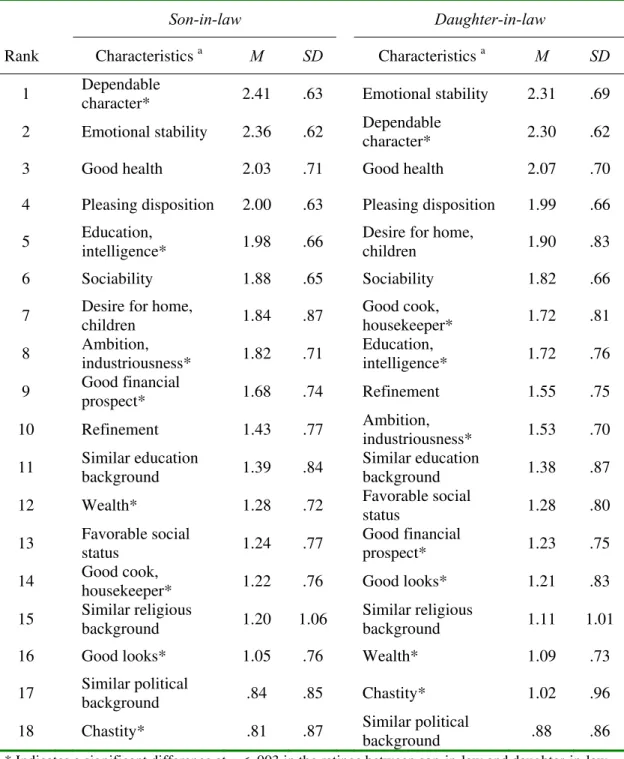
To examine the relative importance that parents attach to the specific items, these items were ranked according to their means (Table 1). Character traits like “kind and understanding” rank at the top of the hierarchy, followed in the middle of the hierarchy by traits associated with resource acquisition capacity, like “ambition and industriousness”. At the bottom of the hierarchy are traits such as “good looks” and “similar political background”. To examine whether parents’ preferences are contingent upon the sex of the in-law a series of paired-samples t-tests were conducted between the rating of the son-in-law and the daughter-in-son-in-law. Bonferroni correction for alpha inflation was applied as before. Ratings differ significantly between in-laws in various dimensions: parents, for instance, place much more emphasis on the resource acquisition capacity of the son-in-law than the daughter-in-law (Table 1). Furthermore, in-law preferences with respect to age differ according to the sex of the in-law [Marginal Homogeneity = 140, p < .001, (two-tailed)], with parents preferring older than their daughters sons-in-law and younger than their sons daughters-in-law.
independent variables. As before, Bonferroni correction was applied. It was found that parents are in agreement in all dimensions, except in emotional stability [F(1, 290) = 16.85, p < .001, (two-tailed), ηp2= .055] which is more important to females than males, and in good looks in an in-law [F(1, 290) = 12.66, p < .001, (two-tailed), ηp2 = .042] which is more important to males than females.
Table 1. Descriptive statistics and ranks of preferences concerning potential in-laws
Son-in-law Daughter-in-law
Rank Characteristics a M SD Characteristics a M SD
1 Dependable
character* 2.41 .63 Emotional stability 2.31 .69
2 Emotional stability 2.36 .62 Dependable
character* 2.30 .62
3 Good health 2.03 .71 Good health 2.07 .70
4 Pleasing disposition 2.00 .63 Pleasing disposition 1.99 .66
5 Education,
intelligence* 1.98 .66
Desire for home,
children 1.90 .83
6 Sociability 1.88 .65 Sociability 1.82 .66
7 Desire for home,
children 1.84 .87
Good cook,
housekeeper* 1.72 .81
8 Ambition,
industriousness* 1.82 .71
Education,
intelligence* 1.72 .76
9 Good financial
prospect* 1.68 .74 Refinement 1.55 .75
10 Refinement 1.43 .77 Ambition,
industriousness* 1.53 .70
11 Similar education
background 1.39 .84
Similar education
background 1.38 .87
12 Wealth* 1.28 .72 Favorable social
status 1.28 .80
13 Favorable social
status 1.24 .77
Good financial
prospect* 1.23 .75
14 Good cook,
housekeeper* 1.22 .76 Good looks* 1.21 .83
15 Similar religious
background 1.20 1.06
Similar religious
background 1.11 1.01
16 Good looks* 1.05 .76 Wealth* 1.09 .73
17 Similar political
background .84 .85 Chastity* 1.02 .96
18 Chastity* .81 .87 Similar political
background .88 .86
Parent-Offspring Conflict and Agreement
In order to identify differences between in-law and mating preferences a series of paired-sample t-tests was conducted between husband and son-in-law and between wife and daughter-in-law ratings on each item of the instrument. Also, a Marginal Homogeneity test was applied on the age item. Bonferroni correction for alpha inflation was applied as in the previous section. The results are summarized in Tables 1 and 2.
The first thing to observe is that preferences between parents and offspring are very similar, and in most variables there are no significant differences. As expected, in-law and mating preferences are strongly correlated. Spearman’s correlation between the ranks of the daughter-in-law and wife is: [rs(17) = .96, p < .001 (two tailed)], while correlation between son-in-law and husband is: [rs(17) = .95, p < .001 (two tailed)].
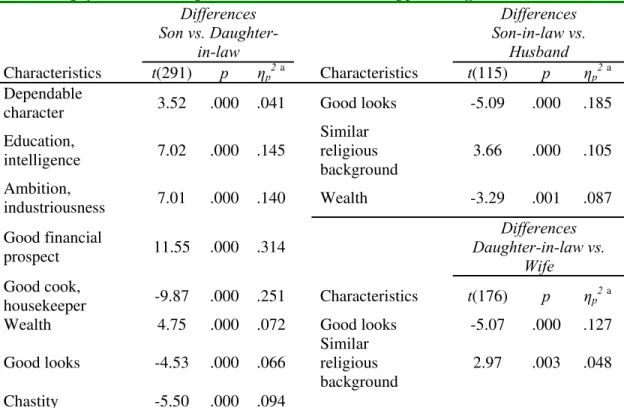
From Table 3, we see that more emphasis is placed on the “wealth” of the husband than that of the son-in-law [t(115) = -3.29, p = .001, (two-tailed), ηp2 = .087]. Also, “similar religious background” is more important in a son-in-law than in a husband [t(115) = 3.66, p < .001, (two-tailed), ηp2 = .105). “Good looks” are more important in a husband than in a son-in-law [t(115) = -5.09, p < .001, (two-tailed), ηp2 = .185]. Moreover, “similar religious background” is preferred more in a daughter-in-law than a son-in-law [t(176) = 2.97, p < .01, (two-tailed), ηp2 = .048]. Additionally, “good looks” are valued more in a wife than in a daughter-in-law [t(176) = -5.07, p < .001, (two-tailed), ηp2 = .127]. Finally, there is no significant difference in the ratings of the age item between son-in-law and husband, and between daughter-in-law and wife.
All participants in this study were parents so inevitably the mean age is not representative of the age of an individual at first marriage. If “good looks” is valued differently at younger ages, the true extent of the parent-offspring conflict may be overrated or underrated in this analysis. To examine whether this is the case, the “good looks” item was regressed on age for both males and females. The age variable was significant only in males [t(176) = -2.10, p < .05, (two-tailed)] with a coefficient of -.010. It can be argued then that males tend to place less emphasis on good looks as they get older. Thus, the conflict over beauty is bigger from the one depicted here since, when marriage takes place, male offspring are usually younger than the participants in this sample.
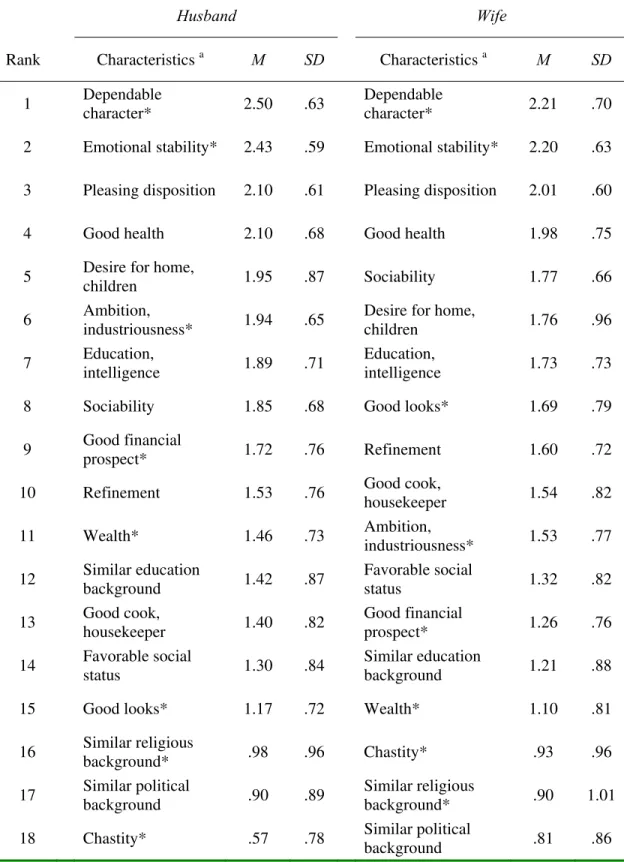
Table 2. Descriptive statistics and ranks of preferences concerning potential husbands or wives
Husband Wife
Rank Characteristics a M SD Characteristics a M SD
1 Dependable
character* 2.50 .63
Dependable
character* 2.21 .70
2 Emotional stability* 2.43 .59 Emotional stability* 2.20 .63
3 Pleasing disposition 2.10 .61 Pleasing disposition 2.01 .60
4 Good health 2.10 .68 Good health 1.98 .75
5 Desire for home,
children 1.95 .87 Sociability 1.77 .66
6 Ambition,
industriousness* 1.94 .65
Desire for home,
children 1.76 .96
7 Education,
intelligence 1.89 .71
Education,
intelligence 1.73 .73
8 Sociability 1.85 .68 Good looks* 1.69 .79
9 Good financial
prospect* 1.72 .76 Refinement 1.60 .72
10 Refinement 1.53 .76 Good cook,
housekeeper 1.54 .82
11 Wealth* 1.46 .73 Ambition,
industriousness* 1.53 .77
12 Similar education
background 1.42 .87
Favorable social
status 1.32 .82
13 Good cook,
housekeeper 1.40 .82
Good financial
prospect* 1.26 .76
14 Favorable social
status 1.30 .84
Similar education
background 1.21 .88
15 Good looks* 1.17 .72 Wealth* 1.10 .81
16 Similar religious
background* .98 .96 Chastity* .93 .96
17 Similar political
background .90 .89
Similar religious
background* .90 1.01
18 Chastity* .57 .78 Similar political
background .81 .86
This analysis indicates that the preferences of males are strongly correlated with the preferences of parents for a daughter-in-law [rs(17) = .94, p < .001 (two tailed)]. Also, males in the Buss et al. (1990) study rank “good looks” higher (9th) than parents (11th) do in the present study. The preferences of the females are also strongly correlated with parental preferences for a son-in-law [rs(17) = .95, p < .001 (two tailed)]. Finally, females rank “good looks” higher in the Buss et al. (1990) study (12th) than parents (16th) do in this one. The correlations of preferences between parents and offspring, although slightly smaller, are nevertheless very similar to the correlations found between in-law and mating preferences in this sample, indicating that being a parent has little effect on an individual’s mating preferences.
Table 3. Significant son vs. daughter-in-law and in-law vs. mating partner differences
Differences Son vs.
Daughter-in-law
Differences
Son-in-law vs. Husband
Characteristics t(291) p ηp2a Characteristics t(115) p ηp2a Dependable
character 3.52 .000 .041 Good looks -5.09 .000 .185
Education,
intelligence 7.02 .000 .145
Similar religious background
3.66 .000 .105
Ambition,
industriousness 7.01 .000 .140 Wealth -3.29 .001 .087
Good financial
prospect 11.55 .000 .314
Differences Daughter-in-law vs.
Wife
Good cook,
housekeeper -9.87 .000 .251 Characteristics t(176) p ηp
2a
Wealth 4.75 .000 .072 Good looks -5.07 .000 .127
Good looks -4.53 .000 .066
Similar religious background
2.97 .003 .048
Chastity -5.50 .000 .094
a
The effect size is by ηp2 which is the proportion of total variability attributable to the independent factor.
Discussion
The present evidence supports the original hypothesis that there is a substantial overlap between in-law and mating preferences, but also a difference with respect to the “good looks” trait. More specifically, in-law and mating preferences are strongly correlated; nonetheless “good looks” is preferred significantly more in a spouse than is preferred in an in-law.
youth, and younger individuals are perceived more attractive than older ones (Buss, 2003). Thus, individuals may prefer younger spouses and older in-laws, as it is indicated by their respective preferences for beauty. Furthermore, parents, in the course of negotiating with other families, may receive direct material benefits for themselves (e.g. gifts or money) for a slight de-emphasis on physical attractiveness. Accordingly, parental preferences may have evolved so as to discount beauty in an in-law. Finally, parents are expected to prefer their offspring to engage only in long-term mating, as short-term mating gives them little if any benefits. Although short term mating strategies are well documented in individual mate seekers (see Buss, 2003 for a review) there is not a single human culture that the author is aware of, that parents choose short-term partners for their offspring. Thus, the offspring are expected to engage in short-term mating, which greatly increases the importance of genetic benefits and thus physical attractiveness, and decreases the relevance of most other traits.
Based on this argument it can be further hypothesized that parents and offspring are in conflict over mating strategies: the offspring’s short term mating strategy conflicts with their parents’ long-term mating strategy. More specifically, a short-term mating strategy can be costly to the parents since it can damage the reputation of their family, while their offspring may commit their investment to an individual their parents do not approve. From the offspring’s point of view such a strategy may be worth following as the genetic benefits can be substantial. However, this is not the case for the parents whose gains from the genetic quality of their in-law are not as much. Conflict will arise between the two parties as the offspring attempt to engage in short-term relationships, while parents will attempt to prevent them from doing so. Future studies on parent-offspring conflict over mating should test this hypothesis.
Apart from “good looks,” significant differences between in-law and mating preferences were found with respect to “wealth” and “similar religious background.” There is no specific theory offered here that accounts for these differences. It can be argued though that differences over wealth may be an indication that females place more emphasis on direct rewards than their parents. Furthermore, it has been hypothesized that parents place more emphasis than their offspring on the family background of the in-law than their offspring (Trivers, 1974). Goode (1964, p. 34) argues that religious endogamy is not a reflection of a preference for theological beliefs, but a preference for social background which is correlated with religion. Thus, similarity in religion may be a proxy for the family background of the in-law, and this may be the reason why this trait is more preferred in an in-law.
A limitation of this study is that participants were chosen irrespective of the age of their child. It could be argued that in-law preferences are “activated” or become stronger when parents have children of reproductive age. Thus, future research should examine whether in-law preferences vary according with the age of the offspring.
The parent-offspring conflict over mating can give us new insight into human mating behavior. In the majority of human pre-industrial societies parents control the selection of the marriage partner for their offspring; as a result the offspring may find themselves married to someone of lower genetic quality than they desire. This exercises evolutionary pressure on the offspring to find a way to balance the cost inflicted by their parents’ choice. One way is through extramarital relations that do not fall in the sphere of parental control. Mating behavior then may have evolved so as to enable individuals to seek good genes outside marriage, in extramarital partners. As it was discussed above such mating strategy should also be a source of conflict between parents and offspring.
Furthermore, the theory of parent offspring-conflict over mating can enable us to better understand and make predictions about family dynamics. In contemporary post-industrial societies, the offspring, and not their parents, select marriage partners. However, as parents and offspring do not share identical mating preferences, the offspring’s choice of a spouse will not always be acceptable by parents. For instance, the offspring may select a good looking spouse with limited financial prospects. In such a case parents may use indirect means to undermine and eventually break up such marriage. Parents may threaten to discontinue any financial help or perhaps inheritance rights if their offspring decides to proceed with the marriage.
To conclude, the present research is one of the first attempts to explore and test specific hypotheses over parent-offspring conflict in relation to mating. It was found that in-law and mating preferences substantially overlap, but there is disagreement over the beauty trait. Further research is needed to identify more areas of conflict and agreement. This is a necessary step for us to understanding the evolution of mating behavior as a product of a co-evolutionary process between parental and individual mating choice.
Acknowledgements: I thank Lia Mexa, Aris Boukouras and Dora Zarkadi for their useful comments during the preparation of this manuscript. I also thank an anonymous reviewer for constructive criticism and comments.
Received 17 December 2007; Revision submitted 17 April 2008; Accepted 28 April 2008
References
Alexander, R.D. (1974). The evolution of social behavior. Annual Review of Ecology and Systematics, 5, 325-383.
Apostolou, M. (2007a). Elements of parental choice: The evolution of parental preferences in relation to in-law selection. Evolutionary Psychology, 5, 70-83.
Apostolou, M. (2007b). Sexual selection under parental choice: The role of parents in the evolution of human mating. Evolution and Human Behavior, 28, 403-409.
Buss, D.M. (2000). The Dangerous Passion. London: Bloomsbury.
Buss, D.M. (2003). The Evolution of Desire: Strategies of Human Mating (2nd ed.). New York: Basic Books.
Buss, D.M., Abbott, M., et al. (1990). International preferences in selecting mates: A study of 37 cultures. Journal of Cross-Cultural Psychology, 21, 5-47.
Buunk, A.P., Park, J.H. and Dubbs, S.L. (2008). Parent-offspring conflict in mate preferences. Review of General Psychology, 12, 47-62.
Fisher, R.A. (1958). The Genetic Theory of Natural Selection (rev. ed.). Oxford: Oxford University Press.
Frayser, S.G. (1985). Varieties of Sexual Experience. New Haven: HRAF Press. Gangestad, S.W., Thornhill, R., and Yeo, R.A. (1994). Facial attractiveness, developmental
stability, and fluctuating asymmetry. Ethology and Sociobiology, 15, 73-85. Goode, W.J. (1964). The Family. Englewood Cliffs: Prentice-Hall.
Grammer, K. and Thornhill, R. (1994). Human (Homo sapiens) facial attractiveness and sexual selection: the role of symmetry and averageness. Journal of Comparative Psychology, 108, 233-242.
Hill, R. (1945). Campus values in mate selection. Journal of Home Economics, 37, 554-558.
Kenrick, D.T., and Keefe, R.C. (1992). Age preferences in mates reflect sex differences in
reproductive strategies. Behavioral and Brain Sciences, 15, 75–133.
Kraut, R., Olson, J., Banaji, M., Bruckman, A., Cohen, J., and Couper, M. (2004). Psychological research online. American Psychologist, 59, 105-117.
Lee, R.B. (1984). The Dobe !Kung. New York: Holt, Rinehart and Winston. Lee, R.B., and DeVore, I. (1968). Man the Hunter. New York: Aldine. Minturn, L., Grosse, M., and Haider, S. (1969). Cultural patterning of sexual beliefs and
behavior. Ethnology, 8, 301-318.
Parker, G.A., and Macnair, M.R. (1978). Models of parent-offspring conflict. I. Monogamy. Animal Behavior, 26, 97-110.
Stamps, J.A., Metcalf, R.A., and Krishnan, V.V. (1978). A genetic analysis of parent-offspring conflict. Behavioral Ecology and Sociobiology, 3, 369-392.
Sussman, M.B. (1953). Parental participation in mate selection and its effect upon family continuity. Social Forces, 1, 76-81.
Thornhill, R., and Gangestad, S.W. (1993). Human facial beauty: Averageness, symmetry, and parasite resistance. Human Nature, 4, 237-269.
Thornhill, R., and Møller, A.P. (1997). Developmental stability, disease and medicine. Biological Review, 72, 497-548.
Trivers, R. (1974). Parent offspring conflict. American Zoologist, 24, 249-264.