www.epjournal.net – 2008. 6(3): 456-468 ¯¯¯¯¯¯¯¯¯¯¯¯¯¯¯¯¯¯¯¯¯¯¯¯¯¯¯¯
Original Article
Parent-Offspring Conflict over Mating: The Case of Family Background
Menelaos Apostolou, Department of Psychology, University of Warwick, Coventry, UK. Email:
Abstract: In human societies the choice of a spouse is the outcome of individual mating choice and parental influence over mating. However, parents and offspring do not share identical interests with respect to mating. Accordingly, in order to understand this process it is necessary to examine the degree to which parents and offspring agree or disagree over mating choices. Trivers (1974) originally hypothesized that the two parties are in conflict over the family background of a mating candidate, with parents valuing this trait more than their offspring in a mating candidate. In this article this hypothesis is developed theoretically and empirically. It is proposed that that historically a preference for good family background increased the fitness of the parents more than the fitness of their offspring. Using a sample of 305 parents, the hypothesis is tested that good family background is preferred more in an in-law than in a spouse. The results from this study provide support for this hypothesis.
Keywords: Parent-offspring conflict, parental choice, mating choice, mating behavior, co-evolution
¯¯¯¯¯¯¯¯¯¯¯¯¯¯¯¯¯¯¯¯¯¯¯¯¯¯¯¯¯¯¯¯¯¯¯¯¯¯¯¯¯¯¯¯¯¯¯¯¯¯¯¯¯¯¯¯¯¯¯¯¯¯¯¯¯¯¯¯¯¯¯¯¯¯¯¯¯¯¯¯¯¯¯¯¯¯¯
Introduction
understood, it is necessary to identify the degree to which parents and offspring agree or disagree over mating decisions.
Parents and offspring are not genetically identical and as a consequence they do not share identical interests with respect to mating (Trivers, 1974). Actually, if both parties had identical interest there would be no reason for parents to strive to control the mating decisions of their offspring in the first place (Apostolou, 2007b). Exploration of parent-offspring conflict over mating has become the focus of recent research efforts (Apostolou, 2008; Buunk, Park, and Dubbs, 2008). The purpose of this study is to contribute to this line of research both theoretically and empirically.
Parent-offspring Conflict over Mating
Committing to a relationship with someone of lower mating quality to one’s own is unlikely to be a successful strategy, as it equals forfeiting the opportunity to engage in a relationship with someone of a superior quality. For this reason, individuals engage in relationships with other individuals of a mating value similar to their own (Blossfeld and Timm, 2003). Consequently, parents and offspring are constrained by their own mating value in relation to the mating value of an individual they can attract (Apostolou, 2008). Mate choice then entails a trade-off, and parent-offspring conflict arises if one or more traits in a mating candidate offer asymmetrical benefits to each party. In this case, the party which benefits less from a given trait compromises more on this trait. This compromise inflicts a cost to the other party to which this trait is more beneficial resulting in conflict between the two.
The genetic quality of a mating candidate has been identified by previous research as giving unequal benefits to parents and offspring (Apostolou, 2007a): parents share 25% of their genes with their grandchildren, and thus, receive less fitness benefits from an individual of high genetic quality than their offspring, who share 50% of their genes with their children. Thus, although mating candidates with good genes are beneficial to both parents and offspring, they are more beneficial to the offspring than they are to their parents. Physical beauty is a proxy of genetic quality (Thornhill and Gangestad, 1993), so this trait is expected to be valued more by the offspring than by parents. Empirical research has confirmed this prediction (Apostolou, 2008; Buunk et al., 2008). However, parent-offspring conflict over mating is not confined only to beauty.
Parent-offspring Conflict over Family Background
Trivers (1974) originally hypothesized that parent-offspring conflict exists over the family background of a mating candidate with parents placing greater emphasis on this trait than their offspring: “Parents may also use an offspring’s marriage to cement an alliance with an unrelated family or group, and insofar as such an alliance is beneficial to kin of the parent in addition to the offspring itself, parents are expected to encourage such marriages more often than the offspring would prefer” (Trivers, 1974, p. 261).
Nonetheless, preferences for this trait are not symmetrical and the reason why becomes apparent when mating choice is examined through an evolutionary perspective. More specifically, the typical pattern of mating in modern foraging societies is arranged marriage, where parents select spouses for their offspring, but the offspring are able to exercise mating choice within marriage (e.g., through extramarital relationships) (Apostolou, 2007b; Broude and Greene, 1983). Modern foraging societies resemble ancestral human societies which also based their social organization on hunting and gathering (Lee and De Vore, 1968). Thus, there are good reasons to believe that this pattern of mating was also typical during the period of human evolution (Apostolou, 2007b; Ember, 1978).
The way parents and offspring had been exercising mating and in-law choice would be reflected in their evolved preferences. To start with, in order to exercise better control over mating decisions, parents marry their offspring early, frequently when they are still children and dependent on them for food and protection (Apostolou, 2007b; Frayser, 1985). The consequence of this strategy is that the selection of in-laws takes place when the offspring and their prospective spouses are very young. As the in-laws are still not fully grown, parents cannot identify among prospective in-laws those with desirable traits, such as industry or working ability. Consequently, they have to rely on other cues, such as the in-laws’ family background, to make a choice which is beneficial for them. On the other hand, the offspring exercise mating choice later in life when they and their prospective spouses are fully grown, so they can rely less on family background and more on other traits of their mating partner.
Moreover, in the context of arranged marriage one way for the offspring to exercise mating choice is through extramarital relationships over which parents have little, if any, control (Apostolou, 2007b). In this case the family background of a short-time mate becomes irrelevant. Such trait will bring no fitness benefits to the mate seeker who is more likely to be interested in other traits, such as genetic quality (Buss and Schmitt, 1993).
If these patterns of mating have been historically the case (and evidence points towards this direction), there should have been weak evolutionary pressure on the offspring, but strong evolutionary pressure on parents to evolve preferences for good family background in a mating candidate. This asymmetry in preferences is a source of conflict between parents and offspring.
In more detail, when parents choose an in-law, they look for an individual with a family background that maximizes their own fitness and not the fitness of their offspring. For instance, across different cultures, marriage is usually accompanied by a transfer of wealth from the parents of the groom to the parents of the bride through the institution of bridewealth (Murdock, 1981). Among the Manus of New Guinea, a father has arranged a marriage for his daughter and has received a substantial bridewealth from the parents of his son-in-law that intends to give to his nephew to “pay” for his own bride: “Her father is well pleased with the match. Ten thousand dogs’ teeth will be paid, ten thousand dog’s teeth which he can very well use to pay for a wife for his brother’s son who is turned fifteen and unbetrothed” (Mead, 1963, p. 50). This arrangement is beneficial for the father who shares on average 25% of his genes with his nephew but it is half as beneficial for his daughter who shares on average 12.5% of her genes with her cousin.
“unit” of good family background parents receive from their in-law increases their fitness more than it increases the fitness of their offspring. Therefore, parents will be willing to exchange more “units” of other traits for family background than their offspring consider it optimal for themselves. This imposes a cost to the offspring who are likely to find themselves married to a spouse with a mix of traits which does not maximize their fitness. For instance, the in-laws that parents have selected may not be as attractive as the offspring would like them to be and this loss in beauty is not compensated by their good family background.
Some empirical evidence provides support for the hypothesis that parents value family background in a mating candidate more than their offspring: Apostolou (2007a) introduced good family background in a set of traits that parents had to rate their desirability in a potential son-in-law and daughter-in-law. It was found that this trait ranked 8 out of 16 for sons-in-law and 6 out of 16 for daughters-in-law. Moreover, Apostolou (2008) found that individuals prefer similar religious background more in an in-law than in a spouse and interpreted this as evidence that parents value the family background of their in-law more than their offspring. Finally, Buunk et al. (2008) found that individuals consider a mating candidate who does not come from a good family background more acceptable than they think their parents would.
The present study, by employing a sample of sexually mature participants who have children and can act both as parents and mate seekers, tests the hypothesis that individuals have evolved to prefer good family background more in an in-law than in a spouse.
Materials and Methods
Participants
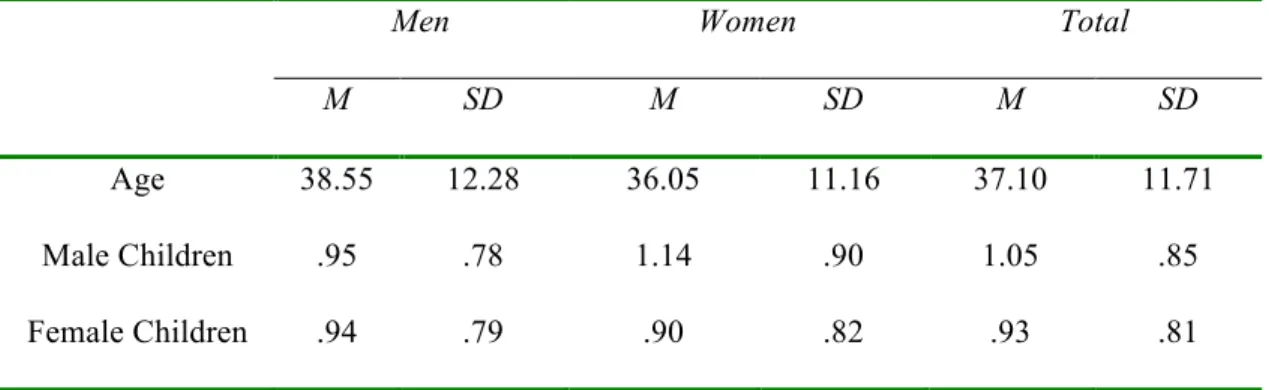
Table 1.Demographic information
Men Women Total
M SD M SD M SD
Age 38.55 12.28 36.05 11.16 37.10 11.71
Male Children .95 .78 1.14 .90 1.05 .85
Female Children .94 .79 .90 .82 .93 .81
Materials
The survey consisted of two parts. In the first part, demographic data were collected: sex, age, nationality, marital status, number of daughters, and number of sons. Then, the following scenario was given: “You have two children, one male and one female, and you live in a society where marriages are arranged. It is your duty as a parent, through negotiations with other parents, to find an appropriate spouse for both your daughter and son
”
and then participants were asked to rate a set of characteristics in a son-in-law and a daughter-in-law. In the second part, participants were given the following scenario “You live in a society where marriages are not arranged and it is up to you to find a husband or a wife. You are not married yet but you think that the time has come for you to do so”,
and then they were asked to rate a set of characteristics in a future husband or wife. The order of presentation of the two scenarios was randomized between participants. Moreover, in each part the participants were asked to indicate the social status of the family they or their offspring would like to marry into: “same social status, higher social status, lower social status, no preference”.The instrument employed to measure mating preferences is an extended version of a previous instrument developed by Buss and Barnes (1986) which in turn was based on a larger instrument developed by Gough (1973) to study family planning. Additional items were added to test specific hypotheses and the instrument in its final form included 18 items (Table 2). More specifically, four items were added so as to measure family background preferences: similar racial background, good family background, good family reputation, wealthy family. The selection of the last three items was based on the ethnographic literature of pre-industrial societies. In particular, good family background and good family reputation are frequently reported to be an important consideration for the parents when they are considering an in-law (e.g., the Nez Perce: Walker, 1998). Furthermore, wealth is also correlated with social status and there are indications that parents are interested in the resources of an in-law’s family (e.g., the Kipsigis: Borgerhoff Mulder, 1988). Finally, similar racial background item was added because race correlates with a family’s social status (Goode, 1964). Each item was rated in the following five-point Likert scale: +2 = very desirable; +1 = somewhat desirable; 0 = inconsequential, or neutral; -1 = somewhat undesirable; -2 = very undesirable.
In-law vs. Mating Preferences Comparisons
Previous studies indicate that the ratings of desired traits in a prospective daughter-in-law and son-daughter-in-law are contingent upon the sex of the spouse and the sex of the daughter-in-law (Apostolou, 2007a; Buss, 2003). Consequently, if comparisons are to be made between in-laws and spouses, this will result in information loss with respect to measuring differences in ratings. Thus, a within-participants design was employed instead, and the ratings of the female participants for a son-in-law were compared with the respective ratings for a husband, and the ratings of the male participants for a daughter-in-law were compared with the respective ratings for a wife. Also, comparisons between wife and son-in-law and between husband and daughter-in-law were not made, since the results from this analysis would fail to distinguish differences in ratings between sexes (men versus women) from differences in ratings between spouses versus in-laws.
Results
Parental Preferences
Not all parents in the sample had children of both sexes, so it should be examined whether the sex of the offspring affects parents’ in-law ratings. This possibility was tested with a series of ANOVA and Chi-square tests. Bonferroni correction for alpha inflation was applied by decreasing alpha from .05 to .003 (.05/18), two-tailed. The results indicate that the ratings of the parents are not affected by the sex of their children. Moreover, to test whether male and female parents differ in their in-law preferences, a series of 2x2 mixed ANOVAs was conducted with the sex of the in-law as a within-subjects factor and the sex of the parent as a between-subjects factor on every item of the instrument. As before, Bonferroni correction was applied. It was found that in-law preferences are not contingent upon the sex of the parent.
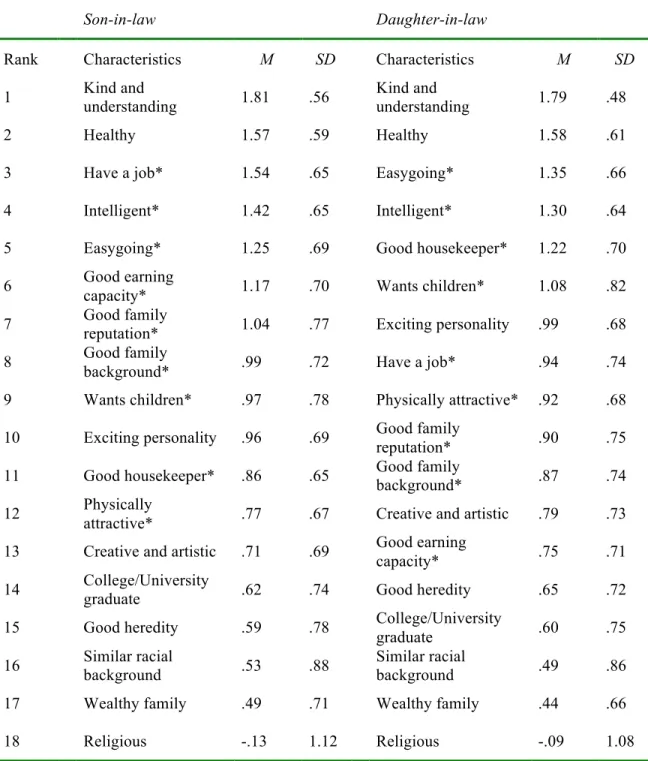
To examine the relative importance that parents attach to the specific items, these items were ranked according to their means (Table 2). With respect to the family background items, we see that good family background and good family reputation rank roughly in the middle of the parental preferences for both in-laws. However, these items rank higher for a son-in-law than for a daughter in-law. The wealthy family item ranks low, at the bottom of the in-law preferences hierarchy. This is also the case for the similar racial background item.
Table 2. Means and ranks of preferences concerning potential in-laws
Son-in-law Daughter-in-law
Rank Characteristics M SD Characteristics M SD
1 Kind and
understanding 1.81 .56
Kind and
understanding 1.79 .48
2 Healthy 1.57 .59 Healthy 1.58 .61
3 Have a job* 1.54 .65 Easygoing* 1.35 .66
4 Intelligent* 1.42 .65 Intelligent* 1.30 .64
5 Easygoing* 1.25 .69 Good housekeeper* 1.22 .70
6 Good earning
capacity* 1.17 .70 Wants children* 1.08 .82
7 Good family
reputation* 1.04 .77 Exciting personality .99 .68
8 Good family
background* .99 .72 Have a job* .94 .74
9 Wants children* .97 .78 Physically attractive* .92 .68
10 Exciting personality .96 .69 Good family
reputation* .90 .75
11 Good housekeeper* .86 .65 Good family
background* .87 .74
12 Physically
attractive* .77 .67 Creative and artistic .79 .73
13 Creative and artistic .71 .69 Good earning
capacity* .75 .71
14 College/University
graduate .62 .74 Good heredity .65 .72
15 Good heredity .59 .78 College/University
graduate .60 .75
16 Similar racial
background .53 .88
Similar racial
background .49 .86
17 Wealthy family .49 .71 Wealthy family .44 .66
18 Religious -.13 1.12 Religious -.09 1.08
* indicates a significant difference at p < .003 in the ratings between daughter-in-law and son-in-law.
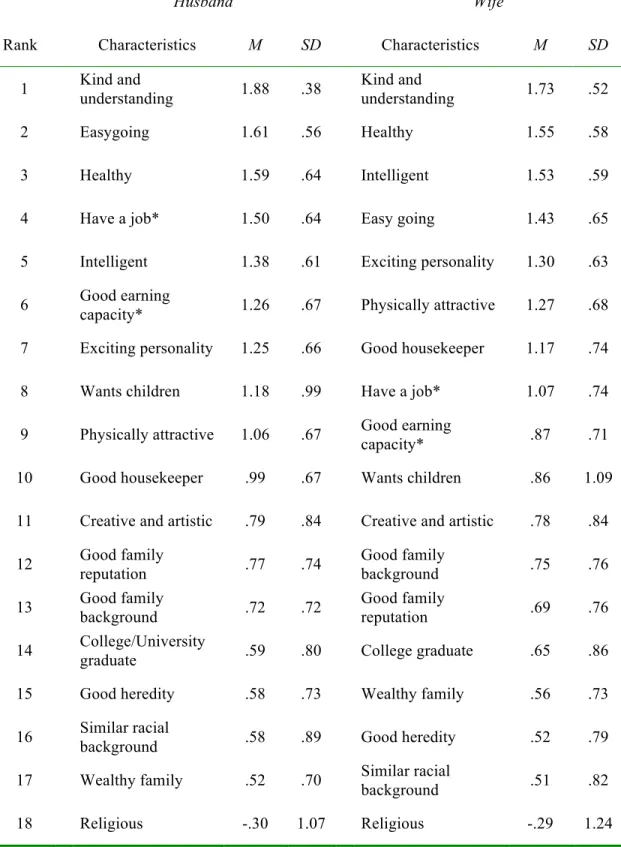
Table 3. Means and ranks of preferences concerning potential husbands or wives
Husband Wife
Rank Characteristics M SD Characteristics M SD
1 Kind and
understanding 1.88 .38
Kind and
understanding 1.73 .52
2 Easygoing 1.61 .56 Healthy 1.55 .58
3 Healthy 1.59 .64 Intelligent 1.53 .59
4 Have a job* 1.50 .64 Easy going 1.43 .65
5 Intelligent 1.38 .61 Exciting personality 1.30 .63
6 Good earning
capacity* 1.26 .67 Physically attractive 1.27 .68
7 Exciting personality 1.25 .66 Good housekeeper 1.17 .74
8 Wants children 1.18 .99 Have a job* 1.07 .74
9 Physically attractive 1.06 .67 Good earning
capacity* .87 .71
10 Good housekeeper .99 .67 Wants children .86 1.09
11 Creative and artistic .79 .84 Creative and artistic .78 .84
12 Good family
reputation .77 .74
Good family
background .75 .76
13 Good family
background .72 .72
Good family
reputation .69 .76
14 College/University
graduate .59 .80 College graduate .65 .86
15 Good heredity .58 .73 Wealthy family .56 .73
16 Similar racial
background .58 .89 Good heredity .52 .79
17 Wealthy family .52 .70 Similar racial
background .51 .82
18 Religious -.30 1.07 Religious -.29 1.24
* indicates a significant difference at p < .003 in the ratings between husband and wife.
In order to identify whether in-law and mating preferences differ, the ratings of the female participants for a son-in-law were compared with the respective ratings for a husband, and the ratings of the male participants for a daughter-in-law were compared with the respective ratings for a wife. A series of paired-sample t-tests was conducted on each item of the instrument. Furthermore, to identify differences in preferences between husband and wife independent samples t-tests were conducted on each item of the instrument with the sex of the participant as a grouping variable. Also, Marginal Homogeneity and Chi-square tests were applied on the family status item. Bonferroni correction for alpha inflation was applied as before.
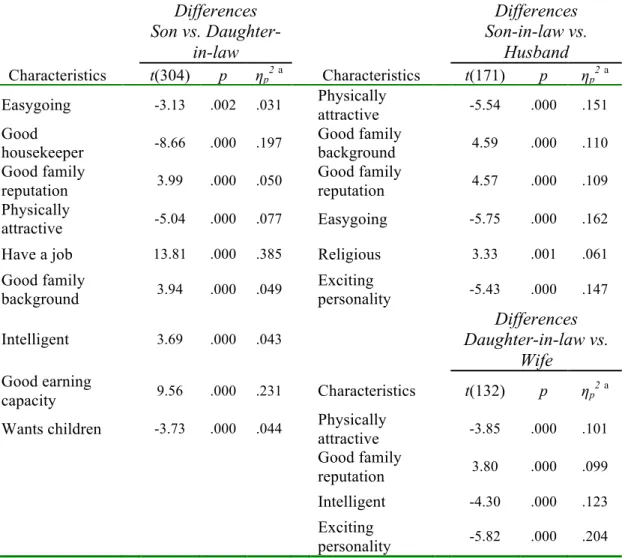
In comparing the ratings of a son-in-law to a husband, significant differences were found in a number of variables: physically attractive [t(171) = -5.54, p < .001, (two-tailed),
ηp2 = .151] is preferred more in a husband than in a son-in-law; good family background
[t(171) = 4.59, p < .001, (two-tailed), ηp2= .110] is preferred more in a son-in-law than in a
husband; good family reputation [t(171) = 4.57, p < .001, (two-tailed), ηp2 = .109] is
preferred more in a son-in-law than in a husband; easy going [t(171) = -5.75, p < .001, (two-tailed), ηp2 = .162] is preferred more in a husband than in a son-in-law; religious
[t(171) = 3.33, p < .001, (two-tailed), ηp2= .061] is considered less undesirable in a
son-in-law than in a husband, and exciting personality [t(171) = -5.43, p < .001, (two-tailed), ηp2 =
.147] is preferred more in a husband than in a son-in-law.
Comparisons between the ratings of a daughter-in-law and a wife, indicated significant differences in a number of traits: exciting personality [t(132) = -5.82, p < .001, (two-tailed), ηp2= .204] is preferred more in a wife than in a daughter-in-law; intelligent
[t(132) = -4.30, p < .001, (two-tailed), ηp2 = .123] is preferred more in a wife than in a
daughter-in-law; physically attractive [t(132) = -3.85, p < .001, (two-tailed), ηp2= .101] is
preferred more in a wife than in a daughter-in-law; and good family reputation [t(132) = 3.80, p < .001, (two-tailed), ηp2= .099] is preferred more in a daughter-in-law than in a
wife. Good family background is preferred more in a daughter-in-law than in a wife, however this difference passes the significance level only when Bonferroni correction is not applied [t(132) = 2.28, p < .05, (two-tailed), ηp2 = .038]. The results from the
comparisons between spouses and in-laws are summarized in Table 4.
With respect to the family’s social status item, 27.1% of the male participants indicated a preference for a wife from a family of equal social status, 6.8% of higher social status, 0.8% of lower social status, and 65.4% indicated no preference. Similarly, 32.6% of the female participants indicated a preference for a husband from a family of equal social status, 6.4% of higher social status, and 61% indicated no preference. Chi-square test indicates independence between the ratings of the family social status and the sex of the parent, whereas Marginal Homogeneity test indicates independence between the ratings for this item and the role of the participant (mate seeker or parent). In other words, preferences for a family’s social status are the same irrespectively of whether individuals are parents or mate seekers, and irrespectively of their sex.
significant only for women [t(171) = 2.29, p < .05, (two-tailed)] with a coefficient of .011. Finally, age was regressed on the good family reputation item for both sexes. As before, this trait came significant only for women [t(171) = 1.99, p < .05, (two-tailed)] with a coefficient of .010. This is an indication that the preference for family background becomes stronger as women grow older. As women in this sample are older than women at marriage age parent-female offspring conflict over family background may be stronger than it appears to be here.
Table 4.Significant Son vs. Daughter-in-law and In-law vs. Mating Partner Differences
Differences Son vs.
Daughter-in-law
Differences
Son-in-law vs. Husband
Characteristics t(304) p ηp
2a Characteristics
t(171) p ηp 2a
Easygoing -3.13 .002 .031 Physically
attractive -5.54 .000 .151 Good
housekeeper -8.66 .000 .197
Good family
background 4.59 .000 .110 Good family
reputation 3.99 .000 .050
Good family
reputation 4.57 .000 .109 Physically
attractive -5.04 .000 .077 Easygoing -5.75 .000 .162
Have a job 13.81 .000 .385 Religious 3.33 .001 .061
Good family
background 3.94 .000 .049
Exciting
personality -5.43 .000 .147
Intelligent 3.69 .000 .043
Differences Daughter-in-law vs.
Wife
Good earning
capacity 9.56 .000 .231 Characteristics t(132) p ηp
2a
Wants children -3.73 .000 .044 Physically
attractive -3.85 .000 .101 Good family
reputation 3.80 .000 .099
Intelligent -4.30 .000 .123
Exciting
personality -5.82 .000 .204
a
The effect size is indicated here by ηp 2
which is the proportion of total variability attributable to the independent factor.
Discussion
Furthermore, participants attach little weight to the similarity of racial background, irrespectively of whether they act as parents or mate seekers. This result comes in contradiction with studies which have revealed the importance of similarity of race in spouse selection (e.g., Liu, Campbell, and Condie, 1995; Warren, 1970). A possible explanation for this discrepancy may be that race is a sensitive matter and a self-report questionnaire may not be appropriate for measuring preferences with respect to this trait.
Moreover, differences between in-law and mating preferences were also found for other traits, such as “easygoing” and “exciting personality” with these properties being preferred significantly more in a husband and a wife than in an in-law. No specific theory is offered that accounts for these results. A plausible hypothesis may be that, as it is the offspring and not the parents who share a lifetime with their spouses, it makes sense for the former to be more sensitive to traits that facilitate co-habitation and co-operation.
Buunk et al. (2008) offer a different explanation for the asymmetry in preferences for family background. More specifically, they argued that in a mating trade-off, which involves an investing mate versus a mate with good genes, parents’ interests are served better if their offspring have highly investing mates than mates of superior genetic quality. This is because parents would get fewer benefits from the genetic quality of their in-laws so they would not like to have as much of this trait as their offspring. Family background is a proxy of an individual’s ability to invest, so parents would tend to prefer this trait more than their offspring, since such preference will enable them to make a more optimal trade-off. However, from this argument follows that parents value good genes less, but not necessarily that they value family background more than their offspring. Also, this argument implies that parents should prefer qualities which are directly associated with an individual’s ability to invest more than their offspring prefer them in a mating candidate. This prediction is inconsistent with the findings of this and a previous study (Apostolou, 2008), which indicated that individuals value traits such as “good earning capacity”, “hard working”, “ambition and industriousness” the same in a spouse and in an in-law.
Additionally, Buunk et al. (2008) argued that the good family background of a mating candidate is more beneficial to parents because they can establish an alliance and/or increase their social status through the marriage of their children. Nonetheless, the offspring may be as sensitive to the family background of their spouses for the same reasons: they may want to establish an alliance which is beneficial to them and/or increase their own social status.
A limitation of this study is that participants had to rate traits on the basis of a hypothetical scenario. Furthermore, the same participants were employed to rate traits in a spouse and in an in-law. This gives additional value to the findings presented here as the same individuals differentiate their preferences according to whether they act as parents or mate seekers. However, the within participants design may mask the true extent of the parent-offspring disagreement, as in this design in-law and mating preferences are likely to appear as more similar than they really are. A future study which compares the ratings of parents with those of their offspring can be more revealing of the true extent of the parent-offspring conflict over mating.
market would primarily reflect the parents’ preferences, while today’s Western mating market primarily reflects the offspring’s preferences. By identifying the differences in the preferences between parents and offspring, the present research, enables us to make certain inferences with respect to ancestral mating market conditions.
More specifically, in the ancestral mating market beauty in a mating candidate would have been in less demand and good family background in higher demand. This has important implications for the evolution of human mating behavior. For instance, in our ancestral past there was less pressure on individual mate seekers to place emphasis on good looks, as selection was based less on this trait. The weaning of parental control in modern societies has increased the demand for beauty, as mate selection is now based more on this trait. This places greater pressure on individuals to improve their appearance, which in turn may be reflected in the higher demand for artificial beauty (e.g., beauty products, plastic surgery, etc.), as individuals attempt to adjust to the novel mating market conditions.
It should be clarified here that this argument does not imply that ancestral populations were indifferent to their looks. The ethnographic literature is rich with examples of individuals in traditional societies who employ various methods for improving their physical appearance (e.g., the Twana of North America, Elmendorf and Kroeber, 1992). However, what is argued here is that an effort to improve one’s appearance in a traditional society, where parents are influential or even in control of their offspring’s mating choice, results into less reproductive benefits than an effort to improve one’s appearance in a post-industrial society, where parents have less or no influence on their offspring’s mating choice.
Parents and offspring do not have identical preferences with respect to mating choice and this is a source of conflict between the two. To understand this conflict, and consequently the evolution of human mating, it is necessary to identify the specific areas of disagreement between the two parties. The present study provides evidence that parents and offspring disagree over the family background of a mating candidate. This is not the only source of conflict over mating, and further research is needed to shed light to this fascinating aspect of human behavior.
Acknowledgements: I would like to thank Lia Mexa, Evangelos Aspiotis and Maria Doritou for their help during the preparation of this manuscript. I would also like to thank Viren Swami and two anonymous reviewers for their constructive comments and criticism.
Received 26 June 2008; Revision submitted 19 August 2008; Accepted 19 August 2008
References
Apostolou, M. (2007a). Elements of parental choice: The evolution of parental preferences in relation to in-law selection. Evolutionary Psychology, 5, 70-83.
Apostolou, M. (2007b). Sexual selection under parental choice: the role of parents in the evolution of human mating. Evolution and Human Behavior, 28, 403-409.
Apostolou, M. (2008). Parent-offspring conflict over mating: the case of beauty.
Evolutionary Psychology, 6, 303-315.
Borgerhoff Mulder, M. (1988). Kipsigis bridewealth payment. In L. Betzig, M. Borgerhoff Mulder, and P. Turke (Eds.), Human reproductive behaviour, a Darwinian perspective (pp. 65-82). Cambridge: Cambridge University Press.
Broude, G.J., and Green, S.J. (1983). Cross-cultural codes on husband-wife relationships.
Ethnology, 22, 263-280.
Buss, D.M. (2003). The evolution of desire: Strategies of human mating (2nd ed.). New York: Basic Books.
Buss, D.M., and Barnes, M. (1986). Preferences in human mate selection. Journal of Personality and Social Psychology, 50, 559-570.
Buss, D.M., and Schmitt, D.P. (1993). Sexual strategies theory: an evolutionary perspective on human mating. Psychological Review, 100, 204-231.
Buunk, A.P., Park, J.H., and Dubbs, S.L. (2008). Parent-offspring conflict in mate preferences. Review of General Psychology, 12, 47-62.
Elmendorf, W.W., and Kroeber, A.L. (1992). The structure of Twana Culture. Washington: Washington State University Press.
Ember, C.R. (1978). Myths about hunter-gatherers. Ethnology, 17, 439-448. Frayser, S.G. (1985). Varieties of sexual experience. New Haven: HRAF Press. Goode, W.J. (1964). The family. Englewood Cliffs: Prentice-Hall.
Gough, H.G. (1973). Personality assessment in the study of population. In J.T. Fawcett (Ed.), Psychological perspectives on population (pp. 329-353). New York: Basic Books.
Kraut, R., Olson, J., Banaji, M., Bruckman, A., Cohen, J., and Couper, M. (2004). Psychological research online. American Psychologist, 59, 105-117.
Lee, R. B., and De Vore, I. (1968). Man the hunter. New York: Aldine.
Liu, J.H., Campbell, S.M., and Condie, H. (1995). Ethnocentrism in dating preferences for an American sample: The ingroup bias in social context. European Journal of Social Psychology, 25, 95-115.
Mead, M. (1963). Growing up in New Guinea. London: Penguin Books.
Minturn, L., Grosse, M., and Haider, S. (1969). Cultural patterning of sexual beliefs and behaviour. Ethnology, 8, 301-318.
Murdock, G.P. (1981). Atlas of World Cultures. Pittsburgh: University of Pittsburgh Press. Sussman, M.B. (1953). Parental participation in mate selection and its effect upon family
continuity. Social Forces, 1, 76-81.
Thornhill, R., and Gangestad, S.W. (1993). Human facial beauty: averageness, symmetry, and parasite resistance. Human Nature, 4, 237-269.
Trivers, R. (1974). Parent offspring conflict. American Zoologist, 24, 249-264.
Walker, D.E. (1998). Nez Perce. In D.E. Walker (Ed.), Handbook of North American Indians: Plateau (pp. 420-438). Washington, DC: Smithsonian Institution.
Warren, B.L. (1970). Socioeconomic achievement and religion: The American case. In E. O. Laumann (Ed.), Social stratification: Research and theory for the 1970s (pp. 130-155). Indianapolis, IL: The Bobbs-Merrill Company.