Please cite this paper as:
Kesmati M, Torabi M, Teymuri Zamaneh H, Malekshahi Nia H. Interaction between anxiolytic effects of magnesium oxide nanoparticles and exercise in adult male rat, Nanomed J, 2015; 1(5): 324-330.
Received: Apr. 23, 2014; Accepted: May. 29, 2014 Vol. 1, No. 5, Autumn 2014, page 324-330
Online ISSN 2322-5904 http://nmj.mums.ac.ir
Original Research
Interaction between anxiolytic effects of magnesium oxide nanoparticles
and exercise in adult male rat
Mahnaz Kesmati1*,Mozhgan Torabi1, Hossein Teymuri Zamaneh2, Hamid Malekshahi Nia2
1
Department of Biology, Faculty of Science, Shahid Chamran University, Ahvaz, Iran 2
Department of Sport Physiology, Faculty of Physical Education and Sport Sciences, Shahid Chamran University, Ahvaz, Iran
Abstract
Objective(s): In recent years, nanotechnology has produced new forms of materials that are more effective than their predecessors. Magnesium is an essential element in the human body and certain studies have proved that its deficiency can induce anxiety in animals. In this study, the effect of magnesium oxide nanoparticles (MgO NPs) on anxiety, related behaviors, and interaction between their effects and anxiolytic effect of the exercises were examined in comparison to the conventional MgO (cMgO).
Materials and Methods: Adult male Wistar rats weighing 190±20 gr were divided into control groups (receiving saline, without physical activity), and exercise groups (receiving cMgO and/or MgO NPs (1 mg/kg i.p.) daily for 6 weeks with or/and without exercise). Exercise groups were performing their daily physical activity protocol 30 minutes after injection. At the end of period, an elevated plus maze apparatus was used to evaluate the anxiety (%pen arm time (%OAT) and %open arm entries (%OAE) and locomotor activity. Results: Exercise significantly increased %OAT and %OAE (P<0.05). MgO NPs caused an increase in %OAT, while cMgO did not have any effect on %OAT or %OAE. There was no notable difference among anxiety parameters in exercise groups with or without taking MgO NPs.
Conclusion: It seems that the anxiolytic effect of exercise and MgO NPs has been mediated through common mechanisms that were a part of the anxiety process of the central nervous system.
Keywords: Anxiety, MgO, Nanoparticles, Physical activity
*Corresponding Author: Mahnaz Kesmati, Department of Biology, Faculty of Sciences, Shahid Chamran University, Ahvaz, Iran.
Correlation between anxiolytic effect of MgO and exercise
Original Research (font 12) Original Research (font 12) Original Research (font 12) Original Research (font 12) Original Research (font 12) Original Research (font 12) Introduction
Magnesium (Mg) is the second most prevalent element in the human body which is essential for neurophysiological processes (1). Some studies have shown that magnesium’s deficiency could induce anxiety (2-4). Magnesium acts on many channels and receptors in the synaptic
space. N-Methyl-D-aspartate (NMDA)
blocks glutamate inotropic receptor,
thereby reducing the effect of glutamate as an excitatory amino acid in anxiety-like behaviors (5). Gamma amino butyric acid
(GABA) is one of the inhibitory
neurotransmitters, whose level magnesium can change in the body (6, 7). Each of the above mentioned mechanisms can aid magnesium in inducing anxiety behaviors. Previous studies have shown that exercise activities also affect emotional health. In humans, exercise has been associated with the improvement of the outcome of treatments for depression and anxiety (8, 9). Exercise activities cause a reduction in the anxiety of mice and rats, as measured in the open field, by elevated plus maze and the light-dark box (10, 11). Moreover, short-term exercise training, including resistance exercise trainings, can increase the signs and symptoms associated with anxiety (12).
It has also been shown that exercise activities decrease serum magnesium levels and induce hypomagnesaemia (13). In fact, some studies suggested that magnesium supplements in athletes could
be compensative agents in
hypomagnesaemia (13, 14).
With the development of nanotechnology, new forms of materials with high therapeutic activity were produced and applied as a new branch of nanotechnology
named nanomedicine (15). Nano drugs can
cross every barrier, especially in central nervous system. In this area, the blood brain barrier had limited drug penetration. It’s a good agent for imaging, for making diagnoses, and in the drug delivery system (16-18). Some advantages of the new materials are prolonged half-time in the
body circulation, and reducing repeated doses. Also, in lower amounts, potentiated effects with minimum side effects can be seen (19, 20).
Magnesium-based nanomaterial such as Nano MgO (as metal oxide nanoparticle) is used in medicine to treat pathological disorders such as bacterial infection, and also for drug delivery (21). MgO nanoparticles (NPs) are nontoxic, bio-degradable, and have few side-effects (21). But the efficacy of Nano MgO, as the new form of magnesium supplement in CNS disorder, especially on anxiety related behaviors, is not yet clear.
This is the first study on the effect of chronic administration of MgO NP and its conventional form (cMgO) on anxiety behaviors in the presence and absence of
anxiolytic mechanisms induced by
exercise.
Material and Methods
Animals
Male albino Wistar rats weighting 190±20 gr were purchased from the animal house of Joundi Shapor University of Medical Sciences in Ahvaz, Iran. Animals were kept in a room with 12/12 hour dark/light cycle and a temperature of 23±1 ºC. MgO NP (lolitech Co, Germany, particle size <50 nm) and cMgO (Merk Co, Germany, particle size >100 nm) was dispersed in 0.9% saline by ultrasonic bath for 20 minutes and shaken for 1 minute before each injection. All drugs were injected intraperitoneally (i.p.), 1 mg/kg in volume of 1 ml/kg, Control groups were only given 0.9% saline.
activities (MgO NP+ Exe or cMgO+ Exe). Training and injections took place during the light cycle. In runner groups, drugs were injected 30 minutes before doing any exercise activity. All procedures were carried out in accordance with the institutional guidelines for animal care, and used by Shahid Chamran University of Ahvaz
Exercise paradigm
The training protocol was a model of forced aerobic exercise (22). Treadmill runners ran on a motorized treadmill that has 8 lines. They ran 5 days per week for 6 weeks. The grade of the apparatus was fixed the whole time. During the first week, animals acclimate to the treadmill, by gradually increasing running time each day (learning stage). During the second and third weeks, time and speed were increased (overload stage), but during the fourth and sixth, both time and speed were kept consistent (consolidation stage).
Elevated plus maze
The wooden elevated plus maze consisted of two opposite open arms (50 cm -10 cm) and two closed arms (50 cm-10 cm with 40 cm walls) in the shape of a cross which was connected by a central square (10×10 cm). The maze was elevated 50 cm above the ground and subjects were placed in the center square facing an open arm, and were allowed to explore the maze for five minutes while their behavior was recorded by camera and analyzed by a maze router software. The observed behaviors included the percentage of open arm time (open/ (open + closed) %OAT), the percentage of open arm entries, (open/ open+ closed) %OAE), and the distance traveled in open and closed arms in 5 min, calculated as locomotor activity (LA). An arm entry
required that all four of the animal’s paws
be entered into the arm. Increasing the time spent or entries in open arms were considered as components anxiolytic effect (23). An anxiety test was done at the end of the training period on the resting day on
all animals without any injection or exercise.
Statistical analysis
The data from the anxiety and locomotor activity test was expressed as the mean± standard error of the mean (SEM). These data were analyzed by using one-way analyses of variance (ANOVA). Post-hoc analyses included student-Newman-keuls among multiple groups, and students’ T -test between two groups. Statistical significance was set at the P<0.05 level.
Results
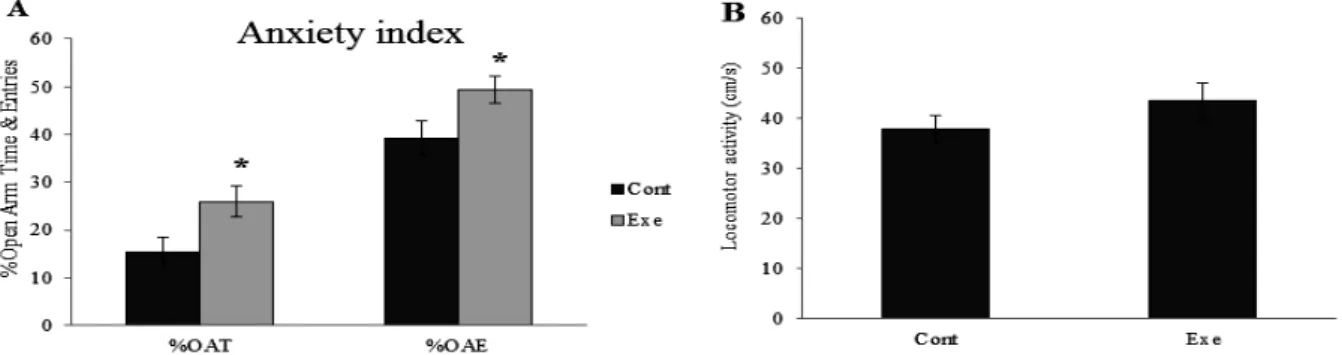
The effect of the exercise activity on anxiety indices and locomotor activity Figure 1 showed that after 6 weeks, exercise activity reduced both anxiety indices significantly (%OAT and %OAE) in comparison with the control group (P<0.05) (Figure 1, A). But it failed to affect locomotor activity (Figure1, B). This shows the anxiolytic effect of exercise activity.
The effect of chronic administration of cMgO and MgO NP on anxiety indices and locomotor activity
The data in figure 2 shows that chronic administration of MgO NP for 6 weeks caused a significant increase in %OAT in comparison with the control group and cMgO (P<0.001), while it didn’t affect %OAE or the locomotor activity (figure 2, A and B). Chronic injection of cMgO for 6 weeks didn’t change any anxiety index or locomotor activity.
The effect of chronic administration of cMgO and MgO NP during exercise activity on anxiety indexes and locomotor activity
Correlation between anxiolytic effect of MgO and exercise
Original Research (font 12) Original Research (font 12) Original Research (font 12) Original Research (font 12) Original Research (font 12) Original Research (font 12)
Figure 1. The effect of exercise activities on anxiety indices and locomotor activity: each bar shows mean± SEM, *P<0.05 significant differences in comparison with control group (Cont), Exe= exercised group. Student t-test was used for comparison between groups.
Figure 2. The effect of chronic administration of cMgO and MgO NP on anxiety indices and locomotor activity: each bar shows mean± SEM, **P<0.01 in comparison with control group (Cont), ++P<0.01 in comparison with cMgO group.
Figure 3. The effect of chronic administration of cMgO and MgO NP during exercise activity on anxiety indices and locomotor activity: each bar shows mean± SEM, Exe=exercised group. There were no differences among groups.
Discussion
Exercise activities cause beneficial effects
on stress reduction, anxiety, and
depression-like behaviors (12, 24). Several
clinical studies have suggested an
anxiolytic effect of regular exercise on humans, and some studies have shown that exercise activities are associated with reduced anxiety across several animal types (11, 25). These results supported our findings that an exercise activity after 6
weeks reduced anxiety without changing locomotor activity (Figure 1).
Exercise activities affect many metabolic and physiologic processes, and the direct and indirect involvement of a variety of neurotransmitter and hormonal systems,
including serotonin, atrial natriuretic
Exercise activities increase the concentrations of atrial natriuretic peptide (ANP). Because ANP has an anxiolytic activity, this hormone might contribute to the anxiolytic effects of aerobic exercise (26). In addition, it has been demonstrated that the endorphin released in the brain of athletes can help reduce their stress and anxiety (28). Our findings also showed that MgO NP reduced anxiety notably after 6 weeks in comparison with the control group and the conventional MgO, both of which had no effect on locomotor activity (figure 2 A and B).
Previous studies have shown that the depletion of Mg leads to an increase in depression and anxiety-related behaviors in mice, while Mg supplementation lessens the anxiety-related behaviors of mice (2, 28). Mg has been proved to modulate both glutamatergic neurotransmission (via a
voltage-dependent block of NMDA
receptors) and GABAergic
neuro-transmission (5-7). It has been
demonstrated that increasing glutamate and GABA levels in brain respectively increases and decreases anxiety in animals (2, 23,30). In addition, Mg has been proved to control the activity of the HPA axis, which is considered to be the main stress response system (3). Some studies demonstrated that, since Mg can block this receptor, the blockers of NMDA induce anxiolytic effect (31). It was also noted that the conventional forms of MgO had no effect on anxiety-related behaviors. In fact
MgO NP reduced anxiety, while
conventional MgO was ineffective. This may be related to the nanoparticles properties and their ability to affect many neurochemical pathways with equal dose (32, 33). Increased surface area of nanoparticles can increase reactive groups more than their conventional form and
increase their reactivity (32, 33).
Following the injection of nanoparticles
and conventional forms of MgO
supplements during training made no changes in the anxiolytic effect of exercise activity (Figure 3A and B).
Exhaustive exercise changed the ionized Mg concentration in the extracellular and
intracellular compartments. Exercise
activity increased the lactate level in athletes, and lactate reduced magnesium level in the body (34). In this study MgO NP and exercise, separately, reduced anxiety, while when applied together, the effect was not better. This may be the anxiolytic effect of MgO NP and exercise
activity modulated through common
mechanisms like GABAergic system (2). Another way is that both exercise or magnesium supplement miss the anxiolytic effect of each another. Exercise activity increases lactate and this reduces the level of magnesium in serum, which may reduce the effect of magnesium released from Nano MgO on anxiety-related behaviors. Or Magnesium supplement may act as a compensatory agent for hypomagnesaemia induced by exercise activities (35).
Conclusion
These findings prove that the chronic administration of MgO NP and exercise activities for 6 weeks reduce anxiety, whereas the anxiolytic effect of them do not increase, when induced at the same time. This interaction is probably related to the common mechanisms involved in anxiety processes, or the reducing effect of one in the presence of the other. To consolidate these findings, more studies need to be done.
Acknowledgments
This study was supported by Shahid Chamran University of Ahvaz, Iran, grant
number 90/302/18672. Hereby, the
researchers of this study would like to express their sincere gratitude to the esteemed Vice-presidency of Research of Shahid Chamran University for their financial and moral supports.
References
Kesmati M, et al
Original Research (font 12) Original Research (font 12) Original Research (font 12)
2. Poleszak E, Szewczyk B, Kedzierska E,
Wlaź P, Pilc A, Nowak G.
Antidepressant and anxiolytic-like activity of magnesium in mice. Pharmacol Biochem Behav. 2004; 78(1): 7-12. 3. Sartori SB, Whittle N, Hetzenauer
A, Singewald N. Magnesium deficiency induces anxiety and HPA axis dysregulation: modulation by therapeutic drug treatment. Neuropharmacology. 2012; 62(1): 304-312.
4. Uteva AG, Pimenov LT.
Magnesium deficiency and anxiety-depressive syndrome in elderly patients with chronic heart failure. Adv Gerontol. 2012; 25(3): 427-432. [Article in Russian]. 5. Hasanein P, Parviz M, Keshavarz M, Javanmardi K, Allahtavakoli M, Ghaseminejad M. Modulation of cholestasis-induced antinociception in rats by two NMDA receptor antagonists: MK-801 and magnesium sulfate. Eur J Pharmacol. 2007; 554 (2-3): 123-127. 6. Gerstein M, Huleihel M, Mane R, Stilman
M, Kashtuzki I, Hallak M, et al. Remodeling of hippocampal GABAergic system in adult offspring after maternal hypoxia and magnesium sulfate load: Immunohistochemical study. Exp Neurol. 2005; 196 (1): 18 – 29.
7. Poleszak E. Benzodiazepine/GABA (A) receptors are involved in magnesium-induced anxiolytic-like behavior in mice. Pharmacol Rep. 2008; 60(4): 483-489. 8. Heidary A, Emami A, Eskandaripour S,
Saiah A, Hamidi S, Shahbazi M. Effects of aerobic exercise on anxiety. Procedia Soc Behav Sci. 2011; 30: 2497-2498.
9. Pietrelli A, Lopez-Costa J, Goni R, Brusco A, Basso N. Aerobic exercise prevents age-dependent cognitive decline and reduces anxiety-related behaviors in middle-aged and old rats. Neuroscience. 2012; 202: 252-266.
10. Binder E, Droste SK, Ohl F, Reul JMHM. Regular voluntary exercise reduces anxiety-related behaviour and impulsiveness in mice. Behav Brain Res. 2004; 155(2): 197-206.
11. Vollert C, Zagaar M, Hovatta I, Taneja M, Vu A, Dao A, et al. Exercise prevents sleep deprivation-associated anxiety-like behavior in rats: Potential role of oxidative stress mechanisms. Behav Brain Res. 2011; 224(2): 233-240.
12. Herring MP, Jacob ML, Suveg C,
O’Connor PJ. Effects of short-term exercise training on signs and symptoms of generalized anxiety disorder. Ment Health Phys Act. 2011; 4(2): 71-77.
13. Hsu MH, Wang JM, Lee MS, Lee CP, Cheng FC, Lin MT, et al. Changes in serum magnesium concentration in trained and untrained subjects after exercise. J Biomed Lab Sci. 2007; 19(1): 25-29. 14. Cheng SM, Yang LL, Chen SH, Hsu MH,
Chen IJ, Cheng FC. Magnesium sulfate enhances exercise performance and manipulates dynamic changes in peripheral glucose utilization. Eur J Appl Physiol. 2010; 108(2): 363-369.
15. Nunes A, Al-Jamal KT, Kostarelos K. Therapeutics, imaging and toxicity of nanomaterials in the central nervous system. J Control Release. 2012; 161(2): 290-306.
16. Kreuter J. Application of nanoparticles for the delivery of drugs to the brain. Int Congr Ser. 2005; 1277: 85-94.
17. Cho Y, Borgens RB. Polymer and nano-technology applications for repair and reconstruction of the central nervous system. Exp Neurol. 2012; 233: 126-144. 18. Sonavane G, Tomoda K, Makino K.
Biodistribution of colloidal gold nanoparticles after intravenous administration: effect of particle size. Colloids Surf B Biointerfaces. 2008; 66(2): 274-280.
19. Garnett MC, Kallinteri P. Nanomedicines and nanotoxicology: some physiological principles. Occup Med (Lond). 2006; 56(5): 307-311.
20. Sekhon BS, Kamboj SR. Inorganic nanomedicine—Part1. Nanomedicine. 2010; 6(4): 516-522.
21. Alexa IF, Ignat M, Popovici RF, Timpu D, Popovici E. In vitro controlled release of antihypertensive drugs intercalated into unmodified SBA-15 and MgO modified SBA-15 matrices. Int J Pharm. 2012; 436(1-2): 111-119.
22. Kesmati M, Torabi M, Malekshahi Nia H, Teymuri Zamaneh H. Effect of chronic administration of zinc supplements (ZnO and nano ZnO) with and without aerobic exercise on nociception in male rats. Physiol Pharmacol. 2013; 16 (4): 415-422. [Article in Persian].
23. Ashabi G, Oryan S, Ahmadi R, Valizadegan F. The effects of hippocampal opioidergic and septal GABAergic system interactions on anxiety-like behavior in rats. Life Sci. 2011; 89(21-22): 821-826. 24. Pietropaolo S, Sun Y, Li R, Brana C,
anxiety, depression, and sensitivity to stress: A unifying theory. Clin Psychol Rev. 2001; 21(1): 33-61.
26. Mandroukas K, Zakas A, Aggelopoulou N, Christoulas K, Abatzides G, Karamouzis M. Atrial natriuretic factor responses to submaximal and maximal exercise. Br J Sports Med. 1995; 29(4): 248-251. 27. Ströhle A. Physical activity, exercise,
depression and anxiety disorders. J Neural Transm. 2009; 116(6): 777-784.
28. Koltyn KF. Analgesia following exercise, a review. Sports Med. 2000; 29: 85-98. 29. Singewald N, Sinner C, Hetzenauer A,
Sartori SB, Murck H. Magnesium-deficient diet alters depression- and anxiety-related behavior in mice influence of desipramine and Hypericum perforatum extract. Neuropharmacology. 2004; 47(8): 1189-1197.
30. Bergink V, Van Megen HJGM, Westenberg HGM. Glutamate and anxiety. Eur J Neuropsychopharmacol. 2004; 14(3): 175-183.
31. Xie Z, Commissaris L. Anxiolytic-like effects of the noncompetitive NMDA antagonist MK801. Pharmacol Biochem Behav. 1992; 43(2): 471-477.
32. Arora S, Rajwade JM, Paknikar KM. Nanotoxicology and in vitro studies: The need of the hour. Toxicol Appl Pharmacol. 2012; 258(2): 151-165.
33. Di DR, He ZZ, Sun ZQ, Liu J. A new nano-cryosurgical modality for tumor treatment using biodegradable MgO nanoparticles. Nanomedicine. 2012; 8(8): 1233-1241.
34. Goodwin ML, Harris JE, Hernández A, Gladden LB. Blood Lactate Measurements and Analysis during Exercise: A Guide for Clinicians. J Diabetes Sci Technol. 2007; 1(4): 558-569.