( 0 J & $%& )& ;$+ )**+ I )**+& ,' $-$.$.+ C #5
3#8'$$7(,)!7",
$2((!!(
> ( # 4$T ) $3 @ & 3&
)1 !( & # & !( &
Abstract: In the present study we were interested in the concept of flow an optimal psychical state which is connected with high achievement and positive experiences. It was supposed that experiencing flow during different musical activities (e. g., rehearsals, solo performance, performance with the orchestra) should be related to subjective well-being, common in life. Eighty-four students of the Academy of Music (28 male and 56 female) completed the Positive Affect Negative Affect Schedule (PANAS), the Satisfaction with Life Scale (SWLS) and the Dispositional Flow Scale (DFS-2), which measures nine dimensions of flow. Results confirmed that several aspects of flow are positively related to measures of subjective well-being. Clear goals, challenge-skill balance, concentration on the task, and autotelic experience are important predictors of positive affect, explaining 36% of its variance, challenge-skill balance is an important predictor for negative affect, explaining 26% of its variance, and clear goals is an important predictor for satisfaction with life, explaining 8% of its variance. We conclude that experiencing flow is more related to emotional than cognitive aspects of subjective well-being, which is not surprising, since flow is an extremely emotional experience.
Key words: flow, subjective well-being, musicians
%
))*((,)/!,(!)
'&!!#(,
> ( # 4 F ( 3 1 !( & & !( Povzetek: V raziskavi nas je zanimal konstrukt zanosa kot optimalnega psihiènega stanja, ki je povezan z visokimi doseki in pozitivnimi izkunjami. Predvidevamo, da je pogostost doivljanja zanosa pri razliènih glasbenih aktivnostih (npr. vadenju, solistiènem nastopu, nastopu z orkestrom) povezana z doivljanjem subjektivnega blagostanja na splono v ivljenju. tiriinosemdeset udeleencev (28 mokih in 56 ensk), tudentk in tudentov Akademije za glasbo, je izpolnilo Vpraalnik pozitivne in negativne emocionalnosti PANAS, Lestvico zadovoljstva z ivljenjem (SWLS) in Vpraalnik zanosa (DFS-2), ki meri devet vidikov zanosa. Rezultati potrjujejo, da je veè vidikov zanosa pozitivno povezanih z merami subjektivnega blagostanja. Jasnost ciljev, ravnovesje med izzivom in sposobnostmi, usmerjenost na nalogo in autoteliènost (samonagrajevalna moè) izkunje so pomembni prediktorji pozitivne
* Naslov / Address: asist. mag. Barbara Smolej Fritz, univ. dipl. psih., Glasbena ola Krko, Kolodvorska 2,
9
emocionalnosti in pojasnjujejo 36 % variance. Ravnovesje med izzivom in sposobnostmi je pomemben prediktor negativne emocionalnosti in pojasnjuje 26 % variance. Jasnost ciljev predstavlja pomemben prediktor zadovoljstva z ivljenjem in pojasnjuje 8 % variance. Zakljuèujemo, da je doivljanje zanosa v veèji meri povezano z emocionalnimi kot pa s kognitivnimi vidiki subjektivnega blagostanja, kar ne preseneèa, saj je doivljanje zanosa izrazito emocionalna izkunja.
Kljuène besede: zanos, subjektivno blagostanje, glasbeniki
CC = 3120
What are the components of a good life? How can an individual evaluate if his or her life is good? One of the possible answers is a total absorption in the present activity. Already in the 60s of the past century, Abraham Maslow (1968) started showing interest in the peak experience in the field of humanistic psychology and called it the summit of self-actualization. Although the highest level of self-actualiza-tion can be reached by few people, he discovered that such peak level experience can be experienced by everyone, although it is frequently not recognized. Flow, the construct introduced by Mihaly Csikszentmihalyi (1975a, 1990, 1997) in the late sev-enties, shares many qualities with peak experience and peak performance (Privette, 1983; Privette & Bundrick, 1991). According to Csikszentmihalyi (1975b), flow is a highly enjoyable psychological state that refers to the holistic sensation people feel
>7#4 7
Challenge High
Low
Skills
Low High
Anxiety Flow
Apathy Boredom
4 $7Model of flow, defined by the challenge-skill concept (Jackson & Eklund,
:
when they act with total involvement (in an activity) (p. 36). Individuals who expe-rience flow are so intensively involved in an activity, that nothing else matters while doing it, they take great pleasure in it and they are very intrinsically motivated.
The main idea of flow is Csikszentmihalyis (1990) concept of challenge-skill balance. Flow occurs only when the individual moves beyond his or her average experience of challenge and skills and where there is an investment of psychic en-ergy into a task. It can be experienced while performing different activities, beginning from everyday ones to those extremely complex. But irrespective of the type of activity, it is the balance between the pretentiousness of an activity and the individu-als abilities that is important. Jackson and Csikszentmihalyi (1999) put this idea into a two-dimensional model of flow, together with the concept of anxiety, boredom and apathy (Figure 1). Whenever a person has much higher abilities than demanded by a situation, he gets bored, but when the demands are too high for his abilities, anxiety ensues. In the case of low situational demand and poor abilities, however, he be-comes apathetic. Flow is experienced when the situational demand as well as abilities are high.
The experience of flow can be characterized using nine dimensions, although each of them is by itself a conceptual element of flow (Csikszentmihalyi, 1990):
1. ? ( . When experiencing flow, the balance between the
pretentiousness of a situation and an individuals abilities to face it is of major importance. An activity should represent a challenge for an individual, but only to the extent that he is still able to realize it.
2. N # # # N.
When people are asked to describe what it feels like to be in flow, ideas about action-awareness merging surface. They talk about an ecstatic state, the com-plete merging with the activity (e. g., with music). Musicians often use the expression »I was totally emerged in music«.
3. ? . Knowledge of objectives, performance preparation and
plan-ning, awareness, and understanding the fine details required for successful outcome all help to set the stage for flow. Individuals describe that they know exactly what they are supposed to do. This clarity of purpose occurs every moment during the performance and keeps the performer fully connected to the task.
4. 1 #(( . Closely following the clear goals comes the
process-ing of how performance is progressprocess-ing in relation to these goals. Payprocess-ing atten-tion to feedback is an important step in determining whether one is on track toward the goals that have been set. Feedback can come from the performer or from a range of external sources. When receiving feedback associated with a flow state, the performer does not need to stop and reflect on how things are progressing.
5. ? . When in flow, the performer is totally focused on
;
distractibility that often accompanies involvement in any task is absent. Being totally connected to the task at hand epitomizes the flow state, and is one of its most frequently mentioned characteristics. The performer is focused on the here and now.
6. . Although the perception of control is inherent to the
experi-ence, absolute situational control does not actually exist in an experiential sense. One must experience challenge in order to experience flow, but challenge does not exist under conditions of absolute control.
7. ! . To experience flow it is important for an
indi-vidual to free himself of his »inner voice« which constantly asks him how he looks in the eyes of others, whether he fulfils their expectations, whether his behaviour satisfies the all accepted rules, etc.
8. 6# # 7 Deep moments of flow seem to transform the
percep-tion of time. For some, the experience is that time stops, for others, time seems to slow down, and still for others, time seems to pass more quickly than ex-pected. These sensations come about through the intense involvement of a flow experience.
9. 9. Csikszentmihalyi (1990) coined the term autotelic
ex-perience to describe the intrinsically rewarding exex-perience that flow brings to the individual. Flow is such an enjoyable experience that one is motivated to return to this state. We can say that autotelic experience is a final result of the eight described dimensions of flow, and it is an essential motivational compo-nent which propels an individual to greater and greater challenges. These feel-ings of immense pleasure can be present only when the performance is over, because all energy during the performance is directed to the task.
In research work on flow, attention can be focused on the common character-istics of flow or to inter-individual differences. In the latter focus, Csikszentmihalyi (1990) introduced the term autotelic person, which refers to individuals who are highly capable of experiencing flow. These individuals are psychologically better equipped for experiencing flow, irrespective of the situation. Little research has been done so far to find out the characteristics of these individuals. Autotelic individuals desire more challenges (Logan, 1988), they are able to concentrate well (Hamilton, as cited in Csikszentmihalyi & Csikszentmihalyi, 1988), they have high self-esteem, they are able to resist distractors, they are less anxious, and they are intrinsically motivated (Jackson in Roberts, 1992).
Little research has been published regarding music and flow, although music is mentioned in flow literature as one of the activities which provoke flow most often (Lowis, 2002). Grindea (2002) investigated the flow in relation to anxiety and tension during music performance, although as a therapist she was more interested in helping individuals and not in the theoretical examination of the concept of flow. Some re-searchers (Byrne, MacDonald, & Carlton, 2003; MacDonald, Byrne, & Carlton, 2006;
<
Sheridan & Byrne, 2002) have investigated the connection between flow and crea-tivity in music. Bakker (2005) compared the experiencing of flow in music teachers and their students. If teachers experience flow frequently, their students experience it more often, too, and vice versa. ONeill and McPherson (2002) investigated the experiencing of flow in different groups of young musicians. They found that average musicians from the school for the gifted experience less flow than their more suc-cessful peers and those who attend ordinary schools and are active in music.
In the present study our attention was focused on the dispositional aspect of experiencing flow and the connection to the subjective well-being of music students. Moneta (2004) summarizes relation between flow and well-being:
4N # ( N(7 ? N & N N # (N(( 9 N7?N # & N N U # (N((# # & # # N7 , &N U N 9 N ( & # N 7(p. 116)
Thus we expected students who experience dimensions of flow more fre-quently to report about higher subjective well-being in general. We expected the strongest relations between dimensions of flow and emotional aspects of subjective well-being due to the emotional nature of the flow experience. One rationale for this prediction is also the fact that positive and negative affect are the basic dimensions of temperament (Watson, Wiese, Vaidya, & Tellegen, 1999), and it is possible that they contribute considerably to the frequency of experiencing flow, especially positive affect.
5!#
!'!(
Eighty-four students (28 male and 56 female) of The Music Academy of Ljubljana (44 students of music pedagogy and 40 students of instruments and compo-sition) took part in this study. Most of them play the piano (46), 10 of them play the violin and the others play wind instruments, brass, percussions, or sing as solo artists. It has to be mentioned that the majority of music pedagogy students reported the piano as the principal instrument.
=>
(!2!(
4N Q 4 2& )**)& )**/ is a
self-reporting instrument, designed to asses the flow in physical activity. The scale was theoretically grounded in the Csikszentmihaly (1990) nine-dimensional conceptualisation of flow, which was already described in the Introduction section. For the purpose of our study, items were adapted to fit the context of musical activi-ties. We provided two independent translations into the Slovene language, which were compared and then a uniform version was created. An English teacher translated it back into English and then the backtranslation was compared with the original. Mini-mal changes were made to adjust the Slovene version to match the original. The scale contains 36 items, four for each of nine subscales. The items relate to the music events during which students experience strong positive feelings. Participants indi-cate on a 5-point scale how valid the statement is for them (1 strongly disagree, 2 disagree, 3 neither agree nor disagree, 4 agree, 5 strongly agree). The scale has good metric characteristics (Jackson and Eklund, 2004; Jackson & Marsh, 1996; Marsh & Jackson, 1999; Vlachopoulos, Karageorghis, & Terry, 2000). Examples of items and Cronbach alpha reliability coefficients for subscales are as follows: for challenge-skill balance (e. g., I am challenged in the performing, but I believed my skills will allow me to meet the challenges.) α = 0.87; for action-awareness merging (e. g., I make the correct movements without thinking about trying to do so.)
α = 0.65; for clear goals (e. g., During the performance I know clearly what I want to do.) α = 0.84; for unambiguous feedback (e. g., It is really clear to me how the performance is going.) α = 0.74; for concentration on the task (e. g., My attention is focused entirely on what I am playing.) α = 0.86; for sense of control (e. g., I have a sense of control over what I am playing.) α = 0.86; for loss of self-con-sciousness (e. g., I was not concerned with what others may been thinking of me.)
α = 0.88; for time transformation (e. g., Time seems to alter, either slows down or speeds up.) α = 0.87; for autotelic experience (e. g., I really enjoy the experi-ence.) α = 0.85.
Before completing the scale, the participants had to consider which music activity provoked the strongest, the most pleasant, or the most special feelings. They had to select one of them and describe it briefly.
6 N ! K!H & 2##& ! & V F & $<.;was designed to measure participants general assessment of their life.
The SWLS contains five items (e. g., In most ways my life is close to my ideal.), to which participants respond by indicating their level of agreement on a 7-point scale (1 strongly disagree, 7 strongly agree). The scale has shown adequate internal con-sistency, temporal stability, and convergent validity with conceptually related meas-ures, such as happiness (e. g. Compton, Smith, Cornish, & Qualls, 1996; Pavot & Diener, 1993). Cronbachs alpha reliability coefficient in our sample was 0.81.
==
6 ' ' H K & ? & V 6&$<.. is a measure of positive affect and negative affect that includes 20
adjectives. Positive affect reflects the extent to which a person feels enthusiastic, active, and alert. Negative affect is a general dimension of subjective distress that subsumes a variety of aversive mood states, including anger, contempt, disgust, guilt, fear and nervousness. Respondents use a 5-point scale (1 very slightly or not at all, 5 extremely) to indicate the amount of time they spend experiencing each emotion. The scales have been found to yield adequate internal consistency and construct validity (Watson et al., 1988). In our sample, Cronbachs alpha reliability coefficients were 0.68 and 0.82 for positive and negative affect, respectively.
Students also wrote down which instrument they played and how many years they had been playing it.
All instruments were group administered during regular classes of psychology at The Music Academy of Ljubljana. Students got written instructions and the help of the person administering the questionnaire in case they needed additional explana-tions.
(!(
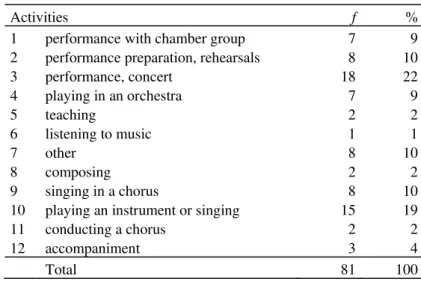
First we examined which musical activities provoke the experience of flow most frequently. Free descriptions of the activities were categorized in 12 categories. As shown in Table 1, students experience flow during different musical activities, frequently during the performance, although anxiety may occur while performing for an audience. Playing in an orchestra or singing in a chorus seems to offer even better opportunities for experiencing flow because of the responsibility dispersion. We did not hypothesize any differences in components of flow or in subjective well-being with respect to a selected activity, thus all further analyses were preformed irrespec-tive of the type of chosen activity.
Correlations between dimensions of flow, positive affect, negative affect and satisfaction with life are presented in Table 2. The lowest correlations exist between dimensions of flow and satisfaction with life. Only three correlations are significant: with challenge-skill balance, action-awareness merging and autotelic experience.
Loss of self-consciousness and time transformation are two dimensions of flow which are not significantly connected with any aspect of well-being. On the other hand, challenge-skill balance, action-awareness merging and autotelic experi-ence are dimensions of flow which are most tightly connected with positive affect, negative affect and satisfaction with life. Students who perceive balance between the challenge of a situation and their skills for mastering this situation or activity, who
=?
know exactly what they are supposed to do during the activity, and who experience the activity as intrinsically rewarding, feel more enthusiastic, active and alert, express less aversive mood states and are more satisfied with their lives.
Because of the high interrelations between different aspects of the flow scales (= 0.120.72) and to determine the proportion of variance for measures of
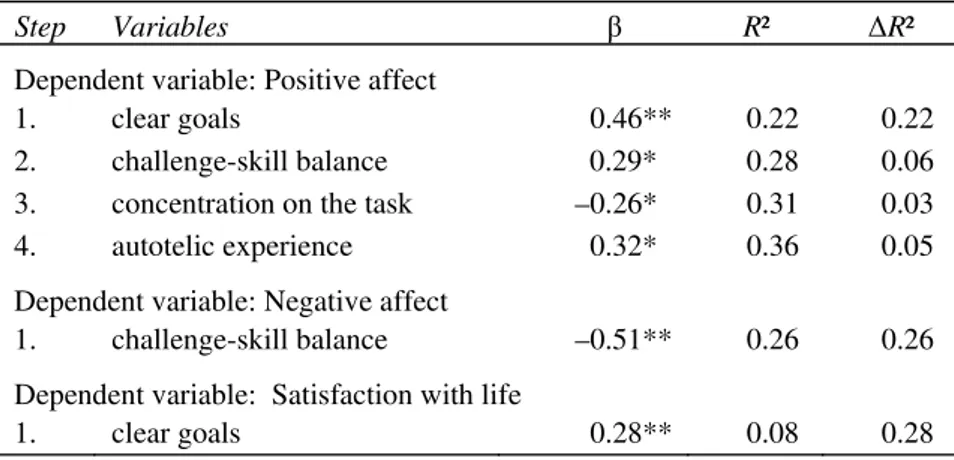
subjec-tive well-being, which could be explained by different aspects of the flow scales, we performed stepwise regression analyses (Table 3). Clear goals, challenge-skill
bal->7#4 7
Table 1. 29 N # 7
Positive affect Negative affect SWLS
Challenge-skill balance 0.44* –0.51* 0.24*
Action-awareness merging 0.25* –0.34* 0.17
Clear goals 0.46* –0.25* 0.28*
Unambiguous feedback 0.18 –0.32* 0.17
Concentration on the task 0.15 –0.25* 0.03
Sense of control 0.33* –0.42* 0.19
Loss of self-consciousness 0.11 –0.12 –0.08
Time transformation 0.12 –0.10 0.05
Autotelic experience 0.42* –0.28* 0.23*
Table 2.? (N N& &
N .
'7SWLS The Satisfaction with Life Scale. * < 0.05. ** < 0.01.
Activities f %
1 performance with chamber group 7 9
2 performance preparation, rehearsals 8 10
3 performance, concert 18 22
4 playing in an orchestra 7 9
5 teaching 2 2
6 listening to music 1 1
7 other 8 10
8 composing 2 2
9 singing in a chorus 8 10
10 playing an instrument or singing 15 19
11 conducting a chorus 2 2
12 accompaniment 3 4
=@
ance, concentration on the task, and autotelic experience are significant predictors of positive affect. Together they explained 36% of the variance for positive affect. For negative affect, only the challenge-skill balance scale appeared to be an important predictor, explaining 26% of its variance. Satisfaction with life as a cognitive indicator of subjective well-being was the least determined by experiencing the flow. The clear goals scale is the only important predictor of satisfaction with life, explaining 8% of the variance.
%(((
The purpose of our study was to investigate the relations between the dispositional aspects of experiencing flow and the subjective well-being of music students. The results confirmed that experiencing flow is an important predictor of subjective well-being, especially for its emotional aspect. In our general hypothesis we expected the individuals who experience more aspects of flow during a music activity more frequently to be happier in general, since the flow experiences are extremely pleasant and they provide the flashes of intense living against dull background (Csikszentmihalyi, 1990). Although it could not be determined by using instruments such as DFS whether an individual had been experiencing flow during a music activity or not, and how frequently, we were able to determine how frequently the individual experienced specific feelings characteristic for flow, and many of them could be related to well-being.
From the specific aspects of flow, the challenge-skill balance is most strongly related to all aspects of subjective well-being. This is not surprising, since it is the
4N (N(#
Step Variables â R² ÄR²
Dependent variable: Positive affect
1. clear goals 0.46** 0.22 0.22
2. challenge-skill balance 0.29* 0.28 0.06
3. concentration on the task –0.26* 0.31 0.03
4. autotelic experience 0.32* 0.36 0.05
Dependent variable: Negative affect
1. challenge-skill balance –0.51** 0.26 0.26
Dependent variable: Satisfaction with life
1. clear goals 0.28** 0.08 0.28
Table 3. A A & ' &
N !7
=6
central aspect of flow. The feeling that you have the skills or ability to manage some-thing really difficult, contribute to better subjective well-being. This idea is not new. In self-determination theory, feelings of competence are one of the basic psychological needs (Deci & Ryan, 2000). This means that their satisfaction contributes to general well-being (e. g., Reis, Sheldon, Gable, Roscoe, & Ryan, 2000) or, in case they are not satisfied, to serious negative consequences for psychological health (Baumeister & Leary, 1995). It seems that the scale challenge-skill balance could be a form of the well-known construct of competence. Satisfaction of this need is
self-reward-ing. In their study, Kowal and Fortier (1999) indeed found that perception of au-tonomy, competence, and relatedness were positively related to flow. The same was found in the research done by ONeill and McPherson (2002). Students who were feeling less competent reported fewer flow experiences.
The second dimension of flow which is related to all three measures of well-being is the scale Clear goals. Flow cannot occur spontaneously if there is no desire to achieve a desired end state. Individuals who have clear ideas about what they should do and what they should achieve every moment during the task performance report about the greater well-being.
And finally, the third dimension which is related to all components of subjective well-being is autotelic experience. The experience of flow is so pleasurable that it is self-rewarding, and at the same time it also motivates an individual to repeat this experience.
Practice and performance music offers musicians many reasons to become totally immersed in the activity, so they are in some way absorbed in the music.
On the other hand, it is interesting that two dimensions of flow, loss of self-consciousness and time transformation, are not related to any measure of well-being. It might be due to the rare experience of these components of flow. A different experience of time might be particularly problematic, since controlling the time is a very important component of quality music performance. Jackson and Eklund (2004) also report about the rare time transformation experience in sport performance.
Regression analyses only confirmed the already mentioned relations between dimensions of flow and subjective well-being measures. They revealed some strong predictors of flow and more clearly indicate that a much greater proportion of vari-ance could be determined by flow dimensions for the emotional compared to cogni-tive component of subjeccogni-tive well-being. Thus, the presence of posicogni-tive emotions and the absence of negative emotions in life in general could be better predicted from dimensions of flow than from the cognitive judgements whether the individual is sat-isfied with life in general. This is not surprising, since flow provides us with an im-mense amount of positive emotions, and the state of flow is predominantly, but not exclusively, an emotional state.
Here, the problem of causation should be mentioned. This study is correla-tional in its nature, thus causal explanations could not be hypothesized. It seems
=A
4N (N(#
sonable to expect that an individual who experiences flow more frequently, together with its autotelic characteristics, is probably happier because of this and reports bet-ter subjective well-being. Flow is particularly related to positive affect, which repre-sents a behavioural activation system and a tendency to experience positive emotions (Watson et al., 1999). Thus, it is also possible that individuals who tend to experience positive emotions more frequently and who have a stronger behavioural activation system, thus motivation to approach, especially rewards, experience flow more fre-quently. From the point of dispositional view, Csikszentmihalyi (1997) talks about the autotelic personality, a person who tends to enjoy life or generally does things for their own sake, rather than in order to achieve some later external goal (p. 117). According to Nakamura and Csikszentmihalyi (2005), this kind of personality is char-acterized by metaskills or competencies that enable the individual to experience flow, such as general curiosity and interest in life, persistence, and low self-centredness. Other researchers operationalized the disposition as intrinsic motivation in high-chal-lenge, high-skill situations. Students with autotelic personality, which was measured by time in flow, had more well-defined future goals and reported more positive cogni-tive and affeccogni-tive states (Adlai-Gail, 1994, as cited in Nakamura & Csikszentmihalyi, 2005).
Although it should not be ignored that extreme positive emotions are actually a consequence, the final state, flow cannot be achieved without high motivation and strain to develop skills. It is perhaps through motivation to achieve this state, thus due to autotelic experience, that positive affect could influence the experiences of the flow. And inversely, the individual who experiences flow more frequently, experi-ences and reports about more positive emotions.
Some limitations of this study and implication for further research should be mentioned. The Slovene version of the questionnaire DFS has not been validated yet. The problem could be the fact that the scale was originally designed to measure flow in sports activity. In future, validation of the Slovene version of the instrument should be carried out for music as specific activity. Although the items had to be minimally adapted to suit music activities, metric characteristics for this population should be determined.
Although the sample in our study was relatively small, it represents about 20 % of the student population on the Academy of Music.
=9 >7#4 7
$(
Bakker, A. B. (2005). Flow among music teachers and their students: The crossover of peak
experiences. " > &%%, 2644.
Baumeister, R. F., & Leary, M. R. (1995). The need to belong: Desire for interpersonal
attachments as a fundamental human motivation. >&$$+, 497
529.
Byrne, C., McDonald, R., & Carlton, L. (2003). Assessing creativity in musical
composi-tions: Flow as an assessment tool. > @2 &)*(3), 277
290.
Compton, W. C., Smith, M. L., Cornish, K. A., & Qualls, D. L. (1996). Factor structure of
mental health measures. &+$& 406
413.
Csikszentmihalyi, M. (1975a). >(# 97San Francisco: Jossey-Bass.
Csikszentmihalyi, M. (1975b). Play and intrinsic rewards. J#
&$;& 4163.
Csikszentmihalyi, M. (1990). 4N:6# 9. New York:
Harper & Row.
Csikszentmihalyi, M. (1997). 4N7New York: Basic.
Csikszentmihalyi, M., & Csikszentmihalyi, I. (Eds.). (1988). # 9:
N. Cambridge: Cambridge University Press.
Deci, E. L., & Ryan, R. M. (2000). The what and why of goal pursuits: Human needs and the self-determination of behavior. ,U&$$& 227268.
Diener, E., Emmons, R. A., Larsen, R. J., & Griffin, S. (1985). The Satisfaction With Life Scale.
#&/<&7175.
Grindea, C. (2002). Fenomen vrhunca doivetja ali flow v glasbenem nastopu [The phenomenon of peak experience or flow in music performance]. 26 (&/
(junij), 3740.
Jackson, S. A., & Csikszentmihalyi, M. (1999). 4N:6# 9
# 7 Champaign, IL: Human Kinetics.
Jackson, S. A., & Eklund, R. C. (2002). Assessing flow in physical activity: The Flow State
Scale-2 and Dispositional Flow Scale-2. 29&
)/, 133150.
Jackson, S. A., & Eklund, R. C. (2004). 64N @ 7Morgantown, WV: Fitness Information Technology.
Jackson, S. A., & Marsh, H. W. (1996). Development and validation of a scale to measure
optimal experience: The Flow State Scale. 29
&$., 1735.
Jackson S. A., & Roberts, G. C. (1992). Positive performance states of athletes: Toward a
conceptual understanding of peak performance. 6&%&156171.
Kowal, J., & Fortier, M. (1999). Motivational determinants of flow: Contributions from
self-determination theory. &$-<, 355368.
Kraus, B. N. (2003). Musicians in flow: Optimal experience in the wind ensemble rehearsal.
=:
4N (N(#
Logan, R. (1988). Flow and solitary ordeals. In M. Csikszentmihalyi & I. Csikszentmihalyi
(Eds.), # 9: N (pp.
172180). Cambridge: Cambridge University Press.
Lowis, M. (2002). Music as a trigger for peak experiences among a college staff population.
? A &$/(34), 351359.
Marsh, H. W., & Jackson, S. A. (1999). Flow experiences in sport: Construct validation of
multidimensional, hierarchical state and trait responses. 2U
@&%&343371.
Maslow, A. (1968). 6N (7Oxford: D. Van Nostrand.
McDonald, R., Byrne, C., & Carlton, L. (2006). Creativity and flow in musical composition:
an empirical investigation. @&-/(3), 292306.
Moneta, G. B. (2004). The Flow Experience Across Cultures. J &
;&115121.
Nakamura, J., & Csikszentmihalyi, M. (2005). The concept of flow. In C. R. Snyder & S. H.
Lopez (Eds.), J ((pp. 89105).New York: Oxford
University Press.
ONeill, S. A., & McPherson, G. E. (2002). Motivation. In R. Parncutt & G. E. McPherson
(Eds.), 6 @(pp. 3147). Oxford: Oxford University
Press.
Pavot, W., & Diener, E. (1993). Review of the Satisfaction with Life Scale.
#&;& 164172.
Privette, G. (1983). Peak experience, peak performance, and flow: A comparative analysis of
positive human experiences. &/;&
13611368.
Privette, G., & Bundrick, C. M. (1991). Peak experience, peak performance, and flow.
> V &%, 169188.
Reis, H. T., Sheldon, K. M., Gable, S. L., Roscoe, J. R., & Ryan, R. M. (2000). Daily
well-being: The role of autonomy, competence, and relatedness.
>&)%&419435.
Sheridan, M., & Byrne, C. (2002). Ebb and flow of assessment in music. > @2 &$<(2), 135143.
Vlachopoulos, S. P., Karageorghis, C. I., & Terry, P. C. (2000). Hierarchical confirmatory
factor analysis of the Flow State Scale in exercise. &$.,
815823.
Watson, D., Clark, L. A., & Tellegen, A. (1988). Development and validation of brief
meas-ures of positive and negative affect: The PANAS scales.
&;/& 10631070.
Watson, D., Wiese, D., Vaidya, J., & Tellegen, A. (1999). The two general activation systems of affect: Structural findings, evolutionary considerations, and psychobiological
evidence. &+%& 820838.