Emerging
and
re
‐
emerging
zoonotic
buffalopox
infection:
a
severe
outbreak
in
Kolhapur
(Maharashtra),
India
Gnanavel
Venkatesan
(1),
Vinayagamurthy
Balamurugan
(2),
Manimuthu
Prabhu
(1),
Revanaiah
Yogisharadhya
(1),
Durlav
P.
Bora
(1),
Pradeep
N.
Gandhale
(1),
M.S.
Siva
Sankar
(1),
A.M.
Kulkarni
(3),
Raj
K.
Singh
(4)&
Veerakyathappa
Bhanuprakash
(1)Summary
Buffalopox is an emerging and re‐emerging
zoonotic viral infection. The authors
investigated an extensive zoonotic outbreak of buffalopox involving many human cases. High morbidity and significant productivity losses
were recorded among domestic buffalo in
Kolhapur (Maharashtra), India, between
February and March 2009. The outbreak
involved a total of 4 000 buffalo from 21 villages in which over 10 000 buffalo were
herded. The outbreak also involved
125 humans who were mostly animal handlers and milkers of all age groups. The disease inflicted a loss of approximately 40% in terms of reduced milk production and a decline in
animal trade. Although pox lesions were
observed on all parts of the body, the most severe were found on the inner ear. This led to otitis and pyrexia in most of the affected animals. Milkers developed pox‐like lesions on the skin of their fingers, hands, forearms, forehead, ears and face, along with pyrexia,
malaise and axillary lymphadenitis and
lymphadenopathy. The causal agent,
buffalopox virus, was confirmed using
counter‐immuno‐electrophoresis, the serum
neutralisation test, virus isolation and
buffalopox virus‐specific ankyrin repeat
protein (C18L) gene‐based polymerase chain reaction. Considering the emergence and re‐ emergence of buffalopox virus in buffalo, cows and humans, not only in India but also in other buffalo rearing countries, regular monitoring
of outbreaks and control measures are
necessary to curb economic losses and also to reduce the public health impact of the disease.
Keywords
Buffalopox, BPXV, Counter‐immuno‐
electrophoresis, Disease, Emerging disease,
India, Outbreak, Polymerase chain reaction, Public health, Re‐emerging disease, Serum neutralisation test, Zoonosis.
Vaiolo
del
bufalo,
zoonosi
emergente
e
riemergente:
una
grave
epidemia
in
Kolhapur
(Maharashtra),
India
Riassunto
Il vaiolo del bufalo è una zoonosi virale emergente e riemergente. Questo studio ha esaminato una grave epidemia di vaiolo del bufalo a Kolhapur
(1) Po xvirus Dise a se La b o ra to ry, Divisio n o f Viro lo g y, Ind ia n Ve te rina ry Re se a rc h Institute , C a m p us Mukte swa r 263 138, Na inita l Distric t, Utta ra kha nd , Ind ia
b ha nu6467@ g m a il.c o m
(2) Pro je c t Dire c to ra te o n Anim a l Dise a se Mo nito ring a nd Surve illa nc e (PD-ADMAS, He b b a l, Ba ng a lo re 560 024, Ka rna ta ka , Ind ia
(3) Dise a se Inve stig a tio n Se c tio n, Aund h, Pune 411 007, Ind ia
Raj K. Singh & Veerakyathappa Bhanuprakash
(Maharashtra) India, nel periodo febbraio e marzo 2009, che ha coinvolto un numero elevato di persone, con un alto tasso di mortalità, e determinato importanti perdite di produttività. Il focolaio ha coinvolto 4.000 bufali su 10.000 capi allevati in 21 villaggi. L’epidemia ha coinvolto anche 125 operatori di tutte le età, per lo più gestori e mungitori degli animali. E’ estata stimata la perdita di circa il 40% della produzione di latte e animali. Anche se le lesioni da vaiolo sono state rinvenute su tutte le parti del corpo, quelle più gravi hanno riguardato l’area delleorecchio interno. La maggior parte degli animali colpiti ha accusato febbre e otiti. I mungitori hanno sviluppato lesioni da vaiolo sulla cute delle dita delle mani, avambraccia, fronte, orecchie e viso, con malessere, comparsa di febbre, linfoadenite ascellare e linfoadenopatia diffusa. L’eziologia del focolaio, da virus del vaiolo del bufalo (BPXV), è stata confermata mediante: counter‐immunoelettroforesi, siero‐neutralizzazione, isolamento del virus e proteina del gene del vaiolo del bufalo con sequenze ripetute (ankyrin repeated) (C18L) mediante PCR. Considerando l’emergere e il riemergere del virus del vaiolo, in India come in altri paesi con allevamenti di bufali, sarebbe opportuno effettuare un regolare monitoraggio dei focolai, attuando misure di controllo necessarie a contenere le perdite economiche e a ridurre l’impatto della malattia sulla Salute Pubblica.
Parole chiave
BPXV, Counter‐immunoelettroforesi, Focolaio, India, Malattia emergente, Malattia riemergente, PCR, Salute pubblica, Siero‐neutralizzazione, Vaiolo del bufalo, Virus del vaiolo del bufalo, Zoonosi.
Introduction
Buffalopox is considered to be one of the emerging and re‐emerging zoonotic viral infections in India and other countries that raise buffalo (2, 14). The disease affects domestic buffalo (Bubalus bubalis) and causes
high rates of morbidity and productivity losses in the form of considerable reductions in milk yield and draught capacity in affected dairy herds, thereby posing an economic threat to dairy sectors in India. Outbreaks of buffalopox or pox‐like infections affecting buffalo, cows
and humans have been recorded in many parts of the world. Several outbreaks of buffalopox have been recorded in buffalo (12) and recently in cows. Cases of zoonotic human infections (2, 5, 18) have been reported regularly from different states in India since the first report was made in 1934 (8). Most of the human infections have been reported among animal attendants, milkers and laboratory workers (2, 4, 14). Even nosocomial outreaks amongst burns patients and among nurses have been reported due to needle stick injury (19). Some genetically related orthopoxviruses, such as monkeypox, buffalopox (14, 17) and bovine vaccinia infections (9), occurred in humans throughout the world after the cessation of smallpox vaccination in 1980.
Buffalopox virus, the causative agent of the disease, is a prototype member of the genus
Orthopoxvirus, family Poxviridae, and a close
variant of vaccinia virus (VACV) (2, 15), based on C18L, a host range protein of the genus Orthopoxvirus (15). The disease is prevalent
throughout the major buffalo rearing areas and outbreaks have been reported in many countries including Indonesia, Egypt and Pakistan (6).
The disease has been recorded in different Indian states from time to time with an host range that has extended to cows and humans in the last decade (2, 18). In the recent past, many reports have been received on the emergence of human and animal pox infections in several parts of the world. In Brazil, pox‐like infections caused by VACV‐ like agents called Araçatuba virus (16) and Contagalo virus have been reported in cattle and humans (3) and wild rodents (1).
Raj K. Singh & Veerakyathappa Bhanuprakash
Materials
and
methods
Clinical
picture
of
zoonotic
outbreak
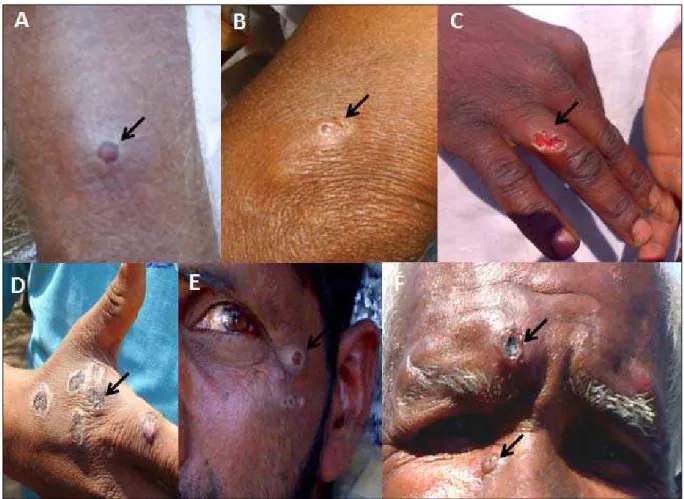
This outbreak was reported in several buffalo farms and herds from several villages located in the Kolhapur District near Pune in 2009. It inflicted approximately 40% morbidity (4 000 buffalo out of a total population of 10 000 at risk) among affected buffalo of different breeds and age groups and had an economic impact in terms of productivity losses in dairy animals. Clinical signs, such as pock lesions on the udder, teats, head, ears and on the hindquarters of the affected animals, were suggestive of pox infection. The lesions were characterised by circumscribed ulcerative lesions with raised edges infected by secondary bacterial and fungal infections in the form of severe otitis (60%‐70%). Some cases of mastitis and teat canal infections (30%‐40%) associated with pox lesions were also observed. The exact source of the infection could not be ascertained. Human cases revealed localised pox lesions in different stages of development, namely: papules, pustules, ulceration and scabs over the forehead, face, forehand, fingers and legs.
Isolation
of
the
aetiological
agent
The clinical samples (n = 51) in the form of
scabs, skin scrapings, milk samples and sera (n = 46) from affected buffalo and skin lesions
(n = 1) and serum (n = 1) from human cases
showing characteristic pock lesions were collected and sent to the Poxvirus Disease Laboratory at the Indian Veterinary Research Institute in Mukteswar to determine the aetiology of the outbreak. Initially, all samples were processed and subjected to counter‐ immuno‐electrophoresis (CIE) for the presence of specific antigen and antibody using standard protocols (7). The serum samples were subjected to serum neutralisation tests (SNT) to detect antibodies against buffalopox virus using the method described by Bhanuprakash et al. (2). Scabs and skin
scrapings of both animal and human cases were washed in a 10% suspension of phosphate buffered saline (PBS) and were used either for the extraction of DNA or for virus
isolation in a cell culture system. Pooled tissue samples were inoculated into Vero cell monolayers and infected cells were maintained using Eagle’s minimum essential medium (EMEM) with 2% newborn calf serum (NBCS) until the development of characteristic cytopathic effects (CPE). The virus was recovered in accordance with the procedure described by Singh et al. (10).
Identification
of
the
aetiological
agent
Total DNA was extracted either from scab samples or infected cell culture fluid of both human and buffalo isolates using the AuPreP™ DNA Extraction Kit (Life Technologies, India, Pvt Ltd, New Delhi) in accordance with the instructions of the manufacturer. The isolated DNA was initially subjected to orthopoxvirus genus‐specific A‐ type inclusion gene‐based polymerase chain reaction (PCR) and finally conventional and real‐time formats of buffalopox virus‐specific diagnostic PCRs, based on host range protein gene, C18L, as described by Singh et al. (15). To
ascertain the genetic relationship between and origin of the virus isolates from animals and humans, the PCR amplicons of the C18L gene
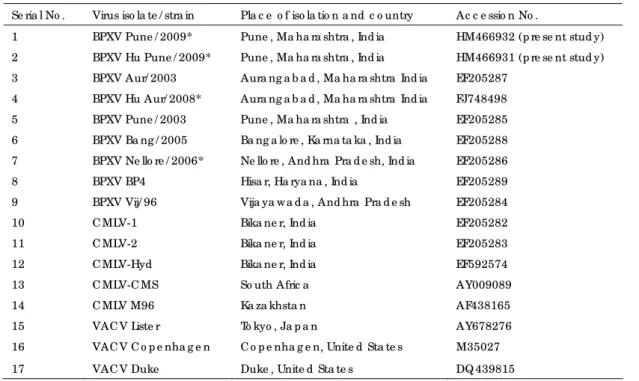
were cloned after gel purification and sequenced commercially using an automated DNA sequencer (ABI PRISM model 377). The edited sequences were aligned with other previous reports using the DNASTAR Megalign program and percent homology was determined. The nucleotide sequences were submitted to GenBank for comparison; other published closely related sequences were retrieved (Table I).
Results
Raj K. Singh & Veerakyathappa Bhanuprakash
Ta b le I
De ta ils o f o rtho p o xviruse s use d in c o m p a ra tive se q ue nc e a na lysis
Se ria l No . Virus iso la te / stra in Pla c e o f iso la tio n a nd c o untry Ac c e ssio n No .
1 BPXV Pune / 2009* Pune , Ma ha ra shtra , Ind ia HM466932 (p re se nt stud y)
2 BPXV Hu Pune / 2009* Pune , Ma ha ra shtra , Ind ia HM466931 (p re se nt stud y)
3 BPXV Aur/ 2003 Aura ng a b a d , Ma ha ra shtra Ind ia EF205287
4 BPXV Hu Aur/ 2008* Aura ng a b a d , Ma ha ra shtra Ind ia FJ748498
5 BPXV Pune / 2003 Pune , Ma ha ra shtra , Ind ia EF205285
6 BPXV Ba ng / 2005 Ba ng a lo re , Ka rna ta ka , Ind ia EF205288
7 BPXV Ne llo re / 2006* Ne llo re , And hra Pra d e sh, Ind ia EF205286
8 BPXV BP4 Hisa r, Ha rya na , Ind ia EF205289
9 BPXV Vij/ 96 Vija ya wa d a , And hra Pra d e sh EF205284
10 C MLV-1 Bika ne r, Ind ia EF205282
11 C MLV-2 Bika ne r, Ind ia EF205283
12 C MLV-Hyd Bika ne r, Ind ia EF592574
13 C MLV-C MS So uth Afric a AY009089
14 C MLV M96 Ka za khsta n AF438165
15 VAC V Liste r To kyo , Ja p a n AY678276
16 VAC V C o p e nha g e n C o p e nha g e n, Unite d Sta te s M35027
17 VAC V Duke Duke , Unite d Sta te s DQ 439815
* iso la te s a sso c ia te d w ith zo o no tic o utb re a k
BPXV b uffa lo p o x virus C MLV c a me lp o x virus VAC V va c c inia virus
Fig ure 1
Raj K. Singh & Veerakyathappa Bhanuprakash
Fig ure 2
Hum a ns infe c te d b y b uffa lo p o x, e sp e c ia lly milke rs a nd a nim a l ha nd le rs, sho wing lo c a l p o x le sio ns o n fo re a rm , fing e rs a nd fa c e
However, among the human cases, mostly females (70%) of all age groups were affected. The buffalopox virus isolates were successfully
recovered in Vero cells at first passage after 4
to 6 days of infection and these isolates were
designated as buffalopox virus Pune/2009
(buffalo origin) and buffalopox virus Pune Hu/2009 (human origin).
Various diagnostic assays based on conventional methods, such as virus isolation and molecular techniques, were successfully applied to clinical samples (scabs and sera); the results are shown in Table II. A total of 39.2% scabs and 54.3% serum samples from buffalo showed precipitin bands indicating a positive reaction in CIE and, in the case of the human samples tested, 100% were found positive upon CIE. Titres ranging from 1:2 to 1:32 in buffalo sera and 1:32 in human sera were observed when using the SNT.
When inoculated into Vero cell monolayers, pooled scab samples produced characteristic CPE, such as ballooning, rounding, increased refractivity and degeneration of cells at first passage (P1) and virus isolates of animal and human cases were recovered with success (Fig. 3). The genomic DNA extracted from isolates and scab samples revealed a specific amplification signal in C18L gene‐based
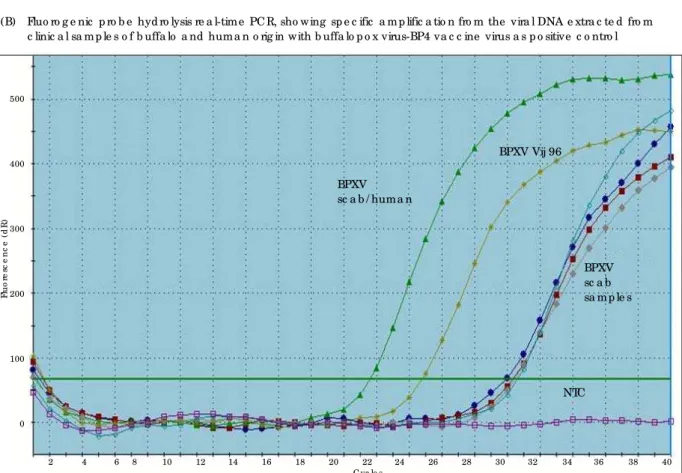
conventional (368 bp) and fluorogenic probe hydrolysis real‐time PCRs (Fig. 4) indicating the aetiology of zoonotic outbreak as buffalopox virus. The PCR amplicons of both species were sequenced to identify the fidelity of the virus isolates and sequences were found to be specific for buffalopox virus, as expected. The edited sequences were submitted to GenBank (Accession Nos HM466931 and HM466932).
Raj K. Singh & Veerakyathappa Bhanuprakash
Ta b le II
Ana lysis o f c linic a l sa m p le s c o lle c te d fro m the o utb re a k
Po lym e ra se c ha in re a c tio n-b a se d o n C 18L g e ne Se ria l
No .
Sa m p le typ e / sp e c ie s (to ta l num b e r)
C o unte rim m uno -e l-e c tro p ho r-e sis (%)
Se rum ne utra lisa tio n
te st C o nve ntio na l
(%)
Ta q Ma n (%)
Virus iso la tio n
1 Sc a b s/ b uffa lo (51)
20 (39.2) NA 34 (66.7) 42 (82.4)
16.82-30.08*
2 Se rum / b uffa lo (46)
25 (54.3) 1:2 to 1:32 NA NA
Po o le d sc a b sa m p le s ino c ula te d o nto Ve ro c e ll m o no la ye r; virus re c o ve re d a t p a ssa g e le ve l 1
3 Sc a b / hum a n
(1)
1 (100) NA 1 (100) 1 (100)
16.02*
4 Se rum / hum a n
(1)
1 (100) 1:32 NA NA
Hum a n iso la te re c o ve re d a t p a ssa g e le ve l 1
* c yc le thre sho ld (C t) va lue s
NA no t a va ila b le
Fig ure 3
Ve ro c e lls infe c te d with b uffa lo p o x virus -Pune / 09 hum a n iso la te , sho wing e xte nsive ro und ing a nd c lum p ing o f c e lls a nd m ic ro p la q ue s fo rm a tio n 48 h p o st infe c tio n
identity with other buffalopox virus isolates, namely: Pune/2003 (buffalo origin) and Aur/2008 (human origin) from the earlier buffalopox outbreaks that occurred in the same region (Maharashtra). Furthermore, the analysis showed 99.7% identity with the Indian live attenuated vaccine strains (buffalopox virus BP4 and buffalopox virus Vij/96) and also with earlier reported isolates of buffalopox virus (Aur/2003 and Nellore/2006) whereas it revealed 99.5% similarity with the buffalopox virus Bangalore/2005 isolate. However, a percentage identity of 59.8‐60.1 was seen with camelpox
virus isolates and 56.6‐63.6 with VACV isolates reported earlier.
The isolates were confirmed for their specificity as buffalopox viruses by C18L
diagnostic PCRs as mentioned earlier (Fig. 4). Comparative sequence analysis based on partial C18L gene sequences also revealed that
the buffalopox virus isolates of both animal and human origin were identical in sequence identity to two earlier outbreaks reported in Maharashtra State, namely: Pune/2003 and Aurangabad/2008. In addition, they had a high percentage identity (99.7%) with other isolates, namely: Nellore/2006 and Aurangabad/2003 and with other vaccine strains (buffalopox virus BP4 and buffalopox virus Vij/96).
Discussion
Raj K. Singh & Veerakyathappa Bhanuprakash
(A) C o nve ntio na l PC R: a g a ro se g e l e le c tro p ho re sis o f PC R p ro d uc ts fro m DNA, b uffa lo p o x virus-BP4 (re fe re nc e virus) (la ne 1)
C linic a l sa m p le s (la ne s 2-6)
100 b p DNA la d d e r (MBI, Fe rm e nta s, Ma ryla nd ) (la ne M)
(B) Fluo ro g e nic p ro b e hyd ro lysis re a l-tim e PC R, sho wing sp e c ific a m p lific a tio n fro m the vira l DNA e xtra c te d fro m c linic a l sa m p le s o f b uffa lo a nd hum a n o rig in with b uffa lo p o x virus-BP4 va c c ine virus a s p o sitive c o ntro l
BPXV b uffa lo p o x virus
Fig ure 4
C 18L g e ne -b a se d p o lym e ra se c ha in re a c tio ns
affects cows and humans (12, 14). However, the outbreak we investigated was associated with many human cases and, compared to earlier reports, affected mostly females who frequently handle and milk the animals. In the past ten years, a series of zoonotic infections of buffalopox have been reported in India and they have incurred considerable economic
losses. Recently, four reports of buffalopox outbreaks in Nellore (Andhra Pradesh), Aundh (Pune), Aurangabad (Maharashtra) and Sardhar Krishinagar (Gujarat), involving humans as well, have been reported (2). The current outbreak was very extensive, affecting a total of 21 villages. The spread of infection among animals and humans in many villages
500
400
300
200
100
0
2 4 6 8 10 12 14 16 18 20 22 24 26 28 30 32 34 36 38 40
C yc le s
F
lu
o
re
sc
e
n
c
e
(
d
R
)
BPXV Vij 96
BPXV sc a b / hum a n
BPXV sc a b sa m p le s
NTC 368 b p
Raj K. Singh & Veerakyathappa Bhanuprakash
was probably facilitated by direct contact between affected and healthy animals, between dairy personnel and also by animal movements, given the trade between the villages. Affected buffalo showed character‐ istic local skin lesions, particularly over the right ear, together with severe otitis; the teats and muzzle were also affected (2, 14). Lesions with otitis and teat infections were treated with local and systemic antibiotics and antifungal agents to prevent secondary infections.
When the samples of pox‐like lesions and sera from affected animals and humans were screened using CIE and SNT, they revealed a significant percentage of positive results, indicating the presence of specific antigen and circulating antibodies to orthopoxviruses. The antibody titres also indicated that the affected buffalo and humans were at different stages of infection during the investigation; this confirmed earlier reports (2, 15).
A buffalopox virus‐specific PCR strategy based on the C18L gene has recently been developed
to differentiate buffalopox virus from other orthopoxviruses (15). Most of the suspected skin scabs of animal and human origin were found positive in C18L gene‐based
conventional and real‐time PCRs, thereby confirming the aetiology of the outbreak as buffalopox virus.
Processed skin lesions from affected buffalo and humans revealed characteristic CPE in Vero cells as early as 36 h and complete degeneration of cell monolayers was observed 48 h post infection (Fig. 3), which confirms earlier observations on buffalopox virus. The virus was recovered successfully at first passage and Vero cells further confirmed the suitable cell line for isolation of buffalopox virus as described elsewhere (2, 10).
In general, pox‐like outbreaks in buffalo have become very frequent in recent years in India, particularly in Maharashtra State and Andhra Pradesh (Nellore). Buffalopox as a zoonosis was reported earlier from villages in the Jalgaon, Dhule and Beed Districts of Maharashtra between 1992 and 1996, in Beed, Nasik and Aurangabad from 1996 to 2003 and
in Aurangabad in 2008. The extent of the present outbreak in human and animals was much greater than those recorded earlier; this could have been due to the difference in the virulence of field strains or it could also have been possible that the virus was more virulent in the presence of both the natural hosts. There might have been spread of buffalopox virus from animals to humans and vice‐versa, which may be the source of several outbreaks in restricted geographical locations and the increased severity of infection as observed here. Since humans and animals live in close proximity, these viruses may become patho‐ genic to people in certain conditions and could establish disease in humans. Persisting human infection may sometimes be the origin of an outbreak in herds (2).
Neutralising antibodies were detected not only in the sera of affected humans but also in in‐ contact individuals. It is assumed that seropositivity in young people who were neither vaccinated against smallpox nor had any history of any poxvirus infection was suggestive of the occurrence of subclinical infection. Moreover, the low sequence similarity of the buffalopox virus isolates with VACV and camelpox virus clearly indicated that the current outbreaks were not due to other orthopoxviruses. Earlier studies on the immunogenic and host range protein gene‐ based analysis of buffalopox virus isolates revealed that the circulating buffalopox virus in buffalo and cows in India probably evolved from the VACV Lister strain (2, 11, 13, 15, 18). Recently, it has been suggested that VACV outbreaks in cows and humans could possibly be caused by the transmission of the virus from wildlife through peridomestic rodents (1); this aspect needs to be investigated in the Indian context.
Conclusions
Raj K. Singh & Veerakyathappa Bhanuprakash
the virus among humans and buffalo in a small geographical niche. Since smallpox vaccination in humans ceased after 1979, there has been an increase in the emergence of pox‐ like infections in humans, such as buffalopox, in India and neighbouring countries, and of VACV‐like viruses in Brazil over the past two decades. Consequently, the control of buffalopox outbreaks is essential as this may well emerge as a serious zoonotic disease in many parts of world. Considering the increased incidence of buffalopox, not only in buffalo but also in cows (18), and the zoonotic impact and productivity losses incurred, a detailed study of the buffalopox virus involved in the human pox‐like infections associated with buffalopox and other vaccinia‐like viruses in animals should be undertaken with specific emphasis on the sequence analysis of several immunogenic structural protein genes, which are responsible for attachment of the virus to the cell, virus virulence and virus pathogenesis to the host.
It would be of immense value to constantly update data on buffalopox virus infections of human origin and to determine the emerging and re‐emerging nature of the virus in human populations, such as vaccinia‐like viruses reported elsewhere (3, 16).
Thorough monitoring of buffalopox outbreaks in different parts of the country and identification and characterisation of the causative agents is of paramount significance.
Furthermore, a systematic study should be conducted on their origins, based on the molecular epidemiology of the virus, existence of reservoirs, biological transmission and the molecular organisation of buffalopox virus from buffalo, cows and humans in relation to other closely related viruses. This may pave the way to a better understanding of circulating virus and could contribute to the control of the disease using suitable diagnostic and prophylactic measures, for example, vaccination in specific endemic areas or zones not only in India but also in other parts of the world.
Acknowledgments
The authors would like to thank the Director of the Indian Veterinary Research Institute (IVRI) for providing the facilities required to conduct this investigation and the staff of the Poxvirus Disease Laboratory (IVRI) in Mukteswar, for their valuable and timely help in conducting this work.
Grant
support
This study was supported by grants from the Indian Council of Agricultural Research (ICAR) as part of the project ‘Niche area of Excellence’ (NAE).
References
1. Ab ra hã o J.S., G ue d e s M.I., Trind a d e G .S., Fo nse c a F.G ., C a m p o s R.K., Mo ta B.F., Lo b a to Z.I., Silva -Fe rna nd e s A.T., Ro d rig ue s G .O .L., Lim a L.S., -Fe rre ira P.C .P., Bo nja rd im C .A. & Kro o n E.G . 2009. O ne m o re p ie c e in the VAC V e c o lo g ic a l p uzzle : c o uld p e rid o m e stic ro d e nts b e the link b e twe e n wild life a nd b o vine va c c inia o utb re a ks in Bra zil? PLo S O ne, 4 (10), e 7428 (w w w .p lo so ne .o rg / a rtic le / info %3Ad o i%2F10.1371%2Fjo urna l.p o ne .0007428 a c c e sse d o n 16 No ve m b e r 2010).
2. Bha nup ra ka sh V., Ve nka te sa n G ., Ba la m urug a n V., Ho sa m a ni M., Yo g isha ra d hya R., G a nd ha le P., Re d d y K.V., Da m le A.S., Khe r HN., C ha nd e l B.S., C ha uha n H.C . & Sing h R.K. 2009. Zo o no tic infe c tio ns o f b uffa lo p o x in Ind ia . Zo o no se s Pub lic He a lth, d o i: 10.1111/ j.1863-2378.2009.01314.x [Ep ub a he a d o f p rint].
3. Da m a so C .R.A., Esp o stio J.J., C o nd it R.C . & Mo ussa tc hé N. 2000. An e m e rg e nt p o xvirus fro m hum a ns a nd c a ttle in Rio d e Ja ne iro sta te : C a nta g a lo virus m a y d e rive fro m Bra zilia n sm a ll p o x va c c ine .
Viro lo g y, 277 (2), 439-449.
4. G ho sh T.K., Aro ra R.R., Se hg a l C .L., Ra y S.N. & Wa tta l B.L. 1977. An inve stig a tio n o f b uffa lo p o x o utb re a k in a nim a ls a nd hum a n b e ing s in Dhulia Distric t (Ma ha ra stra Sta te ). Ep id e m io lo g ic a l stud ie s.
Raj K. Singh & Veerakyathappa Bhanuprakash
5. Ko lha p ure R.M., De o la nka r R.P., Tup e C .D., Ra ut C .G ., Ba su A., Da m a B.M., Pa wa r S.D., Jo shi M.Y., Pa d b id ri V.S., G o ve rd ha n M.K. & Ba ne rje e K. 1997. Inve stig a tio n o f b uffa lo p o x o utb re a ks in Ma ha ra stra Sta te d uring 1992-1996. Ind J Me d Re s, 106, 441-446.
6. La l S.M. & Sing h I.P. 1977. Buffa lo p o x: a re vie w. Tro p Anim Hlth Pro d, 9 (2), 107-112.
7. Sha rm a B., Ne g i B.S., Pa nd e y A.B., Ba nd yo p a d hya y S.K., Sha nka r H. & Ya d a v M.P. 1988. De te c tio n o f g o a t p o x a ntig e n a nd a ntib o d y b y the C IE te st. Tro p Anim He a lth Pro d, 20 (2), 109-113.
8. Sha rm a G .K. 1934. An inte re sting o utb re a k o f va rio la va c c inia in La ho re . Mis Bull Imp C o unc il Ag ri Re s, Se l Art, 8, 1-4.
9. Silva -Fe rna nd e s A.T., Tra va sso s C .E., Fe rre ira J.M., Ab ra hã o J.S., Ro c ha E.S., Via na -Fe rre ira F., d o s Sa nto s J.R., Bo nja rd im C .A., Fe rre ira O .C . & Kro o n E.G . 2009. Na tura l hum a n infe c tio ns with va c c inia virus d uring b o vine va c c inia o utb re a ks. J C lin Viro l, 44 (4), 308-313.
10. Sing h R.K., Ba la m urug a n V., Ho sa m a ni M., Sa the e sh C .C ., Ra so o l T.J. & Ya d a v M.P. 2006. C o m p a ra tive p o lyp e p tid e p ro filing : iso la tio n, p ro p a g a tio n a nd p urific a tio n o f Ind ia n iso la te s o f b uffa lo p o xvirus. J Anim Ve t Ad v, 5, 260-265.
11. Sing h R.K., Ho sa m a ni M., Ba la m urug a n V., Sa the e sh C .C ., Ra so o l T.J. & Ya d a v M.P. 2006. C o m p a ra tive se q ue nc e a na lysis o f e nve lo p e p ro te in g e ne s o f Ind ia n b uffa lo p o x virus iso la te s. Arc h Viro l, 151, 1995-2005.
12. Sing h R.K., Ho sa m a ni M., Ba la m urug a n V., Sa the e sh C .C ., Shing a l K.R., Ta twa rti S.B., Ba m b a l R.G ., Ra m te ke V. & Ya d a v M.P. 2006. An o utb re a k o f b uffa lo p o x in b uffa lo (Bub a lus b ub a lis) d a iry he rd s in Aura ng a b a d , Ind ia . Re v Sc i Te c h, 25, 981-987.
13. Sing h R.K., Ba la m urug a n V., Ho sa m a ni M., De U.K., C ha nd ra Na ik B.M., Krishna p p a G . & Ya d a v M.P. 2007. B5R g e ne -b a se d se q ue nc e a na lysis o f Ind ia n b uffa lo p o x virus iso la te s in re la tio n to o the r o rtho p o xviruse s. Ac ta Viro l, 51 (1), 47-50.
14. Sing h R.K., Ho sa m a ni M., Ba la m urug a n V., Bha nup ra ka sh V., Ra so o l T.J. & Ya d a v M.P. 2007. Buffa lo p o x: a n e m e rg ing a nd re -e m e rg ing zo o no sis. Anim He a lth Re s Re v, 8 (1), 105-114.
15. Sing h R.K., Ba la m urug a n V., Ho sa m a ni M., Ka lle sh D.J. & Bha nup ra ka sh V. 2008. Se q ue nc e a na lysis o f C 18L g e ne o f b uffa lo p o x virus: PC R stra te g y fo r sp e c ific d e te c tio n a nd its d iffe re ntia tio n fro m o rtho p o xviruse s. J Viro l Me tho d s, 154 (1-2), 146-153.
16. Trind a d e S.G ., d a Fo nse c a F.G ., Ma rq ue s J.T., No g ue ira M.L., Me nd e s L.C ., Bo rg e s A.S., Pe iró J.R., Pituc o E.M., Bo nja rd im C .A., Fe rre ira P.C . & Kro o n E.G . 2003. Ara ç a tub a virus: a va c c inia -like virus a sso c ia te d with infe c tio n in hum a ns a nd c a ttle . Eme rg Infe c t Dis, 9, 155-160 (w w w .c d c .g o v/ nc id o d / EID/ vo l9no 2/ 02-0244.htm a c c e sse d o n 16 No ve m b e r 2010).
17. Ve nka te sa n G ., Ba la m urug a n V., G a nd ha le P.N., Sing h R.K. & Bha nup ra ka sh V. 2010. Vira l zo o no sis: a c o m p re he nsive re vie w. Asia nJ Ve t Anim Ad v, 5 (2), 77-92.
18. Ya d a v S., Ho sa m a ni M., Ba la m urug a n V., Bha nup ra ka sh V. & Sing h R.K. 2009. Pa rtia l g e ne tic c ha ra c te riza tio n o f viruse s iso la te d fro m p o x-like infe c tio n in c a ttle a nd b uffa lo e s: e vid e nc e o f b uffa lo p o x virus c irc ula tio n in Ind ia n c o ws. Arc h Viro l, 155 (2), 255-261.