FELIPE VIGATO PRADO
EFFECTS OF
Cowpea mild mottle virus
ON
Bemisia tabaci
Dissertação apresentada à Universidade Federal de Viçosa, como parte das exigências do Programa de Pós-Graduação em Ecologia, para obtenção do título de Magister Scientiae.
VIÇOSA
T
Prado, Felipe Vigato, 1988- P896e
2014
Effects of Cowpea mild mottle virus on Bemisia tabaci / Felipe Vigato Prado. - Viçosa, MG, 2014.
vii, 28f. : il. (algumas color.) ; 29 cm.
Orientador: Simon Luke Elliot.
Dissertação (mestrado) - Universidade Federal de Viçosa. Referências bibliográficas: f.25-28.
1. Bemisia tabaci. 2. Mosca-branca. 3. Soja - Doenças e pragas. 4. Vetor-planta-patógeno. I. Universidade Federal de Viçosa. Departamento de Biologia Animal. Programa de Pós-graduação em Ecologia. II. Título.
CDD 22. ed. 595.754
FELIPE VIGATO PRADO
EFFECTS OF
Cowpea mild mottle virus
ON
Bemisia tabaci
Dissertação apresentada à Universidade Federal de Viçosa, como parte das exigências do Programa de Pós-Graduação em Ecologia, para obtenção do título de Magister Scientiae.
APROVADA: 29 de abril de 2014.
Angelo Pallini Filho Paulo Fellipe Cristaldo
ii
AGRADECIMENTOS
À Universidade Federal de Viçosa/Programa de Pós-Graduação em Ecologia pelas oportunidades oferecidas.
À Fundação de Amparo à Pesquisa do estado de Minas Gerais (FAPEMIG) pela concessão da bolsa de Mestrado.
Ao Professor Simon Luke Elliot pela orientação e ensinamentos, desde 2009.
À Professora Claudine Márcia Carvalho, Fábio Nascimento Silva e Larissa Goulart Zanardo pela imprescindível colaboração.
Aos colegas do Laboratório de Interação Inseto-Microrganismo por toda a ajuda teórica e prática nesses vários anos.
Aos colegas do PET (Programa de Educação Tutorial) por tudo que aprendemos juntos.
Aos amigos de Viçosa e de Paraguaçu por todo o apoio nos momentos em que mais precisei.
À Lívia Ferreira Diniz pelo amor e amizade.
Ao meu irmão e demais familiares por serem minha inspiração.
iii SUMÁRIO
RESUMO... iv
ABSTRACT ... vi
1 INTRODUCTION ...1
2 MATERIAL AND METHODS...6
Insects and plants ...6
Identification of whiteflies ...7
Oviposition experiment...9
Transmission experiment ...13
3 RESULTS ...15
Identification of whiteflies ...15
Oviposition experiment...17
Transmission experiment ...20
4 DISCUSSION...22
iv
RESUMO
PRADO, Felipe Vigato, M.Sc., Universidade Federal de Viçosa, abril, 2014. EFEITO DO Cowpea mild mottle virus EM Bemisia tabaci. Orientador: Simon Luke Elliot.
v
vi
ABSTRACT
PRADO, Felipe Vigato. M.Sc., Universidade Federal de Viçosa, April, 2014. EFFECT OF Cowpea mild mottle virus ON Bemisia tabaci. Adviser: Simon Luke Elliot.
vii
1
1 INTRODUCTION
The ecological relationships between plants, pathogens and vectors are complex and there are many possible direct and indirect effects on the organisms involved. Direct effects involve the vectorborne transmission of the pathogen; the presence and replication of the pathogen in the insect and in the plant; and the sharing of the plant as a resource by the insect and the pathogen. In contrast, indirect effects come from the changes that infection could cause to the plant. All these possible effects could be positive or negative to each of the parties, depending upon the species involved and the evolutionary relationship between them (Belliure et al. 2005; Jiu et al. 2007).
Plant diseases caused by viruses are of great economic importance and the spread of most of these diseases depends upon vectors (Gray & Banerjee 1999). Transmission of a virus by a vector is a very complex event and, due to this, many plant viruses are transmitted by only one vector species. Arthropods are the most common vectors of plant viruses; of these, Hemiptera are most important. These vectors are very common on many crops planted in large monocultures, thus facilitating the spread of diseases (Ng & Falk 2006).
2
As reviewed by Hogenhout et al. (2008), there are four described mechanisms of insect transmission of plant viruses: nonpersistent, semipersistent, persistent circulative and persistent propagative. In nonpersistent transmission the vector is capable to start to inoculate the virus almost immediately after acquisition and retains this ability just for a few minutes after feeding. In semipersistent transmission the insect is capable of inoculation also in a short time, but this ability last a few more hours or even days. The other two types of transmission are persistent, one being circulative and the other propagative. In persistent circulative transmission the virus does not replicate inside the insect and cannot be transmitted to the insect´s offspring. Meanwhile, in persistent propagative transmission, the virus replicates inside the insect and can be transmitted to the embryos and germ cells of females.
Mauck et al. (2012), in their review, proposed and tested some predictions about the relationship between transmission mechanisms of plant viruses and host-vector interactions. In this review, viruses with persistent circulative and persistent propagative transmission were merged just as persistent transmitted viruses. After literature analysis, they found that the most common patterns found was consistent with their predictions, that is: (i) vectors are attracted to virus infected plants independently of the mechanism of transmission; (ii) semipersistent and persistent transmitted viruses prefer to settle and feed on infected plants, whereas nonpersistent have no preference or prefer healthy plants and (iii) vectors perform better on plants infected with semipersistent and persistent transmitted viruses and worse on plants infected with nonpersistent viruses.
3
surface of the leaves. Whitefly abundance is higher in the tropics, but their distribution is cosmopolitan and they are pests also in temperate climates. These insects cause direct damage to plants through feeding (sucking sap and reducing plant vigor) and indirectly through excretion of honeydew, which leads to reducing the photosynthetic capacity of the plant (De Barro et al. 2011).
The main concern with these insects is their capacity to transmit viruses and among them B. tabaci is the most important, which may transmit Begomovirus, Carlavirus, Crinivirus, Ipomovirus and Torradovirus (Navas-Castillo et al. 2011). The current consensus is that B. tabaci is a species complex and that there is no morphological character usable to correctly classify them and the best approach for this classification is the sequencing of the mitochondrial cytochrome oxidase 1 (mtCOI) gene (Brown 2000; De Barro et al. 2005).
Dinsdale et al. (2010) proposed a threshold divergence of 3.5% on the sequences of the mtCOI gene. From that, B. tabaci was separated in 24 morphologically indistinguishable species (low level groups). These 24 species could be grouped, by the threshold of 11% divergence in 11 high level groups. Based on this report, B. tabaci biotype B is now part of the species/group Middle East-Asia Minor 1 species (MEAM1) and so will be called from now on.
The first report of B. tabaci in Brazil occurred in Bahia in 1928 (Bondar 1928). After this, Lourenção & Nagai (1994) reported that the numbers of the insects in Brazil remained low, until the beginning of the 1990’s, when the former “biotype B” (now MEAM1 species) was introduced, probably through the international trade of ornamental plants.
4
capable of mating, which can be repeated several times during their lives. After mating, the time necessary to begin oviposition varies from eight hours to five days depending on the season. A female lays 100 to 300 eggs during her entire life, according to the temperature, host plant and food availability. As reported by Dittrich et al. (1990), when these insects are exposed to insecticides more eggs are produced and in a more female-biased sex ratio than when not exposed. Overall, males live less than females, ranging between 9 to 17 days for males and 38 to 74 days for females, according to host plant and temperature.
As stated by Gill (1990), whiteflies have incomplete metamorphosis and have the stages of egg, nymph (four instars) and adult. The last nymphal stage could also be called pseudo-pupa, due to the interruption of alimentary activity. Adults are the only individuals that can migrate to new plants and the young stages are immobile with exception of the first nymphal stage, also called crawler, which could move short distances on the leaf. Reproduction can be either sexual (production of males and females) or parthenogenetic (arrhenotoky) producing only males (Salguero et al. 1992). According to Villas Bôas et al. (2002) the eggs of the whiteflies are yellowish and pear-shaped, measuring 0.2 to 0.3 cm and are connected to the leaf by a small rod. Nymphs are also yellowish but translucent and the fourth nymphal stage (pseudo-pupa) have red eyes when the adult is about to hatch. Egg to adult time varies between 20 to 27 days, depending on temperature and host plant.
Whiteflies, due to their polyphagy, transmit viruses to a wide range of plant hosts. Begomovirus are the only DNA viral genus that has been detected in whiteflies. On the other hand, there are four genera of RNA viruses transmitted by whiteflies. The number of DNA species vectored by whiteflies is much greater than RNA, because whiteflies transmit 280 species of Begomovirus and less than 60 species of the four RNA virus genera (Rosario et al. 2014).
5
Disease and the symptomatology is: chlorosis, mosaic, vein clearing, dwarfing and leaf/stem necrosis of Glycine max (Almeida et al. 2003, 2005; Iwaki et al. 1982; Tavasoli et al. 2009). The first report of the virus was infecting cowpea (Vigna unguiculata) in Ghana in 1973 (Brunt & Kenten 1973) and, the second report, was almost ten years later, in soybean in Thailand (Iwaki et al. 1982) and the Ivory Coast (Thouvenel et al. 1983). In the same period, the virus was also found in Brazil in common bean (Phaseolus vulgaris) cv. Jalo (Costa et al. 1983). The next reports in Brazil were in the beginning of the 21st century in soybean at Goiás and after two years at Mato Grosso, Bahia, Maranhão and Pará (Almeida et al. 2003).This disease is of great importance in Brazil, due to its severity (Inácio et al. 2003) and also due to the fact that this country is the second largest producer of soybean in the world and in 2013 produced 82 million tons in 27 million hectares (IBGE 2013).
6
2 MATERIAL AND METHODS
Insects and plants
The rearing of B. tabaci was established in 2008 from field infestations of several different crops. The insects were maintained on cabbage plants Brassica oleracea var. capitata (IslaTM) inside cages made of wood and gauze (60cm x 60cm x 60cm).
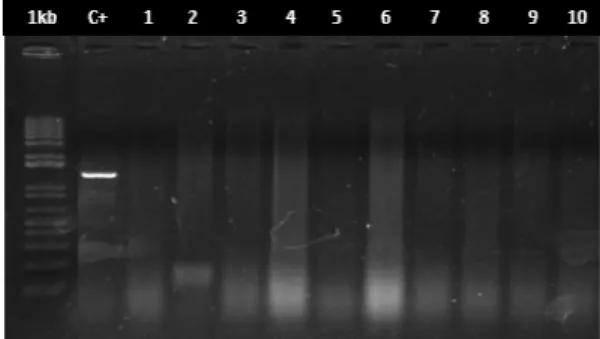
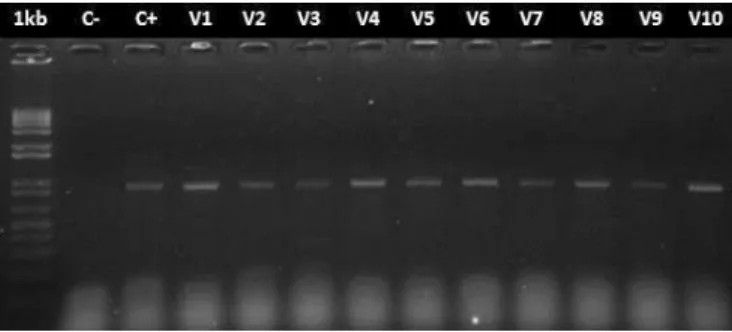
To check whether the B. tabaci were free of Begomovirus, DNA of the insects was extracted, as described below, and evaluated for Begomovirus infection by PCR amplification using the universal nucleotides PBL1v2040 and PCRc1 (Rojas et al. 1993). Presumed viral DNA was amplified in a Bio-RadTM thermal cycler by 30 cycles of melting,
annealing, and DNA extension conditions of 1 minute at 94°C, 1 minute at 50°C, and 3 minutes at 72°C. For the last cycle the extension time was increased to 3 minutes, and then the temperature was decreased to 4°C until the reaction mixtures were removed. No Begomovirus was observed (Fig. 2.1).
Figure 2.1 - Electrophoretic pattern on agarose gel of PCR with universal nucleotides for Begomovirus, from total DNA extracted from B. tabaci. 1kb: GeneRuler 1 kb Plus DNA Ladder; C+:
Positive control (Begomovirus); 1-10:B. tabaci samples.
7
(Tropstrato HT, Vida VerdeTM) and, after 15 days, the seedlings were transplanted to pots (1l) full of soil. These were maintained in greenhouses with average daily temperatures of 26 ± 2 °C and irrigated daily.
Identification of whiteflies
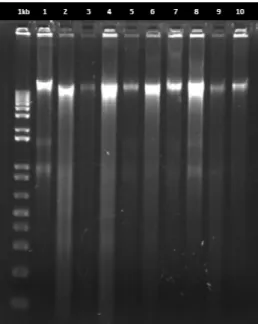
To extract the DNA of B. tabaci, one hundred whiteflies from the rearing were collected and divided into ten samples. Each sample was allocated inside a microtube. In each microtube, 30µl of extraction buffer (50 mM Tris-HCl, pH=7, 100 mM NaCl, 10 mM EDTA and 1% SDS) was added and crushed with a pistil. A further 170µl of extraction buffer was added, with 100µl of saturated phenol and chloroform/isoamyl alcohol (24:1 vol/vol), vortexed for 3 minutes and centrifuged for 3 minutes at 12,000 rpm. The supernatant was removed, transferred to a new tube with 18µl of sodium acetate 3M(0.1 volume; pH=5.2) and 540µL (3 volumes) of absolute ethanol and incubated at -80°C for 20 minutes. After this, the samples were centrifuged for 10 minutes at 14,000 rpm and 4°C. The supernatant was discarded. To the pellet were added 300µl of 80% ethanol and this was centrifuged for 5 minutes. The ethanol was removed with a micropipette and the pellet was dried and resuspended with 20µl of distilled water. The presence of DNA in the samples was checked by loading 1µl of each sample in a well of a 1% agarose gel and proceeding to electrophoresis. In all samples, the DNA extraction was successful (Fig. 2.2).
To identify the species/group of B. tabaci three analyses were performed: (i) comparison of patterns of the mitochondrial cytochrome oxidase 1 gene (mtCOI) digested by the enzymes enzyme TaqI (Thermo ScientificTM) and Tru 9I (PromegaTM), (ii) a phylogenetic analyses of the
8
Figure 2.2 - Electrophoretic pattern on agarose gel of total DNA extracted from B. tabaci. 1kb:
GeneRuler 1 kb Plus DNA Ladder; 1-10: B. tabaci samples.
The portion for the mtCOI was amplified with the oligonucleotides C1-J-2195 (5’-TTG ATT TTT TGG TCA TCC AGA AGT-3’) and L2-N-3014 (5’-TCC AAT GCA CTA ATC TGC CAT ATT A-3’) described by (Simon et al. 1994). The PCR reaction was done with the Kit PCR Master Mix (FermentasTM). For each 50µl, 25µl of Master Mix buffer, 2µl of each
oligonucleotide, 19µl of nuclease-free water and 5µl of DNA were added.
The thermal cycler (Bio-RadTM) was programmed for one initial
denaturation at 94°C for 5 minutes, followed by 34 cycles of 94°C for 30 seconds, 45°C for 1 minute and 72°C for 1 minute, and a final extension for 10 minutes. One aliquot of 6µL of the reaction was mixed with 1 µL of loading buffer and separated in 1% agarose gel with 1X TBE (45 mM Tris-borate, 1 mM EDTA). The fragments was separated by electrophoresis at 80V for 60 minutes and observed at ultraviolet transilluminator. The fragment amplified has about 880 base pairs (bp).
Part of the amplified product of the PCR (10µL) was digested with the enzyme TaqI (Thermo ScientificTM) and Tru 9I (PromegaTM) at 65°C for
9
agarose gel at 80V for 60 minutes and the patterns were compared with the patterns described by Bosco et al. (2006).
The phylogenetic analysis of the mtCOI was based on the partial sequences obtained from 5 isolates of B. tabaci from our rearing aligned with different species of whiteflies with the software Muscle (Edgar 2004) and implemented at the software Mega 5.5 (Tamura et al. 2011). The phylogenetic analyses were generated with the maximum likelihood method and the model Tamura Nei, using transition–transversion ratio (R) with Gamma distribution (Tamura Nei + G), with 2000 repetitions to obtain the bootstrap values.
The identity matrix was done with the same isolates of B. tabaci that were used for the phylogenetic analyses, the comparison between the mtCOI nucleotide sequences was done by pair-to-pair p-distance (proportion of nucleotide sites at which two sequences being compared are different) with the software Mega 5.5 (Tamura et al. 2011).
Oviposition experiment
Soybean plants were mechanically inoculated using a CPMMV-positive samples of the isolate CPMMV:BR:GO:01:1 from Laboratório de Virologia (Zanardo et al. 2013a). Inoculum was obtained by grinding this material in 0.1M phosphate buffer with 0.1% sodium sulphite (pH 7.2). The suspension obtained was used to perform the mechanical inoculation, which consists of producing microlesions on the leaves with gauze soaked in the solution mixed with carborundum. These lesions are then the route of entry of the virus into plants. The leaves inoculated were the first trifoliate of the plants, which were 15 days old, with the second trifoliate still in early development. Control plants were subjected to the same procedures, but without the virus. Each treatment (control and inoculated) had ten repetitions, namely one leaflet of one different plant.
10
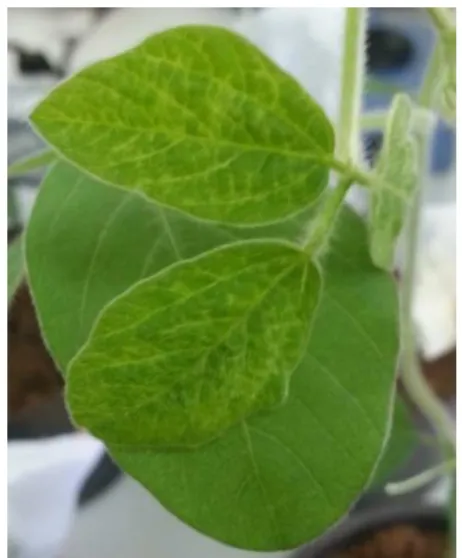
and ten that were characteristically healthy (Fig. 2.3b) were selected. At this age the plants were with the third trifoliate incompletely developed, so in order to standardize the material collected, we worked only with the second trifoliate of the plants. In each trifoliate the central leaflet was collected to be used in the trial and the side leaflets were collected for further confirmation of the presence or absence of the CPMMV by Reverse Transcription Polymerase Chain Reaction (RT-PCR), described below.
After collection, the leaves were held in aluminum foil envelopes and stored in polystyrene boxes until they were either stored in a -80°C freezer (leaves for confirmation) or taken to the laboratory to be washed, on both sides, with sterile water before being placed in the Petri dishes (leaves for the experiment).
Figure 2.3 – Characteristic plants. A: CPMMV-infected; B: Healthy.
In this same day, whiteflies were collected at the fourth instar, using the visualization of compound eyes to indicate that the insects have reached this stage (Fig. 2.4). Insect collection was done with a scalpel, carefully removing the nymphs from the rearing plant and transferring them to the leaf used in the trial. The placement of insects on the leaves was done alternately between treatment and control. Between each leaf the scalpel was cleaned with 70% alcohol to prevent accidental contamination with the virus.
11 Figure 2.4 – Fourth instar nymph with compound eyes.
Autoclaved water-agar culture medium (1L : 15g) was previous added to Petri dishes to provide humidity for the leaves during the trial. However, previous tests showed that there was too much water steam condensation in the Petri dishes lids, which made difficult the visualization of the insects on the leaves. Therefore, adapted from Saldanha et al. (2012), four 10mm-diameter holes were made for ventilation in the lid of the Petri dish and covered with one layer of microporous tape (CremerTM). These holes were made in the edge of the Petri dish so as not to superimpose the leaves (Fig 2.5). After this, the prepared Petri dishes were sterilized under UV light for 15 minutes from both sides.
Subsequently, each of the central leaflets (leaves for the experiment) were placed inside a previous prepared Petri dish. The leaflets were held upside-down, and seven unsexed nymphs of whiteflies were distributed on abaxial surface. The Petri dish was sealed with polyvinyl chloride (PVC) film (BoredaTM) and incubated in a randomized block design (i.e. four blocks) for 12 days at 25±1°C, 57±6 relative humidity and 12-12h light-dark cycle.
12
Figure 2.5 - Petri dishes prepared for the oviposition experiment.
The numbers of hatching nymphs, live adults, and oviposition of the 20 Petri dishes were evaluated daily, during 12 days, with aid of the Zeiss Discovery.V20 stereomicroscope. At the end of the trial, the sexes of the adults were confirmed, according to Souza & Vendramim (2000) (Fig. 2.6) and the leaf areas were measured with AxioVision (SE64, Rel 4.9) software.
Figure 2.6 - Dorsal and ventral views of B. tabaci adults. A: female; B: male.
To confirm the presence or absence of the CPMMV on the leaves, RNA of the samples was extracted from 100mg of leaves tissue with the RNeasy Plant Mini Kit (QIAGENTM) following the manufacturer´s
instructions. The RNA quality was verified in 1% agarose gel and the concentration determined with NanoDrop 200c (Thermo ScientificTM).
13
the primer ORF6R: 5'-TAA AAC CGA GAA AAT AAC-3' (Zanardo et al. 2013a), in accordance with the manufacturer’s recommendations. PCR amplification was done with the GoTaqTM Flexi DNA Polymerase enzyme
(PromegaTM) according to the manufacturer’s recommendations and
specific primers designed for the coat protein of CPMMV:BR:GO:01:1, 5’-ACG TCT CGA GCT GGA GTC AGT GTT TG-3’ and 5'-5’-ACG TGA ATT CTT ACT TCT TAG CGT G-3', forward and reverse, respectively (Carvalho et al. 2013). Amplifications consisted of 35 cycles of 1 minute at 94°C, 1 minute at 65°C, 1 minute at 72°C and a final extension period of 10 minutes at 72°C. Resulting samples were separated in 1% agarose gel at 80V for 60 minutes.
A generalized linear model (GLM), a generalized linear mixed effect model (GLMER) and a linear mixed effect model (LME) were created to analyze the parameters evaluated. The GLM tested the size of the leaves in function of the treatments. The GLMER tested the nymphs hatched in function of the treatments and leaf size, with a binomial error distribution. The LME tested the mean of eggs per female in function of the treatments, day and leaf size. Leaf size entered in the model as a covariate and the variable day entered in the model not only as a fixed effect but also as a random effect due to the fact that the parameters were evaluated repeatedly during 12 days. The variable block entered in the mixed models as a random effect and, when not significant, was excluded. All statistical analyses were performed in R (R Core Team 2012).
Transmission experiment
14
attached to a bamboo skewer to avoid injury to the plant. In order to maximize the chances of acquisition the insects were left for an acquisition access aeriod (AAP) of 48h.
Figure 2.7 - Pooter to aspirate the whiteflies.
Figure 2.8 - Bag with insects placed around the second trifoliate of the plant and attached to the branch with adhesive tape. This photo was taken 18 days after the beginning of the experiment.
15
3 RESULTS
Identification of whiteflies
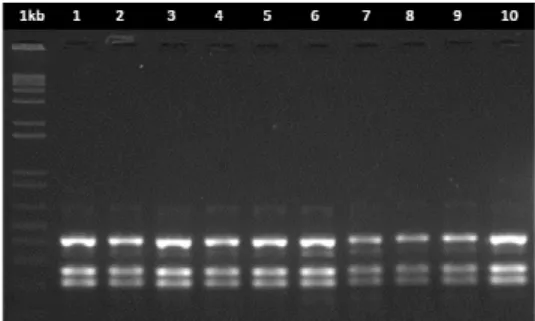
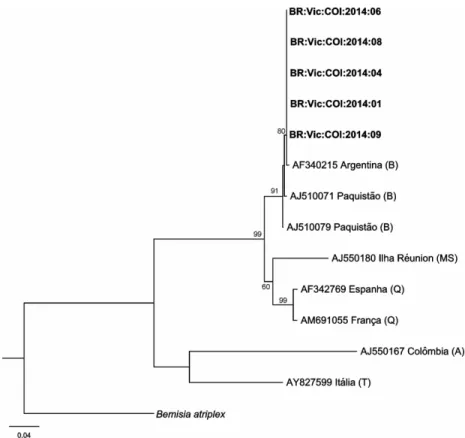
The amplification of the cytochrome oxidase 1 gene (mtCOI) (Fig. 3.1) was successful and the patterns of the bands obtained by digestion proceeded with the enzymes TaqI (Fig. 3.2) and Tru 9I (Fig. 3.3) were related with the so-called biotype B of Bosco et al. (2006). The phylogenetic tree (Fig. 3.4) demonstrate that the five samples from our rearing are closely related with the other three samples of the so-called biotype B, AF340215 Argentina, AJ510071 Pakistan and AJ510079 Pakistan, so these eight samples could be considered as one group . The samples from Réunion Island, Spain and France form another group, but are the most related with the first mentioned group. The samples from Colombia and Italy form a third group and are more related with the two aforementioned groups than with Bemisia atriplex, root of the phylogenetic tree.
Figure 3.1 - Electrophoretic pattern on agarose gel of PCR with nucleotides for mtCOI, from total DNA extracted. 1kb: GeneRuler 1 kb Plus DNA Ladder; C-: Negative control; 1-10: B. tabaci
samples.
16
Figure 3.3 - Electrophoretic pattern on agarose gel of amplified mtCOI digested with the enzyme Tru 9I. 1kb: GeneRuler 1 kb Plus DNA Ladder; 1-10:B. tabaci samples.
Figure 3.4 - Phylogenetic tree obtained from alignment of the partial sequences of mtCOI from the reared whiteflies (in bold) and isolates from different biotypes (A, B, MS, Q and T).
17
Réunion Island, Spain and France, compared to our samples, can be considered as a different species/group (Mediterranean) but as the same high-level group (Africa/ Middle East/ Asia Minor).
Figure 3.5 - Identity matrix from pair-to-pair comparisons of mtCOI from reared whiteflies (in bold) and isolates from different biotypes (A, B, MS, Q and T).
Oviposition experiment
According to the RT-PCR, all leaves were as expected, that is, control leaves were healthy (Fig 3.6) and the CPMMV-treated leaves were infected (Fig 3.7). According to the statistical analyses, the mean of the leaf area was bigger on control plants, 1885±309 mm2, than on infected
plants, 1366±236 mm2 (t=4.219, df=18, p=0.000516) (Fig. 3.8). The
proportions of nymphs that hatched increased with leaf area (χ2[1] =
18
Figure 3.6 – Electrophoretic pattern on agarose gel of RT-PCR from RNA extracted of control leaves of oviposition experiment. 1kb: GeneRuler 1 kb Plus DNA Ladder; C-: Negative control; C+:
Positive control (CPMMV); C1-C10: Control leaves samples.
Figure 3.7 - Electrophoretic pattern on agarose gel of RT-PCR from RNA extracted of CPMMV-treated leaves of oviposition experiment. 1kb: GeneRuler 1 kb Plus DNA Ladder; C-: Negative control; C+: Positive control (CPMMV); V1-V10: CPMMV-infected leaves samples.
Treatments
Le
af
s
iz
e
(m
m
2 )
0 500 1000 1500 2000 2500
Control Virus
19
Leaf size (mm2)
800 1000 1200 1400 1600 1800 2000 2200 2400
P ro po rti on o f n ym ph s ha tc he d 0,0 0,2 0,4 0,6 0,8 1,0
Figure 3.9 – Proportion of nymphs hatched according to leaf size (mm2) (X2[1] = 9.7109, p =
0.001832).
The mean oviposition was neither affected by blocks (Likelihood
ratio = 1.307856, p = 0.2528) nor by infection status (F1,161 = 0.0410, p =
0.8399). Mean oviposition did increase with time (F1,9 = 99.1627, p <
0.0001; Fig. 3.10) and with leaf area (F1,133 = 7.2928, p = 0.0078; Fig.
3.11).
Days
1 2 3 4 5 6 7 8 9 10 11 12
M ea n nu m be r o f e gg s pe r f em al e 0 20 40 60 80 100 120 140 160 Control Virus
20
Leaf size (mm2)
800 1000 1200 1400 1600 1800 2000 2200 2400
M ea n of e gg s pe r f em al e on d ay 1 2 0 20 40 60 80 100 120 140 160
Figure 3.11 – Mean number of eggs per female on day 12 according to leaf size (mm2) (
F1,133 =
7.2928, p = 0.0078).
Transmission experiment
The transmission of CPMMV:BR:GO:01:1 from B. tabaci MEAM1 to
G. max cv. CD206 could be verified due to the fact that 10 days after IAP all the seven plants were symptomatic in the third trifoliate, the one that emerged after the inoculation (Fig. 3.12). Furthermore, leaves of the AAP and of the IAP were infected with the virus (Fig. 3.13).
21
22
4 DISCUSSION
The Bemisia tabaci MEAM1 species/group has colonized the Americas in the last four decades and has displaced the native whiteflies in many regions (Guo et al. 2012; Lima et al. 2002). These whiteflies are generally more fecund, have a broader host range and exhibit significantly higher levels of insecticide resistance than others (Anthony et al. 1995; Costa et al. 1993; Liu et al. 1992). Thus, the identification of the reared whiteflies as MEAM1 increases the applied relevance of the results presented here due to the importance of this whitefly.
The verification that is possible to transmit CPMMV:BR:GO:01:1 to soybean cv. CD206 by the whitefly MEAM1 is fundamental to understand the evolutionary parameters that shape the relationship between these specific organisms. Although the transmission of CPMMV to soybean by whiteflies has already been demonstrated in another studies, these relationships vary in accordance with the strain of the virus, cultivar of the soybean and specie/group of the whitefly.
Due to the fact that some viruses such as CPMMV, are dependent on insect vectors for transmission, it is expected that the most efficient strategies to cause the vector to acquire the virus and inoculate new plants would be favored by natural selection. These strategies are not yet known for these organisms, but evidence that transmission is possible is important to provide the basis for future findings.
Further studies should be carried out to elucidate the details of these specific relationships, for example, (i) what is the minimum number of whiteflies needed to transmit the virus to one plant; (ii) how long does it take for a recently infected plant serve as a source of inoculum; and (iii) what is the speed of spread of the virus by this vector in a soybean field.
23
and reproduced), were not influenced directly by infection with CPMMV. However, both fitness parameters did increase with leaf area and the leaves of infected plants were smaller than those of uninfected plants. Thus, the virus has a direct negative effect on the plants and also an indirect negative effect on the whiteflies. As dwarfism is one of the typical symptoms of Soybean Stem Necrosis caused by this virus (Almeida et al. 2003), it is expected that the CPMMV-infected leaves be smaller than healthy plants, although this has not been specifically described in the literature.
Mauck et al. (2012) reviewed the relationship between transmission mechanisms of plant viruses and host-vector interactions. One of the patterns found is that vectors perform worse on plants infected with nonpersistent viruses than on healthy plants. For example, Donaldson & Gratton (2007) found that the soybean aphid (Aphis glycines) density on healthy soybean plants is nearly double than on soybean mosaic virus infected plants. Hodge & Powell (2008) reported that bean yellow mosaic virus causes a reduction in pea aphid (Acyrthosiphon pisum) survival on fava beans (Vicia faba).
Beyond oviposition, vector survival or longevity are parameters commonly studied to test the effects of viruses on vectors. These parameters have not yet been tested in whitefly-soybean-CPMMV system, thus approach this parameters is an important extension of the studies already carried on. Construction of life tables is also recommended, due to the fact that this approach allows a more holistic comprehension of the effects on vector.
24
A third pattern found by Mauck et al. (2012) is that vectors of nonpersistent viruses prefer to settle and feed on healthy plants or have no preference. Trials to test if the same patterns occur with the CPMMV-whitefly-soybean system have not yet been done, but are already in planning (T. Amaral, personal communication).
The negative effects of CPMMV on the MEAM1 whiteflies at soybean, although indirect, is still consistent with the first aforementioned pattern found by Mauck et al. (2012). Moreover, considering that the other two patterns found are also true for this system, one possible evolutionary explanation for this pattern could be proposed. This one is that the chlorosis induced on the soybean by the CPMMV attract the whiteflies, as the attraction to yellow is a well know trait of this insect (Berlinger 1986; Zanardo et al. 2013a).
Futhermore, the transmission of a nonpersistent transmitted virus will be increased if the vector rapidly disperse to a new (healthy) plant after acquire the virus, because this type of virus is possible to be transmitted by his vector almost immediately after been acquired and this lasts just for a short time. Thus, if the whiteflies probe the infected plant and rapidly migrate to a healthy one the virus dispersal and also the whiteflies fitness will be greater than if the whiteflies remains on the infected plant.
25
5 REFERENCES
Almeida, A.M.R., Piuga, F.F., Kitajima, E.W., Gaspar, J.O., Valentin, N., Benato,
L.C., et al. (2003). Necrose da haste da soja. Embrapa Soja. Doc.
Almeida, Á.M.R., Piuga, F.F., Marin, S.R.R., Kitajima, E.W., Gaspar, J.O.,
Oliveira, T.G. De, et al. (2005). Detection and Partial Characterization of a
Carlavirus Causing Stem Necrosis of Soybean in Brazil, 191–194.
Anthony, N.M., Brown, J.K., Markham, P.G. & Ffrenchconstant, R.H. (1995). Molecular analysis of cyclodiene resistance-associated mutations among
populations of the sweetpotato whitefly Bemisiatabaci. Pestic. Biochem. Physiol.,
51, 220–228.
De Barro, P.J., Liu, S.-S., Boykin, L.M. & Dinsdale, A. (2011). Bemisiatabaci: a
statement of species status. Annu. Rev. Entomol., 56, 1–19.
De Barro, P.J., Trueman, J.W.H. & Frohlich, D.R. (2005). Bemisia argentifolii is a
race of B. tabaci (Hemiptera: Aleyrodidae): the molecular genetic differentiation of
B. tabaci populations around the world. Bull. Entomol. Res., 95, 193–203.
Belliure, B., Janssen, A., Maris, P.C., Peters, D. & Sabelis, M.W. (2005).
Herbivore arthropods benefit from vectoring plant viruses. Ecol. Lett., 8, 70–79.
Bondar, G. (1928). Relatório. Bol. do Laboratório Patol. Veg., 4, 39–46.
Bosco, D., Loria, A., Sartor, C. & Cenis, J.L. (2006). PCR-RFLP Identification of
Bemisiatabaci Biotypes in the Mediterranean Basin, 34, 243–251.
Brown, J.K. (2000). Molecular markers for the identification and global tracking of
whitefly vector–< i> Begomovirus</i> complexes. Virus Res., 71, 233–260.
Brunt, A.A. & Kenten, R.H. (1973). Cowpea mild mottle, a newly recognized virus
infecting cowpeas (Vigna unguiculata) in Ghana. Ann. Appl. Biol., 74, 67–74.
Carvalho, S.L. De, Silva, F.N., Zanardo, L.G., Almeida, Á.M.R., Murilo, F. & Carvalho, C.M. (2013). Production of polyclonal antiserum against Cowpea mild
mottle virus coat protein and its application in virus detection. Tropical, 38, 49–54.
Costa, A.S., Gaspar, J.O. & Vega, J. (1983). Angular mosaic of the Phaseolus
vulgaris variety Jalo, caused by a carlavirus transmitted by the white-fly Bemisia
tabaci. Fitopatol. Bras., 8, 325–337.
Costa, H.S., Johnson, M.W., Ullman, D.E., Omer, A.D. & Tabashnik, B.E. (1993). Sweetpotato whitefly (Homoptera: Aleyrodidae): Analysis of biotypes and
distribution in Hawaii. Environ. Entomol., 22, 16–20.
Cranston, P.S. & Gullan, P.J. (2003). Encyclopedia of Insects. In: Encycl. Insects.
26
Dinsdale, A., Cook, L., Riginos, C., Buckley, Y.M. & De Barro, P. (2010). Refined
Global Analysis of Bemisiatabaci (Hemiptera: Sternorrhyncha: Aleyrodoidea:
Aleyrodidae) Mitochondrial Cytochrome Oxidase 1 to Identify Species Level
Genetic Boundaries. Ann. Entomol. Soc. Am., 103, 196–208.
Dittrich, V., Ernst, G.H., Ruesch, O. & Uk, S. (1990). Resistance mechanisms in sweetpotato whitefly (Homoptera: Aleyrodidae) populations from Sudan, Turkey,
Guatemala, and Nicaragua. J. Econ. Entomol., 83.
Donaldson, J.R. & Gratton, C. (2007). Antagonistic effects of soybean viruses on
soybean aphid performance. Environ. Entomol., 36, 918–25.
Eckel, R.V.W. & Lampert, E.P. (1996). Relative attractiveness of tobacco etch virus-infected and healthy flue-cured tobacco plants to aphids (Homoptera:
Aphididae). J. Econ. Entomol., 89, 1017–1027.
Edgar, R.C. (2004). MUSCLE: multiple sequence alignment with high accuracy
and high throughput. Nucleic Acids Res., 32, 1792–7.
Eichelkraut, K. & Cardona, C. (1990). Biologia, cria masal y aspectos ecologicos
de la mosca blanca Bemisiatabaci (Gennadius)(Homoptera: Aleyrodidae), como
plaga del frijol comun. Turrialba, 40.
Eigenbrode, S.D., Ding, H., Shiel, P. & Berger, P.H. (2002). Volatiles from potato plants infected with potato leafroll virus attract and arrest the virus vector, Myzus
persicae (Homoptera: Aphididae). Proc. Biol. Sci., 269, 455–60.
Fereres, A. & Kampmeier, G.E. (1999). Aphid Attraction and Preference for
Soybean and Pepper Plants Infected with Potyviridae. Entomol. Soc. Am., July,
542–548.
Gill, R.J. (1990). The morphology of whiteflies. Whiteflies their bionomics, pest
status Manag., 13–46.
Gray, S.M. & Banerjee, N. (1999). Mechanisms of Arthropod Transmission of Plant and Animal Viruses Mechanisms of Arthropod Transmission of Plant and Animal Viruses, 63.
Guo, J.-Y., Dong, S.-Z., Yang, X., Cheng, L., Wan, F.-H., Liu, S.-S., et al. (2012).
Enhanced vitellogenesis in a whitefly via feeding on a begomovirus-infected
plant. PLoS One, 7, e43567.
Hodge, S. & Powell, G. (2008). Do Plant Viruses Facilitate Their Aphid Vectors by
Inducing Symptoms that Alter Behavior and Performance ? Do Plant Viruses
Facilitate Their Aphid Vectors by Inducing Symptoms that Alter Behavior and
Performance ?, 37, 1573–1581.
Hogenhout, S. a, Ammar, E.-D., Whitfield, A.E. & Redinbaugh, M.G. (2008).
Insect vector interactions with persistently transmitted viruses. Annu. Rev.
Phytopathol., 46, 327–59.
IBGE. (2013). Levantamento sistemático da produção agrícola [WWW
27
Inácio, L., Rodrigues, R., Campanhola, C., Pires, A.K. & Quast, D.G. (2003). Necrose da Haste da Soja.
Iwaki, M., Thongmeearkom, P., Prommin, M., Honda, Y. & Hibi, T. (1982). Whitefly transmission and some properties of cowpea mild mottle virus on
soybean in Thailand. Plant Dis., 66, 365–368.
Jiu, M., Zhou, X.-P., Tong, L., Xu, J., Yang, X., Wan, F.-H., et al. (2007).
Vector-virus mutualism accelerates population increase of an invasive whitefly. PLoS
One, 2, e182.
Lima, L.H.C., Campos, L., Moretzsohn, M.C., Návia, D. & De Oliveira, M.R. V.
(2002). Genetic diversity of Bemisiatabaci (Genn.) populations in Brazil revealed
by RAPD markers. Genet. Mol. Biol., 25, 217–223.
Liu, H.Y., Cohen, S. & Duffus, J.E. (1992). The use of isozyme patterns to
distinguish sweetpotato whitefly (Bemisiatabaci) biotypes. Phytoparasitica, 20,
187–194.
Lourenção, A.L. & Nagai, H. (1994). Surtos populacionais de Bemisiatabaci no
Estado de São Paulo. Bragantia, 53, 53–59.
Mauck, K., Bosque-Pérez, N. a., Eigenbrode, S.D., De Moraes, C.M. & Mescher, M.C. (2012). Transmission mechanisms shape pathogen effects on host-vector
interactions: evidence from plant viruses. Funct. Ecol., 26, 1162–1175.
Mauck, K.E., De Moraes, C.M. & Mescher, M.C. (2010). Deceptive chemical
signals induced by a plant virus attract insect vectors to inferior hosts. Proc. Natl.
Acad. Sci. U. S. A., 107, 3600–5.
Navas-Castillo, J., Fiallo-Olivé, E. & Sánchez-Campos, S. (2011). Emerging virus
diseases transmitted by whiteflies. Annu. Rev. Phytopathol., 49, 219–48.
Ng, J. & Falk, B. (2006). Virus-vector interactions mediating nonpersistent and
semipersistent transmission of plant viruses. Annu. Rev. Phytopathol.
Polston, J.E. & Capobianco, H. (2013). Transmitting plant viruses using
whiteflies. J. Vis. Exp., 1–10.
R Core Team, D. (2012). R: A Language and Environment for Statistical
Computing. R Foundation for Statistical Computing, Vienna, Austria, 2012. ISBN
3-900051-07-0.
Rojas, M.R., Gilbertson, R.L., Russell, D.R. & Maxwell, D.P. (1993). Use of Degenerate Primers in the Polymerase Chain Reaction to Detect
Whitefly-Transmitted Geminiviruses. Am. Phytopathol. Soc., 77, 340–347.
Rosario, K., Capobianco, H., Ng, T.F.F., Breitbart, M. & Polston, J.E. (2014). RNA viral metagenome of whiteflies leads to the discovery and characterization
of a whitefly-transmitted carlavirus in north america. PLoS One, 9, e86748.
28
growth in nodal cultures of Brazilian ginseng [Pfaffia glomerata (Spreng.)
Pedersen]. Plant Cell, Tissue Organ Cult., 110, 413–422.
Salguero, V., Hilje, L. & Arboleda, O. (1992). Perspectivas para el manejo del
complejo mosca blanca-virosis. Las moscas blancas (Homoptera Aleyrodidae) en
Am. Cent. e El Caribe.
Simon, C., Fratj, I.F., Beckenbach, I.A., Crespi, B., Liu, H. & Flooks, P. (1994). Evolution, Weighting, and Phylogenetic Utility of Mitochondrial Gene Sequences
and a Compilation of Conserved Polymerase Chain Reaction Primers. Ann.
Entomol. Soc. Am.
Souza, A. de & Vendramim, J. (2000). Efeito de axtratos aquosos de Meliaceas
sobre Bemisiatabaci biotipo B em tomateiro. Bragantia, 59, 173–179.
Tamura, K., Peterson, D., Peterson, N., Stecher, G., Nei, M. & Kumar, S. (2011). MEGA5: molecular evolutionary genetics analysis using maximum likelihood,
evolutionary distance, and maximum parsimony methods. Mol. Biol. Evol., 28,
2731–2739.
Tavasoli, M., Shahraeen, N. & Ghorbani, S.H. (2009). Serological and RT-PCR
detection of Cowpea mild mottle carlavirus infecting soybean. J. Gen. Mol. Virol.,
1, 7–11.
Thouvenel, J.-C., Monsarrat, A. & Fauquet, C. (1983). Isolation of cowpea mild
mottle virus from diseased soybeans in the Ivory Coast. Plant Dis., 66, 336–337.
Villas Bôas, G.L., França, F.H. & Macedo, N. (2002). Biotic potential of Bemisia
argentifolii to different host plants. Hortic. Bras., 20, 71–79.
Zanardo, L.G., Silva, F.N., Bicalho, a. a. C., Urquiza, G.P.C., Lima, a. T.M.,
Almeida, a. M.R., et al. (2013a). Molecular and biological characterization of
Cowpea mild mottle virus isolates infecting soybean in Brazil and evidence of
recombination. Plant Pathol., n/a–n/a.
Zanardo, L.G., Silva, F.N., Lima, a T.M., Milanesi, D.F., Castilho-Urquiza, G.P.,
Almeida, a M.R., et al. (2013b). Molecular variability of cowpea mild mottle virus