113
ROLE OF INSTITUTIONAL MANAGERS IN QUALITY ASSURANCE: REFLECTIONS ON KENYA’S
UNIVERSITY EDUCATION.
Gudo Calleb Owino(Corresponding Author)
Deputy Research Director, KCA University PO Box 56808 – 00200 Nairobi. Email: [email protected]
Cell: 0714 560601
Oanda Ibrahim Ogachi
Senior Lecturer, Kenyatta University PO Box 43844. Nairobi. Email: [email protected]
Cell: 0733 745636
Olel Maureen A
Lecturer, Maseno University PO Box 333 MASENO. Email: [email protected]
Cell: 0721 261325
ABSTRACT
Universities are accountable to the stakeholders. To justify their continued existence, the managers of these universities need to guarantee the public that the institutions they lead offer quality teaching, research and community service. The study investigated how effectively university managers have played their role in quality assurance. The results indicated that private universities performed better than public universities in management of quality education. However, public and private universities suffered from interference by political and religious patronage. The other barrier to provision of effective management for quality assurance among Kenyan public and private universities was found to be negative ethnicity and nepotism. Kenyan public universities suffered from insufficient teaching and learning resources and a leadership that did not satisfactorily engage its stakeholders in decision making. It was recommended that managers of the universities should deliberately take short term leadership courses to boost their managerial skills as a significant step towards delivery of quality education. The skills acquired should be sufficient to respond to the challenges of quality education bedeviling the universities.
Keywords: Leadership, Management, Quality Assurance.
INTRODUCTION
Higher education in Kenya is experiencing changes in the form of expansion of the sector, diversification of provision, more heterogeneous student bodies, new funding arrangements, increasing focus on accountability and performance, global networking, mobility and collaboration. These changes have challenged institutional management that, more than ever before, need to revise and specify institutional mission statements, assess impact of new sources of funding, meet requirements for accountability, consider participation in globalization and international competition and the requirements for national, regional and international integration (Lemaitre 2009). The terms leadership and management are often used interchangeably. Attempt to separate the two reveals that management is concerned with the daily running of an organization ensuring that the employees perform the tasks expected of them. Leadership on the other hand is a complex multifaceted process conceived as a set of values, qualities and behaviours exhibited by the leader that encourage the participation, development, and commitment of followers. Leadership is also considered as the art of influencing an individual or individuals in a particular direction which involves casting vision, goal setting and motivating people (Spendlove 2007).
114
community services within rapidly changing environment, despite bureaucratic structural context dominated by process mentality (QUT 1994). As Ndeithu (2007) noted, learning outcomes for any institution are shaped by the determination of the university authorities more than the values of students, lecturers and availability of resources. The quality assurance regulatory body in Kenya (Commission of Higher Education) recognizes that quality assurance is primarily the responsibility of individual universities (Standa 2008).A study conducted in Hong Kong, Pounder (1999), developed organizational effectiveness criteria, which reflected expectations from university management, applicable across higher educational institutions. The organizational effectiveness model comprised four effectiveness criteria, namely:
1. Productivity - efficiency. This refers to behaviour that reflects the extent to which leadership is concerned with the quantity of what it produces and the cost of production.
2. Cohesion. This refers to behaviour that reflects the extent to which it is concerned with staff morale, interpersonal relationships, teamwork and sense of belonging.
3. Information management – communication. This refers to ability of the leaders to distribute timely and accurate information needed by its stakeholders to do their jobs.
4. Planning- goal setting: This aspect of an organization‟s performance has to do with behaviour that reflects the extent of its ability to set goals and objectives and systematically plan for the future.
What is the relationship between organizational effectiveness and quality assurance function of institutional managers? The effectiveness of employee behaviour within organizations and the effectiveness of their performance are referred to in this paper as organizational effectiveness. The studies by Weese (1996) and Lim and Cromartie (2001) recognized that a significant indirect relationship exists between leadership and organizational effectiveness. Changes in an organizational strategy bring about new management challenges which, in turn require new strategies to be successfully implemented. To guarantee that standards and quality of educational provisions are being maintained in the universities, will require that management understands the new challenges and effectively restructure the organizations to achieve the expected outcomes. Organizational effectiveness is therefore necessary for managers to guarantee provision of quality university education. Based on the four critical indicators of organizational effectiveness discussed above, this study sought to establish how effectively university managers in selected universities in Kenya have played their role in quality assurance. The null hypothesis of this study stated that, “There is no statistical difference in the management of quality education in private and public universities in Kenya”.
METHODOLOGY
This study utilized descriptive survey design. Data was collected between May 2010 and November 2010 from a sample of 127 lecturers and 502 students from four universities. Two of the universities were public while the other two were private universities. A one way ANOVA test was employed at 95% confidence interval to test the hypothesis.
LITERATURE REVIEW
115
(CUC 2006) pointed out that the choice that an institution makes concerning the performance indicators on which it wishes to be evaluated will depend on its mission and objectives.Since Vice Chancellors are chosen to deliver against performance indicators, the question arises as to whether institutional performance can be shown to be related in any way to the characteristics of the Vice Chancellors. Goodall (2009) argued that top research universities are led by top researchers and her data showed that the heads of major research universities internationally tend to have previously had highly successful careers as academic researchers. The existence of this relationship raises the issue of causation. Are leaders chosen because their characteristics match the profile of the university?
A study by Sifuna (1998), found out that for all the public universities, the President of the Republic of Kenya was the chancellor. The chancellor appointed and dismissed vice-chancellors, who in majority of cases were not the most able administratively and academically, but politically loyal to the establishment from within the ranks of academic staff. The chancellor‟s powers extended to the appointment of other key university administrators often in violation of the University Acts and statutes. The government nominated most members of the university council. Under this system of appointing council members, it often turned out that government views became particularly dominant in council deliberations and easily steered university affairs in the government‟s favour. This system, he noted, seriously undermined public universities‟ autonomy and academic freedom and tended to diminish democratization of decision making in the universities. This study also found out that the Commission for Higher Education (CHE) established in 1985 with statutory powers to plan, develop and maintain the quality of university education, was denied this function because of politicization of decision making in the expansion of university education.
The appointment of top university managers in public universities in Kenya has been a subject of discussion in education circles because it appears to lack ethnic balance. Gitahi et al. (2010), notes that a trend has emerged where chancellors, vice chancellors and council chair persons are appointed from the community where a university is located. The appointment of the next layer of officials follows that pattern with the result that universities have become ethnic enclaves. He further notes that under the KANU (Kenya African National Union – a political party) administration, staff recruitment, deployment and promotions were largely influenced by party politics. This changed somewhat when the NARC (National Rainbow Coalition– a political party) administration came to power in 2003, with the President relinquishing the positions of chancellor. The positions of Vice Chancellors and deputies were filled through competitive open advertisements. For a while this worked. At last, universities were becoming centres of meritocracy. But the reforms did not go far. He warns that unless checked, we may reach a situation where universities are reduced to village entities, where students are recruited from their localities and staff meetings held in vernacular. A politically compromised university management is a vessel that implements political decisions, which may not necessarily benefit the larger university fraternity nor promote delivery of quality education.
116
Leadership controversy reported at one of the religious private universities (Kumba 2010), was another example of management challenges facing universities. This was where a Presiding Bishop of the sponsoring church dismissed a Vice Chancellor without regard to procedure or written law which regulates and licenses institutions of higher learning in Kenya.Chacha (2004) observed that globally, the environment of higher education is facing relentless and rapid change. The circumstances underscore the crucial role of leadership and management in maintaining morale, enhancing quality and productivity, and helping staff at all levels cope with momentous and rapid change. Those in higher education management and leadership positions are finding it essential that they understand shifting demographics, new technologies, the commercialization of higher education, the changing relationships between institutions and governments and the move from an industrial to an information society. Current leaders must be trained, new leaders prepared and students identified who will both lead and study for the future.
Kinyanjui (2007) stated that visionary and creative leadership is critical to the transformation of higher education. He noted that restructuring of the leadership, governance and management systems of each institution should be a priority. He recommended that administrative and management structures of the public universities should be analyzed and streamlined to create efficient, effective, responsive and lean structures to avoid wastage of resources, duplicated responsibilities and overlapping mandates where members of different levels are members at next level and to institute checks and balances. Partnership and participation should be the hallmarks of good governance. Power to make decisions should be devolved to operational units (faculties, institutes and departments). These operational units should be strengthened to enable them to discharge their functions effectively. The recruitment of deans, directors of institutes, heads of departments, administrators and managers for the operational units should be done competitively at all levels and remuneration be pegged to competence and performance.
With regard to providing students with an enabling academic and learning environment Kinayanjui (2007), noted that the critical issue was to facilitate building capacities of students and make them succeed as intellectuals, leaders, professionals, researchers and creative human resource. University students have time and again expressed their displeasure with university management in a number of ways including demonstrations and riots, often causing destruction to university property and to members of the public. Kinyanjui (2007) further argued that the rules governing students‟ conduct and discipline should be enforced fairly and that students‟ disciplinary regulations need to be reviewed to indicate, among others, minimum period for resolving cases, reporting and appeals.
The adoption of Quality Management System has therefore been considered by some scholars, as a strategic decision by educational institutions to ensure delivery of quality service. This may take the form of ISO certification, structured specific training series for top management, section heads and customer care or a combination of the two approaches. Aruasa (2009), noted that the international standard specific requirements for quality management system include:
(i) Need to demonstrate the ability to consistently provide a product/service that meets customer and applicable regulatory requirements and
117
The ISO certification has fundamentally been a private sector affair, but it is becoming a public sector affair too, especially in Kenya. It is believed that ISO is a mark of quality and a step towards international standards. However, Singels, Ruel & van de Water (2001) in a survey of 950 organizations of North Holland noted a common misconception among the organizations that ISO would mandate higher levels of product quality. They were of the view that ISO certification gives no guarantee that the quality of products or services of an organization is better than the quality of other organizations. According to Dick (2000) the principal motivation for pursuing ISO certification among firms in the UK was the ability of the certificate to open customers' doors that were previously closed, or would close, if ISO certification were not achieved. Gunnlaugsdottir (2002) while conducting a study in Iceland, concluded that ISO certification is a necessary entry ticket for an organization for selling its products abroad in new markets. A study by Staines (2000), in a Swiss hospital, concluded that ISO processes should be designed through consensus meetings, not through one or two individuals. This helps in implementing the redesigned processes and empowers people in the organisation. According to Magoha (2008), the process of ISO certification represents an international consensus on good management practices with the aim of ensuring quality service delivery to clients. ISO certification has become a widespread practice as organizations increasingly work to conform to the international standards. The standards place strong emphasis on process control and continuous improvement which are some of the key characteristics that an organization must possess to be recognized as a leading player. Some of the universities in Kenya that have so far been certified to this standard are Strathmore University (private - the first to be certified in the country) and two public universities Kenyatta University and University of Nairobi (Mang‟eli, 2008).The fact that there is great homogeneity in the socio-demographic characteristics across Vice Chancellors in Kenya suggests that they may not be statistically significantly related to variation in institutional performance, but this is a relationship which can be tested empirically. While one study of senior managers in small and medium-sized enterprises in the UK and their strategy development found a significant relationship between age and organisational performance (Karami et al. 2005), others have reported superior performance associated with younger chief executives, with level of education found to be an important factor (Norburn and Birley 1988). Samuelson et al. (1985) found that the impact of executive leadership on organisational performance was less than the effects of environmental and organisational factors, with executive change at the top of good-sized companies appearing less crucial, and chief executive turnover alone most often not sufficient to overcome organisational inertia. Therefore, there is little reason to suppose that the appointment of a new Vice Chancellor will have a transformational impact upon performance in a university. Breakwell & Tytherleigh, (2010) found that evidence for the importance of Vice Chancellors‟ characteristics for institutional performance was limited but support the notion that whilst the performance of a university may be „moulded‟ by the characteristics of its leader, most of the variability in university performance is explained by non-leadership factors.
RESULTS AND DISCUSSIONS
Table 1 below shows results obtained from the respondents regarding some of the indicators of management
practices in the selected universities.
Table 1: Influence of management on organizational behaviour.
Indicators
Those who agreed or strongly agreed as percentage (%) Lecturers in Public
Universities
Lecturers in Private Universities
University Staff work as a team 68.502 26.191
118
Tribalism and nepotism have hindered equal employmentopportunities in the university
80.488 68.889
Staff are effectively engaged in decision making 40.203 49.405 Students are effectively engaged in decision making 28.107 48.612
There is satisfactory communication between the university management and stakeholders
51.367 73.215
Students‟ admissions are based on available physical facilities
40.437 75.298
Teamwork
This finding showed that public universities had effective teams among their staff while private universities did not have effective teams among lecturing staff. An effective organisation recognises that its own personnel often hold the keys to innovation within themselves and only need the right outlet to share their experiences and ideas. It was interpreted that lack of teamwork in private universities negatively affected the quality of education offered in the institutions.
Staff motivation
It was found that lecturers in private universities were better motivated that those in public universities. Kiganda (2009) noted that low level of staff motivation was mainly due to inadequate remuneration had cost universities the loss of outstanding brains and skills that have migrated abroad. The remaining staff have been forced into income generating activities to supplement their dwindling earnings. It further noted that inadequate remuneration has often been the cause of staff strikes. Thus, inadequate staff remuneration and attendant low morale have negatively affected quality of education in universities. In a study by Olayo (2005) among selected universities in Kenya, it was found that inadequate availability of resources de-motivated employees and did not enhance work performance. This is because possession of skills without adequate relevant tools of trade does not enhance efficiency. He further found out that employees were de-motivated by inadequate training opportunities for capacity building. Ndegwa (2007) also found out that public universities did not prioritize staff training. Capacity building in an organization is vital in enhancing efficiency. This is so because of the changing nature of technology and management styles.
Employment opportunities
It was found that tribalism (ethnicity) and nepotism hindered equal employment opportunities in universities. Ndegwa (2007) found that the management culture in public universities was un-adaptive, rigid, bureaucratic and did not encourage equal employment opportunities. It was found that tribalism (ethnicity) and nepotism were the factors that mostly hindered equal employment opportunities in universities. Consequently, it was interpreted that negative tribalism and nepotism were obstacles to objective search for senior university officers and had the potential of denying universities competent personnel for quality management.
Engaging Staff and Students in decision making
119
involvement of staff in decision making was interpreted as impacting negatively on quality of services offered by the lecturers in both private and public universities. Similarly, students‟ involvement in decision making is significantly different between private and public universities. It was interpreted that students‟ involvement in decision making was better in private universities compared to public universities. This explained why there were more student riots in public universities compared to private universities. According to K‟Okul (2010), the riots were attributed mainly to misunderstanding between the students and the university authority and poor management followed by inadequate learning facilities and ineffective guidance and counseling services. Maina (2011) found that colleges that keep students informed of the challenges that they face in providing services, candidly explaining any setbacks and how these are handled gives students an opportunity to experience management in action. This exposes students to failure and risk management thereby building career resilience. Providing opportunities for students to manage their own affairs within the constraints of available resources offers useful experiences for personal development and self discovery. Opportunities to organize events, participate in student leadership etc, whether successfully or otherwise, build resilience, autonomy, confidence and enhances independence and effectuation behaviour (the pre-disposition to construct outcomes from whatever means that are available). It was thus interpreted that inadequate involvement of staff and students in decision making impacted negatively on quality of teaching and learning in public universities and to some extent in private universities.Communicationamong stakeholders
It was found that there was significant difference between channel of communication among management, staff, students and other stakeholders in private and public universities. According to Standa (2007) quality management involves effective engagement with relevant stakeholders in order to gain their confidence. Secondly, it involves the existence of any policies or procedures for assessing overall student performance. Lack of effective communication with stakeholders was a hindrance to effective implementation future plans and projects. This impacted negatively on provision of quality of services which depend on adoption of management decisions by the stakeholders.
Student admissions
Public universities did not admit students commensurate to available physical facilities; consequently they experienced overstretched facilities due unplanned student admissions by the management.
ISO certification
When lecturers were asked to respond to a statement which read, “Obtaining ISO certification significantly improves university management” 41.66% and 77.165% of respondents from private and public universities respectively agreed with the statement. The results were interpreted to mean, that the lecturers in private universities had not been sufficiently exposed to the benefits of ISO certification or they had not witnessed significant improvement of management and leadership in ISO certified universities.
120
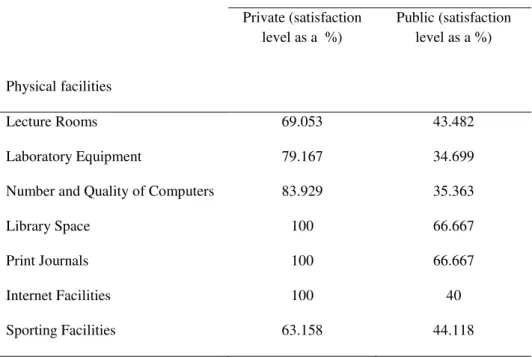
Table 2: Satisfaction level of physical facilities among staff and students in Private and Public universities in KenyaPhysical facilities
Universities
Private (satisfaction level as a %)
Public (satisfaction level as a %)
Lecture Rooms 69.053 43.482
Laboratory Equipment 79.167 34.699
Number and Quality of Computers 83.929 35.363
Library Space 100 66.667
Print Journals 100 66.667
Internet Facilities 100 40
Sporting Facilities 63.158 44.118
The results indicate that:
i. There is a significant difference in availability of teaching and learning facilities between public and private universities
ii. There is shortage of learning physical facilities in public universities
iii. Effective teaching and learning in public universities was hampered by lack of enough essential facilities.
The researchers investigated the lecturers‟ perceived efficiency of quality assurance processes and indicators in private and public universities. Lecturers were asked to respond to a statement, “The University has effective quality assurance procedures”. Results are shown in the table below.
Table 3: Perceived Effectiveness of quality assurance procedures
Effectiveness of quality assurance procedures
Total Strongly
Disagree Agree
121
disagree Agree
Type of institution Public 7 25 36 14 82
Private 4 10 19 12 45
Total 11 35 55 26 127
Table 3 above shows that lecturers perceived effectiveness of quality assurance was 68.889% and 60.976% for private and public universities respectively. It was interpreted that quality assurance processes and indicators were more effective in private universities than public universities. Whereas the lecturers in public universities were of the view that ISO certification helps to improve university management, their opinion on effectiveness of quality assurance in the universities was lower than the perceived level of effectiveness of quality assurance by their counterparts in private universities. It was inferred that ISO certification and university quality assurance measure different performance indicators. This response was interpreted to mean that ISO is fairly technical and formal. It cannot achieve the intended results in isolation from other factors. It proved that things do not change in an organisation because of new procedures, regulations and documentation. They change because people believe that they should change and want them to. This is possible through adequate engagement of stakeholders, inspired and motivated by the management team. The results corroborate findings of a study by Dick (2000), which found that there is no proven link between quality ISO certification and improved business performance. However, better quality had a consistent, positive relationship with business performance.
Testing Research Hypothesis
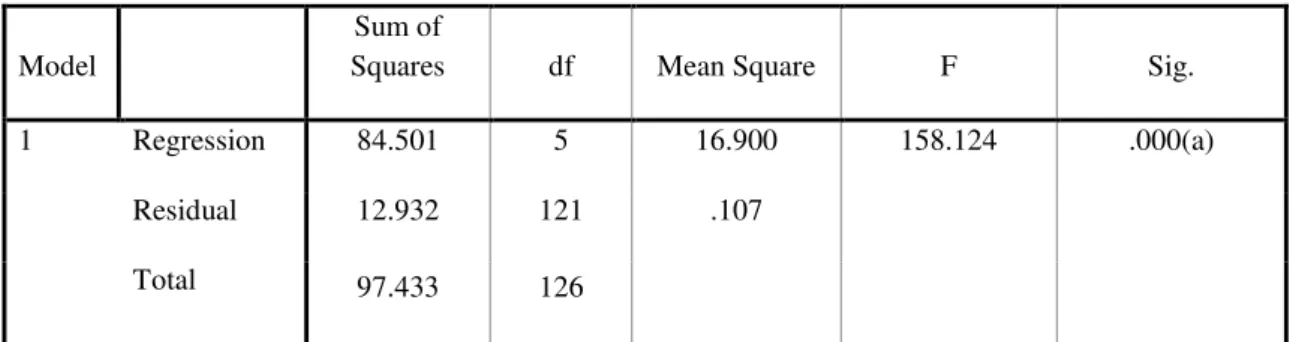
To test the null hypothesis of this study which stated that, “ There is no statistical difference in the management of quality assurance in private and public universities in Kenya”, a one way ANOVA test was employed at 95% confidence interval. The results are shown below:
Table 4: ANOVA Test
Model
Sum of
Squares df Mean Square F Sig.
1 Regression 84.501 5 16.900 158.124 .000(a)
Residual 12.932 121 .107
Total 97.433 126
a Predictors: (Constant), Admissions based on physical facilities, Teamwork, Tribalism and nepotism, Decision making, Communication between management and stakeholders, Staff motivation
b Dependent Variable: Effectiveness of quality assurance procedures
122
management of quality assurance in private and public universities in Kenya. It was further interpreted that private universities did better in management of quality education than public universities. Also, very high F value (158.124) suggests more than just one significant predictor of effective quality assurance in universities. Other predictors such as quality assurance guidelines, curriculum implementation and examination processes are significant predictors that are not reported in this paper.CONCLUSIONS
It was concluded that management of quality assurance in private and public universities in Kenya was significantly different. Private universities were doing better in quality assurance than public universities. This was mainly because private universities had better physical facilities and effectively engaged their stakeholders in management of the institutions. The considerations in appointment of senior university managers in Kenya have not enhanced effective delivery of quality assurance by university managers as the appointments were not only based on academic achievement and experience but more so on ethnic background and patronage. In view of evidence that most of the variability in university performance is explained by situational factors (Samuelson et al. 1985, Breakwell & Tytherleigh, 2010), it was concluded that loyalty to ethnic pressure by the management and patronage (political or religious) of the respective universities were major limitations to observing quality assurance requirements by university management. Socio-demographic characteristics of leaders; especially moral integrity and confidence the followers have on the leader, have significant influences on the performance of the management. Lack of sufficient physical facilities also impacted negatively on the leadership of universities. This was mainly because funding, purchase and maintenance of facilities in public universities was controlled by the relevant government ministry and budgeted funds were hardly received in full by the universities. As a consequence public universities suffered repercussions of demoralised staff and an agitating student body.
ISO certification did not significantly improve efficiency of management in delivering quality education. This is because it was perceived as an end by the management team and enforced without adequate engagement of stakeholders. It was concluded that ISO certification is not consistently associated with having a quality assurance system or better quality education. However, it was important as a marketing tool that improves public image of the institutions that were ISO certified.
RECOMMENDATIONS
a. There is need to appreciate that universities are sites for competing ideas and not fertile grounds for religious dogma, sycophancy or ethnic politics. Universities are seedbeds for the critical mind, national unity, economic, political and social development. These are achievable if universities are autonomous and enjoy freedom of expression in disseminating new knowledge.
b. Senior management of public and private universities should deliberately take short term leadership courses to boost their managerial skills as a significant step towards delivery of quality education. This will help them to appreciate and respond appropriately to the changes being experienced in management of higher education.
c. Unplanned growth of university education without commensurate rise in the level of funding is a threat to quality education at the public universities. To mitigate against decline in quality of education in public universities, student admissions should be based on available facilities. Secondly, the management should plan and budget for gradual improvement of physical facilities to enhance quality learning.
123
touching on the teaching, research and administrative work effectively communicated to relevant stakeholders. Promotions of university staff should be based on proven merit and experience.e. In order to manage quality controls and checks in private and public universities, there is need for external agencies such as Commission for Higher Education to have supervisory role in both categories of universities. Currently only the private universities are supervised by the Commission for Higher Education. It is important to enforce the constitution and laws governing the universities so as to access competent leadership, autonomy of universities and academic freedom. These will in turn democratize decision making processes within the universities by allowing wider representation of stakeholders in key decision university governing bodies.
REFERENCES
1. Aruasa, W.K (2009). Implementation of ISO 9001:2008 Quality Management System at Moi Teaching and Referral Hospital. A speech by the Quality Management Representative.
2. Breakwell, G. M., & Tytherleigh, M. Y. (2010). University Leaders and University Performance in the UK: is it „who‟ leads or „where‟ they lead that matters most? Higher Education Journal Vol 60 pp 491-506.
3. Brunetto, Y (2000). Management of Policy Implementation within Australian Universities. Asia Pacific Journal of Human Resources. Vol 38 No 1. Pp 50-66.
4. Cace, C (2009). Quality Educational Services in University: Self Evaluation Using Quality Indicators. Review of International Comparative Management. Vol 10, Issue 3, pp543-551.
5. Chacha, N.C (2004). Reforming Higher Education in Kenya: Challenges, Lessons and Opportunities. A paper presented at the State University of New York workshop with the Parliamentary Committee on Education, Science and Technology, Naivasha, Kenya.
6. CUC. (2006). CUC Report on the monitoring of institutional performance and the use of key performance indicators (pp. 1–51). Sheffield: University of Sheffield.
7. Creswell, J. W. (2003). Research Design: Qualitative, Qualitative and Mixed Methods Approaches: London. Sage Publication Thousands Oaks.
8. Dick, G.P.M (2000). ISO Certification benefits, reality or myth? The TQM Magazine Vol 12 No 6 pp 365-371
9. Gitahi, L et al (2010). “Varsity recruitment marred by ethnicity”. Daily Nation 16th June, 2010. P.12. 10. Goodall, A. H. (2009). Socrates in the boardroom: Why research universities should be led by top
researchers. Princeton: Princeton U P.
11. Gunnlaugsdottir, J (2002). ISO Certification in Iceland. Records Management Journal. Vol 12 No 2 pp 40 -47.
12. Karami, A., Analoui, F., & Kakabadse, N. K. (2005). The CEOs‟ Characteristics and their Strategy
Development in the UK SME Sector. Journal of Management Development, 25(4), 316–324.
13. Kibaji, E (2010). “Major Challenges: We need to rethink strategies on university education”. Daily Nation 24th June, 2010. p.13.
14. Kiganda, C (2009). East African Universities Vice Chancellors Urged to shift Students Roles to Centre and make the Partners and Responsible Stakeholders. Inter-University Council for East Africa (IUCEA). Newsletter Vol. 39 pp 8-16.
15. Kinyajui, K (2007, July). The Transformation of Higher Education in Kenya: Challenges and Opportunities. Paper presented at the „Mijadala on Social Policy, Governance and Development in Kenya‟ sponsored by Development Policy Management Forum at Nairobi Safari Club.
124
17. Kombo, D. K.and Tromp, D. L. A. (2007). Proposal and Thesis Writing-An Introduction. Nairobi:Paulines Publications Africa.
18. Kothari C.R (2008). Quantitative Techniques: Third Edition. New Delhi: Vikas Publishing House PVT Ltd.
19. Kumba, S (2010). University Wrangles: Bishop moves to take control of KEMU. 27th February, 2010. P.10
20. Lemaitre, M.J (2009). Quality Assurance in a Changing World. INQAAHE Conference. Abu Dhabi, March 2009.
21. Lim, J. Y., & Cromartie, F. (2001). Transformational leadership, organizational culture and organizational effectiveness in sport organizations. The Sport Journal, 4(2), 111-169.
22. Magoha, G. A.O (2008 August 7). Speech delivered by the Vice Chancellor, University of Nairobi on the occasion of presentation of ISO 9001:2000 Certification sin Taifa Hall.
23. Maina, R.K (2011). Determinants of Entrepreneurial Intentions among Kenyan College Students. KCA Journal of Business Management. Vol 3, No 1 pp 1-18.
24. Mange‟li, K (2008 August 7). Speech delivered by the Director Kenya Bureau of Standards during the presentation of ISO 9001:2000 Certificate to the University of Nairobi at the University Taifa Hall. 25. Ndegwa, R.M (2007). A Comparative Study of Factors Influencing Equal Employment Opportunities
Practices in Public Universities: A Case of Non-Teaching Staff in UON, KU and JKUAT. Unpublished MBA Thesis. Kenyatta University.
26. Ndethiu, S.N (2007). The Role of Kenyatta University in Promoting Good Reading Habits among Undergraduate Students. Unpublished PhD Thesis. Kenyatta University.
27. Norburn, D., & Birley, S. (1988). The Top Management Team and Corporate Performance. Strategic Management Journal, 9, 42–59.
28. Olayo, J.O (2005). The Impact of Employee Empowerment on Work Performance: Case Study of Selected Universities in Kenya. Unpublished MBA Thesis. Kenyatta University.
29. Orido, G (2010 June 10). Why do you say „Yes‟, when the Church says „No‟? The Standard, June p.3. 30. Pounder, J.S (2001). “New Leadership” and University Organisational effectiveness: Exploring the
Relationship. Leadership and Organisation Development Journal Vol 22 No 6. Pp 281-290.
31. Samuelson, B. A., Galbraith, C.S., & McGuire, J. (1985). Organizational Performance and Top-Management Turnover. Organization Studies (Walter de Gruyter GmbH & Co. KG.), 6(3), 275. 32. Sifuna, D.N (1998). The Governance of Kenyan Public Universities (pp 175-212). Research in Post –
Compulsory Education, Vol. 3, No. 2, 1998.
33. Singels, J; Ruel, G & van de Water, H (2001). ISO 9000 Series: Certification and Performance. International Journal of Quality and Reliability Management. Vol 18 No 1, pp 62-75.
34. Spendlove, M (2007). Competencies for Effective Leadership in Higher Education. International Journal of Educational Management Vol 21 No 5 pp 407-417.
35. Staines, A (2000). Benefits of an ISO 9001 Certification – The Case of a Swiss Regional Hospital. International Journal of Health Care Quality Assurance Vol 13 No 1 pp27-33.
36. Standa, E (2007). Institutional Autonomy and Academic Freedom. The Uganda Higher Education Review. Journal of Higher Council for Education. Vol 4 No1 Pp.17-20.
37. Standa, E. M (2008). Purpose and Process of Accreditation of Universities in Kenya. Stakeholders Workshop on Enhancing Quality in Higher Education in Kenya. Held at Kenya College of Communication and Technology from 13th to 15th August 2008.
38. The Dearing Report-National Committee of Inquiry into Higher Education. (1997). Online:
http://www.hero.ac.uk/uk/inside_he/government_and_higher_education/major_education_reports4024. cfm.
39. Queensland University of Technology (QUT) (1994). Leading for Quality in Higher Education. Brisbane. QUT.