METALLIC COMPOUNDS IN THE PHASE OF THE
RETICULATED IONIC POLYMERS
Vasile Gutsanu
a*, Constantin Turta
b, George Filoti
ca Department of inorganic and physical Chemistry, State University of Moldova, 60 A.Mateevich str., MD-2009 Chisinau, Moldova *Email: [email protected]
b Institute of Chemistry, Academy of Sciences of Republic of Moldova, 3, Academiei str.. MD-2028, Chisinau, Moldova
c National Institute of Materials Physics, Atomistilor str.105 bis, PO Box MG.7, Magurele, Bucharest, Romania, 077125
Abstract: In this review there are described the results of studying of iron ions state in the ion-exchange resins (KU-2, AN-31, AV-17, Varian – AD, EDE-10P), obtained by Mossbauer spectroscopy. The iron ions have been sorbet on ion exchangers, from aqueous solutions at different temperatures and air conditions. The iron state in polymer phase depends of nature of electron donor groups - amine or carboxylic. To explain the form and temperature dependence of Mossbauer spectra of polymer phase containing iron it was proposed the presence of different compounds like
-FeOOH, α-Fe2O3, and jarosite mineral type compounds: (R4N,H3O)[Fe3(OH)6(SO4)2] or coordination modes: {RCOO-Fe(L4)-OOCR}1+, {R-CO
2=Fe(X2)=O2C-R}n, {R-COO-Fe(X4)-OOC-R}n, and {(-NCH2CH2N-)= Fe(X2) =(-NCH2CH2N-)}, where X= H2O, OH-, SO42-., n= from 3- to 1+. In special conditions the ultrafi ne superparamagnetic particles of Fe2O3 have been obtained.
Keywords: ionexchangers, Mossbauer spectra, iron, superparamagnetic, complexes, polymer phase. Introduction
Reticulated ionic polymers produced in large amounts by chemical industry are widely used as ion exchangers in the water treatment of thermal and nuclear electric power plants, in waste-water and gas purifi cation, in separation and concentration of substances, as well as in acid-basic catalysis. The ion exchange process is conditioned by electrostatic Coulomb interactions between atoms with defi nite electrical charges located in the polymer matrix and mobile ions (contrioni). Therefore, this process is virtually no selective in retention of micro-molecular ions.
In many cases the ion exchange is accompanied by other secondary, often uncontrolled, processes that affect polymers during their use. The ion exchangers are frequently poisoned by iron compounds, which results in reduction their service life and involve considerable additional expenses on chemical reagents and water for their regeneration [1-3]. Often the processes of the ion exchangers “poisoning” are irreversible [[1-3]. All types of ion exchangers are “poisoned” by iron compounds. Poisoning via iron compounds presence can occur even during exchangers’ production [4] by acids or bases solutions, not enough pure [5].
Reticulated ionic polymers containing electron donor atoms (amino groups, phenolic, carboxylic, etc..) can simultaneously participate to complexing mechanisms besides ion exchange process, too. Complexing metal cations by poly-ligands is a relatively new direction in the chemistry active polymers [6.7].. The synthesis of metal compounds in the form of ultrafi ne particles in the polymer phase is considered to be a new direction in physical chemistry of chemically active polymers [8, 9]. Polymers loaded with metallic compounds signifi cantly change their physico-chemical properties. They can become catalysts [10], selective sorbents [11-14], biochemical models of transport substances [15] as well as models for experimental research of relaxation processes [16]. In order to use the metal containing polymers in different physical or chemical processes – it is necessary to know and to control the conditions of loading these metal compounds and, especially to induce the right metal cation state in the polymer phase. Knowing exactly the ions’ state in polymer phase is quite diffi cult for several reasons. Firstly, the polymers of this class are amorphous and reticulated, which limits the number of suitable investigation methods. Secondly, the loading processes of reticulate ionic polymers with metal compounds gives simultaneously rise to other concurrent processes, and an ion exchange is generally required.
Results and Discussion
State of ions in the ionic reticulated polymer phase containing carboxylic groups
As a results of the investigations using potentiometric method and IR spectroscopy [17] it is known that in carboxylic polymer SG-1 type at contact with a solution of 0.003 - 0.5 M Fe (NO3) 3 in 0.5 M NaNO3 in a pH range 1-2.5 the complexes of the typeare formed.
R O
R
O
O Fe O
They are stable in the pH range 2.5 ~ 5.0. These complexes decompose in solutions with pH> 7 and -FeOOH phase is formed. According to [18], a Fe3+ ions from the solution of FeCl
3 are retained by the KB-4 polymer as a result of
complexing process via carboxylic groups with fi nal formation of a precipitate.
The presence of solvent in the polymer phase leads to increasing of Fe3+ ions oscillation amplitude and electric
fi eld gradient (EFG) on their nucleus. The solvent (H2O), which molecules coordinate to metal ions, primarily affects the ion oscillations in chemical bond with ligand, as well as the oscillation of the polymer chain. The non-polar solvent infl uences primarily, on chain oscillation. Various measurements [19] show that the Mossbauer spectra (MS) of Fe3+
ions in carboxylic polymer phase (КБ-2 and others) exhibit doublet patterns. The observed differences, often essential, of iron ions state in carboxylic polymer phase [18-20] confi rm that it depends on many factors, which are not always taken into account.
It is surprising that the nature of anions (Cl-, SO 4
2-) in
fl uence Fe3+ cations complexation with carboxylic groups
of cationite. Increasing of the concentration of either Cl- or SO 4
2-anions have induced a diametrically opposite in
fl uence on the sorption of Fe3+ ions by КB-2 cationite [21].
Sorption of Fe(II) from tartaric acid solutions (0.005 N of Mohr salt, 10 mmol / L of tartaric acid) by КB-2 polymer occurs in the pH range 3-9 with a maximum at pH 6.5. In the polymer phase almost all Fe2+ ions being oxidized
up to Fe3+ [22].
The Fe2+ and Fe3+ ions in cationite КB-2 phase retained from solutions of 0.005 N 57Fe
2 (SO4)3 (pH 2), FeSO4
(inert gas atmosphere, pH = 5), (NH4)2Fe(SO4)2 in 0,01M tartaric acid (pH 5) are found in the high-spin state and in octahedral environment [19]. By keeping in air atmosphere, the oxidation of Fe 2 + ions in the КB-2 polymer phase
ends up to Fe3 + is occurred. But the state of oxidized ions differs from the state of Fe3+ ions absorbed from the Fe 2
(SO4) 3 solution as described in the followings. The Fe 2 + ions retained from FeSO
4 solutions are complete oxidized,
and those retained from (NH4)2Fe(SO4) 2 solutions are only partially oxidized. Existence of tartaric acid in the system from where the Fe 2 + ions were detained from contributes to their oxidation during the storage of polymer in the air
[19]. Asymmetrical lines in Mossbauer spectra of КB-2 samples, containing Fe3+ obtained as a result of air oxidation of
Fe 2 + ions, may be as the results that some Fe3+ ions are in the form of precipitate and need supplemental investigation.
Although the presence of Cl- and SO 4
2- anions in
fl uence in different mode on Fe3+ sorption by КB -2, the stabilized state
of Fe3+ ions practically does not depend on the nature of anions in polymer phase. It is assumed that in polymer phase
one part of Fe3+ ions is in the form of -FeOOH. Fe3+ ions from the Fe
2(SO4)3 solution with pH 1.2 are retained by the КB-2 polymer due to of their complexation with carboxylic groups only. The parameters of Mossbauer spectra of КB-2 samples retained Fe3 + ions from solution with pH 1.2 differ for relevancy from those who have retained cations from
solution with pH 1.7 - 2.0 [19]. The effected investigations using IR spectroscopy [19] showed that the retention of Fe3+
cations from Fe2(SO4)3 solutions the complexes of type I are formed in polymer КB-2 phase, but from FeCl3 solutions - complexes of type I and II co-exist.
X X
R
O R
O
O Fe
O
n
( I )
n
( II )
X X
X X
R R
O
State of iron ions in the phase of the anion exchangers containing amine groups
Anion exchangers containing amine groups, are able to retain both hidroxycationes of Fe2+ and Fe3+ [21], as
well as their complexes from the solutions containing tartaric acid [22.23]. Opportunity to observe Mössbauer spectra at 300 K of a wet sample anion exchanger ЕDЕ-10P demonstrates unequivocally coordination of ions with amine groups of polymer [24]. The parameters of Mössbauer spectra (δNa+ = 0.62-0.72 mm/s, ΔEQ = 0.72 - 0.79 mm/s (δNa+ - isomer shift relative to sodium nitroprusside as reference substance, ΔEQ- quadrupol splitting) shows that Fe3+ ions in polymer phase is in a high-spin state and having a somewhat perceptible distorted octahedral environment.
Relatively small values of spectral lines width Г = 0.52 - 0.56 mm/s and no diffuse broadening of spectra with increasing temperature, especially at T> Tmelting of ice, also confi rms that Fe3+ ions in the ЕDЕ-10P polymer phase are coordinated
with electron donor atoms of poly-ligand matrix. According to the composition of polymer structural unit [4] and the results of publications [24.25] it may be considered that Fe3+ ions form compounds of bis-ethylenediamine type in the
anion exchanger ЕDЕ-10P phase.
CH3 CH3
N CH2 CH2 N
C
H3 NH2
X
N CH2 CH2 N
C H3
C H3
C H3
NH2
Fe
X
At the retention of iron ions in the anion exchanger AN-2FN phase, containing phenolic groups, secondary and tertiary amines [4.26], from the solution of Fe2(SO4)3, Fe2+ ions were also detected in the polymer phase, too [27]. The
Fe2+ and Fe3+ ions are in a high-spin state from AN-2FN polymer phase (Table 1).
Table 1 The Mossbauer spectra parameters (± 0.04 mm/s) of plymer AN-2FN
after contacting with Fe2(SO4)3 solution at different temperatures.
T.K δNa+ ΔEQ Г δNa+ ΔEQ Г α f΄ Fe2+(%)
Fe2+ Fe3+
333 - - - 0.67 0.65 0.52 1.0
-295 1.32 2.68 1.56 0.69 0.78 0.69 2.0
-273 1.33 2.75 1.55 0.69 0.78 0.7 2.3
-234 1.56 3.14 0.62 0.75 0.79 0.8 3.3 23
198 1.57 3.19 0.55 0.77 0.79 0.77 3.5 23
173 1.61 3.29 0.45 0.77 0.80 0.76 3.5 21
123 1.60 3.29 0.53 0.79 0.81 0.78 3.6 27
80 1.64 3.37 0.54 0.82 0.85 0.80 3.5 28
Note: α f΄- a prportional value of Mossbauer effect probability (f΄) for integral spectrum.
For Fe2+ (Tab.1) ions the sharp and essential increasing of line width (Г) at T> 273 K is related to diffusion of these ions
to the active centers of polymer.
The shape of Mössbauer spectra and their evolution with temperature (Fig. 1), seems at the fi rst glimps to correspond to mixed valence iron complexes (Fe2,5+). However a thorough analysis of the results does not con
fi rm this assumption. The sharp diminution of the Mössbauer effect probability for Fe2+ at T> 273 K is probably determined by
At treating of polymer sample by 3% H2O2 solution a part of Fe3+ ions is reduced up to Fe2+. In this case the
Mössbauer effect fraction is not zero at 300 K. So, the vibration amplitude of Fe2+ in the coordinative node B is lower than in
A, i.e strongest bonded in composite lattice.
(A)
C H3
X X
X
N CH2 CH2 N
C H3
C
H3 NH2
Fe
X
O X
X
N CH2 CH2 N
C H3
C
H3 NH2
Fe
X
CH2
(B)
, where X may be H2O, OH-, SO
4 2-.
Putting in contact a water - acetone solution and the sample of polymer ЕDЕ-10P, which contains Fe 3+ from solution of FeCl
3,
the Mossbauer spectra parameters δNa + and ΔEQ have constant values both at 80 as well as 300 K [24], in the whole range of concentration of acetone from 0 to 100%. When dealing with the ЕDЕ-10P sample and water - ethanol solution the
ΔEQ value remains virtually constant throughout the all range of concentrations of ethanol, but the δNa+ value is noticeable changed, especially at ~ 10-15% of ethanol [24].
Perhaps this change in δNa+ value at this peculiar concentration of ethanol, is determined by the change of the solution structure [28.29]. The Mossbauer fraction data f΄300/ f΄80 (where f΄300şi f΄80 is expressing Mossbauer effect probability at 300 and 80 K respectively) indicate that with increasing the acetone concentration and, especially, the ethanol ones in their solution with water the vibration amplitude of Fe3+ ions is
decreased [24]. Enhancing the organic component concentration in solution gives rise to augmentation of the relaxation time, which, considering the low iron content in the polymer phase (15 mg / g), it seems to be most probably of spin- lattice type. This rezoning is confi rmed by comparing Г80K = 0.57 mm / s and Г300K = 0.40 mm/s for EDE-10P probe containing Fe3+ after its treatment with 100% acetone.
The experimental data show that the nature and concentration of anions in solution infl uence on Fe3+ ions
sorption by anion exchangers containing weak basic groups [21.30]. Taking into account the high concentration of anions in the anion exchangers phase (up to 5-8 M) one may assume that some anions coordinate to Fe3+ ions bounded
with groups-ligands of polymer. But the performed investigations using Mossbauer spectroscopy [31] did not provide clear detection of any infl uence of anions ClO4-, NO
3
-, Cl-, SO 4
2- on electronic state of Fe3+ ions retained by the polymer ЕDЕ-10P. This fact does not exclude anions coordination to Fe3+ ions in the anion exchanger comprising weak basic groups. The state of Fe3+ ions in the EDE-0P polymer phase is determined by ethylenediamine groups and presence of
water molecules or OH- ions in solution and practically doesn’t change it. A similar trend for δ
Na+ values was observed
for the addition of ethylenediamine to solutions of Sn(IV) halides [32].
Anions possessing red-ox or complexion character could change essentially the state of iron ions in the anion Fig. 1. The Mossbauer spectra of polymer
sample storage in air after 6 days, 1 and 6 months the amount of Fe2+ is continuously decreased to 62, 55.5 and 46%,
respectively.
In the polymer phase during the storage of a sample in air the processes (1) – (3) 2 [(R3N)nFe]3+ + 3S2- = 2FeS +S + 2n R
3N. (1)
4FeS + 3O2 +2 H2O = 4FeOOH + 4S (2) 2FeOOH +3H2S = 2FeS + 4H2O + S (3) take place analogous to those described in [35]:
Depositing in air the ЕDЕ-10P sample processed with Na2S solution the increase of particle size and modifi cation of structure of compounds containing iron has involved a change the Mossbauer parameters δNa+ , ΔEQ , г
and f΄ as deduced from experimental spectra.
The low temperature Mossbauer spectra of ЕDЕ -10P sample, that retained iron ions from the Fe2(SO4)3 solution after treating with NaF solution, are characterized by appearance of the magnetic hyperfi ne structure (MHS) [33]. In the ЕDЕ-10P polymer phase the paramagnetic Fe3+
ions are in spin blocking state and in this case the magnetic hyperfi ne structure is evidenced through a slow relaxation of the electronic spin [35]. With increasing temperature T> 80 K the electronic spin relaxation time of Fe3+ ions in the
wetted EDE -10P polymer phase is diminished and from T> 230 K the MHS lines merge into a singlet component (Fig. 2)refl ecting a very fast and complete relaxation of spins.
The ground term (6S) of Fe3+ ions in the polymer
processed by solution of NaF is spitted due to ligands crystalline fi eld into three Kramers doublets S = ±5/2, ± 3/2 and ±1/2, which all are populated by electrons. With increasing temperature the spectral lines of the magnetic hyperfi ne structure (MHS) sextets became larger, but do not change sensibly their position. Since the Fe content in the
ЕDЕ-10P polymer phase is small, around 2%, and taking into account the results from [16], it may be as above inferred that the evolution of MHS is characterized by a spin – lattice relaxation type.
Fluor anions completely destroy the Fe(III) compounds with groups-ligands of ЕDЕ-10P polymer as derived from Mossbauer spectra (at T> 230 K, f′ = 0 for damp sample) [34]. For air dry sample of ЕDЕ-10P the relaxation time remains quite high. In this case the formed Fe(III) compounds are located near the functional groups of the polymer. The values of δNa+ = 0.70 ± 0.15 mm / s and Hef = 580 ± 10 kOe (Hef - effective magnetic fi eld intensity on Fe3+ nucleus) indicate that iron compounds with F-anions in the polymer phase contain Fe3+ ions in the high-spin state
and hexagonal coordination environment according to the data from [36]. Furthermore, the symmetrical ESR spectrum, with the relatively narrow spectral line (ΔH = 104 Oe at semi height) and g = 2.005 (77 K) [33], allows, according to [37], to consider that in the ЕDЕ 10P polymer phase which contains Fe (III) when processing it by the NaF solution then the [FeF4 (H2O) 2]- ions are formed and subsequently are retained by the polymer as a result of Coulomb interactions.
The iron ions state in outspent ion exchangers during water treatment
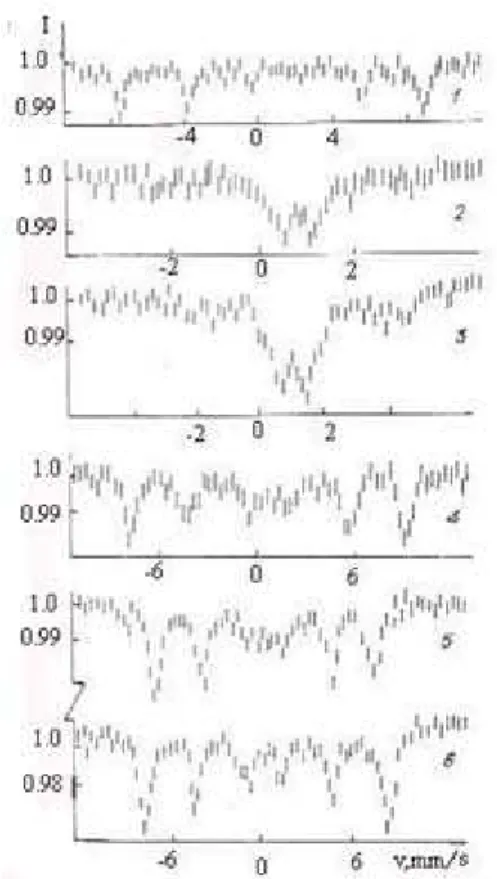
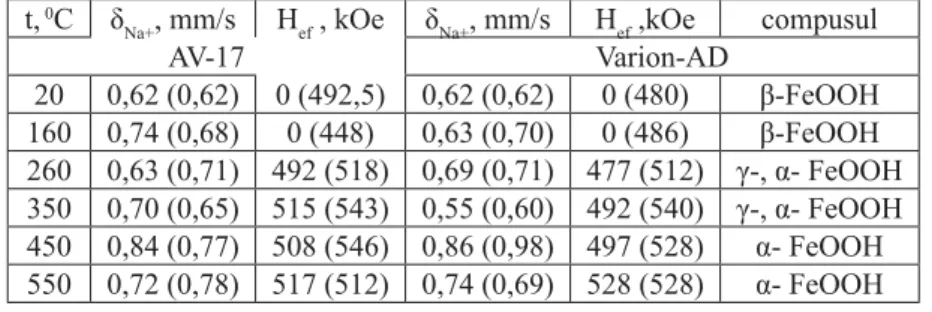
Using Mossbauer spectroscopy it has been investigated the ion exchangers KU-2 and AN-31 which were depleted in water treatment in the fi rst step and the AV-17, Varion - AD - in the second step of the Moldavian thermoelectric station [37.38 ]. Since the iron content in these polymers was relatively small (0.5 to 2.75 mg / g) the polymer samples were thermally treated in air at different temperatures up to 550 oC. The Mossbauer spectra of AV-17 sample are shown
in Fig. 3, and the parameters of Mossbauer spectra of AV-17 and Varion-AD samples in the Table 2. Fig.2. Mossbauer spectra of wetted EDE-10P
The MS parameters show that in the phase of mentioned-up polymers iron is in the ultrafi ne particles of -FeOOH, which during the thermal processing of polymer are transformed in - then α-Fe2O3. According to [39] the transformation of iron(III) oxohydroxide to α-Fe2O3 passes across the formation step of a paramagnetic phase x-Fe2O3 particles with dc = 80 ± 20 Å (dc – is critical diameter). When the particles have d> dC the x-Fe2O3 is transformed to - Fe2O3, and when the particles become more massive (~ 300 Å) - to
α-Fe2O3. With decreasing of particle size of Fe(III) -oxide at d < dC, in case of presence of superparamagnetism, outer sextet lines of the Mossbauer spectra became wider but reduced their intensities and are moving inward to the center until a broad relaxing singlet is formed [40]. Since the superparamagnetic state depends not only of particle size but also of temperature. In the case when the particles dimensions are slightly larger than the dC the superparamagnetic state of magnetic ordered particles appears when the temperature is increasing. Such a situation was observed in the MS with increasing temperature from 300-370 K for used-up Varion -AD sample previously thermally treated at 550oC (Fig. 4) [37].
Therefore it can be concluded that there are ultrafi ne particles of Fe2O3 in the used-up and heat treated at 550oC Varion
-AD polymer phase as well as there are -FeOOH ultrafi ne particles in the exhausted but not heat-treated polymer.
It is known [41], that -FeOOH is chemically more inert than other FeOOH allotropic forms, which makes diffi cult for regeneration of ion exchangers. The chemical stability of -FeOOH can be explained not only by its special structure, but also due to the fact that the Cl-ions enter in its composition [41.42]. The investigations [43] have demonstrated that in this case the composition of precipitate consist of “ -FeOOH +
-FeOOH(CL)” and has the anion exchange properties. The anions with 1- charge (NO3-) substitute the Cl- ion from
-FeOOH easier than anions with larger charge (SO42-).The anion exchange capacity of -FeOOH depends on pH and at
pH 3 it is a 1 mmol (Cl1-)/ g [44].
It is necessary to mention, that after clearing the cause of earlier used-up limit for ion exchangers, the water source alimentation at the Moldavian thermoelectric station was changed.
Table 2 The Mossbauer spectra parameters of termo processing anionites at 300 and 80 K (in brackets).
t, 0C δ
Na+, mm/s Hef , kOe δNa+, mm/s Hef ,kOe compusul
AV-17 Varion-AD
20 0,62 (0,62) 0 (492,5) 0,62 (0,62) 0 (480) -FeOOH 160 0,74 (0,68) 0 (448) 0,63 (0,70) 0 (486) -FeOOH 260 0,63 (0,71) 492 (518) 0,69 (0,71) 477 (512) -, α- FeOOH 350 0,70 (0,65) 515 (543) 0,55 (0,60) 492 (540) -, α- FeOOH 450 0,84 (0,77) 508 (546) 0,86 (0,98) 497 (528) α- FeOOH 550 0,72 (0,78) 517 (512) 0,74 (0,69) 528 (528) α- FeOOH
The iron ions state in the ion reticulate exchangers phase containing strongly basic groups
The monofunctional anion exchangers containing strongly basic groups (R4N+), do not containing in their matrix the
atoms with negative charge or electron donors. In this case, theoretically, they are not entitled to retain cations from solution in static conditions. But in dynamic conditions, being in OH- form, they can retain the metal cations which are
readily hydrolyzed and forming hydroxides [31]. However, surprisingly, it was demonstrated [8.21], that such polymers can retain hydroxocations of Fe (III) in the static conditions from the sulphate solutions with pH = 2.0 at equilibrium. In the same conditions these polymers do not retain hydroxocations of Fe(III) from the solutions of FeCl3 or Fe(NO3)3. The curve of the Fe (III)-containing cations sorption from sulphate solutions on anion exchangers AV-17 (containing R4N+
group) and Varion-AD (containing R4N+ and ROH groups) vs. temperature passes through maximum Fig. 5) [45].
Fig. 5. The temperature dependence of Fe(III) sorbtion by AV-17 and Varion – AD polymers.
Anyhow, it can be affi rmed that the retention of cations by anion exchangers containing strongly basic groups is a chemical process and not a physical one. Sorption of Fe(III) cations by strongly basic polymers takes place in a medium (polymer phase) with relatively high concentration of SO42-anions, and in principle could form anionic complexes inside
the polymer phase, which will be electrostatically retained. But it is well known that the ion exchange is the process which almost does not depend on temperature.
As it is shown in [8] in the AV-17 polymer phase which was in contact with Fe2(SO4)3 solution (pH 1.7 and concentration from 0.03 to 0.06 N), there is a solid iron(III) compound (doublet in the Mossbauer spectrum) and [Fe(H2O)]3+, [FeOH(H
2O)5]
2+ (sextets in the spectrum). The dimmer ions of oxo-or hydroxocomplexes of Fe (III) ions in
polymer phase were not detected. There is only one type of solid Fe (III) compound in the polymer phase after contacting with Fe2(SO4)3 solution at pH 1.85 - 2.00. The parameters of Mossbauer spectra of these compounds (ΔEQ = 1 mm / s) are close to corresponding parameters which are characteristic to Jarosite mineral: A[Fe3 (OH)6(SO4)2], where A may be = Na+, K+, H
3O + , NH
4
+ and other cations [46.47], or hydrated compound FeOHSO
4 [46-48]. The compounds like Jarosite
mineral type are obtained during hydrolytic precipitation of Fe3+ ions in the presence of SO 4
2- anions [48.50].
temperature, to soluble or insoluble FeOHSO4 [51.52]. The Jarosite mineral type compounds are stable up to about 2300C on heating in air, and at T> 2300C one of the thermodecomposing products is FeOHSO
4 [53]. Following the
thermal dehydration of FeOHSO4, the ΔEQ value grows considerably. Boiling in water the iron(III) compounds such as Jarosite are transformed into α-FeOOH in superparamagnetic state [47].
Under thermal treatment in air up to 2000C of Fe (III) Jarosite mineral type compounds in the AV-17 polymer
phase the red-ox processes take place and the Fe (II) compounds as well as stable libber radicals are formed [54]. Mossbauer spectra parameters of AV-17 sample containing Jarosite do not change essential when the sample was heated up to 1800C. So in the AV-17 polymer phase there is not formed FeOHSO
4 when it is in contact with solution of
Fe2(SO4)3. Furthermore, when boiling in aqueous medium the Jarosite from polymer phase is converted to ultrafi ne particles of FeOOH showing superparamagnetic state.
During a few cycles “sorption of Fe (III) then boiling in water”, one part of the magnetic particles become relatively large and magnetically ordered, while another part remains in superparamagnetic state due to location in narrow pores of the polymer [55]. In the solution of Fe2(SO4)3 with pH 2.0 there are [Fe(H2O)6]3+, [FeOH(H
2O)5] 2+ and
[Fe2(OH)2(H2O)8]4+ions [55.56]. The dimeric hydroxocomplexes were not detected in the polymer phase via contacting
with Fe2(SO4)3solution. These complexes are hardly changed to organize in new structural units [57]. The [Fe(H2O)6]3+
ions does also not directly participate in the formation of compounds like Jarosite mineral. So in the polymer phase the [FeOH(H2O)5]2+ ions participate to the formation of compounds of Jarosite mineral type:
R4N+ + 2 SO 4
2- + 3 [FeOH(H 2O)5]
2+ + 3 OH-↔ R
4N[Fe3(OH)6(SO4)2] + 15 H2O (4)
H3O+ + 2SO 4
2- +3 [FeOH(H 2O)]
2+ +3 OH- = H
3O[Fe3(OH)6(SO4)2] +15 H2O (5)
In boiling aqueous solution the iron compounds such as mineral Jarosite decompose according the scheme (6):
2 R4N[Fe3(OH)6(SO4)2]= (R4N)2SO4 + 6 -FeOOH +3 SO42- +6 H+ (6)
Jarosite mineral formation can take place only in the presence of water. When this mineral was found on Mars it was deduced that water is present there too and latter confi rmed.
The Jarosite mineral type compounds are formed as layers of 3 or 6 octahedral cycles [49]. The OH- groups are located in the equatorial plane, forming a bridge between metal ions and SO42-groups are located in axial position, each
coordinating 3 metal ions of 3 octahedrons.
The Jarosite mineral type compoundspresence in polymers phase changes essentially their physical-chemical properties. The R4N+ and H
3O
+ ions from compounds can be exchanged with different cations but at the same time the
anions SO42- connect with different other anions or molecules able to form coordination bonds with the central metal
ions.
The alunit type mineral K[Al3(OH)6(SO4)2] is izostructural with Jarosite mineral. So, at contacting with Al2(SO4)3 solution in the phase of strongly basic anion exchangers it may be formed compounds such alunit [13 ]. Moreover, in the analogical conditions it may be formed compounds like Jarosite mineral type containing other cations species which differ of Fe3+ or Al3+ [12].
The reticulated ionic polymers containing in their matrix not only strongly basic groups, but other chemically active functional groups such as - COOH,-CN etc, also may retain metal cations (M3+) from the solutions of sulfate as a result
of training compounds like Jarosite mineral, as well as function of coordination with electron donor atoms of the polymer [58].
Conclusions
To understand more deeply the formation of metal compounds in chemical active reticulate polymer phase and the processes connected with utilization in different areas of these composites uploaded with metallic compounds polymers it is imperiously required their investigation using various complementary physical methods, including Mossbauer spectroscopy in special.
Acknowledgements
Foshko. Increased reliability and effi ciency water chemical conditions, ways to simplify the technological [3].
schemes and lowering the cost of water treatment at the units S.K.D. and large TETS S.D.V; Leningrad: CKTI II Polzunova. 1973, 128-134 (rus).
Saldadze, K.M.; Pashkov, A.B.; Titov V.S High-molecular-weit ion exchange.materials, Goskhimizdat: Moscow, [4].
1960. 356 (rus.)
Nazarova, R.S.; Sandar, A.A.; Andreev, M.B.; Kovalev, M.P. Plastics. 1974, № 4, 72- (rus) [5].
Gutsanu V.L. Doct.Habilitat. Thesis, State University of Moldova. Chisinau, 1993 (rus.) [6].
Saldadze, K.M.; Kopylova-Valova, V.D. Complex-forming ion exchangers (kompleksities). Chemistry: Moscow, [7].
1980. 336. (rus.)
Gutsanu V.L.; Turta, C.; Gafi iciuc, V.A.; Shofranski, V.N. Russ. J. Phys. Chem. 1988, .62. pp.2515-2422. [8].
(rus.)
Gutsanu V.L. Chemistry and Technology of Water.1990, .12. .№12 pp. 1074-1097. (rus.) [9].
Copylova, V.D.; Astanina, A.H. Ion exchanger complexes in catalysis. Chemistry: Moscow. 1987 . 191 (rus.) [10].
Guţanu V., Druţă R. Procedeu de obţinere a ioniţilor modifi caţi. Brevet de invenţie, MD 810. // BOPI, 1997,nr.8, [11].
p.24-25
Guţanu V., Druţa R. Procedeu de moifi care cu Cr(III) a polimerilor ionogeni reticulaţi ce conţin grupe R4N+ . [12].
Brevet de invenţie, MD 1027. // BOPI,1998. nr.9. p.23
Guţanu V., Druţa R. Obţinerea sorbenţilor selectivi pentru sorbţia coloranţilor alimentari din soluţii // Materialele [13].
I simposion internaţoinal “Biochimie şi biotehnologii în îndustria alimentara ” .Chişinău. Tehnica –Info.2002. p.210-215
Guţanu V., Cojocaru L. Procedeu de obţinere a sorbentului selectiv care conţine compuşi de Bi (III) . Brevet de [14].
invenţie, 32.95 MD . // BOPI, 2007,nr.4, p.42-43
Suzdalev, I.P. Gamma-rezonance spectroscopy of proteines and model compounds. Nauca: Moscow. 1988. 262 [15].
pp. (rus.)
Suzdalev, I.P.; Afanasiev, A.N.; Placinda, A.S.; Golidanskii, V.I. Journ.Exper. and Theor. Physics. 1968, 55. [16].
1752-1765 (rus).
Laskorin, B.N.; Ligvinenko, I.A.; Fedorova, L.A.; Ashurkova, C.B. Journ. Anal. chemistry. 1969.T.42. № 6, [17].
s.1320-1325 (rus.)
Suzdalev, I.P.; Plachinda, A.S.; Makarov, E.F.; Dolgopolova, V.A. Russ. J. Phys. Chem. 1967, V.41, № 11. 2831-[18].
2837 (rus.)
Gutsanu, .VL.; Turte, K.I.; Muntean, S.A. et al Russ. J. Phys. Chem 1990, 64, № 2, 479-487 (rus.) [19].
Dzevitsky B.E., Zviadadze GN, Margulis, VB et al. Russ. Coord. Chem. 1977,3, № 7, 643 - 647 (rus.) [20].
Gutsanu, V.L.; Gafi ychuk, V.A. Russ. J. Phys. Chem 1986, 60,1824-1826. (rus.) [21].
Gutsanu, .VL.; Muntean, S.A.; Turte, K.I Bull. AN MSSR, Ser. biol. and chem. science.1980, N:2, 73-79(rus.). [22].
Gutsanu, .V.L.; Dogaru G.N. Russ. J. Phys. Chem. 1985, 54, №8, 2098-2101 (rus.). [23].
Gutsanu, .V.L.; Turte K.I.; Stukan, R.A.; Gafi ychuk, V.A. Russ. J. Phys. Chem. 1985, 59, № 3, 693-696 (rus.) [24].
Safi n R.Sh.; Gutsanu, .V.L.; Vishnevskaya G.P. Russ. J. Phys. Chem. 1987, 61, №8, 2134 - 2138(rus.). [25].
Lurie, A,L. Sorbents and chromatographic carriers. Nauka: Moscow. 1972. 320 pp. (rus.) [26].
Turte KI, Gutsanu, .V.L.; Bobkova, SA etc. The study of complexation of iron ions on the anion exchanger AN-[27].
2FN / . Izv.Acad.Nauk MSSR. Ser. biol. and chem. science.1980, 4, 54-60 (rus.).
Krestov, G.A.; Klopov, V.I.; Patsatsia, K.M. Journ. Strukt. Chemistry .1969, 10, № 3,417-422 (rus). [28].
Buslaeva, M.N.; Samoilov, O.Y. Journ. Strukt. Chemistry. 1963,4, № 4, 502-505 (rus). [29].
Gutsanu, .V.L.; Gafi ychuk, V.A. Chemistry and Technology of Water. 1989, .11, № 7, 584-588 (rus). . [30].
Gutsanu, .V.L.; Stukan, R.A., Turte, K.I., Gaftychuk, V.A. Russ. J. Phys. Chem. 1986, .60, .936-940 (rus). [31].
Gol’danskii, V.I.; Makarov, E.F.; Stukan, R.A. Proc. AS USSR. 1964, .156, № 2, .400-403 (rus). [32].
Gutsanu, .V.L.; Gafi ychuk, V.A. Russ. J. Phys. Chem. 1990.64, № 2, 488-494 (rus). [33].
Astanina, A.N.; Fung, Chi Chi; Rudenko, A.P., etc. Russ. J. Phys. Chem. 1983, 57, № 6, 1397-1399 (rus). [34].
Chemical Applications of the Messbauer Spectroscopy, Ed. VI Gol’danskii, R.Herber. Mir: Moscow.1970 [35].
(rus).
Edwards, R.P., Johnson, C.E. J.Chem. Phys.1968, v.49, №1, p.211-216. [36].
Gutsanu, .V.L.; Turte, K.I.; Labunskaya N.Y. Russ. J. Phys. Chem. 1987, 61, № 1, 170-174 (rus). [37].
Gutsanu, .V.L.; Turte, KI, Labunskaya N.Y. Chemistry and techn. of water. 1987, .9, № 6, 514-517(rus). [38].
Krupyansky, Y.F.; Suzdalev, I.P. Journ.exper. and theor. phys. 1973, 65, № 4, 1715-1725 (rus). [39].
Suzdalev, I.P. Solid State Physics. 1970, 14, № 4, 988-990 (rus). [40].
Wever, I.E.; May, L.A., Bull. AS Lat. SSR. Ser. Chem.,1979, 2, 147-153 (rus). [41].
Borggard, O.K. Acta Chem. Scand . 1988, A37, №2, 169-171 [42].
Gutsanu, .V.L.; Labunskaya, N.Y. Russ. J. Phys. Chem.. 1986, 60, №12, 3113-3116(rus). [43].
Gutsanu, V., Raisa Drutsa, Rusu V. Reactive and Funct. Polym., 2001, 46, 203-211 [45].
Hrynkiewicz, A.Z., Kubisz, I., Kulgawczuk, D.S. J. Inorg. Nucl. Chem. 1965, 27, №12, 2513-2517. [46].
Matashige Ohyabu, Iusuke Ujihira .J. Inorg.. Nucl. Chem. 1981, 43, 1948 -1949. [47].
Morais, P.S.; Neto, K.S. Polyhedron. 1983, 2, № 9, 875-880. [48].
Archipenko, D .K, Deviatkina, ET, Palchik, NA, Crystallochemical particularities of synthetic jarosites. [49].
Novosibirsk, Nauka 1987.
Betekhtin, AG, Mineralogy. Gos. Acad. Geolog. Litr.: Moscow. 1950. 5-73.(rus.) [50].
Milner, A.; Zapolsky, A.K.; Ryzhuk, N.P.; Jour.n.Appl. Chem. 1986, 59, 499-504.(rus.) [51].
Zapolsky, A.K.; Milner, A.; Ryzhuk, N.P. et al. Chem. and Techn. of water.1985, 7, № 6, [52].
70-73 (rus). [53].
Margulis, E.V.; Savchenko, L.A.; Shokarev, M.M.; et al. Russ. J. Inorg. Chem. 1973, 18, № 5, 1263-1269 [54].
(rus).
Gutsanu, V.; Gafi ichuk, V.; Shofransky, V.; Turta, C. J. Appl. Polym. Sci., Vol. 99, 59-64.(rus.) [55].
Fishtik I.F.; Vataman, I.I. Thermodynamics of Metal Ion Hydrolysis. Shtiintsa: Kishinev. 1988) [in Russian]. [56].
Yakubov, J.M.; Ismailov, M.A.; Offengenden E.Y.; Ibragimov, D.C. Hydroxyl complexation in redox systems. [57].
Taj. State Univ:: Dushanbe. Issue 3, 5-36 (rus).
Belozersky, GN, Baikov, M., Boldyrev, VV, et al. Kinetics and Catalysis 1974, 15, № 4, 929-934 (rus). [58].