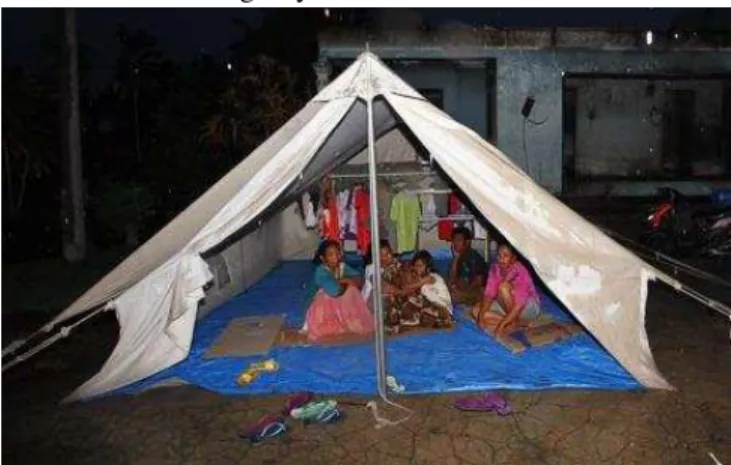
Figure 1. Typical emergency shelter
Abstract— By its geographically location, Indonesia is potential land for natural disasters. In the last decade, tsunami, eartquakes, volcanic eruption and landslides were predominantly Indonesia's natural disasters. This paper looks at the provision of emergency shelter for displaced people in warm and humid environment. Thermal condition of two types of emergency tents; a single and a double layer tents were calculated using
Fanger’s thermal comfort model namely PMV and PPD
indices. The results of the PMV and PPD models then were compared with those obtained from thermal vote questioner. About 16 subjects were voluntarily participated in the study. It is found that the double layer tent gave better results of PMV and PPD indices compared to the single layer tent, but still it was beyond
the range of acceptability of Fanger’s thermal comfort.
However, results from sensation votes and actual percentage of disability showed that the double layer tents were in the range of thermal acceptability of comfort. This indicated that the standard PPD of the ISO 7730 and ASHRAE Standard 55 overestimated the level of dissatisfaction in the emergency tents.
Keywords— Emergency tent, Thermal comfort, PMV, PPD, APD
I. INTRODUCTION
Y its geographically location, Indonesia which has more than 18,000 islands and situated along pacific
‗ring of fire‘ of active volcanoes and tectonic faults is a very vulnerable country to disasters. The 383 out of 471 districts/cities are disaster prone areas with high number of population and unevenly population distribution (Hadi, 2009). Other natural disasters generated by or exacerbated by human activities like floods, landslides, drought, and land/forest fire also expanded the disaster lists in Indonesia. In the last decade, there were at least 6,298 disasters in Indonesia, damaged almost 2 million units houses and caused more than 7,8 million people displaced from their
Manuscript received January 31, 2015; revised February 3, 2015. This research was financial supported by DIKTI, Indonesian Ministry of Education through Program of Academic Recharging (PAR-C) in 2010-2011.
Lusi Susanti is with the Andalas University, Padang, West Sumatera, Indonesia. She is now with the Department of Industrial Engineering, Andalas University (corresponding author to provide phone: 0811660175; fax: 0751-72566; e-mail: [email protected]
properties (BNPB, 2009). The disasters have caused the loss of hundred thousands lives, thousands missing, and million displaced. In the immediate aftermath of a disaster, there is no sufficient facility to house displaced people in any other way, and temporary shelters like tent camps have to be provided with. The shelter is a critical determinant for survival in the initial stages of a disaster. Beyond survival, shelter is indispensable to provide security and personal safety, protection from the climate and to enhance resistance from ill health and disease. It is also important for human dignity and to sustain family and community life as far as possible in difficult circumstances.
In the immediate aftermath of a disaster, there is no sufficient facility to house displaced people in any other way thus temporary shelters have to be used. Shelter is vital part of humanitarian relief and plays a fundamental role in the physical and psychological health of affected populations and is a human right [UNHCR, 1999]. However, like majority of organizations and agencies in aid community in
1
developing countries, shelter for displaced people is not afforded the attention and funding that it should. The concern on the shelter system seems to have been overlooked by the local government and aid communities which proved by inadequate provision of emergency shelters in recent natural disasters, regarding the logistics of supply and the living condition.
These factors were evident in several big disasters in last decade like 2004 Aceh earthquake and tsunami, 2005 Nias Earthquake, 2006 Jogjakarta earthquake, 2009 Tasikmalaya earthquake, 2009 Padang earthquake and the latest 2010 Mentawai Earthquake and Merapi volcano disruption, which had shown that emergency shelters were slow to arrive on
Thermal Comfort Evaluation of Emergency
Tent Using PMV and PPD Model
Lusi Susanti
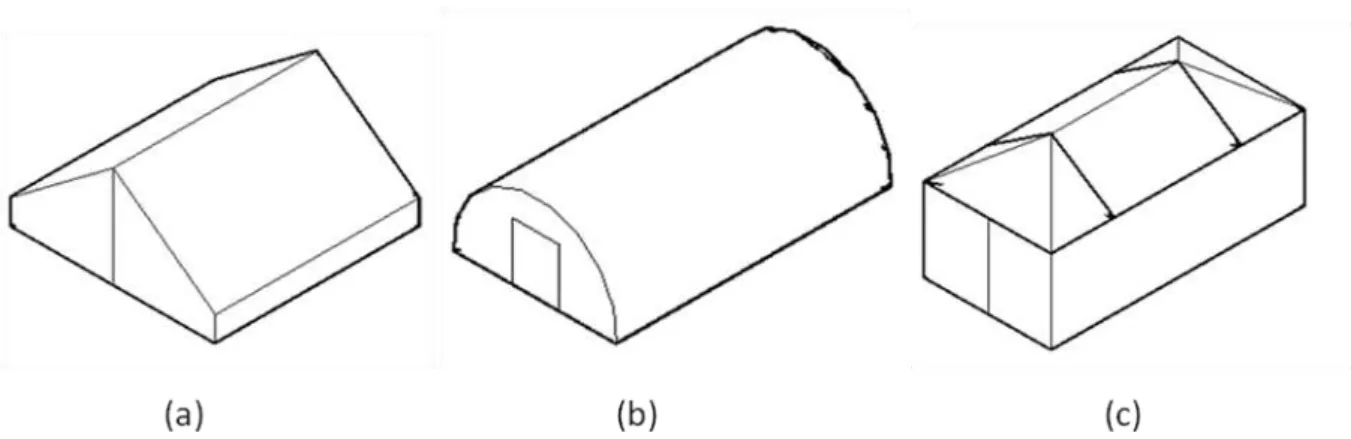
Figure 2. Typical of tents supplied by international aid agencies for Indonesian emergency relief effort; types of structure (a) Ridge, (b) Tunnel, (c) Frame
site causing the refugees had to live longer in an inappropriate settlement. The survey carried out on thermal performance of existing emergency shelter after the Padang earthquake confirmed that the living condition inside the existing tents were very uncomfortable.
For thousands of years, a tent has probably been the basic form of emergency shelter. Tents are relatively quick and simple to erect, they are more acceptable to host nations than more permanent forms of shelter, and remain flexible for later changes to planning or for relocation. A simple ridged shelter using plastic sheeting for temporary roofing and a structural system from locally available materials such as timber or bush poles is a common form of emergency shelter (Figure 1). People may also reuse of material collected from damaged buildings to build temporary settlement before more acceptable shelter such tents are delivered to the site.
There are three types of temporary tents commonly used to house displaced people in Indonesia whenever emergencies preponderate, as seen in Figure 2. The tents are used to accommodate small to medium size family (4-6 people). Ridge and Tunnel tent are made from two layers: one is made from canvas, which forms the waterproof outer flysheet; and the other from cotton, which is hung from inside the flysheet as a liner. They are made from the same material used to manufacture winterized UNHCR tent. Frame tent fabric is made from polyester waterproof 600D Oxford for outer layer and 170T white terylene breathe freely taffeta for the inner fabric. The tents are mostly supplied by international aid agencies for Indonesian emergency relief effort. However, recent examples have shown that existing tents are slow to arrive on site causing refugees stay longer in very appropriate shelters.
Like majority of organizations and agencies in aid community in developing countries, shelter for displaced people is not afforded the attention and funding that it should. Therefore, this work is intended to develop an initial project on provision of emergency shelter for displaced people with better understanding of shelter in tropical weather. The design concept and prototype of the proposed emergency tent have been developed in the previous research [Susanti and Yoki, 2010] and the present paper
focuses on the assessing thermal performance of the tent under warm and humid environment subject to the thermal comfort evaluation. The ultimate goal is to deliver shelter designs and material specifications, which will enable rapid, high quality and low cost shelter deployment in emergencies.
II. RESEARCH METHODS
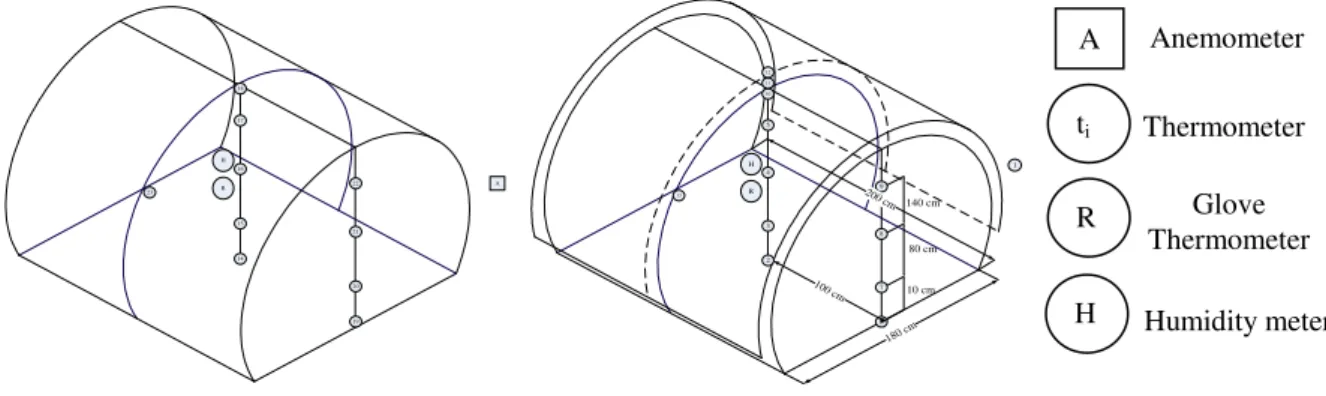
Two tunnel shape reduced scale prototype of emergency tents are designed and constructed in one manufacturer used for the testing purpose. The tent frames are built from fiber bar and the envelopes are made from water-proof polyester fabric. The tents have 2 m length, 1,8 m width and 1,5 m height, designed to accommodate 1-2 persons at a time. According to design guidelines proposed by Adler (1992) considering warm-humid equatorial environment, requirements for building design in this climate is to promote air movement from fan or cross ventilation, low thermal capacity construction, sloping roofs and large overhangs, windows facing north and south. The two tents are identical in shape and size except that the second tent has a double layer which the outermost layer made from a reflective material. Figure 3 shows the schematic model of the two tents.
The selected method in this research is field measurement. Field studies allowed for analyses of many of the contextual factors and other factors than those that can be simulated in climate chamber, as the subjects provided responses in their everyday habits, wearing their everyday clothing and behavior without any additional restrictions. In
the field survey people are able to act as „meters‟ of their
environment [Adebamowo and Olusanya, 2012]. The two tents were erected on campus ground area and let exposed to the surrounding weather. The field study was conducted in hot season from March to June, 2011. Meteorological data showed that hot season in Padang (located on latitude 0o44`
00‖-1o 08‘35‖ S and longitude 100o05‘05‖ – 100o34‘09‖ E) is characterized by high humidity and temperature with low air movement.
Data collection method
Figure 4. Profiles of measured inside tent air temperature
22.00 24.00 26.00 28.00 30.00 32.00 34.00 36.00
07:00-09:00 11:00-13:00 15:00-17:00 19:00-21:00
T
em
pe
ra
tu
re
(
oC)
Observation Time
Ambient Temperature (⁰C) Double layer tent (⁰C) Single layer tent (⁰C)
Figure 5. Relative humidity of two tents
Figure 6. Mean radiant temperature of two tents research methods is common in field studies and helps to
balance the strength and weakness inherent in individual data collection strategies. In this study, the measurement was collected for four period of time in a day: morning (7-9 am), afternoon (11 am – 1 pm), evening (3-5 pm) and night (7-9 pm). Total measurement period lasted for 16 days observation.
Thermal sensation model
Thermal performance inside the two tents can be predicted using Predicted Mean Vote (PMV) and Predicted Percentage of Dissatisfied (PPD). PMV and PPD indices were evaluated from six physical parameters of environment: air temperature, relative humidity, air movement, mean radiant temperature, metabolic rate and clothing insulation. The first four parameters were measured using thermal comfort meter (thermometer and humidity logger, anemometer and radiant meter) and the later two were determined using information derived from measurements, questionnaire data and observation. Measuring points of the environmental variables are displayed in Figure 3. To calculate PMV and PPD indices equations derived by Fanger [1970] were used for the evaluation of PMV and PPD indices, as explained below:
PMV = [0,303 exp (-0,036 M) + 0,028] L
…
...
……
(1)
...(
2
)
L = = (M
–
W)
–
{3,96 x 10
-8fcl x [(tcl+273)
4–
( r +273)
4]
–
fcl hc(tcl
–
ta)}
–
3,05 [5,73
–
0,007(M
–
W)
–
pa]
–
0,42 [(M
–
W)
–
58,15]
–
0,0173M
(5,87
–
pa)
–
0,0014M(34
–
ta)
……….
..(2)
where,
PPD = 100-95exp [(-0.03353PMV4
+ 0.2179PMV2
]………...(3)
Subjective measurement
In the next stage of data collection, questionnaire survey was employed to evaluate the thermal sensation of Figure 3. Schematic model of emergency tents; left: single layer, right: double layer
1
6 8 9
2 4
3 5
10 11 12
13 R
H
7 10 cm
80 cm 140 cm
180 cm 200
cm
100 cm
19 21
20 22
14 16
15 17 18
23 R H
A
A
H R ti
Anemometer
PMV -3 -2 -1 0 1 2 3 Thermal
sensation Cold Cool
Slightly cool Neutral
Slightly
warm warm hot Table 1 ASHRAE thermal sensation vote
Single Layer Double Layer Single Layer Double Layer
07:00 - 09:00 0.94 0.68 46.54 45.09 11:00 -13:00 2.95 2.38 87.24 79.97 15:00 - 17:00 1.36 1.31 51.94 47.91 19:00 - 21:00 -0.49 -0.24 16.34 10.83
Observation time
PMV PPD (%)
Table 2 Summary of PMV and PPD values
The number of questioner having discomfort label Total number of questioner in any section
PPD = x 100%
Figure 7 Predicted mean vote of two tents
Figure 8 Percentage of dissatisfied of two tents
Figure 9 Mean vote from questioner the occupants regarding the thermal comfort parameters. 16
volunteers were participated in the study. They were asked to stay in the tents doing sedentary activities like reading, writing, laying, working with laptop, etc. A set of thermal comfort questioner was given to the participants to get actual response on thermal performance of the two tents.
Percentage Dissatisfied (PD) index based on questionnaire was also computed. To determine PD index, the number of respondents who expressed discomfort on 7-point ASHRAE Standard 55 (2004) about thermal comfort sensation scale were determined. The expression of discomfort is known if the respondent answers between (2, -3) and (+2, +-3) to any of the thermal sensation questions, this question was labeled as a discomfort one. Following Pourshaghaghy and Omidvari [2012] methodology the PD index based on the questionnaires was then computed using the following expression
III. RESULTS AND DISCUSSION
During the period of the field measurement, the weather conditions vary with time on different days of observation. Figure 4-6 show the profiles of measured inside tent air temperature, relative humidity and mean radiant temperature data respectively. Wind velocities recorded during observation ranged from 0 m/s to 1,8 m/s, for both tents. Clothing thermal insulation and metabolic rates values were determined from the type of clothing and activities of participants during the observation. The average values of clothing insulation and metabolic rate were 0.5 clo and 1 met.
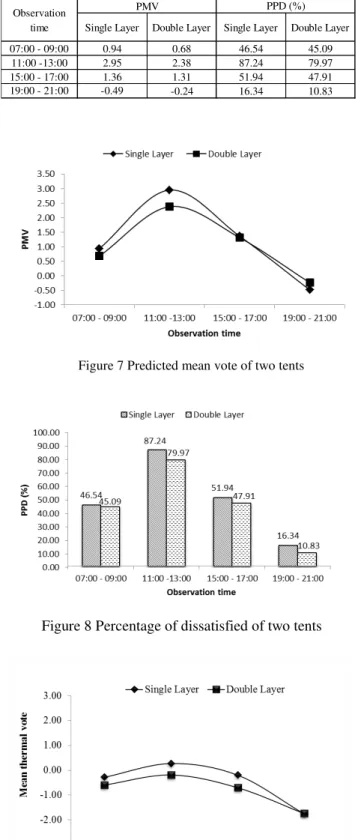
The results of the calculated values of PMV and PPD indices for both single and double layer tents are summarized in Table 2. It is observed that PMV values fluctuated with time because of the fluctuation of solar radiation (Figure 7). In the morning and night, PMV values
fell into category ―neutral‖ for both single and double layer
tents and this was the appropriate thermal comfort condition for the occupants to stay in the emergency shelter. However, PPD values showed that only in the evening, the participants would satisfy with the thermal condition inside the two tents, or in other words, less than 20% of respondents were predicted to express dissatisfaction with the environment. Moreover, approximately 46.54% and 45.09% of respondents would dissatisfy with the thermal condition inside the single and double layer tents, respectively, if they were asked to stay inside during the morning time (Figure 8).
In the afternoon and the evening when the incidence of solar radiation was also high, the PMV values of the
occupants fell into category ―warm‖ and ―slightly warm‖,
respectively for single and double layer tents. This condition
Single Layer Double Layer Single Layer Double Layer 07:00 - 09:00 46.54 45.09 6.25 12.50 11:00 -13:00 87.24 79.97 37.50 6.25 15:00 - 17:00 51.94 47.91 12.50 18.75 19:00 - 21:00 16.34 10.83 31.25 12.50 Observation time PPD (%) APD (%) Table 3 Comparison of APD from questioner with Fanger`s PPD indices
Figure 10 Comparison between PPD and APD of two tents
of single and double layer tents, respectively. When it is compared between thermal comfort of single and double layer tents, it is showed that the double layer tent gave a better PMV and PPD values than those of single layer tent.
The calculated PMV and PPD values showed that outdoor conditions play a role in influencing indoor thermal environment. While the main climatic elements affecting building thermal comfort level (PMV) are solar radiation, air temperature, humidity, wind and rainfall [Mohazabieh et al., 2010; Markus and Morris], solar radiation is the most important element among all, as it influenced the amount of heat transfer to buildings and residents. Besides, the thermo-physical properties, structure, size and orientation are of significant effects on the indoor thermal environment. It is essential for designers to pay more attention to these factors in the early stage of emergency shelter design.
Thermal comfort on the questioner Respondents‘ real vote
Thermal sensation is the most important human responses to thermal environments and their relationships to a large extent determine the definition of optimal conditions and acceptable ranges. The real vote was based on the respondents vote regarding the thermal comfort of the tents. The ASHRAE standard 55 [2004] specified that the thermal acceptability should be defined as the condition where 80% of occupants vote for the central three categories (-1, 0, +1). Comparison between the thermal sensation votes in the two tents showed that the comfort votes recorded by respondents ranged from cool (-2) to slightly warm (+1), as can be seen (Figure 9). The cool and cold sides of the scale accounted for 87.5% for single layer tent and 100% for double layer tent. The mean thermal sensation vote (MTSV) was -0.49 and -0.81 for single and double layer tent, respectively. It was observed that, there was a biased towards the options on the 7-point scale. The bias was predictably accepted since the ability of human being to adapt with the surrounding environment is very high. Other factor contributed to the bias was the present of the wind breeze could increase more cooling sensation to the respondents.
The Actual Percentage of Dissatisfied (APD) from the questionnaire survey is presented in Figure 10 and Table 3. ASHRAE Standard 55 [2004] was designed to provide 80% acceptability of the environment based on 10% dissatisfaction for general (whole body) thermal comfort and an addition of 10% dissatisfaction resulting from local discomfort. Generally, the APD values obtained from questionnaire survey were much lower than those obtained
from Fanger‘s calculation, for both single and double layer tents. For double layer tent, the APD values were less than 20%. This indicated that the percentage of respondents who were dissatisfied from thermal conditions was less than 20%.
However, in the single layer tent, it is still found that about 40% of respondents were dissatisfied with the thermal condition, especially in the time between 11:00 – 13:00.
By comparing the PPD index and actual dissatisfaction (APD), it was found that there were large differences between the actual dissatisfaction rates and the calculated PPD across different observation time. In the double layer tent, the values of PPD index were not within the acceptable range of 20% in three sections of observation time as recommended by standard. On the contrary, the APD values were within the acceptable range of 20% in all observation time. Statistical Z-test showed again that there was significant difference between the respondents` opinions
(questionnaire survey results) and the computed PPDs (p ˂
0.005). This indicated that the standard PPD of the ISO 7730 and ASHRAE Standard 55 overestimated the level of dissatisfaction in the emergency tents. This is a validation of the results of previous studies and also confirmed no agreement between the real sense of thermal comfort in people and the PPD index.
IV. CONCLUSION
The applicability of PMV-PPD model in predicting the quality of indoor climate in both single and double emergency tents in warm-humid area Padang, Indonesia was investigated in the present study. In addition, the study examined the existing thermal environmental conditions inside the emergency tents as well as occupant perception. The key findings from this study were as follows:
Empirical measurements showed that the physical condition of air temperature, RH and velocity in the single and double layer tents were not within the limits set out by the ASHRAE Standard 55 and ISO 7730 Standard. However, occupants found their thermal environment comfortable, satisfying and acceptable.
The thermal environment inside the emergency tents, both for single and double layer tents were unacceptable to the occupants judging by the values of PMV and PPD indices.
In conclusion, the results of this study confirmed the suggestion by previous researchers about the limitation of the PMV-PPD model for predicting thermal comfort
.
ACKNOWLEDGMENT
This research was financial supported by DIKTI, Indonesian Ministry of Education through Program of Academic Recharging (PAR-C) in 2010-2011.
REFERENCES
[1] Hadi, S. (2009a). Experience in Managing Response and Preparation for Recovery: Case of Indonesia. Tsunami global Lesson learned. New York.
[2] BNPB - National Agency for Disaster Management, Data dan Informasi Bencana di Indonesia, 2009 (in Indonesian).
[3] UNHCR (1999). Handbook for Emergencies. UNHCR, Geneva.
[4] Susanti, Lusi (2010). Emergency Shelter System for Tropics. Undergraduate thesis, Andalas University. [5] Adler, D. (1992)Metric Handbook: Planning and Design
Ed Adler D Pub. Oxford Press, pp 37-1.
[6] Adebamowo, M.A. and Olusanya, O. Energy savings in housing through enlightened occupants behaviour and by breaking barriers to comfort: a case study of a hostel design in Nigeria. Proceedings of 7th Windsor Conference: The changing context of comfort in an unpredictable world Cumberland Lodge, Windsor, UK, 12-14 April 2012. London: Network for Comfort and Energy Use in Buildings, http://nceub.org.uk.
[7] Fanger, P.O. Thermal comfort, analysis and applications in environmental engineering. New York: McGraw-Hill; 1972.
[8] ASHRAE Standard 55: Thermal Environmental Conditions for Human Occupancy, American Society of Heating, Refrigerating and Air- Conditioning
Engineering, Atlanta, GA, 2004.