_____________________________
*)
Corresponding author: [email protected]
doi: 10.2298/SOS1503249S
UDK 692.533.1; 622.785; 676.017.2
The Influence of Electrocorundum Granulation on the
Properties of Sintered Cu/Electrocorundum Composites
A. Strojny-N
ę
dza
1*), K. Pietrzak
1,2, W. W
ę
glewski
21
Institute of Electronic Materials Technology, 133 Wólczyńska Str., 01-919 Warsaw, Poland,
2
Institute of Fundamental Technological Research, Polish Academy of Sciences, 5B Pawinski Str., 02- 106 Warsaw, Poland
Abstract:
Copper/alumina composites are extensively used in automotive and aerospace industry for products that are subjected to severe thermal and mechanical loadings, such as rocket thrusters and components of aircraft engines. These materials are well-known for their good frictional wear resistance, good resistance to thermal fatigue, high thermal conductivity and high specific heat. In this paper, the sintering process of copper/electrocorundum composites reinforced by electrocorundum particles with diameters of 3 or 180 µm and 1, 3, 5 vol.% content is presented. The effects of different particle sizes of the ceramic reinforcement on the microstructure, physical, mechanical, tribological and thermal properties of the fabricated composites are discussed.
Keywords: Copper/alumina composites, Sintering, Modeling of thermal properties, Microstructure, Mechanical properties.
1. Introduction
aforementioned properties and, in consequence, on the future applications of the final material [12-13]. In the present paper, Cu/Al2O3 composites were obtained using powder metallurgy
technique by mixing appropriate proportions of starting powders and sintering them at 1050°C under the pressure of 30 MPa. This technique has a considerable drawback. Aluminum oxide added as powder forms agglomerates and cannot be sintered at the process temperature (1050°C) as determined by the melting point of copper (1083°C). In addition this effect hinders the sintering of copper particles. The resultant porosity considerably affects, among other things, the thermal conductivity of composites, thus limiting their applicability.
This paper shows a solution to this problem consisting in using electrocorundum powder as the ceramic reinforcement for copper/alumina MMCs. Electrocorundum is formed by melting aluminum oxide powder (α-Al2O3) in an arc resistance furnace. The main objective is to investigate the effect of the particle size and amount of the reinforcement phase on the microstructure and selected physical, mechanical, tribological and thermal properties of Cu/Al2O3 composites.
2. Experimental procedure
The following commercially available powders were used as the starting materials: copper powder (Sigma Aldrich, 99.9% purity) with granulation 10 µm (Fig. 1a) and the BET specific surface area of 0.61 m2/g, and two kinds of electrocorundum powder with considerably different particle sizes, i.e. fine powder < 3 µm and coarse powder of 180 µm (Polish company KOS, 99% purity). The morphology of the starting powders and particle size distribution are shown in Fig. 1.
a) b) c)
Fig. 1. Particle size distribution and SEM images of the starting powders, i.e. a) copper, b) fine electrocorundum and c) coarse electrocorundum.
observed that copper particles are rather spherical in shape (ball-shaped), whereas those of electrocorundum have sharp edges (Fig. 1).
Three compositions of the powder mixture were prepared with the following Cu to ceramic phase content (vol.%): 99%Cu-1%Al2O3, 97%Cu-3%Al2O3 and 95%Cu-5%Al2O3. They were obtained in a mechanical mixing process in a planetary ball mill (Pulverisette 6, Fritsch) with tungsten carbide balls (Ø5 mm). The high-energy mechanical mixing process was performed at room temperature in air atmosphere, at the rotation speed of 200 rpm and the time of mixing of 6 h. The balls to powder weight ratio (BPR) was 3:1. The mixing conditions were adopted from authors’ previous experiments reported in [14].
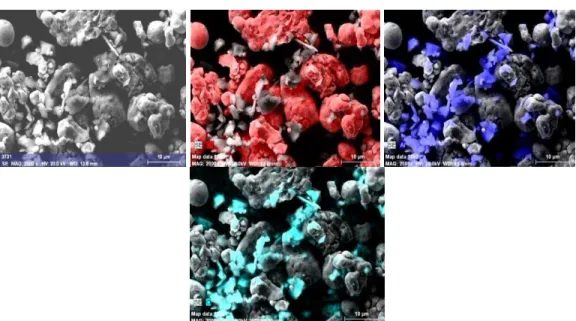
The morphology of the powder mixtures was studied using scanning electron microscopy. Fig. 2 shows examples of the morphology of a fine powder mixture of 95%Cu-5%Al2O3 obtained by mechanical alloying.
Fig. 2. The morphology of powders and the surface distribution of elements in composite mixtures after the mixing process for Cu-5vol.%Al2O3 fine: red-copper, blue-Al2O3,
green-oxygen.
The powder mixtures were placed in a graphite die and sintered in an Astro Thermal Technology hot press for 30 min in argon atmosphere at 1050°C under the external pressure of 30 MPa. After the holding time (30 min), the samples were cooled inside the furnace down to the room temperature, with the external load removed. Then, they were removed from the furnace, mechanically cut, ground and polished.
consideration radiative heat loss. The measurements of the specific heat (used in the calculation of thermal conductivity) of the Cu/Al2O3 composites were performed by a STA 449 Jupiter Netzsch fine thermal analyzer – using the differential scanning calorimetric method with heat flow (DSC). The measurements were made for 4x4x1 mm samples at the temperature of 50°C. The obtained values of specific heat for composite materials were compared with the theoretical values estimated from the rule of mixtures: Cpcomp = 1/ρcomp (VmρmCpm + VrρrCpr); where: Cp is the specific heat, ρ is the density, V is the volume fraction of a component, and superscripts comp, m and r stay for the properties of the composite, matrix and reinforcement, respectively. The bending strength of the composite was determined in a three-point bending test using ZWICK 1446 testing machine at a support spacing of 30 mm and a head travel speed of 10 mm/min. The size of the test specimens was 30x4x2.5 mm. The average values of the bending strength were calculated from five test realizations.
Tribological tests (ball-on-flat) were conducted applying the following parameters: the force Fn – 5 N (steel ball) and velocity – 5 mm/s. The friction force Ft thus generated was measured with a piezoelectric displacement sensor 24 times per second. It was induced and recorded in 30 min long friction processes. The friction coefficient was analyzed using a special software. After the test, the surface of the groove was analyzed using scanning electron microscopy and wear volume of the groove of the samples was measured with a scanning profile-gauge (Veeco).
3. Results and discussion
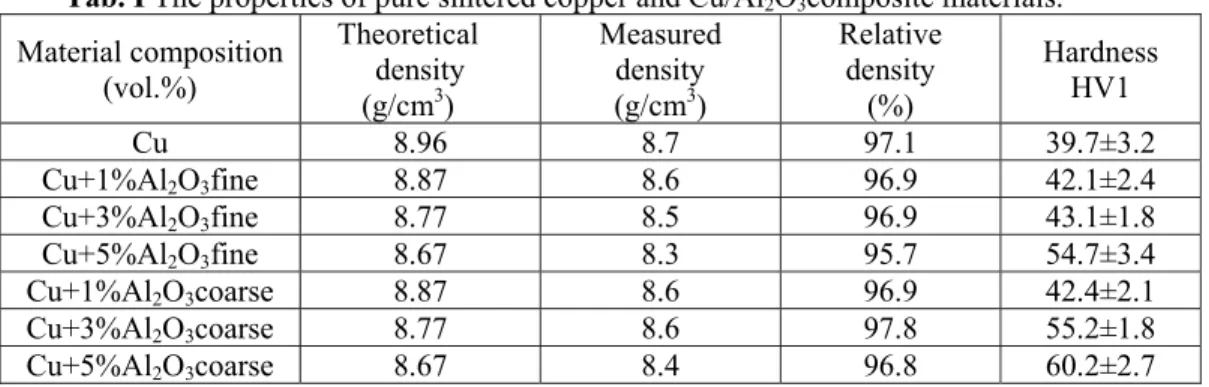
The density and hardness of the Cu/Al2O3 composites obtained by hot pressing (HP) are presented in Tab. I.
Tab. I The properties of pure sintered copper and Cu/Al2O3composite materials.
Material composition (vol.%)
Theoretical density (g/cm3)
Measured density (g/cm3)
Relative density
(%)
Hardness HV1
Cu 8.96 8.7 97.1 39.7±3.2
Cu+1%Al2O3fine 8.87 8.6 96.9 42.1±2.4
Cu+3%Al2O3fine 8.77 8.5 96.9 43.1±1.8
Cu+5%Al2O3fine 8.67 8.3 95.7 54.7±3.4
Cu+1%Al2O3coarse 8.87 8.6 96.9 42.4±2.1
Cu+3%Al2O3coarse 8.77 8.6 97.8 55.2±1.8
Cu+5%Al2O3coarse 8.67 8.4 96.8 60.2±2.7
The data reveal higher relative density for composites with electrocorundum having a coarse particle size. This is because the specific surface of coarser particles is smaller and the powder compressibility is higher. The residual porosity was observed only between copper particles. Most probably, electrocorundum used as the reinforcing phase eliminates intergranular porosity formed between α-Al2O3 powder particles [15-16]. This fact can be easily explained by the rule of mixtures. The higher hardness of the composites can also be attributed to the fact that alumina particles prevent the movement of dislocations [17]. It is obvious that by increasing the amount of alumina phase, with hardness much higher than that of pure copper, the hardness of composites also increases. The obtained results are consistent with the density results for the developed composites.
a) b) c)
d) e) f)
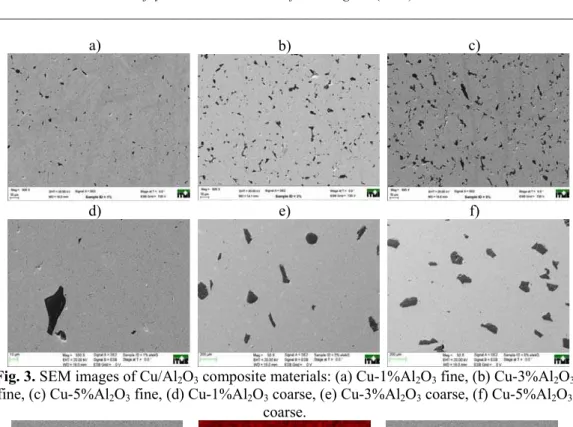
Fig. 3. SEM images of Cu/Al2O3 composite materials: (a) Cu-1%Al2O3 fine, (b) Cu-3%Al2O3 fine, (c) Cu-5%Al2O3 fine, (d) Cu-1%Al2O3 coarse, (e) Cu-3%Al2O3 coarse, (f) Cu-5%Al2O3
coarse.
Fig. 4. SEM/EDS maps of the distribution of elements on the surface for Cu-5%Al2O3 coarse.
The SEM examination has revealed a homogeneous distribution of the ceramic phase in the composite. A good quality bonding (adhesion type) was observed between the copper matrix and the ceramic reinforcement, especially for the samples made with the coarse alumina powder. No significant structural discontinuities were observed at the copper-ceramics boundaries and there was no evidence of the presence of the third phase (Fig. 4).
Tab. II Thermal properties (at 50°C) and mechanical properties of pure sintered copper and Cu/Al2O3 composites with two kinds of Al2O3 particles.
Material composition (vol.%)
Thermal Conductivity
(W/m·K)
Measured Specific heat
(J/g·K)
Theoretic Specific heat
(J/g·K)
Bending Strength (MPa)
Cu 359.2±4.8 - 0.39 -
Cu+1%Al2O3fine 333.5±2.1 0.40±0.1 0.42 291.0±7.7
Cu+3%Al2O3fine 315.2±2.8 0.41±0.1 0.43 275.4±7.9
Cu+5%Al2O3fine 303.5±1.6 0.42±0.1 0.44 294.4±9.1
Cu+1%Al2O3coarse 330.1±3.4 0.40±0.1 0.42 284.5±9.2
Cu+3%Al2O3coarse 320.1±3.4 0.42±0.1 0.43 300.1±8.9
The particle size and the amount of the reinforcement have a pronounced effect on the mechanical properties of the composites. Selected properties of the fabricated Cu/Al2O3 composites are shown in Tab. II.
As expected, the thermal conductivity of composites decreased when increasing the ceramic content. No significant differences in the thermal conductivity and the specific heat were observed for the composites made with fine or coarse Al2O3 powders. In both cases, the measured thermal conductivity was higher than 300 W/(m·K).
The influence of the size of ceramic reinforcement and its distribution within the copper matrix on the thermal properties of the obtained composites was also examined by modelling. To this end, a numerical analysis (FEAP) was performed for two models of the Cu-5%Al2O3 composite taking into account the porosity of 1%, 3% and 5% [18,19]. In model 1 it was assumed that the reinforcement phase is uniformly distributed in the metal matrix and a porosity of 3% was randomly introduced (Fig.5-Model 1- b). Model 2 required random distribution and multiple grinding of the reinforcement phase, with porosity arranged just like in model 1 (Fig. 5-Model 2- b).
MODEL 1 MODEL 2
a) b) a) b)
Fig. 5. FEM mesh for models 1 and 2; blue voxels – porosity, green – ceramic phase, red – copper; a) 0% porosity, b) 3% porosity.
The results of the numerical calculations of thermal conductivity for the assumed models are shown in Tab. III.
Tab. III Results of numerical calculations of thermal conductivity for Cu-5%Al2O3 composites.
0% porosity 3% porosity
Model 1 Model 2 Model 1 Model 2
Thermal Conductivity W/(m·K) 362.0 362.1 348.4 348.7
It is noted that the numerically predicted values of the thermal conductivity of Cu-5%Al2O3 composites (Tab. III) are overestimated when compared with the experimental data in Tab. II. Another conclusion that can be drawn from Tab. III is that distribution of the reinforcement phase in the composite as well as multiple grinding of the ceramic phase grains do not exert a strong influence on thermal conductivity. On the other hand, porosity significantly affects the thermal properties of these composite materials.
properties of the present composites are superior to those reported in [15]. This fact is linked with the elimination of the intergranular porosity which typically forms between non-sintered Al2O3 grains.From the point of view of prospective applications, the tribological properties of composites are particularly important.
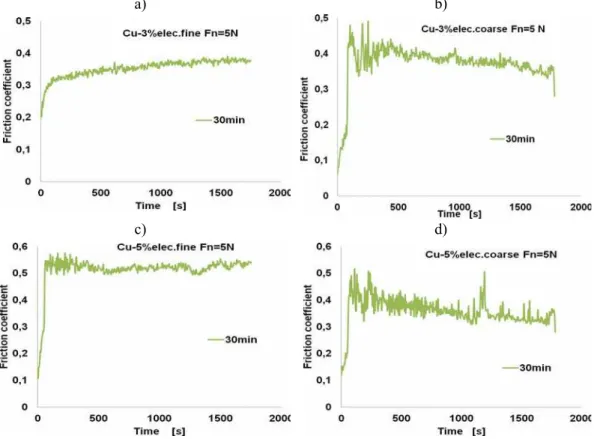
The comparison of the time-dependent friction coefficient for Cu/Al2O3 composites is presented in Fig. 6 for the two groups of materials under investigation. It can be concluded that as a result of an increase in the composite’s hardness with the raise of the ceramic phase content, the resistance to motion and, in consequence, the friction coefficient are also increased. The measured values of the friction coefficient for composites with 1 vol.% of Al2O3 content were similar to those for pure copper (µ = 0.3). For composites with 3 and 5 vol.% of Al2O3 content the friction coefficient vs. time measurements are depicted in Fig. 6. It can be seen that Cu/Al2O3 composites have a relatively high and sTab. friction coefficient.
a) b)
c) d)
Fig. 6. The friction coefficient for Cu/Al2O3: a) Cu-3%Al2O3 fine, b) Cu-3%Al2O3 coarse, c) Cu-5%Al2O3 fine, d) Cu-5%Al2O3 coarse.
For 5 N load, the final value of the friction coefficient (between the steel and composite) for fine Cu/Al2O3 composites is 0.3 (3% ceramic phase) and 0.5 (5% ceramic phase), whereas for coarse Cu/Al2O3 composites it equals 0.4 (3% ceramic phase) and 0.4 (5% ceramic phase). In several initial friction cycles, both the instantaneous value of the friction force and the amplitude of its changes increased for each friction cycle (when movement was made in one direction).
Exemplary images of the groove area are presented in Fig. 7. The macrostructure of the groove is very inhomogeneous: gaps, chipping and accretion are present, which causes rapid friction. In all analyzed cases, tiny ceramic and metal particles, removed during the friction process, were observed.
a) b)
c) d)
Fig. 7. SEM images of the groove area for the time of friction test (Fn=5 N) for composites: a) Cu-3%Al2O3 fine, b) Cu-3%Al2O3 coarse, c) Cu-5%Al2O3 fine, d) Cu-5%Al2O3 coarse.
Figure 8 shows the 3-D profiles of the composite surface after the wear test. The increased content of fine Al2O3 results in an improved frictional wear resistance: the volume of the material abraded during the 30 min test was 0.5×10⁻⁶ cm3, 0.41×10⁻⁶ cm3 and 0.36×10⁻⁶ cm3 for Cu-1%Al2O3, Cu-3%Al2O3 and Cu-5%Al2O3, respectively. As can be observed, there is a significant improvement in the wear resistance when compared with pure copper for which the volume of the groove was 8.1×10⁻⁶ cm3. Similar wear results were obtained for composites with electrocorundum having bigger grains.
a) b) c)
Fig. 8. Wear profiles after the friction test for: a) Cu-1%Al2O3 fine, b) Cu-3%Al2O3 fine, c) Cu-5%Al2O3 fine.
4. Conclusions
µm) was developed. As a result, composite materials with decreased porosity, as compared with the composites reinforced with a non-sintered aluminium oxide powder (α-Al2O3), were obtained. Eliminating intergranular porosity, which is undesirable from the point of view of the material properties, will enable manufacturing of graded Cu/Al2O3 composites (FGM) using hot pressing or tape casting method for target applications in e.g. rocket thrusters.
The obtained Cu/Al2O3 composite materials are characterized by relatively high thermal conductivity (over 300 W/(m·K)). Thermal conductivity depends significantly on the ceramic content - as the volume fraction of the ceramic phase increases, the thermal conductivity decreases. Higher values of thermal conductivity values were measured for composites containing coarse electrocorundum.
No significant differences in the friction coefficient values in relation to the number and size of grains of electrocorundum were observed. On the other hand, an addition of the ceramic phase leads to increased wear resistance when compared with that of pure copper.
By using electrocorundum (polycrystalline material) as ceramic reinforcement in copper-based composites it was possible to decrease porosity in the ceramic phase (electrocorundum used as the reinforcing phase eliminates intergranular porosity formed between α-Al2O3 powder particles, [15]). Finally the improvement of composite properties was obtained, which is so crucial from their future applications point of view.
Acknowledgment
The results presented in this paper have been obtained within the framework of the project funded by the National Centre for Research and Development, decision number DEC-2014/13/N/ST8/00080 (PRELUDIUM) 2015-2017.
5. References
1. M. Knechtel, H. Prielipp, H. Mullejans, N. Claussen, J. Rödel, Scr. Metall. Mater., 31 (1994) 1085.
2. S. Panda, K. Dash, B. Ray, Bull. Mater. Sci., 37 (2014) 227. 3. D. Dash, B. Ray, D. Chaira, J. Alloy. Compd., 516 (2012) 78. 4. S. Islak, D. Kır, S. Buytoz, Sci. Sinter., 46 (2014) 15.
5. J. Ružić, J. Stašić, S. Marković, K. Raić, D. Božić, Sci. Sinter., 46 (2014) 217.
6. S. Charnvanichborikarn, S.J. Shin, M.A. Worsley, I.C. Tran, T.M. Willey, T. van Buuren, T.E. Felter, J.D. Colvin, S.O. Kucheyev, J. Mater. Chem. A, 2 (2014) 962. 7. V. Rajkovic, D. Bozic, M. Popovic, M. Jovanovic, Sci. Sinter., 41 (2009) 185.
8. M. Chmielewski, K. Pietrzak, A. Strojny-Nędza, B. Dubiel, A. Czyrska-Filemonowicz, Int J. Mater. Res., 105 (2) (2014) 200.
9. V. Rajkovic, D. Bozic, M. Jovanovic, Mater. Design, 21 (2009) 1962.
10.V. Rajkovic, D. Bozic, J. Stasic, M. Jovanovic, H. Wang, Adv. Mat. Res., 8 (2014) 318.
11.K. Song, X. Guo, S. Liang, P. Zhao, Y. Zhang, Mater. Sci. Tech.-Lond., 30 (2014) 171.
12.T. Shabana, B. Karihaloo, H. Zhu, S. Kulasegaram, Compos. Part A, 46 (2013) 140. 13.S. Nosewicz, J. Rojek, S. Mackiewicz, M. Chmielewski, K. Pietrzak, B. Romelczyk, J.
Compos. Mater., DOI: 10.1177/0021998313511652, (2014).
14.M. Chmielewski, D. Kaliński, K. Pietrzak, W. Włosiński, Arch. Metall. Mater., 55 (2) (2010) 579.
16.M. Chmielewski, S. Nosewicz, K. Pietrzak, J. Rojek, A. Strojny-Nędza, S. Mackiewicz, J. Dutkiewicz, J. Mater. Eng. Perform., DOI: 10.1007/s11665-014-1189-z, (2014).
17.M. Rahimian, N. Parvin, N. Ehsani, Mater. Sci Eng. (2010) 1031.
18.M. Chmielewski, W. Węglewski, Bulletin Polish Academy Sci Technical Sci 61 (2) (2013) 507.
19.W. Węglewski, M. Basista, A. Manescu, M. Chmielewski, K. Pietrzak, Th. Schubert, Composites Part B - Eng, 67 (2014) 119.
Са р а: К /
, .
О ,
,
. У /
3 180 µm 1, 3, 5
%. И ,
, .
K учн р чи: / , ,