Formal Social Norms and Their Enforcement in
Computational MAS by Automated Reasoning
Roman Neruda, Ondˇrej Kaz´ık
Abstract—Role-based frameworks enrich multi-agent system models with new organizational concepts: roles and groups. We present a formalization of a role-based approach in description logics serving as the common organizational model both for the development process and the management of the system. A central authority of role ontology agent is proposed in this paper. This agent performs management of the system: keeping track of the actual state of the system, querying the model and checking its social norms. Agents in the system can thus act in a sociable way especially in complicated configurations. Algorithms controlling agents in a computational intelligence modeling scenario are shown.
Index Terms—role model; description logic; integrity con-straints; computational intelligence.
I. INTRODUCTION
A
GENT is a computer system situated in some en-vironment that is capable of autonomous action in this environment in order to meet its design objectives [1]. Its important features are adaptivity to changes in the environment and collaboration with other agents. Interacting agents join in more complex societies, multi-agent systems(MAS). These groups of agents gain several advantages, as are the applications in distributed systems, delegacy of subproblems on other agents, and flexibility of the software system engineering. The effort to reuse MAS patterns brings the need of separation of the interaction logic from the inner algorithmic logic of an agent. There are several approaches providing such separation and modeling MAS from the organizational perspective, such as the tuple-spaces, group computation,activity theory orroles [2].
Generally speaking, a role is an abstract representation of stereotypical behavior common to different classes of agents. Moreover, it serves as an interface, through which agents perceive their execution environment and affect this environment. Such a representation contains a set of patterns of interactions, capabilities, and knowledge which an asso-ciated agent may utilize to achieve its goals. On the other hand, the role definesconstraints, which a requesting agent has to satisfy to obtain the role, as well as responsibilities for which the agent playing this role holds accountable. The role also serves as a mean of definition of protocols, common interactions between agents. An agent may handle more roles, and a role can be embodied by different classes of agents. Moreover, agents can change their roles dynamically. The role-based solutions may be independent of a par-ticular situation in a system. This allows to design an overall organization of multi-agent systems, represented by
R. Neruda is with The Institute of Computer Science, Academy of Sciences of the Czech Republic, 182 07 Prague 8, Czech Republic, e-mail: [email protected]. This work has been supported by the Czech Science Foundation under the project no. . O. Kaz´ık is with The Faculty of Mathematics and Physics, Charles University, 118 00 Prague 1, Czech Republic, e-mail: [email protected]
roles and their interactions, separately from the algorithmic issues of agents and to reuse the solutions from different application contexts. The coordination of agents is based on local conditions, namely the positions of an agent playing some role, thus even a large MAS can be built out of simple organizational structures in a modular way.
The above mentioned properties are crucial for agent use in the computational intelligence models for data mining where we typically have a collection of available methods that coop-erate in order to build a hybrid model based on data. Hybrid models including combinations of computational intelligence methods, such as neural networks, genetic algorithms, and fuzzy logic controllers, can be seen as complex systems with large number of components and computational methods, and with potentially unpredictable interactions between these parts. Typical set up of a data mining task employing a computational method contains the agent encapsulating such a method, such as multilayer perceptron neural network, or an RBF (radial basis function) network which is used throughout our example; the data source; and some managing entity responsible for proper configuration and execution of the task. These approaches have demonstrated better performance over individual methods in many data modeling tasks [3]. The modes of cooperation are partially expressed by ontological constraints, while some aspects are dynamical and data dependent.
There are not many software packages that provide a large collection of individual computational methods, as well as the possibility to connect them into hybrid schemes in various ways. Multi-agent systems seem to be a suitable solution to manage the complexity and dynamics of hybrid systems.
The next section discusses the work related to the role-based methodologies, their formalization and implementation support. In Section III the computational intelligence and its role-based model are introduced. In Section IV this model is formalized in description logic with respect to both open world and closed world reasoning. The role ontology agent dealing with this model is introduced in Section V. In Section VI typical agents exploiting services of the ontology agent are shown.
II. RELATEDWORK
organization-centered generic meta-model of multi-agent systems. It de-fines a general conceptual structure which is utilized in the MAS development. The framework describes MAS from an organizational perspective, instead of using terms of agents’ mental states (agent-centered). This model (also called AGR) focuses on three basic concepts: agent, group and role.
In [7], the OWL-based representation of policies and norms in MAS, called OWL-POLAR was proposed. The OWL-POLAR also uses reasoning mechanisms to make policy-governed decisions and policy analysis. This formal-ization is near to the role-based frameworks but, in order to represent policy it has to express it in other formalism, namely SPARQL queries.
The matchmaking, which is one of the functions provided by the ontology agent of our system described in Section V, is also well established discipline in the field of web services. Various middle agents are presented in [8].
Data-mining algorithms and their interfaces are described in a domain ontology KDDONTO [9], based on description logics. This ontology is used for automatic composition of algorithms forming valid data-mining processes
We focused our analysis on the field of hybrid intelligence and computational MAS. In these research areas is laid emphasis on collaboration of different heteronomous compu-tational methods. The multi-agent systems allow distributing not only the computation but also the data sources sensing in real time. This would enable ubiquitous and pervasive com-puting scenarios. The distribution of sensors is extensively studied in wireless sensor network technology, e.g. [10].
In our approach, a computational MAS contains one or more computational agents, i.e. a highly encapsulated objects embodying a particular computational intelligence method, and collaborating with other autonomous agents to fulfill its goals. Several models of development of hybrid intelligent systems by means of MAS have been proposed, e.g. [11], [12], and [13].
III. ROLEMODEL OFCOMPUTATIONALMAS SCENARIO
In order to verify the abilities of role-based models we will present an example of analysis of a computational MAS scenario. We are exploiting the conceptual framework of the AGR model [6]. Its organization-centered perspective allowing modular and variable construction of MAS is well suited especially to more complicated configurations of com-putational agents.
As an example we take the computational MAS from [14]. The system consists of a Task Manager agent, Data Source agent, two computational agents (RBF neural network and Evolutionary algorithm agent) and supplementary agents. In the case of RBF network, there are unsupervised (vector quantization) and supervised (gradient, matrix inverse) learn-ing agents. The evolutionary algorithm agent needs Fitness, Chromosome and Tuner agents. We want to decompose this scenario by means of AGR concepts, i.e. agents, groups and roles.
Such a computational MAS is represented by a role
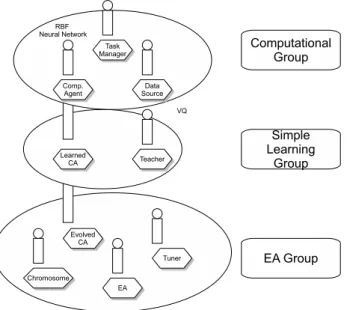
organizational structure, depicted in Figure 1, consists of the following group structures:
• Computational Group Structure. It contains three roles: a Task Manager, Computational Agent implementing a
Fig. 1. Organizational structure diagram of a computational MAS.
computational method and Data Source which provides it with training and testing data.
• Simple Learning Group Structure consisting of two roles: a Teacher and Learned Computational Agent. This structure can be instantiated by groups for different Teacher (e.g. Vector Quantization, Gradient and matrix inverse).
• Evolutionary Algorithm Group Structure contains an Evolutionary Algorithm agent, Evolved Computational Agent, Chromosome which translates representation of an individual into model’s parameters, and Tuner with probabilities of the algorithm.
Every concrete organization is built with respect to the rules of the organizational structures. Aims of the agents are fulfilled by assuming of roles or establishing of groups and interactions. The agents can play different roles in different groups and even complicated MAS can be built from these structures.
We can see, that the role model allows to simplify the construction of more complicated computational multi-agent systems by its decomposition to the simple group structures and roles, to which the agents assigns. Moreover, the position of an agent in MAS in every moment of the run-time is defined by their roles without need to take into account their internal architecture or concrete method it implements. It also reduces a space of possible responding agent when interactions are established.
IV. DESCRIPTIONLOGICMODEL
The family ofDescription Logics(DL [15]), fragment of first-order logic, is nowadays de facto standard for ontology description language for formal reasoning. In DL a knowl-edge base is divided into T-Box (terminological box), which contains expressions describing concept hierarchies, and A-Box (assertional box) containing ground sentences.
model by other formalism is forced by the low expressive power of the OWL, the language based on the DLs, and its standard semantics. First of all, it does not use any variables, thus it is difficult to express more complicated conditions between entities in the model. Furthermore, semantics of OWL is designed for scenarios where the complete infor-mation cannot be assumed, thus it adopts the Open World Assumption(OWA). According to OWA, a statement cannot be inferred to be false only on the basis of a failure to prove it. If there is assumed complete knowledge, the T-Box axioms cannot be used as Integrity Constraints(IC) which would test validity of the knowledge base. In order to check integrity constraints theClosed World Assumption(CWA) is necessary. There are several approaches simulating CWA by different formalisms, e.g. rules or queries [16].
We continue in the effort to describe the computational MAS in description logic model. Our model would incorpo-rate the concepts of group and role elaboincorpo-rated in the previous Section. We want to preserve the simplicity of the OWL models and also to express role ICs in the same language. In [16] authors presented a IC validation solution reducing IC validation problem to SPARQL query [17] answering. Moreover, they introduced prototype IC validator extending Pellet [18], the OWL reasoner. Thus we divided the T-Box of proposed model into two parts. The first part contains axioms describing mainly concepts’ hierarchy and the necessary relations between their instances. This schema is interpreted in OWA and defines the facts the reasoner will infer from the given A-Box. In the second part, there are constraints which define the integrity conditions of the system related mainly to the capabilities of agents. These are interpreted on CWA. The time-dependent information, the actual state of the system is in A-Box of the ontology.
As we have already mentioned, a role is defined as a set of capabilities, i.e. actions (interactions) an agent assuming this role can use, and set of responsibilities or events the agent should handle. A group is then described by a set of the roles, the group contains. A hierarchy of concepts should respect this. The designed T-Box contains the following superior concepts:
• Responderis a responsibility of a role. It stands for a message type the agent handles.
• Initiator represents an action from a capability set and it is closely related to a particular Responder. The functional role isInitiatorOf relates to the agent which the action uses. The role sendsT o contains the agents to which the action is connected.
• RequestInit is a subclass of the previous concept which defines only those initiators that sends messages to one agent (unlike e.g. the contract net protocol). This concept adds the following IC:
RequestInit⊑C6sendsT o.1
• Agent is a superclass of all roles. The role assign-ment is achieved simply by a concept assertion about the agent. The inverse functional roles hasInitiator
(inverse ofisInitiatorOf) andhasRespondercouple an agent with particular actions and responsibilities. While the hasResponder relation is a fixed property, the hasInitiator occurs only when a corresponding
connection is established. Finally, the functional role
isM emberOf indicates belonging to a group.
• Group represents a group in a MAS. It has only one role, an inverse of the isM emberOf role, called
hasAgent.
The computational group structure contains three agents with assigned roles of a task manager, computational agent and data source. Between these roles two connections can be established. First, the task manager sends a control messages to the computational agent in order to solve a problem. It contains necessary parameters (data file name, learning options) and action the computational agent should perform, as is training and testing. The second connection is between the computational agent and data source, which provides data from a specified file. The sending of control messages be-tween the task manager (T askM anager), which is initiating this connection, and computational agent (CompAgent) is modeled by two concepts, an initiator (ControlM sgInit) and responder (ControlM sgResp). The initiator of this connection is an instance of ControlM sgInit which is a subclass of theRequestInitclass. It sends messages only to an agent with a running responder handling these messages, and it is coupled with a Task Manager role as a capability. The schema file of the ontology contains axioms of the initiator and responder concept hierarchy, and a definition of the responder individual:
ControlM sgInit ⊑O RequestInit
The following integrity constraints for this concept check the roles of initiating and responding agents:
ControlM sgInit⊑C∀sendsT o.∃hasResponder.
.ControlM sgResp⊓ ∀isInitiatorOf.T askM anager
The control message responder is a simple descendant of theResponder concept and this class contains the instance
ControlM sg. The schema axioms follow:
ControlM sgResp⊑OResponder ControlM sgResp(ControlM sg)
The data connection between the computational agent and the source of data (DataSource) is divided in two classes: an initiator DataM sgInit and responder DataM sgResp. The following axioms for these concepts are similar to those for the control connection:
DataM sgInit⊑ORequestInit
DataM sgInit⊑C∀sendsT o.∃hasResponder. .DataM sgResp⊓ ∀isInitiatorOf.CompAgent DataM sgResp⊑OResponder
DataM sgResp(DataM sg)
Role definitions are descendants of theAgentconcept and have to contain their responsibilities, i.e. responders they contain (capabilities are defined on the initiator side). The computational agent (CompAgent) has as a responsibility to respond on the control connections. These are axioms inserted in the schema set:
CompAgent ⊑O Agent
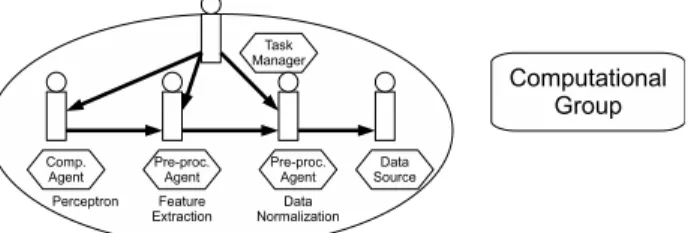
Fig. 2. Example of computational group solving data-mining task which employs two preprocessing agents in order to prepare data for the neural-network classification.
The data source (DataSource) handles requests for data and the task manager (T askM anager) role only sends messages in a group:
DataSource ⊑O Agent
⊓ ∋hasResponder.DataM sg T askM anager ⊑O Agent
Finally, the computational group (CompGroup) contains only the agents which have asserted that they have the computational agent, task manager or data source role. The subclass-axiom is important for open world reasoning:
CompGroup ⊑O Group
On the other hand, entrance of the agent with a wrong role has to be checked by the following closed world constraint:
CompGroup⊑C∀hasAgent.
.(CompAgent⊔T askM anager⊔DataSource) In real data-mining tasks, separate phase of pre-processing before main computation is necessary [19], e.g. feature extraction, missing values and outliers filtering, or resam-pling etc. The pre-processing agent, i.e. encapsulation of a preprocessing method, obtains data from a data source and provides pre-processed data to other agents. The options of the pre-processing method and source-file have to be set by a task manager who controls the computation.
Therefore the interactions defined before can be utilized. The pre-processing agent gains properties of both the data source (it provides data) and computational agent (it receives data from another source and waits for control messages). Thus the role of P reprocessingAgent is defined as an intersection of DataSourceandCompAgent:
P reprocessingAgent⊑OCompAgent⊓DataSource
The pre-processing agent with this role is also able to enter any computational group according to this definition. It also includes the possibility of creation of agents chain, where on the one end is an agent providing original data table and on the other is a data mining computational method. Diagram of such a configuration with two preprocessing agent is at Figure 2.
Thesimple learning group structureis defined in a similar
way with following schema and integrity rules:
LearningM sgInit⊑ORequestInit
LearningM sgInit⊑C∀sendsT o.∃hasResponder. .LearningM sgResp⊓ ∀isInitiatorOf.LearnedCA LearningM sgResp⊑OResponder
LearningM sgResp(LearningM sg)
LearnedCA⊑OAgent T eacher⊑OAgent
⊓ ∋hasResponder.LearningM sg SimpleLearningGroup⊑OGroup SimpleLearningGroup⊑C∀hasAgent.
.(T eacher⊔LearnedCA)
The evolutionary algorithm group structure is example of more complicated organization and it contains an evo-lutionary algorithm, evolved computational agent, tuner with parameters of the algorithm, and chromosome, i.e. represen-tation of individuals. The interactions between these roles de-scribe the necessary flow of information to evolutionary learn a model of the computational agent, i.e. control messages of the algorithm, messages with parameters of the algorithm, requests for fitness computation of single individual, and computation of error rate of CA with chromosome trans-formed to its model. The structure is defined as follows:
EAControlM sgInit⊑ORequestInit
EAControlM sgInit⊑C∀sendsT o.∃hasResponder. .EAControlM sgResp⊓ ∀isInitiatorOf.EvolvedCA EAP aramsM sgInit⊑O RequestInit
EAP aramsM sgInit⊑C ∀sendsT o.∃hasResponder.
.EAP aramsM sgResp⊓ ∀isInitiatorOf.EvoAlgorithm F itnessM sgInit⊑ORequestInit
F itnessM sgInit⊑C∀sendsT o.∃hasResponder.
.F itnessM sgResp⊓ ∀isInitiatorOf.EvoAlgorithm ComputeM odelM sgInit⊑ORequestInit
ComputeM odelM sgInit⊑C∀sendsT o.∃hasResponder. .ComputeM sgResp⊓ ∀isInitiatorOf.Chromosome EAControlM sgResp⊑OResponder
EAControlM sgResp(EAControlM sg)
EAP aramsM sgResp⊑OResponder EAP aramsM sgResp(EAP aramsM sg)
F itnessM sgResp⊑O Responder F itnessM sgResp(F itnessM sg)
ComputeM odelM sgResp⊑OResponder ComputeM odelM sgResp(ComputeM odelM sg)
EvolvedCA⊑OAgent
⊓ ∋hasResponder.ComputeM odelM sg EvoAlgorithm⊑OAgent
⊓ ∋hasResponder.EAControlM sg Chromosome⊑OAgent
⊓ ∋hasResponder.EAP aramsM sg EvoAlgorithmGroup⊑O Group
EvoAlgorithmGroup⊑C ∀hasAgent. .(EvolvedCA
⊔EvoAlgorithm
⊔Chromosome
⊔T uner)
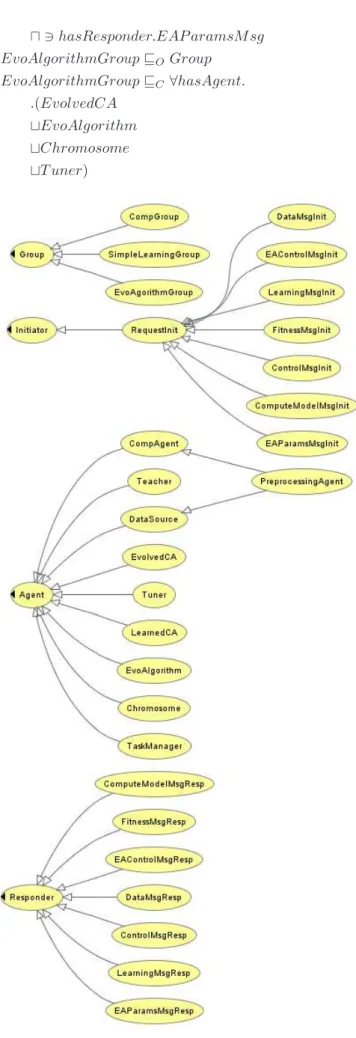
Fig. 3. Hierarchy of DL concepts in the computational MAS model.
We define concepts in this hierarchy in order to describe our computational MAS. The system consists of groups
Fig. 4. Architecture of the role ontology agent.
with three types: computational group, simple learning group and evolutionary algorithm group. Behavior of the agents is formally described by means of allowed roles and protocols of their interactions in these groups. The full formal model is presented in [20]. The main concepts of this ontology are depicted in Figure 3.
V. IMPLEMENTATION
To coordinate the run-time role organization of MAS built according to the schemes and constraints of T-Box, it is necessary to have a central authority, separate agent in which the DL model has to be represented. Other agents will change the state of the model and query it by interaction with this agent.
The model is implemented as an role ontology agent
(ROA) in JADE, Java-based framework for MAS [21]. The goals of the ROA are:
• Keeping track of the actual state of MAS. Agents present in the MAS are registering themselves in ROA; stating changes of their roles; creating and destroying groups and their membership in them; and establishing communication channels.
• Verification of correctness of MAS. ROA controls all changes of the system and does not allow activities which would violate the integrity constraints.
• Matchmaking of agents and groups. Exploiting the concept hierarchy it is possible to search groups of certain types or agents that have a certain role, are members of certain group, or can handle certain types of messages.
The ontology agent (shown in Figure 4) consists of the
The communication ontology for contents of ROA mes-sages has been created. This ontology consists of three types of concepts.
The first group contains actions changing state of the ontology. These actions result in changing of assertions in the A-Box of the model and are validated by the integrity constraints. If any of the ICs is violated, the change is not performed. In this case the action ends by failure.
In the second group are concepts specifyingmatchmaking queries on groups or agents. These queries are transformed in SPARQL queries [16] and executed on the inferred model. For example, query asking for an agent which is member of the group grpand has the responderrespis translated in SPARQL query in the following form:
SELECT ?Agent WHERE { ?Agent isMemberOf grp . ?Agent hasResponder resp . }
This query can also be translated to OWL-DL query of this form:
Query⊑∋isM emberOf.grp⊓ ∋hasResponder.resp
On the other hand, more complicated queries require using variables and cannot be expressed in description logic. For example, if we need an agent which is connected to a data source, where both are in the same computational group, it can be written in SPARQL in the following way:
SELECT ?Agent WHERE {
?Agent hasInitiator ?Init . ?Init sendsTo ?Agent1 . ?Agent1 a DataSource . ?Agent isMemberOf ?Group . ?Agent1 isMemberOf ?Group . ?Group a CompGroup .
}
The third group of concepts contains concepts informing about resultsof actions or queries.
VI. EXAMPLE
The role-based model allows introduction of a social logic in control of agents. So, an agent can directly exploit and manipulate the concepts and individuals of the DL social model (e.g. roles, groups) in fulfillment of their goals by communication with ROA. On the other hand, the agent un-dertakes by registering of a role to handle messages of certain types which are among the responders of the role. In this section we elaborate the computational MAS scenario using various learning methods which requires more complicated structure of 3 groups, computational group, simple learning group and evolutionary algorithm group.
There are seven agents in the MAS: the task manager, RBF network computing agent, data source, vector quantization agent, evolutionary algorithm agent and its supplementary agents, i.e. chromosome representation of an individual and tuner. The data classification problem by RBF network is solved by two different learning algorithms. The vector quantization determines the means of RBF units. In the next step other parameters of the model are optimized by the
Fig. 5. Organization in a state of the computational MAS during computation.
evolutionary algorithm. For the sake of simplicity we assume that these agents are started at the beginning.
Algorithm 1Pseudocode of the task manager agent 1: Registration of the agent by ROA.
2: Set theT askM anagerrole.
3: Create of groupgrp1withCompGrouptype.
4: Enter intogrp1.
5: Wait until the groupgrp1is prepared, i.e. all agents with corresponding
roles are present.
6: Find any computational agentca(agent withCompAgentrole) in the groupgrp1.
7: Establish connection to ca, i.e. create initiator init with type ControlM sgInitand connect it to the agentca.
8: repeat
9: Send a request message with description of the problem and random setting toca.
10: Wait for a result.
11: untilthe problem is solved or the time exceeded 12: End the connection of the initiatorinit. 13: Leave the groupgrp1.
14: Wait until the groupgrp1 is empty.
15: Destroy the groupgrp1.
16: Remove theT askM anagerrole.
The task manager represents the problem which should be solved, and coordinates the actions of other agents in its computational group. A pseudocode of this agent is in Algorithm 1. The algorithms describe mainly organizational aspects of this scenario and consist of statements relating the DL model in ROA. The task manager sends control messages to theRBF network(Algorithm 2), i.e. a computational agent which should classify data. In order to do this, it needs training and testing data from a data source (database agent
Algorithm 3).
The RBF network also creates two new groups with agents whose purpose is to learn its parameters. Thevector quantization algorithmfinds means of clusters in the training data (Algorithm 4).
Algorithm 2Algorithm of the RBF network
1: Registration of the agent by ROA and set theCompAgentrole. 2: Wait until a group with typeCompGroupis found. Name itgrp1.
Enter intogrp1.
3: Wait until the groupgrp1is prepared, i.e. all agents with corresponding
roles are present.
4: Find any data source agentds(agent withDataSourcerole) in the groupgrp1.
5: Establish connection to ds, i.e. create initiator init1 with type
DataM sgInitand connect it to the agentds. 6: whilethe group is fulldo
7: if a request for computation (i.e. with the type ControlM sg) comesthen
8: Send a request for a training data to theds. Wait for the reply. 9: Set aLearnedCArole.
10: Create and enter into group grp2 of type
SimpleLearningGroup.
11: Wait until there is an agenttwithT eacherrole in the group grp2.
12: Create initiatorinit2of typeLearningM sgInitand establish
a connection to the agentt.
13: Send a request for finding means of clusters in the data to the agentt. Wait until this is finished.
14: End the connection of the initiatorinit2.
15: Leave the groupgrp2.
16: Set aEvolvedCArole.
17: Create and enter into group grp3 of type
EvoAlgorithmGroup.
18: Wait until the groupgrp3is prepared.
19: Find an agenteawithEvoAlgorithmrole in the groupgrp3.
20: Create initiatorinit3of typeLearningM sgInitand establish
a connection to the agentea.
21: Send a request for optimization of other parameters to the agent ea.
22: repeat
23: ifa request of the typeComputeM odelM sgcomesthen
24: Evaluate the model with the received parameters and send back the results.
25: end if
26: untiltheeafinds a solution
27: End the connection of the initiatorinit3.
28: Leave the groupgrp3.
29: Wait until the groupgrp2is empty.
30: Destroy the groupgrp2 and remove the roleLearnedCA.
31: Wait until the groupgrp3is empty.
32: Destroy the groupgrp3 and remove the roleEvolvedCA.
33: Do the necessary computations.
34: Send a result of the computation as a reply to the request. 35: end if
36: end while
37: End the connection of the initiatorinit1.
38: Leave the groupgrp1.
39: Remove theCompAgentrole.
Algorithm 3Pseudocode of the database agent
1: Registration of the agent by ROA and set theDataSourcerole. 2: Wait until a group with typeCompGroupis found. Name itgrp1.
Enter intogrp1.
3: Wait until the groupgrp1is prepared, i.e. all agents with corresponding
roles are present. 4: whilethe group is fulldo
5: ifa request of the typeDataM sgcomesthen
6: Find the data file according to the specification in the database. 7: Send the data as a reply to the request.
8: end if
9: end while
10: Leave the groupgrp1.
11: Remove theDataSourcerole.
chromosome translates individuals’ representation into CA’s models and computes fitnesses. After the processing of data and successful classification, the task manager is informed about its result. The developed state of the MAS is showed in Figure 5.
In this scenario, we have not taken into account
possibil-Algorithm 4Pseudocode of the vector quantization agent 1: Registration of the agent by ROA and set theT eacherrole. 2: Wait until a group with typeSimpleLearningGroupis found. Name
itgrp1. Enter intogrp1.
3: Wait until the group grp1 is prepared, i.e. both agents with
corre-sponding roles are present. 4: whilethe group is fulldo
5: ifa request of the typeLearningM sgcomesthen
6: Execute the learning process. 7: Send the reply.
8: end if
9: end while
10: Leave the groupgrp1.
11: Remove theCompAgentrole.
Algorithm 5Pseudocode of the evolutionary algorithm agent 1: Registration of the agent by ROA and set theEvoAlgorithmrole. 2: Wait until a group with typeEvoAlgorithmGroupis found. Name
itgrp1. Enter intogrp1.
3: Wait until the groupgrp1is prepared.
4: Find an agenttwith the role ofT uner.
5: Create initiatorinit1 of typeEAP aramsM sgInitand establish a
connection to the agentt.
6: Find an agentchwith the role ofChromosome
7: Create initiator init2 of type F itnessM sgInit and establish a
connection to the agentch. 8: whilethe group is fulldo
9: ifa request of the typeEAControlM sgcomesthen
10: Execute the evolutionary process, where parameters of the algo-rithm are obtained from the agenttand individual’s fitness is computed by the agentch.
11: Send the reply. 12: end if
13: end while
14: End the connectionsinit1andinit2.
15: Leave the groupgrp1.
16: Remove theEvoAlgorithmrole.
ities of automatic creation and configuration of the system which can exploit the formal description of agents’ capa-bilities. For example, there could be various chromosome representations of an evolved CA in the evolutionary algo-rithm which influences learning speed of the evolution. The creation of suitable agent type playing the chromosome role according to the evolved CA may be subject of metalearning. This is also the case of choice of the computational method with respect to the character of data.
VII. CONCLUSION
In large and open multi-agent systems, where agents can join and leave different groups and behave according to its changing position in the environment, the emphasis shifts from the inner structure and algorithmic logic of individual agents to their interaction and cooperation aspects. Concept of role is a tool for modeling of MAS from this organi-zational perspective. An example of such a heterogeneous system is computational MAS, system supporting creation of hybrid intelligence model.
These functionalities have been tested by implementation of computational MAS scenario. Even this simple example has proved that employing of social concepts simplifies not only the application development process but also the run-time control of agents. The expansion of the model to more complicated MAS is easy with respect to the modular character of the role model.
The future work will be put in improvement of the model in order better to cope with dynamic character of MAS. The groups in the system could be in different modalities, e.g. in the state of their creation in contrast to the complete state, where all agents with appropriate roles are present. The description of such states in the model would allow the agents better to detect the current situation of the environment. We will also implement and test other more sophisticated matchmaking algorithms which would take into account also a description of computational capabilities and previous results of the agent.
REFERENCES
[1] G. Weiss, Ed.,Multiagent Systems. MIT Press, 1999.
[2] G. Cabri, L. Ferrari, and L. Leonardi, “Agent role-based collaboration and coordination: a survey about existing approaches,” inProc. of the Man and Cybernetics Conf., 2004.
[3] P. Bonissone, “Soft computing: the convergence of emerging reasoning technologies,”Soft Computing - A Fusion of Foundations, Methodolo-gies and Applications, pp. 6–18, 1997.
[4] M. Wooldridge, N. R. Jennings, and D. Kinny, “The gaia methodology for agent-oriented analysis and design,”Journal of Autonomous Agents and Multi-Agent Systems, vol. 3, no. 3, pp. 285–312, 2000. [5] G. Cabri, L. Ferrari, and L. Leonardi, “Supporting the development
of multi-agent interactions via roles,” inAOSE 2005, J. P. Mller and F. Zambonelli, Eds., no. LNCS 2935, 2006, pp. 154–166.
[6] J. Ferber, O. Gutknecht, and M. Fabien, “From agents to organizations: An organizational view of multi-agent systems,” in AOSE 2003, P. Giorginiet al., Eds., no. LNCS 3950, 2004, pp. 214–230. [7] M. Sensoy, T. J. Norman, W. Vasconcelos, and K. Sycara,
“OWL-POLAR: Semantic policies for agent reasoning,” in9th International Semantic Web Conference (ISWC2010), 2010, pp. 679–695. [8] K. Sycara, “Multi-agent infrastructure, agent discovery, middle agents
for web services and interoperation,” in Multi-agent systems and applications, no. LNCS 2086. Springer Berlin / Heidelberg, 2006, pp. 17–49.
[9] C. Diamantini, D. Potena, and E. Storti, “KDDONTO: An ontology for discovery and composition of KDD algorithms,” inECML/PKDD09 Workshop on Third Generation Data Mining: Towards Service-oriented Knowledge Discovery, 2009, pp. 13–24.
[10] G. Fortino and S. Galzarano, “Programming wireless body sensor network applications through agents,” inWOA, 2010.
[11] Z. Zhang and C. Zhang, Agent-Based Hybrid Intelligent Systems. Springer Verlag, 2004.
[12] R. Neruda and G. Beuster, “Emerging hybrid computational models,” inProc. of the ICIC 2006, no. LNCS 4113, 2006, pp. 379–389. [13] R. Neruda and O. K. k, “Role-based induced social norms in
com-putational multi-agent systems,” inLecture Notes in Engineering and Computer Science: Proceedings of The World Congress on Engineer-ing and Computer Science 2011, WCECS 2011, 19-21 October, 2011, pp. 437–442.
[14] R. Neruda and G. Beuster, “Toward dynamic generation of com-putational agents by means of logical descriptions,” International Transactions on Systems Science and Applications, pp. 139–144, 2008. [15] F. Baaderet al.,The description logic handbook: Theory,
implemen-tation, and applications. Cambridge University Press, 2003. [16] E. Sirin and J. Tao, “Towards integrity constraints in OWL,” in
OWLED, 2009.
[17] E. Prud’hommeaux and A. Seaborne, “SPARQL query language for RDF,” W3C, Tech. Rep., 2006.
[18] E. Sirin, B. Parsia, B. C. Grau, A. Kalyanpur, and Y. Katz, “Pellet: A practical OWL-DL reasoner,”Web Semantics: Science, Services and Agents on the World Wide Web, vol. 5, no. 2, pp. 51–53, 2007. [19] K. Gibert, J. Izquierdo, G. Holmes, I. Athanasiadis, J. Comas, and
M. Sanchez-Marre, “On the role of pre and post-processing in envi-ronmental data mining,” inInternational Congress on Environmental Modelling and Software – 4th Biennial Meeting, 2008, pp. 1937–1958.
[20] O. Kaz´ık and R. Neruda, “Role-based ontology model for management of data mining mas,” inProc. of The Seventh International Workshop on Agents and Data Mining Interaction, 2011, submitted.