* Corresponding author. Tel: +98-912-2995919 E-mail addresses: [email protected] (S. H. Kia) © 2013 Growing Science Ltd. All rights reserved. doi: 10.5267/j.msl.2013.12.002
Management Science Letters 4 (2014) 31–36
Contents lists available at GrowingScience
Management Science Letters
homepage: www.GrowingScience.com/msl
An investigation on how TQM influences employee performance: A case study of banking industry
Saeed Hakami Nasaba, Yadollah Hemmatia and Seyed Hasan Kiab*
aDepartment op Management, Semnan Branch, Islamic Azad University (IAU), Semnan, Iran bYoung Researchers and Elite club Semnan branch, Islamic Azad University, Semnan , Iran C H R O N I C L E A B S T R A C T
Article history: Received Feb 28, 2013 Received in revised format 19 September 2013 Accepted 23 October 2013 Available online December 2 2013
This paper presents an empirical investigation to study the relationship between employee performance and TQM. The proposed study of this paper designs two questionnaires for TQM and performance measurement and distributes them among some employees who worked for one of Iranian banks in city of Semnan, Iran. The result of Kolmogorov–Smirnov test confirms that all data are normally distributed and the study uses Pearson correlation to investigate the relationship between various components of the survey. The result of the implementation of Pearson correlation ratio indicates that there was a positive and meaningful relationship between employee performance and TQM components (r=4.6223, P-value=0.000). In addition, there are some positive and meaningful relationships between TQM components and employee performance. The highest correlation belongs to relationship between employee performance and feedback (r=4.6223, value=0.000) followed by training and development (r = 0.441, P-value = 0.000) and communication (r = 4.2861, P-P-value = 0.000).
© 2014 Growing Science Ltd. All rights reserved. Keywords:
TQM
Employee perpormance Banking industry Perpormance measurement
1. Introduction
32
objective of customer satisfaction by creating an organizational climate that emphasizes TQM and customer satisfaction also facilitated employee empowerment and improved levels of job satisfaction. They also detected effective strategies for reaching employee empowerment and job satisfaction, together with top management leadership roles in a TQM environment.
Ahmad et al. (2012) considered the relationship between TQM practices and business performance with mediators of Statistical Process Control (SPC), Lean Production (LP) and Total Productive Maintenance (TPM). They identified the relationships among TQM, TPM, SPC and Lean Production practices as a conceptual model. They developed a conceptual model, which would help the academicians and industry players reach better understanding on the relationship between the practices. In addition, business performance improvement and the relationships have been validated using structural equation modeling (SEM) techniques. Soltani et al. (2003) tried to highlight the key generic criteria of a quality-driven HR performance evaluation system through a questionnaire survey of Scottish-based quality-driven organizations. They mapped the most important issues in HR performance evaluation in a quality management context. In addition, the investigation analyzed the degree of effectiveness of the currently conducted HR performance evaluation in detecting training requirements, employee motivation, improvement in future performance and overall performance of the firm.
Sadikoglu and Zehir (2010) investigated the effects of innovation and employee performance on the relationship between TQM practices and firm performance through an empirical investigation among Turkish firms. Prajogo and Sohal (2004) performed an empirical investigation on the multidimensionality of TQM practices in determining quality and innovation performance. The primary proposition investigated in this study was that TQM embodied two various models of practices, mechanistic and organic, with each indicating a different impact in the association with two different kinds of performance, quality and innovation. They used some empirical data gathered from Australian firms and reported some evidences on the proposition in pairing the mechanistic elements of TQM with quality performance and the organic elements with innovation performance. However, the study failed to support the proposition that firms require to configure TQM practices in various ways for reaching various type of performance. Mar Fuentes-Fuentes et al. (2004) investigated the impact of environmental characteristics on TQM principles and organizational performance.
Coyle-Shapiro and Morrow (2003) investigated the role of individual differences in employee adoption of TQM orientation. They reported that increased consideration of individual differences in order to apply TQM and other forms of organizational change more effectively. Prajogo and Sohal (2006) investigated the integration of TQM and technology/R&D management in determining quality and innovation performance. They contributed to the understanding of the co-alignment between TQM and technology management along with R&D management by bridging the gap between the two areas addressed in a separate fashion. They also examined the effect of the integration between TQM and technology/R&D on quality and innovation performance considered as the primary sources of a competitive advantage. Rahman and Bullock (2005) argued that it could be more appropriate to study the direct effect of soft TQM on the diffusion of hard TQM, and then evaluated the direct effect of hard TQM on performance. Analysis of 261 Australian manufacturing firms disclosed substantial positive relationships between soft TQM and hard TQM elements. They also reported that soft TQM had an indirect impact on performance through its effect on hard TQM.
2. The proposed study
S. Hakami Nasab et al. / Management Science Letters 4 (2014) 33 Paying attention to customer
Continuous improvement
Team work
TQM Top management commitment Employee performance
Education and development
Communication inside organization
Performance measurement and feedback
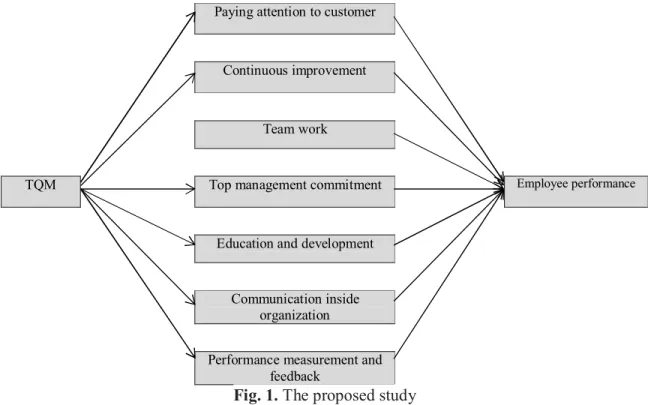
Fig. 1. The proposed study
Based on the information of Fig. 1, the following hypothesis is considered.
Main hypothesis: There is a meaningful relationship between applying TQM and employee performance.
The main hypothesis of this survey consists of the following seven sub-hypotheses,
1. There is a meaningful relationship between paying more attention to customer and employee performance.
2. There is a meaningful relationship between continuous improvement and employee performance.
3. There is a meaningful relationship between team work and employee performance. 4. There is a meaningful relationship between top management commitment and employee
performance.
5. There is a meaningful relationship between education and development and employee performance.
6. There is a meaningful relationship between commitment inside organization and employee performance.
7. There is a meaningful relationship between performance measurement and feedback and employee performance.
34 , ) 1 ( 2 2 / 2 2 2 / q p z N q p z N n (1)
where N is the population size, p1qrepresents the yes/no categories, z/2is CDF of normal
distribution and finally is the error term. Since we have p0.5,z/2 1.96and N=1300, the number of sample size is calculated as n=110. There are two questionnaires used for measuring TQM and measuing employee performance with 35 and 20 questions, respectively. All questions are designed in Likert scale. Table 1 demonstrates the summary of some basic statistics associated with the proposed study of this paper.
Table 1
The summary of some basic statistics
Variable Number Min Max Mean Std. Dev.
Paying more attention to customer 110 8 45 18.20 4.5871
Continuous improvement 110 8 25 18.836 4.0172
Team work and job involvement 110 6 25 18.60 4.2861
Top management performance 110 5 25 18.80 4.3679
Education and development 110 5 25 18.33 4.4149
Communication within organization 110 5 25 18.77 4.4384
Performance measurement and feedback 110 4 30 17.97 4.6223
Employee performance 110 26 100 69.38 18.3413
Next, we present details of our findings on testing various hypotheses of the survey. 3. The results
In this section, we present details of our findings on testing the main hypothesis as well as 7 sub-hypotheses of the survey. We have implemented Kolmogorov–Smirnov test to make sure that all data were normally distributed and the results have confirmed that all components of the survey are normally distributed. Therefore, we use Pearson correlation test to verify various hypotheses.
3.1. Main hypothesis
The main hypothesis of this survey investigates the relationship between TQM implementation and employee performance measurement. Table 2 demonstrates the results of Pearson on testing the main hypothesis of the survey.
Table 2
The summary of Pearson correlation on testing the main hypothesis
Variable Number Median Standard P-value R Result
TQM 110 129.5 25.75
Employee performance 110 69.38 18.34 0.418 0.000 Confirmed
According to the results of Table 2, there is a positive and meaningful relationship between executing TQM and employee performance. Therefore, we confirm the main hypothesis of the survey.
3.2. Testing sub-hypotheses
S. Hakami Nasab et al. / Management Science Letters 4 (2014) 35
Table 3
The summary of testing sub-hypotheses on relationship between employee performance and TQM
Variable Number Median Standard deviation P-value R Result
Paying attention to customers 110 18.20 4.5871
Employee performance 110 69.38 18.3413 0.220 0.02 Confirmed
Continuous improvement 110 18.8364 4.01723
Employee performance 110 69.38 18.3413 0.328 0.02 Confirmed
Team work 110 18.60 4.2861
Employee performance 110 69.38 18.3413 0.287 0.002 Confirmed
Top management performance 110 18.80 4.3679
Employee performance 110 69.38 18.3413 0.346 0.000 Confirmed
Training and development 110 18.33 4.4149
Employee performance 110 69.38 18.3413 0.441 0.000 Confirmed
Communication 110 18.77 4.2861
Employee performance 110 69.38 18.3413 0.403 0.000 Confirmed
Feedback 110 17.97 4.6223
Employee performance 110 69.38 18.3413 0.422 0.000 Confirmed
As we can observe from the results of Table 3, there are some positive and meaningful relationships between TQM components and employee performance. The highest correlation belongs to relationship between employee performance and feedback (r=4.6223, P-value=0.000) followed by training and development (r = 0.441, P-value = 0.000) and communication (r = 4.2861, P-value = 0.000).
4. Conclusion
In this paper, we have presented an empirical investigation to study the relationship between employee performance and TQM. The proposed study of this paper has designed two questionnaires for TQM and performance measurement and distributed them among some employees who worked for banking system in city of Semnan, Iran. The results of the implementation of Pearson correlation ratio have indicated that there were some positive and meaningful relationship between employee performance and TQM components. The highest correlation belongs to relationship between employee performance and feedback (r=4.6223, P-value=0.000) followed by training and development (r = 0.441, P-value = 0.000) and communication (r = 4.2861, P-value = 0.000).
Acknowledgement
The authors would like to thank the anonymous referees for the comments received on earlier version of this paper.
References
Ahmad, M. F., Zakuan, N., Jusoh, A., & Takala, J. (2012). Relationship of TQM and business performance with mediators of SPC, lean production and TPM. Procedia-Social and Behavioral
Sciences, 65, 186-191.
Coyle-Shapiro, J. A., & Morrow, P. C. (2003). The role of individual differences in employee adoption of TQM orientation. Journal op vocational behavior, 62(2), 320-340.
Mar Fuentes-Fuentes, M., Albacete-Sáez, C. A., & Lloréns-Montes, F. J. (2004). The impact of environmental characteristics on TQM principles and organizational performance. Omega, 32(6), 425-442.
36
Prajogo, D. I., & Sohal, A. S. (2006). The integration of TQM and technology/R&D management in determining quality and innovation performance. Omega, 34(3), 296-312.
Rahman, S., & Bullock, P. (2005). Soft TQM, hard TQM, and organisational performance relationships: an empirical investigation. Omega, 33(1), 73-83
Sadikoglu, E., & Zehir, C. (2010). Investigating the effects of innovation and employee performance on the relationship between total quality management practices and firm performance: An empirical study of Turkish firms. International Journal op Production Economics, 127(1), 13-26 Soltani, E., van der Meer, R., Gennard, J., & Williams, T. (2003). A TQM approach to HR
performance evaluation criteria. European Management Journal, 21(3), 323-337.
Ugboro, I. O., & Obeng, K. (2000). Top management leadership, employee empowerment, job satisfaction, and customer satisfaction in TQM organizations: an empirical study. Journal op
Quality Management, 5(2), 247-272.