Teachers working together to foster
self-regulated learning through reading by
students in an elementary school located in
a disadvantaged area
Sylvie C. Cartier
1, Deborah L. Butler
2& Nancy Bouchard
1Abstract
A key question for the educational research community concerns how teachers can adapt theories and practices supported by the scientific literature in ways that meet the particular needs of students in classrooms. The research reported here takes up that question by investigating how a team of teachers in an elementary school in a disadvantaged area built from research and theory to enact, try out, and refine classroom practices supportive of self-regulated LTR in their subject-area class-rooms in light of their students’ needs. Our goals were to (1) describe what classroom activities participating teachers planned and implemented to integrate attention to the curriculum with sup-port for self-regulated LTR; (2) evaluate the match between teachers’ practices and recommenda-tions from the literature, as represented in the framework on which they were drawing; and (3) trace how practices enacted by teachers could be related to the perceptions and learningprocesses of their 123 Grade 5 and 6 students. A key finding was that teachers were successful in embedding activities into classrooms that engaged students in self-regulation, particularly use of cognitive strategies. However, we also found that the practices enacted did not sufficiently push students towards self-conscious, deliberate self-direction of learning. Implications are drawn about how classrooms practices can be constructed to take into account qualities of LTR contexts and supports necessary to foster success in school by young, at-risk learners. Discussion also focuses on benefits and challenges when teachers work together to adapt practices for use in subject area classrooms in ways that are responsive to student needs.
Key words: Self-regulation, learning through reading, cognitive strategies, metacognition, assess-ment, classroom practices, teaching, elementary school, at-risk learners
1
Correspondence concerning this article should be addressed to: Sylvie Cartier, Professeure agrégée, Département de Psychopédagogie et Andragogie, Université de Montréal, Case postale 6128, Succursale Centre-ville Montréal, Québec, H3C 3J7, Canada; email: [email protected]
2
The research reported here investigated how a team of teachers in an elementary school in a disadvantaged area in Quebec built from research and theory to enact, try out, and refine classroom practices supportive of self-regulation in their subject-area classrooms in light of their students’ needs. In general, it is recognized that students in schools lo-cated in disadvantaged areas are less likely to develop competencies for performing structured learning activities and for acquiring knowledge about a wide range of subjects (Bradshaw, 2002; Darden, 2003; Janosz, LeBlanc, Boulerice, & Tremblay, 1997). Con-sequently, research is needed into how teachers can adapt teaching practices to meet the needs of students living in disadvantaged areas and to create learning activities that allow their students to develop important competencies for learning.
In Quebec, schools are judged to be located in a disadvantaged area based on the mother’s level of education and on the job stability of parents (MEQ, 2003), both of which are criteria that have been associated with a higher risk for students to drop out of school prior to completing secondary education. In 2008, 35% of students attending schools in the most disadvantaged areas in Quebec left school prior to obtaining a di-ploma compared to just 20% of students enrolled in schools in relatively more advan-taged areas (MELS, 2009). To help in explaining these kinds of differences in success rates, research has documented important ways in which students’ engagement in learn-ing might be unique within less advantaged areas. For example, students worklearn-ing in disadvantaged areas tend to be more concrete and pragmatic (Drolet, 1991). Their inter-actions with others seem to be grounded more in oral interaction, to be centred on action and in the present, and to value cooperation (Drolet, 1993).
Several studies have also shown that students from disadvantaged areas experience diffi-culty when learning through reading (LTR) (Cartier, Butler, & Janosz, 2006; Chan, 1994; Kozminsky & Kozminsky, 2001), an activity that is required routinely in secon-dary education and is essential for success. Learning through reading can be defined as “a process and a learning activity during which the reader/learner’s goal is to learn about a topic through reading texts while managing his or her work environment and task pro-gress and being motivated to do so”(Cartier, 2006, p. 439). As such, LTR is a key com-petency required of students in elementary and secondary settings, one that requires both making meaning and learning from text in ways that build content area understandings.
for students in schools located in a disadvantaged area, focusing on increasing their com-petency to learn from text effectively has great potential in terms of undergirding their overall success in school.
Various factors might explain students’ challenges in this important area. For example, it is possible that students in disadvantaged areas are provided with fewer opportunities to engage in complex LTR, and so do not have opportunities to build competencies. An-other possibility is that the types of LTR activities in which they are engaged do not support active, self-regulated learning (Zimmerman, 2000). But research suggests that one important way to help students build knowledge and acquire academic competencies is to intervene in their ability to take control over and self-regulate learning (Butler, 1998; Cartier & Théorêt, 2001; 2002; Zimmerman, 2000). Thus, in this study, we fo-cused in on how teachers might support self-regulation in LTR (Barton, 1997; Lindberg, 2003; Vacca, 1998). Our goals were to document how these teachers situated theories and practices supported by the scientific literature into the contexts in which they were working so as to address their students’ particular needs. We also considered whether and how teachers enacted classroom practices with potential to foster self-regulated LTR, and whether and how those practices could be associated with students’ taking on more self-conscious, deliberate control over learning.
Theoretical framework
As noted above, LTR is a common learning activity required of students in elementary and secondary settings. In school, students are required to invest effort in building knowledge in different subject areas (e.g., math, science, humanities) by reading and learning from different kinds of texts (e.g., textbooks, websites, original source materi-als). In the sections to follow, we first outline the theory of self-regulation on which teachers drew in this study. Then we describe the theoretical framework teachers were building from to enact classroom practices supportive of self-regulated LTR.
Self-regulation in learning through reading
In this research, teachers built from Zimmerman’s (2000) definition of self-regulation as “self-generated thoughts, feelings and actions that are planned and cyclically adapted to the attainment of personal goals” (p. 14). Further, to specify key components comprising students’ self-regulated LTR that might serve as the focus for assessment and instruction, they also drew on a situated model of SRL developed and applied in projects underway in both Quebec and British Columbia (Butler & Cartier, 2004a; Cartier & Butler, 2004). The central premise within this theoretical model is that how individuals engage in self-regulation reflects an adaptive response to a given activity as it is framed within a par-ticular context (Brown, Collins, & Duguid, 1989; Hadwin, Winne, Stockley, Nesbit, & Woszczyna, 2001; Perry, 1998).
This model describes the interplay between motivation, emotion, cognition, and self-regulation within a situated learning activity. For example, the model describes how students bring to classrooms knowledge and motivational beliefs that mediate how they perceive academic work and their engagement with it. Examples are knowledge about a subject area (van Dijk & Kintsch, 1983), interpretations about the demands of an activity (Butler & Cartier, 2004b; Butler & Winne, 1995), self-perceptions of competence and control and perceptions of task value (Bandura, 1993; Butler & Cartier, 2004b; Pintrich & Schrauben, 1992; Schiefele, 1996; Schunk, 1994; Viau, 1994; 2009). The model also foregrounds how throughout an activity, students can experience positive or negative emotions when faced with different kinds of tasks (e.g., stress) (Corno, 1993; Zimmer-man, 2000). The model suggests that, in light of their interpretation of activity require-ments, and mediated by self-perceptions and emotions, students set personal objectives (consciously or not) that might support or interfere with learning (e.g., to engage in learning; to exit the activity as quickly as possible).
Most relevant here, the model from which teachers built emphasizes that LTR requires adaptive, flexible use of cognitive and self-regulating strategies as required within a given activity (Butler, 1995; 1998). As an activity, LTR requires coordinated use of strategies for reading, constructing meaning from texts and learning information (Cartier, 2000; Dole, Duffy, Roehler, & Pearson, 1991,Weinstein & Mayer, 1986), as well as a set of recursive, dynamic, and cyclical self-regulating strategies (e.g., planning, monitoring, self-evaluating) to orchestrate task engagement (Butler & Winne, 1995). While teachers in this study aimed to support all components of SRL identified in this model, in this report, we focus on how teachers planned and implemented classroom practices to sup-port students’ deliberate, reflective use of reading, learning and self-regulating strategies during LTR activities.
Classroom practices designed to support self-regulated learning through reading
This research was carefully reviewed by the first author to define an integrative theoreti-cal framework on which teachers in this project drew during the 2006-2007 academic year to define supports to students’ self-regulated LTR (Cartier, 2007). This framework (see Figure 1 on next page) suggests that, to support students’ self-regulated LTR, teach-ers should ideally construct integrated classroom practices that take into account: (1) the LTR context established, and (2) the nature and quality of support needed to support self-regulated LTR processes.
First, the LTR context can be developed and evaluated in terms of its potential to foster self-regulated LTR, across four key dimensions: (a) the ways in which LTR activities focus attention on learning in a domain of study, (b) the nature and structure of the LTR activities, (c) the extent to which opportunities are created for LTR, and (d) the qualities of the text(s) to be read. Teachers considered these dimensions when planning, adjusting and self-evaluating activities. In so doing, they took into account both recommendations drawn from research and theory as well as the characteristics and needs of their students.
More specifically, one key quality of the LTR context concerns how practices are fo-cused in order to support learning in a domain (Johnson & Giorgis, 2001; Laparra, 1986). For example, LTR activities can adopt a disciplinary or interdisciplinary perspective (e.g., by virtue of the way in which the learning goal is framed; by virtue of the texts students are reading). Learning objectives might be narrowly or broadly defined (e.g., learning particular facts or details vs. developing integrative understandings), and may be more or less reflective of authentic learning as defined within a given domain. Perform-ance criteria articulate particular kinds of learning expectations which may be consonant with or undermine productive reading and learning foci. Thus, important to fostering self-regulated LTR is that the LTR context direct students’ attention towards meaningful, active, and deep reading and learning as defined within or across domains.
learning through reading...
387
Figure 1:
A framework for designing classroom practices to support self-regulated LTR (adapted from Cartier, 2007; Contant, 2009; Fournier, 2009)
LTR CONTEXT SUPPORT TO SELF -REGULATED LTR PROCESSES
Domain of study Activity Opportunity Texts
Requires reading
Requires active lear ning
Affords and supports self-regulation Supports
mot ivation
Relevance
Tasks to support self-regulated LTR
Pedagogical methods (practices)
Interpreting task demands Setting personal objectives
Supporting SRL strategies: planning, monitoring, adjusting, self-evaluating
Supporting cognitive strategies
Motivating character
Complexity
Pedagogical approaches (practices)
Content
activities might be more or less motivating (i.e., is significant; is diversified; presents a challenge; is authentic; requires cognitive engagement; allows for choices; allows for interaction; is interdisciplinary; includes clear instructions; allows time for completion).
Unfortunately, research at the elementary and secondary levels has shown that the LTR activities assigned in schools are not optimal for supporting self-regulation. For example, one of the most common LTR activities simply requires students to read a brief text and then answer a set of questions (Frey & Fischer, 2007; Thomas & Rinehart, 1990). Often students are required to provide written answers to questions on exercise sheets where the one correct answer is found in the text (Blaser, 2007; Frey & Fischer, 2007). During activities, teachers often see their role as conveying the one right answer to students after they have read a text and have had time to answer questions (Blaser, 2007; Théorêt, 2003). Students are commonly asked to present understandings orally after reading a text, which often creates performance anxiety in students (Viau, 1995). According to the framework applied here, these kinds of LTR activities are unlikely to spur students’ development of self-regulated LTR because they do not call for rich and meaningful reading or learning processes, afford opportunities for self-regulation, or inspire students’ deep engagement in learning.
A third quality of LTR contexts is the extent to which students have an opportunity to engage in LTR activities (Guthrie, Schafer, & Huang,2001). In the framework applied here, we considered opportunity to be reflected in the frequency with which students were engaged in LTR activities, the duration of those activities, and the number of pages of reading involved. For example, in a study of Grade 4 elementary students, Guthrie, Schafer, and Huang(2001) found that students who read more than 11 pages per week performed best in reading, whereas those who read four pages or fewer performed worst.
A fourth key quality of LTR contexts represented in our framework addresses the quali-ties of texts chosen (Pressley & Afflerbach, 1995; Vauras, 1991). When considering the qualities of texts within an LTR context, our attention focused both on content (e.g., the link between the text content and the curriculum; the scope of material included) and on writing quality (e.g., readability, structure, coherence, and organization). Studies have shown that poor quality elementary school textbooks do exist and that they are challeng-ing for students (Beck & McKeown, 1991; Budiansky, 2001).
Thus, as a first consideration in their development of integrated classroom activities that might support self-regulated LTR, teachers considered how they might establish an LTR context that invited and afforded opportunities for reading and deep learning in a domain by their students. A second important consideration was how they might provide the kinds of supports needed to foster their students’ use of self-regulated LTR processes (see Figure 1). Here, teachers’ attention focused on two broad dimensions: (a) how to integrate tasks into LTR activities that explicitly provoked and supported self-regulation, and (b) pedagogical approaches (e.g., reciprocal teaching; Palincsar & Brown, 1984) and more specific practices (e.g., modeling) that they could employ to support students’ self-regulated engagement in LTR.
asking students to read a text, SRL-supportive tasks might require students to interpret activity demands and then plan how they might use their time, resources, or strategies in order to complete it successfully. For instance, a task to encourage activity interpretation might engage students in asking themselves three questions before starting: What do I have to do? What are the tasks to perform?; and How will I know that I’ve done a good job? (Butler & Cartier, 2004b). Similarly, teachers might build in tasks to engage stu-dents in constructing, selecting, and using reading or learning strategies and monitoring their effectiveness (Rupley, Blair, & Nichols, 2009).
The integrative framework teachers were drawing on suggests, however, that guiding students’ learning processes by engaging them in SRL-supportive tasks (akin to proce-dural facilitators) is helpful, but not sufficient in supporting students to take control over their learning (Butler, 2003). Ample research has documented the importance and bene-fits of various pedagogical approaches in moving students from guided participation towards more independent LTR (e.g., Reciprocal Teaching, Transactional Strategies Instruction, Strategic Content Learning, Integrated Strategies Instruction). Similarly, much research has documented a range of specific pedagogical practices with potential to support self-regulated LTR (e.g., direct instruction, modeling, guided practice, coopera-tive learning, strategic questioning, scaffolding).
Yet, in spite of recommendations generated across two decades through the educational research literature, even recent research suggests that elementary and secondary teachers provide very little explicit support to learning processes during LTR activities, especially in content-area classrooms (Blaser, 2007; Cartier & Théorêt, 2001, 2002; Ciardiello, 2002; Spor & Schneider, 1999; Théorêt, 2003; Thomas & Rinehart, 1990). For example, students are still not frequently supported in their development or use of cognitive strate-gies for reading or learning (Blaser, 2007; Pressley, 2006; Théorêt, 2003). Classroom LTR support practices often focus almost entirely on student knowledge and subject matter, for example, by asking students questions about the content of texts, reacting to student questions, and emphasizing the right answer (Cartier & Théorêt, 2001). This lack of support may have deleterious consequences for students who have not yet developed competencies to engage in LTR on their own. Clearly research is still needed into how teachers can adapt and embed research-based recommendations for practice into class-rooms in ways that are supportive of self-regulated LTR.
Research aims
In the research reported here, we investigated the relationship between the classroom practices established by teachers and the LTR processes of their Grade 5 and 6 students from an elementary school located in a disadvantaged area. Our research goals were to (1) describe what classroom activities participating teachers planned and implemented in their classrooms to foster self-regulated LTR; (2) evaluate the match between teachers’ classroom practices and recommendations from the literature, as represented and summa-rized in the integrative framework on which they drew (see Figure 1); and (3) investigate how the practices enacted by teachers might be associated with the perceptions and learn-ing processes of their 123 Grade 5 and 6 students, particularly in the extent to which students were self-reflectively engaged in self-regulation. We draw implications from our findings to elaborate understanding about qualities of classroom practices necessary to supporting students’ independent, self-regulated LTR.
Thus, this study was designed in part to elaborate on prior research related to qualities of classroom practices supportive of students’ independent, self-reflective, self-regulation of learning. At the same time, if research is to have a broader impact on practice in schools, it is also imperative to understand how principles or practices validated through research can be adapted by teachers working in particular curricular areas to meet the unique needs of their students (Butler & Schnellert, 2008; Putnam & Borko, 2000; Randi & Corno, 2007). Thus, attention in this research also focused on examining how a team of teachers built from research and theory to enact, try out, and refine classroom prac-tices supportive of self-regulated LTR in their subject-area classrooms in light of their students’ needs.
This research is significant because it uncovers successes and challenges experienced by committed teachers working over a number of years to support students’ SRL. Rather than conducting an intervention study that involved controlled application of pre-specified activities, we traced how a group of teachers situated theoretical principles and research-based practices in classrooms in relation to students’ needs to achieve an impor-tant goal. By exploring where and how their insimpor-tantiation of principles succeeded or fell short, we sought to derive implications about how long-term, collaborative approaches might support teachers in making theory-research-practice connections (Butler & Schnellert, 2008). If we are ultimately to make a difference to students’ success on a larger-scale, it is critical that we understand how teachers can create learning environ-ments that respond to the particular needs of their students and foster success at the local level.
Method
practices to support self-regulated LTR in her classroom as part of her master degree requirements. She integrated across three models in constructing practices for her class-room: A model of self-regulated learning (Zimmerman, Bonner, & Kovach, 2000), a project based learning approach (Francoeur-Bellavance, 1995), and a cooperative learn-ing model (Howden & Martin, 1997). These choices rested on her analysis of the needs of her students (Bouchard, 2001), whom she had observed having difficulty reading and self-regulating learning during collaborative project-based learning, an approach empha-sized in Quebec’s educational program (MEQ, 2001).
Between 2002 and 2006, this teacher took on the role as a pedagogical coach and worked with other teachers in her school who similarly wanted to try out and refine practices to support self-regulated LTR in their classrooms. At that time, the school integrated a focus on supporting self-regulated learning into its plan for success. To support her col-leagues’ efforts to foster self-regulated LTR, the pedagogical coach put into place a collaborative approach in which teachers made decisions together about practices they would try, based on the needs of their students, theory and research, and the domain and program of study.
By the time of this study in 2006, the project had expanded to include all Grade 3 to Grade 6 teachers along with many teachers at levels 1 and 2. At that point the school-based team continued to use a project-school-based learning approach. In this year they chose to work from the integrative framework of LTR described above (see Figure 1), with sup-port from a university-based researcher (the first author here). Also with supsup-port from this researcher, in this year the teachers asked their students to complete an LTR assess-ment at the start of the year (the LTRQ; see below), designed to provide a detailed por-trait of students’ perceptions of LTR activities and their engagement within them. Teach-ers then considered both guidelines drawn from the integrative framework and LTRQ assessment data to revise and enact classroom practices that would support students’ self-regulated LTR in ways that addressed their particular needs.
Participants
This study was carried out in a French-speaking elementary school in a disadvantaged urban area in the Province of Quebec in Canada. The school, which enrolled 586 students in 2007, belongs to a group of schools that ranked highest on a deprivation index defined in the province (indicator 103). Given the criteria used in Quebec to identify schools as disadvantaged (described earlier), it can be interpreted that in the catchment area for this school, mothers’ levels of education and parental job stability were among the lowest in Quebec (MÉQ, 2003).
In the 2006-2007 school year, all teachers of students between the third and sixth grades (aged 8 to 12) participated in this project (n=15). In this report, we present data generated
3
from an in-depth study of the practices of six of these teachers and the learning of their 124 Grade five and six students. Five of these teachers were women. They had on aver-age 4.16 years of teaching experience (ranging from 3 to 6 years). Four of the six had participated in the project for three years prior to this one; another had participated in four previous years.
Among the students, 48% were boys and 52% were girls. Their ages ranged from 10 to 13 years (average 10.66, SD = .62). Students had attended this school for an average of 4.46 years (SD = 2.34). Likely, then, most of these students would have participated in a similar project two or three times in previous years. The primary languages spoken in the homes of participating students were: French, the language of instruction (57 %), Creole (12%), Spanish (10%), English (4%), Arabic (2.5%), and others (7.5%).
Study design
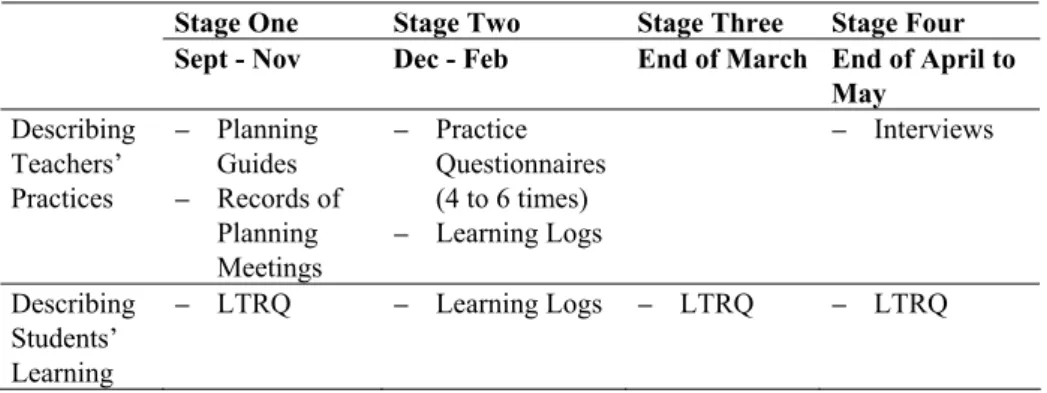
Table 1 provides an overview of the overall study design, which unfolded in four stages. First, between September and November, teachers engaged collaboratively in planning classroom practices. To begin, teachers reviewed a report provided by the pedagogical coach on the previous year`s efforts. During this stage, students’ thinking about LTR activities and their engagement within them was assessed using the Learning through Reading Questionnaire (LTRQ), and teachers considered students’ LTR profiles when planning. We audiotaped planning meetings, and planning activities were supported and recorded using planning guides. Second, between December and February, teachers put into place classroom practices. To document practices enacted, we asked teachers to complete a weekly practice questionnaire. Evidence related to students’ learning proc-esses in this phase was collected using learning logs. In the third stage, after practices had been implemented, teachers again used the LTRQ to assess students’ thinking about their engagement in LTR. In a final stage, teachers were interviewed about their prac-tices, and for a third time, students’ thinking was assessed using the LTRQ. Given the
Table 1: Overall study design
Stage One Stage Two Stage Three Stage Four
Sept - Nov Dec - Feb End of March End of April to
May Describing
Teachers’ Practices
– Planning
Guides – Records of
Planning Meetings
– Practice Questionnaires (4 to 6 times)
– Learning Logs
– Interviews
Describing Students’ Learning
focus of this research report, our data analyses involved describing the practices teachers put into place (e.g., based on planning guides, records of planning, practice question-naires, and interviews) in relation to how students engaged in learning (based on learning logs, LTRQ).
Designing and enacting classroom practices
To support teachers’ planning, the researcher and pedagogical coach launched the project with two half-day meetings with the full team of teachers from Grade 3 to 6. The goals in the first meeting were to describe the objectives of the research project and introduce the integrative theoretical framework (see Figure 1). The second meeting was designed to support teachers’ construction of understanding about the integrative framework. To that end, teachers engaged collaboratively in reading a short text about the integrative frame-work, creating a semantic map related to what they had understood, and describing their understandings to colleagues.
After these meetings, the planning phase began. With support from the pedagogical coach, all of the teachers in the school-based project planned how to enact practices in classrooms to support self-regulated LTR, either on their own or in pairs, sometimes combining classes. In total, six projects were developed and implemented by teachers working in the school-based project, each of which focused on a larger theme and in-cluded a sequence of LTR activities. The six teachers on whom we focused in this study chose to work in pairs. In this report, we focus attention on how they designed and im-plemented three projects, focused, respectively, on: Occupations in communications, Space, and Quebec in the 19th century.
Following this meeting, the pedagogical coach worked with teachers in a full-day session (tape-recorded for later analysis). The coach had developed a planning guide that in-cluded the integrative framework for supporting self-regulated LTR, the situated model of self-regulated learning overviewed earlier (Butler & Cartier, 2004a; Cartier & Butler, 2004), snapshots of students’ responses to the LTRQ, curriculum-based competencies defined for the project and, building from Francoeur-Bellavance (1995), a model of project-based learning. In refining classroom practices and setting goals for this year, the teachers considered these planning materials and articulated: (1) their teaching goals and subgoals; (2) the knowledge students would need to bring to the activities; (3) a precise description of the LTR context to be established each week (domain, texts, opportunities, activities) and pedagogical methods or approaches to be used; and (4) required materials. Teachers’ planning guides were collected as data.
read-ing and learnread-ing. Activities were framed into learnread-ing logs (LL) that students worked through during classes. As data, these learning logs provided important information both about classroom practices and students’ learning.
Teachers also planned to use different kinds of pedagogical methods (e.g., modeling) to support students’ working through activities that were not necessarily reflected in learn-ing logs. Teachers described these practices in weekly questionnaires and in interviews in the final stage of the study. Thus, we also drew on data from these sources to consider how the pedagogical methods or approaches teachers enacted helped in focusing stu-dents’ attention on different kinds of strategies (e.g., cognitive; self-regulating) while LTR.
Data collection: Describing classroom practices
As summarized above, we described classroom practices based on records of planning (planning guides; audio-tapes of planning sessions), and of how practices were enacted (learning logs; practice questionnaires; interviews). The purpose, focus, and content of planning meetings and the planning guides were described earlier. Here we focus atten-tion more specifically on data collected from learning logs, practice quesatten-tionnaires and interviews.
Learning Logs (LL). As described below, we drew on the learning logs teachers created to guide students’ learning to describe students’ engagement in self-regulated LTR. But learning logs also provided an important record of the LTR contexts and supportive practices that teachers established to foster students’ self-regulated LTR. For example, learning logs documented the nature of LTR activities and component tasks that teachers designed and enacted to support students’ learning in a project around a broad theme (e.g., Quebec in the 19th Century). They also provided evidence related to how teachers built SRL-supportive tasks into LTR task sequences. Thus, in addition to providing re-cords of students’ performance, LL provided important information on the qualities of classroom practices established by teachers to support self-regulated LTR.
Practice Questionnaires (PQ). A questionnaire framework was developed to gather information about how planned classroom practices were implemented and about ad-justments to practices teachers might have made. Teachers responded to a practice ques-tionnaire each week. They were given the choice to respond in writing, by audio-taping their responses, or in a telephone interview. Two versions were created (20 and 21 ques-tions, respectively), where the wording differed slightly based on the stage of the project. In both versions, questions asked teachers to describe the nature of the LTR and SRL-supportive tasks assigned and how they were implemented, the time required for each task, and the pedagogical support put into place each day to support students as they worked through tasks.
in their students. The questions addressed in the interview paralleled those addressed in the weekly practice questionnaires. Interviews were tape recorded and transcribed.
Data collection: Describing student learning
Data on student’s perceptions about and performance when LTR were collected from two sources: Learning Logs and the LTRQ.
Learning Logs (LL). We drew on the records generated in learning logs to describe students’ engagement in self-regulated LTR. Learning logs recorded rich information about student learning and performance, including: (1) records of teachers’ and students’ collaborative engagement in self-regulating processes (e.g., co-planning, co-monitoring, co-evaluating), (2) students’ descriptions, assessments, and revisions of reading and learning strategies, (3) traces of students’ strategy use, and (4) records of the evolution of students’ LTR performance over time.
The Learning through Reading Questionnaire (LTRQ) (French version, QAPL) (Cartier & Butler, 2003). The LTRQ is a self-report tool that assesses how students think about LTR activities and their engagement within them (see Butler & Cartier, 2004a; Cartier & Butler, 2004). The LTRQ is contextualized for specific LTR activities in a given domain, and involving particular kinds of texts. For this study, the LTRQ was adapted for elementary students who referred to a curriculum-based, humanities activity. Using a Likert-type scale, they indicated what they would normally think, feel, and do when faced with an activity like the one in that example. The LTRQ was administered by teachers or research assistants following a common protocol.
Questions on the LTRQ ask students to describe their engagement in the full range of self-regulated LTR components implicated in the situated model of SRL described earlier (Butler & Cartier, 2004a; Cartier & Butler, 2004), including motivation, emotion, cogni-tion, and metacognition. Evidence on the validity of the LTRQ in both English and French language versions is available elsewhere (see Butler & Cartier, 2004a; Cartier & Butler, 2004).
LTRQ data were drawn on in this study in two ways: (1) by teachers, when interpreting responses for each items of the questionnaire of their students to set goals while plan-ning, and (2) by researchers, to uncover the relationship between students’ perceptions of LTR and their engagement within it and classroom practices enacted by teachers.
Data analysis: Describing classroom practices
prac-tices reflected the range of quality criteria associated with LTR contexts and supports as defined by the integrative framework presented in Figure 1, and analyzed the strengths and weaknesses of classroom practices in terms of their potential to support self-regulated LTR by students.
To ensure analyses were comprehensive and systematic, data were compiled and ana-lyzed with the support of two series of grids, one focused on qualities of LTR contexts, and the other on qualities of supports to students’ self-regulated LTR. Using word pro- cessing software, research assistants sorted descriptions of classroom practices into the relevant grids. Ten percent of the information assigned to themes by the research assis-tants was checked for consistency of coding. Discrepancies were discussed and adjust-ments made to the coding as necessary.
Four analysis grids were developed to describe and evaluate the quality of LTR contexts, focused respectively on domains, activities, opportunities, and texts. For example, in a first grid, we applied criteria to judge how learning in a domain was focused. Here we considered how goals were structured (interdisciplinary or not; links to the curriculum), learning objectives (number and relationship to goals) and performance criteria (rele-vance and relationship to goals and learning objectives).
In a second grid focused on LTR contexts, we described and evaluated LTR activities in terms of their relevance, complexity, and motivational quality. We judged activities as relevant if they focused on both reading (individual and collaborative) and learning (making links with prior knowledge and between new ideas). Complexity was considered along five dimensions: 1) amount of time required to accomplish task sequences, 2) number of goals, 3) variety in ways in which information could be processed, 4) vari-ety in ways in which work could be created, 5) the comprehensiveness with which a subject could be considered. Finally, the motivational quality of LTR activities was judged across 10 dimensions (as summarized earlier).
A third grid summarized how LTR contexts created opportunities for LTR, with a focus on the frequency of LTR activities, the number of pages to be read and the total duration of the activities. A fourth and final grid that supported our analysis of LTR contexts established by teachers considered the quality of texts assigned, with a focus on both content (link to the curriculum and scope) and writing (readability, structure, coherence and organization).
Data analysis: Describing student learning
Our third research aim required associating classroom practices enacted by teachers with students’ engagement in learning. To that end, we analysed information obtained from the student point of view as observed in the LTRQ and in a subsample of learning logs.
LTRQ data were summarized to reveal students’ thinking about and approaches when LTR for the full sample of 124 Grade 5 and 6 students. First, LTRQ data were subjected to a factor analysis to reveal underlying dimensions. Table 2 provides a summary of the dimensions that emerged from the LTRQ in this study, along with estimates of the inter-nal consistency for each dimension. Then, repeated measures ainter-nalyses of variance were employed to track changes over time in students’ responses across dimensions. In this study, we interpreted LTRQ data as providing a window into how students’ metacogni-tive knowledge development could be related to their participation in classroom activities designed to support self-regulated LTR.
Learning logs were carefully examined to document students’ approaches when LTR in the different tasks assigned for a subsample of 14 students. Learning logs were selected for in-depth study as follows: 1) two students were chosen at random from each of the six partici-pating classrooms (for a total of 12 students); 2) two additional students were chosen at random from among students who were receiving special education support. Learning logs were analyzed to provide evidence of how students engaged in self-regulated LTR activities (e.g., whether they developed strategies) in relation to the LTR contexts established and support provided (e.g., how they were engaged in developing strategies; how they focused attention on planning). To that end, learning logs data were also subjected to a thematic content analysis (Huberman & Miles, 1991, 2003; Van der Maren, 1996; 2003), building from the theoretical frameworks presented earlier (see Figure 1). Information was compiled into grids for each project separately and across all three projects. Again, ten percent of the information was checked for coding consistency, and discrepancies were discussed as a basis for refining coding decisions and coding criteria.
Results
To address our three research aims, we present our results in two sections. In the first section we describe the practices enacted by teachers and how they linked to recommen-dations from the research literature (aims one and two). In the second, we turn our atten-tion to how students were engaged in self-regulated LTR as a funcatten-tion of the practices enacted (aim three).
Classrooms practices enacted in relation to the theoretical framework
Table 2:
LTRQ dimensions derived through an exploratory factor analysis
Topic Area Dimension (number of items)
Description Example item α
Text-Referenced performance criteria (8 items)
Criteria students apply to monitor and evaluate their work linked to reading and learning from text
I know that I’ve done a good job when I understand the subject of the text
.79
Activity interpretation (3 items)
How students understand the purpose of the activity
My teachers is asking me to memorize information
.60
Planning strategies (3 items)
Strategies students describe themselves as using to make a plan
I make a work plan .53
Help-seeking strategies (3 items)
Strategies students describe themselves as using to seek help
I ask someone to explain the instructions
.60
Strategies for monitoring and self-evaluation (8 items)
Strategies students report using for monitoring and self-evaluating
I make sure that I’ve done a good job on what I needed to do
.69
Self-Regulation
Adjusting strategies (9 items)
Strategies students report using to adjust their objectives or strategies
I reread the instructions .73 Strategies for selecting, repeating, and elaborating (9 items)
Strategies students describe themselves as using to work with ideas in the text and connect them with prior knowledge
I summarize what I’ve read in my own words .72 Cognitive Strategies Strategies for organizing (3 items)
Strategies students report themselves as using to organize ideas in a text
I created a table to represent the information
how they were successful in enacting practices consonant with the theoretical model from which they were building. We focus first on the qualities of LTR contexts estab-lished, then on strategies designed to support self-regulated LTR (see Figure 1).
LTR contexts. In considering the extent to which teachers established contexts suppor-tive of self-regulated LTR, we compared enacted practices to quality criteria for do-mains, activities, opportunities, and texts. In each area, we provide a description of the extent to which the three activities created by participating teachers reflected those crite-ria.
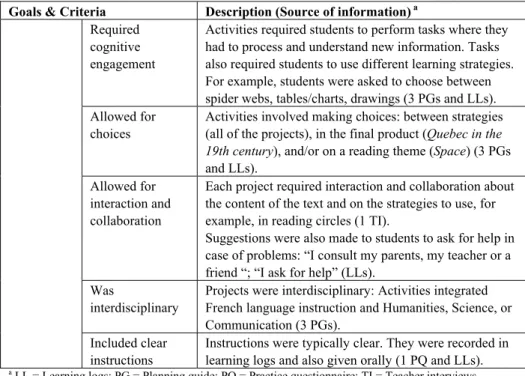
In general, our findings were that teachers did a relatively good job of planning and enacting LTR contexts with potential to support SRL. First, Table 3 presents a descrip-tion of how LTR contexts met criteria for fostering deep learning in a domain. Results suggested, first, that all projects were interdisciplinary, in that they either invited connec-tions across disciplines (e.g., Quebec in the 19th century with Social Studies), or were
Table 3:
LTR contexts established by teachers: Fostering deep learning in a domain
Goals & Criteria Description (Source of information)a
Interdisciplinary – All: competencies developed were connected with the area of French language instruction.
– For each LTR context: links were established with either another curricular domain (Occupations: Communications) or with another discipline (Space: Sciences; Quebec in the 19th century: Social Studies) (3 PGs).
Learning objectives – Objectives required learning in the area of French language instruction.
– Objectives were focused on learning about the targeted curricular domains (e.g. to learn about occupations in communications) or disciplines (e.g., to learn about Quebec in the 19th century in Social Studies) (3PGs).
Performance criteria Examples of rich and varied learning foci were evident and were clearly linked with Ministry of Education criteria for learning in a domain (MEQ, 2001, pp. 51-54). For example, for the area of French language instruction, performance criteria included: – While working on the task, respect the purpose of the
reading;
– Identify explicit and implicit pieces of information; – Organize information contained in a text;
– React in a relevant and specific way;
– Interpret: make connections with personal experience and other pieces of writing;
– Use relevant strategies effectively. (3 PGs).
integrated with a general curricular domain of knowledge (e.g., Occupations in Commu-nications). Our analyses suggested that the contexts enacted did focus attention on prior-ity themes within these areas, as defined within the provincial curriculum (MEQ, 2001). Learning objectives were defined broadly and in ways that invited authentic learning (e.g., to learn about Quebec in the 19th century). Performance criteria were multiple and focused attention both on making and expressing meaning (e.g., linking learning to per-sonal experiences) and on active learning processes (e.g., reading for a purpose, inter-preting, organizing). Thus, we concluded that the contexts designed by teachers did have potential to foster meaningful, active, and deep reading and learning as defined within the domains under study.
Second, Table 4 presents the qualities of the LTR activities teachers designed and en-acted. Our analyses suggested that all three activities met all of our quality criteria for LTR activities related to relevance and complexity. All focused on both reading and learning. For example, in terms of the relevance of reading, students were asked to read both individually and collaboratively. Learning was made relevant when students were asked to make links between information they were reading and prior knowledge. All of the activities were also sufficiently complex, long and diversified (in terms of goals, learning processes, work variety, scope), to afford opportunities for rich learning and active self-regulation.
Table 4:
LTR contexts established by teachers: Activities/Tasks
Goals & Criteria Description (Source of information) a
Required reading At different points in time every week, each project required individual (e.g., silent reading) and group reading (e.g., shared reading) (1 TI).
Relevance
Required learning In all projects, activities/tasks required that links be made between information from texts using different kinds of organizing strategies (e.g., spider webs, tables/charts, drawings). All projects required that personal knowledge be activated and related to new information. For example, in one task, students had to answer a personal question related to the content of the text after reading (What communications occupation might I like to do myself?) (LLs).
Required several class periods
The duration of the projects ranged from 6 to 10 weeks (3 PQs and TIs).
Complexity
Allowed different ways of
processing information
Goals & Criteria Description (Source of information) a Had multiple
goals
Each project had four goals: (1) drawing on prior knowledge to interpret texts, (2) intentionally acquiring new knowledge on a subject, (3) developing
competencies in different domains of learning, (4) self-regulating more effectively (3 PGs).
Allowed for a variety of work
Activities/tasks in each project made it possible to create a variety of work. Examples for all activities: producing spider webs, drawings and paintings, summaries (3 PGs and LLs).
Covered key information on the subject
Each project addressed a different theme. Within each, the topics addressed over time were directly related to that theme (e.g., to learn about Quebec in the 19th century, topics included: public schools, unionization, the Church, and the general store) (3 PGs).
Was significant Each project addressed a theme that cut across different subjects in ways that were linked to the interests and concerns of students. For example, Occupations in
communications that students considered included ones
in front of and behind the camera (e.g., a presenter; director) (3 PGs).
Was diversified and varied
Project themes targeted several domains of learning and competencies prescribed by the provincial curriculum (MÉQ, 2001). Activities also required a range of tasks (e.g., to learn about Quebec in the 19th century, students had to write summaries, write a small play on the theme, create the stage set, etc.) (3 PGs).
Presented a challenge
All activities were grounded in the goals stipulated in the provincial curriculum for students of 5th and 6th grades (3 PGs).
Motivation
Was authentic In each activity, at least some tasks were authentic, in that they were common to students’ experiences (e.g., visiting a Science Centre for young students) (1 TI). In two activities, the work produced by students was also authentic (e.g., when learning about Quebec in the 19th
century, students acted out the plays they had written,
Goals & Criteria Description (Source of information) a Required
cognitive engagement
Activities required students to perform tasks where they had to process and understand new information. Tasks also required students to use different learning strategies. For example, students were asked to choose between spider webs, tables/charts, drawings (3 PGs and LLs). Allowed for
choices
Activities involved making choices: between strategies (all of the projects), in the final product (Quebec in the
19th century), and/or on a reading theme (Space) (3 PGs
and LLs). Allowed for
interaction and collaboration
Each project required interaction and collaboration about the content of the text and on the strategies to use, for example, in reading circles (1 TI).
Suggestions were also made to students to ask for help in case of problems: “I consult my parents, my teacher or a friend “; “I ask for help” (LLs).
Was
interdisciplinary
Projects were interdisciplinary: Activities integrated French language instruction and Humanities, Science, or Communication (3 PGs).
Included clear instructions
Instructions were typically clear. They were recorded in learning logs and also given orally (1 PQ and LLs). a LL = Learning logs; PG = Planning guide; PQ = Practice questionnaire; TI = Teacher interviews.
Criteria for establishing a motivating context were also largely met. For example, activi-ties addressed significant and broad topics in ways that were diversified and varied. They also afforded opportunities for students to engage deeply in learning. That said, there were some ways in which the activities were not optimal, from a motivational perspec-tive. For example, in the Occupations in communication project, instructions were not clear to students when the activities were enacted. In the science project on Space, stu-dents were required to make an oral presentation to the class, a task which lacks authen-ticity because it is not reflective of a real-life task for children (Viau, 2009) and can cause performance anxiety (Viau, 1995).
Table 5 presents our analysis of the extent to which the LTR context established by teachers provided regular opportunities for self-regulated LTR. Students engaged in LTR activities/tasks each day over a six to ten week period, for 35 to 45 hours. Students read, on average, four to six pages of text per week.
Table 5:
LTR contexts established by teachers: Opportunities
Goals & Criteria Description (Source of information) a
Frequency Projects were taken up every day during the six to ten week period (3 PQs). For one activity, on Space, students also had to take reading home: “We gave them the text. They have to read it at home. They have to choose two sections to read“ (1 PQ). Number of pages to
read
The average number of pages to be read per week varied from one project to another, ranging from 3.72 (Quebec in the 19th century) to 5.52 (Occupations in Communications) (3 PGs; 3 PQs; LLs). Total duration of
the activity
The time planned for each project (in total) was 35 to 45 hours spread over the six to ten week period (3 PGs; 3 PQs). a LL = Learning logs; PG = Planning guide; PQ = Practice questionnaire; TI = Teacher interviews.
Table 6:
LTR contexts established by teachers: Texts
Goals & Criteria Description (Source of information) a Link between text content
and the curriculum
For all projects, most texts related to the main theme, which touched on several areas of learning. (3 PGs; 3 PQs). For example, in
Québec in the 19th Century, texts were related to two competencies in Humanities:
Understanding the organization of a Society in one’s homeland, andInterpreting change in a society in one’s homeland. (1 PG).
Content
Themes were addressed with sufficient scope
Texts in one project (Occupations in communications) addressed the main theme with enough scope. In the others, texts addressed subtopics well, but not enough information was available to fully address the main theme (3 PGs).
Readability The number of words per sentence varied
greatly from one text to the next. For example, the number of words with more than five letters ranged from an average of 0.07 for Space up to 2.14 for Occupations in communications. In each project texts accommodated students across reading levels (3 PGs; 3 PQs). Writing
Structure In all projects, text structures were varied:
description (3/3), explanation (3/3), narration (2/3), definition (1/3)
Goals & Criteria Description (Source of information) a Linkage
between texts & themes
For most projects, texts linked and combined well to address themes. But in two, some texts were less obviously related. For example, in
Space, most texts focused on the solar system and planets, but two texts were only tangentially related to the main theme (1 PG).
Coherence
Main thread
For all projects, a main thread ran through the ideas in selected texts. For example, in the text
La vie de Louis Braille (for Quebec in the 19th century)the text traced the events in the life of the character who created an alphabet for the blind (1 PG).
Division into parts
The texts for the projects were divided into sections. For example, for Occupations in communications, the text Rencontre avec un réalisateur (Encounter with a film director) was divided into 7 parts (1 PG).
Facilitating elements
The texts for each of the three projects
contained facilitating elements, such as pictures (3/3), sub-titles (3/3), and definitions (1/3) (3 PGs; 3 PQs).
Organization
Technical terms
In all projects, technical terms used in texts were not explained (3 PGs). For example, texts used for Quebec in the 19th century, included equivalents of terms for carpenters,
woodworkers, clandestine, shipyards,
typographs, conspiracy, and claim that were not explained. (1 PG).
a LL = Learning logs; PG = Planning guide; PQ = Practice questionnaire; TI = Teacher interviews.
LTR activities addressed different kinds of careers, but none focused directly on how students might come to a choice (e.g., what would be the pros and cons of different op-tions? What should be considered in making a choice?). In two projects, not all of the assigned texts could be clearly connected to one another or to the main topic of study. Further, technical terms were introduced in many texts without definitions.
inde-pendent, self-reflective, and deliberate learning. In this section, we describe these suc-cesses and challenges, in turn.
One way in which teachers were successful in building classroom practices was in how they embedded tasks within LTR activities with promise to engage students in self-regulated LTR. For example, tasks were designed to engage students in considering their personal learning objectives. Specifically, for each project, a task embedded in learning logs asked students to “write down subtitles of subjects that you want to learn more about.” Other embedded tasks cued and supported students to choose, plan, enact, and monitor cognitive strategies in relation to how they helped in achieving outcomes. For example, one task embedded in learning logs asked students to choose one of three strategies for organizing information: A table, a spider web, or a drawing. Another task asked students to examine feedback on work (based on self-evaluation and from teach-ers), select strategies to use for the next assignment with that feedback in mind, and justify their selection. Tasks were also developed that engaged teachers and students in co-evaluation of work, and in tracking progress across reading tasks. For example, learn-ing logs showed that activities included tasks that asked students to rate the quality of their reading performance against five criteria, and to describe what they had learned about themselves as readers. At the end of activities, a task in learning logs asked stu-dents to describe their emotions while LTR.
We also observed that teachers successfully planned and used different kinds of peda-gogical methods to support students’ self-regulation during LTR activities. For example, some teachers described how they used discussions to support students to draw on their prior knowledge about a theme. In the Space project, one teacher described the following on a weekly practice questionnaire: “And we did that in class, I remember. We asked them what they already knew about space and all that (…) They were interested, many said: I like it, I like this theme.”
cognitive strategies in light of previous outcomes. In learning logs they provided written evaluations of outcomes and written comments to students.In planning guides they de-scribed how they intended to collaborate with students, with support from a procedural facilitator, to judge how their work met performance criteria and where they needed to identify and enact more effective learning strategies.
Thus, our analyses of teachers’ SRL-supportive tasks and supports suggested that they did a good job in some key areas. They focused particularly well on activating prior knowledge (about the subject; about strategies), and on supporting students’ planning, use, monitoring, and revision of cognitive strategies. That said, our analyses also re-vealed gaps in the kinds of SRL supports teachers provided. In general, attention was too narrowly focused on cognitive strategies, leaving out attention to other kinds of percep-tions and processes also pivotal in self-regulation. For example, although task criteria were explicated, less support was provided to students’ conscious and deliberate interpre-tation of task requirements. Little attention was paid to students’ motivation-related perceptions, or to their use of motivation- and emotion-control strategies.
Further, although teachers did work specifically on helping students perceive connections between cognitive strategies used and outcomes, they did not draw students’ attention explicitly to the self-regulated processes they were using (e.g., setting learning objec-tives, planning, enacting, monitoring and adjusting cognitive strategy, and self-evaluating links between cognitive strategy and outcomes). For example, although stu-dents were cued to set learning objectives (i.e., to write down subtitles of subjects that you want to learn more about), connections between objectives and planning were not explicitly made. While self-evaluation was surfaced as an important part of learning (and was linked to selecting strategies), students were also not pushed to consider their strengths and weakness as self-regulated learners.
Perceptions and learning processes of the Grade 5 and 6 students
In order to draw connections between classroom practices enacted by teachers and the learning processes and perceptions of their Grade 5 and 6 students, in this section we consider evidence of ways in which students engaged in learning (as reflected in learning logs), followed by evidence of what students’ perceived about their engagement in learn-ing (from LTRQ).
Analyses of learning logs also suggested that students were indeed engaged in self-regulated processes as part of LTR activities. For example, students recorded their plan-ning of strategies to use (e.g., planning as an SRL task). One student explained how he planned to approach one task: “I think that a table will help me more than a spider web. Then (…) the day before I evaluate my learning, I’ll make a summary to help myself (…) and I will select the best information.” Students considered strategies they used to man-age resources (material and time). For example, excerpts from two students’ logs in-cluded: "Every day, I read my text and I wrote all the information and I did that every time with my [semantic network]"; and "[when reading] I wrote keywords on a sheet and I revised them before going to sleep.” There was evidence from logs that students self-assessed their performance throughout the project. For example, across a sequence of tasks, one student’s self-assessments were: “I estimate that it is an average performance because I think that I would have been able to make it better" (task 1); "I estimate that it is a good performance because I reached my objective" (task 2). Students also described their emotions (e.g., one student was “disappointed by the evolution of my outcomes”).
Results from the LTRQ. Results from the LTRQ showed some gains on the cognitive strategies dimensions, which were at the heart of the support provided by teachers in this study. One of the changes observed was an increase in students’ self-reported use of cognitive strategies for elaboration, selection, and repetition between stage 1 and stage 3, F(1, 984) = 3.13, p = 0.05. We also observed a small increase in students’ reports of using cognitive strategies for organization F(1,774) = 2.80, p = 0.07. Unfortunately, at stage four of the study a month later, self-reported strategy use reverted back to levels observed in stage one. Thus, we concluded that the instructional practices teachers en-acted, which prioritized helping students make connections between strategies used and outcomes while LTR, had an influence on students’ perceptions about relevant cognitive strategies (but not other types of strategies), though only in the short term.
We did not observe gains for students across LTRQ dimensions focused on self-regulated learning. For most (performance criteria, activity interpretation, planning strategies, help-seeking strategies, adjusting strategies), students’ self-reports remained similar across all study stages. Similarly, we observed no change between stage 1 and 3 on students’ self-reported use of strategies for monitoring and self-evaluation. What is surprising in this study is that, even though teachers engaged students in tasks supportive of self-regulation (e.g., setting personal objectives; planning), and logs documented students’ engagement in those activities, students did not report increases in their use of those strategies.
Discussion, implications, and conclusions
the data from 2006-2007, our three research aims were: (1) to describe the classroom practices 6 teachers co-constructed to meet students’ needs; (2) evaluate the match be-tween those practices and the framework from which teachers were working; and (3) describe how enacted practices could be related to the perceptions and learning processes of students. Our hope was to elaborate understanding about qualities of instruction sup-portive of self-regulated LTR and about how principles or practices validated through research could be adapted by teachers working in particular curricular areas to meet the unique needs of their students (Butler & Schnellert, 2008; Putnam & Borko, 2000; Randi & Corno, 2007).
Describing and evaluating teachers’ classroom practices
What did we learn about the classroom practices that teachers enacted in this study? First, it appeared that teachers were sensitive to students’ needs when creating classroom practices. For example, they interpreted and built from LTRQ data when planning, set-ting goals and construcset-ting practices they felt would best enhance students’ development of key competencies for learning. Further, consistent with Drolet’s (1991; 1993) research on ways of learning most common among students in disadvantaged areas, teachers built practices that were concrete and explicit, action-oriented, experiential, and cooperative (i.e., through project-based learning). Tasks were also designed to move students from more of an in-the-present orientation to self-regulating performance in ways that inte-grated across the past (i.e., tapping into prior knowledge and experience), present, and future (i.e., planning strategies to be used down the road).
Our findings also suggest that the classroom practices teachers co-constructed to support LTR were well designed in many key respects. In creating LTR contexts, teachers merged multiple criteria to create interdisciplinary activities that were well matched to objectives outlined in provincial curricula. Particularly encouraging was our finding that the activities these teachers designed together were both relevant and sufficiently com-plex to afford opportunities for self-regulation. This observation is significant, given ample research showing that LTR activities in schools are typically limited to students reading a text in one sitting, answering questions where the response is most often found directly in the text and then correcting responses (Blaser, 2007; Frey & Fischer, 2007; Théorêt, 2003; Thomas & Rinehart, 1990). In our study, the practices teachers developed were more similar to those described by Allington (2002) who analyzed the qualities of activities in classes where students were performing well in reading. Similar to our ob-servations here, Allington found that activities in these classes were broad in scope, spanned multiple days, integrated more than one subject, proposed multiple goals, de-manded greater self-regulation, and offered choices to students.
meaningful in relation to their day-to-day experiences. According to Viau (2009), this task lacked authenticity because it was not reflective of a real life task for children. Re-quirements to make an oral presentation to the class may also have the potential to create performance anxiety in students (Viau, 1995).
Teachers did create reasonable opportunities for students to engage in reading almost every day for 4 to 6 weeks. This finding is encouraging, because in another study of students learning in a disadvantaged area, secondary teachers stated that they avoided assigning LTR activities because of students’ lack of reading skills and lack of know- ledge in general (Cartier & Contant, 2008). Thus, our findings suggest that the LTR opportunities created by these elementary school teachers were likely greater than those afforded to some secondary students in disadvantaged areas. Nonetheless, for the purpose of fostering student success in reading, the number of pages per week that we observed in this study (on average between 4 and 6 pages per week) was still rather low for this grade level. As described earlier, Guthrie et al.(2001) found that even younger students (4th grade) did better when they read more than 11 pages per week.
What we found suggested that the biggest challenge encountered by these teachers in establishing LTR contexts related to the selection of texts. We described above how texts were not necessarily well connected to the themes under study or to one another. In addi-tion, we noted that the texts chosen had the potential to be quite challenging for students. For example, students in Quebec have typically learned how to read and interpret narra-tive text by the 5th and 6th grade levels. But in the activities assigned in participating classrooms, students were asked to read texts with a wider variety of structures. Introduc-ing a variety of structures was positive in terms of promotIntroduc-ing self-regulated LTR, but support was definitely required to help students in learning how to learn from a wider variety of text structures.
We also observed that teachers built in good supports to students’ self-regulation during LTR activities. They integrated SRL-supportive tasks into LTR activities and provided explicit and sustained support to students’ learning processes, particularly to their use of cognitive strategies. This finding is important because it shows that teachers were able to work together to adapt their practices, in light of a theoretical framework, so as to design and enact practices with promise to support self-regulation in relation to classroom cur-ricula (Paris & Winograd, 2003).
regulation (e.g., in setting personal objectives, planning strategies, monitoring, self-evaluating), not all self-regulating processes were embedded into activities (e.g., insuffi-cient attention to active activity interpretation). Further, it was problematic that teachers did not explicitly surface with students what self-regulation is, and when and how they were self-regulating their performance (e.g., explain how choosing strategies is an impor-tant aspect of planning), either in task instructions, or as part of the support provided.
Relating classroom practices to student learning
Key in this study was that we were able to document a coherent and strong connection between the practices enacted by teachers and the perceptions and learning processes of their students. Students’ attention and learning processes focused most centrally on con-tent and cognitive strategies, which were the areas prioritized by teachers consiscon-tently and over time. At the same time, the learning log and LTRQ data combined to suggest that, even though students were engaged in tasks that facilitated and guided self-regulating strategy use, they did not take that reflective step out of learning activities to view themselves as deliberately self-regulating learning (i.e., marshalling strategies and resources to achieve particular outcomes).
We conclude that it is not sufficient to just require students’ participation in tasks that cue self-regulation for them to know and recognize the processes involved as an impor-tant kind of strategic activity. Instead, it seemed that optimal support to students' self-regulation of LTR would require that these teachers push their practice forward in ways that better engaged students in more explicitly reflecting on their learning processes (Zimmerman, 2000). Experimentation and explication are both essential to students’ development of self-regulation (Cartier, 2007; Conley, 2008). Our findings here echo those in another study (Butler et al., 2008), where we observed that gains in LTR per-formance for secondary students were greatest when instruction was sustained, integrated with the curriculum, and explicit, as was the case here, but also took that extra step to support students’ independent enactment of cycles of self-regulation.