ORIGINAL ARTICLE.
EMERGENCY CONTRACEPTION: EXPLORING THE
KNOWLEDGE, ATTITUDE AND PRACTICES OF
ENGINEERING COLLEGE GIRLS IN NAGPUR DISTRICT
OF CENTRAL INDIA
Nisha Relwani1, Ajeet Saoji2, N.B.Kasturwar3, Jaydeep.Nayse4, Mohd.Junaid1, Poonam Dhatrak1
1Post Graduate Student, 2Associate Professor, 3Professor & Head, 4Assistant Professor, Department of
Community Medicine, NKP Salve Institute of Medical Sciences and Research Centre, Nagpur.
Correspondence: Dr. Relwani Nisha Post Graduate Student,
Department of Community Medicine,
NKP Salve Institute of Medical Sciences and Research Centre, Nagpur, Maharashtra.
Email-[email protected] Mobile-9545455853
ABSTRACT
Background: The major factor limiting the use of EC may be inadequate information about their effectiveness and availability or unfavourable opinions about their safety due to misinformation. So the study was carried to assess the knowledge, attitude and practice of EC among engineering college girls.
Methods: A cross-sectional survey was conducted in an engineering college. All girls from a field were included in the study. Data was collected by a predesigned, pre-tested, self-administered multiple response questionnaires.
Results: A total of 8(5.7%) reported that they had previously used ECPs. An association was found between users and their level of knowledge. Users had Average/Good knowledge as compared to non–users (OR-12.51). A strong association was found between source of information and level of knowledge. In other words, respondent receiving information from the Health Personnel (OR 21.49) and Audio-Visual Media (OR 10.2) were more likely to have good or average knowledge as compared to family and friends (OR 6).
Conclusion: Knowledge of emergency contraception by students is low and the method is still underused. Strategies to promote use of emergency contraception should be focused on spreading accurate information through medical sources, which have been found to be reliable and associated with good knowledge on emergency contraception.
Key Words: Emergency contraception (EC), Emergency contraceptive pills (ECP), Female students
INTRODUCTION
Post-Coital (Or “Morning after” or “Emergency”) contraception is recommended
within 72 hours of an unprotected intercourse.3 2
methods are available:-
1. IUD (Copper Device within 5 Days),
2. Hormonal-In India, Levonorgestrel 0.75 mg
tablet is approved for emergency contraception.1 tablet within 72 hrs of
unprotected intercourse and 2nd tablet after
12 hrs of 1st dose or 2 OCP containing 50
mcg of ethinyl estradiol within 72 hrs after intercourse and the same dose after 12 hrs or 4 OCP containing 30 or 35 mcg of ethinyl estradiol within 72 hrs and 4 Tablets after 12 hrs or Mifepristone 10 mg once within 72
hours.3
intercourse that demand the use of emergency contraception include failure of barrier methods such as slippage, breakage or misuse of condom, sexual assaults, failed coitus interruptus, two or more consecutive missed oral contraceptive pills, or simply because intercourse was unexpected and therefore contraception had not
been used.9
The World Health Organization estimates that 84 million unwanted pregnancies occur annually worldwide. Averagely, 46 million abortions take place every year, out of which 20 million are performed under unsafe conditions. Approximately 13% of pregnancy-related
mortality worldwide is due to unsafe abortions.9
With decreasing age of menarche and early onset of sexual activity; young people are exposed early to unplanned and unprotected sexual intercourse leading to unwanted
pregnancy and, subsequently, abortions.11EC
has the potential, as the last resort, to avoid
unwanted pregnancy and therefore abortion10
FDA approved OTC (Over the counter) for adults aged 18 and older. It remains
prescription-only for minors.5
Knowledge and practice on emergency contraception are particularly important because of high rates of unwanted and teenage
pregnancy.10 NFHS III, the knowledge about EC
Is 11% in women1.The major factor limiting the
use of EC may therefore be inadequate information about their effectiveness and availability or unfavourable opinions about their
safety due to misinformation.9
The aim of this study is therefore to assess the level of knowledge, attitude and practice of emergency contraception among girls at higher
institutes10 i.e. in an engineering college.
DESIGN AND METHODS
A cross-sectional survey was conducted in an engineering college situated in Nagpur. There are total 44 engineering colleges in Nagpur. An engineering college was selected randomly in Nagpur District. There were total 6 different fields in that college, out of which Field of Computer technology was selected randomly and all girls from that field were included in the study. There were approximately 165 girls in that field. However, only girls who were present in the campus i.e. 155at the time the study was conducted actually participated in the survey.
The study was approved by the Ethical Committee of our institute. In addition, authorization was obtained from the appropriate authority of the engineering college prior to the day of the survey.
A predesigned, pre-tested, self-administered multiple response questionnaires was provided to the students. The students who were found in the campus were requested to gather in 2 Lecture halls.
To reduce the non-respondent rate, the information was not disclosed until all students had gathered in the two lecture halls. They were then informed of the survey, its objectives and procedures, and assured that the information collected would be treated as confidential and used only for research purposes. Students who gave their verbal informed consent were provided with the questionnaire.
Students were well spaced out to avoid communication among them during the exercise. They were also asked to request for clarification if any item in the questionnaire was not clear. Students were not required to identify themselves by writing their names on the questionnaire and confidentiality was emphasized. The exercise took about an hour. Each lecture hall had two baskets in which students were asked to put the completed questionnaire before leaving the halls.
The first part of the questionnaire assessed the knowledge of students about emergency contraception; the second part evaluated their attitudes while the third part was concerned with their practices as regards Emergency Contraception.
We determined the knowledge about EC using eight multiple-choice questions. The eight questions to evaluate the level of knowledge about EC were:
1) “Mechanism of action of EC” 2) "Is copper-T used as EC”
3) “Are Oral Contraceptive pills used as EC” 4) “When EC is generally recommended” 5) “Maximum acceptable time after sex for a woman to take the EC”
6a) “Do you know the side effects of EC” 6b) “If yes then mention them”
7) “Is EC a method of early abortion” 8) “Is EC procured easily from retail outlets”
Girls Knowledge was graded as:
Score Level of Knowledge
>5 Good 3-5 Average ≤2 Poor
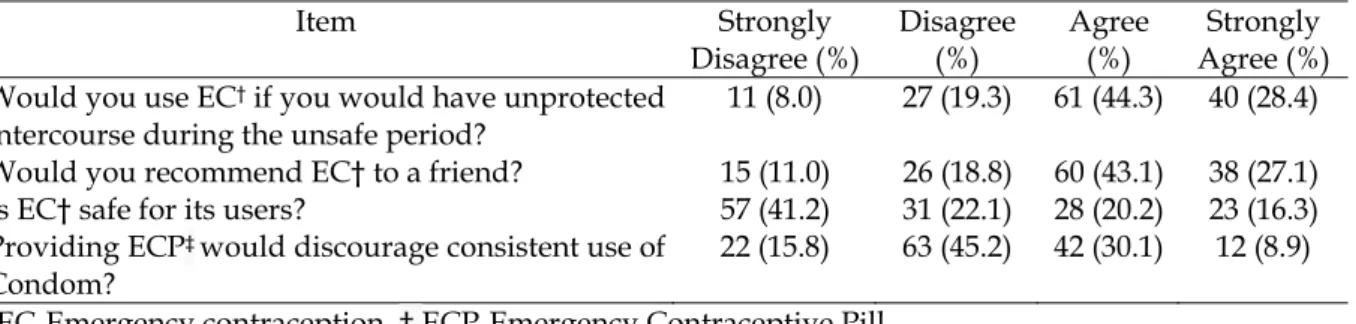
The students' attitudes were measured using four items rated on a four-point Likert scale as (1) strongly disagree, (2) disagree, (3) agree and (4) strongly agree. The four items were: (a) “Would you use EC if you would have unprotected intercourse during the unsafe period", (b) "Is EC safe for its users", (c) " Would you recommend EC to a friend" and (d) "Providing ECPs would discourage consistent use of condom". Using this four-point scale for 4 questions, we arbitrarily set the maximum score for each respondent at 16 and the minimum at 4. We decided that a high score was indicative of positive attitude while a low score would be indicative of a negative attitude.
Part three of the questionnaire required the students to state their prior experience with any type of EC and to mention the type used by them.
The data was entered and analyzed with Epi info software. For descriptive statistics results were expressed in terms of proportions or percentages and for analytical statistics odds ratios were used to examine the relation between variables.
RESULTS
Participation rate
155 girls were approached and accepted to participate in the study. 150 girls completed and returned the questionnaires, giving a total participation rate of 96.7%. Mean age of girls under study was 20.7(SD=1.16) years.
Table 1:-Distribution of Respondents according to Source of Information-
Source of Information Respondent (%)
Audio-Visual Media
(TV/Radio/Internet/Books)
91 (65.5)
Family and friends 34 (24.5)
Health Personnel (Doctors, Nurses and Pharmacists)
12 (8.6)
Other Sources 2 (1.4)
Knowledge of EC
139 (92.7%) reported that they had heard of Emergency Contraception. Only those 139 girls who had heard regarding EC were further analyzed for having knowledge, attitude and practices.
A majority of respondents in this study had knowledge from Audio-Visual Media. The sources were as shown in Table1.Only 37 (26.6%) knew that Cu-T is used as EC. 90 (78.5%) knew that oral contraceptives can be used as EC. Only 64 (46.0%) knew when is EC generally recommended. 59 (42.4%) knew that EC could be taken up to 72–120 hours after unprotected sex. 46(33.1%) girls think ECP interrupts ongoing pregnancy.12(8.6%) knew the side effects of EC. 9 (75%) girls considered Change in Menstrual cycle as the major side effect of EC.76 (54.6%) considered EC as a method of early abortion. 80(57.5%) knew that EC can be procured from retail outlets.
Table2:-Distribution of Respondents according to Knowledge of Emergency Contraception-
Knowledge Frequency (%)
Good 16 (3.6)
Average 38 (27.3)
Poor 85 (61.15)
Total 139 (100.0)
Table 2 table indicates overall knowledge of what constitutes EC was poor.
We tested whether the source of information was associated with the level of knowledge and found a strong association for each of the following categories: Family/Friends (P<0.001), AV Media (P<0.001), Health Personnel (P<0.001). In other words, a respondent receiving information from the Health Personnel (OR 21.49) and Audio-Visual Media (OR 10.2) were more likely to have good or average knowledge as compared to family and friends
(OR-6).Participants having source of
information from other sources were not
significant.( Fisher Exact-p value-0.7444) as
shown in Table 3.
attitude indicating a strong tendency of use of EC in the future by respondents
Table3:-Association of Source of Information according to Knowledge of Respondents-
Source of information Good/
Average (%)
Poor (%) Chi-Square p-Value Odds Ratio Confidence
Limit
Family/Friends 24(70.5) 10(29.5) 19.09 <0.001 6 2.563-14.05
Audio-Visual Media 19(20.8) 72(79.2) 35.82 <0.001 10.2 4.52-23
Health Assistants 11(91.67) 1 (8.33) 15.42 <0.001 21.49 2.685-172
Others 0 2(100) - 0.7444* - -
*Fisher Extract p-Value
Table 4:-Attitude of Respondents towards Emergency Contraception
Item Strongly Disagree (%)
Disagree (%)
Agree (%)
Strongly Agree (%)
Would you use EC† if you would have unprotected
intercourse during the unsafe period?
11 (8.0) 27 (19.3) 61 (44.3) 40 (28.4)
Would you recommend EC† to a friend? 15 (11.0) 26 (18.8) 60 (43.1) 38 (27.1)
Is EC† safe for its users? 57 (41.2) 31 (22.1) 28 (20.2) 23 (16.3)
Providing ECP‡ would discourage consistent use of
Condom?
22 (15.8) 63 (45.2) 42 (30.1) 12 (8.9)
†EC-Emergency contraception, ‡ ECP-Emergency Contraceptive Pill
A total of 8(5.7%) reported that they had previously used ECPs. All 8 girls had used I-Pill as EC. Table 5 shows that the knowledge of ECP users was significantly higher compared to non-users.
Table 5- Association of Knowledge of ECP users compared to non-users.
I-Pill (ECP) †
Average/Good Poor Total
Users 7 1 8
Non-Users
47 84 131
Total 54 85 139
† ECP-Emergency Contraceptive Pill
Yates corrected Chi –square= 6.424 OR-12.51(CL 1.49-104.8).p-Value- 0.01126
DISCUSSION
In India, where rates of unplanned pregnancies and illegal abortions are high, it is estimated that 78% pregnancies are unplanned and 25% are definitely unwanted, despite a 'National Family Welfare Programme' and widespread efforts by
the government. 4 The number of unsafe
abortions has also been increasing despite legalization of abortion in India through MTP Act in 1972. However, morbidity associated with
abortion is preventable to a great extent through use of suitable contraception. Introduction of EC through government supply in the new millennium has a potential to significantly change the scenario by empowering the young females in India.
The awareness of EC among girls in our study was 92.7%. This level of awareness was higher than the level found among university students
in Cameroon (63%) 9, Ghana (43.2%) 13 and
Kathmandu (66%) 14. On the other hand, it was
low compared to the university students, for
example, in the USA (94%).15 Only 12.9% knew
Cu-T can be used as EC which was lower than study from Haryana (14.9%)and
Ethiopia,(34.1%.)10 .70.5% mentioned pills can be
used as EC which was lower than Ethiopian
study (82.8%).10
Knowledge about the correct time for taking EC after unprotected sex was 42.4 %. This finding is
higher than 11.3% reported in Ghana 13and
Cameroon (5.7%) 9. More than half of the
respondents (54.6%) thought EC was a form of abortion which was similar with students from
Cameroon (51.2%) 9and higher than students of
Ghana (25.8%) 13.33.1% girls thought that the
ECP interrupts an ongoing pregnancy which was higher than the study carried out in
Only 16.6% girls mentioned nausea vomiting as most common side effect of ECP which was
much lower than girls from Chandigarh.857.5%
girls knew that ECP can be procured easily from retail outlets which was lower than study from
Sikkim (74%) 11. Only 4.3% girls knew that EC
generally recommended in Rape whereas (32.4%) girls from Haryana knew that EC could
be used in case of rape.4The most important
sources of information on EC for these students was from Audio-Visual Media. Similar findings
have been reported by other studies.10, 13
Unfortunately, Audio-Visual Media which was the largest source of information on EC for the students turned out to be unreliable. The source was associated with misinformation, while medical sources were associated with better knowledge.
Although our students generally held favourable opinions about EC, most of them believed that EC were unsafe for their users. Similar findings have been reported from the
studies carried out in Cameroon and Ghana9, 13.
36.5% girls thought providing ECPs would discourage the consistent use of condoms
compared to 53.4% of students in Ghana13. 39%
girls think that providing ECP would discourage consistent use of Condom
The students were unanimous that the principal objective of condom use was to prevent HIV and so the availability of ECPs could not discourage the use of condoms; if the users understand that ECPs do not prevent HIV infection.
5.7%reported that they had used ECPs before,
compared to 7.4% of students in Cameroon. 9
The knowledge of ECP users was significantly higher compared to non-users (p-Value- 0.01126).OR-12.51(CL 1.49-104.8).
Therefore, the knowledge and practice on emergency contraceptive is very low. There is a need to raise awareness about emergency contraceptives as an option with other contraception methods.
This article is first of its kind which look at emergency contraception among students of Engineering college.
One of the limitations of our study was that it was based on only young women pursuing higher studies. Hence our study may not be truly representative of young females of Nagpur. We cannot guarantee that students
provided honest answers to the questions, since the survey involved a sensitive matter (i.e. sex).
The strength of our study lies in the fact that it focused on young females rather than only on
adult married females.Many studies have been
done on married females but not on college students, who also are important candidates for awareness generation with respect to EC.
CONCLUSION:
We conclude that the knowledge about the general features of EC is poor and misinformation is high among these students; that although the students generally have positive attitudes regarding EC, most of them believe that EC are unsafe for their users; and that, despite widespread availability in Nagpur for several years, the method is still underused.
We strongly recommend that strategies to promote EC use be focused on spreading accurate information through information, education and communication in by health personnel and which have been found to be reliable and associated with good knowledge on
EC.
REFERENCES:
1. Nigam A, Maheshwari N, Prakash A. Knowledge of emergency contraception and contraceptive practices: Representative study from rural Uttar Pradesh. Indian J Community Med 2010;35:449-50
2. Rohit Sharma.More than a quarter of India's youngsters have premarital sex, BMJ 2001; 322:575.
3. Park K. Park’s textbook of Preventive and Social Medicine. 21st edition Jabalpur. Banarasidas Bhanot. 2011:463
4. Puri S, Bhatia V, Swami HM, Singh A, Sehgal A, Kaur AP. Awareness of emergency contraception among female college students in Chandigarh, India. Indian J Med Sci. 2007; 61:338–346.
5. Anjel Vahratian, PhD,1 Divya A. Patel, PhD,1 Kristen Wolff,2 and Xiao Xu. College Students’ Perceptions of Emergency Contraception Provision.J Womens Health (Larchmt). 2008; 17(1): 103–111.
6. Srivastava Reena, Srivastava Dhirendra Kumar, Jina Radha, Srivastava Kumkum,Sharma Neela, Saha Sushmita.Contraceptive knowledge attitude and practice (KAP) survey. J Obstet Gynecol India.Nov/Dec 2005; 55(6): 546-550.
8. Sonia Puri,Alka Sehgal Chetna Mangat Amarjeet Singh. Imparting Knowledge of Emergency Contraception To Female College Students: Is It Dangerous. The Internet Journal of Epidemiology.2008; 6(1):3.
9. Eugene J Kongnyuy,1 Pius Ngassa,2 Nelson Fomulu,2 Charles Shey Wiysonge,3 Luc Kouam,2 and Anderson S Doh2 A survey of knowledge, attitudes and practice of emergency contraception among university students in Cameroon. BMC Emergency Medicine.2007; 7:7. 10. Wegene Tamire1, Fikre Enqueselassie Knowledge,
attitude, and practice on emergencycontraceptives among female university students in Addis Ababa, Ethiopia Ethiop.J.Health Dev. 2007; 21;(2):111-116
11. Hafizur Rahaman,Prachi Renjhen,Ashwini Kumar,Sanjay Pallanshetty,Afrin Sagir,Himanshu Dubey, A study on emergency contraceptive practice among nursing staff in Sikkim, India-A cross sectional study. Australian Medical Journal AMJ 2010; 3, 10,667-671.
12. Corbett PO, Mitchell CP, Taylor JS, Kemppainen J, Emergency contraception: knowledge and perceptions in a university population. J Am Acad Nurse Pract. 2006 Apr; 18(4):161-168.
13. Baiden F, Awini E, Clerk C. Perception of university students in Ghana about emergency contraception. Contraception. 2002; 66:23–26. doi: 10.1016/S0010-7824(02)00315-3.
14. Ramesh Adhikari,Factors affecting awareness of emergency contraception among college students in Kathmandu, Nepal. BMC Women's Health2009, 9:27. 15. Vahratian A, Patel DA, Wolff K, Xu X: College
students' perceptions of emergency contraception provision. J Womens Health (Larchmt) 2008, 17(1):103-111.