Vol. 13, No. 3, October 2016, 335-345
Dynamics Based Modeling of Wheeled
Platform for Humanoid Robot Torso
Vladimir M. Petrović
1, Kosta Jovanović
1, Veljko Potkonjak
1Abstract: From the ancient mythology till the modern times, people were trying to build an artificial mechanical replica of themselves. Inspired by this long tradition of various engineering projects, we will hereby describe a partly humanoid robotic structure. Our robotic configuration is composed out of an anthropomimetic upper body, but instead of legs it uses a wheeled cart for the motion. In our research, this so-called semi-anthropomimetic structure has a four-wheeled cart. This work is aiming to analyze the behaviour of the robot that is exposed to different kind of external disturbances. Disturbances coming from the outside in the form of external forces (impulse and long term) simulate the interactions of the robot and its ambience. Necessary simulations were thoroughly executed (in that way analyzing robotic balance) and proper size of the cart is evaluated following the ZMP theoretical background.
Keywords: ZMP, Semi-Anthropomimetical structure, Antagonistically coupled drives, Biologically inspired robotics.
1 Introduction
Due to evolution of the robotics science in the last fifty years and more, different branches of this scientific field (such as rehabilitation robots, AGVs, industrial manipulators, etc.) have accomplished prodigious results. Still, if we thoroughly observe the historical perspective of robotic science, it is obvious that all of these different classes of robotics were the “side activities”. Main goal, which is result of the research in the entire robotics community, has always been development of the humanoids [1]. Standard humanoids (e.g. ASIMO) imitate the external form of the human body, but mechanisms of such robots are made out of non-compliant drives and rigid segments, that are standard property of industrial manipulators. This seriously limits the types of interactions in which those humanoids could participate. This is one of the reasons why these robots can not compare to humans, considering the performance in the real world.
Anthropomimetic concept tries to solve these problems by copying not just the outer form, but the internal mechanisms as well. The general idea of the
1School of Electrical Engineering, University of Belgrade, Bulevar kralja Aleksandra 73, 11020 Belgrade,
Serbia; E-mails: [email protected], [email protected], [email protected]
approach tells that if robots apply human-like mechanisms, then they can achieve performance capabilities comparable with them. This biologically inspired paradigm has been described recently [2 – 4].
Current researching in humanoids is focused mostly on human-specific movements (like walk or hopping, etc.), which brings attention to a bipedal design. Still, a semi-humanoid robot (an upper body placed on a cart), can also have a good accessibility to the most of human environments, in that way providing a good flexibility and mobility. Although such mobile humanoids do not copy human form, their advantage lies in the cases where rapid motion, and fast maneuvers are desirable.
In our research, semi-anthropomimetic robot (ECCEROBOT placed on a mobile platform) is used. We used numerous simulations, in order to emulate two types of disturbances. First task was to include impulse and long term force, which represent outside disturbances. In the next step, motion is included. In other words, forces were acting on the robot during the motion. Acceleration, both lateral and longitudinal, is taken into account. Circular motion, oscillations of the pitch, roll, and yaw angles, as well as oscillations in longitudinal and lateral direction, are also analyzed. All of the previously mentioned is serving to emulate some everyday situations and tasks imposed to the robot. In order to prevent overturn of the robot and to explore possible motion limitations, we need to properly estimate dimensions of the wheeled platform.
Reviewing of the papers/projects related to our work is given in Section II. Third section shows configuration of our robot, its dynamical properties and short overview of the control strategy. Analysis of the design of a mobile platform of the robot (through appropriate simulations) is described in Section IV.
2 Background
Studies
A huge number of mobile humanoids was developed, but unlike the bipedal gait [5] researches focused on the dynamical stability of wheeled humanoids, especially considering a possible disturbances, are not so well-explored. Considering this, as well as the fact that anthropomimetic principle is a rather new concept, justifies our research.
A method for dealing with dynamics stability for a mobile manipulator is presented in [10]. Control strategy is carefully chosen in order to prevent the system to tip-over. ZMP (Zero Moment Point) is used to define dynamic stability. Another ZMP concept, called “stable region”, and its implementation are fully described in [11, 12]. Extension of the research [11] is presented in [13], where potential method is proposed for stability control. Concepts of the prohibitive and goal state of stability are outlined. Paper [14] is oriented on issues, considering the waist area of a mobile humanoid. Tip-over analysis for a robot that moves on a slope is analyzed in [15]. “Contact forces criterion” is used for stability analysis. Paper [16] describes a stability control of motion, when mobile manipulator is exposed to external forces. Mobile manipulator trajectory planning, with analysis of stability is described in [17]. ZMP theory is used as an index of the stability of the proposed 2-link planar nonholonomic system.
3
Properties and Control Strategy
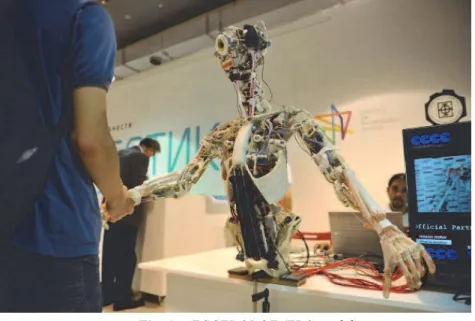
ECCEROBOT (Embodied Cognition in a Compliantly Engineered Robot) was the project funded by European Commission Program. Aim was to build a robot by replicating human skeleton and muscle mechanisms (Fig. 1).
Fig. 1 –ECCEROBOT (EDS model).
muscles, which are antagonistically coupled, are actuating joints similarly to the human muscles (unlike standard humanoids). These muscles represent combination of: threads, elastic tendons, and DC actuators. Overall conclusion is that human muscles and tendons are faithfully replicated in this way.
Standard humanoids use leg motion. In our research, mobile platform is used instead of legs. This semi-anthropomimetic robotic construction is suitable for majority of the house related activities. Robot dimensions are chosen in accordance with the human-friendly design.
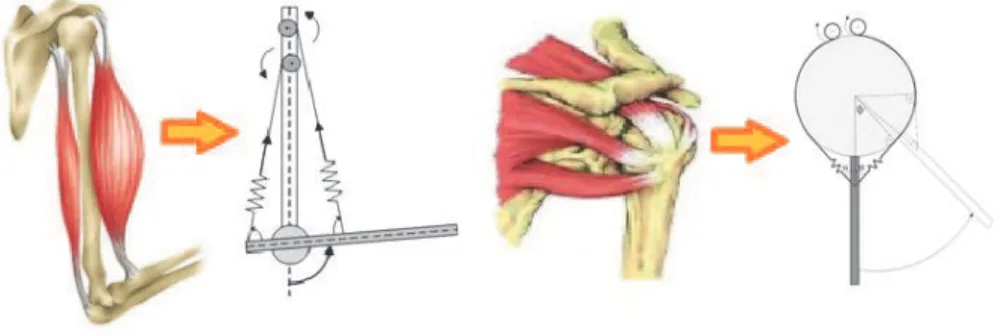
Mechanical structure of the ECCEROBOT has a large degree of complexity. Human-like nature of the robot is complicated for mathematical description. ECCEROBOT model [18] has 20 DOFs (degrees of fredom). Joints are coupled between themselves, and they are forming 3 kinematical chains. Actuation is performed by a couple of DC motors that work antagonistically. Joints are modeled in two manners shown at Fig. 2. Triangular manner is used for modeling of the human elbow. Circular manner is used to model majority of other joints (shoulder, neck, wrist rotation, waist).
Fig. 2 –Left side of the figure shows triangular joint model, while circular joint model is shown on the right side.
Papers [18 − 20] fully describe dynamical model of the
semi-anthropo-mimetic configuration with antagonistic actuators. Thus, we will not go into the details further in the text, but simplified version will be presented via equations (I) and (II).
( , ) ( , ) ( , , , , a, a, b, b) T( )
Q q
H Q q Qɺɺ+H Q q qɺɺ+h Q Q q qɶ ɺ ɺ θ θɺ θ θɺ =J Q R, (1)
( , , , , , )
a
a a b b b
Hθ +h Q Q θ θ θ θ =Cu θ
ɺɺ
ɺ ɺ ɺ
ɺɺ . (2)
In (1) and (2): QJx1 stands for position of J joints, a Jx
Q
1 andQ
bJx1 arecoordinates of the platform,
R
6x1 stands for external force/torque, and = b Jx a Jx Jx u u u 1 2 1 2 12 represents input control voltages for 2J antagonistic motors. One
should take notice, that dynamic model of the cart is not included in the presented mathematical model, assuming that it can be decoupled thus making its solution separate.
At this point, brief description of the control system will be presented. Control strategy is relied on the puller-follower approach [20, 21]. It is bio-inspired, and has originated from the antagonistically coupled human muscles. Main intention is to separate the actuation roles - the agonist initiates action, while antagonist resists to it. Achieving of the wanted joint position through control of the antagonistically coupled drives represents a challenge. In order to solve this problem, coordination must be provided and actuators must be simultaneously driven. This actually means that the puller motor is responsible for controlling the position of the joint. While the follower motor deals with the additional task – it maintains desired tension (in the tendon) which is imposed by preventing of loosening of the antagonist tendon. When it is motion required, exchanging of the roles is performed. Multi joint system solution of the mentioned problem is presented in [22].
4
Designing the Cart
Moving and interacting in a human-centered environment requires large degree of reliability. Although compliant structure makes ECCEROBOT rather convenient regarding safety, controlling of such robotic structure can be problematic. In this part of the paper we will analyze the stability of the semi-anthropomimetic robot exposed to external influences. These influences come as a result of the robot’s interaction in an environment. In our research, the careful observation of the ZMP [23, 24] is performed in the different assignments requested from the robot. Consequently, conclusions about the size of the wheeled platform are made. As it was mentioned before (Section 2), the waist of the robot is the most critical from the control theory view [14], because of the platform movements. One should notice that research [25] showed ineligibility of the effects of the robot’s behaviour to the platform, thus allowing independent synthesis of the control of the platform.
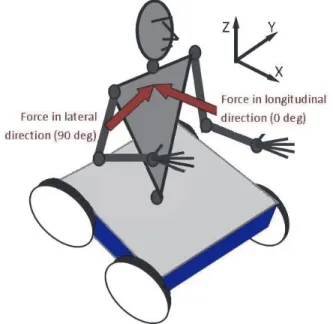
Following the previously analyzed issues presented in [14], our forces will be applied to the torso area. Paper [26] nicely describes examples coming from every day tasks with included external forces. Appearance of unexpected external forces can occur during the motion through an unstructured terrain, etc.
Fig. 3 –Direction of the external forces.
Next task was to generalize simulations – besides external influences, mobile platform motion is provided. This combination of external forces and platform motion is exploring robot’s capability to obtain balance during the imposed assignments. We included typical simple motions, as well as their combination. Lateral and longitudinal motion while accelerating/decelerating, oscillations during the motion in these directions, oscillations and changes of angles, circular motion – all of these were included in simulations.
Ensuring of efficient motion requires a certain bargain. Platform must be smallest possible in order to have high maneuver capabilities, but also it must be sufficiently large to cover ZMP stabile area. Thorough simulations are performed to successfully achieve these requirements.
Table 1 present Zero Moment Point data in cases when: long term and impulse force act on the robot, while there is no motion. The biggest disturbance for the xzmpis in the case when impulse force of 2800 N (duration
t = 0.012 s) hits the robotic structure from the direction of 157.5o
Table 1
ZMP Point (Disturbances following from the described forces – long term, and impulse).
xzmp [cm] yzmp [cm] Direction
[degrees] Fmax [N]
min max min max
Disturbances following from the long term force
0 150 –16.9 2.8 –2 1.5
22.5 160 –12.7 2.9 –1.5 1.4
45 180 –2.5 2.7 –4.1 8.2
67.5 140 2.2 2.8 –5 9.8
90 140 2.7 2.8 –1.9 5.8
112.5 130 2.6 3.3 –1.8 5.9
135 220 2.4 19.1 –3.4 10.8
157.5 140 2.8 22.5 –1.4 0.7
180 130 2.9 23.3 –0.9 1.1
Disturbances following from the impulse force
0 2700 –15.4 2.7 –1.6 0.6
22.5 3100 –21.3 2.8 –0.3 2.9
45 2500 –2.9 2.7 –15.9 6.6
67.5 1600 1.8 2.7 –5.5 4.6
90 1600 2.1 2.8 –6.7 9
112.5 1800 1.8 4.1 –7.3 8.1
135 2500 1.8 9.3 –8.1 9.7
157.5 2800 2.7 24.4 –0.3 2.5
180 2500 2.7 22.3 –1.2 1.1
Table 2 presents the case that is mixture of external and internal disturbances – an impulse force applied to the robot moving longitudinally. It is usual case in everyday life. Duration of the forces is t = 0.012 s. Other cases will be a subject of different publications.
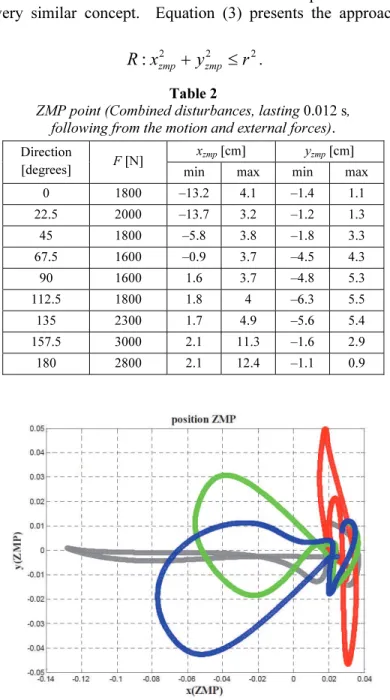
Fig. 4 shows the position of the ZMP when impulse force is applied to the robot moving longitudinally, for several force directions.
inscribed in the square). Introducing of this region prevents cases in which ZMP point is in the corners of the square. These are undesirable situations because stable region becomes narrow in the corners, and therefore stability can be easily threatened due to influences that can not be predicted. Paper [15] proposes very similar concept. Equation (3) presents the approach that we described:
2 2 2
:x y r
R zmp+ zmp≤ . (3)
Table 2
ZMP point (Combined disturbances, lasting 0.012 s, following from the motion and external forces).
xzmp [cm] yzmp [cm] Direction
[degrees] F [N] min max min max
0 1800 –13.2 4.1 –1.4 1.1
22.5 2000 –13.7 3.2 –1.2 1.3
45 1800 –5.8 3.8 –1.8 3.3
67.5 1600 –0.9 3.7 –4.5 4.3
90 1600 1.6 3.7 –4.8 5.3
112.5 1800 1.8 4 –6.3 5.5
135 2300 1.7 4.9 –5.6 5.4
157.5 3000 2.1 11.3 –1.6 2.9
180 2800 2.1 12.4 –1.1 0.9
Here,
x
zmp,y
zmp stand for xandy
coordinates of the ZMP. Stable region is R,and its radius is r. Overturn of the robotic system begins if the ZMP gets outside of the safe region. In order to calculate minimal value of radius (rmin), maximal
absolute values of the x and y coordinates of the ZMP are used, considering all
tested cases: 2 max
2 max 2
min
−
− +
=xzmp yzmp
r . Absolute values are considered, because
we must cover all the possible combinations, and not just separate simulations. Analysis of the results shows that the most interesting situation (considering our approach) appears in the case where impulse force is acting. By analyzing the gained results we found that the maximal absolute values of the ZMP coordinates are 24.4 cm for the xzmp, and 15.9 cm for the
zmp
y .
Bearing in mind the equation (III), it can be concluded that the minimal radius value for the safe region is rmin ≈29.12 cm. Therefore ECCEROBOT’s
platform should be made in the way that the circle with radius r≈29.12 cm can
be inscribed in the square. This ensures robot’s stability in everyday tasks. For the square design, side of a=2r≈58.2 cm is needed in order to provide
reliable motion.
5 Conclusion
This paper aimed to establish the cart dimensions of the semi-anthropomimetic robot, bearing in mind that we must keep the balance against tipping-over. Presented robotic structure is sensitive to disturbances due to its compliance. Our experimental simulations showed how robot stability can be obtained for several types of disturbances. Analysis of the robot balance enables us to properly design the mobile platform. The obtained results are satisfying, which brings an encouragement to the idea that our robot can manage everyday tasks in a human-oriented environment (e.g., home).
6 Acknowledgment
This work was partly funded by the Ministry of Education, Science and Technological Development, Republic of Serbia (contracts TR-35003, and III-44008).
7 References
[1] T. Fukuda, R. Michelini, V. Potkonjak, S. Tzafestas, K. Valavanis, M. Vukobratovic: How Far Away is "Artificial Man", IEEE Robotics and Automation Magazine, Vol. 8, No.1, March 2001, pp. 66 – 73.
[3] S. Wittmeier, C. Alessandro, N. Bascarevic, K. Dalamagkidis, D. Devereux, A. Diamond, M. Jantsch, K. Jovanovic, R. Knight, H.G. Marques, P. Milosavljevic, B. Mitra, B. Svetozarevic, V. Potkonjak, R. Pfeifer, A. Knoll, O. Holland: Toward Anthropomimetic Robotics: Development, Simulation, and Control of a Musculoskeletal Torso, Artificial Life, Vol. 19, No. 1, 2013, pp. 171 – 193.
[4] I. Mizuuchi, Y. Nakanishi, Y. Sodeyama, Y. Namiki, T. Nishino, N. Muramatsu, J. Urata, K. Hongo, T. Yoshikai, M. Inaba: An Advanced Musculoskeletal Humanoid Kojiro, 7th IEEE–RAS International Conference on Humanoid Robots, Pittsburgh, PA, USA, 29 Nov-01 Dec. 2007, pp. 294 – 299.
[5] M. Vukobratovic, B. Borovac, A. Rodic, D. Katic, V. Potkonjak: A Bio–Inspired Approach to the Realization of Sustained Humanoid Motion, International Journal of Advanced Robotic Systems, Vol. 9, Nov. 2012, p. 201.
[6] J. Park, O. Khatib: Contact Consistent Control Framework for Humanoid Robots, IEEE International Conference on Robotics and Automation, Orlando, FL, USA, 15-19 May 2006, pp. 1963 – 1969.
[7] V. Potkonjak, S. Tzafestas, M. Vukobratovic, M. Milojevic, M. Jovanovic: Human–and– Humanoid Postures Under External Disturbances: Modeling, Simulation, and Robustness. PART 1: Modeling, Journal of Intelligent and Robotic Systems, Vol. 63, No. 2, Aug. 2011, pp. 191 – 210.
[8] M. Vukobratovic, M. Milojevic, S. Tzafestas, M. Jovanovic, V. Potkonjak: Human–and– Humanoid Postures Under External Disturbances: Modeling, Simulation, and Robustness. PART 2: Simulation, and Robustness, Journal of Intelligent and Robotic Systems, Vol. 63, No. 2, Aug. 2011, pp. 211 – 231.
[9] L. Sentis, J. Park, O. Khatib: Compliant Control of Multicontact and Center–of-Mass Behaviors in Humanoid Robots, IEEE Transactions on Robotics, Vol. 26, No. 3, June 2010, pp. 483 – 501.
[10] J. Kim, W.K. Chung, Y. Youm, B.H. Lee: Real–time ZMP Compensation Method using Null Motion for Mobile Manipulators, IEEE International Conference on Robotics and Automation, Washington, DC, USA, 11-15 May 2002, Vol. 2, pp. 1967 – 1972.
[11] S. Sugano, Q. Huang, I. Kato: Stability Criteria in Controlling Mobile Robotic Systems, IEEE/RSJ International Conference on Intelligent Robots and Systems, Yokohama, Japan, 26-30 July 1993, Vol. 2, pp. 832 – 838.
[12] Y. Li, D. Tan, Z. Wu, H. Zhong: Dynamic Stability Analyses based on ZMP of a Wheel-based Humanoid Robot, IEEE International Conference on Robotics and Biomimetics, Kunming, China, 17-20 Dec. 2006, pp. 1565 – 1570.
[13] Q. Huang, S. Sugano, I. Kato: Stability Control for a Mobile Manipulator using a Potential Method, IEEE/RSJ International Conference on Intelligent Robots and Systems, Munich, Germany, 12-16 Sept. 1994, pp. 839 – 846.
[14] Y. Li, Z. Wu, H. Zhong: Control and Simulation on the Waist Mechanism of a Humanoid Robot based on Dynamic Model, Chinese Control and Decision Conference, Yantai, China, 02-04 July 2008, pp. 1285 – 1289.
[15] J. Wang, Y. Li: Kinematics and Tip–over Stability Analysis for a Mobile Humanoid Robot Moving on a Slope, IEEE International Conference on Automation and Logistics, Qingdao, China, 01-03 Sept. 2008, pp. 2426 – 2431.
[17] S. Furuno, M. Yamamoto, A. Mohri: Trajectory Planning of Mobile Manipulator with Stability Considerations, IEEE International Conference on Robotics and Automation, Taipei, Taiwan, 14-19 Sept. 2003, Vol. 3, pp. 3403 – 3408.
[18] V. Potkonjak, B. Svetozarevic, K. Jovanovic, O. Holland: Biologically-inspired Control of a Compliant Anthropomimetic Robot, 15th IASTED International Conference on Robotics and Applications, Cambridge, MA, USA, 01-03 Nov. 2010, pp. 182 – 189.
[19] V. Potkonjak, K. Jovanovic, B. Svetozarevic, O. Holland, D. Mikicic: Modelling and Control of a Compliantly Engineered Anthropomimetic Robot in Contact Tasks, 35th Mechanisms and Robotics Conference, Washington, DC, USA, 28-31 Aug. 2011, pp. 23 – 32.
[20] B. Svetozarevic, K. Jovanovic: Control of Compliant Anthropomimetic Robot Joint, Serbian Journal of Electrical Engineering, Vol. 8, No. 1, Feb. 2011, pp. 85 – 95.
[21] V. Potkonjak, B. Svetozarevic, K. Jovanovic, O. Holland: The Puller-Follower Control of Compliant and Noncompliant Antagonistic Tendon Drives in Robotic Systems, International Journal of Advanced Robotic Systems, Vol. 8, No. 5, 2011, pp. 143 – 155.
[22] V. Potkonjak, K. Jovanovic, P. Milosavljevic, N. Bascarevic, O. Holland: The Puller-Follower Control Concept for The Multi–Joint Robot with Antagonistically Coupled Compliant Drives, IASTED International Conference on Robotics, Pittsburgh, PA, USA, 07-09 Nov. 2011, pp. 375 – 381.
[23] M. Vukobratovic, D. Juricic: Contribution to the Synthesis of Biped Gait, IEEE Transactions on Biomedical Engineering, Vol. 16, No. 1, Jan. 1969, pp. 1 – 6.
[24] M. Vukobratovic, B. Borovac, V. Potkonjak: ZMP: A Review of Some Basic Misunderstandings, International Journal of Humanoid Robotics, Vol. 3, No. 2, June 2006, pp. 153 – 175.
[25] N. Bascarevic, K. Jovanovic, P. Milosavljevic, V. Potkonjak, O. Holland: Tip-over Stability Examination of a Compliant Anthropomimetic Mobile Robot, IEEE Multi-conference on Systems and Control, Dubrovnik, Croatia, 03-05 Oct. 2012, pp. 1584 – 1589.