O R I G I N A L A R T I C L E UDC: 355/359:61]::616.248-07 DOI: 10.2298/VSP150612162K
The importance of impulse oscillometry in bronchial provocation
testing in confirming the diagnosis of asthma in male army recruits
Zna
č
aj impulsne oscilometrije kod bronhoprovokativnog testiranja za potvrdu
dijagnoze astme kod muških vojnih regruta
Dragan Koruga*, Kristina Tot Vereš*, Goran Plavec†‡, Olivera Lončarevi憇
*Department of Lung Disease, Military Medical Center of Petrovaradin, Novi Sad, Serbia; †Clinic of Lung Disease, Military Medical Academy, Belgrade, Serbia; Faculty of
Medicine of the Military Medical Academy, University of Defence, Belgrade, Serbia
Abstract
Background/Aim. Impulse oscillometry (IOS) is a technique valid for measuring the lung function in obstructive lung disea-ses and bronchial provocation tests. However, no consensus exists for its use. The aim of the study was to assess impulse oscillometry sensitivity for detection of early airways changes during bronchial provocation testing and to compare with changes obtained with spirometry and bodyplethysmography in male army recruits. Methods. Male military recruits were sub-mitted to bronchial provocation test with histamine by the ae-rosol provocation system. Out of 52 male military recruits sub-jected to attempts to make the diagnosis of asthma the study included 31 subjects with fall of forced expiratory volume in one second (FEV1) above 20%. The changes of impulse oscillometry were measured one step before and after provoca-tion dose (PD) of histamine and compared with the changes of bodyplethysmography and spirometry. Results. The average age of male army recruits was 23.3 year. After bronchoprovo-cation there was an average increase of the total resistance at 5 Hz (R5) by 66.6%, resonant frequency (Fres) by 102.2%, Gol-dman index (AX) by 912.1%, the arway resistance (Raw) by 121.5%, and a decrease in reactance at 5 Hz (X5) by 132.1% and FEV1 by 25.6%. One step before the last inhaled of PD20 there was an average increase of 26.7% in R5, 24.1% in Fres, 85.3% in AX, 11.9% in Raw and a decrease in X5 by 26.9% and FEV1 by 4.3%. A correlation between impulse oscillometry and bodyplethysmography parameters was
obtai-ned. Conclusion. This paper demonstrates a sufficient
sensitivity of impulse oscillometry to detect changes in airways, so it may play a complementary role in the diagnosis of asthma in male military recruits.
Key words:
asthma; diagnosis; bronchial provocation tests; histamine; respiratory function tests; sensitivity and specificity; military personnel; men; personnel selection.
Apstrakt
Uvod/Cilj. Impulsna oscilometrija (IOS) je važeća tehnika za merenje respiratorne impedancije kod opstruktivnih bolesti i bronhoprovokativnih testova, ali ne postoji konsenzus za njeno korišćenje. Cilj studije bio je da se proceni osetljivost impulsne oscilometrije u detekciji ranih promena u disajnim putevima za vreme bronhoprovokativnog testiranja i da se uporedi sa promenama spirometrije i pletizmografije kod muških vojnih regurta. Metode. Muškim vojnim regurtima je urađen bronhoprovokativni test sa histmainom preko aero-solnog provokacionog sistema. Od 52 muška vojna regruta kod kojih je pokušano potvrđivanje dijagnoze astme u studiju je bio uključen 31 ispitanik sa padom forced expiratory volume in one second (FEV1) iznad 20%. Merene su promene impulsne oscilometrije pre i posle pada FEV1 za 20% nakon provo-kacione doze (PD) histamina i upoređivane sa promenama spirometrije i telesne pletizmografije. Rezultati. Prosečna sta-rost muških vojnih regruta bila je 23,3 godine. Posle bronho-provokacije prosečno je povećan realni otpor (resistanca) na 5 herca (R5) za 66,6%, rezonantna frekvenca (Fres) za 102,2%, Goldman-ov indeks (AX) za 912,1%, endobronhijalna rezis-tanca (Raw) za 121,5% i smanjena reaktansa na 5 Hz (X5) za 132,1% i FEV1 za 25,6%. Korak pre inhalirane PD20 doveo je prosečno do povećanja R5 za 26,7%, Fres za 24,1%, AX za 85,3%, Raw za 11,9% i X5 za 26,9% i FEV1 od 4,3. Visok stepen korelacije dobijen je između telesne pletizmografije i IOS. Zaključak. U radu je dokazana dovoljna osetljivost impulsne osecilometrije za detekciju ranih promena u disajnim putevima, te ona može igrati komplementarnu ulogu u dijagnozi astme kod muških vojnih regruta.
Ključne reči:
astma; dijagnoza; inhalacioni testovi; histamin; respiratorna funkcija, testovi; senzitivnost i
Introduction
Asthma is a chronic inflammation, associated with airway hyperresponsiveness that leads to recurrent episodes of wheezing, shortness of breath, chest tightness and coug-hing particularly at night or early in the morning 1. It is cha-racterized by reversible airflow obstruction, inflammation and hyperactivity of the airways 2.
Bronchial hyperresponsiveness (BHR) or increased sensitivity of the airways can be defined as a greater tendency to narrowing of the airways in response to inhala-tion of chemicals (metilcholin, histamine, carbachol) and physical agents (cold air, hyper- and hypo-osmolarity solu-tions), allergens, or exertional 3. It is caused by genetic or environmental factors. Bronchial hyperresponsiveness pre-sents the physiological trademark of asthma, and it does not involve setting diagnosis of asthma. The presence and de-gree of BHR is measured by standardized bronchial provo-cation tests (BPT). They are performed by inhalation of substances that cause narrowing of the airways and increa-sed work of breathing. Asthma patients respond to non-specific agents quickly and more strongly, up to 100 times higher than healthy ones. Bronchial provocation testing is usually performed with histamine as provocative substan-ces 4, 5.
The diagnosis of asthma is a set of characteristic symptoms, skin allergy tests to inhalation allergens, total and specific immunoglobulin E (IgE), sputum eosinophilia, and demonstrate BHR with spirometry, bodyplethysmography and impulse oscillometry as a new method of measuring pulmonary function 6.
The impulse oscillometry system (IOS) is used for de-termining the mechanical properties of the lungs and respiratory system through the relationship of pressure (P) and flow (V) measurement of respiratory impedance (Z) over the input pulses. Z representing the interaction between the impulse of pressure, resistance and the reactivity of the respiratory system, which includes the re-sistance (R) and reactance (X). Rere-sistance is the result of a mechanical breathing and airway resistance. Reactance rep-resents a reactive resistance which is contained in that part of the lung where it is not possible to measure the real resi-stance, and it is on the periphery. Reactance contains two components: capacitance (C) and inertance (I). Respiratory impedance is measured by impulse oscillometry 7. Impulse oscillometry testing does not depend on cooperation of pa-tients, because it is perfect in pulmonology 8, pediatrics 9, geriatrics 10, occupational medicine 11, anesthesiology 12, otorinolaryngolgy 13, sports medicine 14, and experimental medicine 15. Impulse oscillometry has demonstrated high sensitivity in the assessment of BHR at BPT in the early di-agnosis of asthma 16–19.
The aim of the research was to determine the sensitivity of impulse oscillometry in the early detection of bronchial hyperreactivity during BPT and compare the parameters of IOS with the results of spirometry and bodyplethysmography in male army recruits.
Methods
Out of 52 male military recruits, subjected to establis-hing the diagnosis of asthma, the study included 31 subjects, aged 23.3 years in average.
Bronchial provocation test with histamine was analyzed by measuring impulse oscillometry, spirometry, and bodyplethysmography. The changes of impulse oscillometry before and after the fall in forced expiratory volume in one second (FEV1) by 20% after provocation dose (PD20), and comparisons were performed with changes in spirometry (FEV1) and bodyplethysmography endobronchial resistance (Raw), specific resistance (Sraw), and specific conductance (SGaw) 20.
Criteria for inclusion of subjects in the study were: male military recruits aged from 17 to 27 years; asthma according to medical records; indications on guidelines for BPT. Crite-ria for exclusion from the study were the absolute and relati-ve contraindications to the guidelines 21.
Medical history, physical examination and measure-ment of lung function were performed in all the subjects. Bronchial provocation test was evaluated with impulse oscillometry, spirometry and bodyplethysmography. The ba-sic measurements with three tests were performed before the start of BPT. Bronchial provocation testing started so that the subjects inhaled l mL of physiological saline (0.9% NaCl), and after 2 min continued with measurements of lung functi-on then the results were compared with the results of the ba-sic measurement, and then the test using the same model of histamine inhalation in the dose of 0.03; 0,06; 0.12; 0.25; 0.5; 1.0; 2.0; 4.0; 8.0, and 16 mg/mL) 21, 22. Histamine was inhaled in the form of solution of 32 mg/mL and 4 mg/mL (the Institute of Virology and Immunology, Torlak, Beograd)
via the aerosol provocation system (APS) 23, which
automatically designates the given dose.
Survey instruments for measuring lung function were pulsed oscillometer, Series Master Screen IOS (Care Fusion, Jaeger, Würtzburg, Germany) for the measurement of respiratory impedance, spirometer for measuring static and dynamic airway volume, and bodyplethysmography to de-termine the airway resistances and intrathoracic gas volumes were examined with Master Screen Body (Care Fusion, Jae-ger, Würtzburg, Germany). Measurements of impulse oscillometry were performed as recommended by the cons-tructor (Smith HJ), spirometry and bodyplethysmography according to the standards of the American Thoracic Society (ATS) and the European Respiratory Society (ERS) were performed 24–26.
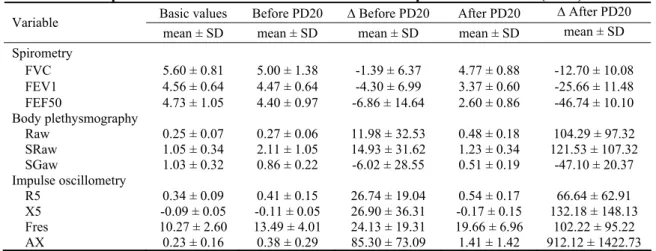
Table 1 Descriptive statistics before and after histamine bronchoprovocation dose 20 (PD20)
Basic values Before PD20 ∆ Before PD20 After PD20 ∆ After PD20 Variable
mean ± SD mean ± SD mean ± SD mean ± SD mean ± SD Spirometry
FVC 5.60 ± 0.81 5.00 ± 1.38 -1.39 ± 6.37 4.77 ± 0.88 -12.70 ± 10.08 FEV1 4.56 ± 0.64 4.47 ± 0.64 -4.30 ± 6.99 3.37 ± 0.60 -25.66 ± 11.48 FEF50 4.73 ± 1.05 4.40 ± 0.97 -6.86 ± 14.64 2.60 ± 0.86 -46.74 ± 10.10 Body plethysmography
Raw 0.25 ± 0.07 0.27 ± 0.06 11.98 ± 32.53 0.48 ± 0.18 104.29 ± 97.32 SRaw 1.05 ± 0.34 2.11 ± 1.05 14.93 ± 31.62 1.23 ± 0.34 121.53 ± 107.32 SGaw 1.03 ± 0.32 0.86 ± 0.22 -6.02 ± 28.55 0.51 ± 0.19 -47.10 ± 20.37 Impulse oscillometry
R5 0.34 ± 0.09 0.41 ± 0.15 26.74 ± 19.04 0.54 ± 0.17 66.64 ± 62.91 X5 -0.09 ± 0.05 -0.11 ± 0.05 26.90 ± 36.31 -0.17 ± 0.15 132.18 ± 148.13 Fres 10.27 ± 2.60 13.49 ± 4.01 24.13 ± 19.31 19.66 ± 6.96 102.22 ± 95.22 AX 0.23 ± 0.16 0.38 ± 0.29 85.30 ± 73.09 1.41 ± 1.42 912.12 ± 1422.73 FVC – forced vital capacity; FEV1 – forced expiratory volume in one second; FEF50 – forced expiratory flow 50%; Raw – endobronchial resistance; SRaw – specific resistance; SGaw – specific conductance; R5 – total resistance at 5 Hz; X5 – reactance at 5 Hz; Fres – resonant frequency; AX – Goldman index.
Table 2 Frequency of changes of impulse oscillometry (IOS) parameters before and after histamine bronchoprovocation
dose 20 (PD20) for resistance at 5 Hz (R5), resonant frequency (Fres) and Goldman index (AX) ∆R5 before ∆R5 after ∆Fres before ∆Fres after ∆AX before ∆AX after Intervals
(%) PD20 (%) PD20 (%) PD20 (%) PD20 (%) Intervals (%) PD20 (%) PD20 (%)
< 20 60.0 16.0 64.0 8.0 < 100 72.0 4.0
21–30 20.0 24.0 16.0 4.0 101–150 20.0 16.0
31–40 12.0 16.0 16.0 12.0 151–200 4.0 20.0
> 40 8.0 44.0 4.0 76.0 > 200 4.0 60.0
∆R5 – interval of total resistance; ∆Fres – interval of resonant frequency; ∆AX – interval of Goldman index.
their changes (%) of spirometry (FVC, FEV1, FEF50) and bodyplethysmography (Raw, SRaw, SGaw) and impulse oscillometry (R5, X5, Fers) are shown.
To calculate relative values of the parameters of impulse oscillometry (R5, X5), reference values of constructor appli-ances (Vogel H and Smith HJ) were used, while for spirometry (FVC, FEV 1, FEF 50) and body plethysmography (Raw, SRaw, SGaw), predicted value of the European Respiratory Society was used. Parameters Raw, SRaw and Fres are presen-ted in absolute values. Reactance at 5 Hz was calculapresen-ted as the difference between the active and planned values, the original formula produced in the software, in the literature referred to as delta X5 27.
After collecting and controlling data, the standard statis-tical methods were used: absolute number, percentage, arith-metic mean, standard deviation. The frequency changes of R5, Fres and AX are shown. The degree of correlation was deter-mined by the coefficient of linear correlation. Statistical analysis was performed on a personal computer by means of statistical software package “Statistica”.
Results
Data analysis was performed in 31 male military recru-its, the average age of 23.2 ± 5.3. A total of 56% were smo-kers and 44% non-smosmo-kers.
Spirometry was performed in all the patients. The mean
basic values of FVC were 5.6 L, for FEV1, and 4.56 L, for FEF50 4.73 L. The average values of changes of FEV1 for 4.3% and FEF50 for 6.8% was decreased before PD20. The mean values of changes of FEV1 to 25.6% and 46.7% for FEF50 were obtained after PD20 (Table 1).
Body plethysmography was also done in all the sub-jects. The average values of Raw before BPT were 0.25 kPa-L. The mean values of changes of Raw for 11.4% and 14.9% for SRaw were increased and SGaw for 6.0% was decreased before PD20. In the control group the mean values of chan-ges of Raw for 104.2%, SRaw for 121.5% was increased and SGaw for 47.1% was decreased.
Impulse oscillometry basic values of R5 0.34 kPa/L/s, X5 -0.09 kP/L/s, Fres 10.2 L /s and AX 0.23 were shown. The average values of changes of R5 for 26.7%, X5 for 26.9%, Fres for 24.1% and AX for 85.3% were increased be-fore PD20. The average values of changes of R5 for 66.4%, X5 for 132.1%, Fres for 102.2% and AX for 912.1% were increased after PD20.
The values of the main parameters of impulse oscillometry R5 and Fres were followed by frequency chan-ges before and after PD20 over four class intervals (less than 20%, 21–30%, 31–40% and over 40%), and also AX para-meter (below 100 %, of 101–150%, 151–200%, more than 200%) (Table 2).
Table 3 Pearson's correlation coefficient between changes before histamine bronchoprovocation dose 20 (PD20)
[impulse oscillometry (PD20-IOS) vs. spirometry, plethysmography]
Variable ΔR5 (%) PD20 ΔX5 (%) PD20 ΔFres (%) PD20 ΔAX (%) PD20
∆FVC (%) PD20 0.15 -0.17 0.00 -0.07
∆FEV1 (%) PD20 -0.05 -0.32 -0.09 -0.28
∆FEF50 (%) PD20 -0.10 -0.25 -0.20 -0.30
∆Rtot (%) PD20 0.34 0.13 0.28 0.35
∆SRtot (%) PD20 0.34 0.29 0.36 0.44*
∆SGtot (%) PD20 -0.42* -0.22 -0.33 -0.43*
Correlations before PD20-histmine. Marked (*) correlations are significant at p < 0.05; N = 31 (Casewise deletion of missing data).
∆R5 – interval of total resistance; ΔX5 – interval of reactance; ∆Fres – interval of resonant frequency; ∆FVC – interval of forced expiratory volume; ∆FEV1 – interval of forced expiratory flow 1; ∆FEF50 – interval of forced expiratory flow 50; ∆Rtot – interval of total specific resistance; ∆SRtot – in-terval of total specific resistance; ∆SGtot – interval of total specific conductance.
Table 4 Pearson's correlation coefficient between changes after histamine bronchoprovocation dose
20 (PD20) [impulse oscillometry (PD20-IOS) vs. spirometry, plethysmography] Variable ΔR5 (%) PD20 ΔX5 (%) PD20 ΔFres (%) PD20 ΔAX (%) PD20
∆FVC (%) PD20 -0.02 -0.27 -0.05 -0.18
∆FEV1 (%) PD20 -0.05 -0.21 0.10 -0.06
∆FEF50 (%) PD20 -0.33 -0.27 -0.23 -0.30
∆Raw (%) PD20 0.74* 0.60* 0.82* 0.88*
∆SRaw (%) PD20 0.67* 0.53* 0.77* 0.83*
∆SGaw (%) PD20 -0.40* -0.45* -0.40* -0.47*
Correlations before PD20-histmin. Marked (*) correlations are significant at p < 0.05; N = 31 (Casewise deletion of missing data).
∆FVC – interval of forced expiratory volume; ∆FEV1 – interval of forced expiratory flow; ∆FEF50 – interval of forced expiratory flow 50%; ∆Raw – interval of endobronchial resistance; ∆Sraw – interval of specific resistance; ∆Sgaw – interval of specific conductance;
∆R5 – interval of total resistance; ΔX5 – interval of reactance; ∆Fres – interval of resonant frequency; ∆AX – interval of Goldman index.
21–30%, in 12% from 31–40% and 8% of the cases over 40% of the values. In the control group the frequency of changes under 20% ocurred in 16% of the study subjects, in 24% from 21–30%, in 16% from 31–40% and more than 40% of the values in 44% of the cases. In the group before PD20 the changes of Fres were in 64% of the subject below 20% of values, in 16% from 21–30%, in 16% from 31–40% and more than 40% of values in 4% of the cases. In the con-trol group changes below 20% occurred in 8%, from 21–30% in 4%, from 31–40% in 12%, and more than 40% of values in 76% of the cases. In the group before PD20 change AX in 72% of the patients were below 100% of values, in 20% from 101–150%, in 4% from 151–200% and in 4% of the ca-ses over 200% of values, while in the control group changes below 100% of values were in 4% of the subjects, from 101– 150% in 16%, from 151–200% and over 200% in 16% of va-lues in 60% of the cases (Table 2).
A correlation before PD20 between IOS and body plethysmography was weak according to spirometry (Table 3). A high degree of significant correlation after PD20 was observed between the values of IOS (Table 4) and body plethysmography, and the most pronounced between Raw and R5 (0.74), Fres (0.82) and AX (0.88).
Disscusion
because it has a high variability. Resistance at 5 Hz and Fres are carriers of the interpretation of findings in BPT. Kohlhaufl et al. 28 conducted a trial with methacholine test among healthy nonsmokers and asymptomatic smokers and proved a 3 times higher value of reactance as compared with FEV1 of asymptomatic smokers, which was probably the consequence of the existence of subclinical bronchiolitis 29. Short et al. 29 compared IOS and spirometry at challange test and bronchodilatory test in the patients who had used beta blocker proparnolol before and two hours after inhalation of histamine and salbutamol. The values of changes of IOS parameters, R5, R5-20, AX, and Fres were higher than spirometry changes, especially R5 and Fres with the mean values of 30.8% and 39.4%, respectively 29.
Frequency changes R5 and Fres before PD20 in the class intervals over 30% of values were present in 20% of the subjects, which means that every fifth BPT can be esti-mated as positive step before PD20. Frequency changes after PD20 for R5 in 60% of subjects, and for Fres in 80% of res-pondents in class intervals over 30% of values were most pronounced, making this method sensitive but not completely specific in assessing BPT.
A correlation between IOS and standard methods before PD20 is not significant; this method gives the possibility of
different interpretation. Good correlation of impulse oscillometry with bodyplethysmography complements these two methods in the assessment of BPT. Poor connections to spirometry as the gold standard for estimating pulmonary fun-ction shows that impulse oscillometry may provide new in-formation in the assessment of BHR. Mansura et al. 30 analyzed the relationship IOS in 20 patients with stable asthma after BPT with methacholine with asthma symptom score, IOS and spirometry. They proved a significant correlation between the score and IOS, but not with spirometry. Hnatiuk et al. 31 compared parameters of IOS (Z-impedance, R5, Fres, PR-periphery resistance) in 48 subjects and spirometry (FEV1) according to increasing doses of methacholine (0.025, 0.25, 2.5, 10, 25 mg/mL). The changes in impedance correlated significantly with changes of FEV1 for all methacholine doses.
Conclusion
This paper demonstrates a sufficient sensitivity of im-pulse oscillometry to detect the changes in the airways, so it may play a complementary role in the diagnosis of asthma in male military recruits. The value of step parameter changes before PD20 suggests that IOS is sensitive in the detection of BHR.
R E F E R E N C E S
1. Global Initiative for Asthma (GINA). Global Strategy for Asthma Management and Prevention. 2014. Available from: http://www.ginasthma.org
2. Freed R, Anderson SD, Wyndham J. The use of bronchial
provo-cation testing for identifying asthma – a review of the prob-lems for occupational assessment and a proposal for a new di-rection. ADF Health 2002; 3: 77−85.
3. Niggemann B, Illi S, Madloch C, Völkel K, Lau S, Bergmann R, et
al. Histamine challenges discriminate between symptomatic and asymptomatic children. Eur Respir J 2001; 17(2): 246−53.
4. Major-Zoričič Z. Bronchial hyperresponsivnes and nonspecific
bronchoprovocational tests. Saopštenja 1991; 29(3−4): 213−21. (Serbian)
5. Cropp GJ, Bernstein IL, Boushey HA, Hyde RW, Rosenthal RR,
Spector SL, et al. Guidelines for bronchial inhalation challenges
with pharmacologic and antigenic agents. ATS News 1980; spring: 11−9.
6. Koruga D. Impulse oscillometry as a new exploratory method in
medicine. Pneumon 2005; 42: 75−9. (Serbian)
7. Smith H, Reinhold P, Goldman M. Forced oscillation technique
and impulse oscillometry. Eur Respir J 2005; 31(5): 72−105.
8. Bickel S, Popler J, Lesnick B, Eid N. Impulse Oscillometry
Inter-pretation and Practical Applications. Chest 2014; 146(3): 841−7.
9. Komarow HD, Myles IA, Uzaman A, Metcalfe DD. Impulse
oscil-lometry in the evaluation of diseases of the airways in children. Ann Allergy Asthma Immunol 2011; 106(3): 191−9.
10.Tomalak W, Czajkowska M, Radliński J. Application of impulse
oscillometry in respiratory system evaluation in elderly pa-tients. Pneumonol Alergol Pol 2014; 82(4): 330−5.
11.Mauer M, Cummings KR. Impulse oscillometry and respiratory
symptoms in World Trade Center responders, 6 years post-9/11. Lung 2010; 188(2): 107−13.
12.Kuhnle GE, Brandt T, Roth U, Goetz AE, Smith HJ, Peter K.
Mea-surement of respiratory impedance by impulse oscillometry:
Effects of endotracheal tubes. Res Exp Med (Berl) 2000; 200(1): 17−26.
13.Komarow HD, Young M, Nelson C, Metcalfe DD. Vocal cord
dys-function as demonstrated by impulse oscillometry. J Allergy Clin Immunol Practice 2013; 1(4): 387−93.
14.Kahan ES, Martin UJ, Spungen S, Ciccolella D, Criner GJ. Chronic
cough and dyspnea in ice hockey players after an acute expo-sure to combustion products of a faulty ice resurfacer. Lung 2007; 185(1): 47−54.
15.Becker S, Reinhold P, Smith HJ, Reiner G. Relationship between
clinical signs and results of impulse oscillometry in pigs origi-nating from the field. Res Vet Sci 2015; 98: 106−11.
16.Bailly C, Crenesse D, Albertini M. Evaluation of impulse
oscil-lometry during bronchial challenge testing in children. Pediatr Pulmonol 2011; 46(12): 1209−14.
17.Koruga D, Plavec G, Ćirić B, Tomic Z, Bošković K. Using impulse
oscillometry in evaluation bronchodilatation respons in pa-tients with chronic cough. Eur Respir J 2008; 32(Suppl 52): 625.
18.Koruga D, Tomic J, Jovicevic J, Plavec G, Perin B, Ćiric B, at al. The utility of the impulse oscillometry system (IOS) in assessing bronchodilator responsiveness in patients with asthma and al-lergic rhinitis. Eur Respir J 2010; 36(Suppl 54): 4634.
19.Koruga D, Plavec G, Perin B, Ćirić B, Letic V. Impulse
oscillome-try in the evaluation of exercise-induced bronchoconstriction in the male army recruits. Eur Respir J 2009; 34(Suppl 53): 393.
20.Sterk PJ, Fabbri LM, Quanjer PH, Cockroft DW, O'byrne PM,
An-derson SD, at al. Airway responsivvness. Standardized
chal-lenge testing with pharmacological, physical and sensitizing stimuli in adults. Eur Respir J 1993; 6(Suppl 16): 53−83.
21.Cocroft DW, Berscheid BA. Standardization of inhalation
22.Ninković M, Radojicić M. Standardization of bronchial provoca-tion tests using histamine. Vojnosanit Pregl 1988; 45(5): 350−2. (Serbian)
23.Koruga D. Aerosol provocation system (APS) the latest
genera-tion Jaeger's system for bronchial provocagenera-tion challenge. Pneumon 2006; 43: 77−84. (Serbian)
24.Miller MR. Standardisation of spirometry. Eur Respir J 2005;
26(2): 319−38.
25.Pellegrino R. Interpretative strategies for lung function tests.
Eur Respir J 2005; 26(5): 948−68.
26.Wanger J. Standardisation of the measurement of lung volumes.
Eur Respir J 2005; 26(3): 511−22.
27.Koruga D. Original lung function reports v4.52i for impulse
os-cillometry, spirometry and body plethysmography as designed in the Jaeger's software. Pneumon 2006; 43: 63−6. (Serbian)
28.Kohlhaufl M, Brand P, Scheuch G, Schulz H, Haussinger K, Heyder J.
Impulse oscillometry in healthy nonsmokers and
asympto-matic smokers: effects of bronchial challenge with methacho-line. J Aerosol Med 2001; 14(1): 1−12.
29.Short PM, Williamson PA, Lipworth BJ. Sensitivity of impulse
os-cillometry and spirometry in beta-blocker induced broncho-constriction and beta-agonist bronchodilatation in asthma. Ann Allergy Asthma Immunol 2012; 109(6): 412−5.
30.Mansura AH, Manneya S, Ayresb JA. Methacholine-induced
asthma symptoms correlate with impulse oscillometry but not spirometry. Respir Med 2008; 102(1): 42−9.
31.Hnatiuk OW, Niven AS, Hurwitz HM, Sierra AN. Use of
im-pulse oscillometry in adult bronchoprovocation testing. Chest 2000; 118(Suppl 4): 198S.