FUNDAÇÃO GETULIO VARGAS
ESCOLA DE ADMINISTRAÇÃO DE EMPRESAS DE SÃO PAULO
EVA HUGUETTE LOUIS GIROD
ECONOMIC DEVELOPMENT AND GROWTH IN WEST AFRICA: A MULTIPLE CASE STUDY ANALYSIS OF SOVEREIGN WEALTH FUNDS’
INVESTMENTS AND PERFORMANCE
EVA HUGUETTE LOUIS GIROD
ECONOMIC DEVELOPMENT AND GROWTH IN WEST AFRICA: A MULTIPLE CASE STUDY ANALYSIS OF SOVEREIGN WEALTH FUNDS’
INVESTMENTS AND PERFORMANCE
SÃO PAULO 2014
Tese apresentada à Escola de Administração de Empresas de São Paulo da Fundação Getulio Vargas, como requisito para obtenção do título de Mestre Profissional em Gestão Internacional (MPGI)
Campo de conhecimento: Finanças e Estratégia
EVA HUGUETTE LOUIS GIROD
ECONOMIC DEVELOPMENT AND GROWTH IN WEST AFRICA: A MULTIPLE CASE STUDY ANALYSIS OF SOVEREIGN WEALTH FUNDS’
INVESTMENTS AND PERFORMANCE
Tese apresentada à Escola de Administração de Empresas de São Paulo da Fundação Getulio Vargas, como requisito para obtenção do título de Mestre Profissional em Gestão Internacional (MPGI)
Campo de conhecimento: Finanças e Estratégia
Data de aprovação: 27/02/2014
Banca examinadora:
Prof. Lauro Emilio Gonzalez Farias (Orientador)
FGV-EAESP
Prof. Cesar Nazareno Caselani FGV-EAESP
Girod, Eva Huguette Louis.
Economic development and growth in West Africa: A multiple case study
analysis of Sovereign Wealth Funds’ investments and performance / Eva
Huguette Louis Girod. - 2014. 89 f.
Orientador: Lauro Emilio Gonzalez Farias
Dissertação (MPGI) - Escola de Administração de Empresas de São Paulo.
1. Fundos de investimento - África. 2. Relações econômicas
internacionais. 3. Banco Mundial. 4. Finanças internacionais. I. Farias, Lauro Emilio Gonzalez. II. Dissertação (MPGI) - Escola de Administração de
Empresas de São Paulo. III. Título.
“I cannot expect to have escaped statistical errors or oversights… All I can do is to take
comfort in the proverb, nothing ventured, nothing gained, and to put my faith in those who will plow the field over again and may produce a richer harvest, in particular obtaining a higher yield per hour for their work”
Remerciements
À mes parents bien-aimés, Martine et François, qui ont toujours cru en moi et m’ont
toujours soutenue,
À mon adorable grand-mère, Thérèse, qui m’a toujours gâtée et encouragée par ses prières,
À ma très chère soeur, Mélanie,
Acknowledgment
I would like to thank Serene Jweied and Sujoy Bose from the International Finance Corporation as well as Damien Catani from the Mubadala Development Company for their availability, time, and advice. Also I would like to thank Professor Lauro Emilio Gonzalez Farias from the FGV-EAESP. His patience and diligence were very valuable for this Master’s thesis. I futher thank Javier Santiso, Javier Capapé, Tomás Guerrero Blanco and Mélanie.
ABSTRACT
During the recent European sovereign debt crisis, sovereign wealth funds (SWFs) have demonstrated their increasing weight in global finance. They contributed to save the financial system of the developed countries, getting credits that the traditional financial entities from the North could not get anymore. In 2012, their assets were estimated at USD 4,620 billion (Preqin, 2012), compared to USD 3,355 billion before the crisis, at the end of 2007. Being almost all created by developing economies, SWFs can consequently be seen as the result of a rebalancing of power in favor of the emerging and developing countries (Santiso, 2008). Moreover, in the near future, SWFs are expected to stand back from developed countries and to make a higher proportion of investments in other developing countries. In this context, African countries are more and more targets for investments (Triki & Faye, 2011). The underlying study analyses two funds, the IFC ALAC fund and the Mubadala Development Company, in order to understand how, according to the perceptions of their managers, SWFs can help in the development of the recipient countries. More precisely, using a multiple case study approach, it assesses the mechanisms by which SWFs may impact the West African development. Results suggested that, according to the managers, SWFs can play a significant role in the development of the recipient countries. They invest in some key economic sectors (banks, infrastructure, etc.), creating favorable conditions for local economic development. Through a multiplier effect, SWFs also leverage additional investments from local and/or global private sector, strengthening the recipient country’s industrial and productive structure. However, it seems that SWF-invested companies do not implement real knowledge and technological transfers, although essential for economic development, and limit themselves to very specific training and CSR programs. Moreover, although SWFs’ investments can boost the continent’s growth and development, they may also worsen the dependence of the African economies on the export of commodities. Finally, SWFs are often confronted to structural barriers requiring deep and long-term changes and hindering their full positive impacts on the development of the region, e.g. political conflicts or barriers regarding the country’s legal framework.
RESUMO
TABLE OF FIGURES AND TABLES
Figure 1: SWFs’ investments in Africa, breakdown by sector and region 32
Figure 2: Overview of the research methodology 38
Figure 3: Rural Electrification rates in Africa 39
Figure 4: Overview of the IFC organization 46
Figure 5: Overview of ETI organization 48
Figure 6: Localization of the CI-202 block 51
Figure 7: Overview of the MDC organization 52
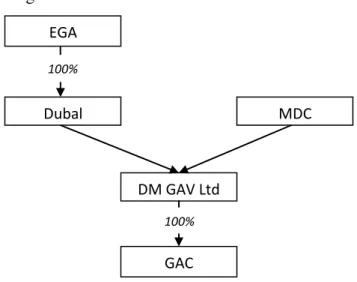
Figure 8: GAC shareholding structure 60
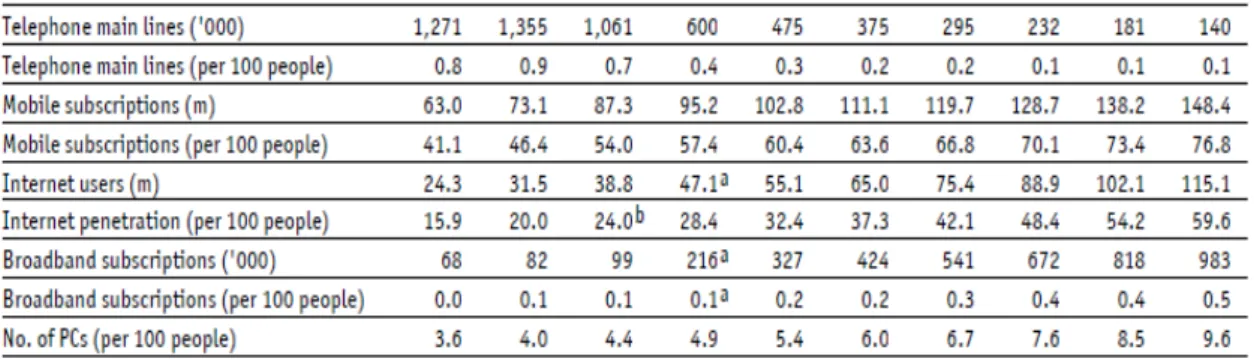
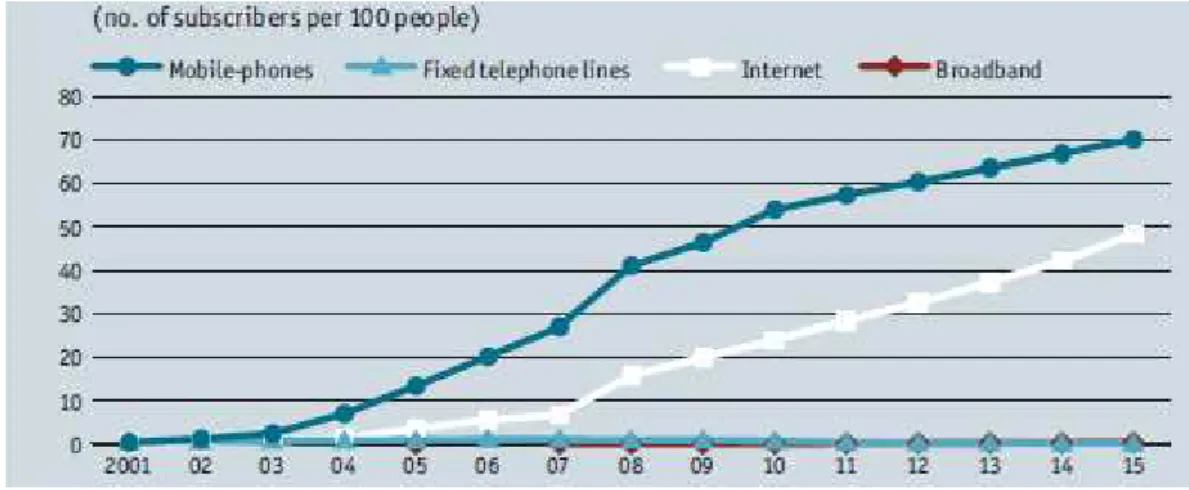
Figure 9: Technology adoption (penetration of mobile, fixed, Internet and broadband) 63
TABLE OF ABBREVIATIONS AND ACRONYMS
AD Anno Domini
AD Abu Dhabi
AMC Asset Management Company Bcf Billion cubic feet
BHP Billiton Broken Hill Proprietary Company Pty Limited CEO Chief Executive Officer
CFO Chief Financial Officer
CSR Corporate Social Responsibility CTO Chief Technical Officer
DUBAL Dubai Aluminium Company Limited EAD Emirate of Abu Dhabi
e.g. exempli gratia
EHS Environmental Health & Safety EIU Economist Intelligence Unit EGA Emirates Global Aluminium EMAL Emirates Aluminium
EMTS Emerging Market Telecom Services Ltd ETI Ecobank Transnational Incorporated Company Etisalat Emirates Telecommunications Corporation EUR Euros
GAC Guinea Alumina Corporation GDP Gross Domestic Product
GSM Global System for Mobile Communications
Hz Hertz
ICT Information and Communication Technology i.e. id est
IFC International Finance Corporation
IFC ALAC International Finance Corporation African, Latin American and Caribbean fund
JV Joint-Venture
km kilometers
MDC Mubadala Development Company MMbbls Million barrels
mt/year metric ton per year NBI Net Banking Income
NIEO New International Economic Order
OPEC Organization of the Petroleum Exporting Countries
pa per annum
RAI Rural Accessibility Index R&D Research and Development SIM Subscriber Identity Module SWF Sovereign Wealth Fund
TEVT Technical Education and Vocational Training tpy tons per year
UAE United Arab Emirates
UASL Universal Access Service License
UNDP United Nations Development Programme
US United States
USD US Dollars
USSR Union of Soviet Socialist Republics
TABLE OF CONTENTS
1. Introduction 15
1.1. Research objective and method 16
1.2. Relevance for scholars and practitioners 16
1.3. Chapter outline 17
2. Context and definitions 19
2.1. Development Economics 19
2.1.1. Defining economic development and its determinants 19
2.1.2. Historical Overview 20
2.1.2.1. Schumpeter and the role of innovations in development 20 2.1.2.2. Rostow and the Modernization School 21 2.1.2.3. Third Worldists and Dependency School 23 2.1.2.4. Self-Reliance or Autocentred Development 24 2.1.2.5. Globalization and the “end of development” 25 2.1.2.6. The “fight against poverty” and the Millennium
Development Goals 26
2.1.2.7. Ross Levine: Financial development and economic growth 27 2.1.3. Note on the African development tragedy 29
2.2. Sovereign wealth funds 30
2.2.1. Definition and typologies 30
2.2.2. Sovereign Wealth Funds in Africa 31
3. Methodology 33
3.1. Method and data collection 33
3.1.1. Note on possible biases in professionals’ judgments 36
3.2. Data analysis 37
3.3. Research question and propositions 38
3.3.1. Capital formation 38
3.3.2. Knowledge and technological transfers 40 3.3.3. Financial and banking development 42 3.3.4. The existence of a leveraging effect 43
4.1. Furthering economic development by encouraging the growth of the
productive private sector – IFC ALAC Fund 45
4.1.1. Project 1: Ecobank or the “world-class pan-African bank” 47 4.1.2. Project 2: Rialto and Ivory Coast natural gas resources 50 4.2. Contributing to the diversification strategy of the UAE’s economy –
Mubadala Development Company 52
4.2.1. Project 3: Etisalat, a UAE-based telecommunications services firm
in Nigeria 53
4.2.2. Project 4: GAC or the UAE's ambition to become an aluminium
giant 57
5. Discussion of research propositions and Conclusions 61 5.1. Proposition 1: Long-term vision, capital formation 61
5.2. Proposition 2: Training and CSR programs 64
5.3. Proposition 3: Stronger banks, larger credit expansion 66 5.4. Proposition 4: Leveraging effect and private sector development 67
5.5. Conclusions 70
5.5.1. Research findings 70
5.5.2. Limitations of research findings 74
5.5.3. Implications for practitioners and further research suggestions 74
6. References 76
7. Annexes 87
7.1. World Development Indicators in West Africa 87
1. Introduction
Since the 1990s, the world has been witnessing a shift in wealth from OECD to emerging countries (Turkisch, 2011). Due to their impressive growth and their increasing participation in the global income, emerging countries have become major players in the world’s economy and finance. These emerging countries are intensifying their political and economic relations with one another and with developed countries. SWFs are mainly the creation of emerging countries. Actually, according to Javier Santiso (2008), only 15% of SWFs have been established by OECD and developed countries. In the underlying study, the considered SWFs are only those from emerging or developing countries. Public pension funds, from Japan or Norway, are, for example, beyond the scope of this research.
SWFs from emerging countries have become key investment vehicles in the global financial markets. They have been the subject of many debates and controversies, especially during the recent financial crisis in Europe. Their investment strategies have been questioned, in particular after their stake acquisitions in big Western companies. Their growing assets have also drawn worldwide attention: in 1990, worldwide SWFs held about USD 500 billion (Johnson, 2007) while in 2012 their assets were estimated at USD 4,620 billion (Preqin, 2012). Moreover, it is estimated that they could hold approximately USD 7 trillion by the end of the decade (Kern, 2009).
Just as the States that established them, SWFs have shown a growing interest in developing countries in their investment strategy, especially after the recent crisis in developed countries leading to lower financial returns (Turkisch, 2011).
As a result, considering the growing interest of SWFs in developing countries as well as their growing assets, these State-owned investment vehicles may represent a major development opportunity. African countries, in particular, are increasingly targets for these investments (Triki & Faye, 2011). SWFs may consequently be a useful tool for Africa to achieve the United Nations’ Millennium Development Goals.
(http://www.worldbank.org): Benin, Burkina Faso, Cape Verde, Ivory Coast, Gambia, Ghana, Guinea, Guinea Bissau, Liberia, Mali, Niger, Nigeria, Senegal, Sierra Leone and Togo. 245 million people live in this region, the vast majority in remote and rural areas (see annex 1).
1.1.Research objective and method
The objective of the underlying study is therefore to respond the following research question: how, according to the perceptions of funds’ managers, can SWFs help in the economic development of West Africa? A set of four research propositions deriving from the literature review provides a theoretical substructure for the research question. This study analyzes in details the relationships between the fund providers, the SWFs, on the one hand, and the recipient companies or countries in Africa on the other hand. The objective consists in understanding by which mechanisms SWFs can, through their investments and according to their managers’ opinions, support the recipient countries’ economic development.
The research was conducted in form of a multiple case study, first presenting and then analyzing two specific funds which have invested in Africa, and more specifically in West Africa. The IFC African, Latin American, and Caribbean Fund (IFC ALAC Fund) was launched by the International Finance Corporation, a World Bank institution, in 2010. It gathers together many SWFs and helps them to channel investments into the African countries. The Mubadala Development Company (MDC) is an investment and development company aiming at supporting the diversification of the UAE’s economy. Its USD 55 billion portfolio includes investments in more than 17 countries all over the world, 2 of them in West Africa.
1.2.Relevance for scholars and practitioners
strategies in Western countries. According to Javier Santiso (2008, p. 302), "the development dimension is missing from the debates". Paradoxically, SWFs have precisely been created by emerging and developing countries. Consequently, it is fundamental to understand what may be the role of SWFs not only domestically (when the country is the recipient of its own SWF’s investments) but also in the development of other emerging and developing countries. This research focuses on the latter scenario. According to Santiso (2008), if SWFs invest 10% of their portfolio in emerging and developing countries in the next ten years, this would represent about USD 1,400 billion, i.e. more than OECD countries’ public aid. Moreover, Griffith-Jones and Ocampo (2008) calculate that if these funds invest 1% of their assets in the capital of development banks from developing countries, it would lead to a yearly increase of USD 70 billion in their lending capacity, i.e. twice the World Bank’s and the three major regional banks’ lending capacity.
Regarding the practitioners, this research can be of particular interest as well for two parties: funds’ managers and politicians. For the first party, this research can help them to identify other managers’ opinions about the impacts of SWF investments on the economic development of recipient economies. In this way, this study sheds light on how to invest in a more structured way, how to orientate funds’ investments so that they have a bigger impact on the recipient’s economic development and so that the funds benefit from a greater added value. For the latter party, this research will raise their awareness on non-economic determinants of development and show them how they can strengthen SWF investments’ impacts on economic development.
1.3.Chapter outline
2. Context and definitions
Before trying to understand the potential relations between SWFs and economic development, it seems necessary to separately define these two concepts. This literature review will provide a theoretical substructure to answer the research question, through a set of four research propositions (Section 3).
2.1. Development Economics
The concept of “economic development” is not easy to define. However, it is essential to understand it in order to orientate our next discussions. This concept has been analyzed for many decades showing economists’ growing interest in this matter but also leading to several definitions and theories.
2.1.1. Defining economic development and its determinants
The concept of "economic development" is both a complex and broad term. Adam Smith had already analyzed the issue of economic development (Hayami & Godo, 2005). However, in the last sixty years, many powerful contributions have been made, showing the growing interest of the economists in the study of this concept.
At the beginning of his book, Gilbert Rist (2008) shows that all the definitions about “development” share one or more presuppositions: “social evolutionism” (catching up with developed countries), “individualism” (focus on human personality) and “economism” (increase in growth and income). However, most of them are only the result of how a particular person imagine and define the ideal living conditions, this subjective feeling varying from an individual to another.
"economic development" goes far beyond economic growth, even if both terms are usually used as synonyms in real life.
In this way, the modern approach regarding economic development, which was born in the 70s, defines "economic development" as an increase in economic welfare. According to Goulet (1971), "the wider meaning of development is self-subsistence, self-esteem and freedom". Moreover, according to Todaro (1985, p.85): "economic development is a multi-dimensional process involving major changes in social structures, popular attitudes and national institutions as well as the acceleration of economic growth, the reduction of inequality and the eradication of absolute poverty". Considering the modern definitions of economic development, the precise measurement of this concept seems to be a difficult task with many practical problems: how to measure changes in social structures, in popular attitudes or in national institutions? There are two kinds of determinants of economic development: economic determinants – e.g. capital formation or skill formation – and non-economic determinants – e.g. political and law environments (Jain & Ohri, 2007).
2.1.2. Historical Overview
The development belief is a product of history, as well as an agent of history (Rist, 2008). For several decades, theories have been replacing and complementing each other, forming the knowledge we now have about this concept.
Our objective here is to present some key historic moments in order to analyze the different and successive interpretations of the words “development”or “growth”.
2.1.2.1. Schumpeter and the role of innovations in development
According to Schumpeter, who wrote The Theory of Economic Development (1912), the development process is above all an endogenous process of technological change, which is the result of innovations performed by entrepreneurs (Aghion et al., 2013).
instability in the “circular flow” system. The circular flow system is destructed when these new combinations are carried out by entrepreneurs. Schumpeter distinguishes five kinds of elements, or innovations, creating instabilities: the introduction of new methods of production, or new markets, new supply sources, new products or, finally, new organizational forms (Lima, 1995).
These economic dynamics are, according to Schumpeter, strongly related to the process of economic development. The main responsible for these new economic dynamics is the entrepreneur, endogenous element in the economy and who differentiates himself by his innovations. For Gilberto Tadeu Lima (1995, p. 183): “entrepreneurs are seen as economic agents whose functions are the carrying out of new combinations, the creative destruction of equilibria, thereby preparing the ground for a superior state of equilibrium”.
For Schumpeter, economic development is an endogenous process, spontaneous and discontinuous because breaking up with the “circular flow” static state of the economy. It is a disturbance of equilibrium. As written by Gilberto Tadeu Lima (1995, p. 182): “technological change should be understood as a spontaneous and internal disturbance which produces a complex, non-adaptative response which will discontinuously and forever displace the prevailing equilibrium configuration”.
Finally, Schumpeter highlights not only the importance of innovations but also the importance of credit (Messori, 2004). For Schumpeter, there is no innovation without bank credit and there is no economic development without the process of creative destruction originated by innovations. Entrepreneurs can introduce new combinations of resources only because they have the necessary financial means provided by the banking system. Credit allows a redistribution of resources in favor of entrepreneurs and innovations. As written by Schumpeter (Lima, 1995, p. 183): “innovation, being discontinuous and involving considerably change and being, in competitive capitalism, typically embodied in new firms, requires large expenditure previous to the emergence of any revenue, credit becomes an essential element of the process”.
2.1.2.2. Rostow and the Modernization School
industries for export, or through industrial production to substitute for imports. Industrialization was actually thought of as the key to modernization and growth. The modernization theory emerged at that time, influencing the political and economic elite of several countries (Rist, 2008).
The modernization theory has been very important since the 1950s. It draws on the biological sciences and applies the biological metaphor to social sciences: according to this theory, societies, as well as economies, are growing organisms, following a natural process composed of different and progressive steps (Rist, 2008).
One of the most famous modernization theorists is Rostow. Rostow published his book The Stages of Economic Growth: A Non-Communist Manifesto in 1960, when the field of “development” was taking form. To summarize his book, Rostow himself wrote: “It is possible to identify all societies, in their economic dimensions, as lying within one of five categories: the traditional society, the preconditions for take-off, the take-off, the drive to maturity, and the age of high mass-consumption” (Rostow, 1960, p. 4).
Through historical comparisons between countries from Europe, North America, India, China and Japan, Rostow shows how all societies should pass from tradition to modernity, through his five previously-defined categories, until “the age of high mass-consumption becomes universal” (Rostow, 1960, p. 167).
According to Rostow (1960), changes from one category to another mainly come from external action. Developing countries need assistance from developed countries to pass from tradition to modernity, for example through funding, technology transfers or provision of new markets.
Among the criticisms addressed to Rostow, the fact that he applies a small number of “rules” to “all societies” is the main one. For Rostow, each country obeys to the same rules, as if it were like any other.
A third criticism addressed to Rostow is that his theory does not say what will happen if the economies that are already flying start to slow down. What happens once the country reaches the age of high mass-consumption? (Foster-Carter, 1976)
Finally, one of the strongest criticisms made to Rostow’s work may be its eurocentricism. For Rostow, developing countries need assistance from the more-advanced countries to progress along the five-category scheme (Foster-Carter, 1976). Then, in the second part of his book, Rostow argues that the USSR represents a distortion of the general theory of modernization. The USSR has already entered in its “maturity” period. But, instead of entering the age of mass consumption, the country deviates from the pattern previously described to impose communism (Rostow, 1960). Rostow’s anti-communism has also been criticized, especially considering the fact that Rostow’s work itself seems to be as utopist and idyllic as Marx’s doctrine. Rist even writes: “Paradoxically, Rostow’s theory of modernization appears as a kind of ‘Marxism without Marx’.” (2008, p. 101).
However, Rostow’s theory of modernization continues to nourish the hopes of some politics. Its final objective, as well as the means towards it (expansion of technology, industrialization, etc.), have remained until today (Rist, 2008).
2.1.2.3. Third Worldists and Dependency School
In opposition to Rostow’s theory of modernization, which has strong impacts on the US and on international organizations, the arguments of the dependency school were adopted by the opponents of the US policy, and in particular by the “Third Worldists” (Amin, 1976).
Opposing the modernization theory and the dependency one, Sharmila Joshi (2005) wrote: “Modernization sees rich countries as helpers of poor countries; dependency sees them as the main obstacle to the well-being of the poorer countries”.
The dependency theory first appeared in Latin America, with for example Raul Prebisch, Celso Furtado, Theotonio dos Santos or Fernando Henrique Cardoso. Among some other personalities who join the Dependency School: Enzo Faletto in Brazil, Orlando Fals Borda in Colombia, and later Samir Amin in Africa, etc (Rist, 2008). As for the modernization theory, the dependency theory was not homogeneous nor unified. However, for Sharmila Joshi (2005), the main idea of the dependency theory is the following: “underdevelopment is not a condition: it is an active process of impoverishment linked to development. That is, some parts of the world are underdeveloped because others are developed. There are not separate processes but two aspects of the same process”.
In other words, the underdevelopment of the Third World is not simply accidental. It is necessary to ensure the growth and development of the North. According to Eric Williams in Capitalism and Slavery (Drescher, 1987), for instance, the slave trade operated by Britain from Africa to the Caribbean islands allowed the “take-off” of Britain and its industrial revolution. The actual underdevelopment of some countries was the result, or the necessary cost, of the development of other countries, creating an international system of inequalities.
For some dependency theorists, this dependency process is continuing until today, for example through transnational firms, which try to impose their position of strength (Joshi, 2005).
2.1.2.4. Self-Reliance or Autocentred Development
At the end of the 60s, in a context of independence of old colonies and debate between modernizers and Third Worldists, a new concept begins to appear, called “self-reliance” (or “autocentred development”), mainly due to the lack of economic progress made in most countries of the South (Galtung et al., 1980).
freedom, equality and unity. Through this philosophy, Nyerere wanted to raise Tanzania from a level of dependency to the one of self-reliance (Ibhawoh & Dibua, 2003).
According to Nyerere: “The doctrine of self-reliance does not mean isolationism. For us, self-reliance is a positive affirmation that for our own development, we shall depend upon our own resources”. Achieving self-reliance was essential for independence as “gifts and loans will endanger our independence” and “gifts (…) have the effect of weakening (and) distorting our own efforts” (Ibhawoh & Dibua, 2003, p. 64).
Following this concept, international trade has to be kept to minimum, to what cannot be produced inside the country. In the same way, the individual produces what he needs and acquires what he cannot produce from the level above (Ibhawoh & Dibua, 2003). According to Rist (2008): “the lower levels should be given as much power as possible, to ensure that they are not subject to domination”.
2.1.2.5. Globalization and the “end of development”
In the early 1990s, the messianic tone of the development discourses seemed to progressively dissipate. Actually, from 1990s, development concerns seem to be forgotten under the impact of “globalization”. Globalization progressively replaced development (Rist, 2008). The enthusiasm which characterized the early 1960s seemed to disappear because of the failure of the development venture. Economic growth has occurred in some regions; however, it has also brought inequalities and marginalization. For Rist (2008): “the end of the 20th century, of the vast enterprise that began after the Second World War in both the North and the South, therefore also marked the end of ‘development’”.
Two reasons can explain this new trend. Firstly, with the globalization process, state-administrated measures or voluntarist policies to control and regulate the economy seemed to be obsolete (Rist, 2008). The market, free competition and free trade now dominated and were the cure for all ills: there was no more special treatment. Moreover, other concerns, e.g. ecological concerns, also led to giving up on the idea that the South could one day “catch up” with the North.
and not assumed by the States anymore, for better efficiency and profitability (World Bank, 1994).
Moreover, in its Human Development Report 1993, the UNDP advocated that “free markets provide the most efficient mechanism yet devised for the exchange of goods and services” (UNDP, 1993). However, these markets can be made “people-friendly” and complemented with “social safety nets (…) to look after the temporary victims of market forces and to bring them back into the markets” (UNDP, 1993). The State is the main casualty of globalization as it actually behaves in an irrational manner.
2.1.2.6. The “fight against poverty” and the Millennium Development Goals More recently, through the “fight against poverty” and the Millennium Development Goals, whose objective is to half extreme poverty, concerns about development are progressively launched again (Perrot, 2002). This “fight against poverty” is one of the last incarnations of the “development” strategies (Rist, 2008). The reduction of poverty becomes the main debate in the recent period and everybody realize that promises about “development” and the “catch up” of the South with the North were unrealizable. The priority now is to reduce inequalities and poverty, always caring about the environment issue (Perrot, 2002).
This priority is not new. For instance, in 1949, President Truman already saw poverty as “a handicap and a menace” (Hazlitt, 1950). However, the idea of “eradicating” it is relatively new (Perrot, 2002).
According to the UNDP’s Overcoming Human Poverty (UNDP, 1997): “poverty is not about income alone, but is multidimensional”: low education, low health conditions and social vulnerability all contribute to this condition.
leading to the concept of “décroissance” (Meadows et al., 1972; Bernard et al., 2003; Latouche, 2006).
2.1.2.7. Ross Levine: Financial development and economic growth
Already in the 1960s, Raymond W. Goldsmith, in Financial Structure and Development (1969), tried to show how a country’s financial structure changes with its economic growth. He wrote: “One of the most important problems in the field of finance, if not the single most important one, almost everyone would agree, is the effect that financial structure and development have on economic growth” (Goldsmith, 1969, p. 390). In the same period, John Hicks (1969) demonstrated the role played by the financial system on the English industrial revolution, for example by easing capital mobilization. According to Schumpeter (Lima, 1995), a good banking system helps in identifying and funding the best entrepreneurs, who can then create innovative products or innovative processes. In this sense, a good banking system enhances technological innovations and development.
In the literature, a lot of research (Demirgüç-Kunt & Maksimovic, 2000) concludes on a positive impact of financial development on economic growth. These researches are conducted either on a cross-country level, an industry level, a firm level or following a temporal approach. Levine expands the existing studies to a bigger number of countries, following the country-, industry- and firm-level analyses (Levine & Demirgüç-Kunt, 2004).
According to him, there are four main views about financial structure, i.e. the financial markets and institutions in an economy: the bank-based view; the market-based view; the law and finance view and finally the financial-services view.
risk management tools. This view highlights the deficiencies existing in the bank-based view. For example, some authors argue that bank-based economies may hinder innovation and growth because banks have preference for low-risk, and consequently low-return, projects since they want their loans to be repaid (Morck & Nakamura, 1999). Banks may also collude with managers, hindering market competition and growth and introducing new inefficiencies in the economy (Hellwig, 1998).
According to the law and finance view, mainly studied by La Porta et al. (1998), the effectiveness of the financial system and its ability to enhance innovation and growth are a direct consequence of the legal system. Depending if the legal system protects investors and if their rights are effectively enforced, financial system will be effective and allows for economic growth. By the way, in this view, this is the financial development, and not the static financial structure (either bank-based or market-based), which is essential for economic success (Levine & Demirgüç-Kunt, 2004).
Finally, in the financial-services view, there are some key financial services which have to be provided by financial system in order to enhance firm creation, industrial development and economic growth (Levine & Demirgüç-Kunt, 2004).
These findings have a strong policy implication. They mean that to have higher economic growth rates, instead of focusing on financial system in itself and its composition, policymakers have to change legal system, e.g. enhancing investors’ rights and contract enforcement. Actually, as Levine wrote: “financial development and the component defined by the legal protection of outside investors explain long-term cross-country growth rates” (Levine & Demirgüç-Kunt, 2004, p. 212).
2.1.3. Note on the African development tragedy
According to Easterly and Levine (1997, p. 1205), “low school attainment, political instability, poorly developed financial systems, large black market exchange rate premiums, large government deficits, and inadequate infrastructure are significantly correlated with economic growth”. More specifically, 2/5 of the growth difference between Sub-Saharan Africa and East Asia are explained by these variables. Their statistical study also shows that “political assassinations are negatively correlated with long-run growth, while education attainment is positively linked to growth” (p. 1211). However, what is really new and original in Easterly and Levine (1997, p. 1213) is the second part of their study, where they show that “political instability, rent-creating economic policies, and poor public goods may reflect a more fundamental country characteristic: ethnic divisions”. They show that greater the ethnic diversity, higher the probability of poor policies and lower the growth-enhancing public goods.
The reason is the following: “ethnic diversity may increase polarization and thereby impede agreement about the provision of public goods and create positive incentives for growth-reducing policies, such as financial repression and over-valued exchange rates, that create rents for the groups in power at the expense of society at large” (Easterly & Levine, 1997, p. 1206).
Africa’s high level of ethnic diversity, therefore, helps explain its tragic growth performance” (Easterly & Levine, 1997, p. 1207).
2.2. Sovereign wealth funds
The second important concept in our research question refers to sovereign wealth funds or SWFs. In this section, we will try to precisely define this concept, show its several typologies and finally we will make a focus on SWFs investing in Africa.
2.2.1. Definition and typologies
The first SWFs have been created many decades ago. However, it is only in the beginning of the 21st century, when they started to grow in both number and assets, that they started to have a significant weight in the global capital markets and to draw attention of media and economists (Das et al., 2010).
The term “sovereign wealth fund” has been used to refer to many kinds of government-controlled investment vehicles. In this study, the considered definition of SWF is the following: a SWF is “an entity that manages state-owned financial assets, and is legally structured as a separate fund or fund manager owned by the state. This structure is intended to insulate the entity from short-term political pressures and enable it to recruit professional fund management personnel” (Das et al., 2010, p. 36). However, within this definition, SWFs can differ a lot according to their sources of revenue, to their operations and objectives.
According to the SWF Institute website (http://www.swfinstitute.org), the three largest SWFs by assets under management are: the Government Pension Fund from Norway (USD 715.9 billion under management), the Abu Dhabi Investment Authority from the UAE (USD 627 billion under management) and the SAFE Investment Company from China (approximately USD 567.9 billion under management).
from foreign exchange reserves, fiscal surpluses and privatization proceeds. More than a half of SWFs were commodity funds in the end of 2011. Nevertheless, non-commodity funds tend to have a faster growth rate (TheCityUK, 2012).
SWFs are established with a variety of objectives, leading to different investment strategies. Stabilization funds are usually established by countries which benefit from rich natural resources. Their objective is not only to provide budgetary support but also to protect the country from the volatility of commodity prices and consequently to protect the national economy from macroeconomic shocks. When commodity prices are high, the funds are built up. However, when these prices decrease, the State can use the funds’ resources. In opposition to the stabilization funds, the saving funds have a longer term perspective. Their main objective consists in supporting intergenerational equity. In the case of a commodity saving fund, non-renewable assets are transferred into a diversified portfolio of financial assets to future generations (TheCityUK, 2012). The IMF also identifies 3 other types of SWFs, with different profiles and objectives: the development funds; the contingent pension reserve funds; and the reserve investment corporations (IMF SWB Report, 2008).
The main differences between SWFs and the other institutional investors such as the private equity funds are the following: most SWFs have long-term liability allowing them to adopt a long-term investment horizon and to invest in illiquid and long-maturity assets. Moreover, they are not highly leveraged and thus represent a constant source of capital (Turkisch, 2011).
2.2.2. Sovereign Wealth Funds in Africa
In Africa, SWFs’ investments are mostly concentrated in the Sub-Saharan region. They are mainly focused on real estate and hotels, industrial sector and extractive industries (traditional natural resources such as hydrocarbon and minerals). In North Africa, SWFs invest mainly in the banking and finance sector (ESADEgeo SWFs Report, 2012). According to Javier Capapé (ESADEgeo SWFs Report, 2012, p. 94): “SWFs from other regions of the world are looking to Africa in search of resources (energy and food, mainly) that their countries need in order to maintain high growth rates in their economies. But we have also observed that sectors such as tourism, telecommunications and real estate are starting to arouse the interest of these new global investors”.
This is in accordance with Turkisch (2011), who argues that SWFs’ investments in Africa are more and more geographically and sectorally diverse. The main part of SWFs’ investments in Africa comes from the Gulf (Dubai World, Abu Dhabi Investment Authority) and from Asia (China-Africa Development Fund), two regions which are very close to Africa. Actually, for Turkisch (2011, p. 12), “when SWFs invest in foreign developing economies, they privilege close countries, where they may hold advantages of information, networks and historical knowledge, and where investments may have direct positive externalities on the domestic economy”.
Figure 1: SWFs’ investments in Africa, breakdown by sector and region
3. Methodology
This research refers to the study of the role that SWFs may, according to the perceptions of funds’ managers, play in the development of the West African economies, seen as recipient countries. Actually, the impact of SWFs on economic development may not be direct so that other variables, in addition to SWFs’ investments, have to be considered to explain the growth of the West African region. Moreover, SWFs are often confronted to structural barriers requiring deep and long-term changes and hindering their potential effects on the development of the region. Consequently, the research design has been adapted accordingly.
In this section are presented the research methodology and the rationale for its application. More specifically, the procedures that have been adopted during the data collection and analysis are exposed and justified.
3.1. Method and data collection
The main method of analysis of this research is the case study approach or cross-case analysis. According to Creswell (1998), a case study is the investigation of a case (object of study) over time and through extensive and in-depth data collection, involving multiple sources (documents, interviews, archival records, observations, etc.). Moreover, according to Yin (2003), a case study is particularly relevant to answer the research questions “how” and “why” while studying contemporary events that go beyond the influential control of the investigator. In his own words: “In general, case studies are the preferred strategy when ‘how’ or ‘why’ questions are being posed, when the investigator has little control over events, and when the focus is on a contemporary phenomenon within some real-life context” (2003, p. 1). The research question of this study fits this definition. This research aims at obtaining some in-depth understanding of a contemporary phenomenon where research has been scarce so far. The following case study is also used to retain holistic and meaningful insights in complex real-life context. Consequently, the case study approach seems to be relevant to answer the research question.
replicate findings that were found in individual cases (replication) and also to study contrasting situations (contrast). Moreover, multiple case studies are “considered more compelling, and the overall study is therefore regarded as more robust” (Yin, 2003, p. 46). According to Yin (1994), the methodological framework is the same for the multiple case study and the single case study. Consequently, both use the same research design.
The case study approach has been criticized by some scholars who have questioned its methodological rigor and the reliability of research findings (March, Sproull & Tamuz, 1991). Nevertheless, it has been more and more used in social and business sciences (Hamel, 1992; Gibbert, Ruigrok & Wicki, 2008). Actually, the case study approach allows more easily the retention of the main characteristics of real-life and complex phenomena and it also allows obtaining holistic and extensive insights in complex contexts. The case study approach is no longer seen as an inappropriate research strategy for analyzing and testing proposals (Yin, 2003).
In addition, regarding the process of data collection, there are six different sources which are usually used in case studies (Yin, 2003): physical artifacts, participant observation, documentation, archival notes, and interviews. Not all the sources need to be used in a case study. This research mainly uses the last three types of sources. The first three types are not used as they are more related to direct sociological investigation. The use of multiple sources enhances, according to Yin (2003), the validity of the research through a better triangulation of the data. Actually, the use of multiple sources facilitates the development of “converging lines of inquiry”, constituting a way to verify and corroborate the findings of the case study.
interviews were conducted either in English or in French, following the preference of the interviewees.
To be able to replicate the findings and for this study to be more robust, we interviewed two people working in two different SWFs. To select the funds’ managers to interview, four criteria were taken into account: (i) SWF investments size; (ii) investments location; (iii) we also sought to include different types of funds in our selection in order to capture the possible influence of these differences on managers’ impressions; (iv) we finally took into account the quantity of public information about the funds’ portfolio and the receptiveness and availability of the managers.
We used the “snowball” strategy (Atkison & Flint, 2001), i.e. that the initial group of interviewees (IFC) indicated us the other potential interviewees (Mubadala). This strategy was necessary since, from the beginning of the data collection process, we met some difficulties to make contacts with funds’ managers.
The IFC ALAC Fund and the MDC were selected because they appear to be the most relevant SWFs to answer the research question and they respect the four previously-defined criteria. They both give a quite strong attention to the African region in their investment strategy. More precisely, as will be detailed below, they are participating in investment projects in West Africa. They are also transparent funds (the MDC has a transparency rating of 10, according to the SWF Institute website) and publish information about their investments. Finally, these two funds were also chosen because they differ in terms of investors with one fund being entirely owned by the Abu Dhabi government while the other one gathers different SWFs. They also differ in terms of organizational form, amount of managed assets and investment strategy. Consequently, these differences in the sample may lead to interesting conclusions on the potential role played by SWFs on the development of the African region.
In the case of MDC, an interview of Damien Catani, Acquisitions and Investment Manager at MDC, and more specifically at Mubadala Aerospace, Communications Technology & Defense Services and Mubadala Real Estate & Infrastructure, was performed. Damien has been working at MDC for 4 years.
To complete the data collection, this research also includes an in-depth analysis of annual reports, funds’ press releases and websites as well as newspaper articles and international organizations’ websites. This analysis was held on an on-going basis.
3.1.1. Note on possible biases in professionals’ judgments
Our research question being: how, according to the perceptions of funds’ managers, can SWBs help in the economic development of West Africa?, it is essential to be aware of the fact that our case studies, based on perceptions and statements of funds’ managers, may present biases related to the interviewees’ judgments and points of view. As stated by Rist (2008): “theobject is always constructed by the one who observes it”. Following the same idea, Bazerman (2006) wrote: “Professionals are not stupid, but they are human”. Professionals and experts can provide very valuable insights about technical and unclear issues. However, their judgments can also lack objectivity.
These biases can be explained by different factors. Firstly, they can come from the limits of human cognition or the human simplifications in the process of data processing aiming at reducing cognitive work. These limits or simplifications are known as "heuristics" (Shah & Oppenheimer, 2008).
Other motivational and emotional factors can also influence the professional’s judgment (Pfister & Böhm, 2008). Actually, as shown by Loewenstein and Lerner (2003), affective and motivational phenomena can strongly impact not only judgments but also decision-making process.
In our specific case, due to the complexity of measuring the concept of economic development (and more precisely, its non-economic determinants) and due to the existence of variables, other than SWFs’ investments, impacting the development process, it is necessary to rely on fund managers’ subjective perceptions and opinions in order to assess the performance and the impacts of the funds on the recipient country’s economic development.
Moreover, the IFC ALAC fund for example is only three years old and only one of its projects has already been partially disinvested. This means that it is too early to try to assess statistically and objectively the IFC’s investments performance and impacts on development, which is a long-term process. That is the main reason why our research question focuses on fund managers’ subjective and biased opinions and judgments.
However, it is essential to keep in mind throughout the research that the fund managers’ can sometimes lack objectivity and that they are also subject to confidentiality pressure. They cannot disclose all the information they know and that is why they can sometimes chose not to say all they know. During the interview with the IFC for example the Corporate Communication department was present to ensure that some kind of information would not be released.
3.2. Data analysis
The first step of the data analysis consisted in identifying the initial variables defined by the funds’ managers during the interviews (from the researcher’s notes and the recorded interviews).
Through a full and close examination of the interviews notes, we paid attention to each passage of the interviews in which the interviewees made reference to one possible variable affecting the recipient country’s economic development through SWFs’ investments.
When necessary, the interviewees were contacted again, by phone or e-mail, in order to ask for clarifications and suggestions, update information and explain apparent inconsistencies found in the interviews.
Figure 2: Overview of the research methodology
Source: The author.
3.3. Research question and propositions
In order to contribute to the previous discussions, the research question how, according to the perceptions of funds’ managers, can sovereign wealth funds help in the economic development of West Africa? is supposed to be answered through the analysis of a set of four research hypothesis or propositions based on the literature review. Through literature review, these research propositions are aimed at contemplating what could be the opinions of funds’ managers on the possible positive impacts of SWFs’ investments on the economic development of the recipient country. They constitute possible managers’ answers to the research question mentioned above.
3.3.1. Capital formation
First, as seen in section 2, development is a long-term process which can only be achieved through long-term and stable funding. SWFs have long-term investment horizons and can consequently provide this long-term funding (Triki & Faye, 2011). As previously seen, SWFs are not debt leveraged so they will not have to call back capital in the short term. Consequently, SWFs’ funding is stable and may not be
Method
Data Collection
Data Analysis
Cross-Case Analysis
Interviews, Archival Notes and Documentation
suddenly withdrawn of the country from one day to another, contributing to its financial and economic stability, which is essential for development (Lensink & Morrissey, 2006). SWFs can more easily make investments in illiquid and long-maturity projects than other investors which are subject to market discipline (Turkisch, 2011). SWF investments have a low volatility, volatility being harmful for development (Lensink and Morrissey, 2006).
Consequently, SWFs can, for example, make long-term and stable investments in economic sectors which are essential for economic development, e.g. infrastructures of all kinds (ICT, irrigation, water and sanitation, power, transport, WSS), participating in the recipient country’s capital formation.
Foster and Briceño-Garmendia (2010) have shown that low level of infrastructure can reduce national economic growth by 2% each year. According to their simulations, if all African countries had the same level of infrastructure than Mauritius, which is the regional example in this matter, regional per capita growth would raise by 2.2%. If they had the same level of infrastructures as South Korea, it would increase by 2.6%. In the article Africa’s Infrastructure – A time for transformation (Foster & Briceño-Garmendia, 2010, p. 1), we can read: “infrastructure has been responsible for more than half of Africa’s recent improved growth performance and has the potential to contribute even more in the future”. Low quality and expensive infrastructure usually represent the main constraint on doing business in Africa, decreasing productivity by approximately 40% (Escribano, Guasch, and Peña 2008).
Today, regarding rural electrification, Foster & Briceño-Garmendia (2010) calculated for example that rural access to power in Africa is only 12%, as shown in figure 3. The national power systems are usually very expensive and of poor quality with frequent supply shortages.
Figure 3: Rural Electrification rates in Africa
Foster & Briceño-Garmendia (2010) finally calculated that considering all types of infrastructure, USD 93 billion have to be invested each year over the 2010-2020 decade to close the infrastructure gap by 2020.
To develop infrastructure, it is necessary to have long-term and stable investments. Actually, it takes time for operations to generate a return on investment and it is essential to make initial investments during several years for the construction of the infrastructure.
Research proposition 1: SWFs, through long-term and stable funding, enable a
continuous increase in the Western African countries’ capital formation, creating the
conditions for their economic development.
3.3.2. Knowledge and technological transfers
According to Borensztein et al. (1998, p. 116): “technology diffusion plays a central role in the process of economic development. In contrast to the traditional growth framework, where technological change was left as an unexplained residual, the recent growth literature has highlighted the dependence of growth rates on the state of domestic technology”.
Technological and knowledge transfers can take place through different channels, e.g. through the imports of high-technology products, foreign technology and through the transfer of foreign human capital. In addition to these channels, investments made by multinational companies constitute one of the most powerful channels for developing countries to access new technology. According to Findlay (1978), foreign direct investments made by foreign companies raise the rate of technological progress in the recipient country via a “contagion” effect from the more advanced technology and management processes used by these firms.
contribution of the introduction of foreign and more advanced technology is stronger when it goes with a good level of human capital in the recipient country. To increase the country’s economic development, it is not only about importing foreign human capital, it is mainly about improving the local human capital.
Through their investments, SWFs can facilitate both technological and knowledge transfers to African industries, for example by investing in companies that participate in the training and education of local workers and/or by encouraging these companies to create R&D units in Africa (Triki & Faye, 2011).
Human development remains one of the main challenges faced by West African countries. However, it is an essential factor to take into account to take full advantage of technological transfer, to reduce poverty and increase development. Human development and education also impact other economic sectors (e.g. health, infrastructure) as it trains the country’s future doctors or engineers. However, African countries not only have little revenue, they also do not spend enough on education, leading to a lack of skilled workers.
Table 1: Public expenditure on education in sub-Saharan Africa in 2007
Source: CRES (2008).
Research proposition 2: SWFs contribute to the technological upgrading of the
recipient country as well as to the development of its human capital through skill
3.3.3. Financial and banking development
In Africa, the banking sector is one of the most underdeveloped. However, banking is critical for the development of a country. As seen in section 2 with Schumpeter, a competent banking system is essential to identify and fund the best entrepreneurs and the best projects, which will then create new products and processes, leading to technological innovations and economic growth. The availability of competent banking and institutional credit organizations is also fundamental for the country’s capital formation.
As seen in section 2, for Levine, banks are critical to mobilize resources, select good initiatives, monitor and control firm managers and manage risk (Levine 1997, 2000). According to the financial-services view, some critical financial services have to be provided by banks and the financial system in general in order to enhance the creation of firms, industrial and economic growth or development. This means that a country whose banks provide these key financial services will grow faster because new firms will be established more easily and will grow more.
The banking sector can affect both capital accumulation and technological innovation (referring to respectively proposition 1 and proposition 2) either by modifying savings rate or by reallocating savings to technological and innovative projects.
Paul Derreumaux (2012), honorary chairman of the Bank of Africa Group, gives a panorama of the current African banking sector. In 2012, the 200 largest banks in Africa had total assets of about USD 1,110 billion as well as a NBI of USD 45 billion. For comparison, the NBI of the BNP Paribas Group alone in 2011 was approximately USD 55 billion. South Africa, Nigeria and North Africa are the dominant countries in the sector, with respectively shares of 36%, 9% and 40% in assets and 45%, 15% and 32% in NBI.
Africa. The financing of SMEs is still an issue throughout the continent. For Derreumaux (2012, p. 5): “Banks must achieve higher professional standards and be more innovative with risk analysis, guarantees and financing arrangements”. He gives an additional recommendation: “Banks must prevent fraud, improve product penetration, capture a substantial number of customers with little or no banking experience, and attract more savers”. Consequently, improvements are still needed in the African financial banking sector to support Africa’s economic development.
Research proposition 3: SWFs, through investments in the banking sector, supply
essential capital for banks to grow and provide key financial services to support firm
creation, industrial and economic development.
3.3.4. The existence of a leveraging effect
If we make the hypothesis, as proposed by World Bank’s President Zoellick (2008), that SWFs invest about 1% of their assets in the African continent, this could have added up to USD 30 billion a year in private investment for Africa in 2008. Moreover, based on Kern’s (2010) projections, SWFs’ assets will reach USD 7 trillion by 2019. Consequently, in 2019, 1% will represent USD 70 billion a year invested in Africa. Note that this amount corresponds to approximately three-quarter of the African infrastructure deficit (see section 4.1.). SWFs’ investments can reach very significant amounts.
Considering the existence of a leveraging effect, this number can be much bigger. Actually, according to Kern (2010), a Chinese SWF is mentioned to have increased by five times the investments made by the SWF, facilitating and generating other investments. Generalizing this example to the other SWFs, the above-mentioned USD 70 billion SWF investments may allow additional USD 350 billion investments in the African continent.
Secondly, when SWFs invest in a developing country, they enhance the attractiveness of this country as a whole and make private investors increasingly interested in it (Turkisch, 2011). Once the benefits of investing in a developing country are evident and once the country’s business and political environments appear to be safer than they look, private investors are more willing to invest in it.
Research proposition 4: SWFs’ investments may be significant and have the capacity
4. Empirical analysis: Case studies
To answer our research question, two funds’ managers were selected for interview, according to the four above-mentioned criteria (Section 3.1.): Sujoy Bose from the IFC ALAC Fund and Damien Catani from the MDC. During each interview, two investments were analyzed in order to have a higher diversity between the cases (in terms of sectors, countries, investment date, etc.): Ecobank and Rialto in the case of IFC ALAC (4.1.); Etisalat and Guinea Alumina Corporation (GAC) in the case of MDC (4.2.).
4.1. Furthering economic development by encouraging the growth of the productive private sector – IFC ALAC Fund
For Turkisch (2011, p. 22): “When investing in Africa, SWFs have recently engaged in increased cooperation with the World Bank and other private financial entities. These cooperation frameworks appear promising and may play a growing role in the future”. The IFC African, Latin American, and Caribbean Fund (IFC ALAC Fund) was launched by the International Finance Corporation in 2010 and follows exactly this kind of “cooperation frameworks”. According to the IFC website (http://www.ifc.org), the USD 1 billion fund has commitments from different types of investors, among them: Korea Investment Corporation, State Oil Fund of the Republic of Azerbaijan, the Abu Dhabi Investment Authority, a Saudi government fund, etc. The analysis of the IFC ALAC Fund is an interesting case because it shows how some global financial institutions can help to direct SWFs investments into African countries.
The IFC ALAC is managed by the IFC Asset Management Company, which is itself a subsidiary owned by the IFC, established in 2009. Three other funds are managed by the IFC AMC: IFC Capitalization Fund, African Capitalization Fund and Russian Bank Capitalization Fund. All these funds’ revenues come from institutional investors, including SWFs, pension funds and development finance institutions. In the end of 2012, the AMC had about USD 4.5 billion assets under management.
could lend money along the IFC in emerging countries. To fill in the gap, the Asset Management Company was set up to mobilize equity capital (not only debt) from investors to invest in emerging markets. This is how the concept of Asset Management Company came along, and then, the ALAC Fund specialized in a geographical area. The ALAC was the second fund established by the AMC to make equity investments in Africa, Latin America and Caribbean islands.
Figure 4: Overview of the IFC organization
Source: The author.
According to its website (http://www.ifc.org), the IFC is “the largest global development institution focused exclusively on the private sector in developing countries”. Consequently, its analysis is relevant to answer our research question. The International Finance Corporation has been working in development through the private sector for many decades and has also been present in Africa for decades. It is a multinational development agency with a dual objective: on the one hand, development and, on the other hand, profitability. In other words, the IFC makes investments in the private sector through the eyes of making money.
As Sujoy Bose told us, the IFC is a very good catalyst to get investors to put money into development and emerging markets. In fact the IFC has established the first emerging market fund which was a very big success. Consequently, the IFC has a strong expertise and track record of looking in these markets for a long time. Emerging markets are not easy to operate in, they have lots of complexities. It is necessary to understand them very well not only to operate profitably but also for the development to happen in a
Investment Advisory IFC AMC
IFC Capitalization
African Capitalization
IFC ALAC Russian Bank
structured and organized way. In this sense, the IFC is seen by many investors around the world as a very good catalyst.
The IFC works following the concept of “mobilization”, i.e. it always looks to bring other private and foreign investors together in its investments. This is the way IFC has been working for many years as Sujoy Bose explained us during the interview.
In terms of portfolio, today the IFC ALAC has made investment commitments totaling USD 610 m (19 investments). Approximately 60% of these investments are in Latin America and 40% in Africa. IFC is always a minority investor so that it usually does not have a great weight on the invested company’s management. The portfolio is well diversified in terms of sector (infrastructure, manufacturing, services and so on). Actually, the IFC does not have a precise investment strategy. It is a diversified fund and the main idea is to have diversification in terms of investments inside the ALAC region, both among countries and among sectors. However, after our own analysis, we can say that the first ALAC fund’s investments were a bit conservative as it invested in two multinationals operating in stable sectors. For instance, the first investment was made in HeidelbergCement, which is one of the biggest cement manufacturers, which planed to expand its activities in West and Central Africa.
The IFC ALAC does not have any specific exit strategy. The fund life is expected to last for 10 years. Until today, as the fund is only 3 years old, the IFC has disinvested only one investment partially, through an IPO. The exit strategy will probably be defined on a case-by-case basis.
As mentioned in 3.1.1., fund managers take great care in not releasing some kinds of information. Because of these confidentiality barriers, it was very difficult to select and analyze specific existing investments. In the case of the IFC ALAC fund, two kinds of investments were considered: on the one hand, an investment in the banking industry; on the other hand, an investment in infrastructure.
4.1.1. Project 1: Ecobank or the “world-class pan-African bank”