Fiabilitate si Durabilitate - Fiability & Durability Supplement No 1/ 2015
Editura “Academica Brâncuşi” , Târgu Jiu, ISSN 1844 – 640X
129
MOTION STUDY OF A WHEELCHAIR PROTOTYPE
FOR DISABLED PEOPLE
1
Assistant Professor PhD. Eng. Ionut GEONEA, University of Craiova, Faculty of Mechanics, Department of Applied Mechanics and Civil Engineering, Calea Bucuresti Street,
no. 107, Craiova, Code 200512, Romania, [email protected] 2
Prof. PhD. Eng. Nicolae DUMITRU, University of Craiova, Faculty of Mechanics, Department of Applied Mechanics and Civil Engineering, Calea Bucuresti Street, no. 107,
Craiova, Code 200512, Romania, [email protected]
Abstract. In this paper is presented the design and experimental prototype of a wheelchair for disabled people. Design solution proposed to be implemented uses two reduction gears motors and a mechanical transmission with chains. The motion controller developed uses PWM technology (pulse wave modulation). The wheelchair has the ability of forward – backward motion and steering. The design solution is developed in Solid Works, and it’s implemented to a wheelchair prototype model. Wheelchair design and motion makes him suitable especially for indoor use. It is made a study of the wheelchair kinematics, first using a kinematic simulation in Adams. Are presented the wheelchair motion trajectory and kinematics parameters. The experimental prototype is tested with a motion analysis system based on ultra high speed video recording. The obtained results from simulation and experimentally tests, demonstrate the efficiency of wheelchair proposed solution.
Keywords: Wheelchair, kinematics, prototype, motion study.
1. INTRODUCTION
This paper is structured in three sections. The introduction section presents a literature review of existing wheelchairs design solutions. The second part presents the design solution of experimental prototype and motion controller implemented to the wheelchair. In the last part is presented the kinematical characterization of the wheelchair, by motion simulation in Adams and experimental motion analysis. The experimental motion analysis is based on high speed cameras motion capture and analysis equipment. To assist mobility of disabled persons, several electrical powered wheelchairs are available on the market [1]-[4]. Power wheelchairs are used predominantly by people with both lower and upper extremity impairment resulting from cerebral palsy, high-level spinal cord injury, or muscular dystrophy [5]. The propulsion system of powered wheelchairs typically consists of a pair of motors, one for each drive wheel, and a drive train consisting of gears, belts and other mechanical
elements that couples the motor’s shaft to the drive wheel shaft. Speed and torque generated
Fiabilitate si Durabilitate - Fiability & Durability Supplement No 1/ 2015
Editura “Academica Brâncuşi” , Târgu Jiu, ISSN 1844 – 640X
130
2. PROPOSED DESIGN AND CONTROL SOLUTION OF WHEELCHAIR Design solution of the wheelchair is developed in Solid Works. Based on wheelchair dynamics calculated parameters is established the necessary torque and speed of propulsion motors. There are used two servo motors from Pololu, with reduction gears. The i00600 Torxis is an ultra-high-torque servo that can deliver a continuous duty torque of up to 115 (kg-cm) at 12 (V). The servo is powered by 12 (V) and draws approximately 3 (A) at full load [11].
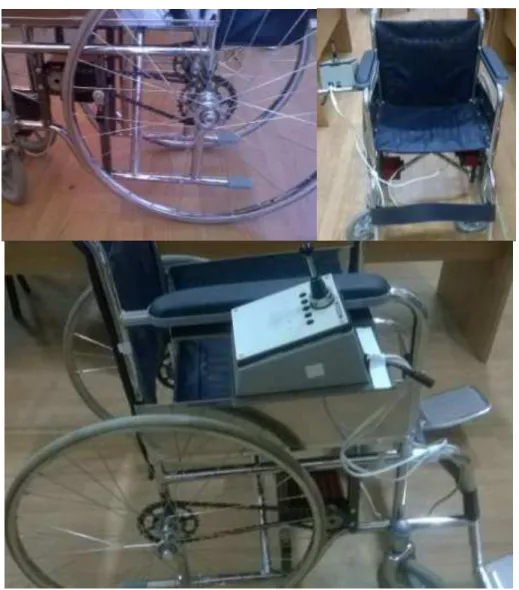
Designed train drive solution uses chain wheels with reduction ratio by 2. The model of the wheelchair, assembled in laboratory is presented in Fig. 1.
Fig. 1. Wheelchair experimental prototype.
Fiabilitate si Durabilitate - Fiability & Durability Supplement No 1/ 2015
Editura “Academica Brâncuşi” , Târgu Jiu, ISSN 1844 – 640X
131
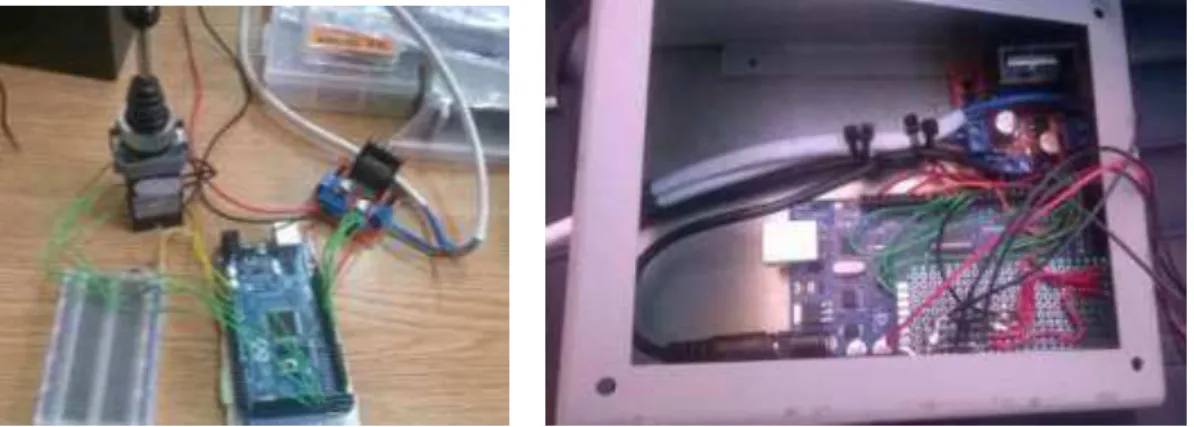
Controller implemented is based on a L298N Dual H-Bridge Motor Controller module. H-Bridge's are typically used in controlling motors speed and direction. An H-Bridge is a circuit that can drive a current in either polarity and be controlled by Pulse Width Modulation (PWM). Pulse Width Modulation is a means in controlling the duration of an electronic pulse. The longer the pulses the faster the wheel will turn, the shorter the pulses, the slower the wheel will turn. Motors will last much longer and be more reliable if controlled through PWM [12]. The microcontroller is based on Arduiono Mega 2560 board. The Arduino Mega 2560 is a microcontroller board based on the ATmega2560. It has 54 digital input/output pins (of which 15 can be used as PWM outputs), 16 analog inputs, 4 UARTs (hardware serial ports), a 16 MHz crystal oscillator, a USB connection, a power jack, an ICSP header, and a reset button [13]-[14], see Fig. 2.
Fig. 2. Aspects of PWM controller and joystick.
Mechanical design solution is innovative from aspect of wheelchair folding for easy transportation. As is presented in Fig. 3 the motorized wheelchair keeps the folding capability. This is very useful in the situation when the person with disabilities is going to another location (a visit for example) and needs to move the wheelchair with a transportation vehicle. This can be done with a family vehicle.
Fiabilitate si Durabilitate - Fiability & Durability Supplement No 1/ 2015
Editura “Academica Brâncuşi” , Târgu Jiu, ISSN 1844 – 640X
132
3. MOTION ANALYSIS OF THE WHEELCHAIR
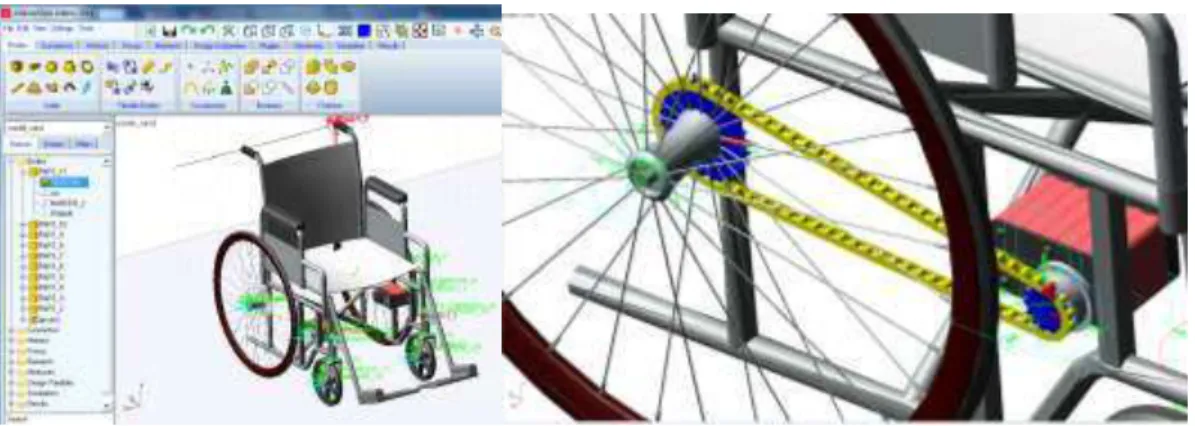
For beginning the motion analysis of the wheelchair is studied in Adams software. For that purpose the CAD model of the wheelchair is imported into Adams software database. Trough a suitable Adams developed procedure is analyzed the wheelchair motion trajectory and motion parameters. First are defined the components materials type, upon the program Adams calculates the inertia properties of elements. Upon this step are defined the rotation joints of the wheels. The front wheels are self directionally, and they are mounted on the wheelchair structure with axial-radial bearings. The kinematic model of the wheelchair constructed in Adams is presented in Fig. 4.
Fig. 4. Adams kinematic model and chain system in Adams Machinery.
The contact forces from wheels and ground are described by a contact mechanics model which is determined by parameters such as stiffness, force exponent, damping and friction coefficients and penetration depth. These parameters are defined by studying the literature [15].
The wheel ground contact parameters necessary to specify, to obtain a proper contact model from wheel and ground, are obtained from literature. Considering the computational efficiency and accuracy, is adopted the impact method to define wheels and ground contact. Necessary parameters for this method are explained [15]-[16]. The friction coefficient between ground and wheels is specified according to the literature: =0.5…0.6 for old asphalt road, old concrete.
a) b)
Fiabilitate si Durabilitate - Fiability & Durability Supplement No 1/ 2015
Editura “Academica Brâncuşi” , Târgu Jiu, ISSN 1844 – 640X
133
It is made robotic wheelchair motion analysis in Adams, in first case for a straight line displacement, when both motors run with same angular velocity. For this simulation the both motors run with 9,55 rot/min, the wheelchair motion trajectory is shown in Fig. 5, a. The wheelchair propulsion speed is constant and is by 550 mm/s.
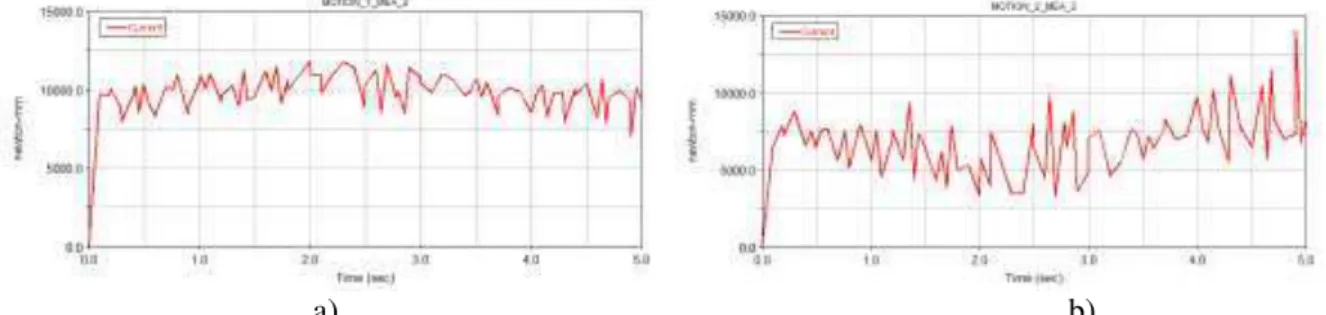
For the second simulation case, the right motor runs with 1,9 rot/min and left motor runs with 9,55 rot/min, the wheelchair obtained trajectory is shown in Fig. 5, b. The wheelchair motors torque, measured in Adams simulation is shown in Fig. 6, a, for right motor, and in Fig. 6, b for left motor. Is observed that is needed a greater torque for right
wheel, because it’s spins with a lower angular speed.
a) b)
Fig. 6. Propulsion torque for wheelchair right wheel and left wheel.
For wheelchair experimental motion evaluation it is used motion analysis equipment – Contemplas, based on ultra speed cameras [17]. Reflective markers have been attached to the wheelchair frame and wheel. The marker motion is captured and processed with TempoloMotion software in order to establish wheelchair wheels rotation and displacement variation in time. Positioning of reflective marker and motion tracking results are indicated in Fig. 7.
The notations used are following:
1), 2) - frame attached reflective markers. 3) - wheel center attached marker.
4) - wheel circumference attached marker.
With Contemplas motion analysis equipment, the wheelchair is analyzed during a straight line displacement. Obtained results for markers trajectories are presented in the Fig. 7, and are analyzed the kinematic parameters. The wheelchair resulting velocity is by 0.4 m/s.
Fig.7. Positioning of reflective markers on the wheelchair and markers obtained trajectories.
1 2
3
Fiabilitate si Durabilitate - Fiability & Durability Supplement No 1/ 2015
Editura “Academica Brâncuşi” , Târgu Jiu, ISSN 1844 – 640X
134
Processing the motion capture, it is obtained markers trajectories, presented in Fig. 7.
4. CONCLUSIONS
This paper proposes to develop a kinematic analysis model of a robotic wheelchair, which will be used for further dynamic studies. In order to increase efficiency propulsion motors must run at a high angular speed. For that are implemented motors with reduction gears and chain drive trains, in order to change the motor speed to a lower speed and increase the available torque to wheels. The virtual model of the wheelchair is designed in Solid Works and upon this model is developed the experimental model. Proposed solution uses two motors, controlled by a joystick module, based on a PWM controller. Kinematic analysis reveals motion trajectories of wheelchair, kinematic parameters of the system: wheel angular displacement and speed, running speed. Further studies concerns the motion study for steering situation, and establish of dynamic parameters of the wheelchair.
5. ACKNOWLEDGEMENT
This work was supported by the strategic grant POSDRU/159/1.5/S/133255, Project ID 133255 (2014), co-financed by the European Social Fund within the Sectorial Operational Program Human Resources Development 2007-2013.
REFERENCES
1. Gonzalez-Rodriguez Antonio, Mechanical Synthesis for Easy and Fast Operation in Climbing and Walking Robots, Climbing and Walking Robots, Intech Viena, 2010.
2. Gurpude R., Design, Synthesis & Simulation Of Four Bar Mechanism For Guiding Wheel For Climbing, International Journal of Engineering Research and Applications, 2012.
3. Hassan Abdulkadir, Design and Fabrication of a Motorized Prototype Tricycle for the Disable Persons, IOSR Journal of Engineering, May 2012, Vol. 2(5), pp.1071-1074.
4. Kumar Vijay, Assistive Devices for People with Motor Disabilities, Wiley Encyclopedia of Electrical and Electronics Engineering. Assistive Devices for People with Motor Disabilities, 1997.
5. R.F. Edlich, K.P. Nelson, M.L. Foley, R.M. Buschbacher, W.B. Long and E.K. Ma, Technological advances in powered wheelchairs, J. Long. Term. Eff. Med. Implants, vol. 14, pp.107-130, 2004.
6. http://www.wheelchairnet.org/WCN_WCU/Research/StakeholderDocs/PDFs/motors.pdf,
accessed April 2014.
7. http://t2rerc.buffalo.edu/pubs/forums/mobility/forum/white_papers/motors.htm, accessed
May, 2015.
8. Modak G. S., Review Article: Evolution of a Stair-Climbing Power Wheelchair, IOSR Journal of Mechanical and Civil Engineering (IOSR-JMCE), pp. 36-41, 2009.
9. Salmin H., Design and Implementation of an Electric Wheelchair to economize it with respect to Bangladesh, International Journal of Multidisciplinary Sciences and Eng. 2014.
10. http://www.wheelchairnet.org/ WCN_WCU/SlideLectures/DAH/AnatPowered
WCs-0699.pdf, accessed April 2014
11. https://www.pololu.com/product/1390/specs, accessed April 2014.
12. http://www.instructables.com/id/Arduino-Modules-L298N-Dual-H-Bridge-
Fiabilitate si Durabilitate - Fiability & Durability Supplement No 1/ 2015
Editura “Academica Brâncuşi” , Târgu Jiu, ISSN 1844 – 640X
135
13. http://www.mantech.co.za/datasheets/products/A000047.pdf, accessed April 2014
14. http://www.digikey.com/product-highlights/us/en/arduino/1037, accessed April 2014
15. http://paper.uscip.us/jvamc/jvamc.2014.1002.pdf, accessed April 2014