Open access journal: http://periodicos.uefs.br/ojs/index.php/sociobiology ISSN: 0361-6525
Temporal Polyethism and Life Expectancy of Workers in the Eusocial Wasp Polistes canadensis
canadensis Linnaeus (Hymenoptera: Vespidae)
VO TORRES1, E GIANNOTTI2, WF ANTONIALLI-JUNIOR3
Introduction
According to Wilson (1990), the non-reproductive division of labor among nestmates is the evolutionary ad-vantage that most promoted the ecological success of social insects. This division of labor among workers that contin-ues throughout their lifetimes is known as temporal poly-ethism; or if according to the morphology of the individual, morphological polyethism (Naug & Gadagkar, 1998a). This phenomenon is most common in termites (Noroit, 1989) and ants (Hölldobler & Wilson, 1990), and was recently discov-ered in a species of bee, Tetragonisca angustula (Latreille) (Grüter et al., 2011).
Temporal polyethism is evident in honey-bees (See-ley, 1995) and stingless bees (Sommeijer, 1984). Both
tem-Abstract
The division of tasks among nestmates is one of the most important traits of the social Hymenoptera, and is responsible for their evoluionary success. This division of labor, which occurs among workers throughout their lives, is called temporal polyethism. This study invesigated how temporal polyethism occurs, and its efects on the life expec-tancy of the eusocial wasp Polistes canadensis canadensis Linnaeus. To evaluate the
diferent aciviies and determine longevity, newly emerged females were individually marked with colored dots on the mesosome. During their lives, workers perform 22 behavioral acts, and the Nonmetric Mulidimensional Scaling analysis revealed a varia-ion in the patern of behaviors performed unil the ith week of life, i.e., close to their mean longevity. The mean life expectancy was 37.06 ± 29.07 days, with a mortality rate of 24.14% in the irst week, coinciding with the onset of foraging acivity. In other, less-derived species this began early in the life of the workers. The high entropy value (H = 0.750) relects the high mortality rate in the irst weeks of life.
Sociobiology
An international journal on social insects1 - Universidade Federal da Grande Dourados, Dourados, Mato Grosso do Sul, Brazil
2 - Universidade Estadual Paulista “Julio de Mesquita Filho”, Rio Claro, São Paulo, Brazil
3 - Universidade Estadual de Mato Grosso do Sul, Dourados, Mato Grosso do Sul, Brazil ReSeaRcH aRTIcLe - waSpS
Aricle History Edited by:
Gilberto M. M. Santos – UeFS, Brazil Received 27 November 2012 Iniial acceptance 31 January 2013 Final acceptance 14 February 2013
Keywords
Division of Labor, worker age, Longevity, Foraging acivity
Corresponding author Viviana de Oliveira Torres Programa de Pós-graduação em Entomologia e Conservação da Biodiversidade, Universidade Federal da Grande Dourados, Faculdade de ciências Biológicas e ambientais, 241, 79804-970, Dourados, Mato Grosso do Sul, Brazil.
e-Mail: [email protected]
poral and morphological polyethism are less evident in Hal-ictinae bees (Michener, 1974), Bombus (Cameron, 1989) and Polistinae wasps (Jeanne, 1991).
their respective groups.
Less-derived social insects have a less-clear division of labor: they are able to perform different tasks according to the needs of the colony (Beshers & Fewell, 2001). Among the species that have been studied are Bombus griseocol-lis (De Geer) (Cameron, 1989), Bombus bifarius nearcticus (Handl) (O’Donnell et al., 2000), Polistes lanio lanio (Fabr-icius) (Giannotti & Machado, 1994) and Belonogaster peti-olata (De Geer) (Jeanne, 1991), in which no clear temporal polyethism was observed. However, other species such as Polistes canadensis (Linnaeus) (Giray et al., 2005), Ropa-lidia marginata (Lepeletier) (Naug & Gadagkar, 1998b), Polistes metricus (Say) (Dew & Michener, 1981), Polistes jadwigae (Dalla Torre) (Tsuchida, 1991) and Polistes dominula (Christ) (Pardi, 1950) have a clearer division of labor.
The degree of temporal polyethism also seems to be related to the size of the colony (Wilson, 1971; Thomas & Elgar, 2003), since the division of labor among workers in general is directly proportional to colony size (Jeanne, 1986). In colonies of ants, bees, wasps and termites with thousands to millions of individuals, the division of tasks is clear and workers are highly specialized (Jeanne, 1986; Hölldobler & Wilson, 1990). However, in small colonies of fewer than a hundred individuals, the workers tend to perform different daily tasks, showing “behavioral plasticity,” for example, species of the genera Polistes (Post et al., 1988), Bombus (Cameron & Robinson, 1990) and Belonogaster petiolata (Jeanne, 1991).
The different tasks performed by workers determine their life expectancy. Antonialli-Junior et al. (2007) found that the life expectancy of workers of Ectatomma planidens (Borgmeier) gradually decreases after the onset of foraging activity. Other studies conducted with wasps, by Miyanno (1980) with Polistes chinensis antennalis (Pérez) and Jeanne (1972) with Mischocyttarus drewseni (Saussure) found that the mortality rate increases after the wasps initiate extra-nest activities.
The irst tasks performed by workers are usually intra-nest, which are safer and less costly. As the workers become older and more experienced, they perform outside-nest tasks (Wilson, 1971). Jeanne (1986) and Toilski (2002) suggested that these sequences of tasks must maximize the workers’ longevity.
This study investigated how temporal polyethism oc-curs and its effects on life expectancy and entropy in the eusocial wasp Polistes canadensis canadensis (Linnaeus), because of the importance of the division of labor in under-standing the level of organization in social-insect colonies.
Material and Methods
The observations were made on colonies of P. c. canadensis constructed in urban areas of the
central-west-ern Brazil (23º56’17” S and 54º16’15” W). The study was conducted between March 2005 and June 2006, totaling 200 hours of observation, in which 145 workers were monitored in 15 colonies.
Workers were marked as they emerged with dots of nontoxic paint on the mesosome, similarly to method used by Nakata (1996), allowing monitoring of their behaviors. Marking allowed us to collect data on life expectancy and to calculate the entropy for the workers.
Temporal polyethism
Marked workers were observed for one hour, three times a week, for qualiication and quantiication of behav -ioral acts performed throughout their lives, to characterize the temporal polyethism. We used the method of all occur-rences (“ad libitum” sensu Altmann, 1974), which involves observing the animal’s behavior including its entire perfor-mance, i.e., its movements and/or immobility. A description of how each action was executed was given by Torres et al. (2009).
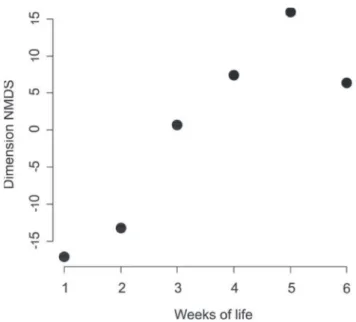
The behavioral repertoire of the workers was grouped by week and analyzed by Nonmetric Multidimensional Scal-ing (NMDS). The Bray-Curtis similarity matrix was used for the NMDS ordination, based on the workers’ behavioral repertoire according to the weeks of life. Behavioral data for the irst six weeks (days 1 to 49) were used for the NMDS analysis, because by that time more than 50% of the workers had died.
Determination of life expectancy and entropy
The workers’ life expectancy was calculated accord-ing to the methodology proposed by Carey (1993) and for the life-table construction and life-expectancy calculation, data were used for 145 workers, which were observed from emergence until death, by using the equation:
Where: Tx= total number of days at age x of survi-vors until the last possible day of life; x= age interval of 1 day; w= maximum age in days reached by the last surviving individual; Lx= mean probability of surviving between suc-cessive ages, calculated as Lx= lx-(dx)/2; lx= proportion of survivors among newly emerged workers in relation to age interval; dx= proportion of individuals that died between age x and x +1, calculated as dx= lx-lx +1. The remaining life expectancy (ex) of individuals at the beginning of each in-terval was calculated as ex= Tx/ lx.
of days lost by the population due to deaths and the number of days that the workers lived, was calculated by the equa-tion:
Where: ex= life expectancy at age x; dx= proportion of individuals that died between ages x and x +1; e0= life expectancy at age 0; and ew= maximum age reached by the last surviving individual.
According to Carey (1993), the lower the value of entropy, the later individuals tend to die; and the higher the entropy value, the higher is the mortality in the initial inter-vals. Therefore, in populations in which individuals reach their maximum longevity, the entropy value is closer to zero; while in populations where the mortality rate is very high in the initial intervals, this value is closer to 1.
Results
Temporal polyethism
The workers of P. c. canadensis performed 22 dif-ferent types of tasks during their lives, and the frequency of each act varied according to age (Fig 1). The behaviors of vibrating wings, cleaning cells, larva-adult trophallaxis, suffering physical dominance, checking cells with antennae, walking on the nest or on the substrate, moving the gaster, self-grooming, adult-adult trophallaxis, checking cells and immobile on the nest were performed more often by younger workers. On the other hand, the behaviors of removing lar-vae from the nest, destroying cells, rubbing the gaster on
the nest and oophagy were performed more often by older workers (Fig. 1).
With respect to foraging activity, the workers of P. c. canadensis started this behavior since the beginning of the irst week of life, and intensiied with the aging of the worker; however, the older females in the colonies did not forage (Fig 1).
Behaviors such as recognizing a newly emerged fe-male, larviphagy, and applying oral secretion on the nest or on the substrate were performed with similar frequencies in both younger and older workers. The nonmetric multidimen-sional scaling analysis (NMDS: R2 = 0.78, F = 14.5, p <0.02,
gl = 4) showed signiicant variation in the behavior of work -ers until the ifth week of life (Fig 2).
Determination of life expectancy and entropy
The mean longevity of the workers was 37.06 ± 29.07 days (1-126 days). The estimated life expectancy was ex= 36.56 days just after emergence, increasing to ex= 40.00 days on the eighth day of life. From that time until the worker reached the maximum longevity, life expectancy decreased more gradually (Fig 3). The highest mortality rate occurred during the irst week of life; 24.14% of the work -ers had died by the seventh day. Half of the work-ers did not reach 45 days, and only 9.65% exceeded 84 days (Fig 3).
The entropy found in P. c. canadensis was H = 0.750 (Fig 4), indicating a high mortality rate during the irst intervals. The survival curve remained between 0.5 and 1.0 until the last life interval of workers (Fig 4). Because of the high number of deaths during the irst days of life, the sur -vival curve for this species has a convex shape. This curve is more pronounced until the 10th day of life and then in-creases more gradually until the last day of life.
Discussion
The results found here demonstrate that the behav-ioral repertoire of the workers varies according to the age (Figs 1 and 2), although the NMDS indicated that this vari-ation occurs only until the ifth week of life, close to the worker’s mean life expectancy. The lack of a clear pattern of task execution after the ifth week shows that despite the existence of temporal polyethism, the workers have a strong “behavioral plasticity” after this age. Similar patterns were observed by Jeanne (1991) and Karsai and Wenzel (1998) in colonies with fewer than 100 individuals.
2001), A. pallipes (Nascimento et al., 2005) and Vespula germanica (Fabricius) (Hurd et al., 2007).
The degree of temporal polyethism also seems to be related to the size of the colony (Wilson, 1971; Thomas & Elgar, 2003), since the division of labor among workers increases as the colony grows (Jeanne, 1986). There is a clear division of tasks and workers in colonies of ants, bees, wasps and termites with thousands to millions of individu-als, and they are highly specialized (Hölldobler & Wilson, 1990; Pie, 2002). However, in small colonies of fewer than 100 individuals, the workers tend to perform different daily tasks, as in species of the genera Polistes (Post et al., 1988; Reeve, 1991), Bombus (Cameron & Robinson, 1990) and Belonogaster (Jeanne 1991).
Polyethism in M. mastigophorus is also affected by dominance interactions between queen and workers and be-tween workers (O’Donnell, 1998a). According to O’Donnell (1998b), the pattern of independent foundation in these wasps suggests that the state of dominance in queens and workers affects the performance and the division of labor among individuals in the colony.
In P. c. canadensis, the queens become more aggres-sive with workers as they age. The increased aggresaggres-siveness of the queen with older workers is known as gerontocracy (Strassmann & Meyer, 1983), in which the behaviors of physical dominance increase with the aging of the worker. This phenomenon was also observed by Pardi (1948) in Polistes gallicus (Linnaeus); Dew and Michener (1981) in P. metricus; and by Strassmann and Meyer (1983) in Polistes exclamans Viereck. However, West-Eberhard (1969) and Jeanne (1972), investigating colonies of Polistes erythro-cephalus (Latreille) and M. drewseni, respectively, observed that younger females are in positions just below the queen.
Figure 2. Ordination by Nonmetric Multidimensional Scaling (NMDS), indicating the behavioral variation according to age in workers of Polistes canadensis canadensis.
Although P. c. canadensis is considered a less-derived species, it displays temporal polyethism, which is considered “weak”. Studies such as those of Jeanne (1991) and Giray et al. (2005) found that species of independent-foundation show little or no correlation between age and the tasks per-formed by workers. As seen in other studies, younger work-ers of P. c. canadensis perform mainly intra-nest tasks, and as they age they begin to perform extra-nest tasks. However, after the ifth week they perform a wider variety of tasks, both intra- and extra-nest.
Studies by O’Donnell (1998a), Naug and Gadagkar (1998b), Shorter and Tibbetts (2008) and Togni and Gian-notti (2010) with Mischocyttarus mastigophorus (Richards), R. marginata, P. dominula and Mischocyttarus cerberus (Richards), respectively, have shown that even less-derived eusocial species have some degree of temporal polyethism. However, temporal polyethism is more evident and deined in the more-derived eusocial species, with large colonies and morphological differences between the castes (Naug & Gad-agkar 1998a), as observed in P. occidentalis (O’Donnell,
Figure 3. Life expectancy of workers of Polistes canadensis canadensis under ield conditions.
al-though JH accelerates ovarian development, it does not af-fect the temporal polyethism (Agrahari & Gadagkar, 2003). The estimated mean longevity of the workers was close to that reported for P. c. antennalis (Miyano, 1980). The survival curve was relatively convex, similar to that described by Jeanne (1972) in M. drewseni, whose work-ers live on average 31 days. Giannotti (1999) described a mean life expectancy of only 14.1 days in Mischocyttarus cerberus styx (Richards), shorter than the species described above. These authors argue that the onset of foraging activ-ity is directly linked to the longevactiv-ity of the workers.
Life tables and survival curves of Polistes (Epicne-mius) cinerascens (Saussure) (Giannotti, 1997) and Polistes lanio (Fabricius) (Giannotti & Machado, 1999) also show high rates of mortality in the irst age interval, which co -incides with the beginning of foraging activity. This rela-tionship was also observed by Simões and Zucchi (1980) in Protopolybia exigua exigua (Saussure) and by Post et al. (1988) in Polistes fuscatus variatus (Cresson). According to O’Donnell and Jeanne (1995), foraging activity implies a greater risk of predation, energy cost and physiological stress, thus reducing the life expectancy and longevity of the worker, and resulting in an entropy value closer to 1. The high mortality rate in P. c. canadenis also coincides with the beginning of foraging activity, as 65% of workers began foraging activity in their irst week of life.
The entropy value of H = 0.750 found here was close to that observed by Giannotti and Von Zuben (2000) for P. l. lanio (H = 0.869) and M. cerberus (H = 0.767), also less-derived species with small colonies in which workers begin foraging activity early.
Although P. c. canadensis has relatively small colo-nies, in which workers exhibit certain behavioral plasticity, they perform most of their repertoire in the irst weeks of life; however, it is possible to perceive a clear division of tasks by the ifth week. Thus, longevity and entropy are di -rectly inluenced by foraging activity early in the irst week of life.
Acknowledgments
To the Mato Grosso do Sul State University for the grants of PIBIC/UEMS, process No. 364/UEMS in March 2005. The “National Counsel of Technological and Scientif-ic Development” (CNPq) for the grants to Antonialli-Junior, W.F. The authors thank also Janet W. Reid (JWR Associ-ates) for the revision of the English text. Two anonymous reviewers provided valuable comments to the submitted manuscript.
References
Agrahari, M. & Gadagkar, R. (2003). Juvenile hormone ac-celerates ovarian development and does not affect age poly-ethism in the primitively eusocial wasp, Ropalidia margi-nata. J. Insect Physiol.,49: 217–222.
Altmann, J. (1974). Observational study of behavior: sam-pling methods. Behaviour, 49: 227–267.
Antonialli-Junior, W.F., Tofolo, V.C. & Giannotti, E. (2007). Population dynamics of Ectatomma planidens (Hymenoptera: Formicidae) under laboratory conditions. Sociobiology, 50: 1005–1013.
Beshers, S.N. & Traniello, J.F.A. (1996). Polyethism and the adaptiveness of worker size variation in the attine ant Tra-chymyrmex septentrionalis. J. Insect Behav., 9: 61–83.
Beshers, S.N. & Fewell, J.H. (2001). Models of division of labor in social insects. Annu. Rev. Entomol., 46: 413–440.
Cameron, S.A. (1989). Temporal patterns of division of la-bor among workers in the primitively eusocial bumble bee, Bombus griseocollis (Hymenoptera, Apidae). Ethology, 80: 137–151. DOI: 10.1111/j.1439-0310.1989.tb00735.x
Cameron, S.A. & Robinson, G.E. (1990). Juvenile-hormone does not affect division of labor in bumble bee colonies (Hy-menoptera, Apidae). Ann. Entomol. Soc. Am., 83: 626–631.
Carey, J.R. (1993). Applied demography for biologists. New York: Oxford University Press.
Dew, H.E. & Michener, C.D. (1981). Division of labor among workers of Polistes metricus (Hymenoptera, Vespidae) – lab-oratory foraging activities. Insectes Soc., 28: 87–101.
Giannotti, E. (1997). Biology of the wasp Polistes (Epicne-mius) cinerascens Saussure (Hymenoptera: Vespidae). An. Soc. Entomol. Bras., 26(1): 61–67.
Giannotti, E. (1999). Social organization of the eusocial wasp Mischocyttarus cerberus styx (Hymenoptera: Vespidae). So-ciobiology, 33: 325–336.
Giannotti, E. & Machado, V.L.L. (1994). Longevity, life table and age polyethism in Polistes lanio lanio (Hymenoptera, Vespidae), a primitive eusocial wasp. J. Adv. Zool., 15: 95–101.
Giannotti, E. & Machado, V.L.L. (1999). Behavioral castes in the primitively eusocial wasp Polistes lanio Fabricius (Hy-menoptera: Vespidae). Rev. Bras. Entomol., 43: 185–190.
Giannotti, E. & Von Zuben, C.J. (2000). Entropy of adult wasps of Polistes lanio and Mischocyttarus cerberus (Hy-menoptera, Vespidae), from colonies in ield condictions. XXI Int. Congress Entomol., Brazil, p.62–62.
Giray, T., Giovanetti, M. & West-Eberhard, M.J. (2005). Ju-venile hormone, reproduction, and worker behavior in the neotropical social wasp Polistes canadensis. Proc. Natl. Acad. Sci. U.S.A., 102: 3330–3335.
Grüter, C., Menezes, C., Imperatriz-Fonseca, V.L. & Rat-nieks, F.L.W.A. (2012). A morphologically specialized sol-dier caste improves colony defense in a neotropical eusocial bee. Proc. Natl. Acad. Sci. U. S. A., 109(4): 1182–1186.
Hölldobler, B. & Wilson, E.O. (1990). The ants. Cambridge: Harvard University Press.
Huang, Z.Y. & Robinson, G.E. (1996). Regulation of hon-ey bee division of labor by colony age demography. Behav. Ecol. Sociobiol., 39: 147–158.
Hurd, C.R., Jeanne, R.L. & Nordheim, E.V. (2007). Temporal polyethism and worker specialization in the wasp, Vespula germanica. J. Insect Sci., 7(43): 1–13.
Jeanne, R.L. (1972). Social biology of the neotropical wasp Mischocyttarus drewseni. Bull. Mus. Comp. Zool., 3: 63– 150.
Jeanne, R.L. (1986). The evolution of the organization of work in social insects. Monit. Zool. Ital., 20: 119–133.
Jeanne, R.L. (1991). Polyethism. In K.G. Ross & R.W. Mat-thews (Eds.), The Social Biology of Wasps (pp. 389 – 425). Ithaca, New York: Cornell University Press.
Karsai, I. & Wenzel, J.W. (1998). Productivity, individual-level and colony-individual-level lexibility, and organization of work as consequence of colony size. Proc. Natl. Acad. Sci. U.S.A., 95: 8665–8669.
Michener, C.D. (1974). The social behavior of the bees: a comparative study. Cambridge: Harvard University Press.
Miyano, S. (1980). Life tables of colonies and workers in a paper wasp, Polistes chinensis antennalis, in central Japan (Hymenoptera: Vespidae). Res. Popul. Ecol., 22: 69–88.
Nakata, K. (1996). The difference in behavioral lexibility
among task behaviors in a Ponerinae ant, Diacamma sp. So-ciobiology, 27(2): 119–128.
Nascimento, F.S., Simões, D. & Zucchi, R. (2005). Temporal polyethism and survivorship of workers of Agelaia pallipes. Sociobiology, 45: 377–387.
Naug, D. & Gadagkar, R. (1998a). Division of labor among a cohort of young individuals in a primitively eusocial wasp.
Behav. Ecol. Sociobiol., 42: 247–254.
Naug, D. & Gadagkar, R. (1998b). The role of age in tempo-ral polyethism in a primitively eusocial wasp. Behav. Ecol. Sociobiol., 42: 37–47.
Noirot, C. (1989). Social structure in termite societies. Ethol. Ecol. Evol., 1: 1-17.
O’Donnell, S. (1998a). Dominance and polyethism in the eus-social wasp Mischocyttarus mastigophorus (Hymenoptera: Vespidae). Behav. Ecol. Sociobiol., 43: 327-331.
O’Donnell, S. (1998b). Reproductive caste determination in eusocial wasps (Hymenoptera: Vespidae). Annu. Rev. Ento-mol., 43: 323–346.
O’Donnell, S. (2001). Worker age, ovary development, and temporal polyethism in the swarm-founding wasp Polybia occidentalis. J. Insect Behav., 14: 201–212.
O’Donnell, S. & Jeanne, R.L. (1995). Worker lipid stores decrease with outside-nest task-performance in wasps – im-plications for the evolution of age polyethism. Experientia, 51, 749–752.
O’Donnell, S., Reichardt, M. & Foster, R. (2000). Individual and colony factors in bumble bee division of labor (Bombus bifarius nearcticus Handl; Hymenoptera, Apidae). Insectes Soc., 47: 164–170.
Pardi, L. (1948). Dominance order in Polistes wasps. Physi-ol. ZoPhysi-ol., 21: 1–13.
Pardi, L. (1950). Recenti ricerche sulla divisione di lavoro negli imenotteri sociali. Boll. Zool., 17: 17–66.
Pie, M.R. (2002). Behavioral repertoire, age polyethism and adult transport in Ectatomma opaciventre (Formicidae: Pon-erinae). J. Insect Behav., 15(1): 25–35.
Post, D.C., Jeanne, R.L. & Erickson, E.H.Jr. (1988). Varia-tion in behavior among workers of the primitively social wasp Polistes fuscatus variatus. In R.L. Jeanne (Ed.), Inter-individual behavioral variability in social insects (pp. 283-322). Boulder, Colo: Westview Press.
Reeve, H.K. (1991). Polistes. In K.G. Ross & R.W. Matthews (Eds.), The social biology of wasps (pp. 99-149). Ithaca, New York: Cornell University Press.
Seeley, T.D. (1995). The wisdom of the hive: the social phys-iology of honey bee colonies. Cambridge: Harvard Univer-sity Press.
Shorter, J.R. & Tibbetts, E.A. (2008). The effect of juvenile hormone on temporal polyethism in the paper wasp Polistes dominulus. Insectes. Soc., 56: 7–13. DOI: 10.1007/s00040-008-1026-1
Sommeijer, M.J. (1984). Distribution of labor among work-ers of Melipona favosa: age polyethism and worker oviposi-tion. Insectes Soc., 31: 171–184.
Strassmann, J. E. & Meyer, D.C. (1983). Gerontocracy in the social wasp, Polistes exclamans. Anim. Behav., 31: 431– 438.
Thomas, M.L. & Elgar, M.A. (2003). Colony size affects di-vision of labour in the ponerine ant Rhytidoponera metallica. Naturwissenschaften, 90: 88–92.
Toilski, A. (2002). Inluence of age polyethism on longev -ity of workers in social insects. Behav. Ecol. Sociobiol., 51: 234–237.
Togni, O.C. & Giannotti, E. (2010). Colony defense behav-ior of the primitively eussocial wasp, Mischocyttarus cer-berus is related to age. J. Insect Sci., 10 (136): 1–14. DOI: 10.1673/031.010.13601.
Torres, V.O., Antonialli-Junior, W.F. & Giannotti, E. (2009). Divisão de trabalho em colônias da vespa social neotropi-cal Polistes canadensis canadensis Linnaeus (Hymenoptera, Vespidae). Rev. Bras. Entomol., 53(4): 593–599.
Tsuchida, K. (1991). Temporal behavioral variation and di-vision of labor among workers in the primitively eusocial wasp, Polistes jadwigae Dalla Torre. J. Ethol., 9: 129–134.
West-Eberhard, M. J. (1969). The social biology of polistine wasps. Misc. Publ. Mus. Zool. Univ. Mich., 140: 1–110.
Wilson, E.O. (1971). The Insect Societies. Cambridge: Har-vard University Press.
Wilson, E.O. (1976). Behavioral discretization and the num-ber of castes in an ant species. Behav. Ecol. Sociobiol., 1: 141–154.