EFFECT OF PRESERVATION METHOD AND STORAGE CONDITION ON ASCORBIC ACID LOSS IN BEVERAGES
Biljana R. Cvetković and Marija R. Jokanović
Global market is flooded with vitamin-enriched foods, mainly beverages. Major vita-mins for enriching beverages are the antioxidant vitavita-mins A, C and E. Ascorbic acid is readily oxidized and lost during storage of the beverages, at rates depending on the con-ditions of storage. This fact is of great importance for the consumer who must know how to store beverages and when to consume them in order to get the maximum benefit of ad-ded vitamin C. The objective of this paper was to determine the amount of ascorbic acid lost in beverages applying different preservation methods and storage condition. Beve-rage was made in laboratory conditions with synthetic L-ascorbic acid added according to the national legislations. After 30 days of storage at 4-8oC ascorbic acid overall loss was from 81.01% to 90.27% in thermally pasteurized samples and from 97.83 % to al-most complete loss in samples preserved with sodium benzoate.
KEY WORDS: L-ascorbic acid, colorimetric method, beverage, storage
INTRODUCTION
L-ascorbic acid is largely accepted as additive in human diets because of its anti-oxidative potential. The richest natural vitamin C sources are fruits and vegetables like pepper, rose hip, citrus fruit, and green vegetables. Fruits and vegetables supply more than 90% of vitamin C in human diets (1).
A high recommendation of daily intake for humans has been suggested, since stress in modern life is known to increase the requirement for vitamin C (2). L-ascorbic acid is nutrient that besides its vitamin action is valuable for its antioxidant effect, stimulation of the immune system and other health benefits, such as prevention of scurvy and mainte-nance of healthy skin, gums and blood vessels. Vitamin C also reportedly reduces the risk of arteriosclerosis, cardiovascular diseases and some forms of cancer.
Vitamin C is a generic name for all compounds exhibiting the biological activity of L-ascorbic acid (AA). AA is the principal biologically active form but L-dehydroL-ascorbic
acid (DHA), an oxidation product, also exhibits biological activity (3). Addition of syn-thetic ascorbic acid increases content of vitamin C, influences maintenance of colour, fla-vour and universal stability of the food products (fruit juices, beverages, baby food, etc.) (4). Natural and synthetic L-ascorbic acids are chemically identical and there are no known differences in their biological activities or bioavailability (5).
Based on available biochemical, clinical and epidemiological studies, the current recommended daily acceptance for ascorbic acid is suggested to be 100-120 mg/day to achieve cellular saturation and optimum risk reduction of heart diseases, stroke and can-cer in healthy individuals (6).
As a consequence of the common man’s increasing awareness regarding the im-portance of vitamin C, the global market is flooded with vitamin-enriched foods, mainly beverages. Major vitamins for enriching beverages are the antioxidant vitamins A, C and E. Vitamin C is usually added as ascorbic acid (7, 8). Fortification is a growing trend in soft drinks and in the dairy sector, and played a role in 8% of all new food and drink products introduced in 2003 (9).
L-ascorbic acid application in the food industry increases quality and technological properties of food, as well as nutritional value (10).
Ascorbic acid is highly sensitive to various modes of deterioration. The main factors that can affect ascorbic acid loss include temperature, salt and sugar concentration, pH, oxygen, light, metal catalysts, initial concentration of ascorbic acid, the ratio of ascorbic acid to dehydroascorbic acid, microbial load and protection by the container (11).
The loss of nutritional quality during processing and storage of food has become an important problem. Since the discovery of the basic vitamins and their many forms, ef-forts have been made to retain them in foods during post-harvest, commercial processing, distribution, storage and preparation. Vitamin C is usually selected as an index of the nutrient quality because of its labile nature as compared to the other nutrients in food (1).
The term beverages-soft drink originally applied to carbonated and non-carbonated drinks made from concentrates, although it now commonly refers to almost any cold drink that does not contain alcohol (12). Ascorbic acid added to beverages is readily oxidized and lost during staying, at a rate depending on the conditions of storage. This fact is of great importance to the consumer who must know how to store the beverages and when to consume them in order to get the maximum benefit of vitamin C content. (13). Determination of the nutrient content of foods is becoming extremely important as researchers learn more about the relationship between dietary intake and human health (14).
Various methods have been reported in the literature for the quantitative deter-mination of vitamin C in foods or biological fluids. The usual methods include titration (AOAC), colourimetric, spectrophotometry, fluorometry, electrophoresis, and high per-formance liquid chromatography (HPLC).
Objectives of this paper were:
a) preparation of non-alcoholic beverages in laboratory conditions with addition of synthetic ascorbic acid and two methods of preservation;
EXPERIMENTAL
Materials
Beverage preparation. Beverage was prepared by diluting commercial beverage concentrate (Aretol no. 72 408, Celje, Slovenia) in water in a ratio 3:97. Sugar was added like inverted syrup (dry matter content in the final product about 9.5 %), and then citric acid was added to get appopriate sensory characteristics. There were alltogether prepared 12 samples. Ascorbic acid was added in two concentrations: 100 mg/l and 150 mg/l. For thermal pasteurisation were transferred into 200 ml glass bottles, second part of samples were first preserved with sodium benzoate and than transferred into 200 ml glass bottles. Preservation. Twelve samples (with both AA added concentrations) were divided in two parts:
a) One part was thermally treated (pasteurisation). Thermal pasteurisation condi-tions (85oC, 15 minutes) were selected to be the same as in a conventional pasteurisation of industrially produced beverages.
b) The other part was preserved with sodium benzoate in concentration of 130 mg /l, in the final product, which is in accordance with national legislations (15).
Shelf-life study. Samples of beverages thermally pasteurised or preserved with sodi-um benzoate were stored in three different temperatures conditions: refrigerator (4-8oC), room temperature (20-22oC), and in a thermostat at 37oC. Samples were evaluated after 30 days of storage, by measuring ascorbic acid content.
Method
Determination of L-ascorbic acid. Ascorbic acid content was determined using co-lourimetric method. L-ascorbic acid reduces the tetrazolium salt MTT (3-(4,5-dimethyl-thiazolyl-2)-2,-diphenyltetrazolium bromide) in the presence of the electron carrier PMS (5-methylphenazinium methosulphate) at the pH 3.5 to a formazan (MTT-formazan), which is determined by measuring absorbance at 578 nm. Under the conditions stated in this procedure, assay is specific for L-ascorbic acid. The L-ascorbic acid content of these clear solutions was determined without any sample treatment. The detection limit of the method was 0.175 mg/l.
Each value was measured in triplicate and averaged with standard deviation.
RESULTS AND DISCUSSION
Table 1. Average ascorbic acid content with standard deviation and it loss in samples immediately after pasteurisation and preservation
Ascorbic acid content (mg/l) Samples
Pasteurisation Sodium benzoate preservation
100 mg/l added ascorbic acid 25.84 ± 3.58 71.19 ± 8.02
150 mg/l added ascorbic acid 37.66 ± 2.98 113.40 ± 8.35
According to Blasco et al. (2004), there are two different rates of ascorbic acid degra-dation observed during the heating process: an aerobic degradegra-dation followed by an anae-robic degradation. In the beginning of the heating process oxygen remains in the bottle and therefore aerobic degradation of the ascorbic acid with oxygen in abundance takes place. With prolonged time of heating the atmosphere in the bottle becomes saturated with vapour, so that the oxygen concentration is minimal and the ascorbic acid is degra-ded anaerobically (16).
During the preservation of beverages with sodium benzoate the loss of added ascorbic acid was much lower than in thermally treated samples. Immediately after preservation, the loss of ascorbic acid in samples with sodium benzoate was 24.40 % and 28.81 % for samples with 150 mg/l and 100mg/l added ascorbic acid, respectively.
74.16
28.81 74.89
24.4
0 10 20 30 40 50 60 70 80
Thermal pasteurisation Sodium benzoate preservation
A
s
co
rb
ic
a
c
id
lo
s
s
(%
)
100 mg/l added vitamin C 150 mg/l added vitamin C
Fig. 1. Ascorbic acid loss immediately after the two methods of preservation
Table 2. Average ascorbic acid content (mg/l) with standard deviations in the beverages after 30 days of storage at 4-8, 20-22 and 37oC
Pasteurisation Preserved with sodium-benzoate
Storage
temperature AA
150 mg/l
AA 100 mg/l
AA 150 mg/l
AA 100 mg/l
4-8oC 28.37 ± 1.26 2.17 ± 0.30 14.6 ± 1.99 0.43 ± 0.08
20-22oC nd* nd nd nd
97.83 99.57
81.01
90.26
0 20 40 60 80 100 120
Thermal pasteurisation Sodium benzoate preservation
A
sc
o
rb
ic
a
cid
lo
ss
(
%
)
100 mg/l added vitamin C 150 mg/l added vitamin C
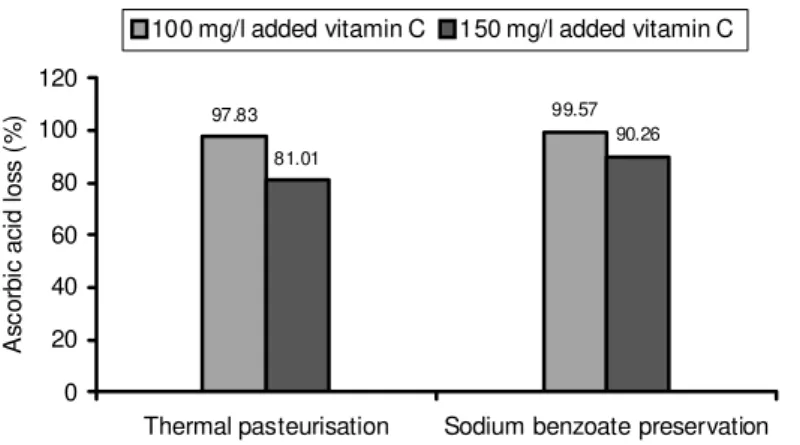
Fig. 2. Ascorbic acid loss after 30 days of storage in a refrigerator (4-8 oC)
Storage temperature had a great influence on ascorbic acid loss. After 30 days of sto-rage at room temperature (20-22oC) and in thermostat at 37oC ascorbic acid was not de-tected in any sample. After 30 days of storage at 4-8oC and thermal pasteurisation the overall loss of ascorbic acid was 81.01 % in samples with 150 mg/l added ascorbic acid, and 97.83 % in samples with 100 mg/l added ascorbic acid. In the beverages preserved with sodium benzoate after one month of storage at 4-8oC ascorbic acid overall loss was from 90.27 % in samples with added concentration of 150 mg/l to almost complete loss for samples with 100 mg/l of added ascorbic acid (Fig. 2). Heating method had a definite influence on the retention of ascorbic acid. According to Vikram et al. (2005), by each heating method of orange juice, temperature had a greater influence and the degradation was rapid at higher temperatures (17).
The decrease of ascorbic acid concentration to levels unacceptable by declaration or industrial practise often defines the product shelf life. During storage, the vitamin C con-tent gradually decreases at a rate depending on the processing and storage temperature. The more rapid decrease of ascorbic acid concentration at the beginning of the storage can be attributed to the immediate reaction of an amount of ascorbic acid with the dissol-ved oxygen (18).
Degradation of ascorbic acid both by aerobic and anaerobic pathways depends upon many factors such as oxygen, heat, light, storage temperature and storage time. Oxidation of ascorbic acid occurs mainly during the processing, whereas, anaerobic degradation of vitamin C mainly appears during storage, which is especially observed in thermally pre-served juices (10).
CONCLUSION
According to Blasco et al. (2004) there are two different rates of ascorbic acid de-gradation observed during the heating process: an aerobic dede-gradation, followed by an anaerobic degradation. In the beginning of the heating process oxygen remains in the bottle and therefore aerobic degradation of the ascorbic acid with oxygen in abundance takes place. With prolonged time of heating, the atmosphere in the bottle becomes satu-rated with vapour, so that the oxygen concentration is minimal and the ascorbic acid is degraded anaerobically (16).
The experiments have shown that L- ascorbic acid added like additive in non-alco-holic beverage is extremely unstable in water solution. The samples with a lower initial content of ascorbic acid lose it faster than those with a greater content. Ascorbic acid loss was greater in preserved than in pasteurised beverages. It should be recommended that beverage with ascorbic acid added should be consumed after preparation with no long time of storage.
ACKNOWLEDGEMENT
The authors gratefully acknowledge the financial support from the Ministry of Scien-ce and Technological Development of the Republic of Serbia (Project TP-20068).
REFERENCES
1. Erentuk. S, Gualaboglu M.S. and S. Gultekin: The effects of cutting and drying medium on the vitamin C content of rosehip during drying. Journal of Food Engine-ering 68 (2005) 513-518.
2. Olivier Fain: Musculoskeletal manifestations of scurvy, Review, Joint Bone Spine (2004).
3. Lee S. K. and Adel A. Kader: Preharvest and post harvest factors influencing vitamin C content of horticultural crops. Post harvest Biology and Technology 20 (2000) 207-220.
4. Del Caro A.: Changes of flavonoids, vitamin C and antioxidant capacity in minimally processed citrus segments and juices during storage. Food Chemistry 84 (2004) 99-105.
5. Lee H.S. and G. A. Coates: Vitamin C in frozen, fresh squeezed, unpasturized, poly-ethylene-bottled orange juice: storage study. Food Chemistry 65 (1999) 165-168. 6. Klimezak I., Malecka M., Szlahta M. and A. Gliszezynska-Swiglo: Effect of storage
on the content of polyphenols, vitamin C and the antioxidant activity of orange juices. Journal of Food Composition and Analysis 20 (2007) 313-322.
7. Arya S. P., Mahajan M. and P.Jain: Non-spectrophotometric methods for the deter-mination of Vitamin C. Analytica Chimica Acta 417 (2000) 1-14.
8. Rodriguez-Comesana M., Garcia-Falcon M. S. and J. Simal-Gandara: Control of nu-tritional labels in beverages with added vitamins: screening of β-carotene and ascor-bic acid contents. Food Chemistry 79 (2002) 141-144.
9. Prieto P. S., Grande C. B., Falkon G. S. and S. J. Gandara: Screening for folic acid content in vitamin-fortified beverages. Food Control 17 (2006) 900-904.
11.Zerdin K., Michael L. R. and J.Vermue: The vitamin C content of orange juice packed in an oxigen scavenger material. Food Chemistry 82 (2003) 387-395.
12.www.wikkipedia.org
13.Kabasakalis V, Siopidou D. and E. Moshatou: Ascorbic acid content of commercial fruit juices and its rate of loss upon storage. Food Chemistry 70 (2000) 325-328. 14.Gokmen V., Kahraman N., Demir N. and J. Acar: Enzymatically validated liquid
chromatographic method for the determination of ascorbic and dehydroascorbic acids in fruit and vegetables. Journal of Chromatography A, 881 (2000) 309-316.
15.Bylaw of quality and other conditions for aditives and their mixtures for food pro-ducts (Službeni list SRJ articles no. 56/2003, 4/2002 and 16/2005).
16.Blasco R., Esteve M. J., Frigola A. and M. Rodrigo: Ascorbic acid degradation kine-tics in mushrooms in a high-temperature short time process controlled by a thermo-resistometer. Lebensm.-Wiss. u.-Technol, 37 (2004) 171-175.
17.Vikram V. B., Ramesh M.N. and S.G. Prapulla: Thermal degradation kinetics of nu-trients in orange juice by electromagnetic and conventional methods. Journal of Food Engineering 69 (2005) 31-40.
18.Polydera A.C, Stoforos N.G. and P.S. Taoukis: Comparative shelf life study and vitamin C loss kinetics in pasteurized and high pressure processed reconstituted oran-ge juice. Journal of Food Engineering 60 (2003) 21-23.
ɍɌɂɐȺȳɆȿɌɈȾȿɄɈɇɁȿɊȼɂɋȺȵȺɂɍɋɅɈȼȺɋɄɅȺȾɂɒɌȿȵȺɇȺ ȽɍȻɂɌȺɄȺɋɄɈɊȻɂɇɋɄȿɄɂɋȿɅɂɇȿɍɈɋȼȿɀȺȼȺȳɍȶɂɆ
ȻȿɁȺɅɄɈɏɈɅɇɂɆ ɉɂȶɂɆȺ
. .
,
-.
, , . -
-, .
( )
.
.
, - .
30 4-8
81.01- 97.83% , 90- 99%.