Article
Digitizing information for wider reach through 'him-Padap-Sanklan',
an e-inventory of Himalayan flora
Amit Kumar, Sanjay Kumar Uniyal, Meenakshi, Rakesh D. Singh, Paramvir S. Ahuja
CSIR-Institute of Himalayan Bioresource Technology (IHBT), Council of Scientific & Industrial Research (CSIR), Palampur – 176 061, Himachal Pradesh, India
E-mail: [email protected]
Received 12 May 2014; Accepted 20 June 2014; Published online 1 September 2014
Abstract
‘him-Padap-Sankalan’ is a digital directory of floral resources of Himachal Pradesh H.P., a biologically rich state of the Himalayan Biodiversity hotspot. It provides information on nomenclature, taxonomic classification,
local name(s), trade name(s) and uses of 3348 plant species along with maps showing their distribution in H.P. The information housed in ‘Him-Padap-Sankalan’ has been compiled from published sources, primarily the
Flora of Himachal Pradesh: Analysis. The Graphic User Interface of the ‘him-Padap-Sankalan’ has been prepared using ASP.Net having MS-Access database in the back end. The 'scientific names', 'trade names', 'local names', 'synonyms', 'genus' and 'species' are the various search modules of ‘him-Padap-Sankalan’, which
can be accessed using an internet browser connected through local area network. Analysis of information reveals that of the 201 families, Poaceae, Asteraceae, Papilionaceae, Scrophularariaceae, Rosaceae,
Cyperaceae, Lamiaceae, Ranunculaceae, Brassicaceae and Apiaceae are the ten dominat families in the state. 24 families and 18 genera are common to all the 12 districts of H.P. The maximum number of families, genera and species are in Shimla district and the least in Bilaspur district of H.P.
Keywords database; Western Himalaya; flora; species richness; cluster analysis; map.
1 Introduction
The information technology has benefitted every sphere of life and the plant science communities in India is
no exception to it. In India, it has been utilized for preparing many databases on plants viz., the Foundation for Revitalisation of Local Health Traditions (FRLHT) has prepared a database (http://envis.frlht.org/indian-medicinal-plants-database.php) on the distribution and taxonomic details of medicinal plants of India. Sasya
Sahyadri (http://www.atree.org), a database on flora of Western Ghat, has been developed by Ashoka Trust for Research in Ecology and the Environment (ATREE). The himFlorIS(Kumar et al., 2010) is an information
system based on floristic survey in Himachal Pradesh prepared by CSIR-Institute of Himalayan Bioresource Computational Ecology and Software
ISSN 2220721X
URL: http://www.iaees.org/publications/journals/ces/onlineversion.asp RSS: http://www.iaees.org/publications/journals/ces/rss.xml
Email: [email protected] EditorinChief: WenJun Zhang
Technology, Palampur. ECAT(Chavan et al., 2003) is the web interface developed by National Chemical Laboratory, Pune that provides information on microbes, plants, animals etc. These databases are compilation
of information from various sources to a common platform and help in retrieving desired information in a single click. Therefore it makes the analyses faster, effortless and time efficient.
The necessity for development of electronic database has also been felt in the western Himalayan region
(Uniyal and Jaryan, 2012). The Himachal Pradesh (H.P.) in India is one of the biologically rich states of the Himalayan Biodiversity Hotspot (Myers et al., 2000)owing to its varied topography, altitudinal range and
climatic conditions. Administratively it has 12 districts, of which maximum forest cover is in Sirmaur (49.03 %) and lowest in Lahaul-Spiti district (1.40 %). The Lahaul-Spiti and parts of Kinnaur and Chamba districts represent the trans-Himalayan characteristics. Overall, 26.37 % geographical area of the state is
covered by forest (FSI, 2011). Altogether it harbors ca 3500 higher plants, of which nearly 500 are of medicinal importance and 150 are aromatic plants (Chauhan, 1999). These plants support the livelihood of the
inhabitants. Habitat degradation, excessive grazing, and over exploitation of these resources coupled with recent environmental changes are threatening the unique biodiversity of the state (Uniyal and Singh, 2012).
In order to monitor and conserve the plant resources, baseline information on plants of the region in the form of electronic database thus becomes imperative as it would be collation of various scattered information
in different formats (Jayakumar et al., 2001; Zhang and Wei, 2009; Ahmad et al., 2013; Baig et al., 2013; Fournier and Sanou, 2013; Podong and Poolsiri, 2013). Keeping this in mind 'him-Padap-Sanklan' has been developed using information gathered from published sources (Aswal, 1994; Chauhan, 1999; Chowdhery and
Wadhwa, 1984; Collett, 1984; Daliwal and Sharma, 1999; Gammie, 1979; Kaur and Sharma, 2004; Nair, 1977; Rau, 1975; Sabnis, 1986; Sinha, 1992; Singh, 1999; Singh and Rawat, 2000; Singh and Sharma, 2006).
Fig. 2 Data flow diagram of ‘him-Padap-Sanklan’.
2 'him-Padap-Sanklan' Framework
The 'him-Padap-Sanklan' is a web application, which is presently accessible through local area network
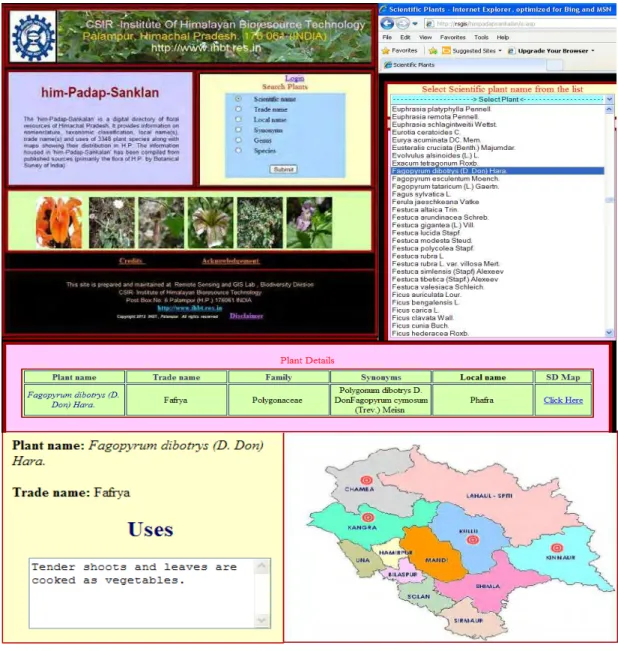
through an internet browser and is planned to be put on web server for general users. The graphic user interface of the 'him-Padap-Sanklan' (Fig. 1) has been designed using Active Server Pages (ASP 2.0). The
CPU with 1024 MB or more RAM, 1280x1024 display, 7200 RPM with a web browser (Internet Explorer 6.0 or higher) installed on it.
It consists of 6 cross search modules such as 'scientific names', 'trade names', 'local names', 'synonyms', 'genus' and 'species'. Since these modules are interlinked, the search query using one module returns the output from the other modules (Fig. 2). In other words, a query based on scientific name of a plant, provides
information on its trade name, local name, synonyms, genus and species.
The 'him-Padap-Sanklan' also provides information on uses of plants and their distribution on the map of
H.P. The dynamic feature to enter a new record or to edit the existing record based on appropriate user right has also been provided in 'him-Padap-Sanklan'. This can be done using 'enter plant detail' or 'update record' windows evoked by 'login' option provided in the 'him-Padap-Sanklan'.
3 Results and Discussion
'him-Padap-Sanklan' is an electronic directory of 3348 plant species distributed across H.P. that belong to 201 families representing 1150 genera. Of the total species, trade names of 148 species, synonyms of 949 species, local names of 1138 species and uses of 386 species have been provided in 'him-Padap-Sanklan'. Shimla
district reported the highest species (1948), families (159) and genera (819) richness (Fig. 3). It was followed by Chamba, Kinnaur and Kullu districts. Bilaspur, on the other hand, reported least values for species (113),
families (45) and genera (95).
Number of Families
Number of Genera
Number of Species
Fig. 4 Family-wise status of plant species in H.P.
The Poaceae, Asteraceae, Papilionaceae, Scrophularariaceae, Rosaceae, Cyperaceae, Lamiaceae,
Ranunculaceae, Brassicaceae, Apiaceae were observed to be the most 10 dominant families of H.P., which comprised of almost 50% of the total species recorded in the state (Fig. 4). Amongst the genera Carex,
Polygonum, Astragalus, Poa, Eucalyptus, Gentiana and Pedicularis are the dominant genera in the state.
Table 1 District-wise dominant families with their number of species in H.P.
District Families (no. of species)
Bilaspur Asteraceae (19), Poaceae (19), Lamiaceae (08), Mimosaceae (06), Euphorbiaceae (05),
Papilionaceae (03), Polygalaceae (03)
Chamba Asteraceae (173), Poaceae (150), Papilionaceae (104), Lamiaceae (77), Ranunculaceae (75)
Hamirpur Asteraceae (21), Poaceae (21), Lamiaceae (10), Euphorbiaceae (08), Mimosaceae (06)
Kangra Asteraceae (100), Poaceae (72), Lamiaceae (54), Papilionaceae (46), Rosaceae (31)
Kinnaur Asteraceae (164), Poaceae (141), Papilionaceae (80), Lamiaceae (69), Rosaceae (63)
Kullu Asteraceae (172), Poaceae (136), Papilionaceae (74), Lamiaceae (70), Ranunculaceae (64)
Lahaul-Spiti Asteraceae (165), Poaceae (113), Papilionaceae (63), Brassicaceae (60), Ranunculaceae (59)
Mandi Asteraceae (42), Poaceae (41), Lamiaceae (32), Rosaceae (12), Cyperaceae (11)
Shimla Asteraceae (194), Poaceae (172), Papilionaceae (145), Lamiaceae (81), Rosaceae (67)
Sirmaur Asteraceae (79), Poaceae (78), Papilionaceae (54), Lamiaceae (45), Rosaceae (28)
Solan Poaceae (50), Asteraceae (17), Lamiaceae (12), Papilionaceae (06), Solanaceae (05)
Una Poaceae (29), Asteraceae (22), Lamiaceae (11), Euphorbiaceae (09), Papilionaceae (08)
Asteraceae and Poaceae are the dominant families in all the districts of H.P. (Table 1). The genera
Cyperus has maximum representation in Chamba, Kangra, Mandi and Sirmaur district while Bilaspur and Hamirpur has maximum representation of Acacia. Carex in Kinnaur, Kullu and Lahaul-Spiti, Eucalyptus in Shimla, Digitaria in Una, and Bothriochloa, Cymbopogon, Datura, Eragrostis, Panicum and Rabdosia in Solan dominate the flora in the respective districts (Table 2).
Poaceae Asteraceae Papilionaceae
Scrophulariaceae Rosaceae Cyperaceae Lamiaceae Ranunculaceae
Table 2 District-wise dominant genera with their number of species in H.P.
District Genera (no. of species)
Bilaspur Acacia (3), Euphorbia (3), Polygala (3), Senecio (3), Setaria (3), Albizia (2), Blumea (2), Corydalis (2), Inula (2), Ixeris (2), Nepeta (2), Rabdosia (2), Sida (2)
Chamba Cyperus (16), Pedicularis (16), Polygonum (15), Impatiens (14), Berberis (13), Geranium (13), Nepeta (13), Salix (13), Saxifraga (13), Senecio (13), Thalictrum (13), Astragalus (12), Carex (12), Corydalis (12), Euphorbia (12), Gentiana (12), Ranunculus (12), Saussurea (12), Sedum (12), Silene (12), Veronica (12)
Hamirpur Acacia (3), Euphorbia (3), Senecio (3), Albizia (2), Bauhinia (2), Blumea (2), Bothriochloa (2), Cassia (2), Corydalis (2), Cyperus (2), Digitaria (2), Diospyros (2), Inula (2), Ixeris (2), Nepeta (2), Paspalum (2), Phyllanthus (2), Polygala (2), Rabdosia (2), Setaria (2)
Kangra Cyperus (13), Ficus (11), Euphorbia (10), Swertia (10), Polygonum (09), Senecio (09), Ranunculus (09)
Kinnaur Carex (16), Saussurea (16), Polygonum (15), Cotoneaster (14), Artemisia (13), Berberis (13), Bupleurum (13), Lactuca (13), Nepeta (13), Pedicularis (13), Euphorbia (12), Gentiana (12), Senecio (12), Thalictrum (12)
Kullu Carex (19), Euphorbia (16), Polygonum (16), Impatiens (15), Gentiana (14), Saussurea (14), Saxifraga (14), Cyperus (13), Nepeta (13), Pedicularis (13), Poa (13), Sedum (13), Senecio (13) Lahaul-Spiti Carex (26), Astragalus (23), Poa (22), Polygonum (20), Artemisia (19), Pedicularis (19) Mandi Cyperus (6), Ficus (5), Acacia (4), Euphorbia (4), Inula (4), Nepeta (4), Quercus (4), Rabdosia
(4), Ranunculus (4), Salvia (4), Solanum (4), Terminalia (4), Aristida (3), Cassia (3), Clematis
(3), Eucalyptus (3), Galium (3), Jasminum (3), Phragmites (3), Polygala (3), Potentilla (3), Rosa (3), Scrophularia (3), Senecio (3), Setaria (3)
Shimla Eucalyptus (26), Berberis (18), Cyperus (18), Astragalus (17), Carex (17), Gentiana (17), Impatiens (17), Senecio (17), Euphorbia (16), Polygonum (16)
Sirmaur Cyperus (13), Desmodium (8), Euphorbia (8), Impatiens (8), Cassia (7), Eragrostis (7), Ipomoea (7), Solanum (7), Anemone (6), Ficus (6), Galium (6), Inula (6), Nepeta (6), Acacia (5), Anaphalis (5), Flemingia (5), Gentiana (5), Jasminum (5), Phyllanthus (5), Plantago (5), Polygonum (5), Prunus (5), Quercus (5), Senecio (5)
Solan Bothriochloa (3), Cymbopogon (3), Datura (3), Eragrostis (3), Panicum (3), Rabdosia (3), Acer (2), Aristida (2), Arthraxon (2), Aster (2), Blumea (2), Bromus (2), Campanula (2), Capillipedium (2), Cassia (2), Digitaria (2), Eucalyptus (2), Eulalia (2), Ficus (2), Geranium (2), Grewia (2), Inula (2), Jasminum (2), Oplismenus (2), Pistacia (2), Polygala (2), Salix (2), Salvia (2), Scutellaria (2), Sida (2), Sorghum (2)
Una Digitaria (4), Acacia (3), Blumea (3), Cyperus (3), Diospyros (3), Euphorbia (3), Nepeta (3), Panicum (3), Senecio (3), Albizia (2), Argemone (2), Aristida (2), Bauhinia (2), Brachiaria (2), Cassia (2), Corydalis (2), Datura (2), Fimbristylis (2), Grewia (2), Inula (2), Ipomoea (2), Ixeris (2), Jasminum (2), Oplismenus (2), Phyllanthus (2), Polygonum (2), Rabdosia (2), Scirpus (2), Setaria (2), Sida (2), Terminalia (2), Trichodesma (2)
The Family to Genus and Family to Species ratio are highest in case of Shimla district but the Genus to
2012). Bilaspur is amongst the smaller district of H.P., while Lahaul-Spiti is the largest.
Table 3 District-wise species richness in H.P.
District Species
( No.) Area (km
2
) Species Richness (No./km2)
Bilaspur 113 1167 0.0968
Chamba 1771 6528 0.2713
Hamirpur 133 1118 0.1190
Kangra 945 5739 0.1647
Kinnaur 1553 6401 0.2426
Kullu 1546 5503 0.2809
Lahaul- Spiti 1220 13833 0.0882
Mandi 393 3951 0.0995
Shimla 1984 5131 0.3867
Sirmaur 846 2825 0.2995
Solan 212 1936 0.1095
Una 186 1549 0.1201
We also worked out the species richness per unit area for each of the district. This was obtained by dividing the total species in a district by the area of that particular district (Table 3). The species richness in H. P. ranged from 0.08 to 0.38 species/km2. The species richness is highest in Shimla district and lowest in
Genus: Species Family: Species
Family: Genus
Lahaul-Spiti, which is a cold desert region. Sirmaur reported 0.29 species/km2 followed by Kullu (0.28 species/km2), Chamba (0.27 species/km2), Kinnaur (0.24 species/km2), Kangra (0.16 species/km2), Una (0.12 species/km2), Hamirpur (0.119 species/km2), Solan (0.110 species/km2), Mandi (0.099 species/km2), Bilaspur (0.097 species/km2).
The district wise cluster analysis (Statistica, 2004) of species richness resulted in two distinct clusters (Fig.
6). The first cluster is represented by Mandi, Hamirpur, Bilaspur, Solan and Una districts which primarily have sub-tropical climate. The districts in the second cluster are comperatively at higher altitude and are
governed by temperate climate.
The 24 families namely Acanthaceae, Asclepiadaceae, Asteraceae, Brassicaceae, Caesalpiniaceae, Convolvulaceae, Cuscutaceae, Cyperaceae, Dioscoreaceae, Ebenaceae, Euphorbiaceae, Fumariaceae,
Lamiaceae, Liliaceae, Malvaceae, Mimosaceae, Orchidaceae, Papilionaceae, Poaceae, Polygalaceae, Ranunculaceae, Rutacceae, Solanaceae and Verbenaceae, and 18 genera namely Aristida, Blumea, Cardamine,
Cuscuta, Cyperus, Dioscorea, Diospyros, Eragrostis, Erigeron, Euphorbia, Habenaria, Inula, Leucaena,
Polygala, Rabdosia, Setaria, Solanum and Tricholepis are found in all the 12 districts of H.P. There are 21 families, 190 genera and 920 species which are recorded from only one district of the state.
A comparision between number of families, genera and species compiled in 'him-Padap-Sanklan' and the same information reported in recently published district flora for Chamba, Kullu, Lahaul-Spiti and Sirmaur
districts of H.P. has been provided in Table 4.
Interestingly, a deficit of taxa is observed for two out of four districts. The recently published flora of Chamba and flora of Kullu report lesser species as compared to earlier estimates. This points to either loss of
species over the time period or limited surveys not encompassing the diverse resources (Vats and Singh, 2002). These species thus require our focus for their relocation. This is one of the many advantages that digitized
informations offer to the users.
Table 4 Comparision between 'published flora' and 'him-Padap-Sanklan'. Families (No.) Genera (No.) Species (No.) Families (No.) Genera (No.) Species (No.)
Flora of Chamba 113 545 1005 'him-Padap-Sanklan' 156 751 1771
Flora of Kullu 126 504 930 'him-Padap-Sanklan' 144 674 1546
Flora of Lahaul-Spiti 79 353 985 'him-Padap-Sanklan' 109 432 985
Flora of Sirmaur 139 544 898 'him-Padap-Sanklan' 124 492 846
4 Conclusion
The 'him-Padap-Sanklan' provides online information on floral resources of H.P., which is presently available in published flora and literature. Accessing and analysing these resources is sometime tedious and difficult.
The present digitized database in the form of 'him-Padap-Sanklan' is expected to rule out these constraints. These digitized information can be conveniently retrieved by interactive user-friendly queries option in the
'him-Padap-Sanklan'. In addition, it also helped in generating various baseline information through analyses of e-inventory. The database may also be analised by researchers, planners, administrators or a common user of any discipline in their own way to retrieve desired result. Maps showing distribution of species across the H.P.
is a unique feature of this application.
Acknowledgements
The authors acknowledge Botanical Survey of India (BSI), Kolkata for permitting the digitization of
information provided in the Flora of Himachal Pradesh Analysis (1984) by Chowdhery, H. J. and Wadhwa (Volumes 1-3). We also thank staff of Biodiversity division of CSIR- IHBT, Palampur for their support. The
Council of Scientific and Industrial Research (CSIR) is acknowledged for financial help. This is IHBT Communication No. 3426.
References
Ahmad S, Dar HU, Dar JA, et al. 2013. Impact of varying disturbances on the structure and composition of grassland vegetation in Anantnag, Kashmir Himalayas. Proceedings of the International Academy of
Ecology and Environmental Sciences, 3(3): 219-228
Aswal. 1994. Flora of Lahaul-Spiti (A Cold Desert in North West Himalaya). Bishen Singh Mahendra Pal Singh, Dehradun, India
Baig BA, Ramamoorthy D,Bhat TA. 2013. Threatened medicinal plants of Menwarsar Pahalgam, Kashmir Himalayas: Distribution pattern and current conservation status. Proceedings of the International Academy
of Ecology and Environmental Sciences, 3(1): 25-35
Chauhan NS. 1999. Medicinal and Aromatic Plants of Himachal Pradesh. Indus Publishing Company, New Delhi, India
Chavan V, Watve A, Krishnan S. 2003. Electronic catalogue of known Indian fauna. Current Science, 85(11): 1515
8(3): 321-348
Chowdhery HJ, Wadhwa BM. 1984. Flora of India series 2 Flora of Himachal Pradesh Analysis (Vol 1-3).
Botanical Survey of India, Kolkata, India
Collett H. 1984. Flora Simlensis (Himachal Pradesh). International Book Distributer, Dehradun, India
Daliwal DS, Sharma M. 1999. Flora of Kullu District (Himachal Pradesh). Bishen Singh Mahendra Pal Singh,
Dehradun, India
Fournier A, Sanou L. 2013. Revisiting plant conservation on wooded shrines by a transversal approach: "Core"
vs. "satellite" species and anthropological knowledge in Bwaba land, Burkina Faso. Environmental Skeptics and Critics, 2(1): 1-19
FSI. 2011. State of Forest Report 2011. Forest Survey of India, Ministry of Environment and Forest (MoEF),
Government of India. Dehradun, Uttarakhand, India
Gammie GA. 1979. A Botanical Tour in Chamba and Kangra. Periodical Experts Book Agency, Delhi, India.
http://envis.frlht.org/indian-medicinal-plants-database.pH.P. Accessed on 10.04.2014 Http://www.atree.org. Accessed on 10.04.2014
Jayakumar S, Kim SS, Heo J. 2011. Floristic inventory and diversity assessment - a critical review.
Proceedings of the International Academy of Ecology and Environmental Sciences, 1(3-4): 151-168 Kaur H, Sharma M. 2004. Flora of Sirmaur (Himachal Pradesh). Bishen Singh Mahendra Pal Singh, Dehradun,
India
Kumar A, Meenakshi, Uniyal SK, BrijLal, Chawla A, Rajkumar S, Ahuja PS. 2010. HimFlorIS – an
information system for flora in Himachal Pradesh, India. Current Science, 99(1): 98-101
Myers N, Russell AM, Cristina GM, et al. 2000. Biodiversity hotspots for conservation priorties. Nature, 403: 853-858
Nair NC. 1977. Flora of Bashahr Himalayas. International Bioscience Publications, Delhi, India
Podong C, Poolsiri R. 2013. Forest structure and species diversity of secondary forest after cultivation in
relation to various sources at lower northern Thailand. Proceedings of the International Academy of Ecology and Environmental Sciences, 3(3): 208-218
Rau MA. 1975. High Altitude Flowering Plants of West Himalaya. Botanical Survey of India, Calcutta, India
Sabnis TS. 1986. Flora of Punjab and Associated Hills Regions. Scientific Publishers Jodhpur, India Sinha BK. 1992. Flowering Plants of Palampur. CSIR Complex, Palampur Himachal Pradesh, India
Singh H, Sharma M. 2006. Flora of Chamba District (Himachal Pradesh). Bishen Singh Mahendra Pal Singh, Dehradun, India
Singh P B. 1999. Commercially Important Medicinal and Aromatic Plants of Himachal Pradesh. Society for
Herbal Medicine and Himalyan Biodiversity, Ram Nager Mandi, Himachal Pradesh, India
Singh SK, Rawat GS. 2000. Flora of Great Himalayan National Park (Kullu - H.P). Bishen Singh Mahendra
Pal Singh, Dehradun, India
Statistica. 2004. Statistica Electronic Manual. Statsoft Inc., USA
Uniyal SK, Jaryan V. 2012. Need for a centralized digital inventory on floral additions. Current Science, 102
(4): 544-545
Uniyal SK, Singh RD. 2012. Natural resources assessment and their utilization analyses from a Himalayan
state. Environment Monitoring and Assessment, 184: 4903-4919
Vats SK, Singh RD. 2002. The accuracy of floristic surveys and digitizing biodiversity. Current Science, 82(10): 1194