Implementation of I2C-DMA & SPI-DMA Interface: A
Comparative Study
Gurkesar *, Abhishek Godara**, Anju Kamboj***
* Student (M.Tech), Department of Electronics and Communication, Shaheed Udham Singh College of Engg. And Technology, Tangori, Mohali (Punjab).
**Assistant Professor, Department of Electronics and Communication, Shaheed Udham Singh College of Engg. And Technology, Tangori, Mohali (Punjab)
***Assistant Professor, Department of Electronics and Communication, Shaheed Udham Singh College of Engg. And Technology, Tangori, Mohali (Punjab)
ABSTRACT
This paper describes the designing and implementation of I2C (master)-DMA and SPI (master)-DMA interface. Direct Memory Access (DMA), being the feature of modern computers and microprocessors permits certain hardware subsystem in a computer machine to access system memory for reading/writing independently of CPU. Sometimes CPU is fully occupied for entire duration of read/write operation and unavailable to perform other work. With DMA, CPU would initiate data transfers and performs other operations while transfer is in progress. For intra-chip serial data transfers, SPI and I2C are used. Both serial protocols are widely used but both have some merits and demerits. In this research work both protocols are interfaced with DMA for SoC (System on Chip) applications and their performance analysis is carried out by implementing on FPGA. VERILOG-HDL is used for designing RTL Code and test-bench verification. Simulations are observed in Modelsim-Altera 6.3 (Quartus II 8.1) simulator.
Keywords
– SPI, I2C, DMA, FPGA, CPU, SoCI.
INTRODUCTION : DMA (Direct
Memory Access)
DMA allows an I/O device to communicate directly to the main memory bypassing CPU (Central Processing Unit) in order to speed up memory operations. When the CPU is using programmed input/output (I/O) without DMA, it is fully occupied for the entire duration of the read/write operation, and is thus unavailable to perform other work. When used with DMA, the CPU initiates the transfer, does other operations while the transfer is in progress, and receives an interrupt from the DMA controller ( a special purpose processor used to transfer data between memory and I/O devices) when the operation is done. This is especially useful in real-time computing applications where not stalling behind concurrent operations is critical. Another related application area is various forms of stream processing where it is essential to have data processing and transfer in parallel, in order to achieve sufficient throughput. Many hardware systems use DMA including disk drive controllers, graphics cards, network cards and sound cards [1][2].
DMA is also used for intra-chip data transfer in multi-core processors, especially in multiprocessor system-on-chips, where its processing element is equipped with a local memory (often called scratchpad RAM) and DMA is used for transferring data between the local memory and the
main memory. Computers that have DMA channels can transfer data to and from devices with much less CPU overhead than computers without a DMA channel. Similarly a processing element inside a multi-core processor can transfer data to and from its local memory without occupying its processor time and allowing computation and data transfer concurrency [3] [4].
II.
SERIAL DATA
COMMUNICATION: I2C & SPI
(SDA) and serial clock (SCL). There is no need of chip select (slave select) or arbitration logic. Any number of slaves and any number of masters can be connected onto these two signal lines and communicate between each other using a 7-bit slave addresses (each device connected to the bus has a unique address). As shown in Fig.1 the I2C bus consists of two wires SDA and SCL and pull up resistors. Both SDA and SCL are open drain drivers i.e. chip can drive its output low but cannot drive it high. For the line to go high pull up resistors are used with 5 volt supply [6].
Figure 1 I2C Communication
The device which initiates the data transfer is known as bus master and at that time, all other devices are treated as bus slaves. The bus master initiates the data transfer by issuing a START condition. After this master sends the address of the device which it wants to access along with read/write condition. After receiving the address, the devices connected to the bus will match with their own addresses. If the match doesn’t occur they will wait till the STOP condition but if the address matches, an ACKNOWLEDGEMENT signal is produced by the chip. After receiving the ACKNOWLEDGMENT signal master initiates the data transfer. When data transfer is complete master issues a STOP condition. Fig.2 shows the START and STOP condition of I2C bus [6] [7] [10].
Figure 2 START and STOP condition of I2C.
Whereas in case of SPI, situation is little bit different. SPI was designed by Motorola (NXP semiconductors) in 1979. It uses 3+N wire where N
in the number of slaves. Generally it is used for point to point communication i.e. single master –slave configuration [8].
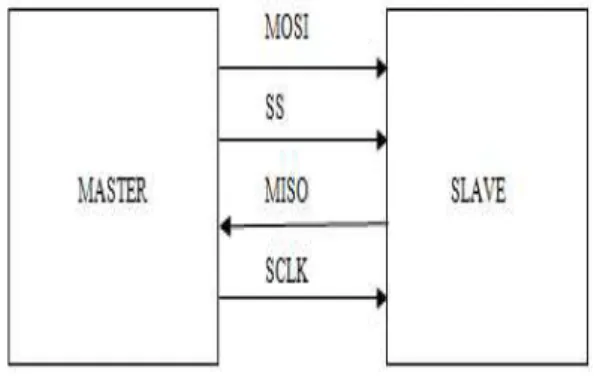
Fig.3 shows SPI. There are two wires for data transmission and reception, MOSI (Master Out Slave In) and MISO (Master In Slave Out). SS pin which is active low is used for slave select (in case when number of slave are more than one SS signal may be used depending upon number of slaves). SCLK signal is the SPI clock signal which is generated by Master and data communication will occur on the edges of SCLK [9] [10].
Figure 3 SPI Configuration
Selection between I2C and SPI requires a good understanding of advantages and disadvantages of both the protocols. Following points shows the comparison of both the protocols:
I2C requires only two wires, while SPI requires 3+N wires( N- Number of slaves)
SPI supports higher speed full-duplex communication while I2C is half duplex and slower.
I2C supports multiple devices on the same bus without additional select signal lines while SPI requires additional signal lines to manage multiple devices on the same bus (best suited for singles master single slave communication). I2C ensures that data sent is received by the
slave device (Acknowledgement signal) while SPI does not verify that data is received correctly or not.
I2C is cheaper to implement than the SPI communication protocol.
SPI only supports one master device on the bus while I2C supports multiple master devices. I2C is less susceptible to noise than SPI
I2C can transmit data over much greater distances, although at low data rates as compared to SPI [5].
applications while I2C is better for suited to communication with a large number of peripherals and dynamic changing of the master device role among the peripherals on the I2C bus.
Both SPI and I2C are robust, stable communication protocols for embedded applications that are well suited for the embedded world [10] [11].
III.
S
YSTEMA
RCHITECTUREThe Fig.4 shows the proposed system architecture comprising of I2C master/SPI master module, Transmit and receive interface and DMA block with transmit and receive FIFO. In this architecture both SPI master and I2C master are working in half duplex mode. Both IPs communicates with DMA’s Transmit and Receive FIFO through transmit and receive IP interfaces. At one instance I2C master is interfaced with DMA and then SPI master is interfaced with DMA. Both IPs transmit data through TX register and receive data through RX register.
Figure 4 DMA-I2C/SPI Interface.
IV.
R
ESULTS ANDS
IMULATIONS The RTL view and Hierarchal view of I2C master is shown in Fig.5.Figure 5 Hierarchal and RTL view of I2C master.
The hierarchal view is obtained on Lattice
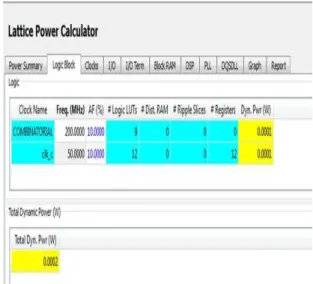
XP2 FPGA kit and RTL view is obtained on Synplify Pro tool. Fig.6 (a), 6(b) and 6 (c) shows the test-bench simulation of I2C-master on Modelsim, calculated dynamic power, number of LUTs, Data path delay.
Figure 6 (a) Test-bench waveform of I2C-Master.
As shown in Fig. 6 (a), I2C- master consists of mainly 4 ports i.e. clock, Reset, SDA and SCL. TX_dat is the transmit data register. The data i.e. 00110011 is transmitted through SDA w.r.t. SCL.
Figure 6 (b) Number of LUTs and Dynamic power calculations.
Figure 6 (c) Timing Path considerations
Fig.7 shows the hierarchal and RTL view of SPI master on FPGA board. The hierarchal view is obtained on Lattice XP2 FPGA kit and RTL view is obtained on Synplify Pro tool.
Figure 7 Hierarchal and RTL view of SPI-Master.
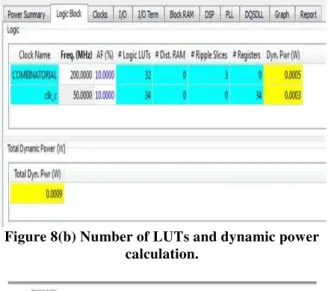
Fig. 8(a), 8(b) & 8(c) shows the test-bench simulation of SPI-master on Modelsim, number of LUTs, dynamic power consumed and timing considerations.
Figure 8 (a) Test-bench waveform of SPI-Master.
SPI-master transmits the data through MOSI
and receives through MISO. The highlighted ports in test-bench waveform shows SCLK, datatx ( tranmit data), SSbar, MISO, MOSI and datarx(receive data). Here, SCLK is divide by 4 of proclk (system clock) depending upon the different baud rate divisor values.
Figure 8(b) Number of LUTs and dynamic power calculation.
Figure 8(c) Timing Path considerations.
The total dynamic power consumed is 0.9 mW, number of LUTs are 66 and data path delay is 6.77 ns. Now, as compared to I2C master, all parameters are greater in number. So, from above discussion I2C consumes low power, less area (number of LUTs) and lesser delay.
Figure 9 I2C-DMA TX-interface.
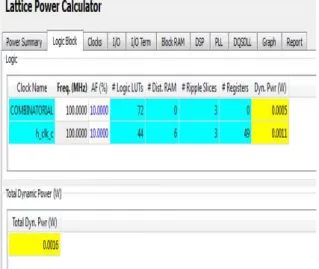
Fig.10 shows the power and area calculation of the design on Lattice diamond XP2 FPGA.
Figure 10 Power and area calculation of I2C-DMA interface.
At frequency of 100 Mhz (h_clk_c) the area (LUTs) consumed by the design is 116 LUTs and dynamic power by both the clocks is 1.6 mW. The total power consumed by the design is shown in Fig.11.
Figure 11 Total power consumption
The total dynamic power consumption of I2C-DMA interface is 18.4 mW. Also, power consumed by different blocks ( logic blocks, PLL, IO,RAM) is 0.1154 W. Maximum frequency for clock(h_clk) is 150.580 MHz.
Fig. 12 shows the SPI-DMA transmit interface. Similar to I2C-DMA interface, SPI also communicates with DMA through transmit and receive interfaces.
Figure 12 SPI-DMA TX-interface.
Figure 13 shows the power and area calculation of the design on Lattice diamond XP2 FPGA.
Figure 13 Power and area calculation of SPI-DMA interface.
At the frequency of 100 Mhz (h_clk_c) the area (LUTs) consumed by the design is 141 LUTs and dynamic power by both the clocks is 1.8 mW. The total power consumed by the design is shown in Fig.14
Figure 14. Total power consumption
The total dynamic power consumption of I2C-DMA interface is 22.9 mW. Also, power consumed by different blocks ( logic blocks, PLL, IO,RAM) is 0.1217 W. Maximum frequency for clock(h_clk) is 162.048 MHz.
The performance comparison between both the protocols and I2C-DMA and SPI-DMA interface is shown in table1.
Table 1 Performance comparison Lattice XP2 (Performance parameters) I2C-Master (50 MHz) SPI-Master (50 MHz) I2C-DMA (100 MHz) SPI-DMA (100 MHz) AREA (LUTs) 21 66 116 141 POWER (mW) 0.2 0.9 1.6 1.8 Dealy(ns) 1.637 6.77 4.898 4.617
V.
CONCLUSION
A practical comparative study has been discussed. This comparison is limited to the master side of I2C and SPI. Both protocols are interfaced with DMA in transmit mode. The paper has shown up the results of FPGA implementation of I2C/SPI –DMA interface (transmit mode). Area, power and delay of I2C master is better than SPI-master. I2C master-DMA interface consumes less area (LUTs) and low power as compared to SPI master-DMA interface. A difference of 45 LUTs has been observed between both the designs. But, in case of delays SPI master-DMA interface is better. So, both the designs have their own importance in SoC communication.
VI.
ACKNOWLEDGEMENTThe authors wish thanks to all who were directly or indirectly provide their kind support.
R
EFERENCES[1] www. Wikipedia. Com /DMA.
[2] Module 3 Embedded systems I/O /DMA, Version 2 EE, IIT, Kharagpur
[3] Design of Digital and Microcomputer systems, Winter session term 2,” Direct Memory Access”.
[4] Selma Saidi, Pranav Tendulkar, Oded Maler,” Optimizing two Dimensional DMA Transfor Scratchpad based MPSoCs platforms”, Elsevier, 2013.
[5] A.K Oudjida, M.L. Berandjia, R. Tiar, A.Liacha, K. Tahraoui,” FPGA implementation of I2C and SPI Protocols: A comparative study”, IEEE, 2009.
[6] “I2C Tutorial, ROBOT Electronics
[7] Tomas Matousek,” Inter Integrated Circuit Bus by Philips Semiconductors”.
[8] Abhishek Godara, Suprita Chaudhary ,”Power consumption reduction using RTL Clock Gating in AHB-Slave SPI-Master Architecture”, International Journal Of VLSI and Signal Processing Applications, 2012.
[9] Sukhwinder Kaur, Abhishek Godara, Amita Choudhary,”Performance Analysis of SPI on FPGA”, Intranational Joutrnal of Engineering Research and Technology, 2014.
[10] Frederic Leens,” An Introduction to I2C and SPI Protocols”, IEEE, 2009.