doi:10.1017/S1751731110000406
Analysis of culling probability in dairy buffalo using
survival models
P. M. Galeazzi
1, M. E. Z. Mercadante
2, J. A. II V. Silva
3, L. G. de Albuquerque
1,
G. M. F. de Camargo
1and H. Tonhati
1-1Animal Science Department, Sa˜o Paulo State University, Jaboticabal, Sa˜o Paulo, Brazil;2Animal Science Experimental Station of Serta˜ozinho, Sa˜o Paulo, Brazil;3Alta
Genetics Brasil, Uberaba-MG, Brazil
(Received 18 December 2008; Accepted 24 January 2010; First published online 9 March 2010)
In order to contribute to the genetic breeding programs of buffaloes, this study aimed to determine the influence of environmental effects on the stayability (ST) of dairy female Murrah buffalo in the herd. Data from 1016 buffaloes were used. ST was defined as the ability of the female to remain in the herd for 1, 2, 3, 4, 5 or 6 years after the first calving. Environmental effects were studied by survival analysis, adjusted to the fixed effects of farm, year and season of birth, class of first-lactation milk yield and age at first calving. The data were analyzed using the LIFEREG procedure of the SAS program that fits parametric models to failure time data (culling or ST50), and estimates parameters by maximum likelihood estimation. Breeding farm, year of birth and first-lactation milk yield significantly influenced (P,0.0001) the ST to the specific ages (1 to 6 years after the first calving). Buffaloes that were older at first calving presented higher probabilities of being culled 1 year after the first calving, without any effect on culling at older ages. Buffaloes with a higher milk yield at first calving presented a lower culling probability and remained for a longer period of time in the herd. The effects of breeding farm, year of birth and first-lactation milk yield should be included in models used for the analysis of ST in buffaloes.
Keywords:age at first calving,Bubalus bubalis, first-lactation milk yield, fixed effects
Implication
Stayability (ST) is an important economic trait that is analyzed in some programs of breeding. This trait measures the period of permanence of the females in the herds and it is highly correlated to milk production and also to its health. As a reproductive trait, it has a great economic value, because the cost to produce a calf is very high. ST is positively correlated with profit.
Introduction
In Italy where there is the most intensive production of dairy buffaloes, the females are generally long-lived, with a mean productive life of six to eight calvings (9 to 11 years of age). In Brazil, the mean productive life is about 12 to 14 calvings (15 to 17 years), but a buffalo may remain in the herd for up to 24 years (Bernardes O, 2008, Personal communication). For buffaloes reared in Bulgaria, Peeva and Ilieva (2007) also reported a mean longevity of 7 years. The ability of the
female to remain in the herd is an economically relevant trait because it is positively correlated with milk production and with conformation traits such as teat placement, udder depth and suspensory ligament (Vollema and Groen, 1998). Despite of the importance of reproductive traits, they are rarely used in genetic breeding programs in Brazil (Alencar, 2002) because of their low heritability. However, over the last few years, stayability (ST) has been one of the repro-ductive traits of females that is receiving great attention from researchers. This trait quantifies the ability of a female to remain in the herd after a certain age or after a certain number of calvings, and corresponds to the capacity of the female to be productive enough to continue in the herd (Silva
et al., 2003). Although ST is intimately related to fertility, this trait is also influenced by milk or meat production. In studies involving dairy herds (Van Raden and Klaaskate, 1993), the selection criterion is done by combining ST and productive traits, not only productive aspects.
In a study analyzing a Holstein herd, Teixeiraet al. (2003) also showed that some production traits can be used to measure longevity. The selection of an animal with greater ST also results in indirect selection for higher fertility,
because in the absence of estrus there is no pregnancy and no milk production.
According to Madalena (1983), ST of cows largely depends on their milk production, with selection based on productivity indirectly improving the longevity of the animals. In a study involving a Holstein herd, Pu¨skiet al. (2002) concluded that that there is a negative correlation between milk production and ST. However, Queirozet al. (2007) observed higher fre-quencies of success for ST in cows with higher first-lactation milk yields. For Murrah buffaloes reared in Bulgaria, Peeva and Ilieva (2007) showed that low milk yield is the second cause of culling, after reproductive problems.
In order to contribute to genetic breeding programs of buffaloes, this study aimed to evaluate the influence of the effects of farm, season and year of birth, class of first-lac-tation milk yield and age at first calving on the culling of buffaloes.
Material and methods
Data from buffaloes born between 1984 and 2001 of nine farms from Sa˜o Paulo, Brazil, were used in this study. These herds consisted of Murrah animals reared on pastures mainly
consisting of Brachiaria sp. and Panicum sp., which are
common tropical grasses.
Dietary supplementation was generally adopted, especially during the dry season (April to September), and consists of chopped sugarcane or grass silage as forage and cotton seed, barley and soy as concentrate. Mineral salts were offered regularly. Sanitary controls were performed according to the recommendations of the Ministry of Agriculture. The control of ectoparasites and endoparasites was achieved by application of specific drugs, on average twice a year.
The selected heifers were exposed to sires at an average age of 24 months, with occurrence of the first calving between 34 and 40 months. Heifers were mated by natural breeding and artificial insemination. The buffaloes were milked twice a day and the calves were with the mother during the milking. The calves were weaned on average at the age of 9 months.
The data file for analysis comprised 1016 Murrah buffaloes from a database of 4219 lactations of 1646 females. The animals without the date of first calving, without the date of test-day milk yield, with test-day records starting 60 days after calving and with the first calving record after 1260 days of age were excluded. In addition, animals that did not have the opportunity to express the traits studied until the beginning of the analysis were also excluded. For example, animals born after 2001, which calved for the first time at 1260 days of age, had the opportunity to remain only 1 year after the first calving in the herd and it happened in 2006. The data were valid up to 2005, and therefore this information was not used.
ST was defined as the ability of the female to remain in the herd for 1 (ST1), 2 (ST2), 3 (ST3), 4 (ST4), 5 (ST5) or 6 years (ST6) after the first calving, with a score of 1 indicating success (remained in the herd) and 0 indicating failure (culled). For each female, the last test-day milk yield record in the
databank was defined as the date of culling. For example, in the case of ST2 a score of 0 (failure) was attributed to a female that calved for the first time at 1152 days of age (3.15 years) and whose last test-day record was obtained at 1728 days (4.73 years), that is, the female did not remain in the herd until 2 years after the first calving. These traits are therefore right-censored. A variable trait called time up to culling was created and was defined as the difference between the last test-day record and the age at first calving, in months, for animals that failed to remain in the herd (ST50). For example, for females that remained until specific ages and therefore presented censored data, the value of ST was 1 (success) and age at culling time up to culling was defined as 12, 24, 36, 48, 60 and 72 months for ST1, ST2, ST3, ST4, ST5 and ST6, respectively.
The effect of month of birth was concentrated in two sea-sons due to the small number of observations in some months, with season one comprising the period from April to Septem-ber and season two comprising the period from OctoSeptem-ber to March. Year of birth included the period from 1984 to 2001 for ST1, 1984 to 2000 for ST2, 1984 to 1999 for ST3, 1984 to 1998 for ST4, 1984 to 1997 for ST5 and 1984 to 1996 for ST6 considering the opportunity to remain in the herd for the years considered after the first calving. The effect of first-lactation total milk yield adjusted to 270 days was divided into five classes: class one, milk yield up to 1000 kg; class two, 1000 to 1500 kg; class three, 1500 to 2000 kg; class four, 2000 to 2500 kg and class five,.2500 kg.
The following survival model of fixed effects was used:
lðt;zÞ ¼l0ðtÞexpfzðtÞ0bg
wherel(t;z) is the risk function of an individual depending on timet(time up to culling, in months);l0(t) is the basic risk
function assuming that it is a log-normal distribution;bis a vector that contains time-dependent fixed effects that affect the risk, withz(t)0being the corresponding incidence vector. The probability density function for a log-normal dis-tribution is given by
fðtÞ ¼ 1
ffiffiffiffiffiffiffiffiffiffi
2pts
p exp ½logðtÞ m
2
2s2
tX0;
wheremis the mean logarithm of failure time andsis the
standard deviation. The survival function of a log-normal variable is represented by:
SðtÞ ¼Ff½logðtÞm=sg;
where F(.) is the standard normal cumulative distribution
function.
The effects included in the model were buffalo breeding farm, year and season of birth, class of first-lactation milk yield adjusted to 270 days of lactation and age at first cal-ving, in months. The data were analyzed using the LIFEREG procedure of the SAS (SAS Institute Inc., Cary, NC, USA), which fits parametric models to failure time data (culling
likelihood estimation. The individual parameters were tested usingx2analysis based on the Wald test.
Results and discussion
The mean age at first calving was 34.863.5 months, or
1058.6 days (Table 1). This result agrees with Sampaio Neto
et al. (2001) who reported a mean age at first calving of
1132.696166.99 days for buffaloes from Ceara´, Brazil.
Cassiano et al. (2004) found a mean age at first calving
of 1088.03 days, a value similar to those reported in the literature. The practically constant mean ages at first calving observed for each measure of ST suggests the absence of changes in management and selection over the years with the intention to reduce the age at first calving.
The mean first-lactation milk yield of Murrah buffaloes adjusted to 270 days was 1506.136473.16 kg. Tonhatiet al.
(2000) reported an estimated yield of 1259.476523.09 kg
milk over 270 days of lactation. A higher milk yield was
obtained by Sampaio Neto et al. (2001) from Ceara´
(2130.806535.60 kg over 301.41649.30 days of
lacta-tion) and by Rosati and Van Vleck (2002) for buffaloes reared in Italy (2286.806492.1 kg milk stopped to 270 days).
The differences in milk production are due to the different management systems applied, variations in the genetics of the animals and the different methods and ages used to calculate milk yield. For example, the higher milk yield of buffaloes in Italy can be explained by the application of selection programs and the use of genetically superior ani-mals, as well as by the use of advanced technologies for animal management in intensive rearing systems. In Brazil, technologies that provide a better performance of dairy buffaloes (supplementation, sanitation, mineralization, etc.) and use of identified sires with high breeding values for milk yield are still being implemented.
Births were found to be concentrated (62.7%) in season two (October to March) which corresponds to the rainy season. Sampaio Netoet al. (2001) also observed a higher percentage of calvings during the rainy period (79.3%) compared to the dry season (20.7%). However, Cassiano
et al. (2004) who characterized phenotypically buffaloes of the Carabao, Jafarabadi, Murrah and Mediterranean breeds and Baio type observed a higher concentration of calvings between August and October, a period that precedes the one observed here.
The percentage of females that failed to remain in herd increased as the females were older. Studying Charolaise cows, Phocas and Ducrocq (2006) observed that 49.3% of the right-censored records remained until 48 months of age and 33.8% remained until 96 months. Queirozet al. (2007), studying ST in a Caracu herd, reported that 60% of the cows remained until 48 months of age, 52% until 60 months, and 55% of the herd had been culled at 72 months of age. We found no studies reporting mean ST values for buffaloes. The mean failure rates to remain in the herd (Table 1) in com-parison with those reported in studies on dairy cows showed that buffalo cows remained in the herd for a longer period of time (Van Raden and Klaaskate, 1993; Pu¨skiet al., 2002). However, it is unknown whether this finding is due to the genetics of the animals or to the management system and/or rearing applied to buffaloes, that is, the selection criteria and number of milking animals are still being defined for the buffalo herds that were analyzed. These facts differ from those observed for dairy cattle herds whose selection pro-grams are more defined and most of which are stable.
Table 2 shows the mean culling probabilities according to farm for ST1, ST2, ST3, ST4, ST5 and ST6. The effects of farm, year of birth and class of first-lactation milk yield were sig-nificantly important (P,0.001) for all measures of ST. It is known that the effect of breeding farm was significant because of the different management systems applied on each farm. The risk of culling was higher for farms 1005, 1006, 1010 and 1032, that is, these farms culled more ani-mals (Table 2). A possible explanation for this fact is that
Table 1Number of observations, year of birth and means of AFC, first-lactation TMY, TUC and incidence of failure for ST to 1, 2, 3, 4, 5 and 6 years of age after first calving obtained for Murrah buffaloes
ST1 ST2 ST3 ST4 ST5 ST6
N 1016 896 742 593 523 415
Birth year 1984/2001 1984/2000 1984/1999 1984/1998 1984/1997 1984/1996
AFC (days) 1058.40 1050.00 1054.77 1060.65 1062.79 1078.04
TMY (kg) 1506.13 1479.20 1476.45 1442.15 1419.31 1442.40
TUC (months) 10.70 19.30 26.43 33.13 38.54 43.31
Failure (%) 31 37 49 57 63 72
AFC5age at first calving; TMY5total milk yield; TUC5time up to culling; ST5stayability.
Table 2 Mean culling probabilities according to farm for ST1, ST2, ST3, ST4, ST5 and ST6 in dairy Murrah buffaloes
ST1 ST2 ST3 ST4 ST5 ST6
Breeding farm
1001 0.19 0.22 0.28 0.32 0.35 0.37
1002 0.22 0.19 0.18 0.35 0.35 0.31
1005 0.35 0.39 0.43 0.44 0.45 0.56
1006 0.34 0.39 0.42 0.47 0.49 0.50
1010 0.35 0.39 0.43 0.45 0.47 –
1011 0.21 0.27 0.34 0.38 0.40 0.43
1012 0.10 0.16 0.22 0.20 0.25 0.27
1032 0.39 0.42 0.42 0.38 0.33 0.31
1054 0.09 0.06 0.06 0.05 0.09 0.26
these farms possess a good breeding stock and are currently selecting and culling females that are no longer candidates for reproduction. Farms 1001, 1002, 1012 and 1054 culled fewer animals, probably because of the fact that the herd is still in expansion and voluntary culling is not performed.
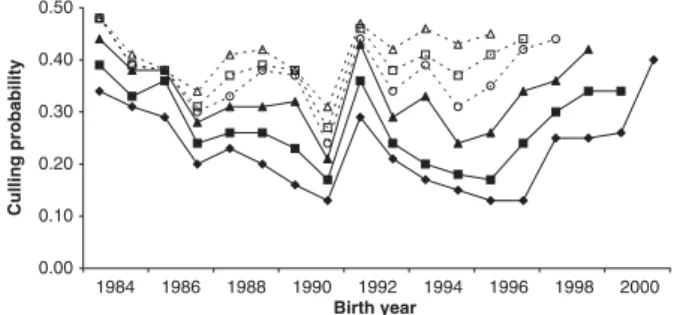
For year of birth, the lowest culling probabilities were observed in 1991, followed by 1996 and 1997 (Figure 1). A possible explanation for this fact is that in these years farmers invested in buffalo raising probably due to the favourable market for buffalo milk production and because of the larger interest in mozzarella manufacture, or even because of the differentiated price compared to bovine’s milk. The culling probability increased after 1998, mainly for ST1, and the maximum culling probability was observed in 2001, probably because of the lower prices practiced on the market.
According to first-lactation milk yield that was divided into five classes, higher culling probabilities were observed for the class of lowest milk yield, with an evident decrease in culling probability and increasing milk yield (P5,1 in class five). This was observed for all measures of ST (Figure 2). Different results have been reported in studies conducted in developed countries where selection for milk yield may have reached an extreme. Vollema (1998) reported that in 70% of dairy cows in Holland, the main cause of culling are diseases in general and the culling caused by low milk production occurs during the first lactation. Studying a Holstein herd, Pu¨ski et al. (2002) con-cluded that there was a negative relationship between milk production and the cow’s probability of remaining in the herd, possibly because these animals are more susceptible to teat and hoof problems that force involuntary culling, and also because of reproductive problems.
In Brazil, since selection for milk yield is less intense, espe-cially in dual purpose breeds and buffaloes, the frequency of culling due to health problems related to high milk production as observed in developed countries is possibly lower. There-fore, culling can be used to penalize less productive females. Queirozet al. (2007) studying Caracu cattle, reported higher frequencies of success for ST in cows with higher first-lactation milk yields, in agreement with this study.
The effect of age at first calving was only significant
(P,0.05) for ST1, with culling probability tending to
increase with advanced age at calving. Queirozet al. (2007) observed that age at first calving was only significant for ST of Caracu cows until 48 months after the first calving. This
finding indicates that age at first calving only interferes in production/reproduction, and consequently in culling, at the first year after calving. After this period, this factor does not affect ST. Phocas and Ducrocq (2006), studying longevity in a Charolaise herd from France, observed that cows calving at a
younger age (,28 months) present a 10% lower risk of
being culled than cows calving at a standard age (28 to 39 months). Cows that calve for the first time at an advanced age (.33 months) present a 20% higher risk of being culled than cows that calve at a standard age.
Conclusion
The effects of breeding farm, year of birth and first-lactation milk yield should be included in models analyzing ST of dairy female buffaloes. Dairy female buffaloes that are older at first calving present higher probabilities of being culled until 1 year after the first calving, without any effect on culling at older ages. Dairy buffaloes with higher milk yield have lower culling probability.
Acknowledgements
Appreciation is extended to Fundac¸a˜o de Apoio a` Pesquisa do Estado de Sa˜o Paulo (FAPESP) and to the Conselho Nacional de Desenvolvimento Cientı´fico e Tecnolo´gico (CNPq) for the financial support and also for the buffalo breeds for the data.
References
Alencar MM 2002. Crite´rios de selec¸a˜o em bovinos de corte no Brasil. Simpo´sio Nacional de Melhoramento Animal, Campo Grande, Brazil, 3pp.
Cassiano LAP, Mariante AS, McManus C, Marques JRF and Costa NA 2004. Paraˆmetros gene´ticos das caracterı´sticas produtivas e reprodutivas de bu´falos na Amazoˆnia brasileira. Pesquisa Agropecua´ria Brasileira 39, 451–457. Madalena FE 1983. Selec¸a˜o e melhoramento gene´tico a nı´vel de fazenda. Simpo´sio de Pecua´ria Leiteira, Campinas, Brazil, 37pp.
Peeva T and Ilieva Y 2007. Longevity of buffalo cows and reasons for their culling. Italian Journal of Animal Science 6, 378–380.
Phocas F and Ducrocq V 2006. Discrete vs continuous time survival analysis of productive life of charolais cows. World Congress on Genetics Applied to Livestock Production, Belo Horizonte, Brazil, 3pp.
Pu¨ski J, Dohy J, Szucs E, Bozo´ S, Tuan TA and Vo¨lgyu-Csı´k J 2002. Relationship of efficiency of lifetime performance to lifetime milk yield and longevity in Holstein-Friesians cows of different body types. World Congress on Genetics Applied to Livestock Production, Montpellier, France, 3pp.
Queiroz AS, Figueiredo G, Silva JAV, Espasandin AC, Meirelles SL and Oliveira JA 2007. Estimativas de paraˆmetros gene´ticos da habilidade de permaneˆncia aos
0.00 0.10 0.20 0.30 0.40 0.50
1984 1986 1988 1990 1992 1994 1996 1998 2000
Birth year
Culling probability
Figure 1 Mean culling probabilities according to the year of birth for ST1, ST2, ST3, ST4, ST5 and ST6 obtained for dairy Murrah buffalo cows; ST5stayability.
0.00 0.10 0.20 0.30 0.40 0.50
<1000 1000-1500 1501-2000 2001-2500 >2500
First-lactation milk yield , kg
Culling probability
48, 60 e 72 meses de idade em vacas da rac¸a Caracu. Revista Brasileira de Zootecnia 36, 1316–1323.
Rosati A and Van Vleck LD 2002. Estimation of genetic parameters for milk, fat, protein and mozzarella cheese production for the Italian river buffaloBubalus bubalispopulation. Livestock Production Science 74, 185–190.
Sampaio Neto JC, Martins Filho R, Loˆbo RNB and Tonhati H 2001. Avaliac¸a˜o dos desempenhos produtivos e reprodutivos de um rebanho bubalino no estado do Ceara´. Revista Brasileira de Zootecnia 30, 368–373.
Silva JA II V, Eler JP, Ferraz JBS and Oliveira HN 2003. Ana´lise gene´tica da habilidade de permaneˆncia em feˆmeas da rac¸a Nelore. Revista Brasileira de Zootecnia 32, 598–604.
Teixeira NM, Ferreira WJ, Torres RA and Barra RB 2003. Paraˆmetros gene´ticos para caracterı´sticas de longevidade de vacas da rac¸a Holandesa no Estado de
Minas Gerais. Reunia˜o Anual da Sociedade Brasileira de Zootecnia, Santa Maria, Brazil, 3pp.
Tonhati H, Cero´n-Mun˜oz MF, Oliveira JA, Duarte JMC, Furtado TP and Tseimazides SP 2000. Paraˆmetros gene´ticos para a produc¸a˜o de leite, gordura e proteı´na em bubalinos. Revista Brasileira de Zootecnia 29, 2051–2056. Van Raden PM and Klaaskate EJH 1993. Genetic evaluation of length of productive life including predicted longevity of live cows. Journal of Animal Science 76, 2758–2764.
Vollema AR 1998. Selection for longevity in dairy cattle. PhD, Animal Breeding and Genetics Group, Wageningen Agricultural University.