CASE REPORT
Abstract
Background: Organophosphates are commercially available agrochemicals for pest control, but may be abused for deliberate self-poisoning. We report a case of suicidal ingestion of dimethoate, a moderately toxic organophosphate insecticide, which can cause refractory hemodynamic instability, and the successful use of methylene blue (MB) for counteracting this complication.
Case Presentation: An unconscious 47-year-old man was referred to emergency department with history of dimethoate ingestion. He rapidly developed hypotension that was refractory to antidotes, resuscitative hydration and multiple vasopressors including norepinephrine, epinephrine and vasopressin. Pulmonary artery catheterization revealed high cardiac output and low peripheral vascular resistance consistent with distributive shock, a complication previously reported in the setting of acute dimethoate toxicity. MB was initiated for the patient and improved hemodynamic status (increased MAP, systolic and diastolic blood pressures) and seized vasopressor requirement. Laboratory tests revealed that on-admission plasma cholinesterase level and dimethoate serum level were
2247 U and 56 μg/mL, respectively. The patient required 2 week ICU course with eventual tracheotomy for ventilation and later transferred to step down level of care.
Discussion:Although MB therapy has been reported to be useful in managing sepsis-induced hypotension, there has been no similar report of its use in organophosphate poisoning. Our patient had no objective evidence for sepsis, and MB infusion improved hemodynamics within 6 hours and the effect was continued even after discontinuation of the therapy. The underlying mechanism of dimethoate-induced hypotension might be related to increase in nitric oxide (NO) formation. MB is effective to inhibit NO synthase.
Conclusion:MB treatment was effective to reverse hypotension and restore hemodynamic instability caused by dimethoate poisoning. This index case may pave way to further investigation of MB therapy for OP-induced hemodynamic instabilities.
Keywords: Dimethoate; Hemodynamics; Methylene Blue; Nitric Oxide; Organophosphate Poisoning
Methylene Blue Is Effective to Reverse Refractory
Hemodynamic Instability due to Dimethoate Poisoning
123
ingestion (as reported by his family) was transferred to emergency department of Community Regional Medical Center, a community-based academic hospital affiliated with the University of California, San Francisco School of Medicine. The patient was found in a barn on his own farm, unresponsive and foaming at the mouth with a noxious odor based on emergency medical services report. According to the history given by his family, past medical history of the patient included peptic ulcer disease, an episode of cerebrovascular accident with no residual defects, hypertension, gout, depression and suicidal ideation. However, despite having a history of depression with suicidal thoughts, he had never attempted any suicide. No other remarkable finding was revealed in his past history. His family reported that he might have ingested dimethoate as he had access to dimethoate at the farm. The family brought a barrel of the substance containing dimethoate from the farm, which was later disposed.
Upon arrival to emergency department, the patient was comatose and intubated for airway protection. His clothing was removed and contact precautions were initiated. _____________
Organophosphates (OPs) have been a commonly used class of agrochemicals for more than 50 years (1). Annually, three million people are estimated to expose to OPs worldwide, with approximately 300,000 fatalities (1). Within the United Sates, 2,513 OP-alone exposures were reported, with 1 fatality in 2012 (2). Dimethoate is a widely used dimethyl OP compound with C5H12NO3PS2 formula. It has
been classified as a moderately hazardous OP compound (Class II) by the World Health Organization (WHO). OP compounds are commonly abused for suicidal purposes in low-income and agriculturally-based countries (3-6), while in the United States; these compounds are unintentionally ingested in the majority of cases (2). In this paper, a successfully treated case of dimethoate poisoning with standard antidotes as well as methylene blue (MB) is presented.
A 47-year-old man with altered mental status after suicidal
__________
INTRODUCTION
*Correspondence to: Nick D. Youssefi; DO. 21-2 Cabernet Drive Concord, NH 03303, USA. Tel: +1 858 232 3330, E-mail: [email protected]
Received 12 June 2014; Accepted 27 June 2015
NICK D. YOUSSEFI*, RAIS VOHRA, JOSE JOSEPH-VEMPILLY, ZACHARIA REAGLE
Department of Internal Medicine, UCSF Fresno Medical Education Program, Fresno, California, USA
How to cite this article: Youssefi ND, Vohra R, Joseph-Vempilly J, Reagle Z. Methylene Blue Is Effective to Reverse Refractory Hemodynamic Instability due to Dimethoate Poisoning. Asia Pac J Med Toxicol 2015;4:123-6.
ASIA PACIFIC JOURNAL of MEDICAL TOXICOLOGY
APJMT 4;3 http://apjmt.mums.ac.ir September 2015
124
Methylene Blue for Dimethoate PoisoningN. D. Youssefi et al.
Nasogastric tube was fixed for suctioning the toxic agent(approximately 1 hour after ingestion) which resulted in removal of 300 mL gray contents. The patient was initially started on pralidoxime 30 mg/kg bolus with 8 mg/kg per hour continuous infusion, along with 5 mg intravenous atropine every five minutes as needed (6 doses given in total). Moreover, he required continuous renal replacement therapy (hemodialysis) for 24 hours due to acidosis, acute renal failure, and anuria. After 48 hours, the patient developed hypotension, and thus aggressive fluid resuscitation of 6 liters normal saline was given. In addition, three vasopressors including norepinephrine (18 μg/minute), vasopressin (0.03 units/minute), epinephrine (2 μg/kg/minute) was given to the patient to maintain adequate perfusion pressure. As no adequate response to the treatments was observed, two doses of MB (129 mg IV, 65mg IV) was administered to the patient 4 hours apart to counteract the toxin-induced peripheral vasodilation and to increase blood pressure (BP).
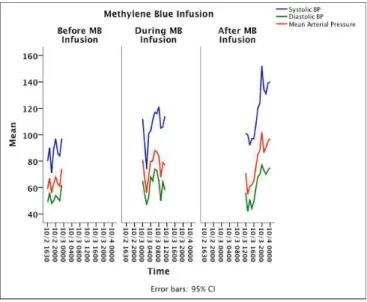
Systolic and diastolic BP and mean arterial pressure (MAP) of the patient was measured before, during and after MB infusion and the mean (± standard deviation) of results of all time-points were compared with each other using repeated measure ANOVA for trend analysis. Mean systolic BP improved significantly from 86.7 ± 8.7 mmHg prior to infusion to 118.0 ± 20.1 mmHg after infusion (P = 0.01). Likewise, mean diastolic BP and MAP increased significantly (P = 0.01) from 52.6 ± 4.6 mmHg and 63.9 ± 5.7 mmHg before infusion to 62.1 ± 12.4 mmHg and 79.5 ± 15.5 mmHg after infusion, respectively (Table 1, Figure 1). By the effect of MB therapy, the patient gradually improved and could be weaned from vasopressor therapy.
The patient later developed ventilator-associated pneumonia confirmed with bronchoalveolar lavage, which was culture positive for methicillin-sensitive Staphylococcus aureus. Nafcillin was initiated for the patient. The patient required 2 week ICU course with eventual tracheotomy for ventilation and later transferred to step down level of care. Laboratory analysis showed serum dimethoate level was 56
μg/mL on admission. Plasma cholinesterase (PChE) levels were 2247 IU/L on admission and 2317 IU/L two weeks after admission (normal range: 9500-15000 IU/L). Although after 30 days of hospitalization the patient had mild cognitive improvement, he was still not verbal or ambulatory.
OP compounds are commonly used for pest control across the world. Dimethoate is an effective OP for killing mites and
insects systemically and on contact (7). In this paper, a dimethoate-poisoned patient who could survive with standard treatments as well as MB therapy was reported, though he finally had residual neurological defects. What made this case unique was the successful use of MB to reverse hemodynamic instability refractory to classic treatments.
The mechanism of action of OP compounds includes binding to acetyl cholinesterase (AChE), inhibiting the enzyme, and thus causing a surplus of acetylcholine at the neuromuscular junction (8). However, some OPs can induce additional signs (8). Depending on the chemical structure of the OP agent, the AChE-OP complex will go through conformational change in protein structure, which causes the enzyme to irreversibly become resistant to reactivation by an antidotal oxime (e.g. pralidoxime) (9). Hence, nicotinic receptors will be rapidly desensitized leading to ganglion blockade and muscle paralysis (10).
The diagnosis of OP poisoning is based predominantly on history of exposure and the characteristic signs of cholinergic over-activity (10). Reduction in PChE or erythrocyte AChE activity is the confirmatory laboratory finding that aid in diagnosis of OP poisoning (11). In the present case, the
patient’s PChE level was considerably reduced. Acute OP ______
Table 1. Systolic, diastolic and mean arterial blood pressures taken before, during, and after methylene blue (MB) infusion in the reported
case
Variables Time of measurement
Before MB infusion During MB infusion After MB infusion
N. of measurements 8 12 13
Systolic blood pressure (mmHg); mean ± SD 86.8 ± 8.7 106.2 ± 12.7 118.0 ± 20.1
Diastolic blood pressure (mmHg); mean ± SD 52.6 ± 4.6 61.5 ± 8.8 62.1 ± 12.4
Mean arterial pressure (mmHg); mean ± SD 63.9 ± 5.7 76.4 ± 9.4 79.5 ± 15.5
Figure 1. Systolic, diastolic, and mean arterial blood pressures
(BP) taken before, during, and after methylene blue (MB) infusion in the reported case
ASIA PACIFIC JOURNAL of MEDICAL TOXICOLOGY
APJMT 4;3 http://apjmt.mums.ac.ir September 2015
toxicity affects the autonomic system, neuromuscular junctions, and central nervous system (10). Effective management of OP poisoning requires timely administration of supportive treatments and specific antidotes. Respiratory failure due to both central and peripheral effects on acetylcholine receptors in the central nervous system and muscles of respiration warrants rapid endotracheal intubation (10). Atropine is effective for competitive inhibition of muscarinic receptors (12). Dosing recommendations are 2-5 mg intravenously, with a doubling of the dose every 3-5 minutes if no effect is seen until pulmonary muscarinic signs are alleviated (12). Clearing of respiratory secretions and cessation of bronchoconstriction are markers of improvement. Pralidoxime is a cholinesterase reactivating agent effective for treating both muscarinic and nicotinic symptoms (9,13-15). Recommended dosing by the WHO includes 30 mg/kg bolus followed by 8 mg/kg/h as the maintenance dose (14,15). The clothing and belongings of patients should also be removed and decontaminated immediately upon exposure. Activated charcoal may not be helpful if administered after 1 hour of exposure. Patients with OP poisoning may benefit from a dose of benzodiazepines (13).
Dimethoate is unique among anticholinergic agents due to its severe toxicity. Acute self-poisoning with dimethoate has a human case fatality three-fold higher than poisoning with chlorpyrifos despite similar toxicity in animals (16). It has an elimination half-life of 30.4 hours in plasma and 23.8 hours in urine (17). In suicidal and lethal poisonings with dimethoate, the blood concentration ranges from 2 to 100
μg/mL (17,18). In our case, the patient’s serum dimethoate level was 56 μg/mL. OP toxicity is known for causing
cardiac effects (10,13,19). Sinus tachycardia and QT prolongation are two common cardiovascular findings of OP poisoning (10,19,20). Dimethoate, additionally, is an OP notorious for causing hypotension (16,17,21-23). Davies et al reported 3 patients with proven severe dimethoate poisoning who all of them had inappropriate peripheral vasodilatation and profound hypotension that progressed despite treatment with aggressive hydration, atropine, pralidoxime chloride, and inotropes (16). They concluded that this progressive hypotension and distributive shock are the result of dimethoate-induced low systemic vascular resistance (16). Similarly, in a series of Japanese OP poisoned patients, which hemodynamic state of patients was monitored by pulmonary artery catheterization, significantly reduced systemic vascular resistance index (SVRI) and pulmonary vascular resistance index were found, while the cardiac output was maintained. In this study, 4 patients with hypotension and metabolic acidosis died when catecholamine administration was ineffective to restore SVRI (21). In an experimental study by Eddleston et al on minipigs poisoned with dimethoate, both dimethoate and its co-formulant hydrocarbons (xylene and cyclohexanone) were ascertained to exert independent and synergistic toxicity on the cardiovascular system causing distributive shock and cardiovascular collapse (22). In another study by Eddleston et al conducted on 802 human subjects, morbidities (i.e. intubation requirement and decreased PChE) and mortality ______
125
were markedly higher in patients with dimethoate poisoning compared with chlorpyrifos and in lesser extent with fenthion poisoning (23). The interesting finding of their study was that death occurred earlier in dimethoate ingestion than ingestion of other pesticides and that was mainly resulted from hypotensive shock (23).
The underlying mechanism of dimethoate-induced hypotension is still unclear. Dimethoate as an OP can block nicotinic transmission at sympathetic and parasympathetic ganglia, which leads to inhibition of the baroreceptor reflexes and consequently a severe drop in BP (10,16). It may also trigger peripheral vasodilatation via the effect of acetylcholine on muscarinic receptors on vascular endothelium (16). In addition, peripheral vasodilation by OP compounds may stem from increase in nitric oxide (NO) formation (24).
MB is a heterocyclic dye that is used to treat variety of toxicologic emergencies. It is an effective treatment for methemoglobinemia caused by sulfanilamide, silver nitrate, aniline dyes or dapson poisoning (25). The mechanism of action of MB on hypotension includes the inhibition of NO-induced vasodilation. NO is produced in endothelial and vascular smooth muscle cells by the effect of NO synthase. NO, then, activates guanylate cyclase, which leads to vasodilation. MB inhibits NO synthase, thus decreases vasodilation and improves systemic vascular tone (26). Although in recent studies, the clinical benefit of MB has been questioned, its use for septic shock was shown to be promising as it improves hemodynamic markers (27). Our patient, however, had no objective evidence for sepsis. In a randomized double-blind placebo-controlled study that MB was used for mechanically ventilated patients with septic shock, MB was able to significantly increase MAP and SVRI (28). It also reduced vasopressor requirements compared with placebo; as the need for norepinephrine, epinephrine, and dopamine use decreased by 40-87% (28). MB has also been shown to increase MAP and SVRI, and reduce the need for vasopressors in patients undergoing cardiopulmonary bypass in patients under treatment of angiotensin converting enzyme inhibitors (29). In addition, serum lactate levels were lower in MB-treated patients suggesting more favorable tissue perfusion (29).
In this unique case of severe refractory hypotension caused by poisoning with an OP compound, dimethoate, MB treatment was successful in reversing hypotension and restoring hemodynamics. This index case may pave way to further investigation of MB therapy for OP-induced hemodynamic instabilities.
Conflict of interest: None to be declared.
Funding and support: None.
1. Eddleston, M, Phillips MR. Self poisoning with pesticides.
BMJ 2004; 328:42.
2. Mowry JB, Spyker DA, Cantilena LR Jr, Bailey JE, Ford M.
2012 Annual Report of the American Association of Poison Control Centers' National Poison Data System (NPDS): 30th Annual Report. Clin Toxicol (Phila) 2013;51:949-1229.
3. Sarkar D, Shaheduzzaman M, Hossain MI, Ahmed M,
Mohammad N, Basher A. Spectrum of Acute Pharmaceutical and Chemical Poisoning in Northern Bangladesh. Asia Pac J Med Toxicol 2013;2:2-5.
4. Prajapati T, Prajapati K, Tandon R, Merchant S. Acute
Chemical and Pharmaceutical Poisoning Cases Treated in Civil Hospital, Ahmedabad: One year study. Asia Pac J Med Toxicol 2013;2:63-7.
5. Dewan G. Analysis of Recent Situation of Pesticide Poisoning
in Bangladesh: Is There a Proper Estimate? Asia Pac J Med Toxicol 2014;3:76-83.
6. Bari MS, Chakraborty SR, Alam MMJ, Qayyum JA, Hassan N,
Chowdhury FR. Four-Year Study on Acute Poisoning Cases Admitted to a Tertiary Hospital in Bangladesh: Emerging Trend of Poisoning in Commuters. Asia Pac J Med Toxicol 2014;3:152-6.
7. Centers for Disease Control and Prevention, National
Biomonitoring Program. Dimethoate, CAS No. 60-51-5 [Internet]. 2013 [Updated 2013 December 4, Cited 2014 July
21]. Available from:
http://www.cdc.gov/biomonitoring/DimethoateOmethoate_Bi omonitoringSummary.html
8. Eyer P, Worek F, Thiermann H, Eddleston M. Paradox findings
may challenge orthodox reasoning in acute organophosphate poisoning. Chem Biol Interact 2010;187:270-8.
9. Buckley NA, Eddleston M, Li Y, Bevan M, Robertson J.
Oximes for acute organophosphate pesticide poisoning. Cochrane Database Syst Rev 2011;(2):CD005085.
10. Mégarbane B. Toxidrome-based Approach to Common Poisonings. Asia Pac J Med Toxicol 2014;3:2-12.
11. Prasad DRMM, Jirli PS, Mahesh M, Mamatha S. Relevance of Plasma Cholinesterase to Clinical Findings in Acute Organophosphorous Poisoning. Asia Pac J Med Toxicol 2013; 2:23-7.
12. Ahmed AS, Basher A, Amin MR, Faiz MA. Effect of Intensive Atropine Doses (Rapid Incremental Loading and Titration) for
Management of Organophosphorus Pesticide Poisoning: a Case Series. Asia Pac J Med Toxicol 2014;3:23-6.
13. Eddleston M, Buckley NA, Eyer P, Dawson AH. Management of acute organophosphorus pesticide poisoning. Lancet 2008;371:597-607.
14. Eyer P, Buckley N. Pralidoxime for organophosphate poisoning. Lancet 2006;368:2110-1.
15. Mahesh M, Gowdar M, Venkatesh CR. A Study on Two Dose
Regimens of Pralidoxime in the Management of
Organophosphate Poisoning. Asia Pac J Med Toxicol 2013;2:121-5.
16. Davies J, Roberts D, Eyer P, Buckley N, Eddleston M. Hypotension in severe dimethoate self-poisoning. Clin Toxicol (Phila) 2008;46:880-4.
17. Hoffmann U, Papendorf T. Organophosphate poisonings with parathion and dimethoate. Intensive Care Med 2006;32:464-8. 18. Tarbah FA, Shaheen AM, Benomran FA, Hassan AI, Daldrup
T. Distribution of dimethoate in the body after a fatal organophosphate intoxication. Forensic Sci Int 2007;170:129-32.
19. Laudari S, Patowary BS, Sharma SK, Dhungel S, Subedi K, Bhattacharya R, et al. Cardiovascular Effects of Acute Organophosphate Poisoning. Asia Pac J Med Toxicol 2014;3:64-7.
20. Mir SA, Rasool R. Reversal of Cardiovascular Toxicity in Severe Organophosphate Poisoning with 20% Intralipid Emulsion Therapy: Case Report and Review of Literature. Asia Pac J Med Toxicol 2014;3:169-72.
21. Asari Y, Kamijyo Y, Soma K. Changes in the hemodynamic state of patients with acute lethal organophosphate poisoning. Vet Hum Toxicol 2004;46:5-9.
22. Eddleston M, Street JM, Self I, Thompson A, King T, Williams N, et al. A role for solvents in the toxicity of agricultural organophosphorus pesticides. Toxicology 2012;294:94-103. 23. Eddleston M, Eyer P, Worek F, Mohamed F, Senarathna L, von
Meyer L, et al. Differences between organophosphorus insecticides in human self-poisoning: a prospective cohort study. Lancet 2005;366:1452-9.
24. Yıldırım E, Baydan E, Kanbur M, Kul O, Cınar M, Ekici H, et
al. The effect of chlorpyrifos on isolated thoracic aorta in rats. Biomed Res Int 2013;2013:376051.
25. Clifton J 2nd, Leikin JB. Methylene blue. Am J Ther 2003;10:289-91.
26. Mayer B, Brunner F, Schmidt K. Inhibition of nitric oxide synthesis by methylene blue. Biochem Pharmacol 1993;45:367-74.
27. Paciullo CA, McMahon Horner D, Hatton KW, Flynn JD. Methylene blue for the treatment of septic shock. Pharmacotherapy 2010;30:702-15.
28. Kirov MY, Evgenov OV, Evgenov NV, Egorina EM, Sovershaev MA, Sveinbjørnsson B, et al. Infusion of methylene blue in human septic shock: a pilot, randomized, controlled study. Crit Care Med 2001;29:1860-7.
29. Maslow AD, Stearns G, Butala P, Schwartz CS, Gough J, Singh AK. The hemodynamic effects of methylene blue when administered at the onset of cardiopulmonary bypass. Anesth Analg 2006;103:2-8.
Methylene Blue for Dimethoate Poisoning
N. D. Youssefi et al.