www.epjournal.net – 2012. 10(2): 225-237
¯ ¯ ¯ ¯ ¯ ¯ ¯ ¯ ¯ ¯ ¯ ¯ ¯ ¯ ¯ ¯ ¯ ¯ ¯ ¯ ¯ ¯ ¯ ¯ ¯ ¯ ¯ ¯
Original Article
Human Nonindependent Mate Choice: Is Model Female Attractiveness
Everything?
Antonios Vakirtzis, Institute of Integrative Biology, University of Liverpool, Liverpool, UK. Email:
[email protected] (Corresponding author).
S. Craig Roberts, Department of Psychology, University of Stirling, Stirling, UK.
Abstract: Following two decades of research on non-human animals, there has recently been increased interest in human nonindependent mate choice, namely the ways in which choosing women incorporate information about a man’s past or present romantic partners (‘model females’) into their own assessment of the male. Experimental studies using static facial images have generally found that men receive higher desirability ratings from female raters when presented with attractive (compared to unattractive) model females. This phenomenon has a straightforward evolutionary explanation: the fact that female mate value is more dependent on physical attractiveness compared to male mate value. Furthermore, due to assortative mating for attractiveness, men who are paired with attractive women are more likely to be of high mate value themselves. Here, we also examine the possible relevance of model female cues other than attractiveness (personality and behavioral traits) by presenting video recordings of model females to a set of female raters. The results confirm that the model female’s attractiveness is the primary cue. Contrary to some earlier findings in the human and nonhuman literature, we found no evidence that female raters prefer partners of slightly older model females. We conclude by suggesting some promising variations on the present experimental design.
Keywords: Nonindependent mate choice, model female, mate choice copying, mate quality bias, sociometer theory, facial attractiveness, personality differences
¯ ¯ ¯ ¯ ¯ ¯ ¯ ¯ ¯ ¯ ¯ ¯ ¯ ¯ ¯ ¯ ¯ ¯ ¯ ¯ ¯ ¯ ¯ ¯ ¯ ¯ ¯ ¯ ¯ ¯ ¯ ¯ ¯ ¯ ¯ ¯ ¯ ¯ ¯ ¯ ¯ ¯ ¯ ¯ ¯ ¯ ¯ ¯ ¯ ¯ ¯ ¯ ¯ ¯ ¯ ¯ ¯ ¯ ¯ ¯ ¯ ¯ ¯ ¯ ¯ ¯ ¯ ¯ ¯ ¯ ¯ ¯ ¯ ¯ ¯ ¯ ¯ ¯ ¯ ¯ ¯ ¯ ¯ ¯ ¯ ¯ ¯ ¯
Introduction
Evolutionary Psychology – ISSN 1474-7049 – Volume 10(2). 2012. -226- as mate choice copying (Dugatkin, 1992; Pruett-Jones, 1992). The copying strategy is captured in the cognitive algorithm ‘increase your attraction towards males that are mating with other females relative to single males’. This phenomenon has now been studied in a variety of promiscuous and polygynous species, mostly fish and birds (reviews in Dugatkin, 1996; Galef, 2008; Vakirtzis, 2011; White, 2004). Note that though, in principle, there may exist some form of homosexual nonindependent mate choice, no research to date has addressed this issue, and in this paper we will be dealing exclusively with heterosexual mate choice.
In humans, the experimental study of nonindependent mate choice has followed a somewhat different trajectory. Some early studies were more or less direct applications of mate choice copying (i.e., presenting some males as being in a relationship and others as being single, and examining whether female raters found coupled or married males to be more attractive) (Eva and Wood, 2006; Milonoff, Nummi, Nummi, and Pienmunne, 2007; Uller and Johansson, 2003). The results of these initial studies were mixed; one study found that female raters perceive partnered men as more attractive (Eva and Wood, 2006) while others did not find this effect (Milonoff et al, 2007; Uller and Johansson, 2003). It is interesting to note that Uller and Johansson (2003) found that married men were actually perceived by female raters as significantly less attractive than single men (Milonoff et al. 2007, found no difference between the two conditions). More recent studies have presented all male stimuli as partnered (i.e., no single males, all males have one mate), and focused on the relative attractiveness of men’s supposed partners (Little, Burriss, Jones, DeBruine, and Caldwell, 2008; Vakirtzis and Roberts, 2010a; Waynforth, 2007; Yorzinski and Platt, 2010). The consistent finding to emerge from these within-stimulus studies is that when men are presented with attractive partners, they receive higher desirability (e.g., attractiveness, interest in short and long-term relationship) ratings compared to when they are presented with unattractive partners. Various authors have suggested that this effect is due to the greater contribution physical attractiveness makes to female as compared to male mate value, which, coupled with assortative mating in terms of mate value, allows observing females to greatly improve their assessment of a man’s mate value simply by looking at his mate (see mate quality bias theory in Vakirtzis and Roberts, 2009; 2010b; see also Waynforth, 2007). Aside from model female attractiveness, another possible cue to which focal females might be sensitive is the model female’s age. Several studies on non-human species have found that focal females prefer the partners of slightly older model females, presumably because the latter are more experienced and can better discern higher quality males (Dugatkin and Godin, 1993; Amlacher and Dugatkin, 2005; Vukomanovic and Rodd, 2007). In line with these studies, one human study found that women raters prefer men that are paired to slightly older model females (in their early to mid twenties; Vakirtzis and Roberts, 2010a).
relation to nonindependent mate choice? The first and most obvious candidate is self-esteem, whose adaptive function based on input received from the ‘mate-value sociometer’ has now been studied extensively (reviewed in Penke, Todd, Lenton, and Fasolo, 2007). Briefly, cues of acceptance or rejection from men lead to adaptive shifts in self-esteem which cause women to raise or lower their ambitions with regard to a mate, and, presumably, adjust their romantic pursuits accordingly (Zeigler-Hill, Campe, and Myers, 2009). The adaptive significance of this mechanism is that it allows women (and of course men) to simultaneously a) set their aspiration floor high enough to avoid settling for lesser mates and b) set their aspiration ceiling low enough to avoid pursuing unrealistic targets (Penke et al, 2007). This line of reasoning suggests that throughout our species’ evolution, women with higher self-esteem would have probably secured more desirable mates. Analogous arguments can be made for female assertiveness, sociability, and social intelligence; namely, that these traits in women would have correlated positively with male partner mate value, whereas a negative correlation would possibly hold between shyness and male partner mate value, with more shy women shunning social contact and missing out on potential mates. Thus, if focal females could identify model females’ standing with regard to these personality dimensions, they may be more attracted to male partners of model females who are high in self-esteem, assertiveness, sociability, and social intelligence, and low in shyness.
Here we test these hypotheses by using muted video recordings of women (model females) that were supposedly describing an ex-boyfriend. These video recordings were presented to a set of female raters who were asked to indicate how interested they would be in dating the men being described by the model females. The model females also filled out a battery of psychometric instruments that allowed us to examine the possible relevance of the aforementioned personality traits (i.e., self-esteem, assertiveness, social intelligence, shyness, and sociability). In addition they filled out a brief measure of the ‘Big Five’ factors of personality. These are Extraversion, Agreeableness, Conscientiousness, Emotional Stability, and Openness to Experience (Goldberg, 1993). This Big Five measure was included in the expectation that, due to their salience and generality (Buss, 1991; 1996), one or more of these Big Five factors might be able to capture some effect that might not otherwise be detectable from the other narrower traits. Extending principles derived in part from animal studies, we also examine the importance of condition-dependent nonincondition-dependent mate choice arising from the side of the raters. Specifically, we tested whether their pattern of ratings was contingent upon differences in their own attractiveness (i.e., do less attractive focal females also prefer the partners of attractive women?; see Penke et al., 2007), sexual experience (i.e., do less experienced women rely more heavily on nonindependent mate choice?; see Nordell and Valone, 1998; Vukomanovic and Rodd, 2007), and relationship status (do single and paired women differ in the degree to which they rely on nonindependent mate choice?).
Materials and Methods
Collection of Stimuli
Evolutionary Psychology – ISSN 1474-7049 – Volume 10(2). 2012. -228- set (these women were mostly undergraduate and postgraduate students from the Schools of Biological and Veterinary Sciences, mean age 22.7 ± 2.9, range 18-29 years). We filmed these women in high-quality 640x480 AVI format for approximately 40-60 seconds while they were facing the camera and describing their ideal romantic partner. We asked participants to describe their ideal (as opposed to a real) romantic partner so as to obtain relatively constant expressions while retaining the relevant romantic content. Participants were informed at the outset that the video clips would be shown to raters but that they would be muted and participants would therefore not be able to hear what was said. Each video clip was subsequently edited to a shorter 20-sec continuous clip using Windows Movie Maker and converted to 640x480, 25 fps WMV format. In selecting the 20-seconds of continuous video we tried to avoid instances where, due to the nature of the task (and presumably not reflecting typical facial expressions), participants made extreme or erratic expressions or gestures (e.g., nervous laughter, uncomfortable silence), or where they spoke in a manner which would make lip-reading easy.
After they had been filmed, participants completed an array of psychometric instruments: a) The Ten-Item Personality Inventory (TIPI; Gosling, Rentfrow, and Swann, 2003), a brief, ten-item inventory of the Big Five with satisfactory psychometric properties that converges adequately with larger measures of the Big Five. b) The 7-item Social Skills subscale of the Tromso Social Intelligence Scale (Silvera, Martinussen, and Dahl, 2001) which includes items like ‘I fit easily in social situations’ and ‘I have a hard time getting along with other people’. c) The Rosenberg self-esteem scale (Rosenberg, 1965), a 10-item instrument with statements like ‘At times I think that I am no good at all’ and ‘On the whole I am satisfied with myself’. d) The Rathus Assertiveness Schedule (Rathus, 1973), a 30-item scale of assertiveness. e) The Shyness and Sociability Scale (Cheek and Buss, 1981), which is composed of two parts: a 9-item shyness and a 5-item sociability subscale. In addition to these standardized questionnaires, participants answered the following two questions (on a 10-point scale, 10 being most) that were designed to serve as self-report measures of sexual experience and self-perceived mate value, respectively: f) ‘Overall, how experienced would you say you are in romantic relationships with men?’ g) ‘Overall, how interested and attracted are men generally in you?’
already been documented in various studies (e.g., Dugatkin, 2000; Jones, DeBruine, Little, Burriss, and Feinberg, 2007; Place, Todd, Penke, and Asendorpf, 2011), and here we were primarily interested in controlling for it with the aim of revealing the relevance of other variables.
Ratings
Ratings were carried out by 52 female students (20.9 ± 2.5 yrs old; see descriptive statistics in first column of Table 2). These were recruited at a university library and were from other faculties than the models (mostly Arts and Social Sciences while the models were from Biological and Veterinary Sciences) in order to minimize the chance that raters would know models. We gave participants a very general explanation as to the purpose of the study, telling them only they would be participating in ‘a study of how women are influenced in their romantic choices by the choices of other women’. Prior to viewing the videos the participants gave information regarding their age, sexual orientation (all were heterosexual), self-perceived physical attractiveness (on a 10-point scale, 10 being most attractive; n = 46, minimum 3, maximum 8, mean 5.84, median 6) and self-perceived sexual experience (also a 10-point scale; n = 48, minimum 1, maximum 9, mean 5.67, median 6), though for these last two questions participants had the option of refusing the information. The instructions for the experiment were viewed on screen prior to the presentation of the videos, and informed the participants that the experimenters had asked some women to think back and bring to mind an ex-boyfriend of whom they had ‘the most fond memories’. The experimenters had then recorded these women while they were describing this ex-boyfriend, and the participants would now be shown these video recordings, though they would be played mute. Their task was to indicate how willing they would be to go out on a blind date with each man being described, on a 7-point scale from ‘1-least’ to ‘7-most’ (participants were assured there were no right or wrong answers).
The 53 muted videos were presented in random order with a custom-made application designed in C-Sharp programming language (the same application as had been used with the eight male and seven female raters in the preliminary part of the study). Participants could give their rating and move on to the next video before they had viewed an entire 20-sec clip (we observed that it was relatively uncommon for participants to watch a 20-sec clip in its entirety). After they had completed the task participants were debriefed and asked if they had recognized any of the women in the videos, in which case their ratings for those particular stimuli were excluded from the analysis. We also excluded from the analysis altogether the ratings of 3 women who stated they had understood the videos were descriptions of imaginary, not real men (two of them by lip-reading one particular model female with whom they were acquainted and who made characteristic mouth movements, the third due to a technical error on the part of the experimenter which resulted in her viewing the videos with sound), thus reducing our sample of raters to 49 women (20.9 ± 2.5 yrs old).
Results
Evolutionary Psychology – ISSN 1474-7049 – Volume 10(2). 2012. -230- and used hierarchical linear multiple regression (assumptions satisfied) with each video as a data-point (n = 53). Based on existing theoretical and empirical evidence, we forced model female attractiveness, model age, and ‘positive expression’ (see above) into the first block of the regression. This first step was highly significant (F3,49 = 43.3, R2 = .726, p < .001)
with the three variables accounting for nearly three quarters of the variance in ratings. Surprisingly, while attractiveness (beta = .543, t = 7.04, p < .001) and positive expression (beta = .538, t = 6.98, p < .001) made significant contributions to the model, age did not (beta = .023, t = 0.303, p = .76). This means that while female raters were more interested in dating the ex-boyfriends of model females who were more attractive and seemingly more positive in their descriptions of the man, they were not more interested in dating the ex-boyfriends of older model females. The second step of the model was a stepwise regression with all the measured personality and behavioral variables (social skills, esteem, assertiveness, shyness and sociability, the Big Five), rated mate value and self-rated sexual experience as predictors. Of all these previously excluded predictors, only emotional stability (one of the Big Five factors) entered the model at the .05 level of significance, but the resulting increment in R2 was a marginal .022, raising the overall explained variance to 74.8%. The final model is presented in Table 1. As can be seen, the relationship between the dependent variable and emotional stability was a negative one (i.e., the opposite of what one would probably expect given any relationship between these two variables). None of the other excluded variables approached significance (all p > .19).
Table 1. Multiple regression predicting female raters’ romantic interest in a man from characteristics in the model female describing him.
Independent variable Beta t p
Attractiveness .557 7.42 < .001
Positive expression .531 7.10 < .001
Age .047 .632 .530
Emotional stability -.150 -2.03 .048
F4,48 = 35.57, p < .001, R2 = .748
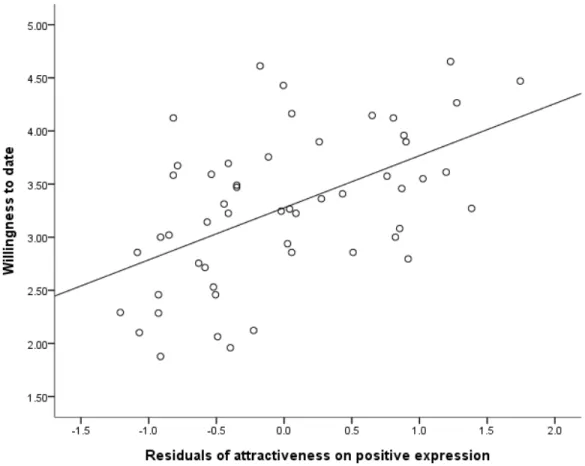
effect of attractiveness at all levels.
Figure 1. Scatterplot depicting the effect of model female attractiveness after positive expression has been controlled.
The second part of our analysis focused on variance arising from the side of the raters. Recall that prior to giving their ratings the raters had given self-ratings (on 10-point scales) of attractiveness and romantic experience. We wanted to examine more closely the behaviour of the raters in the top and bottom quartiles for both of these variables, but due to the limited scale used, no cut-off values gave the exactly desired subsets of raters, and faced with a choice between more extreme subsets but less ratings on the one hand and less extreme subsets but more ratings on the other, we chose the latter. First we ran the stepwise regression using only the ratings of the lesser attractive raters (attractiveness self-rating of 5 or less, n = 14). Attractiveness again emerged as the most important predictor, accounting for 47% of the variance, with positive expression accounting for an additional 14.4% (final
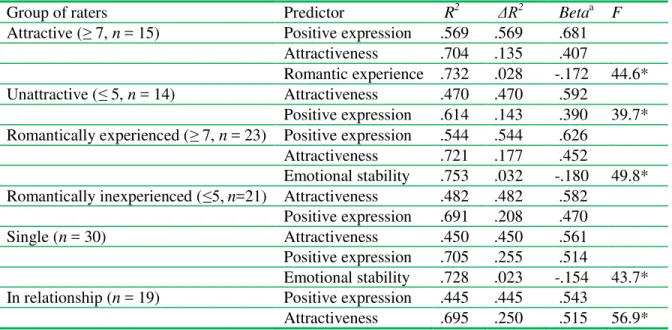
Evolutionary Psychology – ISSN 1474-7049 – Volume 10(2). 2012. -232- 13.5% of variance, and finally, self-rated romantic experience, which explained another 2.8% (final R2 = .732, all excluded variables p > .13). As with emotional stability in previous analyses, the relationship between the dependent variable and the self-rated romantic experience of the model females was in the opposite to expected direction (beta = -.172, t = -2.277, p = .027). These results show that the preference for attractive model females holds for both attractive and unattractive sets of raters; if anything, the more attractive raters depended less on model female attractiveness. We also reran the regressions to compare the ratings of more against less romantically experienced raters, and single raters against those in relationships, but no major differences emerged: for all groups the major predictors were attractiveness and positive expression (see all comparisons in Table 2). Finally, to systematically and more formally examine the influence of all three variables (attractiveness, romantic experience, and relationship status) simultaneously, we a) calculated the predicted value for each model female from regression of the dependent variable on attractiveness and positive expression and then b) for each rater, summed the absolute differences between her own rating of each model female and the predicted value across all 53 model females (i.e. ∑ = |ki-pi|, i = 1,2…53, where k is the rating given by a
rater to a model female and p is the predicted value for the model female). This produced, for each rater, a measure of her propensity to be predictably influenced by model female attractiveness and positive expression, with smaller values indicating a stronger influence. We then regressed this sum (n = 49) against rater attractiveness, romantic experience, and relationship status simultaneously, but the resulting model was not significant (p > .5, all predictors p > .2), indicating no condition-dependent nonindependent mate choice.
Table 2. Stepwise multiple regressions by female rater subgroup. Attractiveness and romantic experience categorizations are based on self-ratings given by the raters on a 10-point scale.
Group of raters Predictor R2 ΔR2 Betaa F Attractive (≥ 7, n = 15) Positive expression .569 .569 .681
Attractiveness .704 .135 .407
Romantic experience .732 .028 -.172 44.6* Unattractive (≤ 5, n = 14) Attractiveness .470 .470 .592
Positive expression .614 .143 .390 39.7* Romantically experienced (≥ 7, n = 23) Positive expression .544 .544 .626
Attractiveness .721 .177 .452
Emotional stability .753 .032 -.180 49.8* Romantically inexperienced (≤5, n=21) Attractiveness .482 .482 .582
Positive expression .691 .208 .470 Single (n = 30) Attractiveness .450 .450 .561 Positive expression .705 .255 .514
Emotional stability .728 .023 -.154 43.7* In relationship (n = 19) Positive expression .445 .445 .543
Attractiveness .695 .250 .515 56.9*
a
*p < .001
Discussion
The preceding has been an attempt to answer the following question: from the viewpoint of a prospecting female, what information in the face of a potential mate’s ex-girlfriend can impact her assessment of the male’s mate value? We used video recordings of model females to allow the examination, for the first time, of dynamic cues like personality factors, while at the same time withholding any stimuli that related to the actual target male (like a video, a photograph, a written description etc.). This design forced the female raters to rely solely on the model female for their assessments and allowed us to avoid additional sources of variance that would arise from the target males. The results presented here suggest that in regard to the question we asked, namely what cues can be found in a girlfriend’s face from the vantage point of a focal female rater, the one-word answer is ‘looks’, and that this preference for more attractive model females is universal among raters, be they attractive or unattractive, experienced or inexperienced (but see Waynforth, 2007), single or in a relationship. Model female attractiveness alone accounted for 45% of the total variance in ratings, and when coupled to ‘positive expression’ (i.e., a measure of how positive a model female’s descriptions of her supposed ex-boyfriend appeared to be) the two variables explained over 70% of the variance in ratings. The importance of positive expression is a straightforward finding that has already been documented in earlier studies (e.g., Jones et al., 2007; Place et al., 2011), and here we were primarily interested in controlling for it with the aim of revealing the relevance of other variables.
Surprisingly, we found no evidence that female raters are more interested in the partners of slightly older model females (in their 20s), a finding that contradicts a recently reported post-hoc result (Vakirtzis and Roberts, 2010a). The importance of model female age has been well-documented in the non-human literature (Amlacher and Dugatkin, 2005; Dugatkin and Godin, 1993; Vukomanovic and Rodd, 2007), and is typically attributed to the greater experience of more mature females and their superior mate-choice skills (Nordell and Valone, 1998). The fact that here we used a design specifically designed to uncover this effect (among others) and that we employed a substantially larger sample size (n = 53 vs. 20) suggests that the earlier finding (Vakirtzis and Roberts, 2010a) was perhaps a chance result. In humans, partner age may not have the same effect that it does in mate choice copying in other species, given that human males tend to prefer younger females (though younger men not so strongly), whereas in other species this age preference is uncommon (Buss, 1989; Kenrick, Keefe, Bryan, Barr, and Brown, 1995).
Evolutionary Psychology – ISSN 1474-7049 – Volume 10(2). 2012. -234- (Zeigler-Hill, Campe, and Myers, 2009). In support of this hypothesis, we found a correlation of .483 between self-esteem and a one-item self-report measure of mate value (see Brase and Guy, 2004; Penke and Denissen, 2008, for similar results). Similar arguments can be made for female assertiveness, sociability, and social intelligence. In addition to these more specific traits, we included a measure of the Big Five (Gosling et al., 2003) in our analysis, with the expectation that due to their salience (Buss, 1991, 1996) and generality, the Big Five would perhaps be able to capture, even if very coarsely, relevant traits that could then be more accurately dissected in future studies. Of all the traits examined, only one of the Big Five Factors, emotional stability, achieved statistical significance (p = .048), but the sign of the correlation (negative whereas a positive would be expected) and the marginal increment in explained variance suggest that this relationship is probably a type I error, owing to the large number of predictors in the regression. Having said this, the possibility that there are indeed other relevant cues in the model female which this study failed to detect cannot be excluded. We used only self-report measures for personality traits and relied on single-item measures to assess mate value and sexual experience. Mate value in particular is a dynamic and convoluted concept and a single item is unlikely to measure it very well. Also, the fact that the videos were played mute and that they only showed the faces of the model females constitutes an impoverishment of the real-life stimuli that future studies could improve upon. Can the traits measured here, most notably self-esteem and assertiveness, as well as the Big Five, be picked up by focal females from watching a muted short video? We assumed here that they could, but note that this question cannot be answered simply by having a separate set of raters assess the model females in the muted videos for the degree to which they appear, say, assertive or extroverted. There is a difference between the conscious assessment of a personality trait and the subconscious influence of that trait on a dedicated nonindependent mate choice mechanism.
Finally, a number of interesting variations on the current design suggest themselves. For instance, model females could be asked to describe an actual former partner (for example the most recent one) and the video recordings could be played with sound, so that a wide array of positive and negative real-life descriptions would be available to focal females. Of particular interest in such a scenario would be those instances where highly attractive women gave very negative descriptions of their former partner (or where very unattractive women gave positive descriptions). Would model female attractiveness still have an effect in these extreme conditions? We predict that it would: in the end there is no more concrete proof of a man’s mate value than the fact that through a typically protracted period of courtship (Trivers, 1972) and sequential evaluation stages (Miller and Todd, 1998), an attractive female formed a relationship with him. What this female subsequently says can never cancel out what she actually did, and given that words are cheap whereas eggs are expensive, her actions should always carry more weight. This design would more accurately simulate real-life social situations (Vakirtzis and Roberts, 2012) where women discuss their romantic lives and gossip about potential mates.
2012
References
Amlacher, J., and Dugatkin, L. A. (2005). Preference for older over younger models during mate-choice copying in young guppies. Ethology, Ecology & Evolution, 17, 161-169.
Brase, G. L., and Guy, E. C. (2004). The demographics of mate value and self-esteem.
Personality and Individual Differences, 36, 471-484.
Buss, D. (1989). Sex differences in human mate preferences: Evolutionary hypotheses tested in 37 cultures. Behavioral and Brain Sciences, 12, 1-14.
Buss, D. (1991). Evolutionary personality psychology. Annual Review of Psychology, 42, 459-491.
Buss, D. (1996). Social adaptation and five major factors of personality. In J.S. Wiggins (Ed.) The five-factor model of personality: Theoretical perspectives (pp. 180-207). New York, NY: Guilford.
Cheek, J. M., and Buss, A. H. (1981). Shyness and sociability. Journal of Personality and Social Psychology, 41, 330-339.
Dugatkin, L. A. (1996). Copying and mate choice. In C.M. Heyes and B.G. Galef, B (Eds.)
Social learning in animals: The roots of culture (pp. 85-105). London: Academic Press.
Dugatkin, L. A. (1992). Sexual selection and imitation: Females copy the mate choice of others. The American Naturalist, 139, 1384-1389.
Dugatkin, L. A. (2000). The imitation factor: evolution beyond the gene. New York, NY: Free Press.
Dugatkin, L. A., and Godin, J-GJ. (1993). Female mate copying in the guppy (Poecilia reticulata): age-dependent effects. Behavioral Ecology, 4, 289-292.
Eva, K. W., and Wood, T. J. (2006). Are all the taken men good? An indirect examination of mate-choice copying in humans. Canadian Medical Association Journal, 175, 1573-1574.
Galef, B. G., Jr. (2008). Social influences on the mate choices of male and female Japanese quail. Comparative Cognition and Behavior Reviews, 3, 1-12.
Goldberg, L. R. (1993). The structure of phenotypic personality traits. American
Psychologist, 48, 26-34.
Gosling, S. D., Rentfrow, P. J., and Swann, W. B. (2003). A very brief measure of the Big-Five personality domains. Journal of Research in Personality, 37, 504-528.
Jones, B. C., DeBruine, L. M., Little, A. C., Burriss, R. P. and Feinberg, D. R. (2007). Social transmission of face preferences among humans. Proceedings of the Royal Society, B, 274, 899-903.
Kenrick, D. T., Keefe, R. C., Bryan, A., Barr, A., Brown, S. (1995). Age preferences and mate choice among homosexuals and heterosexuals: A case for modular psychological mechanisms. Journal of Personality and Social Psychology, 69, 1166-1172.
Evolutionary Psychology – ISSN 1474-7049 – Volume 10(2). 2012. -236- Social influence in human face preference: men and women are influenced more for long-term than short-term attractiveness decisions. Evolution and Human Behavior,
29, 140-146.
Miller, G. F., and Todd, P. M. (1998). Mate choice turns cognitive. Trends in Cognitive Sciences, 2, 190-198.
Milonoff, M., Nummi, P., Nummi, O., and Pienmunne, E. (2007). Male friends, not female company, make a man more attractive. Annales Zoologici Fennici, 44, 348-354. Nordell, S. E., and Valone, T. J. (1998). Mate choice copying as public information.
Ecology Letters, 1, 74-76.
Penke, L., and Denissen, J. J. A. (2008). Sex differences and lifestyle-dependent shifts in the attunement of self-esteem to self-perceived mate value: hints to an adaptive mechanism? Journal of Research in Personality, 42, 1123-1129.
Penke, L., Todd, P. M., Lenton, A. P., and Fasolo, B. (2007). How self-assessments can
guide human mating decisions. In G. Geher and G. F. Miller (Eds.) Mating
intelligence: New insights into intimate relationships, human sexuality and the mind’s reproductive system (pp. 37-75). Mahwah: Lawrence Erlbaum.
Place, S. S., Todd, P. M., Penke, L. and Asendorpf, J. B. (2011). Humans show mate copying after observing real mate choices. Evolution and Human Behavior, 31, 320-325.
Pruett-Jones, S. (1992). Independent versus nonindependent mate choice: do females copy each other? The American Naturalist, 140, 1000-1009.
Rathus, S. A. (1973). A 30-item schedule for assessing assertive behavior. Behavior Therapy, 4, 398-406.
Roberts, S. C., Saxton, T. K., Murray, A. K., Burriss, R. P., Rowland, H. M., and Little, A. C. (2009). Static and dynamic facial images cue similar attractiveness judgements.
Ethology, 115, 588-595.
Rosenberg, M. (1965). Society and the adolescent self-image. Princeton, NJ: Princeton University Press.
Rubenstein, A. J. (2005). Variation in perceived attractiveness– differences between dynamic and static faces. Psychological Science, 16, 759-762.
Silvera, D. H, Martinussen, M. and Dahl, T. I. (2001). The Tromso Social Intelligence
Scale, a self-report measure of social intelligence. Scandinavian Journal of
Psychology, 42, 313-319.
Trivers, R. L. (1972). Parental investment and sexual selection. In B. Campbell, (Ed.)
Sexual selection and the descent of man, 1871-1971 (pp. 136-179). Chicago, IL: Aldine.
Uller, T., and Johansson, L. C. (2003). Mate choice copying and the wedding ring effect: Are married men more attractive? Human Nature, 14, 267-276.
Vakirtzis, A. (2011). Mate choice copying and nonindependent mate choice: a critical review. Annales Zoologici Fennici, 48, 91-107.
Vakirtzis, A., and Roberts, S. C. (2009). Mate choice copying and mate quality bias: different processes, different species. Behavioral Ecology, 20, 908-911.
Vakirtzis, A., and Roberts, S. C. (2010a). Mate quality bias: sex differences in humans.
Vakirtzis, A., and Roberts, S. C. (2010b). Nonindependent mate choice in monogamy.
Behavioral Ecology, 21, 898-901.
Vakirtzis, A., and Roberts, S.C. (2012). Do women really like taken men? Results from a large questionnaire study. Journal of Social, Evolutionary and Cultural Psychology,
6, 50-65.
Vukomanovic, J., and Rodd, F. H. (2007). Size-dependent female mate copying in the Guppy (Poecilia reticulata): large females are role models but small ones are not.
Ethology, 113, 579-586.
Waynforth, D. (2007). Mate choice copying in humans. Human Nature, 18, 264-271.
White, D. J. (2004). Influences of social learning on mate-choice decisions. Learning & Behavior, 32, 105-113.
Yorzinski, J. L., and Platt, M. L. (2010). Same-sex gaze attraction influences mate-choice copying in humans. PLoS ONE, 5, e9115.