Submitted16 January 2016 Accepted 24 March 2016 Published18 April 2016
Corresponding author Ondřej Slavík, [email protected]
Academic editor Robert Toonen
Additional Information and Declarations can be found on page 9
DOI10.7717/peerj.1937
Copyright 2016 Slavík et al.
Distributed under
Creative Commons CC-BY 4.0
OPEN ACCESS
How does agonistic behaviour differ in
albino and pigmented fish?
Ondřej Slavík, Pavel Horký and Marie Wackermannová
Department of Zoology and Fisheries, Faculty of Agrobiology, Food and Natural Resources, Czech University of Life Sciences in Prague, Prague, Czech Republic
ABSTRACT
In addition to hypopigmentation of the skin and red iris colouration, albino animals also display distinct physiological and behavioural alterations. However, information on the social interactions of albino animals is rare and has mostly been limited to specially bred strains of albino rodents and animals from unique environments in caves. Differentiating between the effects of albinism and domestication on behaviour in rodents can be difficult, and social behaviour in cave fish changes according to species-specific adaptations to conditions of permanent darkness. The agonistic behaviours of albino offspring of pigmented parents have yet to be described. In this study, we observed agonistic behaviour in albino and pigmented juvenileSilurus glaniscatfish. We found that the total number of aggressive interactions was lower in albinos than in pigmented catfish. The distance between conspecifics was also analysed, and albinos showed a tendency towards greater separation from their same-coloured conspecifics compared with pigmented catfish. These results demonstrate that albinism can be associated with lower aggressiveness and with reduced shoaling behaviour preference, as demonstrated by a tendency towards greater separation of albinos from conspecifics.
SubjectsAnimal Behavior, Aquaculture, Fisheries and Fish Science, Zoology
Keywords Albinism, Siluriformes, Catfish, Pleiotropic effect, Aggressive and Mobile display
INTRODUCTION
Albinism is generally the result of combinations of homozygous recessive mutations from pigmented parents, and in particular, albinos are often unable to synthesize tyrosine and melatonin hormones (Carden et al., 1998). This disability is not only associated with red irises and light skin colouring (oculocutaneous albinism, OCA; Carden et al., 1998) but also with physiological, behavioural and social alterations. Some of vertebrate albinisms are indeed associated with increased levels of tyrosine and catecholamine accompanying with physiological and behavioural changes that occur during adaptation to specific conditions in caves (Bilandžija et al., 2013).
Information on the prevalence of terrestrial albino animals in the wild is primarily based on reports, and information on social interactions between albinos is mostly limited to studies of specially bred strains of albino rats, whose behaviour is strongly influenced by domestication (Himmler et al., 2014). The eyes of albino rodents show reduced adaptation to light, often leading to photoreceptor degradation (Prusky et al., 2002;Refinetti, 2007;
and/or photophobia (Abeelen & Kroes, 1967;Owen, Thiessen & Lindzey, 1970). Albino rodents have a poorer sense of smell (Keeler, 1942) and display lower activity levels compared with pigmented conspecifics (Fuller, 1967;DeFries, 1969). In particular, their activity is low during the day and increases during the night (Stryjek et al., 2013). Albino rats also spend longer periods in deep sleep (rapid eye movement, REM), especially during the dark phase (Benca, Gilliland & Obermeyer, 1998), and during the night, they sleep more often out of the nests relative to pigmented conspecifics (Stryjek et al., 2013). Albino rats are slower to inhibit the fear response and explore new objects (Pisula et al., 2012), and they are less effective in completing spatial tasks (Harker & Whishaw, 2002). For example, albino rats displayed higher hoarding activity (Rebouças & Schmidek, 1997), and they burrowed more slowly and constructed less complex systems of tunnels compared with wild conspecifics (Stryjek, Modlińska & Pisula, 2012).
Furthermore, albino vertebrates can be found in water environments, and compared with pigmented conspecifics, they display physiological and behavioural differences. For example, blind tetraAstyanax mexicanus(De Filippi 1853) living in caves (Jeffery, 2001), compared with the pigmented surface-dwelling form, display physiological adaptations to permanent darkness and limited food availability, such as greater number of taste buds (Yamamoto et al., 2009) and highly sensitive sensors in the lateral line (Yoshizawa et al., 2010;Yoshizawa, O’Quin & Jeffery, 2013;Yoshizawa et al., 2014). Such physiological adaptations appear to have resulted in a decrease in the length of sleep (Duboué, Keene & Borowsky, 2011), loss of schooling behaviour (Kowalko et al., 2013), and an evolutionary shift from fighting to food source searching, leading to the loss of hierarchy dominance and aggressiveness (Elipot et al., 2013). On the contrary, blind albino catfish in caves displayed agonistic behaviour (Parzefall & Trajano, 2010) likely reflecting their relatively large body size and bottom-dwelling form associated with stronger competition for resources. For example, the catfishPimelodella kronei(Ribeiro 1907) showed a similar level of aggressiveness to its pigmented and sighted ancestor Pimelodella transitoria(Ribeiro 1907;Trajano, 1991).
Albinism in catfish often occurs in surface waters as well (Dingerkus, Seret & Guilbert, 1991; Britton & Davies, 2006;Wakida-Kusunoki & Amador-del-Angel, 2013;Leal et al., 2013).Slavík, Horký & Maciak (2015) described the separation of albinoSilurus glanis
MATERIALS & METHODS
Albinism in catfish Silurus glanis L. 1758 has been commonly recorded in the wild (Dingerkus, Seret & Guilbert, 1991), where catfish usually occur in groups (Boulêtreau et al., 2011). Only juvenile catfish were used to reflect the behaviour of wild fish. These juveniles were spatially separated from adults (Slavík et al., 2007), and showed complex social behaviours under the experimental conditions (Slavík, Maciak & Horký, 2012;Slavík et al., 2016).
Experimental animals
The fish used in this experiment were hatchery-reared juvenile catfish. One shoal of pigmented and one shoal of albino catfish that were unfamiliar to each other were obtained from local fish suppliers (Czech Fishery Ltd., Rybářství Hluboká and Rybářství Třeboň, Czech Republic, respectively). A total of 400 approximately equally sized fish (200 from each shoal) were transported from the hatcheries to the laboratory at four months of age. The fish were transported under stable conditions in oxygenated tanks in an air-conditioned loading space. Transport lasted approximately 2 h, and there were no observable effects on the health or mortality of the fish.
The fish were maintained in two separate holding tanks (380 L each, initial density 1.9 kg m−3; one shoal or 200 individuals per tank) for eight weeks prior to the start
of the experiment. The fish were fed food pellets ad libitum (Biomar Group, Denmark,
www.biomar.com) that were distributed throughout the entire tank, providing free access to food to all individuals twice a day. The fish were maintaining under a natural photoperiod, which was the same regime they had become accustomed to in the hatchery. The water was purified using biological filters with an integrated UV sterilizer (Pressure-Flo 5000; Rolf C. Hagen Inc.,www.lagunaponds.com). The water temperature and dissolved oxygen were controlled automatically (HOBO data logger; Onset Computer Corporation, Bourne, MA, USA). Fish were measured (mean 103 mm; range 90–117 mm) and weighed (mean 10 g, range 6–15 g) at the end of the experiment and removed to separate tanks to prevent mixing with unused conspecifics.
All experimental fish (400 individuals) survived. After the experiment, the fish were released under the control of the Fish Management Authorities into fish ponds with extensive production management.
Experimental design
Data analysis
In the laboratory experiment, we tested two levels of aggressive interactions among juvenile catfish, designated as aggressive or mobile displays (Lehtonen, 2014). Aggressive displays were further subdivided into frontal and lateral displays, and mobile displays were further subdivided into chasing and biting displays (Hsu & Wolf, 1999;Dijkstra et al., 2009). The sum of aggressive interactions, referred to as ‘total aggression,’ was used in further analyses (Pauers et al., 2012). The bottom of the experimental arena was divided into six equally sized squares (9 ×12 cm) that were used in the analyses of ‘mutual
distance.’ Mutual distance was set as a three level class variable. A mutual distance equal to 1 meant that the individuals were in the ‘same zone,’ meaning that both conspecifics were in the same square. A mutual distance equal to 2 meant that the individuals were in ‘adjacent zones,’ meaning that conspecifics were in adjacent squares. A mutual distance equal to 3 meant that the individuals were in the ‘farthest zones,’ meaning that there was one square between conspecifics. Variable ‘size difference’ was defined as the difference between the weights of two interacting conspecifics in an experimental arena (mean 1.9 g; range 0–6 g). For the purpose of analysing the probability of occurrence of different types of agonistic behaviour over time, a ‘time grid’ of 5 s was set. For every time grid value, the probability of occurrence of a particular agonistic behaviour was recorded as 1 (behaviour occurred) or 0 (behaviour did not occur). The EthoLog software program (http://www.ip.usp.br/docentes/ebottoni/EthoLog/ethohome.html) was used to assign the number of particular agonistic behaviours as well as the ‘duration’ (in seconds) that conspecifics spent at particular mutual distances.
Statistical analysis
Statistical analyses were performed using the SAS software package (version 9.2; SAS Institute Inc., Cary, NC, USA). When necessary, the data were square root transformed to meet normality requirements.
Total aggression and duration were analysed using mixed models with random factors (PROC GLIMMIX with Poisson distribution for total aggression and PROC MIXED with normal distribution for duration). Random factors were used to account for repeated measures collected for the same experimental units (pair of conspecifics) across the duration of the experiment. The significance of each exploratory variable (i.e., fixed effects, including their interactions) in the particular model was assessed using an F-test in which we sequen-tially dropped the least significant effect, beginning with the full model (backward selection procedure). Least-squares means (LSM), henceforth referred to as ‘‘adjusted means,’’ were computed for class variables. The differences between the classes were tested using a
Figure 1 Total number of aggressive interactions (adjusted means±SE) across albino and pigmented treatments. Significant differences are indicated (*; Tukey–Kramer adjustedP< 0·0002).
were designed to estimate the probability of occurrence of particular agonistic behaviours (i.e., chasing, biting, frontal and lateral displays) across the duration of the experiment.
Ethics statement
All of the laboratory experimental procedures were in compliance with valid legislative regulations (law no. 246/1992, § 19, art. 1, letter c). The permit was granted to O. Slavík, according to Law no. 246/1992, §17, art. 1; permit no. CZ00167. All laboratory samplings were conducted with the permission of the Departmental Expert Committee for Authorization of Experimental Projects of the Ministry of Education, Youth and Sports of the Czech Republic (permit no. MSMT-31220/2014-6). This study did not involve endangered or protected species.
RESULTS
In total, we observed 1208 aggressive interactions, 68% of which were classified as lateral displays, 16% as frontal displays, 11% as chasing displays and 5% as biting. The total number of aggressive interactions was lower in the albino group (F1,110.6=14.51,P< 0.0002;Fig. 1).
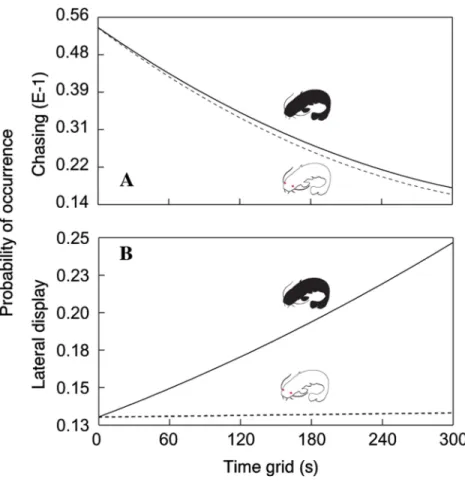
In addition, the probability of chasing (χ2=6.64, d.f.=2;P< 0.0362;Fig. 2A) and lateral
display (χ2=6.04, d.f.=2;P< 0.0488;Fig. 2B) changed over time and differed between
Figure 2 Probability of chasing (A) and lateral display (B) as a function of time across the two treat-ments.Dotted line = albino catfish; black line = pigmented catfish.
Furthermore, the time that conspecifics spent at a particular distance from other conspecifics varied in both groups (F5,111=29.43,P< 0.0001;Fig. 3). While the catfish
(both albino and pigmented) generally spent the least amount of time in the farthest zones (time spent in the farthest zones did not differ between albino and pigmented catfish), albinos spent more time in adjacent zones and less time in the same zones than pigmented conspecifics (Adj.P< 0.05). Taken together, we found that albino catfish showed a higher tendency to be spatially separated from conspecifics, whereas pigmented catfish showed a tendency towards close contact.
DISCUSSION
The assumption that albinism is associated with different levels of aggression is supported by this study. In particular, our results support the theory that species with different levels of colouration should display different levels of aggression (Pryke & Griffith, 2006) and that the level of aggression should correspond to different colour morphs (Pryke, 2009;
Dijkstra et al., 2009). Indeed, one colour morph is often predicted to be more aggressive
Figure 3 Duration (adjusted means±SE of square root data) of time that conspecifics spent at
partic-ular mutual distances across albino and pigmented treatments. Significant differences are indicated (*; Tukey–Kramer adjustedP< 0·05).
affect both skin pigmentation and aggressive behaviour (Gonzales, Varizi & Wilson, 1996;
Ducrest, Keller & Roulin, 2008). As reported byHorth (2003), increases in the aggression of the melanic form of mosquitofish correlate with changes in melanin synthesis. Therefore, albinism, in contrast to melanism, may be generally associated with lower aggression due to shared genetic control mechanisms.
it can be inferred that its role in the aggressive behaviour of albino catfish S. glanisis also minor. Although it can be assumed that albino catfish from surface waters are able to see, their vision may be impaired. Accordingly, albinism in mice has been correlated with acrophobia, photophobia and lower visual acuity (Owen, Thiessen & Lindzey, 1970;
Prusky et al., 2002;Buhusi, Perera & Meck, 2005). Moreover, specially bred strains of albino rats (Sprague-Dawley) displayed a higher probability of playful attacks compared with wild-type pigmented strains (Himmler et al., 2014). The behaviour of this Sprague-Dawley strain, however, was also different from other albino strains. Interestingly, the authors attributed these differences to differing levels of domestication in each of the strains. Playful attacks are associated not only with domestication (see reviewHimmler et al., 2014) but also with reduced aggression, as albino rats are less aggressive than their wild-type pigmented counterparts (Barnett, Dickson & Hocking, 1979;Barnett & Hocking (1981)). Although a direct comparison between aggressiveness in catfish and rats is not possible, we speculate that albinism may be generally associated with lower aggression compared with normally pigmented conspecifics.
Aggression is also associated with social position or rank (Mazur & Booth, 1998;Staffan,
Magnhagen & Alanärä, 2002). For example, an albino female vampire batDesmondus
rotundusbred with pigmented individuals hold the lowest social position (Uieda, 2001). Hence, albinism may be associated with not only lower aggressiveness but also lower dominance, as these characteristics are often correlated (Dijkstra, Seehausen & Groothuis, 2005;Pryke & Griffith, 2006). Indeed, consistent with this idea, ostracism of albino catfish by a group of pigmented conspecifics has been described (Slavík, Horký & Maciak, 2015), and the low ability of albinos to remain within a group may be another reason for the high predation risk in albinos (Ellegren et al., 1997).
Albino catfish also showed a greater tendency towards spatial separation compared with their pigmented conspecifics, which preferred to be nearer to one another. This finding differs from what was observed in domesticated albino rats, which were found to be more tolerant of conspecifics compared with wild-type strains (Himmler et al., 2013;Himmler et al., 2014). Indeed, colour-assortative shoaling is often observed (McRobert & Bradner, 1998;
Spence & Smith, 2006;Goméz-Laplaza, 2009;Rodgers, Kelley & Morell, 2010). Considering the fact that albino catfish are unable to darken their body colour to avoid aggressive interactions with dominant conspecifics (O’Connor, Metcalfe & Taylor, 1999;Höglund, Balm & Winberg, 2000), spatial separation may be a strategy for avoiding the escalation of aggressive behaviours. On the other hand, if albino catfish have poor vision, then their low tendency towards grouping may be a result of this weakened physiological condition. Accordingly, blind cave fish displayed loss of schooling behaviour (Parzefall & Trajano,
2010;Kowalko et al., 2013). In the case of troglobites, however, a low tendency towards
CONCLUSIONS
Similarities to the shift in the behaviour of albino catfish towards lower aggressiveness can be found in domesticated albino rodents and their wild pigmented counterparts as well as between blind cave fish and their sighted ancestors from surface waters. Therefore, loss of pigmentation may not only be linked to aggression in albinos, but also have other pleiotropic effects that can be observed, for example, as impaired eyesight in surface environments and/or specie-specific evolutionary adaptations to conditions of permanent darkness. In addition, albinos were found to maintain greater distances between themselves compared with pigmented individuals in the present study, corresponding to the loss of schooling behaviour in blind cave fish.
ACKNOWLEDGEMENTS
The authors sincerely thank Sergio Pellis, Tobias Backström and the anonymous referee for critical evaluation and valuable comments on the manuscript. In addition, the authors wish to thank A Slavikova for the help with earlier versions of the manuscript.
ADDITIONAL INFORMATION AND DECLARATIONS
Funding
This work was supported by the Czech Science Foundation (No. 16-06498S). The funders had no role in study design, data collection and analysis, decision to publish, or preparation of the manuscript.
Grant Disclosures
The following grant information was disclosed by the authors: Czech Science Foundation: 16-06498S.
Competing Interests
The authors declare there are no competing interests.
Author Contributions
• Ondřej Slavík conceived and designed the experiments, performed the experiments,
wrote the paper, prepared figures and/or tables, reviewed drafts of the paper.
• Pavel Horký conceived and designed the experiments, performed the experiments,
analyzed the data, contributed reagents/materials/analysis tools, wrote the paper, prepared figures and/or tables, reviewed drafts of the paper.
• Marie Wackermannová analyzed the data.
Animal Ethics
The following information was supplied relating to ethical approvals (i.e., approving body and any reference numbers):
according to Law no. 246/1992, § 17, art. 1; permit no. CZ00167. All laboratory samplings were conducted with the permission of the Departmental Expert Committee for Authorization of Experimental Projects of the Ministry of Education, Youth and Sports of the Czech Republic (permit no. MSMT-31220/2014-6). This study did not involve endangered or protected species.
Data Availability
The following information was supplied regarding data availability: The raw data has been supplied as Supplemental Datasets.
Supplemental Information
Supplemental information for this article can be found online athttp://dx.doi.org/10.7717/ peerj.1937#supplemental-information.
REFERENCES
Abeelen van JHF, Kroes WH. 1967.Albinism and mouse behaviour.Genetica 38:419–429DOI 10.1007/BF01507473.
Barnett SA, Dickson RG, Hocking WE. 1979.Genotype and environment in the social interactions of wild and domestic ‘‘Norway’’ rats.Aggressive Behaviour5:105–119
DOI 10.1002/1098-2337(1979)5:2<105::AID-AB2480050202>3.0.CO;2-U.
Barnett SA, Hocking WE. 1981.Further experiments on the social interactions of domestic ‘‘Norway’’ rats.Aggressive Behavior 7:259–263
DOI 10.1002/1098-2337(1981)7:3<259::AID-AB2480070309>3.0.CO;2-V.
Benca RM, Gilliland MA, Obermeyer WH. 1998.Effects of lighting conditions on sleep and wakefulness in albino Lewis and pigmented Brown Norway rats.Sleep 21:451–460.
Bilandžija H, Ma L, Parkhurst A, Jeffery WR. 2013.A potential benefit of albinism inAstyanaxcavefish: downregulation of theoca2gene increases tyrosine and catecholamine levels as an alternative to melanin synthesis.PloS ONE8:e80823
DOI 10.1371/journal.pone.0080823.
Boulêtreau S, Cucherousset J, Villéger S, Masson R, Santoul F. 2011.Colossal aggrega-tions of giant alien freshwater fish as a potential biogeochemical hotspot.PLoS ONE 6:e25732DOI 10.1371/journal.pone.0025732.
Britton JR, Davies GD. 2006.First record of the white catfishAmeiurus catusin Great Britain.Journal of Fish Biology 69:1236–1238DOI 10.1111/j.1095-8649.2006.01171.x.
Buhusi CV, Perera D, Meck WH. 2005.Memory for timing and auditory signals in albino and pigmented rats.Journal of Experimental Psychology—Animal Behaviour 31:18–30DOI 10.1037/0097-7403.31.1.18.
Carden SM, Boissy RE, Schoettker PJ, Good WV. 1998.Albinism: modern molecular diagnosis.British Journal of Ophthalmology82:189–1995DOI 10.1136/bjo.82.2.189.
Dijkstra PD, Hemelrijk CK, Seehausen O, Groothius TGG. 2009.Colour polymorphism reduces intrasexual selection in assemblages of cichlid fish.Behaviour Ecology
20:138–144DOI 10.1093/beheco/arn125.
Dijkstra PD, Lindström J, Metcalfe NB, Hemelrijk CK, Brendel M, Seehausen O, Groothius TGG. 2010.Frequency-dependent social dominance in a color polymor-phic cichlid fish.Evolution64:2797–2807DOI 10.1111/j.1558-5646.2010.01046.x.
Dijkstra PD, Seehausen O, Groothuis TGG. 2005.Direct male–male competition can facilitate invasion of new colour types in Lake Victoria cichlids.Behaviour Ecology and Socio-Biology58:136–143DOI 10.1007/s00265-005-0919-5.
Dingerkus G, Seret B, Guilbert E. 1991.The first albino wels,Silurus glanisLinnaeus, 1758, from France, with a review of albinism in catfishes (Teleostei: Siluriformes).
Cybium15:185–188.
Duboué ER, Keene AC, Borowsky RL. 2011.Evolutionary convergence on sleep loss in cavefish populations.Current Biology21:671–676DOI 10.1016/j.cub.2011.03.020.
Ducrest A-L, Keller L, Roulin A. 2008.Pleiotropy in the melanocortin system, coloration and behavioural syndromes.Trends in Ecology and Evolution23:502–510
DOI 10.1016/j.tree.2008.06.001.
Elipot Y, Hinaux H, Callebert J, Rétaux S. 2013.Evolutionary shift from fighting to foraging in blind cavefish through changes in the serotonin network.Current Biology 23:1–10.
Ellegren H, Lindgren G, Primmer RC, Møller PA. 1997.Fitness loss and germline mutations in barn swallows breeding in Chernobyl.Nature389:593–596
DOI 10.1038/39303.
Espinasa L, Yamamoto Y, Jeffery RW. 2005.Non-optical releasers for aggressive behaviour in blind and blinded Astyanax (Teleostei, Characidae).Behavioural Processes70:144–148DOI 10.1016/j.beproc.2005.06.003.
Fuller LJ. 1967.Effects of the albino gene upon behaviour of mice.Animal Behaviour 15:467–470DOI 10.1016/0003-3472(67)90045-0.
Goméz-Laplaza ML. 2009.Recent social environment affects colour-assortative shoaling in juvenile angelfish (Pterophyllum scalare).Behavioural Processes82:39–44
DOI 10.1016/j.beproc.2009.04.002.
Gonzales MI, Varizi S, Wilson CA. 1996.Behavioural effects of a –MSH and MCH after central administration in female rat.Peptides17:171–177
DOI 10.1016/0196-9781(95)02092-6.
Griffith SW, Brockmark S, Höjesjö J, Johnsson IJ. 2004.Coping with divided
attention: the advantage of familiarity.Proceedings of the Royal Society of London B: Biological Sciences271:695–699DOI 10.1098/rspb.2003.2648.
Himmler BT, Derksen SM, Stryjek R, Modlinska K, Pisula W, Pellis SM. 2013.How domestication modulates play behaviour: a comparative analysis between wild rats and a laboratory strain ofRatus norvegicus.Journal of Comparative Psychology 127:453–464DOI 10.1037/a0032187.
Himmler SM, Modlinska K, Stryjek R, Himmler BT, Pisula W, Pellis SM. 2014.
Domestication and diversification: a comparative analysis of the play fighting of the Brown Norway, Sprague-Dawley, and Wistar Laboratory strains of (Rattus norvegicus).Journal of Comparative Psychology128:318–327DOI 10.1037/a0036104.
Höglund E, Balm PHM, Winberg S. 2000.Skin darkening a potential social signal in sub-ordinate Arctic charr (Salvenius alpinus): the regulatory role of brain monoamines and pro-opiomelanocorticon-derived peptides.Journal of Experimental Biology 203:1711–1721.
Horth L. 2003.Melanic body-color and aggressive mating behaviour are correlated traits in male mosquitofish, (Gambusia holbrooki).Proceedings of the Royal Society of London Series B270:1033–1040DOI 10.1098/rspb.2003.2348.
Hoste B, Simpson SJ, DeLoof A, Breuer M. 2003.Behavioural differences inLocusta migratoriaassociated with albinism and their relation to [His7]-corazonin.Physiology & Entomology28:32–38DOI 10.1046/j.1365-3032.2003.00312.x.
Hsu Y, Wolf LL. 1999.The winner and looser effect: integrating multiple experiences.
Animal Behaviour57:903–910DOI 10.1006/anbe.1998.1049.
Hupfeld D, Hoffmann K-P. 2006.Motion perception in rats (Rattus norvegicussp.): deficits in albino Wistar rats compared to pigmented Long-Evans rats.Behavioural Brain Resources170:29–33DOI 10.1016/j.bbr.2006.01.022.
Jeffery RW. 2001.Cavefish as a model system in evolutionary developmental biology.
Developmental Biology291:1–12.
Keeler CA. 1942.The association of the black (non-agouti) gene with behaviour in the Norway rat.Journal of Heredity33:371–384.
Kenward MG, Roger JH. 1997.Small sample inference for fixed effects from restricted maximum likelihood.Biometrics53:983–997DOI 10.2307/2533558.
Kowalko EJ, Rohner N, Rompani BS, Peterson KB, Weber J, Hoekstra EH, Jeffery RW, Borowsky R, Tabin JC. 2013.Loss of schooling behaviour in cavefish through sight-dependent and sight-independent mechanism.Current Biology23:1874–1883
DOI 10.1016/j.cub.2013.07.056.
Landeau L, Terborgh J. 1986.Oddity and the ‘confusion effect’ in predation.Animal Behaviour34:1372–1380DOI 10.1016/S0003-3472(86)80208-1.
Leal ME, Schulz UH, Albornoz PL, Machado R, Ott PH. 2013.First record of partial albinism in two catfish species of genidens (siluriformes: ariidae) in an estuary of Southern Brazil.Brazilian Archives of Biology and Technology56:237–240
DOI 10.1590/S1516-89132013000200008.
Lehtonen TK. 2014.Colour biases in territorial aggression in a Neotropical cichlid fish.
Oecologia175:85–93DOI 10.1007/s00442-013-2879-1.
Liang KY, Zeger SL. 1986.Longitudinal data analysis using generalized linear models.
Marc RE, Jones BW, Watt CB, Vazquez-Chona F, Vaughan DK. 2008.Extreme retinal remodelling triggered, by light damage: implications for age related macular degeneration.Molecular Vision14:782–806.
Mazur A, Booth A. 1998.Testosterone and dominance in men.Behavioural Brain. Science 21:353–397.
McRobert PS, Bradner J. 1998.The influence of body coloration on shoaling preference in fish.Animal Behaviour56:611–615DOI 10.1006/anbe.1998.0846.
O’Connor KL, Metcalfe NB, Taylor AC. 1999.Does darkening signal submission in territorial contest between juvenile Atlantic salmon,Salmo salar?Animal Behaviour 58:1269–1276DOI 10.1006/anbe.1999.1260.
Owen K, Thiessen DD, Lindzey G. 1970.Acrophobic and photophobic responses associated with the albino locus in mice.Behavior Genetics1:249–255
DOI 10.1007/BF01074656.
Parzefall J, Trajano E. 2010. Behavioral patterns in subterranean fishes. In: Trajano E, Bichuette ME, Kapoor BG, eds.Biology of subterranean fishes. Enfield, NH: Science Publishers, 81–114.
Pauers MJ, Kapfer JM, Doehler K, Lee TJ, Berg CS. 2012.Gross colour pattern is used to distinguish between opponents during aggressive encounters in a Lake Malawi cichlid.Ecology of Freshwater Fish21:34–41DOI 10.1111/j.1600-0633.2011.00520.x.
Pisula W, Turlejski K, Stryjek R, Nalęcy-Tolak A, Grabiec M, Djavadian RL. 2012.
Response to novelty in the laboratory Wistar rat wild-captive WWCPS rat, and the grey short-tailed opossum (Monodelphis domestica).Behavioural Processes 91:145–151DOI 10.1016/j.beproc.2012.06.010.
Pohlmann K, Grasso FW, Breithaupt T. 2001.Tracking wakes: the nocturnal predatory strategy of piscivorous catfish.Proceedings of the National Academy of Sciences of the United States of America98:7371–7374DOI 10.1073/pnas.121026298.
Prusky GT, Harker KT, Douglas MR, Whishaw IQ. 2002.Variation in visual acuity within pigmented, and between pigmented and albino rat strains.Behavioural Brain Research136:339–348 DOI 10.1016/S0166-4328(02)00126-2.
Pryke SR. 2009.Is red an innate or learned signal of aggression and intimidation?Animal Behaviour78:393–398DOI 10.1016/j.anbehav.2009.05.013.
Pryke SR, Griffith SC. 2006.Red dominants black: agonistic signalling among head morphs in the colour polymorphic Gouldina finch.Proceedings of the Royal Society of London Series B273:949–957DOI 10.1098/rspb.2005.3362.
Rebouças RCR, Schmidek RW. 1997.Handling and isolation in three strains of rats affect open field, exploration, hoarding and predation.Physiology & Behaviour 62:1159–1164DOI 10.1016/S0031-9384(97)00312-0.
Refinetti R. 2007.Enhanced circadian photoresponsiveness after prolonged dark
adaptation in seven species of diurnal and nocturnal rodents.Physiology & Behaviour 90:431–437DOI 10.1016/j.physbeh.2006.10.004.
Slavík O, Horký P, Bartoš L, Kolářová J, Randák T. 2007.Diurnal and seasonal behaviour of adult and juvenile European catfish as determined by radio-telemetry in the River Berounka, Czech Republic.Journal of Fish Biology 71:104–114.
Slavík O, Horký P, Maciak M. 2015.Ostracism of an albino individual by a group of pigmented catfish.PLoS ONE10:e0128279DOI 10.1371/journal.pone.0128279.
Slavík O, Horký P, Maciak M, Wackermannová M. 2016.Familiarity, prior residency, resource availability and body mass as predictors of the movement activity of the European catfish.Journal of Ethology 34:23–30DOI 10.1007/s10164-015-0441-9.
Slavík O, Maciak M, Horký P. 2012.Shelter use of familiar and unfamiliar groups of juvenile European catfishSilurus glanis.Applied Animal Behaviour Science 142:116–123DOI 10.1016/j.applanim.2012.09.005.
Spence R, Smith C. 2006.The role of early learning in determining shoaling preferences based on visual cues in the Zebrafish,Danio rerio.Ethology113:62–67.
Staffan F, Magnhagen C, Alanärä A. 2002.Variation in food intake within groups of juvenile perch.Journal of Fish Biology 60:606–614.
Stryjek R, Modlińska K, Pisula W. 2012.Species specific behavioural patterns (digging and swimming) and reaction to novel objects in wild type, Wistar, Sprague-Dawley and Brown Norway rats.PLoS ONE7:e40642DOI 10.1371/journal.pone.0040642.
Stryjek R, Modlińska K, Turlejski K, Pisula W. 2013.Circadian rhythm of outside-nest activity in wild (WWCPS), albino and pigmented laboratory rats.PloS ONE 8:e66055DOI 10.1371/journal.pone.0066055.
Theodorakis CHW. 1989.Size segregation and effects of oddity on predation risk in min-now schools.Animal Behaviour38:496–502DOI 10.1016/S0003-3472(89)80042-9.
Trajano E. 1991.The agonistic behaviour ofPimelodella kronei, a troglobitic catfish from Southeastern Brazil (Siluriformes, Pimelodidae).Behavioural Processes23:113–124
DOI 10.1016/0376-6357(91)90062-5.
Uieda W. 2001.Behavior of an albino vampire bat,Desmondus rotundus(E. Geoffroy) (Chiroptera, Phyllostomatideae), in captivity.Revista Brasiliera de Zoologica 18:641–644DOI 10.1590/S0101-81752001000200031.
Valdimarsson SK, Metcalfe NB. 2001.Is the level of aggression and dispersion in territorial fish dependent on light intensity?Animal Behaviour61:1143–1149
DOI 10.1006/anbe.2001.1710.
Wakida-Kusunoki AT, Amador-del-Angel LE. 2013.First record of albinism in gafftop-sail catfishBarge marinus(Pisces: Ariidae) from southeast Mexico.Revista de Biologia Marina Y Oceanografia48:203–206DOI 10.4067/S0718-19572013000100019.
Ward AJW, Hart PJB. 2005.Foraging benefits of shoaling with familiars may be exploited by outsiders.Animal Behaviour69:329–335
DOI 10.1016/j.anbehav.2004.06.005.
Yamamoto Y, Byerly MS, Jackman WR, Jeffery WR. 2009.Pleiotropic function of embryonic sonic hedgehog expression link jaw and taste bud amplification with eye loss during cavefish evolution.Developmental Biology330:200–211
Yoshizawa M, Gorički Š, Soares D, Jeffery RW. 2010.Evolution of a behavioural shift mediated by superficial neuromasts helps cavefish find food in darkness.Current Biology20:1631–1636DOI 10.1016/j.cub.2010.07.017.
Yoshizawa M, Jeffery RW, Netten van MS, McHenry JM. 2014.The sensitivity of lateral line receptors and their role in the behaviour of Mexican blind cavefish (Astyanax mexicanus).Journal of Experimental Biology217:886–895DOI 10.1242/jeb.094599.